Article Contents:
- Furniture that doesn't need to be thrown away
- Why the facade is more important than the body
- What exactly stucco changes on a furniture facade
- Moldings on a furniture facade: how a simple door becomes paneled
- Polyurethane moldings for furniture
- Moldings made of solid wood
- How to mark frames on a furniture facade
- Which furniture to put moldings on
- Decorative overlays: when the facade needs an accent
- Where to place decorative overlays
- Decorative polyurethane molding for furniture
- Styling of overlays to match the interior
- Handles: the final detail that transforms the entire facade
- Wooden handles for classic and neoclassical facades
- Bracket handles: universal classic
- Long handles for tall doors
- Knob handles: for small drawers and lightweight facades
- Handles with and without coating
- Painting: how to unify everything into a single facade
- Surface Preparation
- Choosing paint
- Color Strategies
- Updating different types of furniture: specific scenarios
- Built-in wardrobe in the living room or bedroom
- Dresser in the bedroom or living room
- Kitchen fronts
- Wardrobe in hallway
- Wardrobe in a children's room
- What not to do: common mistakes when updating a facade
- Practical table: what to buy for different tasks
- How to calculate material: a practical checklist
- Frequently Asked Questions
- About the Company STAVROS
Furniture that doesn't need to be thrown away
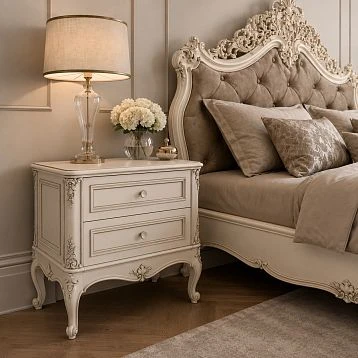
There is a category of interior solutions rarely spoken about but practiced by all thoughtful people: not buying new, but making the old better. This is not a compromise or forced saving. It is a completely conscious approach where a good cabinet body, sturdy chest of drawers, or built-in furniture gets a new facade — not by replacing the furniture, but by transforming it.
Molding for furniture, Moldings for furniture, decorative overlays, and new handles are exactly the set of tools that turn a simple flat facade into a visually rich, expensive, stylistically refined one. Not by replacing the body. By making the facade different.
Why does this work? Because a person perceives furniture primarily through its facade. The body is inside. Shelves are inside. Drawers are inside. Outside is only the facade. And it is the facade that shapes the feeling of the furniture: cheap or expensive, simple or thoughtful, random or part of the interior.
An MDF cabinet with flat doors and metal handles is one piece of furniture. The same cabinet with molding frames on the facade, a decorative overlay in the center of the door, and wooden handles for painting is already a different piece of furniture. Visually. Emotionally. In terms of the interior feel.
That's what the entire article is about.




Why the facade is more important than the body
Furniture design follows a clear logic: the body is the technical part, the facade is the declarative part. The body is responsible for strength, storage, functionality. The facade is responsible for how the furniture looks and what it says about the interior as a whole.
In this logic, updating a cabinet through its facade is an absolutely professional technique. This is exactly how good workshops specializing in furniture renovation work: they keep the body and completely redo the facades. New doors, new decorative elements, new handles, new paintwork — and the furniture is worth a completely different amount.
But it is not necessary to change the doors themselves. If they are straight, without deformations, and hang securely on their hinges — it is enough to change their surface. And here Moldings for Furniture does the work that neither painting alone nor replacing handles alone can do.
Our factory also produces:


What exactly does stucco molding change on a furniture facade
A flat facade without decoration is perceived as a "neutral blank." The brain sees: there is a surface, no details, the furniture is functional but not thought out. As soon as a molding frame appears on the facade — a change occurs: the brain sees structure, order, intentionality. The facade ceases to be "just a plane" and becomes "part of the design."
A decorative overlay in the center of the door adds another level: an accent. The gaze stops, notices the detail, reads it as a style element. New handles complete this signal: the furniture is designed in a unified key, everything is coordinated, everything works together.
That is why the set of "moldings + overlays + handles + painting" is not "decoration," but a full-fledged change of the facade concept.
Get Consultation
Moldings on a furniture facade: how a simple door becomes paneled
Let's start with the most important and most effective element. furniture moldings These are profile strips that are glued onto the door and form decorative frames. This technique imitates a paneled facade — the very furniture with "recessed" rectangles that looks expensive and traditional.
The difference between a facade with moldings and without is colossal. A flat facade without frames reads as budget and inexpressive. The same facade with one or two molding frames looks like furniture from a higher price segment. And this is not an illusion — it is real added value.
Polyurethane moldings for furniture
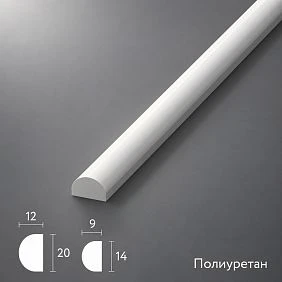
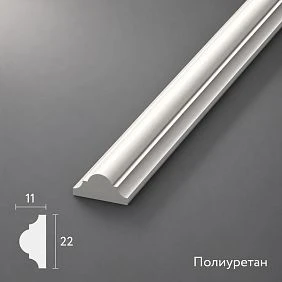
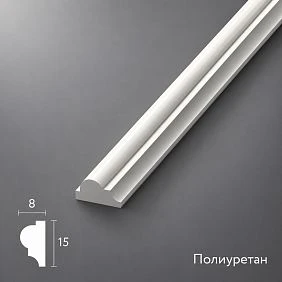
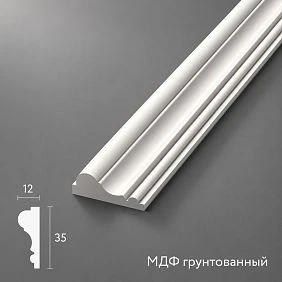
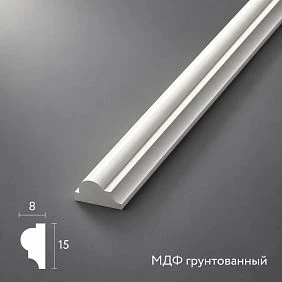
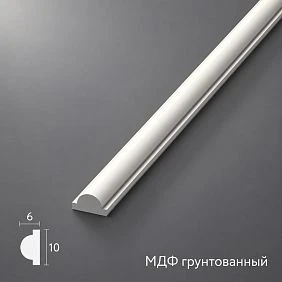
Moldings made of polyurethane — lightweight, geometrically precise, adhere perfectly to MDF and laminated chipboard, accept any paint. For furniture facades, this is the optimal choice: the material does not add weight to the door, does not interfere with hinge operation, and does not deform with temperature changes in the room.
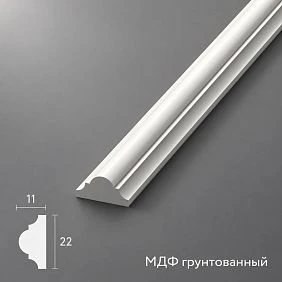
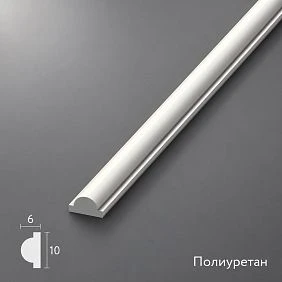
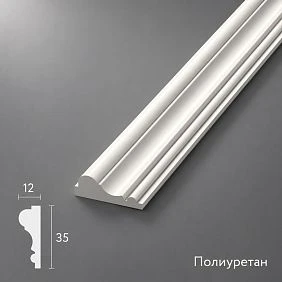
Profile width for furniture facades: from 10 to 40 mm. Thinner ones (10–15 mm) are delicate, for small doors and drawers. Medium ones (20–30 mm) are universal, work on doors of any size. Wide ones (35–40 mm) are for large facades, tall cabinet doors, monumental solutions in classic style.
Molding profile — flat, semi-oval, S-shaped, stepped. For furniture, profiles with moderate relief are most often chosen: they provide good chiaroscuro and look expressive, but do not overload the facade.
Solid wood moldings
For furniture with wooden handles and wooden decor — Moldings from solid wood more organic: they create a unified "wooden system" of the facade. Wooden moldings have a natural texture, accept oil, wax, or paint well, and create a warm feeling of natural material.
Wooden moldings work especially well in combination with wooden pull handles or knob handles: all wood, a single material tone, no mismatch.
How to mark frames on a furniture facade
Before gluing moldings — marking is needed. A few rules that always work:
-
Indentation from the edge of the door — uniform on all sides, usually 30–50 mm. This creates a "field" between the edge of the door and the frame.
-
The ratio of frame to door — the frame should occupy at least 60% of the door area. A small frame on a large door is a weak technique.
-
One or two frames — on a narrow door (up to 400 mm) there is usually one frame. On a wide door (from 500 mm) you can make two vertical frames side by side.
-
On a tall cabinet door — one vertical frame along the entire height or top and bottom frames separated by a horizontal molding.
For marking — pencil, tape measure, painter's tape around the perimeter of the future frame. Moldings are cut with a miter box at 45° at the corners. Glue — special furniture assembly glue.
Which furniture to apply moldings to
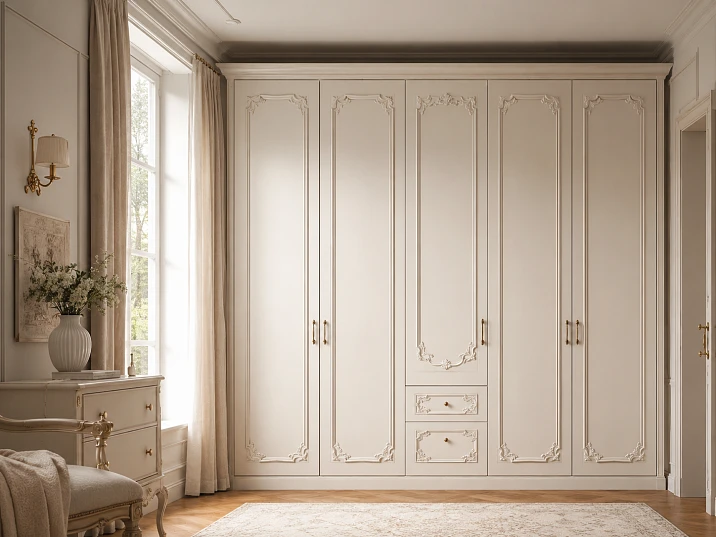
On built-in wardrobe doors. The most popular case. A built-in wardrobe with flat doors — and molding frames + painting = a wardrobe that looks like built-in furniture from an expensive joinery workshop.
On kitchen cabinet fronts. Smooth MDF kitchen fronts with molding frames turn into a classic kitchen with custom-made fronts.
On a chest of drawers. Each drawer of the chest is a separate frame made of moldings. Result: a chest of drawers that looks like an antique or classic piece of furniture.
On a TV stand. The front doors of the stand with molding frames create the feel of higher-class furniture.
On a hallway wardrobe. The hallway is the first thing everyone sees. A wardrobe with molding fronts and coordinated handles instantly changes the impression of the hallway.
Decorative overlays: when the facade needs an accent
A molding frame is a structure. A decorative overlay is an accent. The difference is important: structure organizes the facade, accent makes it expressive.
decor for furniture made of solid wood are carved elements that are glued directly onto the facade surface. Ornamental medallions, rosettes, floral motifs, classic acanthus leaves, laurel weaves, geometric cartouches. Each of them is an independent statement about the aesthetics of furniture.
Where to place decorative overlays
In the center of the door. The most obvious and most effective option. An overlay in the center of a molding frame is like the "lock" of a stained glass window. It completes the frame, giving it a semantic center.
At the top of the facade. For tall doors — a horizontal decorative overlay at the top of the door, above the central field. This is a classic technique of furniture baroque: the upper field with decor, the lower field clean.
In the corners of the molding frame. Corner decor — a small ornamental element at the intersection of the horizontal and vertical molding of the frame. This is the final detail that turns the frame from a "set of strips" into an architectural detail.
Above the handle. A small decorative overlay directly above the handle is a technique characteristic of classic furniture of the 18th–19th centuries. The handle gets a "pedestal," and the facade gets an additional vertical axis.
On a chest of drawers. A chest of drawers is a special case. Each drawer is a small separate surface. A decorative overlay in the center of each drawer, matched in size to the width of the drawer, immediately elevates the furniture to a different class.
Decorative polyurethane molding for furniture
In addition to wooden overlays, for furniture facades it is also suitable Decorative polyurethane molding. Polyurethane overlays are lighter than wooden ones, do not put a load on the door, are glued with assembly adhesive, and accept paint well.
A feature of polyurethane overlays is that they are produced by casting with high precision of relief detailing. Complex ornamentation — acanthus leaves, weaves, classic cartouches — is reproduced accurately and without loss of detail. After painting to match the facade, a polyurethane overlay is visually indistinguishable from wooden decor.
For furniture, you should choose decorative molding small and medium-sized ones — up to 200 mm on the long side. Large ceiling or wall overlays look disproportionate on a furniture facade.
Styling of overlays to match the interior
The decorative overlay should "speak" the same language as the entire interior. A few examples:
-
Classic and neoclassic — acanthus leaves, laurel wreaths, shell motifs, medallions with classic ornamentation
-
Provence and country — floral motifs, natural plant weaves, light ornamentation without baroque heaviness
-
Empire — strict geometric motifs, laurel garlands, Greek ornamentation
-
Modern classics — minimalist cartouches, geometric rosettes, overlays with clean contours without complex relief
If there are already on the walls applied decoration for furniture — the style of overlays on the cabinet should be coordinated with them. An ornamental "family" creates unity in the interior.
Handles: the final detail that changes the entire facade
After molding frames and decorative overlays appear on the doors, old handles often start to look completely out of place. This is normal: the facade has become richer, more decorative, more stylistically saturated — while the handle remains the same, neutral, or simply unsuitable.
That is why Furniture Handles — a mandatory part of the kit when updating a cabinet. Not "later," not "if you feel like it" — but immediately, as part of the project. The handle is the final touch that completes the facade and unites all its elements into a single statement.
Wooden handles for classic and neoclassical facades
If the moldings are wooden or the facade is planned in a classic style — wooden furniture handles are organic like nothing else. Wood provides a single material tone with all the facade decor. The texture of the wood and the relief of the overlays together create a natural, lively character for the furniture.
Wooden handles for a classic cabinet — brackets with a figured arch profile, knobs with an ornamental surface, long handles with a rounded cross-section. The forms are expressive but not overloaded: the handle should complete the facade, not compete with the overlays.
Pull handles: universal classics
Staple handle — two mounting points, U-shaped profile. For cabinets and dressers, this is the most ergonomic option: comfortable grip, reliable opening, even load on the facade.
For a dresser — staples with a center distance of 64–96 mm per drawer. A uniform rhythm of staples across all drawers creates a characteristic "point-point" rhythm along the entire height of the dresser.
For a cabinet with doors — staples with a center distance of 96–128 mm. The size should be proportional to the door: for a narrow door (up to 400 mm) — 64–96 mm, for a wide door (from 500 mm) — 128 mm.
Long handles for tall doors
long wooden handles — for tall doors of a built-in wardrobe. Handle from 200 to 400 mm, vertical, one for the entire height of the door. This is an expressive detail that emphasizes the height of the wardrobe and creates a clear vertical axis of the facade.
Knob handles: for small drawers and lightweight facades
Knob — one mounting point, compact protruding element. For small dresser drawers, nightstands, jewelry boxes. A round wooden knob is the most versatile option: neutral shape, works in any style from Scandinavian to classic.
Handles with and without coating
Wooden handles come with factory paint and without coating. Handles with coating are ready for installation immediately, requiring no additional treatment. Handles without coating can be painted exactly to match the facade, which is especially important for monochrome painting of the entire furniture.
For a built-in wardrobe that will be painted together with the doors in a single color — handles without coating allow for complete tonal unity. A wooden handle matching the white facade, readable only through shape and shadow, is a very modern, very professional technique.
Painting: how to unify everything into a single facade
Moldings are glued, overlays are installed, handles are selected. The next step is painting. It is painting that unifies all the disparate elements into a single surface: moldings, door, overlay, handle (if without coating) — everything becomes one color, one tone, one piece of furniture.
Surface preparation
Before painting, the surface must be prepared:
-
Sand the old coating with 120–150 grit sandpaper to ensure adhesion
-
Degrease — especially around the installation areas of moldings and overlays
-
Fill the joints of the moldings with acrylic sealant or wood putty
-
Prime — one coat of furniture acrylic primer
-
Sand the primer with 240 grit sandpaper after drying
Paint Selection
For furniture — use furniture or alkyd enamel on a water base. It provides a smooth, hard surface that does not scratch or smudge. Matte or semi-matte for a calm classic look. Satin for modern furniture.
Do not paint furniture with regular water-based wall paint: it is soft, wears out quickly, and does not withstand wet cleaning well. Furniture requires a specialized formula.
Color strategies
Monochrome painting — all furniture and all decor in one color. White, ivory, gray, blue, green — the molding is read through the shadow from the relief, not through color. This is the most modern, cleanest technique.
Two-tone painting — the body in one color, the moldings and overlays in another (usually lighter or darker). This is a more decorative, richer option: decorative elements 'stand out' from the background.
Imitation patina — base color plus dark glaze in the recesses of the relief. Creates a sense of antiquity, age, and an "antique" character of furniture.
Updating different types of furniture: specific scenarios
Built-in wardrobe in the living room or bedroom
A built-in wardrobe with flat doors is one of the most common requests for updating. The scenario works as follows:
Vertical molding frame on each door, 40 mm offset from the edge, 25 mm molding. Decorative overlay at the top of the frame — a small medallion or horizontal ornamental element. Wooden pull handles 96–128 mm in the color of the paint or natural wood.
Painting: the body and doors in one color. Moldings, overlays, and handles — in the same color or a shade lighter.
Result: a built-in wardrobe that looks like a custom project from a joinery workshop. The body remains the same — the facade is completely new.
Chest of drawers in the bedroom or living room
A chest of drawers is a piece of furniture that is constantly visible and viewed from close range. Detailing is important here.
On each drawer — a horizontal molding frame across the entire width of the drawer with 25–30 mm offsets from the top and bottom. Or a frame around the perimeter of the drawer with equal offsets on all sides. In the center of the frame — a small decorative overlay. A round knob handle or a 64–96 mm pull — centered on the drawer.
All drawers are in a unified system. A single type of molding, a single type of overlay, a single type of handle. A single rhythm, a single style.
Painting the entire dresser in one color — white, cream, gray-beige, blue. Moldings and overlays to match the body.
Kitchen fronts
The kitchen is a space with high demands on the coating. For kitchen fronts:
-
Moldings — polyurethane, with coating: moisture-resistant, do not attract grease
-
Decorative overlays — polyurethane, matching the front
-
Handles — wooden with or without coating for subsequent painting with durable kitchen enamel
Upper fronts: molding frames + small knob handle or horizontal pull. Lower drawers: molding frames + comfortable pull 96–128 mm with a good grip.
Wardrobe in the hallway
The hallway is the place of first impression. A sliding or hinged wardrobe in the hallway with molding fronts changes the entire impression of the hallway.
For the hallway — calm, not overloaded decor. Thin molding 15–20 mm, one frame per door, without overlays or with a minimal overlay at the top. Handle — long vertical for ease of opening, 200–300 mm.
Wardrobe in the children's room
In the children's room — a joyful, light interpretation of the same technique. Molding frames create "panels" on the doors. Colored inserts can be placed in the frames, or each frame can be painted in its own color. Handles — wooden round knobs in bright colors. Overlays — optional, if the style allows.
What not to do: common mistakes when updating a facade
Too many moldings. Moldings that cover the entire door without a gap create chaos, not structure. Rule: the frame occupies 60–80% of the door area, and there should be 'breathing' between the edge of the door and the frame.
Mismatch between the scale of the overlay and the door. A 300 mm overlay on a 250 mm wide dresser drawer is overload. The overlay should be smaller than the frame and proportionate to the door.
Different molding widths on the same piece of furniture. If the top door has a 25 mm molding and the bottom one has 15 mm, the system breaks down. A uniform profile across all doors is mandatory.
Mismatched handles. Wooden overlays plus chrome metal handles create a conflict of materials and styles. Handles should be from the same material family as the overlays.
Painting without primer. Paint without primer on MDF will peel off within a few months. Priming is mandatory.
Style mismatch. Baroque overlays on modern minimalist furniture look random. The decor style should match the interior style.
Practical table: what to buy for different tasks
| Task | What to buy |
|---|---|
| Make a flat facade visually more expensive | Moldings + glue + paint + primer |
| Add a classic or neoclassical accent | Decorative overlays made of wood or polyurethane |
| Update the dresser | Moldings + overlays + wooden knob or pull handles |
| Make the built-in wardrobe part of the interior | Moldings + molding cornices on top + handles |
| Don't overload the modern facade | Thin moldings 15 mm + simple handles without ornament |
| Furniture in neoclassical style | Molding frames + overlays + painting in a neutral tone |
| Kitchen with decorative facades | Polyurethane moldings + coated handles |
| Hallway wardrobe | Molding frames + long handles + monochrome painting |
| Children's wardrobe | Molding frames + round knobs in bright colors |
How to calculate material: a practical checklist
Before ordering, go through this list:
-
Measure the perimeter of all frames on all doors — this is the base amount of molding in linear meters
-
Add 20% extra — frame corners are cut at 45°, and you need a reserve in case of mistakes
-
Count the overlays — one for each door (central) and four corner ones (if planned)
-
Handles — one for each door and each drawer
-
Glue — special mounting adhesive for polyurethane or furniture PVA for wooden moldings
-
Acrylic sealant — for filling joints in frame corners
-
Furniture primer — one coat on all surfaces before painting
-
Furniture enamel — two to three coats on the primed surface
Frequently asked questions
Can moldings be used on a furniture cabinet?
Yes. For furniture fronts, moldings, decorative overlays, and small to medium-sized stucco decor are used. It is important to choose the right scale: decorative elements should not be larger than the door size allows. It is better to glue with special mounting adhesive for polyurethane or furniture glue.
What is better to choose: wooden or polyurethane moldings?
Wooden moldings provide a natural texture and blend organically with wooden handles. Polyurethane ones are lighter, more moisture-resistant, more precise in geometry, and cheaper. For the kitchen — polyurethane. For the bedroom and living room — both options work, choose based on style and budget.
Do I need to change the handles after adding decor?
In most cases — yes. If the facade has become more decorative, old handles often start to look too simple or stylistically out of place. New handles from the same "material family" as the decor complete the look.
What glue to use for moldings on furniture?
For polyurethane moldings — construction adhesive for polyurethane or liquid nails. For wooden moldings — furniture PVA or construction adhesive. In both cases, pre-degrease the working surfaces.
How to paint furniture with moldings so that everything looks monolithic?
Prime the entire surface (both the facade, moldings, and overlays) in one layer of furniture acrylic primer. After drying — sand. Paint in 2–3 layers with furniture enamel. Pre-fill the corners of the frames with acrylic sealant — this will hide the joints and make the frame visually monolithic.
Can I update kitchen facades with moldings myself?
Yes. The main thing is to choose moldings with a coating (moisture-resistant), use furniture construction adhesive, thoroughly prime before painting, and paint with kitchen-resistant enamel. The result is a kitchen that looks custom-made.
What to buy for a minimal wardrobe update?
Minimal set: moldings (around the perimeter of one frame for each door), construction adhesive, primer, furniture enamel, and new handles. This already changes the facade dramatically.
About the company STAVROS
All elements for updating a furniture facade — Moldings for furniture, decor for furniture, Decorative stucco, Furniture Handles и Moldings made of polyurethane — is produced and sold by STAVROS.
STAVROS is a Russian company with its own production of furniture and architectural decor made from solid wood and polyurethane. The STAVROS catalog offers a full range for updating furniture facades: wooden moldings and polyurethane moldings, carved overlays from solid oak and beech, polyurethane stucco decor, wooden handles with over 150 models — knobs, pulls, long handles, inset handles, with and without coating.
All STAVROS products are manufactured with high geometric precision: straight moldings, overlays with clear relief, handles with precise center distances for standard mounting templates. Delivery across all of Russia.