Article Contents:
- What exactly are we buying: NPU-193 — a carved decorative overlay made of polyurethane
- Why facade decor cannot be chosen the same way as an overlay on a wall inside a room
- Pediment 2400 mm and NPU-193: what the 10.8% calculation really shows
- Visible angular size: why one NPU-193 “shrinks” as you move away from the house
- Full-size mockup 260 × 194 mm — a mandatory check before purchase
- Where to look at the mockup from: four real points instead of one
- Why a photo without zoom is more useful than a beautiful close-up shot
- 20 mm of relief: why depth can help a small-area element
- Color matters no less than physical size
- Where to place the overlay on the pediment: geometric center is not always the visual center
- When one NPU-193 looks large enough
- When NPU-193 is truly too small for the chosen role
- How to compare NPU-193 with larger decor without buying two items
- One large element or several small ones: do not substitute quantity for the task
- How existing entrance group details change the size of NPU-193
- Installation on an already painted pediment: scale checked, now need to preserve the finish
- Weather and lighting: check the mockup more than once
- Pediment measurement map: what data to record before the mockup
- Small size, details are lost, or contrast is insufficient: three different reasons for poor visibility
- How to make a choice commercially rational
- Decision matrix: NPU-193 is suitable or a larger composition is needed
- Mistakes that cause a facade element to be purchased at the wrong scale
- What to choose if NPU-193 is too small
- Step-by-step algorithm before purchasing NPU-193
- Conclusion: NPU-193 is not "too small in general" — it may be small specifically for the chosen distance and role
- FAQ
- Can NPU-193 be placed not in the center of the gable?
- What to do if NPU-193 is clearly visible from 5 m but almost disappears from 12 m?
- Can two NPU-193 be placed mirror-wise on the edges of the gable?
- Should the NPU-193 be used on a very high second-floor gable?
- Will contrasting paint help if the NPU-193 seems small?
- Can I buy the NPU-193 first and then decide where to place it?
- How should I evaluate the NPU-193 if a tree or canopy partially covers the gable?
- Is a molding frame needed around the NPU-193?
- How can I tell if the 20 mm relief is sufficient?
- Where can I look for other options if the NPU-193 fails the test?
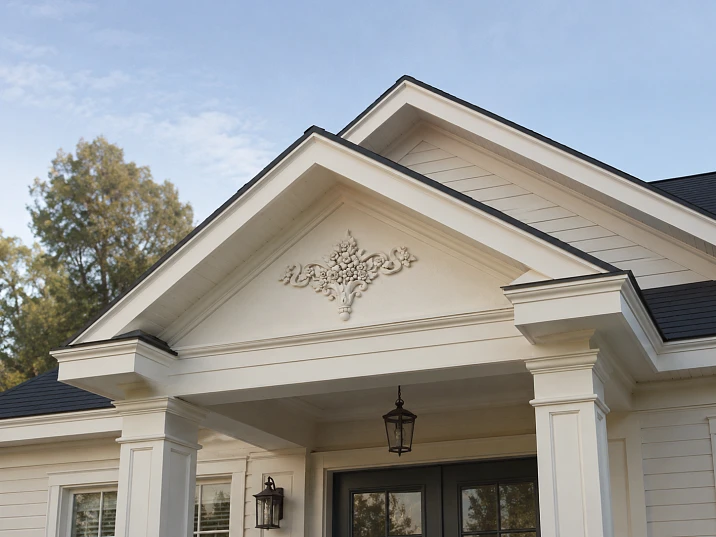
The gable above the porch is already plastered and painted. In terms of size, the carved overlay NPU-193 fits there without difficulty, so the first reaction is clear: just find the center, glue one element, and get a neat decorative accent. But on the facade, geometric compatibility is only half the task. The second half is more important: will an element measuring 260 × 194 × 20 mm actually be readable from the point where people see the entrance to the house.
The NPU-193 is not a small furniture detail: up close, its plant relief looks expressive. But a facade is perceived differently than an interior. A person does not stand 60–80 cm from the gable and examine the curls. They approach along the path, open the gate, get out of the car, and see the porch across the yard. At that distance, it is not the physical size of the product that decreases, but its visible scale: first, fine details are lost, then the ornament reads as a general silhouette, and at an even greater distance, as a small spot on the plane of the gable.
Therefore, the direct answer is this: the NPU-193 can be used on a gable, and the manufacturer explicitly allows facade use, entrance groups, and gable decoration for it. But the size of 260 × 194 mm cannot automatically be considered sufficient for any gable. Before purchasing, you need to place a full-size mock-up on the facade, step back to real viewing points, and check whether not only the presence of a decorative spot is preserved, but also the required architectural role of the element.
For example, consider a pediment with a clean decorative field 2400 mm wide. If in the approved orientation of the product the horizontal dimension of NPU-193 is 260 mm, the overlay occupies about 10.8% of the field width. This shows that it is physically not cramped and has plenty of space around it. But such a calculation does not answer the main question: is 10.8% enough for a composition that must work with 5, 8, or 12 meters. Only a distance fitting answers this.
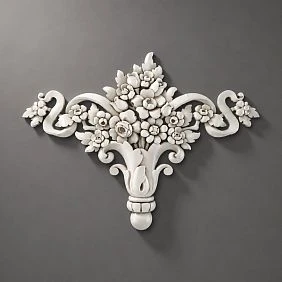
What exactly are we buying: NPU-193 is a carved decorative polyurethane overlay
For the article, it is important to maintain the correct product type.
NPU-193 is a carved decorative polyurethane overlay.
Not a molding, not a cornice, not a trim, and not a rosette. It is a separate central relief element that is mounted on a finished surface as an accent.
| Parameter | NPU-193 |
|---|---|
| Type | Carved decorative overlay |
| Material | Polyurethane |
| Size A × B × C | 260 × 194 × 20 mm |
| Price | 4,980 ₽/pc. |
| Main article scenario | one central accent on the pediment |
| External use | allowed by the manufacturer |
The STAVROS card indicates for NPU-193 use in interiors and on facades; among exterior scenarios, entrance groups and pediment decoration are separately described. Therefore, choosing this product for this area does not need to be justified by guesswork.
After checking the scale, you can buy carved overlay NPU-193 made of polyurethane as one central element, without assembling a mandatory frame around it.
What does the size 260 × 194 × 20 mm mean
The card confirms the size as A × B × C = 260 × 194 × 20 mm. However, the text version of the page does not show the axis drawing clearly enough to unconditionally declare A as horizontal and B as vertical in any permissible orientation.
Therefore, in the geometric calculations below, a simple rule is followed:
-
when 260 mm is used as the horizontal dimension, this is explicitly stated as a condition of the chosen orientation;
-
if the actual drawing or approved position of the ornament shows a different orientation, the calculation of free margins is recalculated;
-
there is no need to arbitrarily rotate the floral pattern just for convenient arithmetic — first, the composition of the ornament itself is assessed.
For the visibility task, this does not interfere: the two main face dimensions are still known — 260 and 194 mm, and the relief depth is 20 mm. These three values are involved in the scale assessment.




Why facade decor cannot be chosen the same way as an overlay on a wall inside a room
In the interior, a person constantly approaches the decor closely. Even a small relief on a door or wall panel can be examined at arm's length. On the facade, the main viewing begins much farther away.
There are three levels of perception.
Close level: the porch and the area in front of the door
A person is directly at the entrance. Here, NPU-193 can be read in detail: the overall pattern, large curls, and the shadow from the relief are visible.
But this is not the only point for which the pediment is designed. If a decorative element exists only for a person already standing under it, it barely participates in the appearance of the entrance group from a distance.
Medium distance: the path to the house
From a few meters away, details begin to merge into a silhouette. Here the question is different: whether NPU-193 reads as a deliberate central accent or looks like a small random mark on a large painted surface.
For most entrance groups, this distance is the most indicative: a person sees the door, porch, pediment, columns or canopy posts, lights, and part of the facade simultaneously.
Far distance: the gate, parking, driveway to the house
Here, fine ornament inevitably gives way to overall mass and contrast. If the overlay is to participate in the architectural image of the house from this point, it needs sufficient visual weight relative to the entire pediment.
This leads to an important conclusion: the question of whether the NPU-193 is visible cannot be answered with a single word. It may be visible as a spot, but no longer readable as a full ornament. Or it may work well near the porch, but be too small for the view from the gate. Before purchasing, you need to determine which level of perception is most important to you.
If a broader context on the design of this part of the house is needed, it is useful to review the STAVROS material about decorating the pediment with decorative elements, and then return to the specific question of the NPU-193 scale.
Our factory also produces:
Pediment 2400 mm and NPU-193: what the 10.8% calculation actually shows
Suppose the clean field of the pediment along the main horizontal line has a width of 2400 mm. By "clean field" here we mean not the entire roof overhang or the entire width of the porch, but precisely the plane within which the central decor can actually be placed.
If in the selected horizontal orientation the NPU-193 occupies 260 mm, we get:
260 / 2400 × 100 ≈ 10,8%.
That is, in width, one overlay takes up approximately one ninth of the decorative field.
If the approved orientation of the product assumes 194 mm horizontally, the share will be different:
194 / 2400 × 100 ≈ 8,1%.
These percentages are useful not as a ready-made design standard, but as a way to understand the nature of the composition.
What does a share of about 8–11% mean?
This is clearly not a "dense filling" of the pediment. A large amount of background remains around the central element. Consequently, NPU-193 will work precisely as a single sign, not as a large filling composition.
This approach can be successful if:
-
the pediment is small;
-
there are already cornices, moldings, pilasters, or other elements around;
-
a delicate center is needed, not a large panel;
-
color or shadow helps highlight the relief;
-
the entrance group is viewed primarily from close and medium distances.
And the same share may prove insufficient if:
-
the pediment is tall and wide;
-
the field around is completely empty;
-
the house is mostly viewed from 10–15 meters;
-
the overlay is painted with almost no contrast;
-
it is this that should be the main decoration of the entrance.
Therefore, the percentage answers only one question: how large the product is relative to the field. It does not replace distance checking.
Get Consultation
Visible angular size: why one NPU-193 “shrinks” as you move away from the house
To assess distance more objectively, you can use not only centimeters but also angular size — how large an angle the object occupies in the field of view.
This is not a “visible / not visible” standard. It is needed to compare the same NPU-193 at different distances.
For face dimensions of 260 and 194 mm, we get approximately:
| Distance to the gable | Visible side size 260 mm | Visible side size 194 mm |
| 3 м | about 4.96° | about 3.70° |
| 5 м | about 2.98° | about 2.22° |
| 8 м | about 1.86° | about 1.39° |
| 12 м | about 1.24° | about 0.93° |
What does this table give in practice?
At 3 m, the overlay occupies a noticeable part of the field of view, so the relief and silhouette are perceived much more confidently.
At 5 m, it is still present in the composition, but fine details already depend more strongly on contrast and light.
At 8 m, the overall silhouette becomes more important. If the ornament blends tonally with the wall, the element may be read more as a small relief spot.
At 12 m, the role of color, overall shape, and free space around becomes even higher. Individual leaves and thin curls should no longer be the main selection criterion — what matters more is whether the central mass itself is perceived.
This table explains why a close-up product photo is almost useless for answering the facade question. In the NPU-193 card, it is always large. On the house, its "size" is also determined by distance.
Full-size mockup 260 × 194 mm — a mandatory check before purchase
The best way to resolve the issue without risk is to make a full-size silhouette of the product and temporarily attach it to the gable.
Not a small picture, not a printout on half a sheet, but a 1:1 scale mockup.
First mockup: simple dimensions
For the very first test, a rectangle or a rough silhouette based on the front dimension of 260 × 194 mm is sufficient. It will answer the questions:
-
Is the element not too small relative to the field;
-
Is the center not lost;
-
Is there enough free air around;
-
Is the installation height chosen correctly.
Such a mockup can be made from cardboard, foam board, thick paper, or thin sheet material.
Second mockup: silhouette of the ornament itself
The rectangle slightly overestimates the visual mass, because the real NPU-193 has a cut-out plant contour, not a solid plate. Therefore, after the first check, it is better to make a silhouette more similar to the actual overlay.
If there is a frontal image of the product, it can be printed at 1:1 scale and the overall outer contour can be cut out.
Third stage: volume
The depth of NPU-193 is 20 mm. A flat mockup does not show the shadow. For a final assessment, you can add a substrate of the appropriate thickness to the template or attach a temporary three-dimensional sample.
20 mm matters on the facade precisely because of side light. Morning and evening sun can make the relief more noticeable than frontal diffused light.
How to attach to an already painted facade
Temporary attachment must not damage the finished coating. The specific method depends on the type of facade paint and the substrate. You cannot automatically use strong double-sided tape on an unknown coating.
If it is difficult to safely secure the template directly to the gable, you can hold it on a lightweight temporary batten or use another reversible method that does not affect the finish layer.
Only after such a check does it make sense to order NPU-193 260 × 194 × 20 mm.
Where to look at the mockup: four real points instead of one
A very common mistake is to attach the template, step back two meters, say "it's visible," and finish the check.
The facade exists for human movement. Therefore, several points are needed.
Point 1. Right at the door
It shows the quality of the details, but says almost nothing about the facade scale. Use it to assess the relief and future installation, not to decide "is it big enough."
Point 2. Middle of the path to the porch
Most often, it is here that a person first perceives the entrance group as a single whole. If the NPU-193 is already lost here, it will not become stronger at a further distance.
Point 3. Gate or beginning of the property
This is a check of the architectural accent. The overlay doesn't have to show all the carving, but it should maintain its intended role: a central sign, a light or dark spot, the completion of the pediment.
Point 4. Parking area or where a person gets out of the car
Sometimes this point is farther than the gate and turns out to be the main one. If guests see the house from here for the first time, it's worth evaluating the decor from here as well.
For each point, it's useful to take a photo without digital zoom using the regular main camera of the phone. The phone is not a precise measuring instrument of perception, but a series of identical shots helps to honestly compare the scale.
Why a photo without zoom is more useful than a beautiful close-up shot
When choosing facade decor, photographs can easily deceive.
If you zoom in on NPU-193, it will again take up half the frame and appear quite large. But the human eye does not "zoom" the pediment in this way.
A proper reference photograph should:
-
be taken from the actual viewing point;
-
include the entire pediment and a noticeable part of the entrance group;
-
be taken without digital zoom;
-
maintain approximately the same camera height for comparison;
-
show not only the overlay, but also the door, porch roof, columns, windows, and the adjacent facade.
After that, ask not the question "do I see the mockup," but three more useful ones:
-
Can I immediately find the central decor without staring?
-
Does it look like a deliberate part of the architecture or a small mark?
-
If you remove it from the photo, will the composition of the entrance group change?
The third question is especially telling. If the mockup disappears and the architecture barely changes, NPU-193 is likely working too quietly for the role you expect from it.
20 mm of relief: why depth can help a small-area element
NPU-193 has a depth of 20 mm. On a flat painted facade, this creates a shadow.
But depth does not turn a small element into a large one. It enhances its readability under certain light.
Side sunlight
When light comes at an angle, the plant relief casts a more pronounced shadow. The overall silhouette becomes deeper, and the element can be read better even when its color is close to the facade.
Frontal diffused light
In cloudy weather or on the north side, shadows are softer. Then the contour itself and the color difference become decisive.
Artificial entrance lighting
If there is a sconce or a light under the canopy nearby, you need to check the evening scenario. Sometimes an overlay looks good during the day, but in the evening it ends up in shadow. It can also be the other way around: the light creates an expressive side shadow and makes the relief more noticeable.
Therefore, a full-size test should be carried out in at least two modes — during the day and in the evening with the real porch lighting.
The general principles for choosing polyurethane molding for exterior decoration are discussed in more detail in the STAVROS material about polyurethane molding for the house facade.
Color matters no less than physical size
The same NPU-193 on the same gable can be perceived completely differently after painting.
In the color of the gable
The most architectural and calm option. The overlay becomes part of the surface, and the pattern is revealed through light and shadow.
Advantage — there is no feeling of a "glued-on badge."
Disadvantage — from a distance, the relief may get lost sooner, especially in soft lighting.
This option works well when the NPU-193 should be a subtle detail, not the main facade accent.
Lighter or darker than the background
Moderate contrast improves silhouette readability. At the same time, it is not necessary to turn the overlay into a bright spot.
This solution is especially useful if the viewing distance is large and the pediment itself is relatively large.
Strong contrast
Strong contrast can make the 260-millimeter element noticeable from afar, but at the same time change the style of the entrance group. The small overlay starts to work more like a graphic sign than traditional stucco molding.
This is acceptable if such an effect is intentional.
To match the color of other facade details
If trim, cornices, columns, or brackets are already highlighted in a separate color, the NPU-193 can be tied to them. Then even a small element gets support from the entire system.
Polyurethane decor is designed for subsequent painting; STAVROS covers individual color scenarios in the material about stucco molding for painting.
Where to place the overlay on the pediment: geometric center is not always the visual center
If the pediment is triangular, its center cannot be determined only as the middle of the rectangle by width and height.
The upper field narrows toward the apex, so the same vertical shift changes the amount of air around the overlay.
Too low
NPU-193 may start to visually stick to the door cornice, canopy, or horizontal lintel. Then it is perceived not as pediment decor, but as another detail above the door.
Too high
The closer to the apex, the less free width around the product. The overlay may look squeezed between the slopes.
In the compositional center of the tympanum
Often the best option is between these extremes: high enough for the element to belong to the pediment, and low enough for free space to remain around it.
If the pediment is asymmetrical
The porch may be offset relative to the wall, one post may be wider than the other, and a window may be nearby. In such a case, the geometric center of the pediment and the visual center of the entrance group do not coincide.
The solution again shows the mockup. Before gluing or marking the permanent position, move the full-size silhouette across the pediment and take several shots from the same distance.
For a broader architectural logic of pediments, you can use STAVROS material on the role of decorative elements from corners to pediments, but the specific position of NPU-193 is still determined by your finished field.
When one NPU-193 looks large enough
A small size does not automatically mean "too small for the facade."
One overlay can work convincingly if several conditions are met.
The pediment is small
If the field above the porch is local, a size of 260 × 194 mm no longer looks microscopic.
There is an architectural frame around it.
The cornice along the base of the pediment, moldings along the slopes, pilasters or porch posts create a system. Then NPU-193 should not fill an empty plane alone—it only sets the central point.
There is good contrast or chiaroscuro.
Even a small relief becomes more noticeable if its edge reads well against the background.
The main viewing point is close.
If the porch is located near the gate and the distance to it is 3–5 m, the scale requirements differ from a site where the house stands 15–20 m from the entrance.
The element requires an accent, not a dominant.
NPU-193 can work well as a "detail that gets noticed," but be insufficient as the "main decoration of the entire pediment." The role needs to be chosen in advance.
If these conditions are met after the mockup, you can buy one NPU-193 for the central decor of the pediment without automatically needing to add a second one or build a frame around it.
When NPU-193 is truly too small for the chosen role
There are also opposite situations.
The pediment is wide and empty
On a field of several meters, one overlay can look lost, especially if there are no other architectural lines around.
The house is viewed primarily from a distance
If the main view opens from the road or parking lot, the central element should work primarily through its silhouette.
A main dominant of the entrance group is needed
If NPU-193 is expected to 'pull together' the entire pediment, the size of 260 × 194 mm may be insufficient even with good contrast.
The background and overlay are the same color, and the facade provides almost no side shadow
There is a 20 mm relief, but in soft light it does not create as strong graphics as contrasting paint.
There are much larger details nearby
Large columns, massive brackets, a wide pediment, or large light fixtures can visually reduce the NPU-193 even further.
In such a situation, you don't need to buy an element just because you like it in the product card. Better to open catalog of decorative polyurethane overlays and look for an option that specifically solves the facade task in terms of scale.
How to compare the NPU-193 with larger decor without buying two products
The buyer doesn't necessarily need to order the NPU-193 and a larger overlay "for comparison."
Make two or three mockups.
For example:
-
Mockup #1 — the actual dimensions of the NPU-193;
-
Mockup #2 — a conditionally larger element occupying a noticeably larger share of the gable;
-
Mockup #3 — not a single overlay, but a composition of a central element and an adjacent profile.
What matters is not the specific invented size of the second template, but the change in role.
If layout No. 1 looks like a delicate sign, and layout No. 2 finally assembles the pediment into a cohesive composition, it becomes clear that the problem is not in the NPU-193 design, but specifically in the scale.
After that, you can Choose decorative polyurethane overlays already with a concrete understanding of how much larger the next candidate should be.
For central single accents, you can additionally check the section central polyurethane overlays, where NPU-193 is placed among other solutions.
One large element or several small ones: do not substitute quantity for the task
If NPU-193 seems small, there is a temptation to install two or three identical overlays.
This is not always the right approach.
A single central NPU-193 creates hierarchy: there is one main sign.
Two identical overlays create a symmetrical pair and require new axes.
Three turn the pediment into a rhythmic composition.
These are already different architectural tasks. Multiplying the quantity is not a simple way to "make a small element larger."
If a single central accent is needed, it is better to choose one element of appropriate scale than to force several NPU-193 units to solve someone else's task.
If the project initially involves a symmetrical ornament, multiple elements are acceptable, but their placement, distances, and overall rhythm should be designed separately.
How existing entrance group details change the size of NPU-193
The pediment does not exist in a vacuum. Below it there is a door, a canopy, columns or posts, lights, sometimes windows. The same size of NPU-193 can look noticeably different depending on what large forms are already nearby.
Wide entrance door
A large double door itself sets a strong scale. A small overlay above it may look weaker than above a standard opening. This does not mean that NPU-193 is automatically unsuitable, but the central element should be checked together with the door in the same frame.
Massive columns or posts
They make the entrance group heavier. The central element must withstand this visual weight or consciously remain delicate. If two columns already create a powerful frame, a small NPU-193 can work as a point rather than an independent dominant.
Large lamp
A pendant or large wall lanterns can draw attention away from the relief. This is especially noticeable in the evening: the lamp glows, while the overlay remains a secondary shadow.
Cornice along the base of the pediment
It can help. A horizontal line brings the composition together, and the central overlay no longer has to "hold" the entire field on its own.
Door color
A dark door under a light pediment creates a strong contrast at the bottom. An overlay in the tone of the pediment can get lost against such a powerful lower accent. Sometimes moderate contrast NPU-193 helps bring the center back up, sometimes it is better to choose a larger relief.
The general approach to the exterior design of the door, porch, and facade is covered in the STAVROS article about facade stucco for the entrance group. Our task now is narrower: to understand whether NPU-193 specifically holds the scale within the finished entrance composition.
Installation on an already painted pediment: the scale has been checked, now the finish needs to be preserved
After a positive visual inspection, the practical question of installation begins.
The gable is already painted, so the overlay will be attached not to an "abstract wall," but to a specific finish layer.
You need to know the substrate under the paint
This could be:
-
mineral plaster;
-
facade putty;
-
concrete;
-
sheet material;
-
another structure.
Adhesive installation must account for both polyurethane and the existing facade layer.
The paint must adhere firmly
If the coating is peeling, the overlay may come off with it. Therefore, before gluing, not only the adhesive but also the condition of the base is checked.
The template must not be used in a way that damages the facade.
This especially applies to strong tapes. A temporary mock-up is part of the check, not a reason to repaint the gable later.
After installation, finishing the junction is important.
A relief element 20 mm deep casts its own shadow. An uneven seam along the contour can be more noticeable than it seems at arm's length.
The specific mounting system is selected based on the actual base and facade covering. The NPU-193 card allows outdoor use, but this does not replace checking the compatibility of the adhesive and paint.
If you need to review the entire range before making a final choice, to view facade moldings for the entrance group it is useful after both the scale and the mounting base are understood.
Weather and lighting: check the mock-up more than once
If the task is to understand visibility specifically, a single sunny photo can be misleading.
Bright side sun
Shadows enhance the relief, NPU-193 appears more expressive.
Overcast day
Shadows are weaker. It's clearly visible how much the element holds only due to silhouette and color.
Evening
The entrance group lights are on. Sometimes they make the overlay the main accent, and sometimes they leave it in a dark zone.
Winter and snow
If the house is in a region with snowy winters, the overall contrast of the facade changes. There's no need to automatically change the product because of this, but it's worth understanding that the same decor color is perceived differently in different seasons.
The test doesn't require weeks of observation. It's enough to at least compare daytime and evening scenarios. If the decision is borderline, overcast weather provides a useful additional check.
Gable measurement map: what data to record before the layout
Scale verification becomes much more accurate if you collect a short map of the object before making the template. This does not require a complex architectural survey. It is enough to record the values that actually affect the decision.
| Parameter | What to record | What it's for |
| Clear width of the decorative field | actual value in mm | comparison of NPU-193 scale with the gable |
| Clear height of the field | actual value in mm | selection of vertical position |
| Height of the field center from the platform level | Actual value | understanding how much a person looks upward |
| Distance from the porch | Actual value | close scenario |
| Distance from the middle of the lane | Actual value | main approach scenario |
| Distance from the gate or parking area | Actual value | far scenario |
| largest adjacent element | door, column, light fixture, cornice | visual scale comparison |
| Gable color | actual | contrast assessment |
| Daylight direction | by observation | assessment of relief shadow |
Such a map helps avoid abstract arguments with yourself: "260 mm seems small" or "it looks fine in the photo." It ties the product to a specific house.
Why installation height also affects the perception of size
Two identical NPU-193 units can be perceived differently even on gables of the same width. If one gable is low and located almost above the door, a person looks at the overlay at a slight angle. If another is raised high above a massive porch, the element is farther from the eyes and visually smaller.
Therefore, for a high gable, one cannot rely only on the horizontal share of 10.8%. The actual distance from the eyes to the overlay is greater than the horizontal distance on the ground. The mockup automatically accounts for this difference — this is why physical fitting is more reliable than a single percentage.
Why it is useful to measure neighboring elements
The size of the door or column itself is not needed for the mathematical formula of the "correct overlay." It is needed as a visual reference.
If the NPU-193 appears several times smaller in width than the central light fixture or decorative keystone above the door, the viewer will perceive it as a secondary detail. If there are no large competitors around, the same 260 × 194 mm gains more visual weight.
This allows you to formulate the role in advance: should NPU-193 be the main detail of the pediment or just a small finishing accent? Without such an answer, the debate about size remains meaningless.
Small size, lost details, or lack of contrast: three different reasons for poor visibility
After the mockup, you need to correctly diagnose the problem. Not all poor visibility means that NPU-193 is physically small.
Scenario 1. The silhouette is clearly visible, but the fine ornament is not readable
This is a normal feature of distance perception. If an expressive central shape is visible from the path, but individual leaves and curls become clear only up close, enlarging the element is not necessary.
For a facade accent, it is often enough that the overall silhouette works from afar, and details open up as you approach the porch. In this case, NPU-193 performs a two-level task: a sign at medium distance and carved decor up close.
Scenario 2. The silhouette itself turns into a random small spot
This is already a scale problem. Contrast paint can make the spot more noticeable, but it will not increase its architectural mass.
If you want the central element to truly bring the pediment together, it is wiser to switch to a larger product. To find such a solution, it is useful to compare the assortment in the section central decorative polyurethane overlays and then repeat the same test with a new full-size template.
Scenario 3. The size looks normal, but the element almost blends into the background
Here the issue is not the dimensions, but the tone and light. Try a different contrast level on the mockup rather than a different size. You can make a paper silhouette in the color of the pediment and a second one slightly lighter or darker.
If moderate contrast solves the problem without feeling like a foreign spot, increasing the product size may not be necessary.
Scenario 4. The overlay is visible, but looks "lonely"
This is a compositional problem. There may be too much empty space around it, even though the NPU-193 itself reads normally.
Here you have a choice: take a larger central element or create an architectural system where the NPU-193 is supported by cornices, moldings, pilasters, or other facade lines. General principles for such construction can be found in the STAVROS material about polyurethane decor for facades and exteriors.
You cannot solve this problem by randomly adding two small overlays on the sides. First, you need to determine whether a larger central mass or a more developed architectural frame is needed.
Scenario 5. During the day the size is normal, but in the evening the decor disappears
This is a question of the lighting scenario. If the entrance group is important in the evening, the placement of the light fixture or the color scheme can be adjusted, but such changes should not be made solely for one overlay without checking the entire composition.
If the evening appearance is crucial and the lighting cannot be changed, a larger silhouette may be more resilient to low light.
Diagnostic table
| What is visible on the model | What the likely problem is | Next step |
| Good silhouette, details are lost | normal distance-based loss of detail | keep the size and check color/light |
| A small random spot is visible | insufficient scale | compare with a larger overlay |
| The silhouette is normal, but it blends with the background | low contrast | test the coloring |
| Visible well, but too empty around | composition, not size | compare large center and framing system |
| Good during the day, bad in the evening | Lighting | check the lighting scenario |
| Good from the porch, weak from the gate | different role at different distances | determine the main viewing point |
It is this division that protects against an incorrect purchase. Without it, a person easily chooses larger decor, although they lacked contrast, or tries to repaint a too-small overlay, when the problem was in scale.
How to make a commercially rational choice
NPU-193 costs 4,980 ₽. For a facade, this is not a case where a mistake will necessarily lead to huge material losses, but the problem is different: after installation on a finished painted pediment, replacing an element means new work with the base and painting.
Therefore, a cheap template check is more profitable than buying "on a trial basis."
The rational order is as follows:
-
determine the clear field of the pediment;
-
choose the intended position;
-
make a mock-up of 260 × 194 mm;
-
check from 3–4 real distances;
-
evaluate daylight and evening light;
-
check the color;
-
compare with a mockup of a larger element if NPU-193 looks weak;
-
only then buy.
If NPU-193 works confidently, order one carved overlay NPU-193 — a simple and clear set.
If not, it's better not to try to "save" the small scale with random extra details, but buy facade decoration made of polyurethane of the appropriate scale.
Decision matrix: NPU-193 is suitable or a larger composition is needed
| Situation | Solution |
| Small pediment, viewing distance 3–5 m, the model reads well | NPU-193 works as a standalone accent |
| Field about 2.4 m, NPU-193 is visible but looks delicate | Buy if you specifically need a delicate centerpiece |
| At 5–8 m only a small spot remains, but a strong accent is needed | Look at a larger overlay |
| The model gets lost against the massive columns and cornice | Increase the scale of the decor or change the composition |
| The pediment is well designed even without a central element | NPU-193 is not required |
| The element is visible only due to strong contrast, which does not suit the style | choose a larger relief instead of artificial contrast |
| Main viewing point at the door | NPU-193 may be sufficient even with weak long-distance readability |
| Main viewing point at the gate or parking lot | priority to a large silhouette and overall mass |
This table does not replace the layout. It helps interpret its result.
Mistakes that cause a facade element to be purchased at the wrong scale
Mistake 1. Looking at NPU-193 only in the product card
Why it happens: a large photo shows the entire relief and creates a sense of significant size.
Consequence: on the facade, the element turns out to be much smaller relative to the architecture.
Check: full-size mockup on the actual pediment.
How to avoid: make a decision only after a remote fitting.
Mistake 2. Considering "fits" as a synonym for "suits"
Why it happens: a person sees large free fields and perceives this as a good margin.
Consequence: compositionally, the center looks empty, and the overlay too quiet.
Check: photo of the entire pediment without zoom.
How to avoid: evaluate the role of the element, not just the absence of intersections.
Mistake 3. Checking from one meter away
Why it happens: it is more convenient to examine the mockup this way.
Consequence: the decision is made based on the distance from which almost no one perceives the pediment as a whole.
Check: path, gate, parking.
How to avoid: determine the main viewpoint in advance.
Mistake 4. Compensating for a small size with too sharp a color
Why it occurs: there is a desire to make the overlay more noticeable.
Consequence: it becomes a graphic spot and ceases to look like a natural part of the facade.
Check: color mockup.
How to avoid: first check the scale, and use contrast as a stylistic tool, not as a "visibility enhancer."
Mistake 5. Multiplying the number of identical elements without a new composition
Why it occurs: one seems small, so three should be better.
Consequence: a random row appears that is not related to the pediment architecture.
Check: the overall layout of the entire composition.
How to avoid: if one center is needed, look for one center that fits the scale.
Mistake 6. Not accounting for the 20 mm relief and light
Why it occurs: decisions are made based on a flat image.
Consequence: the actual overlay looks completely different in the evening or in side sunlight.
Check: 3D simulation and two lighting scenarios.
How to avoid: evaluate not only the outline, but also the shadow.
What to choose if NPU-193 is too small
There are four normal paths.
1. Larger decorative overlay
The most straightforward solution if you need exactly one central relief.
Go to catalog of carved and decorative polyurethane overlays and select not only by pattern, but also by the dimensions shown in your mockup.
2. Central overlay of a different scale
If the task remains strictly central, it is more convenient to look at polyurethane central overlays, rather than mixing corner, paired, and linear elements into one list.
3. Composition of an overlay and architectural framing
Sometimes the NPU-193 itself is liked and you don't want to change it. Then you can enhance not the size of the overlay, but the architectural surroundings: add a meaningful molding, cornice, pilasters, or another facade element.
This is no longer an article about a single overlay, so the solution needs to be designed as a whole. General options are presented in the section principles of a decorative pediment in classical composition.
4. Leave the pediment clean
If the layout looks weak, and larger stucco overloads the entrance, the absence of a central overlay may be the best solution.
An empty painted surface is not an unfinished look if the proportions of the pediment already work.
Step-by-step algorithm before purchasing NPU-193
To avoid returning to the same thought in different sections, let's gather the entire process into one working order.
Step 1. Measure the clean decorative field
Not the entire canopy and not the entire facade, but the actual plane inside the pediment where the overlay can be placed.
Step 2. Fix the main distance
From where is the house most often seen: 3 m, 5 m, 8 m, 12 m, or further?
Step 3. Make a mockup 260 × 194 mm
If necessary, confirm the orientation of the ornament according to the drawing or card before accurately calculating the horizontal field.
Step 4. Find the visual center
Move the mockup higher or lower and take several photos.
Step 5. Check at least three distances
Porch, path, gate, or parking area.
Step 6. Shoot without zoom
Otherwise, the photo stops showing the real scale.
Step 7. Check the light
Minimum daily and evening scenarios.
Step 8. Check the color
In the color of the pediment and with moderate contrast — if in doubt.
Step 9. Compare with a larger mockup
If NPU-193 gets lost, don't try to convince yourself that it will "become more noticeable" after installation.
Step 10. Make the purchase only after choosing the role
If a delicate central detail is needed — NPU-193 might be exactly the solution. If a facade dominant is needed — choose the scale based on distance.
Conclusion: NPU-193 is not "too small in general" — it may be small specifically for the chosen distance and role
The carved decorative overlay NPU-193 made of polyurethane has a confirmed size of 260 × 194 × 20 mm and a price of 4,980 ₽. The manufacturer allows its outdoor use and separately lists facades, entrance groups, and pediments as suitable areas.
Therefore, the question is not whether it is "possible" to use NPU-193 above the porch. It is possible.
The question is different: what do you want to see from the ground.
If the gable is small, the main viewing point is at 3–5 m, there is supporting architecture around, and the layout maintains a confident central silhouette, one NPU-193 can be a very precise and delicate solution.
If the decorative field is wide, the house is viewed from 8–12 m and further, and NPU-193 on a full-size layout turns into a small spot, it is not worth buying it just because the pattern was liked in the catalog. It is better to immediately choose a larger polyurethane facade decor or another carved overlay.
For a conditional field of 2400 mm, an overlay with a horizontal dimension of 260 mm occupies about 10.8% of the width. This is a useful figure, but not a final verdict. The final decision is made only by checking from a real distance.
Before ordering:
full-size layout → real viewing point → photo without zoom → checking light and color → comparison with a larger scale → purchase.
If after this NPU-193 retains the needed role, you can buy NPU-193 260 × 194 × 20 mm for the gableIf not, it's better to go to the section of central polyurethane overlays or explore a broader polyurethane facade decor for the home.
Thus, the buyer pays 4,980 ₽ not for an element that "formally fits," but for decor that truly works in the architecture of the entrance group.
FAQ
Can NPU-193 be placed not in the center of the pediment?
Yes, if the asymmetry is supported by the architecture itself: a shifted door, window, column, or other decor. For a symmetrical pediment, arbitrary offset usually requires visual justification. It's best to check it with the same full-size mockup.
What to do if NPU-193 is clearly visible from 5 m but almost disappears from 12 m?
Determine which distance is primary. If the entrance architecture is primarily designed for approaching along the path, this may be a normal result. If the house should have an expressive central sign already from the gate, a larger scale or a different composition is needed.
Can two NPU-193 be placed mirror-wise on the edges of the pediment?
Technically, it is possible to design a paired composition, but that is a different task. Two overlays create two axes and require checking the distance between them, the edges of the pediment, and the direction of the ornament. Such a pair cannot be considered a simple way to "enlarge one NPU-193."
Is it worth using NPU-193 on a very high pediment of the second floor?
The higher and farther an element is, the more its visible scale decreases. For a high pediment, a full-size test from the ground is especially essential; one dimension of 260 × 194 mm without distance proves nothing.
Will contrasting paint help if NPU-193 seems small?
Contrast helps to see the silhouette but does not increase the physical and angular size. If the problem is specifically the scale, a strong color can make a small element more noticeable but will not turn it into a full-fledged dominant.
Can I first buy NPU-193 and then decide where to place it?
You can, but it is less rational than a mock-up. The facade is already painted, and the product has a specific price. A full-size template allows you to check both the size and position without purchasing and without risk to the finished finish.
How should NPU-193 be evaluated if the pediment is partially covered by a tree or canopy?
Use real viewing points specifically under current conditions. If seasonal foliage covers the pediment in summer, that is also part of real perception. There is no need to evaluate the decorative element from an artificially chosen point that no one uses in everyday life.
Is a molding frame around NPU-193 needed?
Not necessarily. One overlay can work independently. The frame is only needed if the gable architecture requires additional framing. Adding it just because NPU-193 seems small, without an overall layout, is not worth it.
How to understand if a 20 mm relief is enough?
Do a volumetric fitting or at least add a backing of similar thickness to the flat silhouette and look at it under side light. Depth affects the shadow, but does not replace the necessary scale in width and height.
Where to look for other options if NPU-193 did not pass the test?
Start with categories of polyurethane decorative overlays. If the task is already broader than one central piece, move on to the general catalog of polyurethane molding for interiors and facades and material about facade stucco for the entrance group.