Article Contents:
- When a long handle is indispensable — scenarios and selection logic
- Tall hinged wardrobe — why a small handle doesn't work
- Built-in wardrobe from floor to ceiling
- Wardrobe in the bedroom — decorative accent without overload
- Wardrobe in the hallway — function plus appearance
- Walk-in wardrobe — system with a unified rhythm
- Facades without extra decor — when the handle becomes the only accent
- Length matters — practical selection table
- Vertical or horizontal — a rule that always works
- Swing door — vertical
- Drawers and low sections — horizontal
- Mezzanines — a special case
- Design exceptions
- Types of long handles for cabinets — and when to choose which
- Surface-mounted handle — a universal choice
- Profile handle — for minimalist facades
- Wooden handle — warmth of natural material
- Handles with coating — color as an accent
- How to choose handles to match the style of your wardrobe — specific and to the point
- Modern minimalist wardrobe
- Classic wardrobe — made of solid wood or wood-look
- Neoclassical — a balance of decor and simplicity
- Wardrobe in the hallway — practicality and style
- Wardrobe in a children's room
- At what height to install long handles on a hinged wardrobe
- Standard grip zone
- Rule of indentation from the edge of the facade
- Height for upper and lower sections
- Materials and coatings of long handles — comparison by parameters
- Mistakes when choosing and installing long handles for a cabinet
- How to calculate the number of handles for a hinged cabinet — simple arithmetic
- Long handles and the furniture fitting system
- How to check everything before buying — a checklist
- FAQ — answers to popular questions about long handles for cabinets
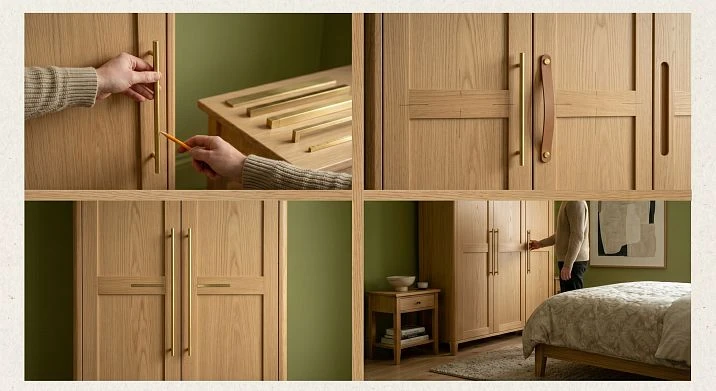
A handle on a cabinet is a detail that is touched by hand several times a day. This means: it should be comfortable, durable, and visually appropriate. But it is with handles that the most mistakes are made when furnishing furniture. Too small on a tall door — looks random. Too short on a wide facade — gets lost. Uncomfortable in shape — irritates every day.
Long handles for a cabinet — these are not just "bigger handles." This is a conscious design and ergonomic solution for hinged cabinets with tall facades, built-in wardrobes, cabinets in the bedroom and hallway. How to choose the right length, where to place the handle, which material suits which cabinet — all in one guide.
View Furniture Handles for Cabinets made of solid wood — in the STAVROS catalog.
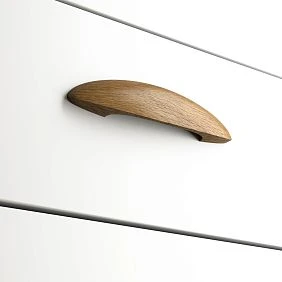
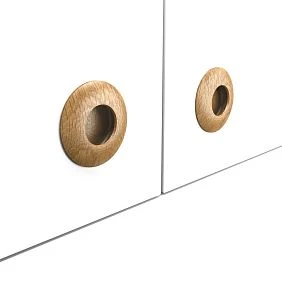
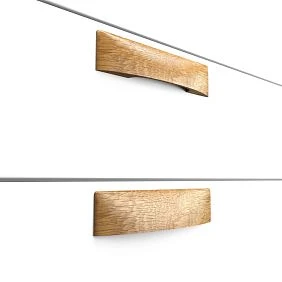
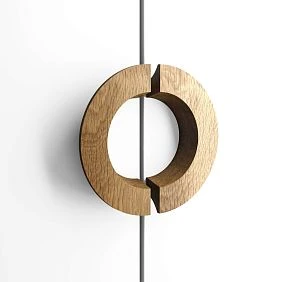
When you can't do without a long handle — scenarios and selection logic
Before talking about specific sizes and shapes, it's worth understanding: why exactly is a long handle needed? After all, technically you can open a cabinet with any handle — even a button, even a 32 mm bracket.
It's not about whether it's "possible" or "not possible." It's about proportion, convenience, and the image that the furniture creates in the room's space.




Tall hinged cabinet — why a small handle doesn't work
Imagine a cabinet 2200 mm high with smooth MDF or veneer fronts. The area of each door is about 0.5–0.7 m². On such a plane, a small handle 96–128 mm long looks like a dot on an A1 sheet. It gets lost, doesn't visually "hold" the front, and doesn't provide a proper grip when opening a heavy door.
Long handle for cabinet A handle 300–800 mm long on such a door is a different story. It structures the front, sets a vertical line, emphasizes the cabinet's height, and simultaneously creates a convenient grip point across the entire working area.
Our factory also produces:
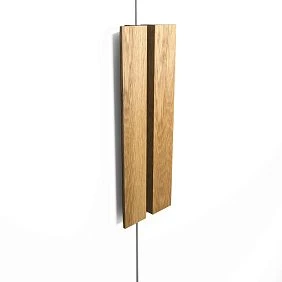
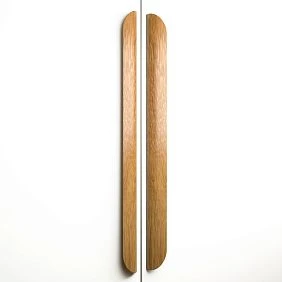
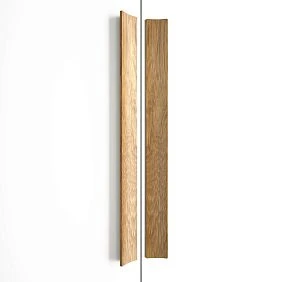
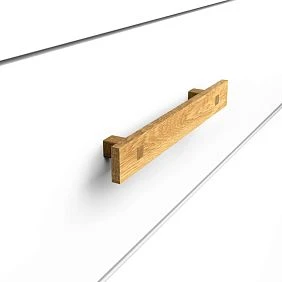
Built-in floor-to-ceiling cabinet
This is the most demanding case. A built-in cabinet with doors 2400–2700 mm high is a spatial object that occupies an entire wall. Here, long vertical handles are almost an architectural element. They set the rhythm of the wall, break the monolithic plane into vertical lines, and give the built-in furniture the look of an expensive wardrobe.
For such cabinets Furniture Handles for Cabinets a length of 600–1000 mm is the norm. These are the sizes that maintain the proportion of the front.
Get Consultation
A wardrobe in the bedroom is a decorative accent without overload
The bedroom is a space where furniture should "breathe." A hinged wardrobe in the bedroom is not retail equipment or an office shelf. Here, the handle should be decoratively precise: an elongated shape, restrained material, tinting that supports the overall tone of the room.
A long wooden handle on a bedroom wardrobe is a living texture that "rhymes" with the wooden floor, nightstands, and wooden items in the interior. Chrome metal handles here can look alien — especially in a classic or neoclassical bedroom.
Wardrobe in the hallway — function plus appearance
The hallway is a high-traffic area. The wardrobe is opened 10–20 times a day. The handle here is primarily about ergonomics: a comfortable grip, correct height, reliable fastening. A long handle installed vertically at a height of 900–1200 mm from the floor solves the problem perfectly: it is convenient for both adults and children to grab. There is no need to search for a small button in the dark or bend down to a low-mounted handle.
Wardrobe closet — a system with a unified rhythm
A wardrobe closet is not one door, but several sections. Here long handles for a hinged wardrobe create a visual rhythm: identical handles, identical placement, one color. This turns a set of cabinet sections into a single furniture system.
With different lengths or shapes of handles on adjacent wardrobe doors, the ensemble falls apart. Uniformity of handles is a mandatory condition for a built-in wardrobe.
Facades without unnecessary decor — when the handle becomes the only accent
Modern minimalist facades — smooth MDF, frameless veneer, lacquered surface — are deliberately devoid of decor. Profiles, moldings, routing are absent. In this case, the handle is the only decorative and functional element. A long handle on such a facade works as a designer's "signature": it sets the style, format, and tone of the entire wardrobe.
Length matters — a practical selection table
There is no single correct handle length. There is a proportion — the ratio of handle length to facade size. It determines whether the handle will look appropriate.
| Front height | Recommended handle length | Center-to-center distance |
|---|---|---|
| Up to 600 mm | 96–160 mm | 96–128 mm |
| 600–900 mm | 160–256 mm | 128–224 mm |
| 900–1400 mm | 256–400 mm | 224–352 mm |
| 1400–1800 mm | 400–600 mm | 352–512 mm |
| 1800–2200 mm | 600–800 mm | 512–700 mm |
| 2200–2700 mm | 800–1000 mm and more | 700–900 mm |
These are not strict rules, but guidelines. A wooden profile handle 400 mm long on a 1800 mm door looks normal. A 128 mm handle on the same door looks very weak.
Important: handle length is the full size of the product, including decorative parts beyond the mounting holes. Center-to-center distance is the distance between the centers of the mounting holes. It determines whether standard screws will fit and whether you will have to drill the facade for a different pitch.
Vertically or horizontally — a rule that always works
The question of handle orientation seems simple, but this is where mistakes are made.
Swing door — vertical
On swing doors of cabinets, a long handle is installed vertically. This is the logic of movement: a person grabs the handle and pulls the door toward themselves with a full arm motion. With a vertical handle, this movement is natural — the hand wraps around the handle and guides the door. With a horizontal handle on a tall door, the grip is uncomfortable, and the hand quickly "slips off."
Additional argument: vertical Long handle for cabinet visually elongates the facade upward. A cabinet with vertical handles looks taller and more elegant. Horizontal lines on a vertical facade — shorten it.
Drawers and low sections — horizontal
On pull-out drawers, nightstands, chests of drawers, and horizontal sections, the handle is placed horizontally at the center of the facade width. This is the only logical option: the drawer pulls out horizontally, and the handle should support this movement symmetrically.
Mezzanines — a special case
Upper mezzanine cabinet doors are often equipped with small handles — horizontally or at a slight angle. The pull of a mezzanine door is downward and toward yourself, so a small horizontal handle is acceptable here.
Design exceptions
In designer interiors, intentionally breaking the rules is a technique. A long horizontal handle on a vertical door can create an interesting counterpoint — but only if it is part of a well-thought-out concept, not a coincidence.
Types of Long Cabinet Handles — and When to Choose Which
Surface-mounted handle — a universal choice
Surface-mounted cabinet handle — a classic format. It is attached to the facade through two screws passing through the facade. The handle body protrudes 20–35 mm (projection) above the door plane, creating a convenient grip gap.
Advantages of a surface-mounted handle:
-
Simple installation without routing the facade.
-
Wide selection of shapes, lengths, and materials.
-
Works well on any surface: wood, MDF, veneer, lacquer.
-
Noticeable as a decorative element — it enhances the facade's appearance.
Disadvantages:
-
Protrudes from the facade — may catch on clothing in narrow passages.
-
On a smooth lacquered facade, the mounting holes must be made precisely.
Surface-mounted uncoated solid wood handles — for cabinets made of wood or wood-like materials where the natural texture of the material is important. For painting to match the facade — an option for white or colored cabinets.
Profile handle — for minimalist facades
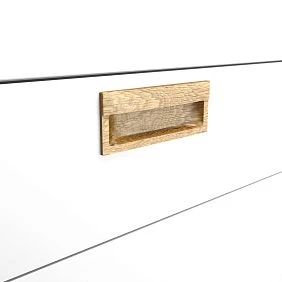
Profile Handle — a flat or semi-circular handle with minimal projection (5–12 mm). It is practically integrated into the plane of the facade, does not protrude significantly. Grip is achieved by the lower or side edge of the profile.
For whom: modern minimalism, facades without relief, built-in wardrobes in the bedroom, interiors where the "invisibility" of furniture is a deliberate strategy.
Feature: the profile handle requires precise installation — it is only "readable" at the correct installation angle. If the profile is slightly tilted, it is immediately noticeable.
A long profile handle on a vertical wardrobe door is a technique that creates the feeling of a monolithic wall with barely noticeable vertical lines. Very relevant for designer projects.
Wooden handle — warmth of natural material
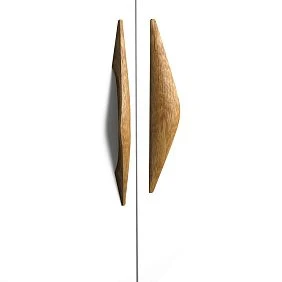
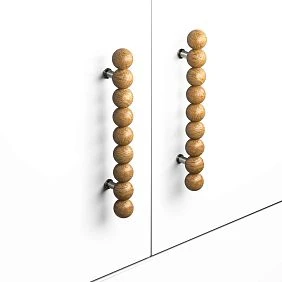
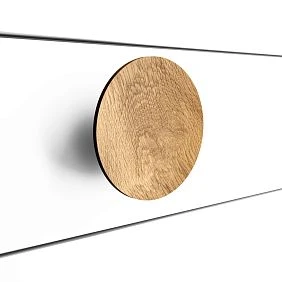
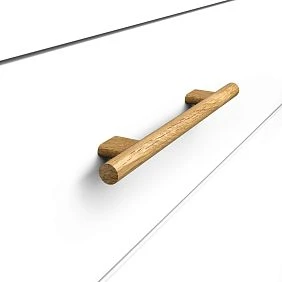
Wooden handle for cabinet — made of oak or beech — is an organic choice for natural interiors. Wood feels warm to the touch, has a lively texture, and with the right tinting becomes an extension of the facade, not a foreign element.
When choosing a wooden handle:
-
A cabinet made of solid wood or veneer of oak, beech, ash.
-
Interior with a wooden floor and wooden moldings.
-
Bedroom or living room in Scandinavian, classic, country, or neoclassical style.
-
When you need to support the wood in the decor — Rafter panels on the walls, Wooden Inlays on the furniture.
A wooden handle made of solid wood with oil or lacquer finish is a durable, tactilely pleasant, and aesthetically strong detail. Unlike metal, wood does not cool the hand in winter and does not heat up from the sun in summer.
Handles with coating — color as an accent
Handles with metal coating (gold, matte gold, bronze, matte black, nickel, chrome) — for interiors where hardware should be a noticeable accent. This is not only about cabinets — it is a systemic choice: cabinet handles, hinges, furniture legs, and decorative details in one color.
Popular combinations:
-
White cabinet + gold long handles — neoclassical, "Hamptons", modern classic.
-
Gray or anthracite cabinet + matte black handles — strict modern style.
-
Wooden cabinet + bronze handles — warm, cozy look.
-
White cabinet + chrome handles — neutral, office-clean style.
Important: the color of the handle should match the color of other metal elements in the room: hinges, curtain rods, lights, hooks in the hallway.
How to choose handles for the cabinet style — specific and to the point
Modern minimalist cabinet
Smooth facades, no relief, monochrome palette. Here work:
-
Long flat profile handles.
-
Overlay handles with minimal projection and rectangular cross-section.
-
Color: matte black, dark metal, matte silver.
Length: for a cabinet 2000–2200 mm high — handle 600–800 mm. One long handle is better than two short ones.
Classic cabinet — made of solid wood or wood-like finish
Profile frame fronts, possibly carved elements, moldings. Here are suitable:
-
Wooden overlay handles made of oak or beech.
-
Handles with bronze or gold finish.
-
Shapes with soft curves, no sharp corners.
Classic cabinet with wooden handles made of solid wood — this is unity of material: wood everywhere. Such a cabinet looks like furniture from a workshop, not a mass-produced product.
Neoclassicism — a balance of decor and conciseness
Neoclassical wardrobe: framed facades, restrained decor, ivory or gray enamel. Handles: elongated rectangular shape, matte gold or bronze. Length: 300–500 mm. Not too long, but not small buttons.
For a neoclassical bedroom long furniture handles with a light decorative profile — the presence of a small chamfer or rounding at the ends — adds nobility without excessive pomp.
Wardrobe in the hallway — practicality and style
The hallway is the first thing guests see. The wardrobe here should be functional and neat. Handles: long (400–600 mm), vertically, at a height of 900–1200 mm from the floor. Material: wood to match the hallway's tint, or metal to match the hinges and hooks for clothes.
In the hallway, the handle is also a tactile "marker": a person arrives with keys in hand, with bags — the handle must be grasped without fail. A long vertical handle solves this problem better than a point button.
Wardrobe in the children's room
In the children's room, the hinged wardrobe is opened by children. The handle should be:
-
At a height accessible to a child — 700–900 mm from the floor.
-
Without sharp corners or protruding elements.
-
Wooden or with a soft plastic coating — safer than metal.
A long handle on a children's wardrobe is acceptable if it is of a safe shape (rounded ends, no sharp edges) and installed at the correct height.
At what height to install long handles on a hinged wardrobe
This is the question most often asked. And the correct answer depends on several variables.
A detailed guide on at what height to place wardrobe handles, — in a separate article. Here are the basic principles.
Standard grip zone
The comfortable grip zone for an adult is 900–1200 mm from the floor. In this zone, the hand reaches for the handle without bending or stretching upward.
For a vertical long handle, the center of the handle should be approximately in this zone. If the handle is 600 mm, its top end is at a height of 1200 mm, the bottom end at 600 mm. The center is 900 mm. This is ideal.
Rule for indentation from the edge of the facade
The handle on a vertical hinged door is installed on the side opposite the hinges (the opening side). Indentation from the edge of the facade: 30–60 mm from the vertical edge to the axis of the mounting hole. With a smaller indentation, the handle looks "collapsed" toward the edge. With a larger one, it does not provide the necessary leverage when opening.
Height for upper and lower sections
-
Upper mezzanines (facade at a height of 1800–2400 mm): the handle is placed along the lower edge of the facade or in the center. Grip — pull downward.
-
Lower cabinets (facade at a height of 400–600 mm): the handle is placed along the upper edge or in the center. Grip — pull upward.
-
Middle sections (facade at a height of 600–1800 mm): the handle is placed at the center of the height or in the upper third.
Materials and coatings of long handles — comparison by parameters
| Material | Tactility | Durability | Style | Painting |
|---|---|---|---|---|
| Oak solid wood | Warm, lively | High | Classic, eco, Scandinavian | Yes, any |
| Beech solid wood | Warm, slightly softer | High | Classic, natural | Yes, any |
| MDF with coating | Neutral | Medium | Modern, budget-friendly | Depends on coating |
| Metal (steel, aluminum) | Cold | Very High | Minimalism, loft, industrial | No (powder coating) |
| Metal with galvanic coating | Neutral | High with maintenance | Neoclassical, contemporary | No |
For a natural interior — wood. For minimalism and loft — metal. For neoclassicism — metal with decorative coating or wood painted to match the facade.
Mistakes when choosing and installing long handles for a cabinet
Years of experience in interior design show that handle mistakes are among the most common in furniture design. And fixing them after installation is difficult: extra holes in the facade are not the best "story."
Mistake 1: Handle too short for a tall facade.
Result: the handle "gets lost," the facade looks unfinished. Rule: for a facade taller than 1400 mm, the handle should be no shorter than 300–400 mm.
Mistake 2: Different installation heights for handles on adjacent doors.
Result: a "crooked" line of handles, visual chaos. Rule: during installation, use markings with a level and template. All handles on the same horizontal axis.
Mistake 3: Handle chosen without considering the center distance.
Result: standard screws don't fit, need to drill again. Rule: before purchasing, measure the distance between holes in the facade or choose a handle with a center distance matching the standard step (128, 160, 224, 320, 448 mm).
Mistake 4: Handle in a different style than hinges and other hardware.
Result: the cabinet looks "assembled from different parts." Rule: handles, hinges, side panels of hardware — in the same color scheme and style.
Mistake 5: Heavy metal handle on a thin 16 mm MDF facade.
Result: over time, the attachment point deteriorates, the handle becomes loose. Rule: for heavy handles — reinforce the facade from the inside (10 mm plywood backing) or choose a handle with a wider base.
Mistake 6: Mixing handle shapes without a system.
Different handles on doors and drawers of the same cabinet (surface-mounted, profile, knobs) — only acceptable in custom design. In a standard interior — chaos. Rule: one type of handle for all elements of the same cabinet.
Mistake 7: A handle that is uncomfortable to grip.
Too small a projection (5 mm or less), sharp edges, too narrow a cross-section — all this creates discomfort during daily use. Rule: before purchasing — evaluate the grip. Minimum comfortable projection for a surface-mounted handle — 20–25 mm.
Mistake 8: A horizontally installed long handle on a vertical hinged door.
Result: uncomfortable grip, visual shortening of the facade. Exception — a deliberate design technique, but not a random occurrence during installation.
How to calculate the number of handles for a hinged cabinet — simple arithmetic
It would seem obvious: one door — one handle. But there are nuances.
Standard hinged cabinet (2 doors): 2 handles on doors + handles on drawers (if any). If there are 3 drawers — another 3 handles. Total: 5 handles.
Wardrobe (6 doors + 4 drawers): 6 handles on doors + 4 handles on drawers = 10 handles. All identical — purchased as a set.
Built-in wardrobe with mezzanine: Main wardrobe doors — long handles (600–800 mm). Mezzanine — shorter handles (160–300 mm) or horizontal ones. Different handle lengths on different sections — acceptable if they are from the same family (same shape, same color).
Wardrobe with double-door sections: Two adjacent doors of one section — each with its own handle on the opening side. Handles are mirror symmetrical.
Order tip: take handles with a margin of +10–15% of the calculated quantity. If one handle gets damaged during installation — you already have a spare, and you don't need to prove to the supplier that you need the same batch.
Long handles and furniture fitting system
Handles are part of the fitting system. Well-chosen furniture is when handles, hinges, drawer slides, legs, and decorative elements form a single ensemble.
Furniture fittings for wardrobes — this is a wide range where it is important not only to choose a "beautiful handle" but also to coordinate it with other elements.
Wooden handles go together with wooden furniture legs — for cabinets and bedside tables. The tint matches. The material is uniform.
Classic-style handles combine with with wooden appliqués on the facades — it creates the impression of a complex relief, although the facade is smooth.
profile handles in a minimalist wardrobe — paired with slatted wall panels behind the bed or in the hallway. Vertical lines everywhere, a unified interior language.
If in one room there is a wardrobe with long handles and a chest of drawers — the chest of drawers has shorter handles, but of the same shape and color. One style — different scale.
For sliding and pocket doors — a separate logic for choosing handles for a sliding wardrobe.
How to check everything before purchase — checklist
Go through each item before placing your order:
-
Facade height — determines the minimum required handle length.
-
Door width — the handle should not occupy more than 60–70% of the facade width.
-
Center-to-center distance — measure existing holes or choose a standard in advance (128, 160, 224 mm, etc.).
-
Facade material — thickness, strength (MDF 16 mm or solid wood 20+ mm).
-
Cabinet style — classic, minimalist, neoclassical, Scandinavian.
-
Color — matching hinges, other hardware, metal elements in the room.
-
Handle type — surface-mounted, profile, coated, wooden.
-
Grip comfort — projection, shape, cross-section.
-
Quantity — with a margin.
-
Compatibility — with other furniture hardware in the room.
FAQ — answers to popular questions about long handles for cabinets
Which handles are best for a hinged wardrobe?
For tall hinged doors — long vertical handles Furniture Handles for Cabinets with a comfortable grip. The length should be proportional to the facade height: for a 2000 mm door — a handle no shorter than 400–600 mm.
What length should a wardrobe handle be?
Guideline: the handle takes up 25–40% of the facade height. For an 1800 mm door — 450–700 mm. For a 2400 mm door — 600–900 mm.
Can long handles be installed horizontally?
On hinged doors — better vertically. Horizontal is suitable for drawers, lower cabinets, mezzanines. Forced horizontal on a vertical door — only a deliberate design choice.
What is better: an overlay handle or a profile handle?
Overlay handle — more noticeable, better for classic and neoclassical styles, easier to install. Profile — for minimalism, less overhang, less noticeable.
Are wooden handles suitable for a modern cabinet?
Yes — if the cabinet is in a natural color scheme, there is other wood in the interior (floor, wall panels, cabinets), and there is no need to create a "sterile" industrial look.
At what height should handles be placed on a cabinet?
Standard: center of the handle at a height of 900–1200 mm from the floor. For a long handle — the middle of the handle in this zone. More details in the article about choosing furniture handles for a cabinet and dresser.
How many handles are needed for a cabinet with 4 doors and 3 drawers?
4 handles for doors + 3 handles for drawers = 7 handles. Buy with a spare of +1–2 pieces.
How is a long handle better than a knob handle?
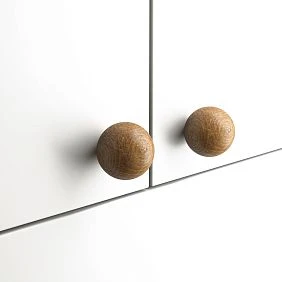
On a tall door — more comfortable grip, better proportion of the facade. A knob is appropriate for small drawers, cabinets, low sections. On a door 2000+ mm high, a 32 mm knob looks weak and is inconvenient for a heavy door.
The handle on the cabinet is the last detail to be installed and the first to be touched. It should be chosen with the same care as the cabinet itself. A long vertical handle on a tall hinged cabinet is not an aesthete's whim, but a correct design and ergonomic solution.
STAVROS manufactures Furniture Handles for Cabinets made of solid oak and beech: overlay, profiled, long vertical ones, for painting and for tinting. In one catalog — Handles, Legs, Moldings, applique and a full range furniture hardware. Production in Russia, warehouses in St. Petersburg and Moscow, delivery throughout the country. STAVROS — fittings that work for the furniture's image every day.