Article Contents:
- Why furniture handles affect the entire look of a cabinet and dresser
- Three functions of a furniture handle
- Which handles to choose for a cabinet
- Size Matters
- Installation height
- Vertical or horizontal placement
- One or two mounting holes
- Which handles to choose for a dresser
- Handles for dresser drawers: load and convenience
- Rhythm of handles on the dresser facade
- Knob handles for a dresser
- Pull handle or knob handle: what is the fundamental difference
- Pull handle: arguments in favor
- Button handle: arguments 'for'
- Practical rule
- Comparison table
- How to choose the size of a furniture handle
- Staple length and center distance
- Handle protrusion from the facade
- Rod diameter or handle cross-section
- Wooden handles for classic furniture
- Why wooden handles for classics
- Turned wooden handles: shape and feel
- Connection with legs, overlays, and moldings
- How to choose handles to match furniture color
- Strategy one: handles matching furniture
- Strategy two: contrast
- Strategy three: connection with the interior
- Handles for painting
- Handles for furniture restoration: a new life for an old cabinet
- What to consider when replacing during restoration
- Restoration as a design solution
- How to combine handles with legs, overlays, and moldings
- Single wood species
- Unified profile
- Connection with moldings
- Common mistakes when choosing furniture handles
- Mistake 1: Handle too small on a large cabinet
- Mistake 2: Uncomfortable grip
- Mistake 3: Different handle styles on different furniture pieces
- Error 4: Choosing only by photo without considering size
- Error 5: Random wood shade
- Error 6: Mismatch of handles and legs in style
- Error 7: Installing handles without marking
- Wooden handles and overall furniture decor: a unified system
- Where to buy furniture handles for cabinets and dressers
- STAVROS: catalog of wooden furniture handles
- Order from one piece and wholesale supplies
- Frequently Asked Questions
- How to choose furniture handles for a cabinet?
- Which handles are best for dresser drawers?
- Can I paint wooden handles myself?
- How to choose handles for white furniture?
- How not to make a mistake with the handle size?
- How to combine wardrobe handles with dresser handles in one room?
- Where to buy solid wood furniture handles in Russia?
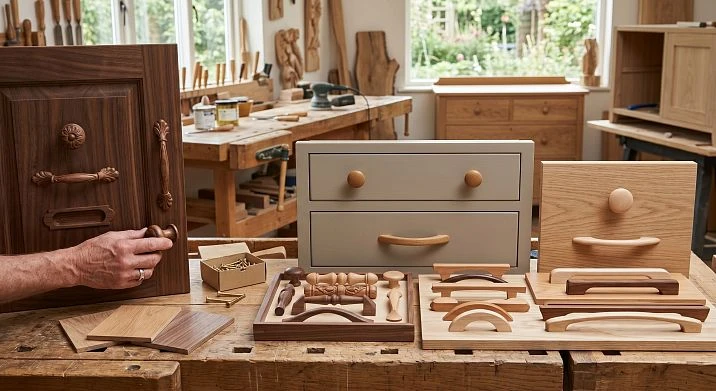
Look at any beautiful wardrobe or dresser — and you will notice: the first thing that catches your eye after the overall shape of the furniture is the handles. They create the first tactile and visual impression. They turn a faceless facade into a statement about taste, style, and attention to detail. And they are most often changed during restoration, renovation, or interior redesign.
Furniture handles for wardrobe and dresser — a topic that is underestimated. It would seem: what is there to choose? You pick what you liked in the picture, screw it on — and it's done. But that's exactly how interiors appear where expensive furniture looks awkward, and cheap furniture looks unexpectedly good. Because handles are the final chord that can make furniture complete or ruin everything that was built before it.
In this article — a detailed, honest, and practical breakdown: which furniture handle choose for wardrobe, for chest of drawers, for bedside table and drawers, how to select size, shape and finish, how to match hardware with other wooden decor. No fluff or generalities.
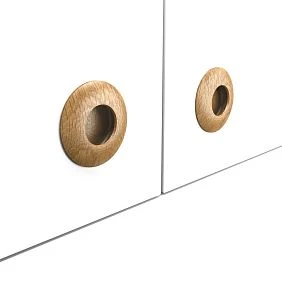
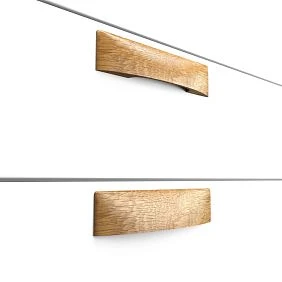
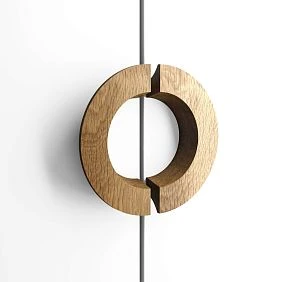
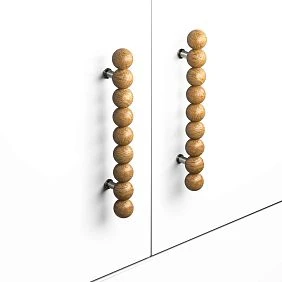
Why furniture handles affect the entire look of a wardrobe and chest of drawers
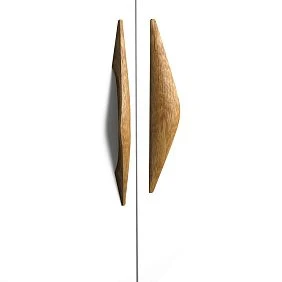
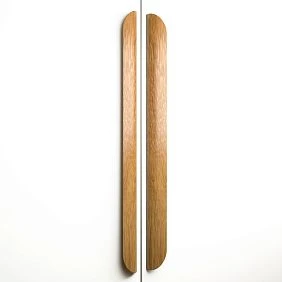
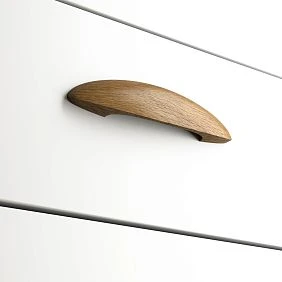
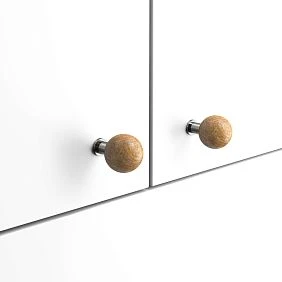
Try a thought experiment. Take the same white chest of drawers. Put large gold baroque-style handles on it — and you have a luxurious piece in the spirit of a Versailles bedroom. Replace them with thin matte black handles — and the same chest becomes minimalist, almost Scandinavian. Put turned wooden knobs made of natural oak — and the chest suddenly gains warmth, naturalness, and the coziness of Scandinavian country style.
A handle is not a detail 'for later.' It is an accent that reads instantly. It changes the character of furniture without changing any other detail.




Three functions of a furniture handle
Functional. The handle should be comfortable to grip, withstand the load when opening heavy doors and drawers, and not loosen over years of use.
Aesthetic. The handle shapes the style of the facade. It sets the tone — classic or modern, richness or asceticism, naturalness or industrialism.
Systemic. Handles should work in a unified system with other furniture and interior elements: legs, overlays, moldings, facade finishes, and the color of other items in the room.
That is why choosing a wooden handle is not a question of 'like / dislike.' It is a question of suitability.
Our factory also produces:
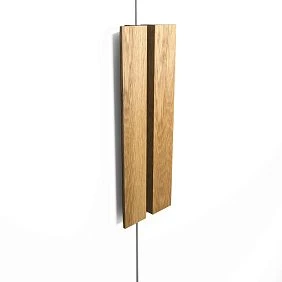
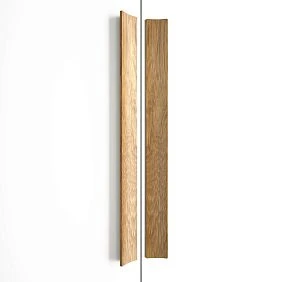
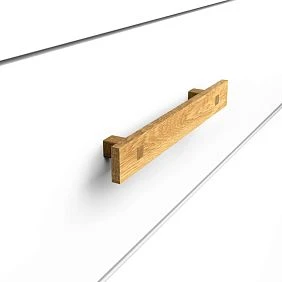
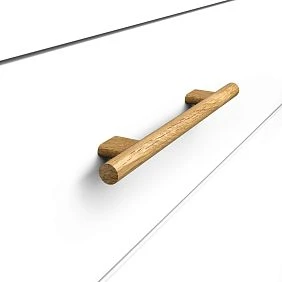
Which handles to choose for a wardrobe
A wardrobe is a large piece of furniture with tall doors. Here, the handle must work at the scale of a large facade.
Get Consultation
Size Matters
The first rule: the handle must be proportionate to the facade. A wardrobe door 200 cm high and 60 cm wide is a large surface. A tiny button with a diameter of 25 mm on such a facade will get lost and look like a random detail. Optimal for a tall wardrobe is a pull handle 96–128 mm long or a larger turned handle 100–160 mm long.
Installation height
The standard installation height for a handle on a wardrobe door is 90–110 cm from the floor. This is a comfortable level for most adult users. For double-door wardrobes, handles are installed symmetrically at the same height — this creates rhythm and order on the facade.
If the wardrobe is two-tiered (lower and upper drawers or sections), the handles of the lower part are installed at a height of 80–90 cm, and the upper part at 130–150 cm.
Vertical or horizontal placement
On tall wardrobe doors, a pull handle can be installed either vertically or horizontally. Vertical placement "stretches" the facade, adding dynamism. Horizontal placement creates a calm, "settled" line. Both options are acceptable — the internal logic is important: if the wardrobe has several doors, all handles must be oriented the same way.
One or two mounting holes
A pull handle is attached at two points — this is reliable for heavy doors. A knob handle is attached at one central point — suitable for lightweight facades. For heavy sliding wardrobes with mirrored or massive doors — only a pull handle or a large bracket-shaped handle with two mounting points.
Which handles to choose for a chest of drawers
A chest of drawers is a fundamentally different scenario. Here, handles work on drawers: from two to seven or more per piece of furniture. This means that chest of drawers handles serve not only an aesthetic but also a rhythmic function — they form the vertical or horizontal rhythm of the entire facade.
Handles for chest of drawers: load and convenience
A fully loaded dresser drawer can weigh 10–20 kg. When opening, the load on the handle is of a jerking type: a person grabs the handle and pulls it toward themselves in one motion. This means the drawer handle must provide a secure grip: a comfortable width between the handle and the facade (at least 25–30 mm), and sufficient length of the arc or gripping surface.
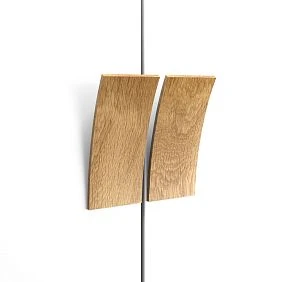
wooden hook handle — the optimal choice for drawers. The bracket provides a comfortable grip with the whole palm or two fingers, evenly distributes the load across two mounting screws, and does not rotate when opening.
The center-to-center distance (distance between mounting holes) for dresser drawers is standard 64, 96, or 128 mm. Check this parameter before purchase — it determines whether the handle will fit the existing holes in the facade.
Rhythm of handles on the dresser facade
If the dresser has five drawers — each with one handle. All five handles must be identical: shape, size, color, orientation. This creates a vertical rhythm — a straight line of accents from the top drawer to the bottom.
For wide drawers (wider than 60 cm), it is possible to install two handles symmetrically — this is more convenient functionally and more expressive visually.
Knob handles for dresser
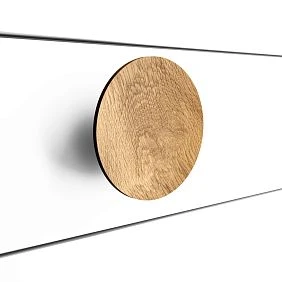
wooden button handle on dresser drawers — an elegant minimalist choice. The knob occupies the center of the drawer, creating a point accent. This is good for small drawers, nightstands, and decorative furniture. The knob competes less with the pattern of fabric, veneer, or lacquered facade — it is modest and delicate.
Bracket handle or knob handle: what is the fundamental difference
This question arises for everyone who chooses wooden furniture handlesTo avoid wandering in doubt, let's settle it once and for all.
A detailed comparison of these two types is in a separate article a bracket handle or a knob handle made of wood, here we will provide the main principles.
Handle-bracket: arguments 'for'
-
Comfortable grip with the whole hand — especially important for elderly people and children
-
Even load on two mounting screws — high reliability
-
Visually larger — suitable for large facades
-
Reads well from a distance — creates an expressive accent
-
Optimal for cabinets, sideboards, chests of drawers with wide drawers
Handle-button: arguments 'for'
-
Minimalist design — does not overload the facade
-
Single mounting point — easier installation
-
Great for small drawers, nightstands, decorative items
-
Creates a focal point in the center of the facade
-
Suitable for neat classic, Scandinavian, and modern furniture
Practical rule
For heavy doors and large drawers — a pull handle. For lightweight facades and small drawers — a knob. If in doubt, the pull handle is more versatile.
Comparison table
| Parameter | Bracket handle | Button handle |
|---|---|---|
| Ease of grip | High | Average |
| Enhanced | High | Medium |
| Visual size | Large | Small |
| Facades | Cabinets, large drawers | Cabinets, small drawers |
| Installation | Two holes | One hole |
| Style | Universal | Minimalism, classic |
How to choose the size of a furniture handle
Size is one of the most underestimated parameters. Buying a handle based on a picture and getting "the wrong one" is a story that happens all the time.
Staple length and center distance
The main parameter of a staple handle is the center distance (distance from the center of one mounting hole to the center of the other). This is not the same as the total staple length: the total length is always greater by the size of the "ears" — the protrusions where the holes are located.
Standard center distances: 32, 64, 96, 128, 160, 192, 256 mm. When replacing handles, it is important to keep the same center distance if you do not want to drill new holes. If you are making furniture from scratch, choose the center distance based on the size of the facade.
Guidelines:
-
Drawer up to 40 cm wide → center distance 64–96 mm
-
Drawer 40–60 cm wide → center distance 96–128 mm
-
Drawer over 60 cm wide → center distance 128–160 mm or two handles
-
Cabinet door → center distance 96–160 mm
Handle protrusion from the facade
The distance from the facade surface to the lower point of the bracket arc is the "clearance" for gripping. The minimum comfortable clearance is 25 mm. For buttons, the height of the button above the surface is 20–35 mm.
Rod diameter or handle cross-section
For a wooden bracket, the rod diameter (arc cross-section) affects grip comfort. Too thin — uncomfortable to hold. Too thick — hand gets tired. The optimal diameter for a wooden bracket rod is 18–25 mm. This is a "finger" grip, where the fingers fully wrap around the handle.
Wooden handles for classic furniture
A classic wardrobe, chest of drawers, sideboard, display cabinet, nightstand — these are furniture pieces with history. And wooden furniture handle here — it's not just hardware. It's a continuation of the stylistic program.
Why wooden handles for classic style
Metal handles (brass, chrome, nickel, bronze) are appropriate in classic style, but they create a certain "metallic" accent. A wooden handle works differently: it continues the natural material of the furniture, creating organic unity. A cabinet made of solid oak with wooden handles from the same oak is a complete, finished piece without unnecessary metal inclusions.
Especially organic Wooden fittings and decor for furniture in interiors where the focus is on natural materials: solid wood, natural fabrics, stone surfaces.
Turned wooden handles: shape and feel
A turned handle made of oak or beech is a turned product with a profile: necks, rollers, smooth diameter transitions. Such a handle is tactilely rich — you pick it up and immediately feel that it is quality. Visually, a turned handle creates a connection with architectural orders — the same rollers and necks used in wooden moldings and turned furniture legs.
Connection with legs, overlays, and moldings
Here is the key principle of systematic decor. If a chest of drawers has turned wooden legs made of oak with a walnut tint, then the handles should either be made of the same material and tone, or deliberately contrasting. If a display cabinet has wooden moldings on the solid wood facade, the handles should be of the same wood.
Wooden legs + wooden handles + wooden overlays — this triad creates a unified decorative program for the furniture. Breaking it with random metal handles means destroying the logic.
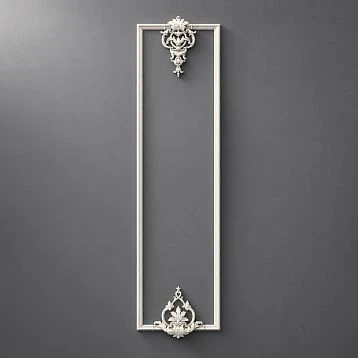
О decorating furniture with wooden overlays is written in detail — it shows how carved and milled solid wood overlays turn an ordinary cabinet into furniture with character.
How to choose handles to match furniture color
Color is the second most important characteristic of a handle after shape. And there are several strategies here, each giving a different effect.
Strategy one: handles matching the furniture
An oak wood handle on a natural oak cabinet is a monochrome strategy. The handle "blends in" with the facade, creating no separate accent. The decor here is the texture and profile shape, not a color contrast.
This approach is good for interiors that already have enough accents — a bright rug, saturated walls, complex fabric patterns on upholstered furniture. Here, the handles should be silent, not shout.
Strategy two: contrast
White enamel cabinet — dark oak handles. Dark stained furniture — bleached or light walnut handles. Contrast creates liveliness, accent, visual play.
For white furniture, wooden handles made of natural oak or stained walnut are one of the most popular techniques. Warm wood on a cold white facade creates a balance of natural and neutral.
Strategy three: connection with the interior
Handles are chosen not for the furniture, but for the interior as a whole. If the room has dark oak parquet, the dresser handles should be a similar tone — they will create a horizontal "response" to the flooring.
If the room has wooden slats on the walls or a wooden baseboard of a certain shade, furniture handles in the same shade will create a system of "wooden accents" that visually unifies the entire space.
Handles for painting
buy wooden handles In an unpainted form — an excellent solution if you want to exactly match the furniture shade. Unpainted solid wood accepts any paint, stain, varnish, or enamel. Paint the handles the same color as the facade — and you get "hidden" handles that only emphasize the shape. Or in a contrasting color — and you get a bright accent.
Handles for furniture restoration: a new life for an old cabinet
Furniture restoration is a separate and very rewarding scenario. Often, an old cabinet or chest of drawers has a beautiful frame and tabletop, but outdated or worn handles make it a "Soviet" item that doesn't fit into a modern interior.
Replacing handles is the fastest and cheapest way to change the perception of furniture. One evening, a few screws — and an old chest of drawers turns into a stylish piece.
What to consider when replacing handles during restoration
Center-to-center distance. If you don't want to re-drill the fronts, the new handles must have the same center-to-center distance as the old ones. Measure it before ordering.
Mounting hole diameter. The standard diameter is 4–5 mm. Most handles use this standard.
Front thickness. The length of the mounting screw must match the front thickness. The screw should not protrude from the back side.
Style. New handles should match the new concept. If you are painting furniture in a white Provence style — choose white or light wooden handles. If you are keeping the cabinet's natural finish — choose handles made of the same wood.
Restoration as a design solution
Wooden handles for children's furniture — a separate topic where restoration often solves not only an aesthetic but also a safety task: wooden handles without sharp metal edges.
For adult furniture, restoration with replacement of handles with wooden ones gives a feeling of "handmade", care, naturalness — values that are more in fashion today than ever.
How to combine handles with legs, overlays and moldings
This is the highest level of working with wooden fittings. The level that distinguishes "just furniture with handles" from an "interior project".
Single wood species
The ideal option: handles, legs and furniture overlays made of the same wood species — oak or beech — and with the same finish. This creates the impression that the furniture was conceived as a single piece, rather than assembled from different sources.
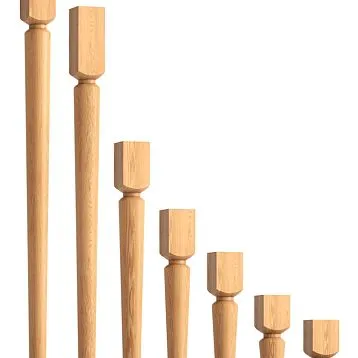
Buy furniture legs for a 200-room hotel project — this is not an ordinary deal, but a partnership requiring a special approach. made of oak and there — wooden handles made of oak: one species group, one finishing logic.
Unified profile
If the handles are turned — with rollers and necks — the legs should also be turned. If the handles are geometrically strict with clean straight lines, the legs should be the same. Mixing a turned handle profile with rectangular geometric legs is a stylistic dissonance.
The same principle applies to decorative elements for furniture: carved overlays with smooth floral patterns are combined with turned handles. Geometric milled overlays — with straight or tapered brackets.
Connection with moldings
If the cabinet doors have Wooden decoration in the form of moldings and panels, the handles should be proportionate to this decor. Large moldings — large handles. Delicate thin moldings — delicate thin knob handles.
Common mistakes when choosing cabinet handles
Here is a specific list of mistakes that occur constantly — and each of them is easily fixable with the right approach.
Mistake 1: Handle too small on a large cabinet
A 25 mm diameter knob on a two-door cabinet with doors 60×210 cm is a lost detail. The eye doesn't find it, the hand reaches for the door edge. For a tall cabinet — a pull handle with a center-to-center distance of at least 96–128 mm.
Mistake 2: Uncomfortable grip
The handle is beautiful, but there is only 15 mm between the arc and the facade. Fingers barely fit. With regular opening, this becomes annoying. The minimum clearance for a comfortable grip is 25 mm. Check this parameter, not just the overall length.
Mistake 3: Different handle styles on different furniture pieces
In the bedroom, a cabinet with gold metal handles, a dresser with dark wooden handles, nightstands with matte black pulls. Three different styles in one room — this is not eclecticism, it's a mess. All wooden handles in the space should be from the same series or at least the same style.
Mistake 4: Choosing only by photo without considering size
In the photo, the handle looks elegant and small. In reality, it arrives — and it turns out that a 128 mm long bracket on a small nightstand looks like an axe handle. Always check the actual dimensions and visualize them on your specific facade.
Mistake 5: Random wood shade
"Well, it's also wood" — and as a result, honey oak handles on a dark walnut cabinet. Two fundamentally different wood tones on one piece of furniture. Take a sample of your furniture finish when choosing handles — or choose unpainted handles for DIY painting.
Mistake 6: Mismatch between handles and legs in style
Baroque carved handles with curls and massive "ears" — and thin tapered Scandinavian legs. This is an absurd combination that occurs less often than you might expect — but it still does. The profile of the handles and the profile of the legs should speak the same stylistic language.
Mistake 7: Installing handles without marking
Handles installed "by eye" — one slightly higher, another a bit to the left. On one piece of furniture, it's unnoticeable. On a chest of drawers with five drawers, it's immediately obvious. Always use marking and a template for precise positioning.
Wooden handles and overall furniture decor: a unified system
When it comes to furniture and decor made of solid wood, handles are just part of a larger system. The complete decorative solution for cabinet furniture includes:
-
Handles — wooden, in the same wood species and finish
-
Legs — turned or geometric, made from the same wood
-
Overlays — carved or milled decorative elements on facades
-
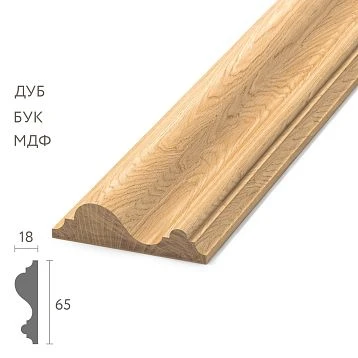
Moldings — profiles for framing doors and display cases
-
Millwork — baseboards and cornices that connect furniture with the space
When all these elements are sourced from one manufacturer, from the same wood species, with compatible proportions — furniture ceases to be just a functional object and becomes part of a conscious interior design project.
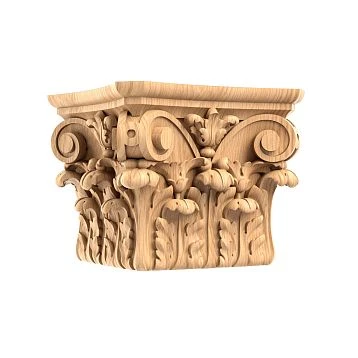
decor for furniture from solid wood in the STAVROS catalog covers the full range: from carved medallions and corner rosettes to milled bands and flat overlays. All of this matches furniture handles in material and proportions.
Where to buy furniture handles for a wardrobe and dresser
When the question is clearly formulated — you need wooden pull handles or knob handles made of oak, with a specific center-to-center distance and desired finish — it comes down to a supplier who has all of this in one place, with transparent parameters and guaranteed quality.
STAVROS: catalog of wooden furniture handles
STAVROS is a manufacturer and distributor of wooden products for furniture and interiors. The company's catalog features a full range of furniture handles: pulls, knobs, turned and geometric models, made of oak and beech, in unfinished form and with coating.
Wooden handle from STAVROS — this is a product made of professionally dried solid wood with multi-stage sanding and stable geometric parameters. Each handle undergoes quality control: even mounting holes, precise compliance with stated dimensions, high-quality finishing.
The catalog also includes handles without coating — wooden knob handles — for those who want to independently select the finish tone for specific furniture.
Order from one piece and wholesale supplies
You can order wooden handles from STAVROS from one piece — this is important for private customers engaged in restoration or updating a single piece of furniture. For furniture manufacturers, carpentry workshops, and design studios — stable wholesale supplies with guaranteed batch quality.
Delivery across all of Russia. Warehouse program — always in stock. buy wooden handles delivery can be arranged in a few clicks through the catalog on the website.
Frequently asked questions
How to choose furniture handles for a cabinet?
Determine the interior style → choose the shape (bracket or knob, turned or geometric) → select the center-to-center distance for the facade → choose the finish to match or contrast with the furniture. For tall cabinet doors — a bracket with a center-to-center distance of at least 96 mm.
Which handles are best for dresser drawers?
For medium-width drawers (40–60 cm) — bracket handles with center-to-center distance of 96–128 mm. They provide a comfortable grip and reliable fastening. For small drawers (up to 40 cm) — knobs or brackets with center-to-center distance of 64 mm.
Can I paint wooden handles myself?
Yes, this is a common practice. Unpainted handles made of solid oak or beech accept any paint, stain, varnish, or enamel. Apply stain or primer, then a finish paint or varnish — and you will get handles exactly matching the color of your furniture.
How to choose handles for white furniture?
Three good options: white painted handles (monochrome unity), natural oak handles (warm natural accent), dark tinted handles (contrast). White and oak are the most popular combinations for Provence, Scandinavian, and neoclassical interiors.
How to avoid mistakes with handle size?
Focus on the size of the facade. For facades wider than 50 cm — a bracket with a center-to-center distance of at least 96 mm. Measure the distance between existing mounting holes and select handles for that distance. Check the clearance between the bracket arch and the facade — at least 25 mm.
How to combine wardrobe handles with dresser handles in the same room?
Optimally — one series of handles for all furniture. Or one shape (all brackets or all knobs) in the same wood species and finish. Differentiation is acceptable: tall wardrobe — large brackets, dresser — medium brackets, nightstand — knobs. But all handles must be in a unified style.
Where to buy solid wood furniture handles in Russia?
STAVROS is a manufacturer and distributor of wooden furniture handles made from solid oak and beech. Full range of brackets and knobs, unpainted and coated, from single pieces, Contact us to confirm shipping to your destination.
STAVROS is a company that has been creating wooden furniture fittings and decor for decades, with a quality standard you can rely on. Furniture Handles From the STAVROS catalog is not just fittings. It's part of a system: handles, legs, overlays, moldings, millwork — all from the same wood, in uniform proportions, with the same level of craftsmanship. When you choose STAVROS, your furniture gains completeness. And that's exactly what everyone who loves their home wants.