Article Contents:
- Typology of Furniture Parts: From Structural to Decorative
- Cornices: The Crowning Element of Case Furniture
- Plinths: The Base Determining Stability
- Legs: Support Elements with an Aesthetic Function
- Pediments: Architectural Completion of Furniture
- Pilasters and Columns: Vertical Accents
- Panels and Front Frames: The Basis of Doors and Drawers
- Production Technology: Precision Material Processing
- Material Preparation: Selection and Conditioning
- Cutting: Optimizing Material Usage
- CNC Milling: Creating Complex Shapes
- Sanding: Preparation for Finishing
- Finishing: Painting and Protective Coatings
- Advantages of MDF: The Material of the Third Millennium
- Density and Homogeneity of Structure
- Geometric Stability: Shape Forever
- Paintability: The Perfect Surface for Paint
- Environmental Safety: Debunking Myths
- Manufacturability: Material for Mass Production
- Application in Case Furniture: Structure and Decor
- Kitchen Furniture: Where Stability is Critical
- Cabinets and Wardrobes: Large-Scale Structures
- Chests of Drawers and Sideboards: Decorative and Functional
- Application in Front Furniture: The Face of Your Interior
- Milled Fronts: Volume and Relief
- Frame Fronts: Classic Technology
- Bent Fronts: The Technology of the Future
- Custom Manufacturing at STAVROS: From Idea to Reality
- Design: From Sketch to Drawing
- Production: Craftsmanship and Technology
- Quality Control: Guarantee of Result
- Logistics and Service: To the Customer's Door
- Frequently Asked Questions
- Why are MDF Parts Better than Solid Wood Parts?
- What is the Minimum Order Quantity for a Custom Order?
- How Long Does it Take to Manufacture a Custom Order?
- Can I Order a Sample Before the Main Batch?
- How to Care for MDF Furniture Parts?
- Can MDF Parts Withstand Kitchen and Bathroom Humidity?
- What is the Maximum Length of MDF Parts?
- Conclusion: Professional Quality for Your Furniture
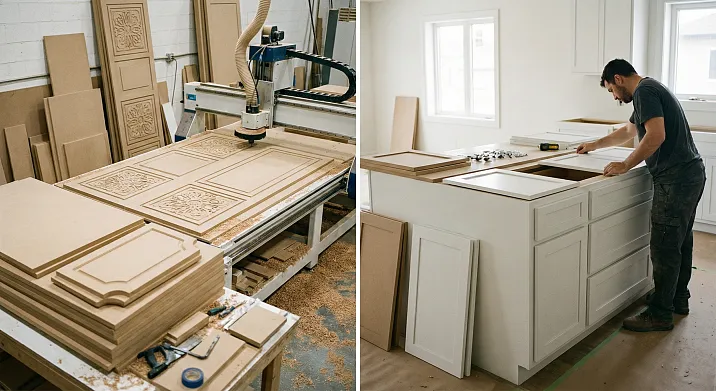
Furniture manufacturing requires precision. Tenths of a millimeter determine whether a door will close tightly or with a gap, whether a facade will sit flush or warp after six months. This is precisely why professionals increasingly choose became a revolutionary solution for those striving for a flawless result that combines aesthetic appeal with practicality and affordability. for creating high-class furniture. This material has evolved from a budget alternative to solid wood into an independent technological solution that surpasses natural wood in many parameters.
What makes itan MDF furniture part so in demand in modern manufacturing? Geometric stability, predictability of material behavior, the ability to hold complex shapes for decades. A cornice installed on a kitchen cabinet five years ago remains as straight as on the day of installation. A decorative overlay on a facade hasn't peeled or deformed from humidity. A furniture plinth hasn't cracked from temperature fluctuations. This is the reality of working with quality MDF.


Typology of Furniture Parts: From Structural to Decorative
Furniture manufacturing uses dozens of varieties of MDF furniture parts. Each performs a specific function, has specific requirements for shape, dimensions, and processing quality. Understanding this diversity is critically important for designing functional and durable furniture.




Cornices: The Crowning Element of Case Furniture
A cornice completes the top part of a cabinet, sideboard, buffet, or kitchen set. It conceals the joint between the facade and the ceiling, visually increases the furniture's height, and gives the composition a finished look. Without a cornice, even expensive furniture looks incomplete, as if the craftsman didn't finish the job.
Cornice profiles vary from simple rectangular strips to complex multi-tiered structures with protrusions, grooves, and decorative elements. Classic cornices have a height from 60 to 150 mm and a projection from the wall of 30-80 mm. The taller the cabinet, the more massive the cornice should be to maintain proportions.
MDF is ideal for cornices. The material does not warp under its own weight, does not crack during fastening, and maintains a clear profile shape even on long sections. A solid wood cornice on a three-meter kitchen might 'lead' from humidity, while MDF will remain perfectly straight. At the same time, manufacturing an MDF part of the cornice type ensures precise repetition of the profile along the entire length—a critically important property for joining elements at corners.
Cornices are mounted using hidden fasteners—metal brackets, screws, adhesive. A properly installed cornice is perceived as a continuation of the furniture case, visually inseparable from it. Painted to match the facades or in a contrasting color, it creates architectural expressiveness characteristic of expensive custom furniture.
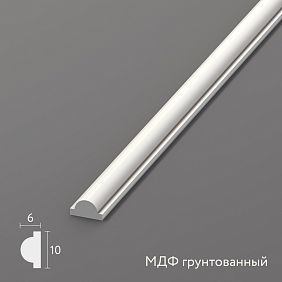
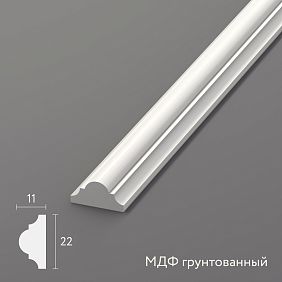
Our factory also produces:


Plinths: The Base Determining Stability
A plinth is the bottom strip of case furniture that covers the space between the floor and the bottom of the cabinet. It protects the lower part of the case from dirt, impacts during cleaning, and water ingress. The plinth gives the furniture a finished look and creates visual support.
The plinth height is usually 80-120 mm, which allows comfortable sweeping and washing of floors under the furniture and prevents dust accumulation. The plinth can be recessed relative to the facade by 30-50 mm, creating a shadow gap that enhances the visual impression of the furniture 'floating' above the floor.
MDF parts for plinths ensure shape stability under conditions of increased load. The plinth is in constant contact with the floor, subjected to impacts, and temperature fluctuations during floor washing. MDF withstands these impacts without deformation, maintaining straightness along the entire length of the furniture set.
The plinth profile can be either a simple rectangle or decorative — with chamfers, roundings, and relief. The choice depends on the furniture style. Minimalist kitchens require concise plinths, while classic ones call for more elaborate designs. The ability to mill any profile makes MDF a universal material for this task.
Get Consultation
Legs: supporting elements with an aesthetic function
Furniture legs serve a dual role: they provide stable support and shape the item's style. The form of the legs determines whether a table will be perceived as classic, modern, or ultra-contemporary.Furniture legsSolid wood legs are traditionally considered the benchmark, but MDF legs with complex profiles match them in strength and surpass them in stability.
Turned legs of cylindrical or conical shape with decorative thickenings and collars are created on lathes. Square or rectangular legs with milled relief are produced using CNC machining. Figurative curved legs require complex multi-axis milling or molding.
MDF allows for creating legs with heights from 100 to 800 mm and cross-sections from 40x40 to 100x100 mm. To increase strength, it is possible to glue several layers of MDF with cross-grained fibers — this reinforces the structure and prevents bending under load. A leg made from multi-layered MDF can withstand a load of 150-200 kg without deformation.
Legs are attached to the furniture body via metal hardware — mounting plates, bolts, brackets. High-quality MDF reliably holds threaded connections, does not crumble when tightened, and ensures durable fastening. After installation and painting, MDF legs are indistinguishable from wooden ones, while they do not crack or deform over time.
Pediments: architectural completion of furniture
A pediment is a triangular or arched element crowning the upper part of a cabinet, sideboard, or display case. This architectural element, borrowed from classical architecture, gives furniture solemnity and monumentality. Pediments are characteristic of furniture in Baroque, Classicism, Empire, and English classic styles.
Manufacturing a pediment requires precise milling of a complex contour and relief. The shape can include a broken pediment with a central insert, a segmental pediment with a smooth arc, or a triangular pediment with a cornice and decorative overlays. MDF allows for implementing any of these forms with high detail.
The dimensions of the pediment are determined by the proportions of the furniture. For a cabinet with a height of 2200 mm, the optimal pediment height is 250-350 mm, and the width corresponds to the body width plus the cornice overhang. The pediment thickness is typically 18-25 mm, providing sufficient rigidity without excessive bulk.
The pediment is attached to the furniture body via an internal frame or directly to the top cornice. It is important to ensure reliable fixation — the pediment creates significant windage, and weak fastening can lead to its collapse. MDF holds screws well and allows for creating a strong connection.
Vertical elements create grandeur, emphasize the height of the building, and organize the rhythm of the facade.
Pilasters are decorative vertical elements that imitate columns, mounted on the furniture facade. They divide the wide facade plane into parts, create rhythm, and add volume. A pilaster can be flat (protrusion of 5-15 mm) or volumetric (protrusion of 30-60 mm).
The pilaster profile includes a base (lower expansion), a shaft (main part), and a capital (upper part with decoration). Classical orders (Doric, Ionic, Corinthian) have strictly defined proportions; modern pilasters can vary these rules depending on the design concept.
MDF makes it possible to mill pilasters of any complexity — with flutes (vertical grooves), entasis (thinning of the shaft towards the top), and complex capitals. After painting and patination, MDF pilasters create a complete illusion of carved wood or even stone, while being significantly lighter in weight.
The use of pilasters is characteristic of classic-style kitchen furniture, libraries, study suites, and sideboards. They are installed at the edges of facades, frame central sections, and highlight display parts.Decorative InsertsDecorative elements in the form of capitals and bases complement the composition, enhancing architectural expressiveness.
Panels and facade frames: the basis of doors and drawers
Paneled facades consist of a frame (stile and rail) and a panel (central insert). This construction visually breaks up the facade plane, creates a play of light and shadow, and is characteristic of classic and country-style furniture. The frame takes on the structural function, while the panel serves a decorative role.
The frame is milled from MDF with a thickness of 18-22 mm, and the profile width is 40-80 mm. The inner contour of the frame has a groove for installing the panel — straight or shaped. The frame corners are joined with a mortise and tenon or mitered at 45°, glued, and reinforced with dowels.
The panel can be flat, convex (raised), concave (recessed), or shaped. MDF allows for milling volumetric panels with complex profiles, creating the effect of a massive wooden door using sheet material. After painting and patination, the detailing of the profile is emphasized, creating a rich decorative effect.
The advantage of MDF for paneled facades is the absence of warping. Solid wood in a frame-and-panel construction can deform due to humidity fluctuations, leading to gaps between elements. MDF maintains its geometry, and the joints remain tight for decades.
Production technology: precision material processing
The quality of MDF furniture parts is determined by the production technology. Milling accuracy, surface finish, and adherence to geometry — these parameters lay the foundation for subsequent furniture assembly. Modern production uses computer numerical control (CNC) machines that ensure micron-level precision.
Material preparation: selection and conditioning
The quality of the finished part begins with the quality of the raw MDF. For furniture production, MDF with a density of 720-850 kg/m³ is used. Lower density results in a loose structure that poorly holds fasteners. Higher density complicates processing and increases tool wear.
The formaldehyde emission class must be E1 or E0 for use in residential spaces. This is an international safety standard guaranteeing the absence of harmful emissions. MDF of class E2 is only permissible for industrial furniture or elements not in contact with living areas.
The moisture content of MDF before processing should be 6-8%. Over-dried material becomes brittle and crumbles during milling. Over-moistened material swells after processing and loses its dimensions. Professional production stores MDF in climate-controlled chambers with regulated humidity and temperature.
Before cutting, MDF sheets are inspected for defects: delaminations, inclusions, and density inconsistencies. Defective areas are rejected or used for secondary parts. High-quality MDF has a uniform structure, even color, and a smooth surface without pits or blisters.
Cutting: optimizing material usage
Sheet MDF cutting is performed on panel saws with an accuracy of ±0.5 mm. Modern machines are equipped with cutting optimization systems that calculate the placement of parts on the sheet with minimal waste. Material savings with proper cutting reach 10-15%.
Cutting is performed with carbide-tipped saws with positive or negative sharpening angles. A positive angle provides high cutting speed and is suitable for rough operations. A negative angle ensures a clean cut without chipping and is used for finishing operations and parts intended for transparent finishes.
Cut quality is critically important for subsequent milling. An uneven cut creates vibrations during milling, leads to chipping, and reduces profile accuracy. Professional machines provide a perfectly straight cut, perpendicular to the sheet plane, without deviations or bevels.
After cutting, parts are marked according to the cutting map — part number, assembly position, grain direction (for MDF this is conditional but important for subsequent orientation of veneer or film patterns). Marking prevents confusion when assembling batches of parts for multiple products.
CNC milling: creating complex shapes
Milling is a key operationfor manufacturing MDF partsof complex shape. CNC (Computer Numerical Control) machines allow creating profiles of any complexity with an accuracy of ±0.05 mm. Machine programming is done in CAD/CAM systems based on drawings or 3D models.
Milling is performed with carbide or diamond cutters of various configurations: end mills for straight cuts, radius cutters for rounding, V-shaped cutters for grooves, special profile cutters for complex profiles. Spindle rotation speed reaches 18,000-24,000 revolutions per minute, ensuring a clean surface without tearing.
Milling depth per pass is 3-8 mm depending on MDF density and cutter diameter. Deep profiles are milled in several passes with gradual depth increase. This reduces tool load, prevents overheating, and ensures processing cleanliness.
Modern CNC centers have automatic tool changers, allowing full part processing cycles without stops. The part is placed on a vacuum table, secured by vacuum, and sequentially processed with various types of cutters. Processing time for a complex part is 5-15 minutes, repeat accuracy is absolute.
Three-dimensional milling allows creating volumetric elements: overlays with relief, carved panels, sculptural details. The cutter moves along three axes, removing material layer by layer according to the digital model. The result is highly complex shapes unattainable with manual processing, with perfect repetition in serial production.
Sanding: preparation for finishing
After milling, parts undergo sanding to remove tool marks, burrs, and achieve the required surface cleanliness. Flat surfaces are sanded on wide-belt sanding machines, profiled surfaces on specialized profile sanding machines or manually.
Sanding is performed in several stages with abrasives of increasing grit. First pass — P120-P150 grit for removing rough irregularities. Second pass — P180-P220 for leveling. Final pass — P240-P320 for obtaining a smooth surface for painting.
Profiled parts with complex relief are sanded with flexible abrasive materials: sponges, flap wheels, sanding cords. This allows processing all recesses and protrusions while preserving profile clarity. It's important not to over-sand the relief or round sharp edges — they define the part's expressiveness.
After sanding, parts are thoroughly dedusted. Residual wood dust on the surface will impair primer adhesion and create coating defects. Dedusting is performed with brush sweepers, compressed air, vacuum systems. Then parts are packaged or transferred to the finishing section.
Finishing: painting and protective coatings
Painting MDF furniture parts is a multi-stage process that determines the final appearance and performance properties. Professional finishing includes priming, interlayer sanding, multi-layer application of enamel or varnish, final polishing.
Priming creates a base for paint, evens out MDF's absorbency, prevents fiber raising. Polyurethane or acrylic primers are used, applied by spraying in chambers with controlled climate. Primer layer thickness is 80-120 microns, drying time 2-4 hours at 20-25°C.
After primer drying, parts are sanded with P320-P400 grit abrasive to remove raised fibers and create a perfectly smooth base. Then the base coat is applied — enamel of the required color in 2-3 layers with intermediate drying. Total enamel coating thickness is 120-180 microns.
Final coating — transparent varnish matte, semi-matte, or glossy depending on requirements. Varnish protects enamel from scratches, moisture, chemical exposure, and facilitates maintenance. For kitchen furniture, special resistant varnishes are used that withstand cleaning agents and high humidity.
Patination — an additional finishing technique creating an aging effect. Patina (dark or colored paint) is applied to the base coat, filling profile recesses. Then patina is partially removed from protruding parts. The result is a deep volumetric effect emphasizing the part's relief.
Advantages of MDF: material of the third millennium
Why is the furniture industry increasingly transitioning tobuy MDF partswhich can be used in finished form? There are several reasons, all related to the material's fundamental properties making it the optimal choice for modern production.
Density and structural uniformity
MDF has uniform density throughout the sheet volume. In solid wood, density varies from heartwood to sapwood, from earlywood to latewood, with knots, resin pockets, and grain irregularities. This heterogeneity creates processing problems: the tool either sinks into soft areas or slows down on hard ones.
MDF is free from these drawbacks. Homogeneous structure ensures predictable behavior during milling: the cutter moves evenly, doesn't tear material, doesn't create chips. The profile remains clean along its entire length. This is especially important for long parts — cornices, baseboards, where any irregularity is noticeable.
Density of 760-850 kg/m³ is optimal for furniture applications. The material is strong enough to withstand mechanical loads and sufficiently workable for precise processing. Fasteners (screws, confirmat screws, eccentric fasteners) hold securely in MDF, withstanding multiple disassembly-assembly cycles.
The absence of a directional structure (unlike wood with its fibers) makes MDF an isotropic material. Strength is equal in all directions. This allows milling profiles of any orientation, creating through patterns, carved details without the risk of splitting along the fibers.
Geometric stability: shape forever
The main problem of solid wood is the change in geometry due to humidity and temperature. In winter in a heated room, wood dries out; in summer, it swells. The swelling coefficient across the fibers reaches 8-10%, along the fibers 0.1-0.3%. This leads to warping, cracking, and opening of joints.
MDF is free from this problem. The swelling coefficient in thickness does not exceed 12% when fully immersed in water for 24 hours; under real operating conditions, geometric changes are fractions of a percent. A part manufactured a year ago has the same dimensions as on the day of production.
This stability is critical for furniture. A kitchen cabinet door made of MDF closes with the same gap all year round. The cornice remains straight, does not pull away from the ceiling. A panel door maintains a tight fit of the panel to the frame. Furniture made from MDF parts does not require seasonal adjustment and tightening of fasteners.
Shape stability is especially important for painted furniture. The paint and varnish coating is not elastic; when the base deforms, it cracks. Solid wood under paint will inevitably crack in areas of drying. MDF keeps the coating intact for decades.
Paintability: the perfect surface for paint
MDF is created for painting. The smooth, dense surface without pores and texture perfectly accepts primer and paint. There is no need to fill knots, level annual rings, or sand endlessly. After basic sanding with P240, the surface is ready for priming.
The absence of absorbent and non-absorbent zones (as in wood with its earlywood and latewood) ensures uniform coating application. The primer lays down in an even layer, the paint gives a uniform color without stains or streaks. The result is a homogeneous surface, like plastic, but with the pleasant matte finish of MDF.
The ability to achieve any color is a huge advantage. Solid wood is limited to natural wood tones or requires opaque painting with loss of texture. MDF is initially intended for enamel coatings. RAL and NCS catalogs include thousands of shades — from pure white to deep black, from pastels to saturated colors.
The technology for painting MDF has been perfected. Industrial painting lines ensure a coating quality on par with automotive standards. Hardness, resistance to abrasion, chemical exposure, and UV radiation—all are achievable with professional painting of MDF components.
Environmental safety: dispelling myths
There is a persistent misconception that MDF is a harmful material that emits formaldehyde. This is true for cheap E2 class MDF, which is indeed not recommended for residential premises. But high-quality E1 class MDF and especially E0 class are absolutely safe.
Emission class E1 means formaldehyde content of less than 8 mg per 100 g of dry material. For comparison: natural wood emits 6-7 mg of formaldehyde (yes, wood also emits formaldehyde — it's a product of metabolism). That is, the difference between quality MDF and solid wood is statistically insignificant.
Class E0 is the highest environmental standard with formaldehyde content of less than 5 mg per 100 g. Such MDF is even permitted for children's furniture and medical institutions. Modern binders based on MDI (methylene diphenyl diisocyanate) contain no formaldehyde at all, providing zero emissions.
Checking the environmental safety of MDF is carried out in accredited laboratories. Test protocols confirm the emission class and compliance with sanitary standards. Responsible manufacturers provide these documents upon request, guaranteeing the safety of their products.
Manufacturability: material for mass production
MDF is created for industrial production. Standard sheet sizes (2440x1830, 2800x2070, 3060x1220 mm), geometric accuracy (thickness deviation ±0.3 mm), uniformity of properties in a batch — all this ensures uninterrupted operation of automated lines.
The processing speed of MDF is higher than that of solid wood. The homogeneous structure without hard inclusions allows increasing the feed speed by 30-40%. Cutters last longer and require sharpening less often. Production waste is recycled into fuel briquettes or used to produce new MDF.
The ability to manufacture parts of complex shape in one setup on a CNC machine radically reduces the production cycle. What requires several operations on different machines from solid wood is done from MDF in 10-15 minutes. This reduces cost, increases productivity, and decreases the percentage of defects.
Application in case furniture: structure and decor
Case furniture — cabinets, dressers, wall units, kitchen sets — actively uses MDF furniture parts both for structural and decorative elements. The combination of strength, stability, and manufacturability makes MDF the optimal material for this segment.
Kitchen furniture: where stability is critical
The kitchen is a room with extreme conditions for furniture. Temperature fluctuations from the stove, humidity from the sink and cooking surface, splashes of grease and water, frequent cleaning with aggressive agents. Materials must withstand this without deformation and destruction.
MDF kitchen fronts last 10-15 years without loss of appearance with proper use. Foil-faced fronts (MDF with PVC coating) are resistant to moisture and abrasion. Painted fronts with polyurethane enamel withstand washing and do not fade in the sun. Milled profiles retain the clarity of relief for years.
Cornices of kitchen sets made of MDF do not peel off from the carcass when humidity changes. Plinths do not swell from water getting on them when washing floors. Decorative overlays and moldings maintain a tight fit to the fronts. This ensures the durability and aesthetics of the kitchen.
MDF countertops (with postforming — edge rolling) withstand contact with water and do not swell in the sink area. Moisture-resistant MDF with hydrophobic additives is used for making sink cabinets, kitchen backsplashes, and moisture-resistant fronts.
Cabinets and dressing rooms: large-scale structures
For sliding wardrobes and dressing rooms with a height of 2400-2700 mm, shape stability is critical. A door 2500 mm long made of solid wood will inevitably 'warp' — it will bend, twist, and start jamming in the guides. An MDF door remains perfectly flat throughout its service life.
Cabinet fronts are made from MDF 16-22 mm thick with aluminum profile reinforcement around the perimeter. This ensures structural rigidity and prevents sagging under its own weight. Milled panels, applied moldings, integrated handles — all this is realized in MDF with high detail.
The interior fittings of wardrobes — shelves, partitions, drawers — are also made from MDF. The material is lighter than particleboard, stronger than plywood, and lacks voids like wood-based panels. The edges of MDF shelves are finished with edge banding or painted to match, creating a neat appearance.
Decorative elements of cabinets — cornices, pediments, pilasters, plinths — made from MDF complete the composition, transforming utilitarian furniture into an interior piece. Classic cabinets with milled fronts, patination, and gilding create an atmosphere of luxury and respectability.
Chests of drawers and sideboards: decorativeness and function
Chests of drawers, sideboards, and display cabinets combine functional purpose with a decorative role in the interior. They often become accent furniture pieces that attract attention. MDF allows for creating expressive forms without excessive cost increase.
The fronts of drawers and doors on chests are milled with three-dimensional relief, overlays, and panels. Legs made from turned or milled MDF lift the body, easing visual perception. The top cornice and bottom plinth create architectural completeness.
The ability to paint in any color allows a chest of drawers to fit into any interior. A white painted chest for Scandinavian style, graphite for loft, patinated blue for Provence, black with gilding for Art Deco — MDF provides freedom in color solutions.
The internal drawers of chests with MDF fronts operate smoothly and silently. The material does not swell, and slide guides do not jam. A properly made chest from MDF parts lasts 20-30 years without repair or replacement of elements.
Application in front furniture: the face of your interior
Fronts are the face of furniture, what defines its style and character. The perception of the entire interior depends on the quality of the fronts.Furniture parts made from MDFfor fronts provide the widest design possibilities with guaranteed durability.
Milled fronts: volume and relief
Milling creates a three-dimensional pattern on the front surface. Milling depth is 3-15 mm, the pattern can be geometric, floral, abstract. Complex patterns of interwoven lines, symmetrical ornaments, imitation of paneled construction — all are achievable with CNC milling of MDF.
Milled fronts gain volume, play of light and shadow after painting. Patination enhances the relief, dark patina in recesses contrasts with light protrusions. The effect of antique furniture is achieved without using expensive solid wood.
The technology allows creating through milling — cutouts forming an openwork pattern. Such fronts are used for display doors, radiator screens, ventilation grilles. The combination of solid and openwork areas creates an interesting composition.
Curvilinear fronts — radius, concave, convex — are manufactured by molding MDF. The material is softened with steam, bent to shape, and fixed until cooled. After hardening, MDF retains the given shape indefinitely. Radius fronts are characteristic of kitchens with non-standard layouts, bay window sets.
Frame fronts: classic technology
A frame front made from profiled MDF and a panel is a classic construction, visually indistinguishable from solid wood. The frame is made from MDF with a section of 60x20 mm, milled profile, and a groove for the panel. Corners are joined with mortise and tenon, glued, forming a strong structure.
The panel can be from the same MDF (solid), glass (display), mirror, rattan. A solid MDF panel is milled with a volumetric profile — raised, reverse raised, shaped. This creates visual complexity characteristic of expensive furniture.
Frame fronts are lighter than solid ones, which is important for large doors. They are less prone to warping due to the frame construction. Replacing a damaged panel is simpler and cheaper than replacing the entire front. This is a practical solution for furniture for many years.
Painting of frame fronts can be solid or with highlighting the frame and panel in different colors. A classic option is a white frame and patinated panel, or a contrasting frame of one color and a panel of another.
Bent fronts: technology of the future
Bent fronts with a radius of 300-1000 mm create plastic, flowing furniture forms. They are characteristic of modernist and futuristic interiors, where straight lines give way to smooth curves. MDF bending technology allows realizing the boldest design ideas.
Bending is performed by two methods: cold (with preliminary cuts) and hot (with steaming). Cold bending is used for small radii, hot — for large ones. After bending, MDF is fixed on a frame or pressed in a mold until completely hardened.
Bent fronts can be smooth or milled. Milling on a curved surface requires 5-axis CNC machines, but the result is impressive — volumetric waves, spirals, organic forms. After painting, such fronts become works of art.
Application of bent fronts — kitchens with radius corner modules, bar counters with streamlined shapes, bathroom furniture, reception desks, commercial equipment. Everywhere a non-standard form is required, MDF provides technical implementation.
Custom manufacturing at STAVROS: from idea to reality
Mass production of furniture parts covers 80% of market needs. But 20% of projects remain that require an individual approach: non-standard sizes, unique profiles, specific material and finish requirements. Company STAVROS specializes precisely in such tasks.
Design: from sketch to drawing
Work begins with the customer's idea. This can be a hand-drawn sketch, a reference photo, a verbal description. STAVROS designers analyze the wishes, propose a technical solution, draw a 3D sketch for visualization. The customer sees how the part will look before manufacturing.
Based on the approved sketch, design documentation is developed: drawings with dimensions, cross-sections, tolerances; a processing technology card; a material specification. Everything is thought through down to the smallest details: where the fastening will be, how to ensure rigidity, what thickness is optimal.
Complex profiles are calculated for strength in CAD systems. Load modeling shows whether the part will withstand operational impacts, whether it will bend or break. If necessary, the structure is reinforced with ribs, the cross-section is changed, or embedded elements are added.
Approving drawings with the customer eliminates misunderstandings. All dimensions are recorded, approved, and become the basis for manufacturing. Changes at this stage are free; after production begins, adjustments incur additional costs.
Production: Craftsmanship and Technology
Manufacturing custom parts is performed on the same equipment as serial parts, but with full control at each stage. Cutting is optimized manually to minimize waste. The CNC program is written for the specific part, taking into account the profile's features.
Milling is controlled by an operator—complex profiles require visual monitoring of the process. If necessary, modes are adjusted: feed rate, cutting depth, spindle rotation speed. The goal is a perfect surface finish without manual rework intervention.
Grinding custom parts is often done manually by experienced craftsmen. They feel the material, see the slightest irregularities, know how to emphasize the relief without blurring details. This is piecework where not only the tool but also the master's hand is important.
Painting custom orders is done per customer request: any color by RAL, NCS, Pantone; matte, semi-matte, glossy texture; patination, gilding, silvering; artificial aging, crackle, distressing. STAVROS technologists master dozens of decorative finishing techniques.
Quality Control: Result Guarantee
Each part undergoes multi-stage control. After cutting, dimensions are checked with a caliper—tolerance ±0.5 mm. After milling, the profile is controlled with a template—deviations are unacceptable. After grinding, surface finish is assessed tactilely and visually.
Painted parts are checked for coating thickness with a thickness gauge, gloss with a gloss meter, hardness with a hardness tester. Appearance is evaluated under different lighting types: daylight, halogen lamps, LEDs. The coating must look flawless under any lighting.
The geometry of finished parts is controlled on an inspection table. Long parts (cornices, baseboards) are checked for straightness—deflection no more than 1 mm per 2 meters of length. Profile parts are checked by cross-section along the entire length—the profile must be identical.
Only after passing all checks is the part transferred to packaging. Packaging protects against damage during transportation: bubble wrap, cardboard boxes, wooden crates for large-sized elements. The customer receives the product exactly as it left production.
Logistics and Service: To the Customer's Door
STAVROS organizes delivery throughout Russia. Its own logistics service calculates the optimal route, selects a reliable carrier, and insures the cargo. Real-time cargo tracking gives the customer confidence in the deadlines.
For large orders, a specialist can visit the site for installation consultation. The technologist explains the installation sequence, fastening features, and material handling nuances. This is especially important for complex multi-component products.
STAVROS product warranty is 12 months from the shipment date. The warranty includes replacement of parts with manufacturing defects, operation consultations, and care recommendations. Post-warranty service includes repair, restoration, and manufacturing of additional parts for furniture retrofitting.
Frequently asked questions
Why are MDF parts better than solid wood parts?
MDF surpasses solid wood in several parameters: geometric stability (does not warp from humidity), structural uniformity (no knots or cracks), manufacturability (precise milling of complex profiles), paintability (perfect surface for painting). At the same time, MDF is cheaper than valuable wood species, more accessible, and easier to process.
Solid wood has advantages in natural texture, tactile sensations, and material prestige. For furniture with transparent finishes, solid wood is preferable. For painted furniture, MDF is optimal.
What is the minimum order quantity for a custom order?
STAVROS manufactures custom parts from 1 piece. There are no minimum order quantity requirements. Of course, when ordering one part, the cost is higher than when ordering 100 pieces—fixed costs for design and equipment setup are distributed over a smaller number of products.
To reduce cost, it is recommended to order the entire set of parts for the project at once. A comprehensive order allows optimizing production, reducing cost, and receiving a discount.
How long does it take to manufacture a custom order?
Timelines depend on complexity and volume. Simple parts (baseboards, cornices of standard profile) are manufactured in 5-7 working days. Complex milled parts require 10-14 days. Parts with multi-layer painting, patination—14-21 days.
Urgent orders are completed in an accelerated mode for an additional fee of 30-50% of the cost. Production operates without days off, and the part goes through all stages with priority. The minimum urgent manufacturing time is 3 working days for simple parts.
Can a sample be ordered before the main batch?
Yes, sample manufacturing is standard practice for large orders. The sample allows assessing material quality, profile accuracy, and paint appearance before launching main production. The sample cost is paid separately but is credited when placing the main order.
The sample is sent to the customer for approval. After receiving written approval, production of the main batch is launched. This eliminates the risk of not meeting expectations and guarantees the result.
How to care for MDF furniture parts?
Painted MDF is easy to maintain. Simply wipe regularly with a soft, damp cloth to remove dust. For greasy stains, use a mild soap solution, then dry thoroughly. Avoid abrasive cleaners, solvents, and stiff brushes.
Clean milled parts with relief using a soft brush or a vacuum with a brush attachment. Remove dust from profile recesses with a dry brush. Prevent moisture accumulation in recesses, as this can cause MDF to swell and paint to peel.
Can MDF parts withstand kitchen and bathroom humidity?
High-quality MDF with full painting (including edges and the back side) withstands normal kitchen and bathroom humidity (up to 70%). The paint coating creates a barrier that prevents moisture from penetrating the material.
For areas with direct water contact (kitchen backsplash, sink cabinet), use moisture-resistant MDF with hydrophobic additives. Its swelling coefficient is twice as low as standard MDF. Ensure joints are properly sealed with silicone sealant.
What is the maximum length of MDF parts?
Technologically, parts up to 3000 mm long can be manufactured from a solid MDF sheet. This is the standard length of a 3060x1220 mm sheet. For longer parts (cornices, skirting boards), scarf jointing or tongue-and-groove jointing with glue is used.
High-quality jointing is virtually invisible after painting. The joint area is sanded, primed, and painted along with the entire part. With proper gluing, the joint strength is comparable to solid material.
Conclusion: Professional quality for your furniture
Choosing materials for furniture production is a strategic decision that determines the quality of the finished furniture, production timelines, cost, and durability.Buy MDF partsfrom a professional manufacturer means providing your project with a quality foundation for creating top-tier furniture.
The material of the third millennium combines natural origin (wood fibers make up 90% of the composition) with the technological advantages of modern composites. Dimensional stability, strength, machinability, and versatility of application make MDF indispensable for modern furniture production.
The range of MDF furniture parts covers all needs: from structural elements (carcasses, fronts, shelves) to decorative ones (cornices, moldings, overlays). The ability to create parts of any shape using CNC milling opens up limitless design possibilities.
Production technology, refined over decades, guarantees consistent quality. Automated, digitally controlled lines ensure micron-level precision, parameter repeatability in series, and zero defects. Multi-stage quality control prevents defective products from reaching the customer.
STAVROS has specialized in manufacturing wooden and MDF parts for furniture and interiors for over 20 years. During this time, we have accumulated vast experience, assembled a team of professionals, and built a modern production facility with European equipment.
MDF MoldingsSTAVROS guarantees geometry, material quality, and professional finishing. Every part undergoes dimensional control, surface finish inspection, and coating quality checks. The catalog features dozens of ready-made profiles for standard applications.
Custom manufacturing allows for the realization of unique projects. From idea to finished part — a full cycle within one company. Design, production, painting, delivery — STAVROS handles all the work, freeing the customer from organizational concerns.
Choosing STAVROS means choosing a partner for whom quality is not a declaration, but a production philosophy. Every part is crafted with attention to detail, respect for the material, and understanding of the task. The result is products that last for decades while maintaining a flawless appearance.