










































































Article Contents:
- What is a wooden casing and why is it needed: function and meaning
- Technical function
- Aesthetic Function
- Casing as an element of the design system
- Where wooden casings are used: eight scenarios
- Interior Doors
- Entrances to rooms: openings without a door
- Portals
- Arched openings
- Classic interiors and neoclassicism
- Country houses and cottages
- Office and Library
- Hall and Foyer
- How a casing differs from a molding and decorative overlay
- How to choose the width of a casing: scale matters
- Narrow casing: 30–50 mm
- Medium casing: 55–80 mm
- Wide casing: 80–130 mm
- Proportion rule
- Smooth, shaped or carved: casing profile and interior style
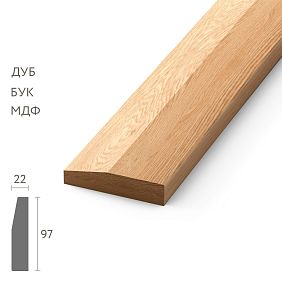
- Smooth rectangular profile
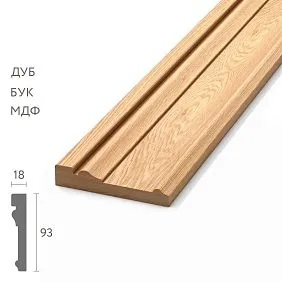
- Profile with ogee
- Profile with quarter round
- Shaped composite profile
- Carved casing with pattern
- Casing for painting
- Trim material: wood, MDF or polyurethane
- Solid wood
- MDF
- Polyurethane
- How to choose trim for interior style: eight style solutions
- Classic and neoclassic
- Modern classicism
- Scandinavian Style
- English study
- Country house in Russian style
- Loft and Industrial Style
- Art Deco
- Interior in Provence and shabby chic style
- How to combine trim with baseboard, door and cornice: a system of wooden decor
- Trim and baseboard: joining in the lower corner
- Trim and door leaf: tinting
- Trim and ceiling cornice: profile coordination
- Trim and wall moldings
- Mistakes when choosing wooden trim: ten pitfalls easily avoided
- Mistake 1. Too narrow trim for a massive door
- Mistake 2. Not considering ceiling height
- Mistake 3. Buying trim without connection to the baseboard
- Mistake 4. Mixing different wood shades
- Mistake 5. Choosing a carved profile for a minimalist door
- Mistake 6. Forgetting about wall thickness and extensions
- Mistake 7. Not calculating linear meters
- Mistake 8. Not accounting for corner joints
- Mistake 9. Buying trim without trying it on the frame
- Mistake 10. Not planning the finish coating
- Carved trim: a tradition that is relevant again
- Ornament options
- Trim for an opening without a door: a special case
- How to calculate and order a wooden trim: a step-by-step algorithm
- FAQ: answers to popular questions about wooden trim
- STAVROS: wooden trim as the finishing point of the interior
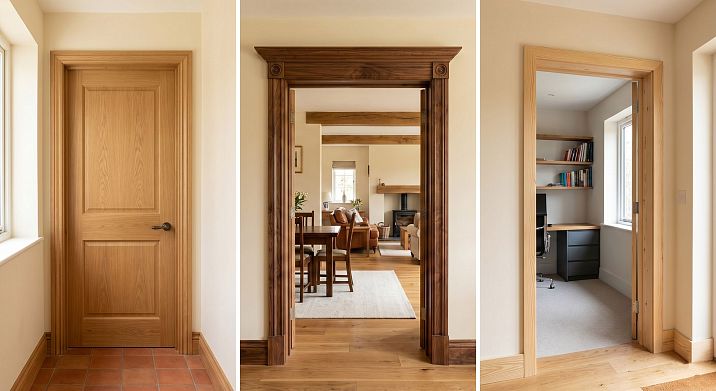
There are details that go unnoticed when they are present. And are immediately seen when they are absent. A wooden door trim is exactly such a detail. It does not shout about itself, does not claim to be the main element of the interior. But it is what covers the installation joint between the frame and the wall, sets the final rhythm of the opening, and visually connects the door with the baseboard, cornice, furniture — with everything that makes up the interior.
When the trim is chosen correctly, the door is 'integrated' into the wall. When it is not, the opening looks like an unfinished detail that was 'forgotten to be styled'. Two millimeters of profile, a correctly chosen pattern, coordinated tinting — and the entire room gains completeness.
A wooden trim is not just a linear element. It is the frame for the door, just like a frame for a painting. And its selection should be approached with the same seriousness.


What is a wooden trim and why is it needed: function and meaning
To be honest, the trim has two functions — technical and aesthetic. And both are equally important.




Technical function
When installing a door frame, an installation gap always remains between it and the wall. It is filled with mounting foam, but visually it is an unsightly seam: foam, plaster, the raw end of the wall. The casing covers this joint. Without it, the opening looks construction-like, rough, unfinished — even if a beautiful expensive door stands behind it.
The width of the casing must cover the gap between the frame and the wall finish with a margin of at least 10–15 mm on each side. The standard gap is 10–20 mm, so the minimum working width of the casing is 30–40 mm. The actual decorative width is 50–120 mm depending on the style.
Our factory also produces:



Aesthetic Function
wooden casing — this is the frame of the doorway. It determines how the door is perceived in the space: as an opening in the wall or as an architectural element. A narrow smooth casing — strictness and minimalism. A wide figured one — classicism and solidity. A carved casing with ornament — individuality and historical character.
The casing also creates a visual transition: from the door to the wall, from dark to light, from the vertical of the opening to the horizontal of the baseboard.
Get Consultation
Casing as an element of the design system
In a well-designed interior, the casing is part of the system. The profile of the casing is coordinated with the profile skirting boards, cornice и molding on the walls. The tint matches the color of the door leaf or interior furniture. All wooden elements "speak" the same language — and the interior reads as a single statement.
Where wooden casings are used: eight scenarios
A wooden door casing is a universal element used in a variety of spaces.
Interior doors
Main application. The casing is installed on both sides of the doorway: from the room side and from the corridor side. For interior doors, it is most often a symmetrical casing on both sides, with the same profile and tint.
Entrances to rooms: openings without a door
An arched or rectangular opening without a door leaf is a popular solution in modern apartments. Such an opening is framed with a casing in the same way as a door: the casing covers the end of the wall and creates a visual "frame" for the entrance.
Portals
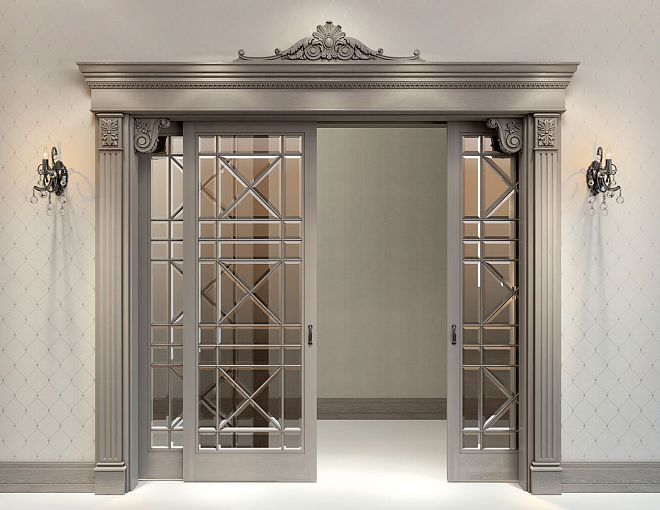
A door portal is a reinforced decorative framing of a doorway: a wide casing + a horizontal element above the opening (a sandrik or cornice) + sometimes pilasters on the sides. The portal is used for main entrances to the living room, study, dining room — where the door should be read as an architectural accent.
For a portal, a wide casing is needed — from 80 to 150 mm. In the classic version — with a figured profile or with carved decoration.
Arched openings
An arch is a separate case. Here, the side parts of the casing are straight, the upper part is bent along the radius of the arch. A wooden casing for an arch is either cut from straight elements to the shape of the arch (for small radii) or made to order as a bent one. Important: the profile of the upper part of the arch must match the profile of the side parts.
Classic interiors and neoclassicism
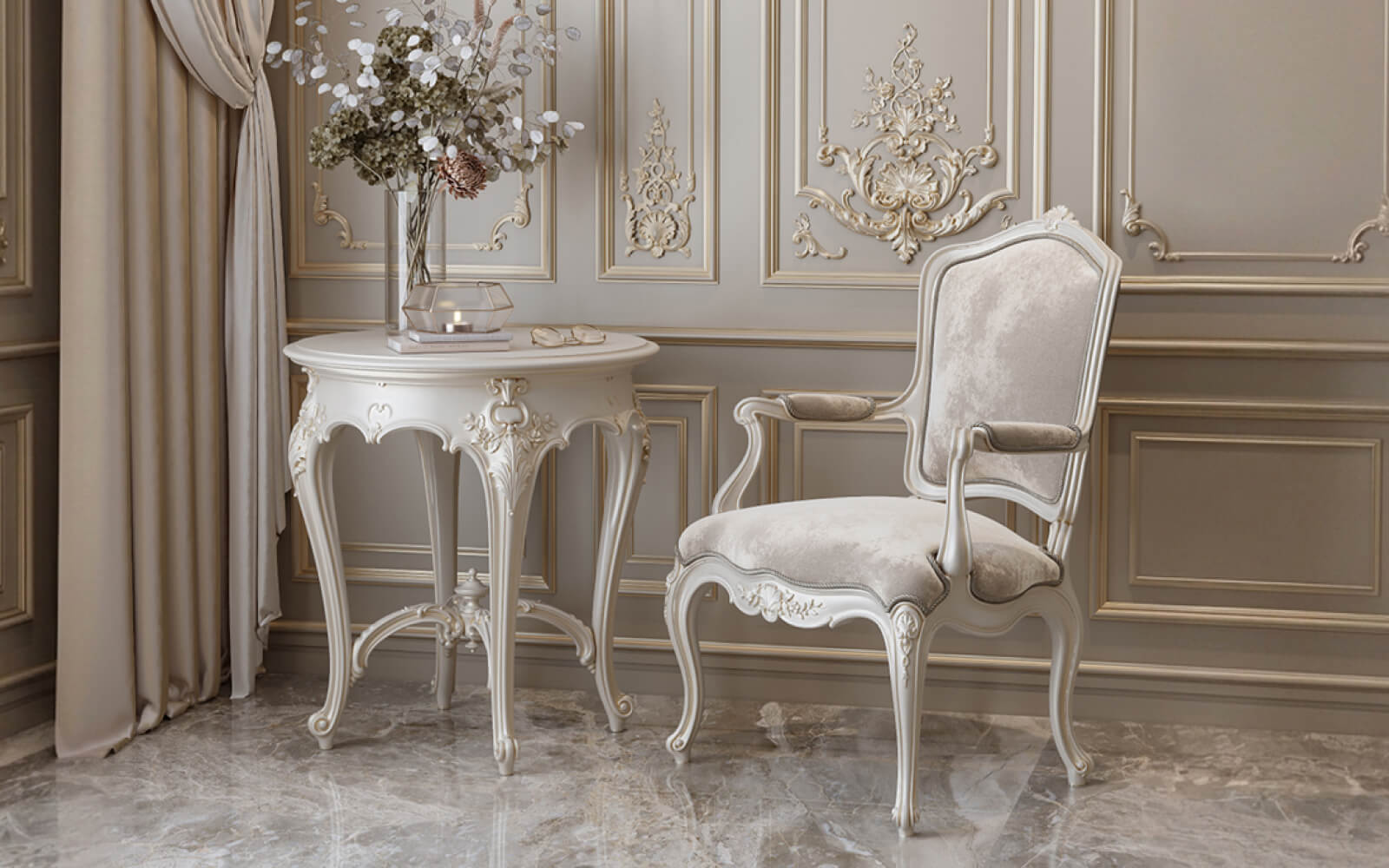
The casing in a classic interior is a separate "theme" with its own profile, width, and proportions. Ogee, quarter round, straight chamfer with fillet — classic profiles for classic casings. Tint: walnut, oak, dark oak, white enamel with patina.
Country houses and cottages
For a country house with wooden floors, timber walls, and wooden doors, a solid wood casing is an organic and essential element. House Carving as additional decor above the casing — a tradition of Russian wooden architecture, transferred to the modern interior of a country house.
Office and library
In the office, the door casing is part of the space's "dress code." Dark wood, figured profile, possibly with with carved ornament corner elements. These are details that create the image of a serious workspace.
Hall and Entrance
In the hall, the casing is the first wooden element a guest sees. The width and profile of the casing in the hall set the tone for the entire interior: narrow and strict — modern style, wide and figured — classic.
How the casing differs from molding and decorative overlay
This is an important question that is often asked — and the confusion here is quite understandable.
A casing is a linear element installed around the perimeter of a doorway. Its task is to cover the joint and frame the opening. It is mounted tightly to the frame and the wall, forming a U-shaped contour around the door.
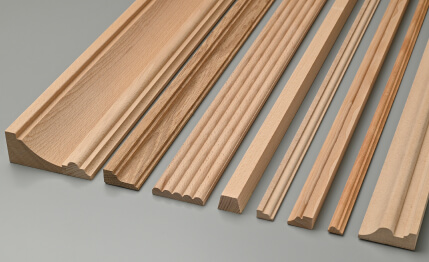
Molding is a general-purpose profile strip. Wooden moldings can function as a casing if used to frame an opening — but by themselves, they are not casings. Molding is also used for wall frames, cornices, and furniture decor.
An overlay is a decorative element of fixed shape that is attached on top of a finished surface: on the door leaf, above the opening, on the corner of the casing. Decorative Inserts complement the casing but do not replace it.
| Element | Where is it installed | Function |
|---|---|---|
| Casing | Around the perimeter of the doorway | Covers the joint, frames the opening |
| Molding | Walls, furniture, opening | Universal profile |
| Overlay | On top of the finished surface | Point decor |
| Molding | Around the perimeter of the floor, ceiling, opening | Linear decor and finishing |
How to choose the width of the trim: scale matters
Width is the first parameter to determine. And it's not a matter of taste, but a matter of proportions.
Narrow casing: 30–50 mm
For standard interior doors in apartments with ceilings 2.5–2.7 m. For modern, minimalist, and Scandinavian styles. Strict, unobtrusive — does its job and fades into the background.
Important: a narrow casing requires precise installation. Any deviations of the frame from the wall will be visible — the narrow profile does not provide a "margin" to cover errors.
Medium casing: 55–80 mm
The most versatile range. Suitable for most standard interiors: classic, modern classic, neutral style. Works with ceilings 2.6–3.0 m.
Wide casing: 80–130 mm
For high ceilings (from 3 m), portals, grand entrances, classic interiors with elaborate decor. A wide casing creates a powerful, expressive frame — the door is perceived as an architectural element.
Proportion rule
Casing width / opening height = 1/25 – 1/35.
Example: opening height 2,100 mm. 2100 / 30 = 70 mm. Recommended casing width range: 60–85 mm.
For the portal: the proportion shifts to 1/20 – 1/25.
Smooth, shaped or carved: the profile of the trim and the character of the interior
The profile of the trim is its "face". It determines how expressive the door frame is and what style it belongs to.
Smooth rectangular profile
Trim without relief, only with chamfered corners. Minimalistic, modern, technological. Suitable for loft, minimalism, modern classic without stucco. Goes well with smooth doors and laconic furniture.
Profile with "cyma"
Cyma (cyma) is an S-shaped curve on the cross-section of the profile. A classic element of European architecture. Trim with cyma is for classic, neoclassic, interiors with stucco decor. The wider and more expressive the cyma, the more "ceremonial" the character of the trim.
Profile with quarter-round
Quarter-round (ovolo) is a convex quarter-circle. A softer and more traditional profile than cyma. Often used in combination with straight chamfers and fillets. For classic, country house, study.
Shaped composite profile
Several profile elements — shaft, ogee, shelf, fillet — are combined in one architrave. This is the most "rich" option: an architrave with a developed profile reads as an architectural element. Used for portals, main entrances, classic interiors.
Carved architrave with pattern
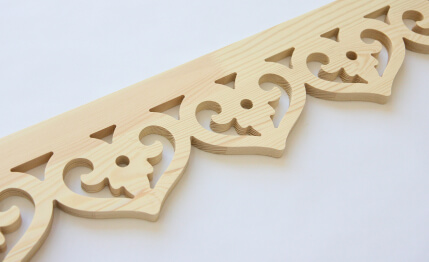
Wooden door casing with a pattern — a separate category. Here, ornamental carving is added to the profile shape: floral pattern, geometric ornament, classic motifs (acanthus, meander, braid). This is the most expressive option — for interiors where the architrave should become an accent.
A carved architrave is made on a CNC machine or by hand. For a country house in Russian style — House Carving made of wood creates a character that cannot be imitated by any other material.
Architrave for painting
If the architrave will be completely painted in one color — both MDF and solid wood are suitable for painting. For a white classic interior: an architrave for white enamel with a clear profile and smooth surface. Pine or beech solid wood accepts enamel well after priming and sanding.
Architrave material: wood, MDF or polyurethane
Choosing a material is a choice between naturalness, convenience and price.
Solid wood
The best option for a durable, natural, warm-to-the-touch framing. solid wood millwork — this is genuine wood with a living texture that can be tinted in any shade, coated with varnish, oil, or enamel.
Wood species for architraves:
-
Pine — affordable, easy to work with, good for light tinting or white enamel
-
Beech — dense, even, accepts any coating well, uniform texture
-
Oak — expressive texture, prestigious material, hard, durable
-
Ash — straight grain, similar to oak, slightly lighter
Solid wood — the only material that can be restored: sanded, repainted, retinted after 10–15 years without replacement.
MDF
MDF — the best choice for architraves exclusively for painting. Smooth surface, no pores, no knots or texture irregularities. Ideal for white or colored enamel. But: not suitable for tinting (no texture), less impact-resistant at the ends, sensitive to moisture.
Polyurethane
For architraves — less preferable than for facade elements. Soft, dents upon impact with the door frame. On doors — high probability of mechanical impacts: handle, hinge, accidental bumps. Polyurethane architrave only makes sense for interiors with minimal load (study, bedroom). For hallway and foyer — undesirable.
| Material | Tinting | Painting | Strength | Durability | Price |
|---|---|---|---|---|---|
| Solid wood | Excellent | Excellent | High | 20+ years | Higher |
| MDF | No texture | Excellent | Medium | 10–15 years | Medium |
| Polyurethane | No texture | Good | Low | 5–10 years | Below |
How to choose an architrave to match interior style: eight style solutions
The rule is simple: the trim should belong to the same style code as the entire interior. It should not "quote" another style.
Classicism and neoclassicism
Wide trim (70–120 mm) with a "goose neck" profile or a composite figured profile. Toning: dark walnut, "antique" oak, white enamel with light patina. Corner blocks (rosettes or square inserts) at the top corners of the trim. Coordinated with crown molding и baseboard from the same series.
Modern classic
Medium trim (55–75 mm) with a "quarter round" profile or a straight profile with a chamfer. Finish: white or cream matte enamel. Clear geometry without ornamentation. Corner blocks — simple square.
Scandinavian style
Narrow trim (35–50 mm) with a minimalist profile. Natural light wood (pine, beech) without coating or with oil impregnation. No corner blocks, no carved ornaments.
English study
Trim 70–100 mm made of dark oak or walnut with a composite profile. Toning: mocha, tobacco, dark walnut. Coordinated with the lower panel zone of the walls and wooden molding.
Country house in Russian style
Trim with carved pattern — traditional ornament, solar symbols, plant design. Wide trim (80–130 mm) made of pine or linden in light toning or under protective oil. This is not an imitation — it is a living tradition of wooden house carving.
Loft and industrial style
Trim of minimum width (25–40 mm) or its complete absence (opening with an open wall end). If trim — then dark toning under "aged wood" or black enamel.
Art Deco
Medium width trim (60–80 mm) with a geometric profile. Stepped shape, clear horizontals and verticals. Toning: dark or contrasting relative to the wall.
Interior in Provence and shabby chic style
Casing 60–80 mm with a soft profile, white or cream enamel with artificial aging. Profile "goose neck" or rounded roll — nothing sharp or geometric.
How to combine casing with baseboard, door, and cornice: a system of wooden decor
This is perhaps the most important section of the article — because this is where most people make the main mistake.
Casing and baseboard: joining at the bottom corner
The bottom corner of the casing meets the baseboard. There are two ways to join:
Method 1: Through a corner block (plinth). A small square or rectangular block is installed at the bottom corner of the casing. Its height equals the height of the baseboard, width equals the width of the casing. The baseboard butts into this block from the end — and no miter cutting is needed. This is the cleanest and most professional solution.
Method 2: Without corner blocks. The casing goes behind the baseboard, and the baseboard is cut to match the casing profile. This is more complex, requires precise work, but creates a more "refined" connection.
Wooden baseboard from the same array and same tint as the casing — a mandatory condition. Baseboard in white enamel + casing in dark oak = stylistic contradiction (only acceptable with a deliberate designer contrast).
Casing and door leaf: tinting
Classic approach: the trim matches the door leaf. Dark oak door → dark oak trim. White door → white trim.
Alternative approach: the trim matches the wall (if the wall is painted), the door leaf is in a contrasting color. Then the trim "dissolves" into the wall, and the door stands out as an accent element.
Third option: natural wood trim as a contrast to white walls and a white door. Works in Scandinavian style and modern classic.
Trim and ceiling cornice: profile coordination
wooden cornice The ceiling cornice and door trim should belong to the same profile family. They can be of different widths, but the character of the profile should be similar.
If the cornice has a classic "gooseneck" profile, the trim should also have a gooseneck (or a gooseneck as part of a complex profile). If the cornice is strict and straight, the trim should be similar.
Trim and wall moldings
Frame moldings on the walls visually form a "continuation" of the trim. The width of the wall molding and profile are coordinated with the trim profile. Sometimes the trim and wall moldings are literally the same profile used in different places.
Mistakes when choosing a wooden architrave: ten pitfalls easily avoided
Mistake 1. Architrave too narrow for a massive door
A massive door 2 100 × 900 mm made of dark oak with wide milled chamfers — and an architrave of 30 mm. Result: the framing looks "weak", the door dominates, the architrave does not hold it. Rule: the more massive the door — the wider the architrave.
Mistake 2. Ceiling height is not taken into account
In a room with a ceiling of 2.4 m — a wide architrave of 120 mm visually "presses" on the opening. In a room with a ceiling of 3.5 m — a narrow architrave of 40 mm gets lost. The proportion "architrave width / opening height" is violated.
Mistake 3. Buying an architrave without connection to the baseboard
The most common mistake. First, they buy a baseboard, then — a different architrave. As a result, different profiles, different tints, different heights. The bottom corner does not join without an unsightly gap. Solution: buy the baseboard and architrave from the same catalog, the same series.
Mistake 4. Mixing different wood shades
Architrave "dark walnut", baseboard "wenge", doors "natural oak". Three different shades — this is not "warmth of wood", this is "chaos of wood". All wooden elements — in the same tint or in a deliberately contrasting pair (dark + light).
Mistake 5. Choosing a carved profile for a minimalist door
A carved architrave with ornamentation next to a smooth modern door without decor is a stylistic conflict. Architrave with pattern requires a matching door and interior.
Mistake 6. Forgetting about wall thickness and extensions
If the wall is thicker than standard (more than 74–100 mm depending on the frame), extensions are needed: wooden planks covering the wall end between the frame and the architrave. Without extensions, the architrave simply won't reach the wall.
Mistake 7. Not calculating linear meters
"I'll buy as much as needed" — and they buy without a reserve. Calculation: perimeter of one opening = 2 × opening height + opening width. Multiply by the number of doors. Multiply by 2 (architrave on both sides). Add 15% for trimming and joints.
Example: 5 doors. Opening 2,100 × 900 mm. One perimeter: 2 × 2100 + 900 = 5,100 mm = 5.1 linear meters. On both sides: 5.1 × 2 = 10.2 linear meters. Five doors: 10.2 × 5 = 51 linear meters. Reserve 15%: 51 × 1.15 = 59 linear meters.
Mistake 8. Not accounting for corner joints
At the top corners of the architrave, two planks join at a 45° angle. If the cut angle is inaccurate, a gap is visible. For classic interiors, corner blocks are installed at the top corners — then cutting at 45° is not needed, and the joint is covered by the block.
Error 9. Buying a casing without trying it on the frame
Before purchasing — make sure the groove of the casing (back side) allows it to fit snugly against the frame. If the frame has a non-standard profile, the casing may not fit tightly. Measure the width of the frame's "contact surface."
Error 10. Not planning the finish coating
A solid wood casing without coating is a temporary solution. Unfinished wood darkens, collects dust, and absorbs dirt. A finish coating: varnish, oil, enamel, or tinting oil — is necessary. This should be decided before installation, not after.
Carved casing: a tradition that is relevant again
A separate topic — Wooden door casing with a patternIn recent years, carved casings have experienced a renaissance. And it's not just about country houses.
An ornamental carved casing appears in city apartments: in a classic interior with wooden parquet, in a study with dark furniture, in a living room with wall moldings. House Carving — this is the detail that makes the interior unique, not "from a catalog."
Ornament options
-
Geometric — diamonds, squares, zigzags. Strict, rhythmic, suitable for a modern classic interior
-
Botanical — leaves, stems, buds. Soft, natural, for classic and country style
-
Traditional Russian — solar symbols, braids, "blades". For houses in Russian style, for ethnic interiors
-
Classic European — acanthus, volutes, meander. For strict classic and neoclassical
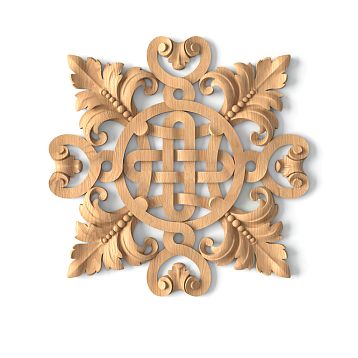
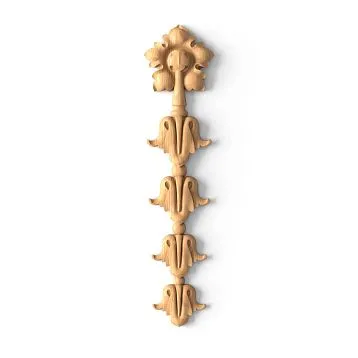
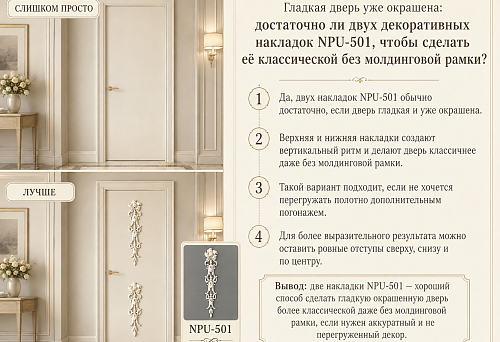
A carved casing is ordered for a specific opening size and profile — it is not always a standard linear element. Carved wooden decoration as an addition to a smooth casing — corner inserts, a top element above the casing — a more affordable option.
Casing for an opening without a door: a special case
An opening without a door leaf — a wide entrance from the hallway to the living room, between the kitchen and dining room, in an arched corridor — requires a casing just like a door does.
Here the casing works differently: it is not pressed against the frame (there is no frame), but is attached to the end of the wall at a set offset. It is important to correctly determine the width of the casing: it should cover the end of the wall and create a "frame" of the opening with a visible offset of 15–30 mm from the edge of the end.
For wide openings (from 1,200 mm) — the casing should be wider than standard: 80–130 mm. For arched openings — see the section on arches.
How to calculate and order a wooden casing: step-by-step algorithm
Step 1. Measure each opening. Height and width of the door opening (not the leaf, but the opening) — record for each door separately.
Step 2. Determine the type of joint — with corner blocks or without. If with blocks — count their number (2 blocks per opening × number of sides).
Step 3. Calculate the linear footage. For each opening: 2 × height + width = perimeter. Multiply by the number of sides (usually 2). Add 15%.
Step 4. Choose the width and profile. Focus on ceiling height, interior style, and door type.
Step 5. Choose the material and tint. Coordinate with the baseboard, cornice, and door leaf.
Step 6. Check compatibility with the frame: the width of the trim's contact plane with the frame.
Step 7. Order with a reserve. It's better to have leftovers than to buy from the next batch (the shade may not match).
FAQ: answers to popular questions about wooden trim
How to choose a wooden door casing?
Base your choice on three parameters: ceiling height (determines width), interior style (determines profile), furniture and baseboard tint (determines color). Wooden trim in the same tint as the baseboard — a basic rule.
How is a platband different from a molding?
A platband is a trim for a door opening: it covers the joint between the frame and the wall. Wooden moldings — a profile for wall frames, cornices, furniture decor. Sometimes the same profile can be used both as a molding and as a platband.
Which platband is best for an interior door?
For a standard apartment with a ceiling of 2.6–2.8 m — width 55–75 mm, a 'quarter-round' or straight profile with a chamfer. Made of solid wood tinted to match the door color. With corner blocks for a neat joint with the baseboard.
Is a carved platband suitable for an apartment?
Yes, if the interior is classic or neoclassical. Architrave with pattern It looks good in living rooms with moldings on the walls and wooden parquet. For minimalism — no.
How to choose a platband to match the baseboard?
Buy from the same series or from the same material. The width of the platband and baseboard does not have to be the same, but the profile should belong to the same family. Wooden baseboard and the casing is of the same tint.
Can a wooden casing be used for an opening without a door?
Yes. The casing is attached to the end of the wall, covers it, and creates a frame for the opening. The width of the casing is sufficient to cover the end plus a visible offset of 15–30 mm.
Which is better: smooth or shaped casing?
Smooth — for modern style, minimalism, Scandinavian interior. Shaped — for classic, neoclassical, country house. The choice is determined by the interior style, not by personal taste out of context.
Can a wooden casing be painted?
Yes. A casing made of solid wood or MDF can be painted with any interior enamel after priming. Solid wood can also be tinted, varnished, or oiled while preserving the texture.
How to calculate the amount of casing for a door?
Perimeter of the opening: 2 × height + width. Multiply by 2 (two sides). Add 15% for joints and trimming. Plus corner blocks: 4 pieces for each opening (if used).
Where to buy wooden door platbands?
In the STAVROS catalog: solid wood millwork, House Carving for carved casings with a pattern, Moldings, Baseboards и Crown Molding from solid wood. Full range — on STAVROS main page.
STAVROS: wooden architrave as the finishing point of the interior
An architrave is the final touch. Not the loudest, not the most expensive, but the one without which the interior remains unfinished. It's like a signature on a painting: a small detail that says, "everything here is thought through to the end."
A properly selected wooden architrave — coordinated with the baseboard, cornice, wall moldings, door leaf, and overall style — is a detail that brings the space together into a cohesive whole. And it is in this detail that the difference between "renovation" and "interior" lies.
STAVROS offers a full range of solid wood products for interior finishing: Wooden trim, Moldings, Baseboards, Crown Molding, house carving и Carved Decor for those who want not just an architrave — but a detail that lasts for decades.
STAVROS — because details matter.