















































































Article Contents:
- What is a wooden casing: purpose and essence of the element
- What does a set of casings consist of
- Where are wooden casings used: all application scenarios
- Interior doors in an apartment
- Entrances to the living room, study, bedroom
- Country house and wooden houses
- Portals and wide openings without a door
- Hall and entrance area
- How a wooden casing differs from molding and corner trim: clear distinctions
- Casing and molding
- Casing and corner
- Final Comparison
- How to choose the width of a wooden casing: proportions and logic
- Narrow casing (40–60 mm)
- Medium casing (60–90 mm)
- Wide casing (90–150 mm and more)
- Proportion Rule
- How to choose the profile of a wooden casing: from smooth to carved
- Smooth (flat) trim
- Shaped (profiled) casing
- Carved wooden casing
- Wide casing with corner rosettes
- Door casing for interior door: how to choose the right system
- Door casing and door leaf
- Door casing and extension
- Door casing and baseboard
- Door casing and wall
- Door casing for classic interior: how to create a palace framing system
- Connection of door casing with moldings
- Connection of door casing with baseboard
- Corner rosettes and pedestals
- Carved wooden door casing: when carving is appropriate and how to choose it
- Country house in Russian style
- Classic interior with wooden doors
- Office and representative rooms
- When carving is inappropriate
- Wooden trim material: oak, beech, pine, ash
- Oak
- Oak
- Spruce
- Ash
- Choosing the type of wood for the task
- Wooden trim coating: varnish, stain, enamel, oil
- Toning + varnish
- Enamel
- Oil/wax
- Without coating (for self-treatment)
- Trim for a country house: selection features
- Humidity and temperature fluctuations
- Wooden houses: logs and timber
- Trim on the front door from outside
- Mistakes when choosing a wooden casing: what absolutely should not be done
- How to calculate the number of wooden casings
- Where to buy a wooden casing: assortment and the right approach
- FAQ: Answers to Popular Questions
- About the manufacturer
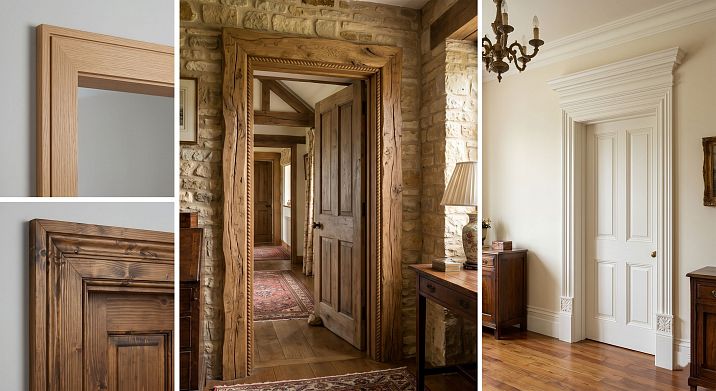
A door without a casing is like a painting without a frame. The leaf is there, the opening is there, but there is no finish. The eye catches on the gap between the frame and the wall, on the uneven edge of the plaster, on the technical gap that cannot be hidden anywhere. It is the wooden casing that covers all this — neatly, once and for all — and turns the doorway from a construction unit into an architectural element of the interior.
Wooden casing — this is a linear profile made of solid wood, which is mounted around the perimeter of a door or window opening. Its task is to close the installation gap between the door frame and the wall, to shape the transition, to create a visual frame around the door and connect it with the baseboard, moldings, and the overall style of the room. This is the final touch of door installation — but it is what determines whether the door looks "integrated" into the interior or installed hastily.
This article is a detailed guide: how to choose a wooden casing for an interior door, what to pay attention to when choosing width and profile, how to combine casings with baseboards, which material to prefer, and what mistakes to avoid. Read carefully — there is no fluff here, only precise practice.


What is a wooden casing: purpose and essence of the element
Before choosing, you need to understand what exactly you are buying and why.
Wooden door trim — this is a flat or profiled wooden profile with a length of 2.1 to 2.4 meters (for vertical posts) and from 0.8 to 1.2 meters (for the horizontal crossbar). It is installed on three sides of the doorway: two vertical elements and one horizontal at the top.
The casing performs two functions simultaneously — technical and decorative. Technical: it covers the compensation gap between the door frame and the wall opening. This gap is mandatory when installing doors — without it, the frame will not fit into the opening when the wood expands. The width of the gap is usually 10–20 mm. The casing covers it completely. Decorative: it creates a visual "framing" of the door — it becomes not just a hole in the wall, but a designed element of the interior.




What does a trim kit consist of
Full set wooden architraves for one door includes:
-
Two vertical uprights (height of the opening + allowance for trimming).
-
One horizontal crossbar (width of the opening + allowance).
-
For double-sided installation — three more elements for the second side.
A standard interior door 2 meters high requires about 5.5 linear meters of trim per side of the opening — taking into account the miter joint at the top and the connection to the baseboard at the bottom.
Our factory also produces:
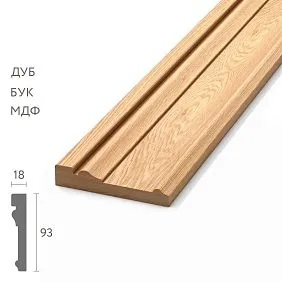

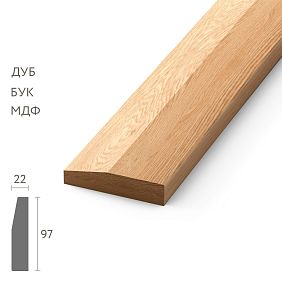


Where wooden trims are used: all application scenarios
Wooden trim are used much more widely than it seems at first glance.
Get Consultation
Interior doors in an apartment
The most widespread application. Every doorway in an apartment requires architraves — on both sides. In a standard two-bedroom apartment, this means 4–6 doors, i.e., 8–12 sets of architraves. A unified system is important here: all architraves in the apartment must be from the same profile and the same wood species — this creates a sense of a cohesive, well-thought-out interior.
Entrances to the living room, study, bedroom
In these rooms, the door is the face of the room. A wide opening into the living room requires a wide, "representative" architrave. A study with wooden furniture and dark tones — a dark oak architrave. A bedroom in a light neoclassical style — a white architrave under enamel.
Country house and wooden houses
In a country house, architraves work differently than in a city apartment. Here they are often visible both from the outside and inside, often interacting with wooden walls, timber or logs, with warm tones of natural wood. A carved wooden architrave in a wooden house is not a whim, but a stylistic necessity.
Portals and wide openings without doors
In interiors with arched or rectangular openings without a door leaf — for example, between the living room and dining room — a wooden architrave works as a portal frame. A wide figured profile, possibly with corner rosettes — this is no longer just an architrave, but a full-fledged decorative portal.
Hall and entrance area
The entrance area of a house or apartment is the first thing a guest sees. The architrave on the front door from the hallway sets the tone for the entire interior. This is where wider, more expressive profiles are appropriate — they create a "ceremonial" entrance.
How a wooden architrave differs from molding and corner trim: clear distinctions
Many people confuse architraves with other wooden profiles — molding and corner trim. Let's break down the fundamental differences.
Casing and molding
Wooden moldings — are decorative profiles that create ornamental lines on walls, ceilings, and furniture. Molding is not tied to a specific structural node: it is placed where you want to add a decorative line — horizontally along the wall, around the perimeter of the ceiling, on furniture facades.
Casing — is tied to a specific task. It always stands on a door or window opening, always covers a specific gap. Molding can be removed — the interior will change, but structurally nothing will happen. If you remove the casing, an open technical gap will remain.
Casing and corner
Wooden angle has an L-shaped cross-section and covers external or internal corners: joints of two planes, corner connections of panels, transitions between materials. This is a profile for corner nodes.
Casing — flat or profiled, without an L-shape. It works in the plane of the wall, covering the gap between the vertical plane (wall) and the door frame.
Final Comparison
| Profile | Task | Installation location | Function |
|---|---|---|---|
| Casing | Framing the opening, closing the gap | Perimeter of door/window opening | Technical + decorative |
| Molding | Decorative line | Any surface | Decorative only |
| Corner piece | Corner closure | Corner joints of planes | Technical + decorative |
How to choose the width of a wooden trim: proportions and logic
The width of the trim is one of the most important parameters. A wrong choice here cannot be corrected: you will have to remove and reinstall.
Narrow trim (40–60 mm)
A concise option for:
-
Small openings and low ceilings (up to 2.7 m).
-
Modern, minimalist, Scandinavian interior.
-
Small apartments where it's important not to 'weigh down' the walls.
-
Doors with a thin frame (85–95 mm), where a wide architrave will overhang.
A narrow architrave creates a light, unobtrusive frame. It almost 'dissolves' into the wall — which is what is needed in minimalist spaces.
Medium architrave (60–90 mm)
A universal format. Suitable for:
-
Standard apartments and houses with ceilings of 2.7–3.0 m.
-
Any style — from modern to classic.
-
Doors with a standard frame.
Medium width is the 'gold standard' of the Russian market. Most standard doors are equipped with such architraves.
Wide architrave (90–150 mm and more)
Expressive, "weighty" profile for:
-
High ceilings (from 3.0 m and above).
-
Classic interiors with baseboards 100 mm high or more.
-
Country houses with representative openings.
-
Portals and wide openings.
-
Interiors with large wooden furniture.
Wide Wooden door trim creates a "portal" effect: the door acquires solemnity, additional architectural weight. In a classic interior, this is not redundancy but a necessity — a thin trim on a tall door will look like an unfinished job.
Proportion Rule
The width of the trim should be roughly aligned with the height wooden baseboard. If the baseboard is 80 mm high — trim 70–90 mm. If the baseboard is high, 120–150 mm — trim 100–120 mm. This is the rule of "visual weight": elements of one space should be in the same scale.
A sharp mismatch — a wide baseboard and a narrow trim, or vice versa — creates a feeling of incompleteness and lack of thought.
How to choose a wooden trim profile: from smooth to carved
A profile is the cross-section of a trim. It defines its character, style, and 'voice' in the interior.
Smooth (flat) casing
A rectangular cross-section without relief. Minimalism in its purest form. No profile, no chamfers, no rounding — just a clean wooden plane.
A smooth trim is chosen for:
-
Modern interiors.
-
Scandinavian and Japanese styles.
-
Spaces where wood should 'stay silent' — be present, but not shout.
-
Situations where the trim is planned to be painted the same color as the wall and made nearly invisible.
Shaped (profiled) trim
The front surface is profiled: bevel, fillet, step, complex multi-level profile. This creates a play of light and shadow on the trim's surface — it 'lives' in the light.
Figured Wooden casing — a classic option for the vast majority of interiors. It is expressive but not flashy. Works well in classic, neoclassical, Provence style, and traditional wooden interiors.
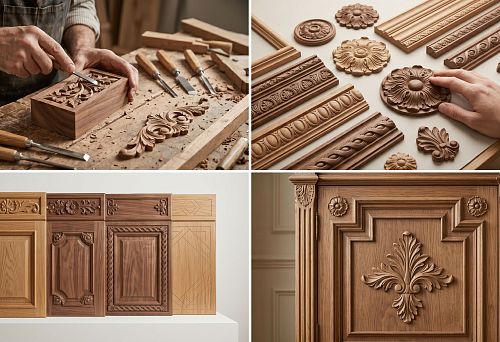
Carved wooden architrave
Carving on the architrave is no longer just a profile; it is a decorative statement. Carved wooden decoration on the architrave may include:
-
Plant ornaments (leaves, scrolls, flowers).
-
Geometric patterns (weave, stars, diamonds).
-
Thematic motifs (Russian style, historical ornaments).
A carved architrave is a choice for a country house, study, hall, or any interior with a strong decorative program. It requires coordination with other carved elements: carved wooden decor on furniture, wooden overlay elements, and the overall ornamental language of the room.
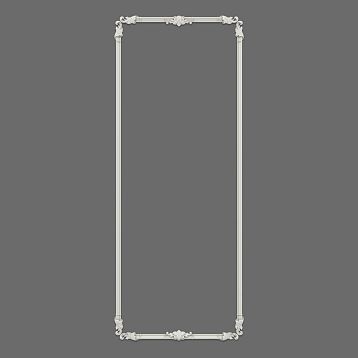
Wide architrave with corner rosettes
A special type is a wide casing paired with corner decorative rosettes (square or round overlay elements in the upper corners of the opening). This is a classic solution for portals: the casing is joined not at a miter, but into a corner rosette — this simplifies installation and adds an additional decorative accent.
in combination with wood furniture decor Corner rosettes form a system of overlay decor — casing, rosettes, furniture overlays — a single ornamental series.
Casing for an interior door: how to choose the right system
One casing is not a choice. A choice is a system: casing + door + baseboard + extension + wall. Let's break down each element of coordination.
Casing and door leaf
The casing should be made of the same material as the door frame, or matched in tone. If the door is oak with a dark stain — the casing is also oak in the same stain. If the door is white — the casing is white.
Violating this rule is one of the most common mistakes: a dark door with light casings, or vice versa. This creates a dissonance that is hard to explain in words but very easy to see.
Casing and extension
An extension is a plank that covers the end of the wall in a doorway (for thick walls). The extension, casing, and door frame must be made of the same material and have the same finish. This is a unified system.
Buying a door with a frame and extension from one manufacturer, and casings separately, means risking a tone mismatch. Ideally, all elements should be from the same batch.
Architrave and skirting board
Wooden baseboard At the base of the wall, it adjoins the lower part of the architrave. This is the 'meeting' of two profiles — and it must be neat.
There are two options for the junction:
-
Butt joint: the lower end of the architrave is cut horizontally and rests against the top edge of the skirting board. This option requires precise height matching.
-
Using a pedestal (base block): a square or rectangular overlay element at the bottom corner of the architrave, into which both the architrave and the skirting board rest. This is a classic solution that simultaneously simplifies installation and adds a decorative accent.
The height of the skirting board should be coordinated with the width of the architrave — this is the rule of 'visual weight' mentioned above.
Architrave and wall
The color of the wall determines whether the architrave will be a 'visible' accent or a delicate frame. An architrave in the color of the wall (one shade of enamel) is the most neutral option. An architrave in the color of the door (contrast with the wall) is an accent. An architrave in natural wood on a white wall is a warm, natural accent.
Architrave for a classic interior: how to create a palace framing system
A classic interior is a special case. Here, the architrave is not just a technical detail, but part of the overall architectural concept. In classics, details define everything.
Connection of the casing with moldings
In a Classic Interior Wooden moldings on walls and ceiling create an ornamental system. The casing should be part of this system: its profile repeats or responds to the profile of the moldings.
For example: a molding on the wall has a profile with a smooth rounding and bevel. The casing in the same room should carry a similar character — not identical, but coordinated. This is the rule of "response": elements of a classic interior echo each other, not contradict.
Connection of the casing with the baseboard
In classic style, the baseboard is high — 100–150 mm or more. The casing should also be wide — from 90 to 130 mm. Wooden baseboard and the casing in a classic interior form a "frame" of the entire room: at the bottom — the baseboard, along the opening — the casing, along the ceiling perimeter — a cornice or molding. All three elements should be coordinated in material and finish.
Corner rosettes and pedestals
In the classic version, pedestals (foot blocks) are installed at the lower corners of the casing, and decorative corner rosettes at the upper corners. This simplifies installation (no miter joint needed) and makes the framing more elegant.
Rosettes and pedestals made of natural wood, combined with wooden molding, create a unified system of wooden decor — not a set of parts, but an architectural ensemble.
Carved wooden architrave: when carving is appropriate and how to choose it
Carved wooden architrave is a special class. It requires serious stylistic justification.
Country house in Russian style
Traditional Russian architecture features carved wooden architraves on windows and doors. Ornaments with plant motifs, geometric patterns, symbolic images. In the interior of a wooden house in Russian style, a carved architrave is not a decoration, it is a mandatory element.
Here, a high degree of manual work is important: machine-milled carving and hand carving by a master are different levels of detail and expressiveness.
Classic interior with wooden doors
In a classic house with solid wood doors, with carved wooden decor on furniture, with wooden overlay elements — a carved architrave is organic. Especially if the carving on the architrave repeats the ornamental motifs of the carved decor on furniture or doors.
Study and representative rooms
In a study with wooden panels, dark doors, and a prestigious setting, a carved architrave adds 'weight' and seriousness. It is a signal: everything here is well-thought-out and expensive.
When carving is inappropriate
In minimalist, modern, Scandinavian interiors, a carved architrave is a mistake. It will look like a random "ethnic" element with no stylistic connection to the rest of the space. Here, a smooth or shaped profile is needed — as concise as possible.
Material of the wooden architrave: oak, beech, pine, ash
The material of the architrave determines durability, workability, texture, and price.
Oak
Oak is an elite species for wooden architraves high-end use. Hard, durable, with an expressive coarse-grained texture and a warm golden-brown hue. Oak takes stains well: the range from light honey to dark mocha is all available.
Nuance: oak contains tannins that cause yellowing when in contact with light paints. For white enamels, an insulating primer is mandatory.
An oak architrave is a choice for classic interiors, country houses, and studies. It is a long-term investment: such an architrave will last for decades without replacement.
Beech
Dense, uniform, with fine pores. Beech is the best material for architraves intended for painting: paint applies evenly, without yellowing, without pores. White, gray, pastel enamels on beech are flawless.
For carved architraves, beech is preferred over oak: the relief of the carving on beech is sharper and cleaner.
Spruce
Affordable, easy-to-work wood. Pine trim is a budget option, suitable for non-critical applications or for full painting. For open, visible facades — less preferable: soft wood, scratches and dents under mechanical stress.
Ash
Light wood with expressive grain. Ash trim is a good choice for clear lacquer or golden-toned staining. In Scandinavian interiors, light ash is a popular material.
Choosing the wood species for the task
| Task | Recommended Wood Species |
|---|---|
| Classic, representative interior | Oak |
| For white or colored painting | Beech |
| Carved trim with ornament | Beech or oak |
| Budget solution for painting | Spruce |
| Scandinavian/light style | Ash |
Wood trim coating: varnish, stain, enamel, oil
Proper coating is not just aesthetics, but also durability. The trim is daily subjected to accidental impacts, touches, cleaning. The coating must withstand this.
Tinting + varnish
Standard for trims under 'natural wood'. Stain sets the desired shade — from light honey to deep walnut. Varnish fixes and protects. Matte or semi-matte — for modern and neoclassical interpretation. Glossy — for classic with high shine.
Enamel
For trims to be painted. White, gray, anthracite, green, beige — any RAL color. Primer before painting. For oak — an insulating primer. Enamel provides a uniform opaque color — the trim visually blends with the door frame or the wall, depending on the task.
Oil/wax
For rustic and natural style. Maximum natural look: the wood breathes, the texture is as expressive as possible. The downside is that it requires renewal every 2–3 years.
Uncoated (for self-treatment)
A sanded trim without a finish coating — for those who want to coat it themselves in the desired color. Often used during renovations when all finishing work is done turnkey and the coating is applied on site.
Trim for a country house: selection features
A country house imposes more serious requirements on wooden trims than a city apartment.
Humidity and temperature fluctuations
In a country house, especially one that is periodically unheated, humidity varies over a wide range. Wood reacts: it expands and contracts. For a country house — wider trims that cover the gap with a margin, and more durable coatings: oil + wax or water-resistant varnishes.
Wooden houses: logs and timber
In log or timber houses, door openings are often framed with architraves in the same style as the walls: rough texture, natural colors. A carved architrave with an ornament, a chamfered architrave, or a simple rectangular solid wood profile — all options are appropriate if they match the wall material.
In a wooden house, the connection is especially important wooden trim in a unified style: baseboard, architrave, corner — from the same wood species, with the same finish, of the same character.
Exterior architrave for the front door
When designing the entrance of a country house, the exterior architrave must be protected from weather conditions — rain, frost, UV. Only oil with a UV filter, water-resistant facade varnish, or protective paint are suitable here. Untreated wood outside is not an option: it will darken and crack within one season.
Mistakes when choosing a wooden architrave: what you absolutely should not do
These mistakes occur regularly. Most of them are the result of haste or insufficient attention to detail during planning.
Choosing an architrave without considering the baseboard width. A mismatch between the architrave width and the baseboard height is one of the most noticeable mistakes. A wide baseboard and a narrow architrave create an impression of "broken proportions."
Buying a profile that is too narrow for a tall door. A door 2.1–2.3 m high with a ceiling of 3.0 m and an architrave width of 45 mm is like a "matchstick" around a "gate." The scale doesn't work.
Not accounting for extensions and wall thickness. If the wall is thicker than 75 mm (standard frame thickness), extensions are needed. Without them, the architrave will lie crooked — against the wall end, not flush with the wall surface. Extension + architrave = correct plane.
Mixing different wood shades from different batches. Buy all trims for one project from the same batch. Tone variation in different batches of the same article is a normal production situation. Only a single purchase can prevent this.
Painting the trim after installation. Applying coating after installation is difficult, with a risk of drips and staining the wall and floor. Optimal: treat the trim before installation, after installation only touch up the joints.
Not counting linear meters. Wooden trims are sold in linear meters. If you don't calculate the exact linear footage, you risk buying less than needed or, conversely, overpaying for excess.
Not accounting for cutting waste. Each top corner requires a 45° miter cut. Joints waste up to 5–10 cm per strip. For 8 doors (16 corners), that's 1.5–2 meters just in cutting losses. Add 15% to the calculated linear footage.
Choosing a carved trim without connection to the door style. A carved trim on a smooth white interior door in a minimalist interior is a stylistic conflict that is impossible to 'not notice'.
How to calculate the quantity of wooden trims
Accurate calculation saves money and eliminates extra trips for additional purchases.
Step 1. Determine the number of door openings. Keep in mind that each opening requires trims on both sides (from one room and from the other).
Step 2. For each opening: two vertical elements at the height of the opening + a margin of 10–15 cm each. One horizontal element at the width of the opening + a margin of 20–25 cm for cutting corners.
Step 3. Standard calculation for one-sided finishing of one opening (height 2.0 m, width 0.9 m):
-
Two verticals: 2.15 m × 2 = 4.3 m.
-
One horizontal: 1.1 m.
-
Total for one side: 5.4 m.
Step 4. Multiply by the number of sides (2 for each opening). Multiply by the number of openings. Add 15%.
Example: 5 doors, double-sided design:
-
5.4 m × 2 × 5 = 54 m.
-
With a 15% margin: 54 × 1.15 = 62.1 m → round up to 63 linear meters.
Where to buy wooden trim: assortment and the right approach
Buy wooden architrave Right means finding a supplier with a full range of wooden moldings, where you can immediately select matching baseboards, moldings, and corner pieces.
In the Stavros catalog — Wooden casings of different widths and profiles, made of oak, beech, and other solid wood species. Nearby — Wooden baseboard in matched profiles, Wooden moldings for walls and ceilings, Wooden angle for corner joints, Wooden trim wide range and Carved wooden decoration for classic interiors. All Wooden products for interior from a single source, allowing for a stylistically unified wooden finish.
FAQ: Answers to popular questions
How to choose a wooden door casing?
Determine the interior style, ceiling height, and baseboard width. Coordinate the material and finish with the door. Choose the width proportionally to the baseboard. Select the profile according to the style.
How is a wooden casing different from MDF?
A solid wood casing is more durable, better withstands mechanical stress, has a more expressive texture, and is easy to stain. MDF is cheaper but less resistant to impacts and moisture.
What width should a door casing be?
Base it on the height of the baseboard and ceiling height. For a standard apartment — 60–90 mm. For classic style and high ceilings — 90–130 mm or more.
How to combine architrave with baseboard?
Made from the same wood species, with the same finish. The width of the casing should be close to the height of the baseboard. Connection — butt joint or via a pedestal.
Is a wooden casing suitable for painting?
Yes. The best material for painting is beech. Priming is mandatory. Finish — any RAL color.
When is a carved casing needed?
In a country house in Russian or classic style, in studies and halls with wooden doors, in interiors with rich wooden decor.
Can a casing be used for a wide opening?
Yes. For wide openings, choose wider casings with corner rosettes — this is a "portal" framing.
How to calculate the number of casings?
The perimeter of the opening on one side ≈ 5.4 linear meters. Multiply by 2 (sides) × number of doors. Add 15% reserve.
What to choose: smooth or shaped platband?
Smooth — for minimalist and modern interiors. Shaped — for classic and any interiors with pronounced wooden decor.
Where to buy wooden door platbands?
In the STAVROS catalog: Wooden casings made of solid wood with delivery throughout Russia.
About the manufacturer
STAVROS — Russian manufacturer of wooden products for finishing, furniture, and interiors. The assortment includes — Wooden casings different profiles, Wooden baseboard, Wooden moldings, Wooden angle, Wooden trim и Carved wooden decoration — a complete system of wooden finishing for any interior. If you want to buy a wooden platband with a guarantee of solid wood quality and correct profile — STAVROS offers an assortment with delivery throughout Russia.