Article Contents:
- Why N-498 and NPU-498 can be directly compared
- What the wooden N-498 made of oak or beech offers
- What the polyurethane NPU-498 offers
- Oak, beech or polyurethane: three different routes
- How to choose the facade material
- How to choose an overlay for enamel
- How to choose an overlay for tinting, oil or varnish
- How the size 41 × 307 × 11 mm affects the facade
- Single overlay or symmetrical pair
- How to position the overlay relative to the handle
- Application on a cabinet
- Application on a chest of drawers, nightstand, and sideboard
- Application on an interior door
- Application on a wall panel
- How to combine the overlay with wooden moldings
- How to prepare the facade
- How to choose glue without risk
- Paint before or after installation
- Can a vertical overlay be trimmed
- If N-498 does not fit in width
- How to calculate the position on the facade
- Practical choice for different tasks
- What to Buy Together
- How not to confuse N-498 and NPU-498
- Mistakes in selection and installation
- Who N-498 is suitable for
- Who NPU-498 is suitable for
- How to buy N-498 or NPU-498 on STAVROS
- Comparison of selection scenarios
- Similar vertical overlays by size
- Table of 'what to buy together'
- How to design a series of identical facades
- How to accept completed installation
- Why a finished overlay is better than a random blank
- Checklist before ordering
- N-498 and NPU-498 on kitchen facades
- Decor for bedroom and dressing room
- Decorative overlay in the hallway
- Overlays in the study and library
- Commercial interior: hotel, restaurant, salon
- Restoration of an old wardrobe
- Custom-made furniture
- How to coordinate the oak shade
- How to preserve the relief under the enamel
- How to organize serial marking
- How to store overlays before installation
- Care for finished decor
- How to accept finished furniture
- Why a ready-made ornament is more profitable than manual cutting
- Final check before cart
- Control layout before final order
- Kit check before handover to installer
- FAQ: questions about N-498 and NPU-498
- Are N-498 and NPU-498 really the same size?
- What is the main difference between N-498 and NPU-498?
- What to choose for an oak facade?
- What to choose for a white MDF facade?
- Can NPU-498 be installed on wooden furniture?
- Can N-498 be installed on MDF?
- Which overlay is lighter?
- Do you need one overlay or two?
- How to position the overlay relative to the handle?
- Can N-498 or NPU-498 be trimmed?
- Which overlay to choose for a clear tint?
- How to paint NPU-498?
- Can N-498 be combined with moldings?
- Is the overlay suitable for a door?
- Which model to choose for a wall panel?
- What to do if 41 mm is too wide?
- What should I check before ordering?
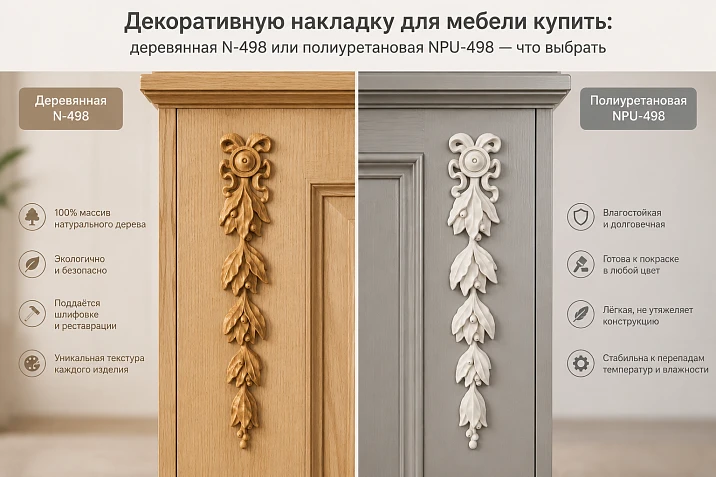
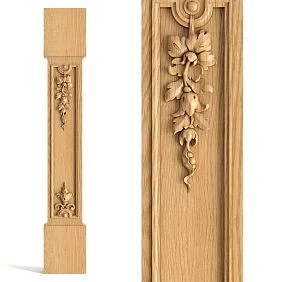
It is easiest to buy a decorative furniture overlay when the buyer chooses between different patterns: one ornament is liked more, another less. With N-498 and NPU-498, the situation is more interesting. We have the same vertical laurel garland measuring 41 × 307 × 11 mm, but made from two fundamentally different materials. The wooden N-498 is made from solid oak or beech, while NPU-498 replicates the same shape in polyurethane. Therefore, the comparison is not about the leaf composition or dimensions, but about the logic of future finishing, the facade material, the weight scenario, the installation method, and whether the surface should retain the natural wood texture.
It is the identical size that makes this pair especially useful for an informed choice. The buyer can draw a 41 × 307 mm rectangle on the facade in advance, check the handle position, the distance to the molding, and the door height, and then decide which version best suits the project. N-498 is needed where real solid wood, oak texture, beech base for enamel, and connection with other wooden parts are important. NPU-498 is convenient for painting in the color of the facade, MDF furniture, wall panels, and projects requiring a uniform surface and low weight of the decorative part.
A random purchase is especially risky here. The identical ornament creates an impression of full interchangeability, but the material affects the preparation of the base, finishing, and installation. A wooden overlay cannot be considered as a polyurethane one just because the dimensions match. A polyurethane one cannot be passed off as solid wood and expected to have a natural grain pattern. Before ordering, you need to decide whether the decor will be tinted, coated with oil or varnish, painted with opaque enamel, installed on a wooden facade, MDF, door, or wall panel.
Below we will analyze N-498 and NPU-498 as two commercial routes of the same shape. The article will help you understand what to choose for white enamel, what for transparent tinting, when one vertical overlay is needed, and when a symmetrical pair, how to place the laurel garland relative to the handle, how to glue the decor without unconfirmed promises, and what similar sizes to look at if the width of 41 mm or height of 307 mm is not suitable.
Short answer. Choose N-498 from oak or beech if you need real wooden decor, natural texture, tinting, oil, varnish, or opaque enamel on a wooden base. Choose NPU-498 from polyurethane if low weight, uniform surface, painting in the color of the facade, and installation on MDF furniture or a wall panel are important.
The size and pattern of the models are the same — 41 × 307 × 11 mm. Therefore, the choice is determined by the material, finish, base, and future role of the decor. For oak furniture with visible texture, N-498 is more logical. For a white MDF facade and even solid color painting, NPU-498 is often more convenient, although beech N-498 is also suitable for enamel.
Buy wooden decorative overlay N-498 Buy polyurethane overlay NPU-498 View overlays from oak and beech View polyurethane decor for furniture
Why N-498 and NPU-498 can be directly compared
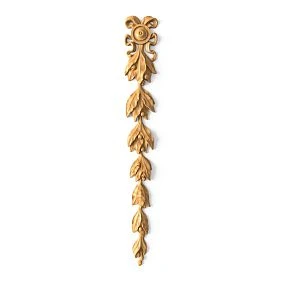
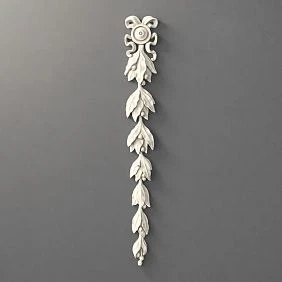
Usually, comparing wood and polyurethane is complicated by different sizes, relief depth, and pattern. Here, these variables are almost eliminated: both models measure 41 × 307 × 11 mm and feature the same vertical plant motif. The buyer can evaluate the material without adjusting for a different shape. This is a rare and convenient case where the decision truly comes down to the question of "solid wood or polyurethane."
| Characteristic | N-498 | NPU-498 |
|---|---|---|
| Product type | Carved decorative overlay | Decorative molding overlay |
| Size | 41 × 307 × 11 mm | 41 × 307 × 11 mm |
| Material | Solid oak or beech | Polyurethane |
| Shape | Vertical laurel garland | The same vertical plant ornament |
| Application | Furniture fronts, doors, interior decor | Furniture, doors, wall panels |
| Key feature | Natural solid wood and finish selection | Light weight and uniform surface |
| For transparent finish | Oak preserves the texture | No natural wood texture |
| For opaque enamel | Beech is suitable for enamel | Suitable for painting |
| For a wooden facade | A particularly logical choice | Possible after base inspection and installation |
| For an MDF facade | Possible with proper installation | Direct scenario for painting in the facade color |
| What to clarify | Wood species, finish, base and glue | Priming, paint, base and glue |
The table shows that NPU-498 is not a "simplified copy" of a wooden part, and N-498 is automatically the more correct choice for any expensive furniture. Both versions solve the same decorative task but are revealed in different projects. Oak N-498 is stronger where the material should be visible. NPU-498 is more rational when the decor is fully painted and should become part of a uniform facade.




What the wooden N-498 made of oak or beech provides
The wooden N-498 maintains a material connection with the facade, door, and other solid wood parts. If the furniture is made of oak, the oak overlay allows you to continue the texture and select the tint in the overall system. The ornament does not look glued on top of a foreign material but is perceived as part of the wooden object.
Beech creates a different path. It is chosen for opaque enamel and custom color finishes. The buyer receives a carved element made of real wood but is not obliged to show the natural grain. This option is suitable for a classic wardrobe, chest of drawers, sideboard, or door where other wooden parts are also painted.
Solid wood is especially valuable in projects where the surface is viewed up close. Light passes through the carved leaves, and the material's structure remains part of the impression. Even under a transparent or semi-transparent finish, the oak N-498 retains its natural character, which cannot be replicated with monochrome polyurethane.
For such a scenario, you can buy wooden overlay N-498 after checking the wood species and future coating. If the size fits, the further choice comes down to oak for preserving the texture or beech for enamel.
Wood requires careful preparation. The color of the overlay and the facade must be matched on samples, and installation must be done after checking the evenness and compatibility of materials. Matching wood species does not guarantee an automatic match of shade: natural wood has its own grain.
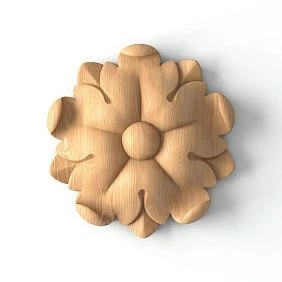
Our factory also produces:
What polyurethane NPU-498 provides
NPU-498 repeats the same pattern and size but translates it into polyurethane. The main advantage is low weight and a uniform surface. The decor is convenient to include in a project where the entire door, wall panel, or furniture front is painted in one color.
Polyurethane is especially logical on MDF. The front and overlay can receive a uniform opaque finish, and the buyer does not have to coordinate the wood texture. After proper preparation, the ornament becomes part of the overall relief surface.
On a wall panel, the low weight simplifies the logic of the decorative composition itself but does not eliminate the choice of suitable adhesive and base preparation. Compatibility of any mounting compound cannot be guaranteed: the panel material, wall covering, and manufacturer's instructions must match.
If the task is a smooth, solid-color paint, you can Buy polyurethane overlay NPU-498 and test the primer, paint, and mounting system for a specific facade.
The polyurethane version does not replace oak where natural texture is required. Even an exact shape reproduction does not create wood grain. Therefore, NPU-498 is chosen deliberately: for painting, uniformity, and low weight, not as an imitation of solid wood.
Get Consultation
Oak, beech, or polyurethane: three different routes
In fact, the buyer chooses not two but three scenarios. The first is oak N-498 with preserved wood grain pattern. The second is beech N-498 for opaque enamel. The third is NPU-498 made of polyurethane for painting in the facade color.
Oak is suitable for furniture where oil, varnish, transparent protection, or tinting are important. It connects the overlay with oak moldings, frames, handles, and other details. This option looks especially convincing on a cabinet or door made of wood.
Beech is needed for a buyer who wants a specifically carved wooden element but plans white, black, or colored enamel. Under the coating, the texture becomes less noticeable, but the base remains solid wood.
Polyurethane is chosen when uniformity and low weight are more important. It fits well with MDF facades, painted panels, and projects where the decor should completely blend with the base in color.
You cannot choose based only on price or photo. The same pattern will be perceived differently after transparent oak tinting, dense enamel on beech, and solid-color polyurethane painting.
How to choose facade material
The base material does not prohibit using a different overlay, but it sets the most natural route. On an oak facade, the wooden N-498 creates a cohesive material system. On an MDF facade, NPU-498 is easier to integrate into the overall painting.
The wooden N-498 can be installed on MDF if the mounting compound is compatible with both materials and the surface is prepared. Such a choice is justified when the customer needs a genuine carved element, despite the panel base.
NPU-498 can be used on wooden furniture if the project involves opaque painting and the installation is confirmed. But on tinted oak, a polyurethane part will not be able to continue the natural texture.
Special care is needed on a veneered facade. The glue and preparation must not damage the thin decorative layer. Before installation, it is better to perform a test on an inconspicuous sample.
For finished furniture, the facade material is sometimes unknown. In this case, do not guess. Remove a handle or examine the edge, find the technical documentation, and only then choose the overlay and installation.
How to choose an overlay for enamel
Both beech N-498 and polyurethane NPU-498 are suitable for opaque enamel. The difference remains in the base, mass, and preparation method. Beech is for those who want to preserve the wooden nature of all parts. Polyurethane is for those who value a smooth, uniform surface.
White enamel emphasizes the shadows of the laurel garland and makes the decor architectural. On dark enamel, the pattern becomes deeper; on colored enamel, it turns into a noticeable vertical accent.
Do not apply too thick a layer that will fill the thin lines of the leaves. The primer and enamel system must preserve the relief. A test coating helps to see how clearly the shape is readable.
If the facade is already painted, matching the color requires a sample. Even two white coatings can differ in temperature and gloss. It is better to paint the overlay in the same system or coordinate the result before installation.
For a monochrome project, NPU-498 is often more rational, but this does not make the beech version a mistake. The decision depends on whether the buyer values solid wood as a material.
How to choose an overlay for tinting, oil, or varnish
Transparent and semi-transparent finishes reveal the advantage of oak N-498. Tinting changes the shade but preserves the texture. Oil and varnish also allow the wood base to remain visible if the coating system suits the project.
Beech for such a task is chosen only after separate approval, since in the SEO scheme it is primarily associated with opaque enamel. The main route for visible texture is oak.
Polyurethane NPU-498 has no wood fibers, so a transparent coating will not create the same effect. It can be painted to look like wood using decorative methods, but such a finish cannot be passed off as natural oak texture.
When tinting the facade and overlay, perform tests on the same type of oak. Even the same composition manifests differently on different areas of the wood. It is better to finish the set simultaneously.
An oak overlay is especially appropriate next to a wooden molding if both elements receive the same tint. This combination creates a unified facade without material differences.
How the size 41 × 307 × 11 mm affects the facade
A width of 41 mm makes the overlay a narrow vertical detail. It does not cover most of the door but forms a noticeable central line. A height of 307 mm is large enough for the ornament to read as a garland rather than a small rosette.
A thickness of 11 mm creates a relief that must be considered near the handle and adjacent doors. The overlay should not interfere with opening, catch on another facade, or protrude into the passage.
On a narrow door, 41 mm can occupy a significant portion of the field. On a wide sash, the overlay looks more delicate. Therefore, a full-size paper template is more useful than abstract advice.
A height of 307 mm is suitable for a tall door, pilaster, central part of a chest of drawers, and an interior door. On a small drawer, the ornament may not fit or may visually overload the surface.
The identical size of both models allows you to first establish the geometry and choose the material later. This is convenient for the designer and cabinetmaker: centers, offsets, and handles remain unchanged.
One overlay or a symmetrical pair
One N-498 or NPU-498 is suitable for the central part of a single door, pilaster, cabinet end, or narrow wall panel. This installation creates a single vertical axis.
On a two-door cabinet, a pair is more often considered. The overlays are placed mirror-symmetrically or identically on both doors, maintaining equal offsets from the central gap and outer edges.
A paired composition requires doubling the quantity and checking the direction of the pattern. If the ornament does not have a mirror version, two identical overlays may look like a repeat rather than a mirror pair. This is assessed based on the actual pattern.
On a wide dresser, two overlays can divide the facade into sections and support the edge zones. One central overlay works better when the composition is built around a single handle or medallion.
The quantity is chosen before ordering. Purchasing one piece for a project that visually requires a pair leads to repeated delivery and the risk of differences between batches of finish.
How to position the overlay relative to the handle
The handle and overlay should not compete for the same spot. First determine the comfortable position of the handle, then place the decor so that it does not interfere with the grip and mounting holes.
On a tall door, the overlay can be placed above or below the handle, or aligned on the same vertical axis if there is enough space between them. The exact layout depends on the shape of the handle.
With a central handle, a laurel garland can be placed above it as a decorative finish. On a two-door cabinet, paired overlays are often placed closer to the center, with handles between them or below.
Before gluing, apply a paper template and open the door. Check not only the appearance but also the hand movement. A beautiful ornament should not impair the usability of the furniture.
If the handle is already installed, measure from its axis, not from a random edge of the facade. This helps maintain symmetry across a series of doors.
Application on a cabinet
On cabinets N-498 and NPU-498 emphasize the door height. A narrow vertical garland makes a smooth facade more classic and helps connect it with the cornice, molding, or pilaster.
For a wooden cabinet with a transparent finish, choose oak N-498. For a painted MDF cabinet, choose NPU-498 or beech N-498 for enamel.
On one door, the overlay becomes a central accent. On two doors, paired elements create symmetry. Before ordering, calculate the distance to the central gap and handles.
The height of 307 mm requires enough free space. On a paneled door, the overlay must fit inside the frame and not overlap the molding.
If N-498 is too narrow or short for the cabinet, compare similar models N-499, N-501, and N-502 by confirmed dimensions.
Application on a chest of drawers, nightstand, and sideboard
On a chest of drawers, a long vertical overlay is usually placed not on a narrow drawer, but on a side stile, door, or overall facade panel. This helps avoid overloading several horizontal lines.
On a sideboard, the laurel garland complements classic handles, cornice, and panels well. Oak N-498 suits natural wood, NPU-498 suits painted construction.
On a nightstand, the size must be checked especially carefully. The height of 307 mm may be close to the full facade height. Leave margins at the top and bottom so the ornament does not look cramped.
For restoring old furniture, a wooden overlay preserves the historical material character. A polyurethane one helps achieve the same pattern in a painted, updated facade.
Do not use the overlay to mask cracks or damage. First repair the base, then install the decor.
Application on an interior door
A vertical garland is suitable for the central part of a paneled or smooth door. It makes the leaf more decorative without completely replacing the structure.
Wooden N-498 looks especially natural on a solid wood door or veneered leaf with matching finish. NPU-498 is convenient on a painted door and MDF panel.
Before installation, check the movement of the handle, lock, and casing. The 11 mm thickness should not interfere with opening or fall into the area of constant contact.
On a double door, a pair can be used, but the offsets must account for the central rebate. A template on both leaves helps visualize the composition before gluing.
A door is often viewed from a distance, so one narrow overlay can look delicate. For a larger pattern, consider comparing N-499 or N-501.
Application on a wall panel
NPU-498 is especially convenient for a painted wall panel, as its low weight and uniform surface match stucco decor. Wooden N-498 is appropriate if the panel contains natural oak or wooden moldings.
Vertical overlays can be repeated at equal intervals, forming a row. In such a project, it is important to calculate the quantity and axes in advance, because an error in the first element will repeat across the entire wall.
One garland fits a narrow pier, pilaster, or the center of a frame. Paired elements help design a symmetrical panel around a mirror, console, or door.
Light from above or from the side emphasizes the leaves. Under a dense solid color, NPU-498 looks architectural, while oak N-498 adds natural texture.
The wall base must be strong and level. The overlay does not fix waves, peeling paint, or weak plaster.
How to combine an overlay with wooden moldings
The molding sets the frame, and the vertical garland fills the inner field. Together they create a more finished facade than a randomly installed single overlay.
For a wooden composition, you can choose a wooden molding for the overlay. Oak N-498 and an oak profile can receive the same tint, a beech overlay and molding — a common enamel.
NPU-498 can also be used with moldings if the materials and finish are coordinated. However, a wooden profile under clear varnish and a polyurethane overlay under enamel will be perceived as different layers.
The distance between the frame and the garland should leave a free field. If the decor almost touches the molding, the facade looks overloaded.
Before purchasing, assemble a full-size paper diagram: the outer contour of the frame, the overlay 41 × 307 mm, and the handle. This makes it easier to determine the actual proportions.
How to prepare the facade
The base must be clean, strong, and level. Dust, grease, weak old coating, and peeling enamel impair installation regardless of the overlay material.
On finished furniture, first test the finish in an inconspicuous spot. The cleaner, primer, or adhesive should not soften the coating.
Before installation, it is useful to let a wooden overlay acclimate to the room conditions and check its geometry. For a polyurethane overlay, inspect the back surface for cleanliness and readiness for the chosen system.
Marking is done along the central axis and horizontal reference lines. Relying only on the top or bottom of the door is risky, especially if the facade has a molding.
Before gluing, do a dry fit, open the door, and evaluate the handle. Correcting the position after fixing is significantly more difficult.
How to choose an adhesive without risk
The SEO scheme provides a link to a general category of materials, not a confirmed universal composition. This is the correct approach: wood, polyurethane, MDF, veneer, enamel, and wall paint require different compatibility.
Before installation, open the section where you can select materials for decorative installation, and check the specific product's instructions against both bases.
The adhesive must hold the long vertical element, not damage the coating, and not protrude onto the front surface. Excess is especially dangerous on oak under a transparent finish.
Do not use a random compound just because it is called mounting adhesive. Clarify the base type, absorbency, and operating conditions.
For a critical project, perform a test on a sample. It shows adhesion and helps select the amount of material without contaminating the relief.
Paint before or after installation
Both options are possible depending on the project. Painting before installation facilitates access to the leaves and side edges, but requires careful installation without scratches.
Painting after installation helps achieve a uniform color for the facade and overlay. In this case, you need to protect adjacent surfaces and thoroughly paint the joint.
Oak under a transparent finish is often best treated together with the facade or according to an approved sample. NPU-498 under a solid-color enamel can be included in the overall painting system of the panel.
Do not leave the back side in a condition that interferes with the adhesive. The sequence of primer, paint, and installation must comply with the material instructions.
For a furniture series, pre-approve the technology on one control facade, then repeat it on the others.
Can the vertical overlay be trimmed?
The size 41 × 307 × 11 mm is a complete composition. Trimming may disrupt the laurel garland and alter the decorative balance.
Without card confirmation, it cannot be guaranteed that the tree or polyurethane allows safe shortening. Even if the material is technically cut, the ornament may lose its finish.
If the height of 307 mm is not suitable, it is better to choose a different model. N-501/NPU-501 have a height of 300 mm, N-502/NPU-502 also have 300 mm, but differ in width and thickness.
If non-standard fitting is necessary, consult with a manager or craftsman before ordering. Do not experiment on the finished part after finishing.
The template helps to understand whether trimming is actually required. Sometimes it is enough to change the position of the overlay and leave more or less margin.
If N-498 does not fit in width
The series contains other vertical pairs made of wood and polyurethane. N-499/NPU-499 have dimensions 60 × 351 × 10 mm and are suitable when a wider and taller garland is needed.
N-501/NPU-501 with dimensions 58 × 300 × 11 mm offer a different vertical geometry at a similar height. They take up more width than N-498.
N-502/NPU-502 with dimensions 35 × 300 × 9 mm are narrower and thinner. This option is useful for a narrow field, pilaster, or door where 41 mm is too large.
The URL of individual analogs is not specified in the provided scheme, so commercial transition should be made through confirmed categories of wooden and polyurethane overlays.
For wooden options, open catalog of carved wooden overlays, for light paintable finishes — Polyurethane appliqués catalog.
How to calculate the position on the facade
First, measure the width and height of the free field without the handle, molding, or panel. Then mark a rectangle 41 × 307 mm in full size.
In width, the overlay is usually centered relative to the facade or the inner field of the frame. In height, the position depends on the handle and other details.
On two doors, use one common baseline rather than measuring each separately from a random edge. This reduces visual misalignment.
Check the indentation from edges and moldings. Leaves should not look cramped. Free space around the ornament helps it read well.
Take a photo of the template from a normal viewpoint. A close-up does not show the scale of the entire piece of furniture.
Practical choice for different tasks
For an oak cabinet under oil or tinting, choose N-498 from oak. For a white MDF cabinet — NPU-498 or beech N-498 under enamel.
For restoring a classic sideboard with wooden details, N-498 preserves material logic. For updating painted modern furniture, NPU-498 is easier to include in a single color.
For a wall panel with repeating decor, the light weight of NPU-498 is especially useful. For a wooden pilaster with molding, N-498 is more convincing.
For one central door, one overlay is needed. For a two-door cabinet, a pair is often considered, but orientation and symmetry are checked.
For a project with a transparent finish, oak is chosen. For opaque painting, beech and polyurethane are compared based on the desired material base.
What to buy together
The overlay is rarely used separately from the entire facade system. Materials for installation, coating, moldings, and possibly additional overlays for symmetry will be needed.
A broad request is better directed to the category where you can Buy decorative furniture overlays from oak and beech. There it is more convenient to compare other sizes and ornaments.
For a paintable light composition, you can buy polyurethane overlays and select elements of one material group.
If the facade is built as a frame, it is worth buy moldings for furniture facade and check the width of the inner field in advance.
The installation and finishing kit is selected in the section materials for preparation and finishing of furniture. Specific compatibility is confirmed according to the instructions.
How not to confuse N-498 and NPU-498
Article N-498 refers to a wooden overlay made of oak or beech. NPU-498 refers to the polyurethane version. The letters PU in the article help distinguish the material.
The same size does not mean the same finish. N-498 may retain the texture of oak, NPU-498 is designed for painting and does not have a natural wood pattern.
Do not confuse the overlay with the molding. The molding creates an extended frame line, while N-498/NPU-498 is a complete vertical ornament.
Do not replace one model with another after approving a transparent finish. Polyurethane will not become oak just because of a similar color.
Check the full card URL and material before ordering, especially if the specification uses several identical shapes from different bases.
Errors in Selection and Installation
The first mistake is choosing only by photo. On screen, materials may look the same, but after finishing, oak, beech, and polyurethane give different results.
The second is ignoring size. A height of 307 mm is not suitable for every drawer or small door.
The third is buying one overlay for a project where a pair is visually needed. Symmetry is determined before ordering.
The fourth is placing decor without considering the handle. A garland may interfere with grip or mounting holes.
The fifth is using random glue. Compatibility of wood, polyurethane, MDF, and coating must be confirmed.
The sixth is painting with too thick a layer. Fine relief loses clarity.
The seventh is trying to cut a finished ornament without consultation. The composition may lose its completion.
The eighth is installing decor on a weak coating. The overlay will peel off with the paint.
The ninth is expecting natural wood texture from NPU-498. For that, you need oak N-498.
Tenth — not checking the card and current execution before ordering.
Who N-498 is suitable for
N-498 is suitable for owners of wooden furniture, restorers, carpenters, and designers who need real oak or beech wood.
It is especially useful under transparent finishes, tinting, oil, varnish, and projects with wooden moldings.
The beech version is suitable under opaque enamel when the wooden base of all parts is important.
N-498 may be unnecessary if the MDF facade is fully painted and natural texture is not needed. In this case, NPU-498 is often more rational.
Who NPU-498 is suitable for
NPU-498 is suitable for painted MDF furniture, wall panels, doors, and series of identical facades.
It is chosen for its low weight, uniform surface, and the ability to paint the decor in the color of the base.
The polyurethane version is especially convenient when many repeating elements are required on a panel or cabinets.
NPU-498 is not suitable for a project where the customer wants to see a real oak pattern and a transparent finish.
How to buy N-498 or NPU-498 at STAVROS
First, make a template 41 × 307 mm and check the space on the facade. Determine one overlay or a pair, the handle position, and the distance to the moldings.
Then choose the material: oak for visible texture, birch for enamel, or polyurethane for uniform coloring.
For solid wood, open the card where you can Buy wooden decorative overlay N-498. For a light paintable version, open the card where you can Buy polyurethane overlay NPU-498.
After selection, check the finish, base, and installation. If the facade is already finished or veneered, it is better to discuss compatibility with a STAVROS manager in advance.
When ordering multiple items, record the article number, material, quantity, and color in the specification. This prevents mixing wood and polyurethane in the same series.
Comparison of selection scenarios
| Scenario | What to choose | Why | What to Check |
|---|---|---|---|
| Oak facade under oil | N-498 from oak | Natural texture is preserved | Match of tint and wood grain |
| White MDF facade | NPU-498 or N-498 from beech | Both versions are suitable for opaque painting | Material base, primer, glue, and gloss |
| Wall panel with repeat | More often NPU-498 | Light weight and uniform surface | Marking, quantity, base strength |
| Restoration of a wooden sideboard | More often N-498 | The array supports historical materiality | The species and finish of existing furniture |
| Painted interior door | NPU-498 or beech N-498 | One color unites the panel and decor | Gaps, handle, glue compatibility |
| Two wardrobe doors | A pair of identical overlays | Symmetry is forming |
Similar vertical overlays in size
| Wooden model | Polyurethane model | Size | When to look |
|---|---|---|---|
| N-498 | NPU-498 | 41 × 307 × 11 mm | Narrow laurel garland for facade, door or panel |
| N-499 | NPU-499 | 60 × 351 × 10 mm | Need a wider and taller composition |
| N-501 | NPU-501 | 58 × 300 × 11 mm | Need a different vertical geometry with similar height |
| N-502 | NPU-502 | 35 × 300 × 9 mm | Field is already 41 mm or need a thinner decor |
Individual analog URLs are not provided in the SEO scheme, so the article does not substitute made-up addresses. For selection, use confirmed categories: View overlays from oak and beech or choose a lightweight overlay for painting.
Table "what to buy together"
| What to add | Why | For which scenario | What to Check |
|---|---|---|---|
| Materials for decorative installation | Prepare the base and secure the overlay | Wood, polyurethane, MDF, door, panel | Compatibility of glue with both materials |
| Wooden moldings for the facade | Assemble a frame composition | Cabinet, door, sideboard, wall panel | Size of the inner field and overall finish |
| Wooden decorative inlays | Select a pair, analog, or adjacent ornament | Solid wood furniture and clear finish | Breed, size and pattern direction |
| polyurethane panels | Assemble a light paintable series | MDF, walls and solid-color facades | Preparation, color and quantity |
| Second N-498 or NPU-498 | Create a symmetrical pair | Two-door wardrobe or door | Orientation, same finish and axes |
| Test swatch | Approve color and preserve relief | Enamel, tinting, oil or varnish | Layer thickness and alignment with the facade |
How to design a series of identical facades
For a kitchen, dressing room, or built-in wardrobe, it is important not only to choose the material but also to repeat the decor position on all doors. Marking is done from a common baseline, not from each random edge.
First, assemble one control facade. Check the color, relief, handle, gaps, and installation on it. Only after approval proceed to the rest of the series.
Wooden overlays of one project are best finished simultaneously. This makes it easier to match the shade of oak or enamel on beech. Polyurethane elements are also painted with the same system to ensure gloss and color do not differ.
Each part is marked before installation. This is especially useful if N-498 and NPU-498 are used in different rooms or on different types of facades.
How to accept completed installation
After installation, inspect the overlay in daylight and artificial light. It should be aligned on the axis, have no traces of glue, and maintain a clear leaf pattern.
Open the door to its full angle and check the handle. The 11 mm relief should not touch the adjacent facade, trim, or wall.
On paired doors, compare the top and bottom marks. Even a slight shift is noticeable when the same ornament is repeated nearby.
Save the article number, material, and finish sample. This data will be useful for repairs, expanding the set, or replacing one overlay.
Why a ready-made overlay is better than a random blank
A laurel garland is difficult to carve by hand identically on multiple facades. The ready-made N-498 or NPU-498 already has a finished pattern and precise dimensions.
The buyer does not need to find a craftsman to repeat the ornament, compare different templates, or correct differences between paired parts.
The ready-made form simplifies design: the designer works with a known rectangle of 41 × 307 × 11 mm, and the cabinetmaker calculates offsets and handles in advance.
The commercial sense of such a purchase lies not only in saving operations but also in the predictability of the result. Material, finish, and installation remain under control.
Pre-order checklist
Write down the article number, material, quantity, facade size, handle position, and selected finish. For a pair, specify both doors and the common axis.
Take photos of the template on the furniture and save them together with the specification. This way, the installer will see not only the dimensions but also the expected result.
Before mass installation, perform one test unit. It confirms the glue, color, position, and handle convenience.
After verification, you can place a full order without accidentally replacing wood with polyurethane or vice versa.
N-498 and NPU-498 on kitchen facades
In the kitchen, the decorative overlay works in a row of repeating doors, so even a slight difference in height or position is immediately noticeable. The size 41 × 307 × 11 mm is convenient to transfer to a template and check on the upper, lower, and tall facades separately.
For a kitchen made of painted MDF, NPU-498 is more often considered: a uniform surface helps to incorporate the ornament into the overall color. Beech N-498 is also suitable for enamel when the project is based on wooden decorative details.
On an oak kitchen with transparent tinting, N-498 made of oak looks more natural because it continues the texture. The polyurethane version in such an environment will be a separate painted layer and will require a deliberate contrast.
Before installation, check the steam, heat, cleaning, and position of the handles. The article does not prescribe a universal glue for the kitchen: the composition is chosen based on the facade, the overlay material, and the manufacturer's instructions.
Decor for the bedroom and dressing room
In the bedroom, a laurel garland can support the headboard, bedside tables, and classic handles. The narrow vertical format does not overload a tall door if there is free space around it.
For a wooden cabinet with tinting, choose N-498 made of oak. For a white MDF dressing room, choose NPU-498 or beech N-498 for enamel. The decision depends on whether real solid wood is important.
On a two-door cabinet, paired overlays enhance symmetry. Their axes are tied to the central gap and handles, not just to the edges of each door.
In the dressing room, the 11 mm protrusion should not catch on clothes or the adjacent door. After a trial installation, open the door fully and check actual use.
Decorative overlay in the hallway
The hallway often includes narrow cabinets, doors, and wall panels, so the size needs to be checked especially carefully. The 307 mm height is suitable for a tall door, but may be large for a small cabinet.
NPU-498 is convenient on painted panels and MDF facades. N-498 in oak connects the decor with a wooden console, mirror frame, or door for a clear finish.
The passage area requires careful placement. The overlay should not be on a protruding edge where it is constantly bumped by a bag or clothing.
The color and material are coordinated with handles, moldings, and baseboards. One vertical garland can combine several details, but should not add a fourth unrelated finish.
Overlays in the office and library
In the office, the wooden N-498 highlights cabinets, bookcases, and oak panels. The natural texture works well next to wooden shelves and frames.
NPU-498 is suitable for a painted library, built-in furniture, and wall panels. It can be matched to the same color as the facade, preserving only the shadow of the ornament.
On tall doors, 307 mm is perceived as a delicate vertical element. For particularly large furniture, it is worth comparing wider N-499/NPU-499 or N-501/NPU-501.
Handles, locks, and glass inserts are added to the drawing before placing the overlay. The ornament should not overlap structural nodes.
Commercial interior: hotel, restaurant, salon
In commercial interiors, decorative elements are repeated across many facades and wall panels. Therefore, the small mass of NPU-498 and the possibility of serial monochrome painting often become a practical advantage.
Wooden N-498 is needed for projects where solid wood is part of the concept: a classic hotel, office, restaurant buffet, or wooden counter.
For a series, one control module is made first. It checks the glue, paint, placement, and resistance to regular cleaning. After approval, the technology is repeated.
Spare overlays, a color sample, and specifications are handed over to the facility manager. This simplifies repairs without accidentally mixing wood and polyurethane.
Restoration of an old cabinet
During restoration, the decorative overlay is installed after repairing cracks, leveling the facade, and restoring hinges. It should not hide a defect that continues to deteriorate.
N-498 made of oak or beech preserves the material honesty of old furniture. Oak is suitable for visible texture, beech for enamel and patina.
NPU-498 is useful when an old cabinet is completely repainted and the task is to create a new relief facade, rather than preserving the original solid wood.
Before ordering, check if there are any old holes or overlays left. The new ornament should only cover the free field, not conflict with the previous hardware.
Custom new furniture
In new furniture, N-498 or NPU-498 should be included in the project before manufacturing the facades. Then the handle, molding, and holes are calculated considering the width of 41 mm and thickness of 11 mm.
The constructor can prepare a level field and common baselines for the pair. The painter knows in advance whether the wood will be tinted or the polyurethane painted to match the MDF color.
The customer sees a full-size template before production. This prevents the situation where the finished overlay seems too small on a tall door or too large on a narrow one.
The specification records the article number, material, and quantity. The wording "laurel overlay" is insufficient because one shape exists in two materials.
How to coordinate the oak shade
Oak N-498 retains its natural texture, but the shade depends on the specific wood and coating. Therefore, the color cannot be chosen solely by the name of the stain, oil, or tint.
Make a test on an oak sample and compare it with the facade in daylight and evening light. The relief leaves reflect light differently than a flat surface.
It is better to finish the overlay and facade with the same system and at a close time. This reduces the risk of color and gloss differences.
If an exact match is impossible, the overlay can be made intentionally darker or lighter. Such contrast should be repeated in the moldings or handles.
How to preserve the relief under the enamel
The laurel garland contains small transitions and leaf lines. Too thick a primer or enamel fills the relief and makes the wooden and polyurethane versions visually poorer.
A test coating shows how many layers are required for coverage without losing shape. The side edges and recesses are painted especially carefully.
On NPU-498, a uniform surface helps achieve an even color, but the preparation must still match the material. On beech, the wood base and sanding are controlled.
After drying, inspect the overlay under side lighting. If the leaves have fused, adjust the coating system before processing the entire batch.
How to organize serial marking
For several identical doors, make a template with a central axis, top and bottom marks. Apply it to each facade, maintaining the same position.
On paired doors, it is better to use a common template for the entire width of the cabinet. This keeps the distance from the overlays to the central gap symmetrical.
Check the markings with a level and the diagonals of the facade. Do not rely solely on the edge of the door if the furniture is installed with a slight misalignment.
After dry layout, photograph and label all elements. This helps the installer avoid mixing up wooden and polyurethane positions.
How to store overlays before installation
Store decorative elements in a clean, dry place, protecting the relief from impacts and contamination. Do not place heavy objects on top of the leaves.
Keep wooden N-498 in conditions close to the installation room and do not leave them near a strong heat source. Also protect polyurethane parts from deformation and damage.
Label each batch: article number, material, facade, and color. This is especially important when the same pattern is ordered in oak, beech, and polyurethane.
Before painting and gluing, re-check the dimensions and condition. Do not try to hide a damaged part with a thick layer of enamel.
Care for finished decor
The care method is determined by the finish. Oak under oil, beech under enamel, and painted polyurethane cannot be automatically cleaned with the same product.
Remove dust with a soft brush or cloth, passing over the leaves without strong pressure. Abrasives can alter the sheen and damage sharp relief details.
In the kitchen, it is better to remove dirt promptly. Dried grease requires more aggressive treatment, which is undesirable for a decorative surface.
If the overlay detaches, first check the condition of the base and adhesive layer. Reinstall after cleaning and inspecting the materials.
How to accept finished furniture
Inspect the overlay from the front and side. It should be aligned on the axis, fit tightly, and have no visible traces of glue around the contour.
On a pair, compare the height, pattern orientation, and distance to the handles. A small difference is more noticeable when two identical ornaments are placed side by side.
Open all doors and check the gaps. The 11 mm thickness should not interfere with movement or touch adjacent elements.
Keep a sample of the finish and the article number. If one overlay is damaged, this will allow you to order the same shape and restore the composition.
Why a ready-made ornament is more profitable than hand cutting
Manually repeating a laurel garland requires a template, a tool, and an experienced craftsman. Making two or ten completely identical parts is especially difficult.
N-498 and NPU-498 already have a known size and identical pattern. The designer can build the facade around the finished part, rather than waiting for the result of custom carving.
The buyer only chooses the material and finish. This reduces the number of unknowns and simplifies the calculation of a single overlay, a pair, or a series.
The finished form also makes replacement easier: the article number allows you to find the same ornament if the part needs to be restored.
Final check before checkout
Make sure the correct material is selected: N-498 from oak or beech, or NPU-498 from polyurethane. The same photo of the ornament should not be misleading.
Recalculate the quantity considering paired doors, wall repeats, and a reserve for a responsible project. Do not count only by the number of furniture items.
Check the size 41 × 307 × 11 mm against the template on each type of facade. A cabinet, a nightstand, and a door may require different models.
Add materials for installation and finishing only after checking compatibility. If in doubt, send photos and base dimensions to the STAVROS manager.
Control mockup before final order
Even with completely matching sizes of N-498 and NPU-498, it is useful to make a mockup not only of the overlay itself, but of the entire facade area. On a sheet or cardboard, mark the door, molding, handle, central axis, and a rectangle 41 × 307 mm. Such a mockup shows whether there is enough free space at the top and bottom, and whether the laurel garland looks too narrow on a large door.
If the project includes two doors, the template is made for both at once. This helps to see whether the overlays should be placed closer to the center, to the outer edges, or strictly along the axis of each door. At the same time, check whether the handles are convenient to use and whether the decor overlaps the mounting holes.
To compare materials, you can prepare two small finish samples: oak with the selected tint and a painted surface in the intended color of NPU-498 or beech N-498. Even without full-size parts, this shows which route better supports the furniture.
A control mockup is also useful when ordering analogs. If 41 mm seems too narrow, apply a width of 60 mm for N-499/NPU-499, 58 mm for N-501/NPU-501, or 35 mm for N-502/NPU-502 on the same facade. The buyer sees the difference before purchase, not after receiving the kit.
The final decision is recorded in the specification: article number, material, quantity, position, coating, and selected category of mounting materials. Thanks to this, the same ornament does not become a source of confusion between wood and polyurethane, but becomes a precise part of the project.
Checking the kit before handing it over to the installer
Before installation, lay out all overlays on the facades and label each item. In one project, the same laurel garland may be ordered from oak, beech, and polyurethane, so external similarity is not enough for correct sorting.
Check the quantity against the drawing: one part for a single door, two for a symmetrical pair, separate items for a wall panel or door. At the same time, verify that the materials for mounting and finishing are intended for the selected base.
The installer is given a template with axes, a color sample, and the order of work. This protects against a situation where the overlay is glued before the final marking of the handle or painted in a different system.
After such verification, N-498 and NPU-498 remain clear product items, rather than similar parts that can be easily confused on site.
Additionally, check that all facades have the same margins around the ornament, the selected finish matches the material of each overlay, does not hide the thin lines of the laurel leaves, and looks the same under both daytime and evening lighting in the room.
FAQ: questions about N-498 and NPU-498
Are N-498 and NPU-498 really the same size?
Yes. Both models have a confirmed size of 41 × 307 × 11 mm and feature the same vertical plant ornament.
What is the main difference between N-498 and NPU-498?
The material. N-498 is made of solid oak or beech, NPU-498 is made of polyurethane. This determines the finish, weight, and material character.
What to choose for an oak facade?
Oak N-498, if you need to preserve the natural texture and apply tinting, oil, or varnish.
What to choose for a white MDF facade?
More often NPU-498 or beech N-498 under enamel. Polyurethane is convenient for uniform coloring, beech — when a wooden base is needed.
Can NPU-498 be installed on wooden furniture?
It can be considered for opaque painting and confirmed installation. For transparent finishing, N-498 made of oak is more natural.
Can N-498 be installed on MDF?
Yes, if the glue and preparation are compatible with solid wood and MDF. Installation needs to be checked before the main setup.
Which overlay is lighter?
The advantage of low weight is confirmed for NPU-498. The exact weight is not specified in the provided data.
Do you need one overlay or two?
For one door or pilaster, one is enough. For two doors, a pair is often chosen, checking symmetry and pattern direction.
How to position the overlay relative to the handle?
First, determine a comfortable handle position, then place the overlay template so it does not interfere with the grip and holes.
Can N-498 or NPU-498 be trimmed?
It is better not to trim without confirmation. The ornament has a complete composition; if the height is unsuitable, choose a different model.
Which overlay should I choose for a transparent tint?
N-498 is made of oak. Polyurethane does not have a natural wood texture.
How to paint NPU-498?
Select a compatible preparation and painting system, perform a test, and do not fill the relief with too thick a layer.
Can N-498 be combined with moldings?
Yes. An oak or beech overlay with a wooden molding in a common finish looks particularly cohesive.
Is the overlay suitable for a door?
Yes, both models are used on doors. You need to check the size, handle, gaps, and base.
Which model to choose for a wall panel?
More often NPU-498 due to its low weight and uniform paintable surface. For a wooden panel, N-498 is appropriate.
What to do if 41 mm is too wide?
Look at N-502/NPU-502 size 35 × 300 × 9 mm through the corresponding categories.
What should be checked before ordering?
Field size, facade material, one overlay or a pair, handle position, finish, glue, and base condition.
Result: N-498 or NPU-498
N-498 and NPU-498 offer a rare opportunity to choose the material without changing the pattern and size. Both overlays have a format of 41 × 307 × 11 mm and create one vertical laurel garland. Therefore, the buyer does not have to sacrifice the composition for a different material.
Choose N-498 from oak when a natural texture, tinting, oil, or varnish is needed. Choose N-498 from beech under opaque enamel if a wooden base for all parts is important. Choose NPU-498 when the facade is made of MDF or the wall panel is painted in one color, and low weight and uniform surface are more important than the wood grain.
Before ordering, make a template, determine one overlay or a pair, check the handle, molding, and free field. Then select materials for installation and perform a test finish. This route helps avoid the mistake when a decor suitable in pattern turns out to be incompatible with the facade or future coating.
On STAVROS, you can move from comparing two cards to categories of wooden and polyurethane overlays, select moldings and installation materials. The ready-made form eliminates the need to manually cut a complex laurel garland: the buyer focuses on the material, finish, and precise installation.