Article Contents:
- Two NPU-204s with the same pattern — two different scales
- Why a product photo distorts the perception of size
- Why price should not determine the size either
- How to transfer the size to a real facade
- Look at the template not only from the front
- Central placement
- Paired placement
- Dresser with multiple drawers
- A smooth door and a paneled door require different approaches
- One overlay or several
- When the NPU-204 is above the handle
- When the handle runs nearby horizontally
- Handle first or decor first
- The thickness is especially noticeable in side light
- Why percentage is sometimes more useful than millimeters
- Mount before painting or after
- Why a test paint-out is useful even for white color
- One NPU-204 in a molding frame
- Repeating several overlays
- The frame helps a small size work on a large surface
- Large NPU-204 can work without additional framing
- One overlay
- Two overlays
- Several repetitions
- Why the installation method should be checked before painting
- Adhesive does not fix an incorrect size
- Mistake 1: Choosing the Size Based on a Product Card Photo
- Error 2. Thinking that 380 mm is only 80 mm more
- Error 3. Measuring the entire door, but not the clear field
- Error 4. Not installing the handle on the mockup
- Error 5. Choosing the larger option just because it is more expensive
- Error 6. Choosing the smaller one just to save money
- Error 7. Looking at one door of a two-door wardrobe
- Error 8. Adding molding after choosing the size without re-fitting
- Error 9. Buying several NPU-204 without laying out the entire repeat
- Error 10. Considering 19 and 24 mm an insignificant difference
- Error 11. Finally painting the facade before approving the layout
- Error 12. Buying glue before the base is determined
- Error 13. Trying to close a defect using a bounding rectangle
- Error 14. Using NPU-204 on every surface just for the sake of consistency
- Add the purpose
- A control photo is better than a verbal description
- For a furniture series, one reference facade is approved first
- Which size of NPU-204 is better — 300 or 380 mm?
- What exact sizes are available for NPU-204?
- What is NPU-204 made of?
- Is NPU-204 suitable for furniture fronts?
- Can it be used on a door?
- Is NPU-204 suitable for a wall?
- Should I take 380 mm for a tall door?
- Is 300 mm always needed for a small cabinet door?
- How to know that 380 mm is too big?
- How to know that 300 mm is too small?
- Can two NPU-204 be used on one piece of furniture?
- Can NPU-204 be installed on two cabinet doors?
- How to account for a furniture handle?
- Do I need to drill holes for the handle first?
- Can NPU-204 be painted to match the furniture color?
- What is better: one large NPU-204 or two small ones?
- Is a molding around NPU-204 required?
- Which NPU-204 is better for a molding frame?
- How to calculate the quantity?
- Do I need to buy a spare?
- What is NPU-204 attached with?
- Can the overlay be glued onto an already painted facade?
- What to do if both sizes don't fit?
- Can the NPU-204 be trimmed if it doesn't fit slightly?
- Where to see other options for polyurethane decor?
- Where can I see overlays similar in purpose?
- Is a fitting needed if the designer has already made a visualization?
- Can I use 300 mm on one piece of furniture and 380 mm on another in the same room?
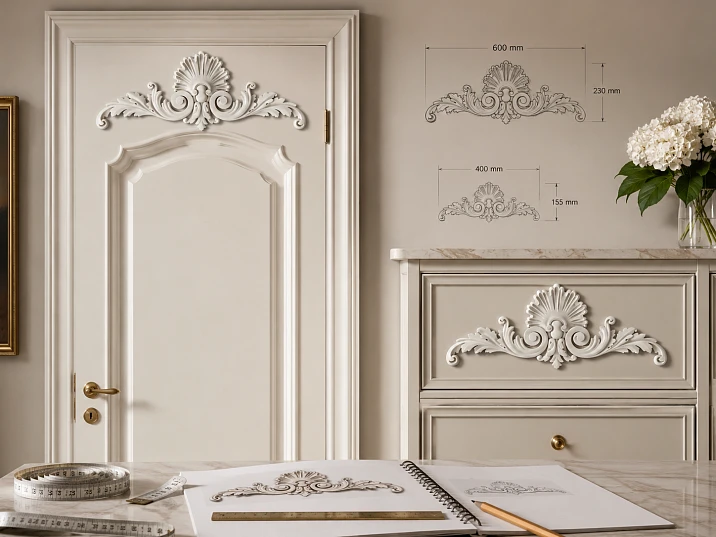
There are purchases where the difference in size seems clear even before ordering: a table 1200 or 1800 mm long, a handle 96 or 160 mm, a mirror 600 or 900 mm wide. With a decorative overlay, it's more complicated. On the NPU-204 card, the buyer sees the same ornament in two variants at once — 300 × 116 × 19 mm and 380 × 147 × 24 mm. Both are appealing. Both are made of polyurethane. Both are intended for decorative finishing. But when you transfer these numbers from the screen to a real door or furniture facade, it becomes clear: the choice between them is a choice of the scale of the entire composition.
For a small door, a too-large relief can take up almost the entire free field and compete with the handle. On a tall door, on the contrary, the compact version may get lost and look as if it was chosen not for the surface, but simply because it was the first in the card. Therefore, the question "which NPU-204 to buy — 300 or 380 mm" cannot be decided by looking at the product photo separately from the furniture.
There is a very practical way to solve this problem. Before ordering, you need to measure the clean field of the facade, mark handles, panels, moldings, edges, and other details, then apply a template of exactly 300 × 116 mm and a second one of 380 × 147 mm to the surface. After such a fitting, the screen stops dictating the choice: the buyer sees the real scale directly on their door.
If the ornament is already selected, you can immediately open the card and buy the stucco decor NPU-204, but it is better to fix the size only after a natural fitting. This is especially important for furniture facades, where a few centimeters change not only the appearance, but also the distance to the handle, frame, door edge, and neighboring elements.
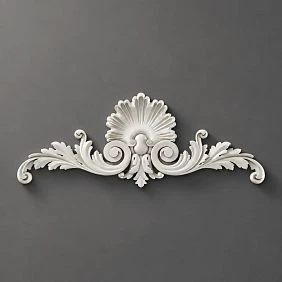
Two NPU-204 with the same pattern — two different scales
NPU-204 does not have two different ornaments. The difference is precisely in the size.
| Parameter | Compact version | Large variant |
|---|---|---|
| Size A × B × C | 300 × 116 × 19 mm | 380 × 147 × 24 mm |
| Material | Polyurethane | Polyurethane |
| Application | Doorways, furniture facades, wall accents | Doorways, furniture facades, wall accents |
| What changes visually | More free space around the ornament | The ornament occupies a large portion of the surface |
| What to check | Will the detail get lost on a large surface | Will the overlay become too tight for the selected field |
| How to choose | Using the 300 × 116 mm template | Using the 380 × 147 mm template |
On the wide side, the larger version is 80 mm longer. That's about a quarter more than the compact one. On the second side, the difference is 31 mm and gives almost the same proportion. The thickness also increases from 19 to 24 mm. So this is not about a minor increase in one detail, but about scaling the entire shape.
If you compare the area of the overall rectangles, the 380 × 147 mm version takes up about 1.6 times more space than the 300 × 116 mm one. This does not mean that the relief itself literally covers such an area entirely: the ornament's shape is more complex than a rectangle. But for a preliminary fitting, this figure is useful — the large version visually requires noticeably more free space.




Why a product photo distorts the perception of size
In the online catalog, two options can look almost identical: the photo is scaled to fit one page block. On a monitor, 300 mm and 380 mm become images of the same width.
This leads to a typical mistake. The buyer chooses the larger option because on the card it seems like "the same thing, just a bit more expressive." On the dresser door, it turns out the overlay is too close to the edges. Or, conversely, they take 300 mm, and after installation on a tall door, the ornament looks lonely and insufficiently connected to the rest of the design.
Therefore, in the case of NPU-204, the photo answers only one question: whether you like the pattern itself. It does not choose the size.
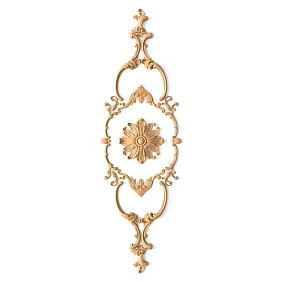
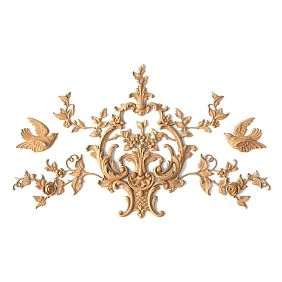
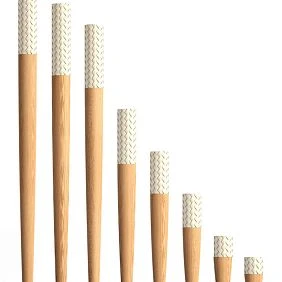
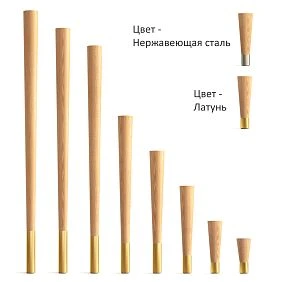
Our factory also produces:
Why price should not choose the size either
The two dimensions have different material consumption and different costs, but for a facade, the wrong scale is more expensive than any savings between options. If the smaller overlay does not fit the proportions, its low price will not fix the composition. If the large one overloads the door, the more expensive option does not automatically become more expressive.
First, choose the size based on the surface. Then compare the cost of the selected configuration.
Get Consultation
The most reliable way to choose is a full-size template
When it comes to decorative molding, many start with a photo of the interior. For NPU-204, it is much more useful to start with a sheet of paper, cardboard, or painter's tape.
You need two dimensional templates:
-
300 × 116 mm;
-
380 × 147 mm.
It is not necessary to draw the entire ornament. At the first stage, a rectangle of the appropriate size is sufficient. It will show how much space the overlay will take and how much free field will remain around it.
How to transfer the size to a real facade
Measure the facade completely, and then separately its clean decorative zone. These values do not always coincide.
The door may have:
-
a frame around the perimeter;
-
a panel;
-
a molding contour;
-
handle;
-
a keyhole;
-
hinges that affect the allowable mounting zone;
-
an adjacent facade with a minimal gap;
-
decorative milling.
For example, a facade 500 mm wide formally seems sufficient for an NPU-204 that is 380 mm long. But if the frame takes 50 mm on each side, the clear field is already 400 mm. After installing a large overlay, only about 10 mm of geometric margin will remain on the sides of the overall rectangle. For one project, this may be a deliberately tight composition; for another, it is obvious crowding.
There is no universal rule that exactly 30, 50, or 100 mm must remain around the ornament. It all depends on the facade design. Therefore, the template is more important than an abstract norm.
Look at the template not only from the front
After fixing the template, step back to the distance from which the furniture is usually perceived.
For a dresser, this may be a few steps. For a door, a glance from the hallway or adjacent room. For a wardrobe, a point in front of the entire furniture group.
Check three distances:
-
up close — whether the decor collides with the handle and frame;
-
from a normal distance — whether the ornament reads as part of the facade;
-
from a far point in the room — whether the small version disappears and the large one dominates.
This simple check often immediately resolves the question of which size to order.
NPU-204 on a small furniture door: compactness is often more important than the strength of the relief
The query "molding for furniture" seems broad, but for a specific door the problem is always the same: the decorative element must conform to the size of the surface.
For a small cabinet, bedside table, or narrow front, it is reasonable to first try the 300 × 116 × 19 mm option. This does not mean that the large NPU-204 is forbidden on small furniture. It is just that the smaller version leaves more space for the handle, frames, and a calm background.
If you need to choose other elements, Moldings for Furniture it is presented in the category of polyurethane overlays of various shapes and sizes. But for the already liked NPU-204, you should start not by browsing another hundred ornaments, but by checking its two dimensions.
Central placement
The most understandable scenario is one overlay in the center of the front.
Here it is important to first determine the center of the clean decorative field, not the center of the entire door. If the handle is located on the side, the center may coincide. If the handle is centered at the top or bottom, the compositional field already changes.
Secure the template with masking tape and see if there is enough air:
-
above the ornament;
-
below it;
-
on the sides;
-
between the decor and the handle.
If the 380 mm option almost touches the frame, while 300 mm leaves a calm field, the compact size usually reads as neater. If 300 mm looks like a small badge on a large surface, that's a signal to try 380 mm.
Paired placement
On two symmetrical doors, the question changes. Here, the overlays are perceived not individually, but as a pair.
Suppose a cabinet has two doors of equal width. An NPU-204 is planned for each. A vertical seam remains between the doors. Even if the larger version fits physically, the distance between the two ornaments in the closed state needs to be checked.
Two large overlays can visually form a too-dense central group. Two compact ones can provide a calmer rhythm.
Therefore, templates should be attached to both doors at once, rather than choosing the size based on one door.
Chest of drawers with multiple drawers
On a dresser, the NPU-204 can be perceived as the central decor of the entire front block or as an ornament for individual drawers. These schemes yield completely different results.
If one large element is installed on a large central panel, the 380 mm version may be appropriate. If the ornament is repeated on several low drawers, 300 mm may already be large—it all depends on the height of each field.
Repeating the same NPU-204 on each drawer without a mockup is risky. Several identical reliefs add up visually, and the furniture can become significantly richer than it seems from a single detail.
High door: why 300 mm sometimes looks smaller than expected
On an interior door, the scale changes radically. The height of the panel is measured not in hundreds of millimeters, as with a box, but in meters. Therefore, decor 300 mm long occupies a relatively small portion of the surface.
This does not make the compact NPU-204 wrong. It can work as a neat accent inside a panel, above the handle, or as part of a molding frame. But if the task is to create a standalone central ornament on a large smooth door, the 380 × 147 × 24 mm version deserves a mandatory try-on.
The card confirms the use of NPU-204 for door openings, so the stucco decor NPU-204 for doors can be considered precisely as a subject detail, not just as a wall element.
A smooth door and a paneled door require different approaches
On a smooth panel, the entire surface is available as a single field. The overlay becomes an independent graphic figure.
On a paneled door, it cannot be evaluated by the overall size of the panel. The size of the specific panel or central zone matters. If NPU-204 crosses the boundary of a panel, such a decision must be deliberate. If the overlay should be inside it, choose a size that does not conflict with the frame.
Therefore, the same door, for example, about two meters high, may require either 300 mm or 380 mm — depending on the internal architecture of the panel.
One overlay or several
A high surface sometimes provokes adding a second and third element so that it doesn't look empty. This is not always necessary.
First try one NPU-204 and assess whether you can strengthen the composition not with the number of identical overlays, but with a molding frame. When linear framing is required, it is more appropriate buy polyurethane moldings to assemble an architectural field around the central decor.
Thus, one overlay retains its role as an accent, while the molding organizes the larger door area.
The handle can change the size choice more than the facade width itself
When trying on a decorative element, you cannot mentally remove the handle. It will remain on the finished furniture.
This is especially noticeable if the handle:
-
long;
-
is shaped;
-
is installed in the center;
-
has large rosettes;
-
located close to the intended decor;
-
highlighted with contrasting metal.
Two beautiful details can conflict simply because there is not enough free space between them.
When the NPU-204 is above the handle
Mark the actual position of the handle on the facade template. Then move the paper NPU-204 up and down.
Evaluate not only the minimum physical gap. A visual gap is needed so that the handle and the overlay do not appear as accidentally interlocked parts.
The large 380 mm version takes up more space and may require a higher placement. The compact 300 mm one fits more easily between the handle and the top frame.
When the handle runs horizontally nearby
On a wide door, the handle may be on the side. Then not only the length of the NPU-204 is critical, but also its 116 or 147 mm on the other side.
If a large relief is too close to the hand grip zone, it can interfere visually or actually end up where fingers constantly touch the facade. This is another argument for checking the layout on real furniture rather than on a blank sheet.
Handle first or decor first
If the handle is already chosen and holes are drilled, NPU-204 is adjusted to the existing geometry.
If the facade is new, it is better to design the handle and decor simultaneously. Then you can shift the hardware, choose its length and position so that both parts work together.
The main mistake is to finally drill holes for the handle without applying the future overlay in full size.
Size 380 mm is not "richer", and 300 mm is not "simpler"
Decorative choice is often described with words like "bigger is more luxurious". For furniture, this is too primitive logic.
A large NPU-204 indeed creates a stronger presence of relief. But on a small facade, it can reduce the perception of the furniture itself: the surface seems tighter because almost the entire field is occupied by the ornament.
The compact version leaves more background. On a large surface, this can look refined and deliberate, not poor.
That is why size is evaluated relative to the object.
| Situation | What to try on first | Why | What can change the decision |
| Narrow furniture door | 300 × 116 mm | Keeps more free space | Very simple smooth surface |
| Medium cabinet front | Both sizes | The difference depends on the frame and handle | Pairing of doors |
| Large door | 380 × 147 mm and 300 × 116 mm side by side | The small variant may get lost | Presence of a panel or molding |
| 380 × 147 mm | 380 × 147 mm | Holds a large field more strongly | If a deliberately thin accent is needed |
| Dresser with several drawers | 300 × 116 mm | Repetition enhances the decor | If only one element is used |
| Two symmetrical panels | Two templates of the same size at once | A pair assessment is needed | Width of the central seam |
| Wall composition | Both sizes | Scale depends on the frame and wall area | Number of repeats |
This table does not replace fitting and does not set a standard. It shows which option is more reasonable to start with to see the correct proportion faster.
Polyurethane allows working with relief without the feel of a massive wooden part
NPU-204 is made of polyurethane. For the buyer, this primarily means the ability to use a pronounced decorative relief on furniture, doors, and wall accents without needing to find a carved solid wood part with exactly the same pattern.
At the same time, the material does not eliminate design considerations. A lightweight overlay still has a real dimension of 300 or 380 mm and a real thickness of 19 or 24 mm. On a flat facade, these 5 mm differences in relief also affect light and shadow.
If you need to compare not just one product, but different ones Polyurethane decorative appliquesIt is better to do this after determining the maximum size. Then the catalog does not overload the selection: you immediately discard items that are physically too large or too small for the surface.
The thickness is especially noticeable in side light.
A cabinet facade next to a window, a door opposite a wall lamp, a wall panel under directed light — in such conditions, the shadow from the relief becomes part of the pattern.
The 24 mm option creates a deeper protrusion than 19 mm. This is not a reason to automatically prefer the larger model. It is just that in side lighting it will look more sculptural and stand out more from the base.
Therefore, a mock-up made of flat paper gives only the overall dimensions. If the decision is debatable, it is useful to make a three-dimensional imitation: place cardboard of the appropriate thickness under the template or assemble a simple mock-up. Then it is easier to imagine how far the relief will protrude.
What does "free field" mean and why it needs to be measured
The free field is not an official product parameter. It is a working concept of a designer and furniture maker: the area of the facade that remains around the decor and allows it to be read separately from edges, handles, frames, and other details.
For NPU-204, it cannot be calculated only by the width of the furniture.
Suppose the door has a dimension of W × H. A frame runs inside. Then the clear field W₁ × H₁ is determined first. The rectangle of 300 × 116 or 380 × 147 mm is then applied to it.
A simple check can be written:
Free horizontal margin = clear field width − corresponding NPU-204 dimension.
Free vertical margin = clear field height − corresponding NPU-204 dimension.
If the overlay is positioned exactly in the center, the geometric margin is divided between the two sides. But this is only math. Visually, the ornament may be uneven, the handle may shift the center, and the frame may require a different position.
Why percentages are sometimes more useful than millimeters
The same 80 mm of free margin is perceived differently on a door 400 mm and 900 mm wide.
Therefore, after absolute dimensions, it is useful to see what share of the clear field the overlay occupies. This is not a strict standard, but a way to compare options.
If a large NPU-204 takes up almost the entire width of the central panel, it becomes the main motif. If a compact one takes up about half, the surface retains a calmer character.
This way, the buyer chooses not "millimeters for the sake of millimeters," but the degree of decorative richness.
Overlay on a painted MDF facade: the size must be decided before finishing
Furniture facades are often designed in advance: holes for handles, milling, primer, enamel. If NPU-204 is added to such a project, its position should be determined before the final finish.
The reason is simple. After painting, any change to the layout becomes more expensive. If the overlay covers part of the milling, comes too close to the handle, or requires a different frame, the rework affects an already finished surface.
Mount before painting or after
There is no single universal answer for any furniture. The scheme depends on the desired visual result and the materials used.
If the overlay and the facade should look like a single monolithic field of one color, the designer usually plans joint preparation and painting in advance.
If the NPU-204 should remain a separate accent, separate finishing and subsequent mounting are possible.
Something else is critical: the size and location must be approved before irreversible operations begin.
Why a test paint-out is useful even for white color
A white surface does not make the relief unnoticeable. On the contrary, without material contrast, the pattern shows through light and shadow.
The 380 × 147 × 24 mm version, when in the same color as the facade, can look much more active than a small one, precisely because of the depth of the relief and the area.
Therefore, in a complex project, it makes sense to evaluate not only the paper outline, but also a small painted sample of the material or a visualization with real lighting.
Wall accent: the same sizes start to work differently
The card allows the use of NPU-204 on wall accents. On a wall, 300 and 380 mm are perceived differently than on a cabinet door.
A wall has no small edge of its own that immediately limits the ornament. Therefore, a single element can get lost on a large surface, while several overlays can, on the contrary, form a whole composition.
If the task goes beyond furniture and you need to assemble a panel, niche, or accent zone, you can look at Polyurethane wall decor and match NPU-204 with other elements of the system.
One NPU-204 in a molding frame
This is one of the most straightforward ways to use the overlay on a wall.
First, a frame is formed, then the central element is placed inside it. In this scheme, choose 300 or 380 mm relative to the inner field of the frame, not the entire wall.
If the inner area is small, 380 mm may fill it too tightly. If the frame is large and elongated, 300 mm may require additional elements.
Repeating several overlays
Repetition increases the overall decorative density.
Three elements of 300 mm are not perceived as one 300 mm element. They form a rhythm and occupy a large part of the wall. Therefore, with repeated use, it is often wise to test a compact size first.
But even here there is no automatic rule. A large pair of 380 mm can be stronger and cleaner than six small elements. The layout of the entire wall makes the decision.
When NPU-204 needs molding, and when it will be superfluous
Molding is useful if the overlay requires an architectural boundary: a frame on a facade, door leaf, or wall.
But adding a frame just because "molding is traditionally framed" is not necessary. On a small furniture facade, NPU-204 itself can fulfill the decorative task.
When a frame is truly needed, polyurethane moldings buy it makes sense to do so after fixing the dimensions of the central overlay. Then the width and position of the molding are selected around the specific NPU-204, not the other way around.
A frame helps a small size work on a large surface
Suppose on a tall door, NPU-204 300 × 116 mm seems too small. It is not necessary to immediately switch to 380 mm.
You can make a molding frame, inside which a compact ornament becomes the center of a separate field. The scale of the composition increases, while the relief itself remains lighter.
This is a good example of why the choice cannot be reduced to the formula "big door — big NPU-204."
A large NPU-204 can work without additional framing
On a smooth middle door, the 380 mm version itself creates a sufficiently pronounced center. Additional molding can turn a calm surface into one that is too dense.
Again, the fitting works: first one overlay, then a frame is added on the mockup. If the composition is already complete without it, there is no need to complicate things.
Decorative polyurethane elements should be chosen as a system, not as a random collection of beautiful details
The buyer often starts with one item, then sees several more overlays, moldings, and rosettes nearby. The desire arises to add everything they like into one project.
Instead, it is better to define a hierarchy:
-
main element;
-
supporting lines;
-
functional fittings;
-
color and finish.
If NPU-204 becomes the main element, the surrounding decor should not draw attention away.
To compare auxiliary shapes, you can open decorative polyurethane elements, but they should only be added to furniture when they solve a specific task: cover a frame corner, support the central motif, or connect several parts of the composition.
One NPU-204 or two: quantity also changes the scale
Sometimes the size is chosen correctly, but the quantity is wrong.
One large element of 380 mm and two compact ones of 300 mm are not equivalent solutions.
One creates a center.
Two create an axis, a pair, or symmetry.
Four form a grid and already require a much calmer environment.
One overlay
Suitable when the surface has a natural center: facade, panel, door, or board.
Two overlays
Work on paired doors, double-door furniture, or elongated panels.
Several repetitions
Require step calculation. It is not enough to simply divide the surface width by the number of items. Space must remain between them, and the outer elements must align with the frame.
Before ordering multiple pieces, lay out paper templates in full quantity. This costs almost nothing and immediately shows whether an elegant ornament turns into a too-dense pattern.
How to account for pattern direction
Even if NPU-204 is symmetrical or perceived as a central element, it is important to choose the orientation in advance for a specific door. This issue should not be left to the installer at the time of application.
Take a photo of the approved layout and attach it to the working documentation.
If elements on two doors must be oriented identically, this is fixed.
If the composition is mirrored, the position of each part is also recorded.
A size without orientation is not yet a complete specification.
Assembly adhesive is chosen after the substrate, not just after the word "polyurethane."
The NPU-204 card links installation with the adhesive method. But a furniture facade, a painted door, and a prepared wall are different substrates.
Therefore, you cannot take the first compound labeled "universal" and consider the matter closed.
To understand the principles, it is useful to read the material in advance. how to choose adhesive for moldings and then compare the recommendations with the specific substrate and finish.
Why the installation method should be checked before painting
If the adhesive requires certain surface preparation, this affects the facade technology.
For example, the area under the overlay may require different preparation than the visible painted surface. The specific scheme is determined by the instructions of the composition used and the base material.
The main idea is simple: first, they approve 'base + adhesive + finish + NPU-204', then perform the finishing work.
Adhesive does not fix an incorrect size
Even the most suitable mounting compound does not solve a compositional error.
If NPU-204 380 mm is too large for the door, its reliable adhesion will only fix the incorrect scale.
Therefore, installation is closer to the end of the selection process, not the beginning.
What to buy together with NPU-204
The correct set depends on where the overlay is used.
| What to add | Why | When really needed | Inner page |
| NPU-204 of the selected size | Central ornament | Always | order NPU-204 made of polyurethane |
| Other polyurethane overlays | Support the composition | For paired or complex decor | buy stucco decor |
| Moldings | Create a frame | For a door, wall, or large facade | buy polyurethane moldings |
| Decor for moldings | Decorate the corners and joints of the composition | Only if the frame scheme requires it | polyurethane decor |
| Suitable adhesive | Fix the overlay | After checking the base | how to choose glue for moldings |
You don't need to collect all table rows at once. For a simple furniture door, NPU-204 and a compatible mounting compound are sufficient. Molding, additional overlays, and corner decor are added only when they are specified in the layout.
How not to confuse choosing NPU-204 with choosing "generally beautiful moldings"
The buyer has two different tasks.
First: choose the molding style from scratch.
Second: the NPU-204 ornament is already liked, now you need to choose its size.
The second task is much narrower. You don't need to go back into an endless search through hundreds of elements. First, check if one of the two sizes fits your facade. Only if both don't work, return to the category.
If you still need a broader search, Buy moldings you can use the general section where products are grouped by purpose. But for a specific SKU, the main criterion is already known: matching the scale of the surface.
How to compare NPU-204 with another ornament
Comparison should be done under identical conditions.
You cannot view NPU-204 380 mm as a large photo and another product as a small thumbnail, and then decide which is more expressive based on that.
For each candidate, write down:
-
overall dimension;
-
thickness;
-
shape;
-
assumed location;
-
quantity;
-
position relative to the handle;
-
color;
-
presence of a frame.
Then create mockups at the same scale.
Only this way are the products themselves compared, not the size of photos on the screen.
Practical scenario #1: cabinet door with one handle
Initial situation: a small door, the handle is located at the top or side, the surface is smooth.
First, we apply NPU-204 300 × 116 mm.
If there remains a convincing free field around, and the ornament reads from a normal distance, you can stop here. We check the larger option only for comparison.
If 300 mm seems too cautious, we set 380 mm and see whether the relief has come too close to the edges and the handle.
The decision is made not based on the entire cabinet area, but on a single door.
Practical scenario No. 2: a tall cabinet with two doors
Here, one template won't help. We need two at once.
Attach the 300-millimeter mockups symmetrically to both doors, photograph the cabinet. Then replace them with the 380-millimeter ones.
Compare:
-
distance between the overlays;
-
ratio of the ornament to the cabinet height;
-
interaction with the handles;
-
density of the central zone.
On double-door furniture, a large size may look stronger, but two large pieces together can sometimes create excessive saturation. Only the overall look of the cabinet shows the right answer.
Practical scenario #3: smooth interior door
First, determine whether NPU-204 will be the only decor.
If so, the large version often deserves a first try simply because the door surface is large.
If a molding frame is planned around it, the small option may gain sufficient scale from the overall composition.
Do not choose a size until the boundaries of the future frame are at least marked with painter's tape.
Practical scenario #4: paneled door
Here, the main dimension is the inner area of the panel.
Measure that, not the entire door leaf.
If 380 × 147 mm turns out to be close to the edges, try 300 × 116 mm.
If both options fit, look at the distance to the panel profile. The ornament does not have to occupy the maximum possible width.
Practical scenario No. 5: dresser facade under enamel
First, fix the position of the handles.
Then select the size of NPU-204.
After that, determine whether the overlay will be painted in the color of the facade or stand out.
Only when the composition is approved, proceed to the technological scheme of painting and installation.
So the sequence goes from scale to technology, and not vice versa.
Practical scenario No. 6: wall panel with moldings
First, create a full-size frame with painter's tape.
Insert the 300 and 380 mm templates alternately inside.
If the frame is large, the small element can be supported by other parts. If you want a clean solution, the large NPU-204 can work alone.
If you need to expand the set, you can buy polyurethane molding decor in the same product category and select additional overlays by size and shape.
Practical scenario No. 7: restoration of existing furniture
When the furniture is already finished, there is less freedom.
There are handles, existing routing, old coating, possibly holes or traces from previous decor.
NPU-204 should not only look proportional, but also solve the specific task of the surface.
If you need to cover an old damage, first measure its maximum dimension. Then check whether the overlay covers this area with sufficient margin in shape.
You cannot rely only on the overall figure of 300 or 380 mm, because the ornament itself does not fill the entire bounding rectangle evenly. To mask a defect, you need the actual contour of the product or a drawing.
Practical scenario No. 8: door portal with repeating ornament
On the NPU-204 door portal, it can be used not on the leaf itself, but around the opening.
Here, a different coordinate system emerges: the width of the trims, the height of the portal, the distance to the cornice, and the symmetry of the left and right sides.
In such a case, the 380 mm option may be justified by a larger architectural scale. But if there are already many profiled elements nearby, the compact NPU-204 can provide a more refined accent.
Do not automatically transfer the solution from a furniture door to a portal. The same SKU performs differently at different scales.
NPU-204 purchase mistakes that are easy to prevent before ordering
Mistake 1. Choosing the size based on a product photo
On screen, both options are scaled. Make a template.
Mistake 2. Assuming that 380 mm is only 80 mm larger
The linear difference is about a quarter, but the overall area of the larger option is roughly 60% bigger. Visually, this is a noticeable jump.
Mistake 3. Measuring the entire door, but not the clear field
Frames and handles reduce the available area.
Error 4. Not installing the handle on the mockup
The hardware will remain after installation and may conflict with the ornament.
Error 5. Choosing a larger option just because it is more expensive
Price does not determine proportion.
Error 6. Choosing a small one just to save money
On a large door, it may not fulfill the decorative task.
Error 7. Looking at one door of a two-door wardrobe
Two overlays should be evaluated together.
Error 8. Adding a molding after choosing the size without re-fitting
The frame reduces the free field and changes the scale.
Error 9. Buying several NPU-204 without laying out the entire repeat.
Quantity enhances decorative density.
Error 10. Considering 19 and 24 mm an insignificant difference.
The depth of the relief affects chiaroscuro and the protrusion above the facade.
Error 11. Finally painting the facade before approving the layout.
Any rework after the finish is more difficult.
Error 12. Buying adhesive before the substrate is determined.
A painted door, MDF, and wall require checking the compatibility of the mounting system.
Error 13. Trying to cover a defect using the overall rectangle.
The ornament has a figured contour. Need to check the actual shape.
Error 14. Use NPU-204 on every surface only for unity
How to calculate the quantity without excess stock
For NPU-204, the quantity is usually determined not by linear meters, but by the number of decorative points.
Create a report:
| Location | Size of NPU-204 | Quantity | Orientation | Note |
| Left cabinet door | 300 or 380 mm | 1 | according to the layout | Symmetrical to the right |
| Right door | The same | 1 | Mirrored/identical per project | Check the handle |
| Central door | selected | 1 | Centered | Separate composition |
| Wall frame | selected | 1 or several | By layout | Check step |
After that, sum up the elements of each size separately.
If the project is complex, one additional copy makes sense only as a deliberate reserve for a specific risk. There is no need to automatically buy a large percentage of stock, as for linear molding.
What should be recorded in the order
Bad specification:
NPU-204 — 4 pcs.
It has no size.
More correctly:
Molding decor NPU-204, polyurethane, 300 × 116 × 19 mm — 4 pcs.
Or:
Molding decor NPU-204, polyurethane, 380 × 147 × 24 mm — 4 pcs.
If both sizes are used in one project, they must be separated into two lines.
Add purpose
For a complex object, it is useful to label:
-
wardrobe;
-
door;
-
wall frame;
-
reserve.
This way, during installation, the large version won't accidentally end up on a small facade.
How to buy NPU-204 on STAVROS without unnecessary returns to selection
The order is simple.
First, open the product card and save both dimensions.
Then measure the surface and make two templates.
Approve the size.
After that, you can order NPU-204 made of polyurethane with a specific size and quantity.
If the composition requires a frame, select moldings after approving the central overlay. If additional ornaments are needed, go to the polyurethane decor category with the known style and scale.
Thus, the catalog works as a system, not as a source of random purchases.
Why the frequent query "stucco decor" here really leads to the purchase of a specific product
The concept of stucco decor is very broad. It includes moldings, overlays, rosettes, and other elements. But a user who has reached NPU-204 has already gone through most of the selection path.
He doesn't need to be re-explained the whole history of decorative stucco. He needs to decide:
-
whether the pattern fits;
-
what size to take;
-
where to install;
-
how many to order;
-
what to combine with.
That is why stucco decor in this article is used as a transition to the category only where the buyer may really need a comparison.
Decorative stucco on furniture should take into account the item itself, not just the style of the room.
A classic living room does not mean that the smallest dresser needs the largest ornament. A modern interior does not forbid an expressive NPU-204.
The style of the room sets the language, but the size of the furniture sets the scale.
Therefore, when choosing decorative stucco, ask yourself not the question "how rich is my interior", but three specific questions:
-
how much clean space is there on the facade;
-
what elements already occupy this space;
-
From what distance will the overlay be visible?
These answers are more useful than any general classification of styles.
Light, color, and shadow can change the impression after trying on.
A paper template determines the size but does not show the final light and shadow.
After a preliminary decision, evaluate the color.
If NPU-204 is painted in the color of the facade, the relief will be revealed through shadow.
If the shade is contrasting, the visual impact increases, and a compact size may be sufficient.
If the surface is dark and light falls from the side, the deeper 24 mm option can appear more active.
Therefore, the choice of size and color cannot be completely separated.
A contrasting NPU-204 requires more visual breathing room.
Imagine a light facade and a dark overlay. Even 300 mm will be noticeably more prominent than when painting tone-on-tone.
In such a scheme, the large version can become dominant.
If the facade and decor are painted the same, 380 mm is sometimes perceived as calmer than expected from bare polyurethane.
Check not only the geometry, but also the future contrast.
Why the decorative overlay should be aligned with the facade edge
The closer the relief comes to the edge, the stronger the feeling of tightness.
On a frameless door this is especially noticeable. The furniture edge itself forms a strong line. If the NPU-204 almost touches it, the ornament stops 'lying' on the field and begins to compete with the door contour.
On a framed facade, the situation is even more complex: there is an outer edge and an inner frame.
Therefore, the size is chosen relative to the nearest active boundary, not always relative to the full furniture dimension.
Can the NPU-204 be reduced by trimming
You cannot independently consider a standard overlay as a "blank for reduction." Any trimming changes the pattern and may disrupt the completeness of the ornament.
If the standard size does not fit, it is better to choose another option rather than randomly remove part of the shape.
This is especially important for symmetrical decor: the loss of one edge immediately becomes noticeable.
What to do if you need a size between 300 and 380 mm
The product card confirms two standard options. If a specific project requires an intermediate dimension, you cannot independently promise its production.
First, it is worth reconsidering the composition:
-
change the free margin;
-
adjust the frame;
-
try a different position;
-
use the small NPU-204 in a larger architectural field.
If individual manufacturing is essential, the possibility and conditions should be clarified separately with STAVROS.
Who NPU-204 is especially convenient for
NPU-204 is worth considering if the buyer needs the same ornament in two scales.
This is convenient:
-
for a furniture project with facades of different sizes;
-
for a door and furniture in the same room;
-
for a pair of “large central element + compact repeat”;
-
for a wall composition where one pattern should appear in multiple fields.
Two sizes allow preserving the motif without forcing all surfaces to conform to a single dimension.
Who should look for other decor
A different article is more reasonable if:
-
300 mm is already too large;
-
380 mm is still too small;
-
the shape conflicts with the handle;
-
the overlay does not fit inside the panel;
-
a corner element is needed, not a central one;
-
a linear profile is required instead of a point ornament;
-
the mounting area does not allow placing the product.
In such a situation, do not convince yourself that 'it will be fine after painting.' The scale problem will remain.
Mini-project before purchase: five minutes that save rework
Before ordering, prepare a photo of the facade strictly from the front.
Write down the actual dimensions.
You can make a simple scale diagram on the photo, but it's even better to supplement it with a natural paper template.
Secure the selected option with masking tape.
Place the handle or its template.
Take a photo.
Step back.
Compare.
This short procedure is more useful than a long discussion about whether 380 mm looks "too big" from memory.
Ready-made selection procedure for NPU-204
-
Determine the specific surface.
-
Measure the full and clean decorative field.
-
Mark handles, frames, and routing.
-
Make a template 300 × 116 mm.
-
Make a template 380 × 147 mm.
-
Try both in one position.
-
Look from a working distance.
-
Check the thickness of 19 and 24 mm relative to adjacent parts.
-
If there are multiple overlays, place all templates at once.
-
Add a molding to the layout if it is provided.
-
Approve the color scheme.
-
Select the mounting compound for the base.
-
Record the size in the specification.
-
Only after that place the order.
Layout for approval: how to communicate the selected size to the designer, client, and cabinetmaker
When the decision is made only verbally — "we'll take the small one" or "let's go with the large one" — an error is still possible. In the card, one SKU NPU-204 combines two dimensions, so in correspondence, the words "small" and "large" are better not used as the final designation. In a week, one project participant may remember 300 mm, another — 380 mm, and the buyer will see only the SKU in the invoice.
It is more reliable to create a short approval sheet. On it, a photo of the front strictly from the front, the outline of the selected overlay, and four signatures are enough: NPU-204, 300 × 116 × 19 mm or 380 × 147 × 24 mm, quantity, installation location. If a handle is nearby, its position should also be visible. For paired doors, both leaves are shown, not one half of the furniture.
Such a sheet solves several tasks at once. The designer sees the proportion, the client understands what exactly they are approving, the buyer gets the exact size, and the craftsman knows the position of the part. This scheme is especially useful when both variants of NPU-204 are used in one interior: compact on furniture and large on a door or wall panel.
A control photo is better than a verbal description
After fitting the paper template, photograph the front with a tape measure or another clear scale reference. This does not replace a drawing, but helps not to lose the decision between project stages.
In the photo, it is useful to mark:
-
the central axis of the front;
-
the top and bottom of the overlay;
-
distance to the handle;
-
the position of the nearest frame or panel;
-
ornament orientation;
-
surface number, if there are several facades.
If installation is performed by someone other than the person who selected the decor, such fixation is especially valuable. The craftsman receives not an abstract instruction like "approximately centered," but a specific agreed-upon picture.
For a furniture series, one reference facade is first approved
When making several identical cabinets or dressers, there is no need to re-select the position on each door. First, one reference facade is fully assembled: the NPU-204 size, handle, distances, color, and relief after finishing are checked. Then a placement template is taken from it for the remaining items.
The template itself must be tied to the base edges of the facade, not to a random point in the pattern. Then repetition will be identical even for a large batch. If a 300-mm NPU-204 is used, this is indicated directly on the template; if a 380-mm one is used, a separate template is created. Mixing two sizes in one production card is dangerous.
This stage turns a decorative purchase into a normal production task: first the scale is approved, then the coordinates, then the finish, and only after that the series is repeated. This is how the ornament maintains the same position on all facades and does not depend on who performs the installation.
FAQ: NPU-204 for doors, cabinets, and furniture facades
Which NPU-204 size is better — 300 or 380 mm?
There is no universally best size. The choice depends on the clear field of the facade, handle position, frames, and overall surface scale. Both options should be pre-applied in full size.
What are the exact dimensions of NPU-204?
The card shows 300 × 116 × 19 mm and 380 × 147 × 24 mm.
What is NPU-204 made of?
made of polyurethane.
Is NPU-204 suitable for furniture facades?
Yes. The card lists furniture facades among the application options.
Can it be used on doors?
Yes. The description includes finishing door openings.
Is NPU-204 suitable for walls?
Yes, the product is also used as a decorative wall accent.
Should I take the 380 mm for a tall door?
Not necessarily. On a large smooth surface, it's worth trying it first, but the compact version may work better inside a panel or molding frame.
For a small cabinet door, is 300 mm always needed?
No. It's a reasonable first option to try, but the final choice depends on the actual width of the clear field.
How to understand that 380 mm is too large?
Make a template of 380 × 147 mm and check the distances to the nearest frames, edges, and handle. If the field looks cramped, compare with 300 mm.
How to understand that 300 mm is too small?
Look at the entire facade from a normal distance. If the ornament gets lost and looks like a random small detail, try 380 mm or add a molding frame.
Can two NPU-204 be used on the same piece of furniture?
Yes, if it's provided for by the composition. Before ordering, place two full-size templates and evaluate the distance between them.
Can NPU-204 be placed on two cabinet doors?
Yes. The size should be assessed immediately on both closed doors to check symmetry and density of the central zone.
How to account for a furniture handle?
Apply its actual position to the layout before choosing the overlay. There should be visually and functionally sufficient space left between the handle and the relief.
Do I need to drill holes for the handle first?
It is better to finalize the handle and decor together. If holes already exist, NPU-204 is selected to match the existing geometry.
Can NPU-204 be painted to match the furniture color?
Polyurethane decor is used in paintable interior compositions, but the specific preparation and coating system should be coordinated with the chosen facade materials and paint.
What is better: one large NPU-204 or two small ones?
These are different compositions. One creates a pronounced center, two form a pair or rhythm. The choice depends on the surface.
Is a molding needed around NPU-204?
No, not always. Molding is useful when you need to organize a large field or create a frame. On a small facade, the overlay can work on its own.
Which NPU-204 is better for a molding frame?
The size is determined by the inner field of the frame. First, mark its boundaries on the surface, then apply both options.
How to calculate the quantity?
Count each installation point separately and divide positions by sizes. If the project has 300 and 380 mm, they should go as separate lines in the order.
Is it necessary to buy a spare?
For piece decor, the allowance is calculated based on project risks, not automatically as a percentage. For regular furniture, it is often more important to accurately determine the number of installation locations.
What is NPU-204 attached with?
The card links installation to the adhesive method. The specific compound is chosen based on polyurethane and the base material.
Can the overlay be glued onto an already painted facade?
The possibility depends on the coating and the chosen adhesive. Compatibility and adhesion need to be checked, not assuming all painted surfaces are the same.
What to do if both sizes do not fit?
Look at another article or change the decorative scheme. Do not choose an unsuitable size just because you liked the pattern.
Can the NPU-204 be trimmed if it doesn't fit slightly?
The standard ornament should not be considered a blank for arbitrary reduction. Trimming may disrupt the pattern; it's better to choose a suitable size or another element.
Where to see other options for polyurethane decor?
In the general catalog, molding can be purchased after determining the required type, size, and place of application.
Where can I see overlays similar in purpose?
In the category that collects polyurethane overlays of various sizes and shapes. This is useful if both sizes of NPU-204 don't work on a specific facade.
Is a fitting needed if the designer has already made a visualization?
Yes. Visualization helps evaluate the idea, but a natural template checks the real millimeters on the manufactured facade.
Can 300 mm be used on one piece of furniture and 380 mm on another in the same room?
Yes. This is exactly one of the strong scenarios for two sizes: the pattern is preserved, and the scale adapts to the surface.
Before payment, write down not only the article number but also the specific size
NPU-204 is a good example of a product where one article number is not enough for an error-free order.
The specification should include four things:
article number — size — quantity — installation location.
For example:
NPU-204, 300 × 116 × 19 mm, 2 pcs., dresser doors.
NPU-204, 380 × 147 × 24 mm, 1 pc., interior door.
Such a record eliminates the situation where the client approved one scale, the designer meant another, and the installer received only the general article number.
The size is chosen on the facade, not in the product card
NPU-204 has an important advantage: one ornament is available in two noticeably different scales. This allows using a common decorative motif on a door, wardrobe, dresser, or wall panel without forcing all surfaces to adopt the same size.
But this freedom only works with the correct sequence.
First, the surface is measured.
Then a clean field is marked.
Then handles, frames, and moldings come into place.
After that, two full-size templates are applied.
And only then is a specific NPU-204 chosen.
STAVROS company allows you to start with one product, and if necessary, build the entire system around it: choose polyurethane overlays, moldings, wall decor, and suitable installation solutions. If this exact ornament is needed, the main next step is — buy NPU-204 in size 300 or 380 mm already after a real-life fitting.
This way, the buyer orders not just a decorative molding they like, but an element that truly matches the scale of the door or furniture facade. For a decorative detail, this is the main criterion for an accurate choice: the pattern should appeal in the photo, and the size should work on the actual surface.