Article Contents:
- What is included in polyurethane wall decor
- Why polyurethane is convenient for wall decor
- Weight is the main advantage over plaster
- Precision and serial production
- Painting and integration into the interior
- Water resistance and durability
- Suitable for any style
- Wall moldings: the most popular way to design an interior
- Molding frames: the main technique of wall decor
- Wall decoration behind the sofa
- Moldings for the headboard
- Moldings in the hallway and corridor
- Moldings around doors
- Wall stucco: when sockets, overlays, and ornaments are needed
- When stucco works better on the wall than molding
- Symmetry as a principle of wall stucco
- Decor for moldings: corner and intermediate inserts
- Buy stucco decor and overlays
- Where to use polyurethane wall decor
- Living room: main wall and TV area
- Bedroom: headboard and calm rhythm
- Hallway and corridor: structure in a narrow space
- TV zone: architecture for the screen
- How to choose a style of wall decor
- Neoclassicism: rigor and nobility
- Classic: richness and depth of relief
- Modern interior: molding as an art object
- Japandi and calm minimalism
- Mistakes when choosing wall decor
- Can polyurethane decor be used not only indoors but also on the facade
- Where to buy polyurethane wall decor
- FAQ: Answers to Popular Questions
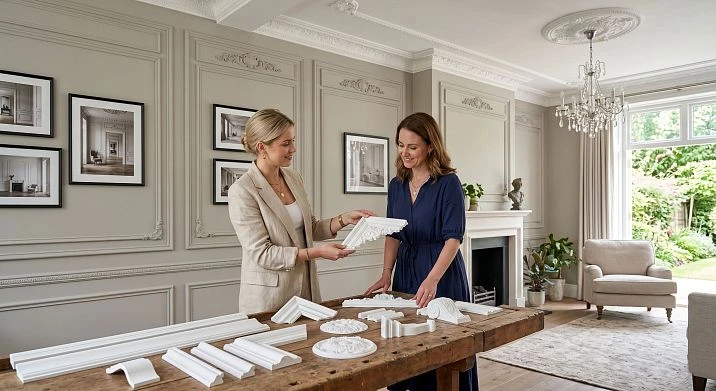
A wall is not a background. It is a plane that either works for the interior or simply exists. The difference between these two states lies precisely in whether it has structure. Polyurethane wall decor is a tool that transforms a simply painted or wallpapered plane into an architecturally meaningful surface.
It's not about "decorating." It's about assembling the interior: highlighting the wall behind the sofa, giving the headboard visual weight, styling the TV area so it doesn't look like just a screen hung on the wall, structuring the hallway where decor also serves as spatial navigation.polyurethane wall decorsolves all of this — and is installed without construction renovation, without dust, and without hiring a team of specialists.
What exactly works on the wall?Wall molding, moldings, appliedWall Decorative Elements, corner inserts, rosettes, ornamental appliqués. Polyurethane as a material provides precise relief, minimal weight, and complete freedom in color choice. Let's break it all down in order.
What relates to polyurethane wall decor
Before choosing, you need to clearly understand what exactly falls into this category. Many confuse it with ceiling decor or facade elements — although some products are indeed universal. For walls, there is a specific assortment with a clear logic of application.
decorative polyurethane elementsfor walls are:
-
Moldings — profile strips that divide the wall into zones, create frames, frame the wall perimeter and doorways;
-
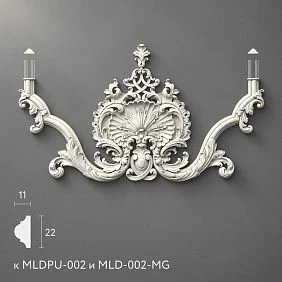
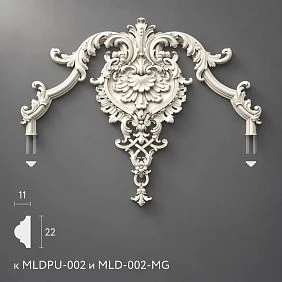
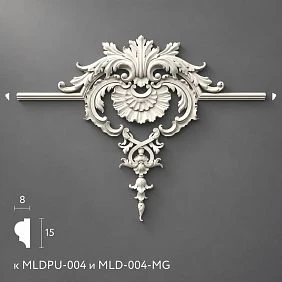
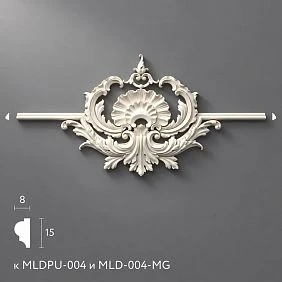
Decorative overlays are three-dimensional relief elements: ornamental, floral, geometric. They are mounted as accent details inside frames or as standalone accents;
-
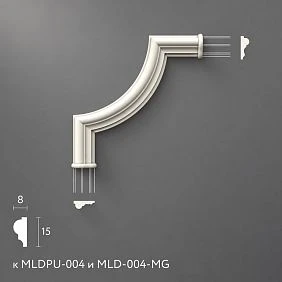
Corner elements are decorative inserts into the corners of molding frames, at the intersections of horizontal and vertical rods. Without them, the corner joints look rough;
-
Rosettes are round or polygonal overlay elements with symmetrical relief. They are used as central accents in frames, on wide walls, above a sofa, above a fireplace;
-
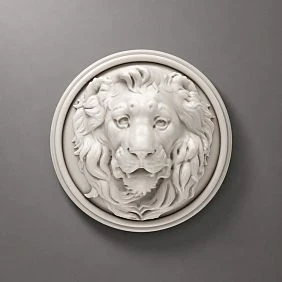
Relief Decorationare ornamental overlays with deep relief: acanthus leaves, cartouches, garlands, mascaron, geometric ornaments;
-
Decor for Moldingare special decorative elements mounted directly onto moldings: corner and intermediate overlays, central medallions for molding profiles;
-
Baseboards and cornices are the lower and upper belts of the wall, completing the plane from below and above;
-
Elements for the TV zone are frame compositions made of moldings, accent overlays around the perimeter of a niche or screen, horizontal and vertical rods to create a structure around the television.
Wall Decormade of polyurethane in STAVROS is divided into collections: "Neoclassic", "Versailles", "Peterhof", "Petersburg", "Tsarskoye Selo", "Pavlovsk", "Japandi", "Botanical Garden" and others. These are not just marketing names — behind each collection is a specific system of proportions, ornamental motifs, and combinable elements developed as a single whole.
polyurethane decorative elementsin these collections can only be mixed within one collection — this is fundamental. Mixing elements from "Versailles" and "Japandi" will create a stylistic conflict that cannot be fixed by repainting.




Why polyurethane is convenient for wall decor
An honest question to ask before buying: why polyurethane specifically? What makes it better than plaster, wood, PVC, MDF? The answer is based not on advertising, but on the practical characteristics of the material in relation to the task.
Our factory also produces:
Weight is the main advantage over plaster
Classic plaster stucco weighs 3–5 times more than polyurethane of the same size and relief. A typical plaster rosette with a diameter of 400 mm weighs 1.5–2 kg. A polyurethane one of a similar size weighs 300–400 g. The difference is critical during installation: heavy plaster requires anchor fastening, metal inserts, and precise positioning of the load-bearing wall layer. Polyurethane is mounted with assembly adhesive — quickly, without drilling, without dust.
This means:Polyurethane Itemsfor walls, you can install it yourself, without a construction crew, without renovations. And redo it if necessary — also.
Get Consultation
Precision and consistency
Polyurethane Decoris produced by casting into rigid molds: all copies of the same article are absolutely identical. Handmade plaster stucco has variations from cast to cast. If you need 8 identical corner inserts for four symmetrical frames — polyurethane will provide an exact match. This is especially important when creating geometric wall compositions.
Painting and integration into the interior
polyurethane decoraccepts any water-based or alkyd-based paint. This means complete freedom of color choice: white on a white wall (a subtle classic technique — the decor is invisible but creates relief); white on a dark-toned wall (pronounced contrast, Scandinavian accent); tone-on-tone with the wall with a slight lightening (characteristic of neoclassicism); gold or bronze patination (for a classic rich interior).
Moisture resistance and durability
Polyurethane moldingsis not afraid of moisture — which is critical for bathrooms, kitchen areas, and hallways with high humidity. Plaster, with chronic humidity, darkens, swells, and gradually deteriorates. Polyurethane does not.
The service life in normal interior conditions is practically unlimited: the material does not rot, does not crumble, and does not react to moisture. The paint lasts 7–10 years when using high-quality paints.
Suitable for any style
Polyurethane Items in the STAVROS catalog cover the full stylistic spectrum: from rich classics with deep ornamentation to minimalist profiles for modern neoclassicism and laconic moldings for Japandi-style interiors. This is not "stucco for classics" — it is a universal material for any interior context.
Wall moldings: the most popular way to decorate an interior
If you had to choose one element that produces the greatest visual effect with minimal cost and effort, it would be polyurethane wall moldings. It is they that form most of the "beautiful walls" found in professional interior photos and that you want to replicate in your own home.
What exactly does molding do to a wall? It creates a line — horizontal or vertical. The line sets the structure. Several lines assembled into a rectangle create a frame. The frame visually divides the plane into organized cells. This is the same principle that underlies classical architecture: a plane itself is not interesting, its structure is.
Frames from moldings: the main technique of wall decor
Frames from moldings on the wall is a classic and yet relevant decorative technique that is experiencing a renaissance in modern interior design. The essence is simple: several of decorative polyurethane moldings are assembled into rectangles forming a system of panels on the wall.
There are many application options:
-
One large frame across the entire width of the wall behind the sofa or above the headboard of the bed creates a focal point, the main visual accent of the room;
-
A system of several vertical frames of the same size is a classic panel look, characteristic of English interiors and French classics;
-
A horizontal belt of frames in the lower third of the wall imitates paneling with a high degree of visual richness;
-
An asymmetrical system of frames of different sizes is a modern interior technique for contemporary neoclassicism.
The size of the frames is selected based on the ceiling height and wall width. The basic rule: the frame should have an indent from the edge of the wall (or from the adjacent frame) of at least 15–20% of its own width. Frames placed too close to the edges or to each other create a feeling of tightness.
There should be a clear gap between the frames made of moldings and the ceiling cornice, typically equal to the width of one frame plus an indent. This creates "breathing" in the upper part of the wall and prevents the decor from "flowing" into the ceiling.
Decorating the wall behind the sofa
The wall behind the sofa in the living room is the most "loaded" plane in the room. Everyone who enters looks at it. It sets the tone for the entire interior.Moldings made of polyurethaneHere, several options work.
The first is a system of two to three vertical frames of the same size, arranged symmetrically relative to the center of the wall. This is a classic solution that looks equally good in a strict classical interior and in modern neoclassicism.
The second is one wide horizontal frame across the entire width of the wall with a small indent at the top and bottom. Inside the frame, you can place accent painting in a different tone or vertical wallpaper stripes. This creates the effect of an architectural niche without a real niche.
The third is a vertical belt of moldings from the baseboard to the cornice. The wall is divided into three parts: the left and right are decoration, the center is an accent with a sofa. It visually narrows a wide wall and gives it scale.
Moldings for the headboard of the bed
polyurethane wall moldingsbehind the bed is one of the most popular requests in interior decor. The logic is clear: the headboard is a functional and aesthetic zone of the bedroom that requires visual framing.
The frame of moldings behind the bed is equal in width to the width of the bed plus 20–30 cm on each side. The lower edge of the frame coincides with the upper edge of the bed headboard or is close to it. The upper edge of the frame is 30–50 cm below the ceiling.
Inside the frame, the following are appropriate: a different wall color, vertical wallpaper stripes with texture, decorative plaster, accent paint in a dark tone against a light frame. The central accent above the frame is a smallpolyurethane decorative overlaywith an ornament or a rosette.
Moldings in the hallway and corridor
The hallway is a tricky place: typically narrow, with limited walkway width and the need to place functional elements (coat rack, mirror, shelves).polyurethane decorative moldingshere they work as a way to add architecturality without clutter.
The best technique for a hallway: a horizontal molding belt at a height of 90–100 cm, dividing the wall into a lower panel part and an upper part. The lower part is painted in a dark tone, the upper part is light. This is a classic way to design a corridor, creating a sense of order and architectural completeness.
Moldings around a mirror in the hallway: a rectangular frame around the perimeter of the mirror made of profile rod is significantly more elegant than the mirror's frame profile. The mirror is "embedded" into the wall and becomes an architectural element.
Moldings around doors
A door opening without framing is incompleteness.Moldings made of polyurethanearound the perimeter of the door opening create a casing — an interior analogue of a facade window frame. This looks especially expressive in classic and neoclassical interiors: a door with a profiled frame and a keystone at the top becomes a full-fledged architectural element of the room.
Stucco on the wall: when rosettes, overlays, and ornament are needed
wall moldingis not the same as moldings. A molding creates a line. Stucco creates a relief image: ornament, figure, accent. Both categories are needed — but in different points of the interior.
When stucco works better on the wall than molding
Situation one: a large empty wall with a single frame of moldings. Inside the frame is just a painted plane without an accent. A smallDecorative stuccoin the center of the frame — an ornamental rosette or a relief cartouche — fills this void and creates a focal point.
Situation two: a classic interior where a single molding profile is not a rich enough solution. Here, moldings are supplemented withmolded decoration made of polyurethanein the corners of the frames, at the intersections of profiles, along the center of the top horizontal of the frame.
Situation three: an accent wall that should be clearly "richer" than the others. One wall in the living room (usually the one with a fireplace or TV) can carry significantly more decor than the other three. A symmetrical composition of molding frames with ornamental overlays creates the "main wall" of the room.
Symmetry as a principle of wall stucco
wall moldingis built on symmetry — this is almost a mandatory condition for classical and neoclassical interiors. Two identical ornamental elements on each side of the central point of the wall. Four corner decorative inserts in the corners of the frame. A central rosette above the headboard of the bed, symmetrically framed by two side overlays.
Asymmetrical arrangement of stucco elements is acceptable in modern interiors with a deliberately disrupted rhythm. But for classics — symmetry is mandatory.
Decor for moldings: corner and intermediate inserts
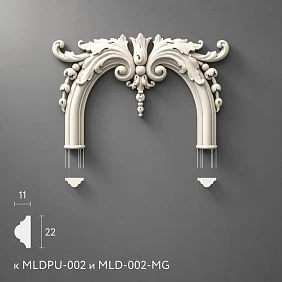
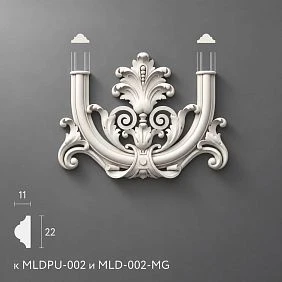
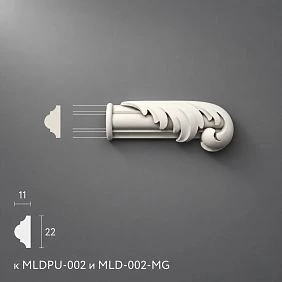
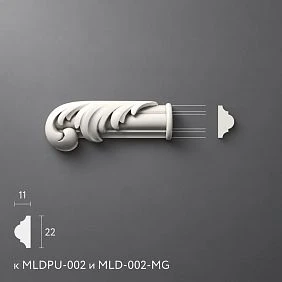
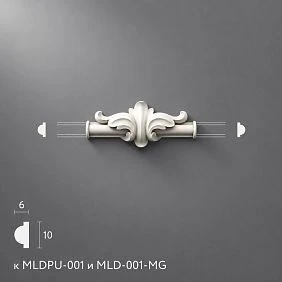
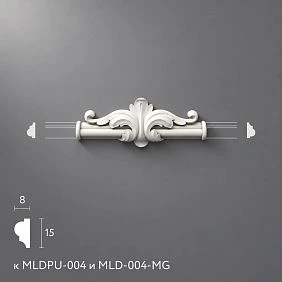
Decor for Moldingis a special category that is often overlooked when choosing. These are corner inserts mounted at the intersections of moldings at right angles, and intermediate overlays installed in the center of long straight sections.
Without corner inserts, the joints of moldings in the corners of frames look like simply connected profiles at an angle — this is acceptable but not beautiful. With a corner rosette or ornamental insert, the corner gains architectural completeness. This is a small detail that makes a big difference in the final impression.
Intermediate overlays on long horizontal moldings create rhythm and eliminate the monotony of a long profile. On walls wider than 3–4 m, one central overlay on the molding belt becomes an important accent.
Buy stucco decor and overlays
Buy Molded Decorationfrom polyurethane at STAVROS means choosing from a wide range of relief overlays: ornamental rosettes, cartouches with plant motifs, corner overlays with geometric or leaf ornament, central medallions, relief frieze strips for molding belts. All products are made of polyurethane with a closed-cell structure, the surface is ready for painting without preliminary priming of porous layers.
Where to use polyurethane wall decor
Understanding "what" is important. Understanding "where" is no less important. Each room has its own logic of wall decor, its own limitations, and its own possibilities.
Living room: main wall and TV zone
The living room is a space with the greatest potential for wall decor. Here there are large surfaces, high ceilings, the need to create a main accent wall, and structure the space.
Wall decor in the living room is built on the principle of hierarchy: one wall is "main," three are "supporting." The main wall (usually opposite the entrance or where the sofa is) gets maximum decor: molding frames, ornamental overlays, a high-profile ceiling cornice.
polyurethane wall decorThe TV zone is a separate task. A TV on the wall is a technological object, and simply "hanging it on a white wall" is not design. A molding frame around the perimeter of the TV zone visually integrates the screen into the wall's architecture. A horizontal shelf made of molding under the TV creates a line. Two vertical profiles on the sides add symmetry. All together — the TV zone as an architectural element, not just a device on the wall.
Stucco on the wall in the living room is appropriate in several places: corner inserts within frames, a rosette above the sofa in the center of the wall, an ornamental overlay in the upper belt above the molding.
Bedroom: headboard and calm rhythm
Wall decor in the bedroom requires a different approach. The bedroom is a space of rest. An excess of relief and richness of ornament here works against the atmosphere. Therefore, moldings for the bedroom are generally more laconic in profile, and frames are less saturated with ornament.
Moldings behind the bed in the bedroom are a key decorative technique. A frame from the width of the bed plus a symmetrical offset. Inside the frame — a neutral accent: a different shade of paint, textured wallpaper, horizontal stripes. This creates a headboard — even if there is no physical headboard.
Stucco molding at the headboard in the bedroom: a small symmetrical overlay or rosette centered on the top horizontal line of the frame above the bed. Nothing extra. One accent — in the right spot.
polyurethane wall moldingsIn the bedroom, profiles with a lower height are chosen than in the living room: 35–60 mm for a standard bedroom. A wider profile will create a feeling of overload.
Hallway and corridor: structure in a narrow space
Wall decor in the hallway solves a complex problem: the space is small, surfaces are narrow, and there are many functional objects. The task of decor is to add structure without cluttering.
A horizontal molding belt at a height of 90 cm is the best solution for a hallway. It creates a "low/high" division and allows working with color on two levels: dark at the bottom, light at the top — a classic technique for small dark corridors that visually expands the space.
Wall Decorative ElementsIn the hallway — minimal ornament: only molding profiles and possibly frames around the mirror and coat rack. No dense stucco ornament — it will feel oppressive here.
TV zone: architecture for the screen
Decor for the TV zone made of polyurethane is a topic that deserves special attention because the typical "problem" of the TV zone is familiar to most: the TV just hangs on the wall, and the wall around it is empty. Or — chaotically placed shelves and equipment that do not create any visual system.
Frames made of moldings on the wall around the TV form a clear architectural block. Vertical molding strips on the sides set the width of the zone. Horizontal molding below and above the screen creates "shelves" in the space. Corner overlays complete the intersections. The result: the TV stands in an architectural niche — even if drawn on a flat wall.
Wall DecorSTAVROS for the TV zone is available in collections where compatible molding profiles and decorative overlays are selected to create such compositions without the need to independently assemble compatible elements from different categories.
How to choose a wall decor style
Style is not "what I like prettier." Style is a system that must be followed consistently. By choosing a direction, you define the entire set of permissible tools: the molding profile, the depth of the ornament, the color scheme.
Neoclassicism: rigor and nobility
Neoclassicism is today the most popular request in the field of wall decor. It is classicism through minimalism: molding frames with laconic profiles without complex ornamentation, light walls with decor in a close tone, clean lines without overload.
Wall decor in neoclassicism is built on moldings: wide straight rods, simple rectangular frames, a horizontal belt. Ornamental overlays are minimal: only at key points (the center of the main wall, corner inserts in frames). The color of the decor is white, cream, or 2-3 tones lighter than the wall.
Moldings made of polyurethaneThe "Neoclassic" collection by STAVROS is specially designed for this style: laconic profiles with clear geometry, without historical ornaments, with a modern scale.
Classicism: richness and depth of relief
Full classicism is the other pole. Here the moldings are rich, the ornament is deep, the frames are complex. The "Versailles," "Peterhof," "Petersburg," "Tsarskoye Selo" collections are all about true historical stylization with a full set of elements.
Classical stucco on the wall involves:
-
complex cornice profiles in the upper part of the wall;
-
horizontal belt with ornamental band;
-
vertical pilasters or simple molding strips at corners and in piers;
-
frames with ornamental corner inserts;
-
central medallions or ornamental overlays inside frames.
Decorative stuccoin a classic interior, it's all about detailing. It's important not to overload, but also not to impoverish. Classics require a system: each element in its place, each carrying a load.
Modern interior: molding as an art object
A modern interior doesn't mean 'without decor'. Moldings in a modern interior work differently: they can be contrasting (dark molding on a light wall), graphic (wide flat strips instead of profiled strips), asymmetrical (deliberate violation of symmetry as an artistic technique).
polyurethane wall decorfor a modern interior, these are primarily simple profiles without ornamentation, used unconventionally: a very wide molding as a single horizontal strip, a system of several thin vertical strips, a decorative frame in a non-standard proportion.
Japandi and calm minimalism
Japandi is a style that combines Japanese minimalism with warm Scandinavian aesthetics. At first glance, polyurethane decor and Japandi seem incompatible. But this is not so: in this style, thin wooden moldings or laconic polyurethane strips of minimal profile are acceptable, creating a barely noticeable wall structure.
Laconic wall decor in Japandi style is a thin molding profile of 20–30 mm, creating a frame without noticeable thickness. Or a horizontal strip at a height of 120 cm, dividing the wall into two parts with different finishes. The "Japandi" collection at STAVROS is specifically designed with this logic in mind.
Mistakes when choosing wall decor
Knowing what not to do is as valuable as knowing what to do. Mistakes in wall decor repeat from project to project.
Too many elements on a small wall. A wall 2.5 m wide is not a place for three rows of molding frames with ornamental overlays in every corner. An overloaded wall creates visual noise. Rule: the smaller the wall, the less decor.
Thin molding on a high wall.polyurethane wall moldingsProfiles of 25 mm on a ceiling height of 3.5 m are simply not visible. The scale of the molding must match the scale of the room. For high ceilings, use wide profiles.
Incorrect frame height. A common mistake: frames are made too narrow in height relative to their width. The classic proportion of a vertical frame is 1:1.5 (width to height). A frame that is too wide and flattened looks "squashed."
Mixing styles within one room. Corinthian corner overlays in one frame and Art Deco molding in the next is a conflict. All wallPolyurethane Decordecor in one room should be from the same collection or at least from the same stylistic direction.
Lack of symmetry in a classic request. If you are creating a classic or neoclassical interior, symmetry is mandatory. An odd number of frames of different sizes without apparent meaning is not a "creative approach" but a mistake.
Installation without a layout plan.Wall moldingand moldings require a preliminary drawing — at least a schematic one. The placement of frames, their sizes, indents — all this needs to be recorded on paper before purchase. Otherwise, there will either be not enough elements or too many left over.
Installation on an unprepared wall. A dusty, damp, loose, or freshly painted surface is a poor base for mounting adhesive. The surface must be dry, clean, and primed. Details on preparation and installation technique are in the article aboutinstalling polyurethane moldingand in the guide toinstalling polyurethane molding STAVROS.
Different shades of white in different elements. Moldings from one manufacturer, overlays from another, a cornice from yet another source — and each has its own 'white'. After painting with one paint, the difference is smoothed out, but low-quality paint or different primers can give a noticeable color mismatch. All elements are from one catalog, everything is painted with one paint from one batch.
Can polyurethane decor be used not only indoors but also on the facade
Yes — but with a caveat.Polyurethane Itemscome in two types: for interior and for exterior use. These are different material compositions with different frost resistance and UV resistance characteristics.
Interior stucco on the facade is a critical mistake. Without UV stabilizers, polyurethane degrades under direct sunlight within one or two seasons: it yellows, becomes brittle, and loses relief detail.Facade Decorationis a separate product category with specially developed characteristics for operation in a temperature range from -40 to +60°C.
If you need to decorate not only the interior but also the facade, STAVROS offers a full range of exterior elements: cornices, molding belts, brackets, applied stucco elements, and linear profiles for facade corners and transitions. All are made from exterior-grade polyurethane and must be painted with facade paint containing a UV filter.
Where to buy polyurethane wall decor
STAVROS has been a manufacturer of architectural decor since 2002. The catalog includes a full range of decorative wall elements: moldings, overlays, rosettes, corner inserts, molding decor, and ready-made collections for various styles.
Buy polyurethane wall decorin STAVROS means choosing a ready-made collection (with pre-matched compatible elements) or selecting elements yourself by category. The catalog includes collections for neoclassicism, full classic, modern interior, minimalism, and Japandi.
Buy polyurethane wall moldingsis a section of profile trims with filtering by width, profile height, and style direction. For walls, ceilings, and door frames.
Buy Molded Decorationare ornamental overlays, rosettes, corner inserts, and central medallions for wall frames.
Decor for Moldingare corner and intermediate decorative inserts for the professional finishing of molding frames. This section is what distinguishes a quality result from "just attached profiles."
FAQ: Answers to popular questions
How to choose the right size molding for a wall?
Focus on ceiling height: for 2.7 m, use a 40–60 mm profile; for 3 m and above, use 60–90 mm. Molding frames should not occupy more than 70% of the wall area: leave "breathing space" around the perimeter.
Can polyurethane decor be painted to match the wall color?
Yes. This is a classic technique: decor in the same tone as the wall creates a subtle relief effect without strong contrast. Always paint from the same batch of paint — then the shade will be identical.
Is primer needed before painting polyurethane?
Yes, a special adhesion primer for polyurethane or a universal acrylic primer. Without it, the paint will apply unevenly and start to peel off.
What is used to glue polyurethane moldings?
Specialized mounting adhesive for polyurethane or liquid nails on a polyurethane base. Not epoxy adhesives or mounting foam — they can damage the material.
How to join moldings at the corners of frames?
At a 45° angle using a miter box or miter saw. The joint is additionally coated with glue and, if necessary, sealed with acrylic sealant followed by painting.
How to choose a collection for a neoclassical interior?
The "Neoclassic" and "Neoclassic Light" collections by STAVROS are specially designed for this style. "Neoclassic" is a more saturated system, "Neoclassic Light" is a minimalist option for more restrained interiors.
Can polyurethane wall decor be used in a bathroom?
Yes. Polyurethane is moisture resistant. It is important to use moisture-resistant paint and acrylic sealant on all joints — to protect against direct water ingress into the joints.
Where can I see the full catalog of STAVROS wall decor?
In the section. Clear lines, created using modern technologies, emphasize the strict aesthetics of the room. Each decorative element harmoniously fits into the overall concept, creating a sense of order and thoughtfulness. — with navigation by collections and categories. For moldings, there is a separate sectionof polyurethane moldings. For overlay elements, a sectionstucco decoration.