Article Contents:
- Why you should choose the finish before buying balusters, not after
- Which balusters are suitable for painting
- What matters for a good paint job
- Baluster shape for painting
- Beech balusters for painting: the best choice
- Which balusters are best for varnish
- What varnish highlights and what it reveals
- Oak under varnish: when texture is everything
- Beech under varnish: neatness, not expressiveness
- Ash under varnish: long fibers, Nordic restraint
- Turned balusters under varnish: relief in a favorable light
- Beech, oak or solid wood: what to choose for finishing
- Comparative table of wood species for different coatings
- Array: what this term means in practice
- White-painted balusters: a classic that never ages
- When choosing white balusters
- What matters when choosing balusters for white paint
- Balusters for stain and tinting: matching the color
- How tinting works on different wood species
- Matching the tone of the floor, steps, or furniture
- Tinting in wenge, walnut, and mocha: tips
- What to buy with balusters: a systematic approach to staircase finishing
- Why a set paints better than a collection of random elements
- Full list of elements painted in a single tone
- Compatibility of elements by profile
- Price of balusters for painting and varnishing: what the budget depends on
- Key factors affecting the price
- Approximate price ranges
- What to add to the budget besides balusters
- Mistakes when buying balusters for painting and varnishing
- Mistake 1: different wood species in one railing
- Mistake 2: chose expensive oak for white opaque paint
- Mistake 3: did not check the sanding grade
- Error 4: bought balusters without railings and posts from the same batch
- Error 5: stain on pine
- Error 6: didn't account for installation when choosing the shape
- Error 7: didn't take a spare
- How to choose balusters correctly: step-by-step algorithm
- Where to buy balusters for painting and varnishing
- About the Company STAVROS
- FAQ: Answers to Popular Questions
- Which balusters are best to buy for painting?
- Can wooden balusters be coated with varnish?
- What is better: painting or varnish for balusters?
- Do I need to buy railings and posts at the same time?
- Which balusters are best for white enamel?
- How to match the shade of the steps when tinting balusters?
- Where to buy wooden balusters for painting?
- How much do beech balusters for painting cost?
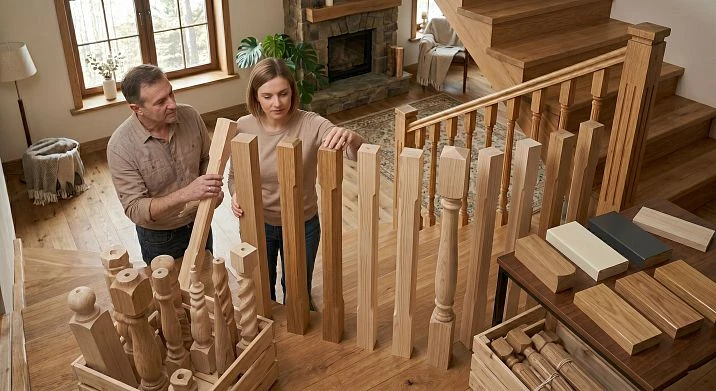
There are decisions made intuitively — and later regretted. Choosing balusters for finishing is one of them. A person looks at the shape, likes it — and buys. Then they paint, varnish — and realize: some balusters raise the grain after priming and require five sanding cycles, others drink paint like a sponge, and still others look dull under varnish because the wood grain is weak.
Correctly Buy wooden balusters for a specific coating — means deciding three things in advance: which wood species will give the desired result, which shape will look good after painting, and whether the surface is sufficiently prepared with factory sanding. These are not whims — this is basic logic, without which buying balusters becomes a lottery.
In this article, we will break down everything in order: which balusters are suitable for painting, which for varnish and tinting, how to choose beech or oak for each type of finish, and why buying balusters separately from handrails and posts is almost always a mistake.
Why the coating should be chosen before buying balusters, not after
Most people think differently: first buy, then figure out what to paint with. This is understandable logic — but in the case of balusters, it works against you.
Let's consider specific scenarios.
Scenario one. You want white balusters to match white enamel. You chose oak — beautiful, expensive. But under white opaque enamel, the oak grain completely disappears. You get a smooth white surface that could have been made from more affordable beech. The money for oak is wasted.
Scenario two. You want balusters under natural varnish to highlight the wood texture. You chose pine. Under clear varnish, pine gives a loose, yellowish surface with large resin streaks. Beautiful? It depends on taste. But if you wanted a pronounced grain, pine is not the best choice.
Scenario three. You chose balusters with deep carving for a complex wenge color stain. The stain applies unevenly: darker in the recesses, lighter on the protrusions. This is either an artistic effect or a defect — it depends on the painter's skill and your preference.
The conclusion is simple: the type of coating, wood species, and baluster shape are an interconnected system. The decision needs to be made comprehensively.
Which balusters are suitable for painting
Painting is an opaque coating that hides the wood grain. This provides freedom in choosing the wood species but imposes strict requirements on surface quality.
Our factory also produces:

What is important for good painting
Quality of sanding. For painting, the baluster should be sanded with a grit of at least P120–150. If the surface is processed more coarsely, after applying primer and paint, marks from the sander will be visible. This can be corrected with additional hand sanding before applying the coating. Clarify the processing class when ordering.
Absence of resin pockets. Pine releases resin when heated indoors — it pushes the paint from the inside. For painting, it is better to choose beech or oak.
Structure uniformity. The more uniform the structure, the smoother the paint will lay. By this criterion, beech is the leader: dense, even structure without open pores.
Get Consultation
Shape of balusters for painting
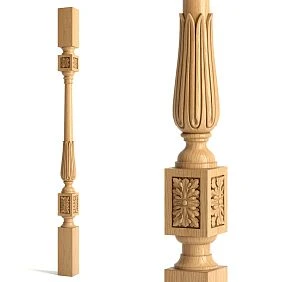
Square balusters are an ideal base for painting. Flat faces paint evenly, corners are sharp, the result is predictable. square balusters for stairs made of beech under white enamel is impeccable classic.
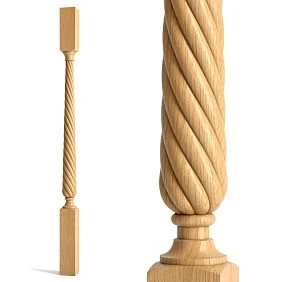
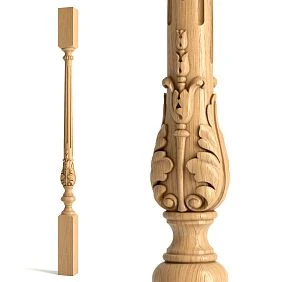
Simple turned balusters with 2-3 profile elements also paint well. The main thing is good sanding of the fillets (transition zones between profile elements). The brush should reach these places well.
Flat balusters are excellent for painting. A wide flat surface means ease of application, even results, quick drying. Buy flat balusters made of beech — and paint with a roller in two passes: the result is neat even without professional experience.
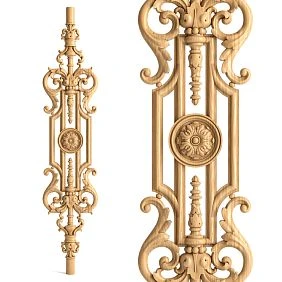
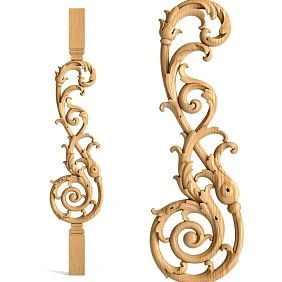
Carved balusters require patience for painting. Each carving element is a recess that needs to be painted with a brush, thoroughly. Under white paint, the carving creates a rich light-and-shadow relief — it looks luxurious. But the work is labor-intensive. Buy carved wooden balusters — and immediately budget for professional painting.
Beech balusters for painting: the best choice
Buy beech balusters — this is the first thing to consider when choosing balusters for painting. Reasons:
-
Beech does not resin: the coating holds without "breakthrough" from the inside
-
Uniform structure: primer and paint lay evenly, without spotting
-
Hardness 3.5 units on the Brinell scale: the painted surface is resistant to mechanical loads
-
Sands well: less time for preparation before painting
For white enamel, light gray, cream, or any opaque paint — beech works perfectly.
Which balusters are best for varnish
Under varnish — transparent, semi-matte, or glossy — the wood opens up. Here, not only the geometry and quality of processing matter, but also the wood species: its texture, tone, density.
What varnish emphasizes and what it exposes
Varnish is an honest coating. It does not forgive defects: every stain, scratch, unevenness, blue stain, or resin spot becomes visible in the final coating. That is why balusters for varnish have increased requirements for the quality of the blank and sanding.
What does the varnish want to see underneath:
-
Beautiful wood grain
-
Uniform tone without blueness or resin pockets
-
Fine sanding (P180–220)
-
Dense, closed structure
Oak under varnish: when texture is everything
Buy oak balusters under clear varnish — this is perhaps the best solution for a formal staircase in a classic home. Oak under varnish provides:
Golden-honey tone with dark fibers. Characteristic oak pattern — "feathery" moiré in radial cut, large pores, dark rays. This is not just a surface — it is a living texture that reads as natural material.
Dense surface. Oak absorbs little varnish, allowing a beautiful result in just 2–3 coats. Without excessive material consumption.
Coating durability. Oak hardness (3.7–3.9 Brinell) means the varnish coating lasts longer: the surface deforms less under load, the varnish does not crack.
Oak under glossy alkyd varnish — rich and solemn. Under semi-matte oil varnish — warm and natural. Under a tinted coating of "walnut" or "dark oak" — noble.
Beech under varnish: neatness, not expressiveness
Beech under clear varnish is more "beautifully neutral" than "bright." The beech pattern is subtle: fine pores, barely noticeable texture, even light tone. Under clear varnish, beech looks neat, but without the character that oak has.
When beech under varnish is justified:
-
When the steps are made of beech and the balusters must match in tone
-
When a light neutral tone without yellowness is needed
-
When the varnish is tinted: under a "bleached beech" or "white oil" tint, beech gives a soft Scandinavian look
Ash under varnish: long fibers, Nordic restraint
Ash is increasingly chosen for stairs in Scandinavian and modern styles. Under clear oil-varnish, ash gives a light, almost whitish surface with long longitudinal fibers. It is fresh, modern, and pairs beautifully with light interiors.
Turned balusters under varnish: relief in a favorable light
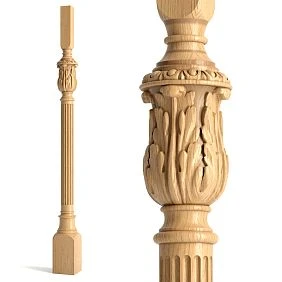
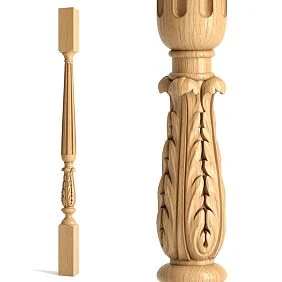
Under the varnish, the turned profile of the baluster acquires a special dimension. Each vase, each thinning casts its own shadow, creating a sculptural volume. The more complex the profile, the more interesting the play of light and shadow under the transparent coating.
Turned wooden balusters for stairs buy made of oak under a transparent glossy varnish — this is an image that never goes out of style, neither in a classic nor in a neoclassical staircase.
Beech, oak or solid wood: what to choose for the final finish
The question "what is better: beech or oak" comes up in every third consultation. The answer depends not on the abstract quality of the wood species, but on a specific decision: what you will cover it with and what image you want to achieve.
Comparative table of wood species for different coatings
| Criterion | Pine | Beech | Oak | Ash |
|---|---|---|---|---|
| Painting (white enamel) | Poor (resins) | Excellent | Good | Good |
| Tinting to walnut/wenge | Weak (uneven) | Good | Excellent | Good |
| Transparent varnish | Satisfactory | Good (neutral tone) | Excellent (expressive pattern) | Good (Scandinavian tone) |
| Oil (natural) | Satisfactory | Good | Excellent | Excellent |
| Price relative to oak | ×0,4–0,5 | ×0,7–0,8 | ×1 | ×0,8–0,9 |
| Hardness | 2.5 units | 3.5 units | 3.7–3.9 units | 3.5–3.8 units |
Solid wood: what this term means in practice
"From solid wood" means cut from a single piece without gluing or laminating. This is important for two reasons.
First, solid wood is sanded without the risk of "reaching a seam" — there are no layers, no joints. Under paint or varnish, there is no risk of delamination.
Second, solid wood provides a uniform coating across the entire surface: there are no areas with different densities that would absorb paint unevenly.
Buy wooden balusters from solid wood — means getting a workpiece that will behave predictably under any coating.
Balusters for white paint: a classic that never ages
White balusters are one of the most enduring interior images. Why? Because a white staircase railing is not a trend, but an architectural code tied to classical European tradition: palaces, mansions, elegant provincial homes.
When choosing white balusters
White balusters are organic in the following situations:
Classic and neoclassical interior. White balusters with a wooden or painted handrail, dark steps — a classic contrast. This technique works at any scale.
Bright interior with white walls. The railing "dissolves" into the space, leaving the emphasis on the steps and the shape of the staircase — not on the railing.
Contrasting pair. White balusters + dark handrail made of oak or walnut — this is an elegant design move. The dark handrail emphasizes the horizontal line, while the white balusters emphasize the vertical.
Staircases with a decorative niche or gallery wall. The white railing does not compete with the wall decor — it quietly holds the volume.
What is important when choosing balusters for white paint
For white enamel, choose beech: uniform structure, minimal pores, no resin. Under white paint, all these advantages of beech turn into an even, flawless coating without stains or unevenness.
Buy oak balusters for white balusters, this is a technically correct solution, confirmed by both painters and carpenters.
Shape for white paint: the more complex the carving, the more festive the effect, but the more difficult the painting. For DIY installation and self-painting — square or simple turned profiles. For a professional result — Carved wooden balusters under white enamel with a brush.
Balusters for stain and tinting: matching the color
Stain, oil-wax, tinting varnish — these are all types of coatings that change the tone of the wood while preserving its texture. This is the most delicate of the three types of finishes because the result depends on the wood species no less than on the coating itself.
How stain works on different wood species
The same stain tone gives different colors on different wood species. This is not a manufacturer defect — it's physics. More porous wood absorbs more pigment and yields a darker, richer tone. Dense wood gives a lighter, more even result.
Oak + walnut stain → rich dark brown with a moire pattern. Expressive and luxurious.
Beech + the same stain → lighter neutral brown. Even, without texture 'play'.
Pine + the same stain → blotchy result: resinous streaks and latewood stain unevenly. This is either a stylistic choice or a problem.
Matching the tone of floors, steps, or furniture
The goal 'I want the balusters to match the steps' is technically achievable but requires a proper approach.
If the steps are made of oak — Buy oak balusters and coat with the same stain. Same wood species + same coating = same result. This is the most reliable method.
If the steps are made of beech — similarly, use beech balusters for stairs and use the same coating. The tone will match by default.
If the steps and balusters are made of different wood species — get ready for fine-tuning the coating: different concentrations, different number of layers. This is a job for an experienced painter.
Toning for wenge, walnut, and mocha: tips
Dark tonings (wenge, mocha, walnut, rosewood) require:
-
A solid base: oak or beech — but not pine
-
Good sanding: under dark stain, scratches are clearly visible
-
Priming: without primer, the stain absorbs unevenly
-
Multiple coats: first — wood warming, second — main tone
Oak balusters under wenge — one of the most beautiful results. The oak pattern under dark stain becomes almost graphic: contrasting fibers on a dark background create an almost jewelry-like effect.
What to buy with balusters: a systematic approach to staircase finishing
A moment many realize too late: painting or varnishing a staircase is not coating individual elements. It is coating a system. And if the system elements are from different wood species, from different manufacturers — achieving a uniform tone is nearly impossible.
Why a kit paints better than a set of random elements
buy balusters and handrails from the same batch, same species, same manufacturer — this is the only way to guarantee:
-
Uniform density and surface porosity across all elements
-
Uniform absorption tone for any coating
-
Tone match after painting without manual concentration adjustment
A handrail from one oak supplier and balusters from another oak supplier are formally the same species. But different drying conditions, different batches of blanks, different humidity — and under the same coating they will give a different shade.
Complete list of elements painted in a uniform tone
-
Balusters
-
Handrail (in linear meters)
-
Supporting Wooden stair posts
-
Transition elements on landings
-
End caps and finials
All these elements must be ordered from the same batch. handrails and balusters made of wood from a single series — this is not over-insurance, but a basic condition for a good result.
Compatibility of elements by profile
Besides tone, the second critical parameter: the baluster tenon must fit precisely into the handrail groove. This is a geometric parameter that varies by 1–5 mm between different manufacturers. It seems like a small detail. But when installing 50+ balusters, this play turns into visible gaps or, conversely, the need to manually adjust each tenon.
buy staircase components from a single manufacturer — the only reliable guarantee of compatibility.
Price of balusters for painting and varnishing: what determines the budget
The price of a baluster is a variable that is important to understand correctly. Cheaper doesn't mean worse — but cheaper without understanding the differences means risk.
Key factors affecting the price
Wood species. Pine is cheaper than beech, beech is cheaper than oak. The difference between pine and oak is 2–2.5 times. But choosing pine for varnish or tinted oil means a loss in the result — and that means separate costs for rework.
Shape. Square baluster = minimum operations = minimum price. Simple turned = lathe, standard run. Complex turned = long processing program, slower = more expensive. Carved = lathe + milling machine = maximum labor intensity = highest price.
Processing class. Sanding P80 (basic) and sanding P180 (finish, for varnish) — different prices. For balusters under varnish, specify: "need finish sanding."
Size. Standard height — 900–1000 mm, diameter 45–55 mm. Non-standard sizes — custom order, higher price.
Order volume. A large batch is always more profitable than per-piece. Calculate accurately, order at once — do not reorder later.
Approximate price ranges
| Baluster type | Pine | Beech | Oak |
|---|---|---|---|
| Square 45×45×900 | from 1,400 RUB | from 2,100 RUB | from 2,900 RUB |
| Turned simple, ø50×900 | from 1,900 RUB | from 2,800 RUB | from 3,500 RUB |
| Complex turned, ø55×900 | from 2,400 RUB | from 3,400 RUB | from 4,200 RUB |
| Carved milling-turning | from 3,200 RUB | from 4,500 RUB | from 5,800 RUB |
| Flat, 900 mm | from 1,600 RUB | from 2,300 RUB | from 3,100 RUB |
Current Balusters buy price — in the STAVROS catalog with filtering by type, breed, size, and collection.
What to add to the budget besides balusters
-
Handrail: average price 1,200–2,500 RUB/linear meter depending on profile and wood species
-
Support posts: 4,000–12,000 RUB/piece depending on size and wood species
-
Fasteners (studs, nuts, glue): 3,500–6,000 RUB for a full set of 50+ balusters
-
Painter's work for painting/varnishing: a separate item, depends on region and volume
Mistakes when buying balusters for painting and varnishing
This is not theory. Each of the mistakes below occurs regularly — and each one results in rework or extra costs.
Error 1: different wood species in one railing
We took beech balusters, an oak handrail — "it's the same wood, it'll be fine." Painted with white enamel. Fine. Tinted with walnut stain — not fine at all: beech gave a light coffee tone, oak gave a rich dark brown. Two elements in one railing, two different colors.
Solution: one wood species for all elements.
Mistake 2: chose expensive oak for white opaque paint
Oak under white enamel looks like beech in the end. The texture is hidden, the difference is invisible, money wasted. Oak is for clear varnish or stain where its grain is visible.
Error 3: didn't check the grinding class
We took balusters with basic grinding P80 — and under varnish we got visible scratches from the sander. Manual finishing of each baluster was required before coating. When ordering a batch of 50 pieces, this is a significant labor cost.
Solution: when ordering balusters for varnish, specify the grinding class and, if necessary, pay extra for finishing.
Error 4: bought balusters without handrails and posts from the same batch
We bought balusters — enough for now, we'll buy the handrails later. Then we bought a handrail from a different batch. Under the same coating — a different shade. Repainted — another shade. Once more — a bit closer. And so on for four iterations.
Solution: balusters, posts, and handrails buy at once, from one batch, from one manufacturer.
Mistake 5: stain on pine
"I want dark walnut, I'll take pine — it's cheaper." Pine under walnut stain gives uneven results due to the difference in density of early and late wood. The striped, spotted effect is not walnut, it's ruined pine.
For tinting to imitate expensive species — oak or beech. No compromises.
Mistake 6: didn't account for installation when choosing the shape
Carved balusters with deep relief — painting with a brush, access to every recess. For DIY installation without experience, this is a challenge. You can coat them well, but it takes time and patience. For simple DIY painting — square or simple turned balusters. Details on installation — in the instructions installation of wooden railings and balusters.
Error 7: didn't take a spare
"I'll take exactly as many as needed." Several balusters were damaged during installation, one chipped during sanding, one was cut in the wrong place. Reordering means waiting and, possibly, a different batch with a slightly different shade.
Rule: +10% to the calculated quantity always.
How to choose balusters correctly: step-by-step algorithm
Let's put it all together into a practical sequence.
Step 1. Determine the type of finish coating: white paint / colored paint / clear varnish / tinting (stain, oil).
Step 2. Choose the wood species: for painting — beech; for clear varnish — oak; for light oil — beech or ash; for tinting — oak or beech.
Step 3. Choose the shape: simple task (DIY painting) → square or simple turned; maximum decorative effect → carved; country and naturalness → flat; modern minimalism → square.
Step 4. Specify the processing class: for varnish → final sanding P180–220; for paint → standard P120–150.
Step 5. Calculate the quantity based on the length of the flight and the installation step. Add 10% reserve.
Step 6. Order in one set: Buy balusters and posts for a wooden staircase + handrail + fasteners. All from the same batch, same wood species.
Where to buy balusters for painting and varnishing
balusters for staircase to buy Directly from the manufacturer — the best price, system order, and free consultation for selection based on your specific coating.
In the STAVROS catalog:
-
Over 50 baluster models for any finish
-
Species: oak, beech, pine, ash
-
Shapes: turned, carved, square, flat
-
Support posts, handrails, and staircase components from the same series
-
Kiln drying to 8–10% moisture — stable geometry during painting
-
Free calculation of the kit for your dimensions
About the company STAVROS
STAVROS is a Russian manufacturer of solid wood products since 2002. Full production cycle: drying, turning and milling on CNC machines, multi-stage sanding. Balusters from the catalog are ready for coating with paint, varnish, stain or oil — the surface is prepared according to finishing requirements.
System approach: all railing elements — balusters, posts, handrails, and fasteners — are produced within unified series with guaranteed compatibility. One order, one delivery, one batch.
Pickup from Moscow and St. Petersburg. Delivery throughout Russia. Managers will help you choose balusters for coating, calculate the quantity and create a full specification.
FAQ: Answers to popular questions
Which balusters are best to buy for painting?
For opaque painting — wooden beech balusters: uniform structure, no resin, smooth coating. Shape — square or simple turned for easy application, carved for decorative effect.
Can wooden balusters be coated with varnish?
Yes, and this is one of the best options for oak balusters: clear varnish highlights the texture and grain of the oak. Important: balusters for varnish must have a final sanding of P180–220.
What is better: paint or varnish for balusters?
Paint — if you need to match the interior color, hide the texture, make a white railing. Varnish — if you want to preserve and emphasize the natural wood grain. For varnish — oak or ash.
Do I need to buy handrails and posts at the same time?
Absolutely. Only when ordering from the same batch and same wood species will all elements have the same tone under any coating.
Which balusters are best for white enamel?
Beech: uniform structure, no resin secretions, paint applies evenly. Shape — square or turned. Carved ones provide a decorative light-and-shadow effect.
How to match the tone of the steps when tinting balusters?
Buy balusters from the same wood species as the steps. One species + one coating = identical result.
Where to buy wooden balusters for painting?
In the STAVROS catalog — with consultation on selecting the species and shape for a specific coating, free calculation of the set, and systematic ordering.
How much do beech balusters for painting cost?
Approximately from 2,100 rubles for a square one to 4,500 rubles for a carved one. Current prices are in the stavros.ru catalog with filtering by model.