Article Contents:
- Natural Wood — Classic Interior Cladding
- Plank — Universal Solution for Any Room
- Wall Panels Boiserie — Aristocratic Luxury
- Lath Systems — Modern Interior Graphics
- Polyurethane Moldings — Classic Without Weight
- Moldings and Baseboards — Finishing Details
- Crown Molding — Framing the Upper Zone
- MDF Panels — Practicality and Versatility
- Combined Finishing — Multi-Layer Composition
- Foundation Preparation — The Foundation of Quality
- Installation Technologies for Various Materials
- Final Finishing — The Final Touch
- Stylistic Solutions for Interior Finishing
- Functional Aspects of Wall Finishing
- Ecological and safe materials
- Care and maintenance of various materials
- Economic Aspects of Material Selection
- Popular Questions About Interior Wall Finishing
- Which Material is Better for Finishing Walls in a Wooden House?
- Can Wooden Panels Be Used in a Bathroom?
- How Much Does Boiserie Wall Finishing Cost?
- How Long Does Spruce Plank Last?
- How Does Polyurethane Moldings Differ from Gypsum?
- Do Walls Need to Be Level for Wooden Panels?
- What Wall Color is Currently Trendy?
- Can Finishing Be Installed by Yourself?
- Conclusion

Walls Define the Character of Living Space — Do You Feel the Warmth of Natural Wood or Are You Enchanted by the Elegance of Molded Decor?Internal wall finishingHas become an art where functional tasks merge with aesthetic aspirations, creating interiors that serve for decades. Modern materials and technologies open boundless possibilities for transforming any space, whether an urban apartment or a country house, allowing to realize the most daring design concepts.


Natural Wood — Classic Interior Cladding
Wood remains an unmatched material for creating cozy and eco-friendly interiors.Wooden materials for interior wall finishingThey possess unique properties — natural texture creates visual depth, tactile warmth of wood contrasts with cold synthetic materials, ability to regulate humidity forms a healthy microclimate. Each wood species carries its own character: oak embodies aristocratic strength, beech — Scandinavian elegance, ash — modern minimalism.
Solid panels made of natural wood create a monumental base forinner wall claddingwhere each element emphasizes the status of the space. The panel manufacturing technology includes chamber drying to 8-10 percent humidity, which eliminates deformation after installation. Four-sided planing ensures ideal geometry, and size calibration to the millimeter guarantees tight joints without gaps.
wooden claddingwooden claddingeven in rooms with increased humidity.




Plank is a universal solution for any room
Wooden plank consists of profiled boards with tongue-and-groove joints, creating a continuous cladding surface without visible gaps. Thismaterial for interior workcombines accessibility with high performance characteristics, allowing to quickly transform any room. Plank hides wall irregularities, provides additional thermal insulation, and creates a ventilated space between cladding and base.
profiles of plank differ by the configuration of the front surface. Euro-plank has a deeper groove and ventilation grooves on the back side, shiplap plank creates almost a smooth surface without visible seams, block-house imitates a round-edged log. The choice of profile determines the visual characterwall finishes— from modern minimalism to cozy rustic aesthetics.
Wood species for plank are selected depending on operating conditions. Spruce remains a popular choice due to its affordable price and pleasant pine aroma, larch surpasses other species in moisture resistance and durability, cedar creates a healing atmosphere due to phytoncides. Grade affects appearance and cost — Extra grade has no knots or defects, grades A and B allow healthy knots, creating a characteristic natural pattern.
Our factory also produces:

Boiserie wall panels — aristocratic luxury
Boiserie are a system of decorative panels with framed and molded construction, transforming walls into architectural artworks.wall panels boiserieHistorically, they adorned palace interiors, and today they are accessible for creating status spaces in private residences, reception halls, and premium projects. Each panel consists of a framing, central molding, decorative appliqués, and moldings — these elements create a multi-layered composition with depth and perspective.
Boiserie manufacturing technology requires the highest level of carpentry craftsmanship. Frames are assembled from solid wood with tongue-and-groove joints, moldings can be flat or relief, carved appliqués are made on high-precision CNC machines or by hand using traditional methods. Finish includes multi-layer sanding, priming, painting, or toning while preserving wood texture. Patination, gilding, and brass inlay add individuality to each project.
Functional advantages of boiserie go beyond decorative aspects. Panels hide wall irregularities without requiring leveling, create additional sound insulation, and form an air gap for thermal insulation.Internal decorative wall claddingPanels allow integrating hidden storage systems, concealing engineering utilities, and zoning space without additional partitions.
Get Consultation
Lath systems — modern interior graphics
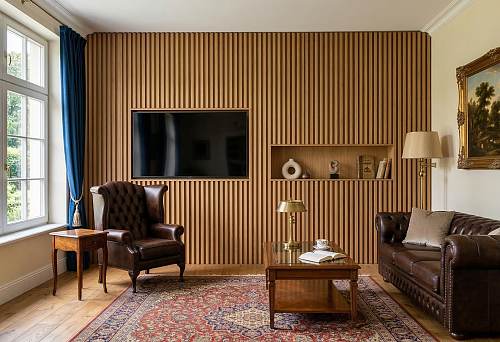
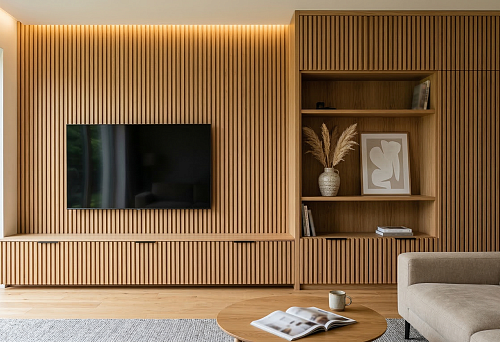
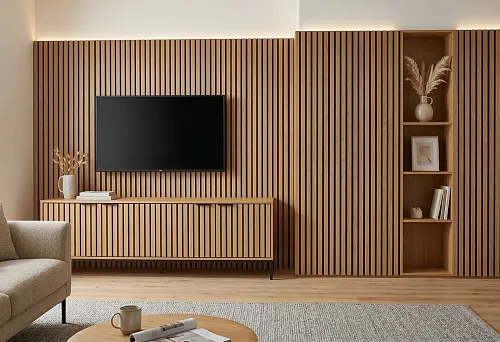
Wooden laths have become a symbol of modern design, where minimalist form combines with the expressiveness of natural material.Wall cladding with wooden lathsCreates a rhythmic structure that organizes space without physical barriers. Vertical laths visually raise the ceiling, horizontal laths expand narrow rooms, diagonal placement adds dynamism to static spaces.
Lath systems are installed on hidden framing using clips or clamps, which secure each plank without visible fasteners. The technology allows creating perfectly flat surfaces with uniform gaps.
Installation of track systems is performed on a hidden substructure using clamps or clips that secure each rail without visible fasteners. The technology allows creating perfectly flat surfaces with uniform gaps.How to finish interior wallsfor creating a modern interior — lath systems provide the answer, combining functionality with minimalist aesthetics.
Polyurethane molding — classic without weight
Polyurethane elements revolutionized the possibilitiesinternal wall finishingby offering an alternative to traditional plaster molding. The material’s lightness — the weight of a polyurethane element is 5-7 times less than that of a plaster equivalent — radically simplifies installation and eliminates the risk of collapse even for large compositions. Moisture resistance allows using decor in bathrooms, kitchens, and pools without risk of deformation or damage.
Polyurethane molding production technology is based on precision casting into high-precision molds reproducing the finest ornament details. Two-component polymer system creates a dense structure with closed pores, ensuring strength with phenomenal lightness. Elements are produced with ideal geometry, guaranteeing tight joints when installing long compositions.
The assortment of polyurethane wall elements includes moldings of various profiles, pilasters and half-columns, decorative panels and medallions, corner elements and rosettes, cornices and baseboards. Combining elements allows creatingdecorative wall finishesany complexity — from simple framed compositions to multi-level panels with relief.
Moldings and baseboards — finishing details
Moldings create structure on wall surfaces, dividing them into separate zones and forming a geometric composition.Wall decorative finishing systemis built on the combination of moldings of different widths and relief heights. Wide profiled moldings form the main composition frame, narrow strips fill the inner space of frames, decorative inserts add ornamental accents.
Molding materials differ by their performance characteristics and aesthetics. Solid oak or beech wood moldings create a warm classic atmosphere, polyurethane elements provide moisture resistance and easy installation, polystyrene profiles offer an economical solution for budget projects. Material selection is determined by interior style, usage conditions, and project budget.
Wooden skirting boardscomplete wall finishing, creating a transition to flooring. The height of the baseboard affects the visual perception of space — standard profiles 60-80 mm suit most interiors, high baseboards 100-120 mm create monumentality characteristic of classical interiors. The profile can be straight for modern spaces or ornate with cornices for traditional styles.
Crown moldings — framing the upper zone
Ceiling moldings create a smooth transition from wall to ceiling, visually increasing room height and completing the composition.Wooden and polyurethane crown moldingsdiffer in scale, profile complexity, and ornament character. Simple cornices create a minimalist transition for minimalist interiors, elaborate multi-tiered moldings with modillions form rich plasticity in classical spaces.
Wooden crown moldings are made from solid oak, beech, or ash, followed by processing on high-precision equipment. Kiln-drying wood to 8-10% moisture content prevents deformation after installation. Multi-spindle milling creates complex profiles with sharp edges and smooth transitions. Gradual reduction of abrasive grit during sanding ensures a smooth surface.
Polyurethane crown moldings offer a practical alternative to traditional wood. The material’s absolute moisture resistance allows use in any type of room, lightweight construction simplifies installation even on gypsum board structures, and flexibility of certain models enables decorating curved surfaces.Polyurethane wall molding and wooden crown moldingcreate an exquisite duet, where classic aesthetics combine with modern technologies.
MDF panels — practicality and versatility
MDF is a medium-density fiberboard that combines accessibility with excellent performance characteristics. Its smooth, uniform surface is ideal for painting in any color, veneering with natural veneer, or laminating with decorative films.Materials for interior workbased on MDF, allow creating interiors of various styles with optimal price-to-quality ratio.
MDF wall panels are available in various formats. Large-format sheets speed up installation of large areas, slat panels create modern graphics, framed compositions imitate classic bouquets. Profiled panels with milled relief add volume to flat surfaces. Flexible panels made of thin MDF allow decorating curved walls, columns, and arched openings.
Finish of MDF panels determines their visual character. Painting with enamel creates a smooth glossy or matte surface in rich colors, veneering with natural oak or ash veneer gives the appearance of solid wood at a lower cost, laminating films simulate various textures from stone to fabric.How to finish interior wallsconsidering budget — MDF panels provide a universal solution.
Combined finishing — multi-layer composition
Combining different materials on one wall creates a rich textured composition, where each element plays its role. Wooden panels form the basic structure, polyurethane overlays add decorative accents, moldings frame zones, creating architectural logic.Interior wall claddingusing combined materials requires precise planning and professional execution.
The technology of combined finishing implies layered installation of elements. The base layer — wooden panels or MDF — is installed on a frame, creating a flat surface. Overlay elements are attached over the base using adhesive compositions, forming a relief composition. Moldings and strips are installed as the final layer, framing separate zones and forming a complete structure.
Color solutions for combined finishing can be based on contrast or harmony of shades. Natural wood with white moldings creates a classic combination of restrained elegance, tinted panels with gilded overlays form palace luxury, monochromatic solutions in a single palette emphasize the relief and shape of elements.Wall cladding optionsusing combined materials are limited only by the designer’s imagination.
Foundation preparation — the foundation of quality
The quality of the final finish directly depends on proper wall preparation. Inspection of the base reveals defects that must be addressed — cracks, unevenness, peeling of old coatings. Measuring wall verticality and flatness determines the need for leveling.Materials for interior workFrame-based systems are less demanding regarding wall flatness compared to adhesive systems.
Wall leveling is performed using plastering or drywall systems. Plastering allows eliminating minor unevenness and creating a monolithic surface, while drywall on a metal frame more quickly levels significant defects and forms an ideally flat plane. Priming the prepared surface improves adhesion of finishing materials, reduces absorption of the base, and strengthens the surface layer.
The framing for panel systems is made from wooden beams or metal profiles. Vertical studs are installed at 400-600 mm intervals depending on the cladding type, horizontal crossbars reinforce the structure. Leveling the framing in a single plane is critically important for creating a smooth finish surface. Treating wooden framing with antiseptics prevents biological degradation.
Installation technologies for various materials
Veneer installation is performed using hidden mounting with clips or finishing nails through the groove. The first board is set strictly vertically according to level, each subsequent board is tightly inserted into the groove of the previous one and secured to the framing.wooden plank claddingRequires material acclimatization — boards are left in the room for 2-3 days to adapt to the microclimate.
Installation of buazery wall panels begins with mounting frame elements that form the composition's frame. Frames are attached to the wall via hidden brackets or directly to the framing. Panels are inserted into frame grooves, decorative overlays are mounted in the final layer. Assembly accuracy is critical — even millimeter deviations disrupt symmetry and spoil the overall impression.
Polyurethane elements are installed using a special adhesive that ensures secure fixation on any base. The wall surface must be clean, dry, and primed. Adhesive is applied with a notched trowel to the back of the element, the part is pressed firmly against the wall and secured until it sets. Joints between elements are filled with acrylic sealant, which is sanded flush after drying.
Final finish — the finishing touch
Painting wooden surfaces requires careful preparation. Sanding with gradually decreasing grit creates a smooth base, priming seals pores and equalizes absorption.Interior Wall Finishes PhotoDemonstrates various types of finish coatings — from transparent varnishes preserving wood texture to opaque enamels in rich colors.
Staining wood changes its color while preserving visible texture. Stains based on water, alcohol, or oil penetrate wood pores, coloring fibers from within. Patination creates an effect of noble antiquity — dark pigment is rubbed into recesses of the relief, remaining in the texture after light sanding to emphasize volume. Gold or silvering individual elements adds luxury to classic interiors.
Protective coatings extend service lifewall finishing in apartmentsand simplify maintenance. Water-based varnishes are eco-friendly and odorless, polyurethane varnishes create a durable coating resistant to abrasion, oil-based compositions highlight texture and impart a silk-like finish. Wax finish forms a pleasant-to-touch surface with matte sheen but requires periodic renewal.
Stylistic solutions for interior finishing
Classic style requires use of natural materials with rich decorative detailing.wall panels boiserieWith carved appliqués, pilasters with capitals, developed cornices with modillions create an atmosphere of aristocratic luxury. Color palette is built on noble tones — creams, beiges, gray-blues with accents of gold or patina.
Modern minimalism prefers simple forms and natural textures. Light wood lath systems, smooth panels primed for neutral tones, simple moldings without ornament create a calm space without visual noise.Wall cladding optionsIn minimalist style, construction is based on texture and volume play with minimal decorative elements.
Scandinavian style combines warmth of natural wood with white surfaces and abundance of light. Vertical light wood paneling, painted with white matte paint, creates a backdrop for accent walls of natural wood. Tall white baseboards and simple cornices complete the composition, forming an interior inviting relaxation and calm.
Functional aspects of wall finishing
Sound insulation becomes critical in multi-apartment buildings where protection from neighbor noise is required.Wooden wall claddingOn framing with air gap filled with sound-absorbing materials, noise level is reduced by 15-25 decibels. Mineral wool with density 40-60 kg/m³ effectively absorbs sound waves, while wood additionally disperses sound due to fibrous structure.
Thermal insulation increases room energy efficiency and creates a comfortable microclimate. Air gap between cladding and wall acts as an additional thermal insulation layer, insulation in framing enhances this effect. Wooden panels have low thermal conductivity, so wall surface remains warm to the touch even when room air is cool.
Humidity regulation — a unique property of natural wood, which absorbs excess moisture when humidity increases and releases it when air dries. This creates a stable microclimate without need for technical humidification systems.wall finishing materialsMade from wood, they form a healthy atmosphere, especially important for children's rooms and bedrooms.
Ecological and safety of materials
Natural wood remains the most ecological material forinternal wall finishingnot emitting harmful substances during use. FSC certification guarantees that wood is sourced from responsibly managed forests where reforestation is practiced. Water-based protective compositions without volatile organic compounds ensure safety for home occupants' health.
Polyurethane produced in modern times is a chemically neutral material that does not emit toxic substances at normal operating temperatures. Its dense structure with closed pores does not accumulate dust and does not promote the growth of microorganisms. MDF is produced using binders based on melamine or polyurethane resins, which are safer than traditional formaldehyde-based compositions.
The hypoallergenic nature of materials is important for people with heightened sensitivity. Wood does not cause allergic reactions, polyurethane elements are inert to biological agents, and high-quality MDF with low volatile compound content is suitable even for children's facilities.How to finish interior wallsConsidering ecological requirements — choosing natural and certified materials ensures a healthy environment.
Care and maintenance of different materials
Wooden surfaces require regular but simple maintenance. Dry cleaning with a soft cloth or vacuum cleaner with a brush attachment removes dust without damaging the finish; wet wiping is permissible for surfaces with protective lacquer or oil-based coatings. Periodic renewal of the wax coating restores protective properties and appearance.Wooden wall claddingMaintains beauty for decades with minimal maintenance.
Polyurethane elements require no special care due to their moisture resistance and resistance to contamination. Wet cleaning with a soft cloth and neutral cleaning agents maintains surface cleanliness. Colored elements can be repainted if desired to change the interior color scheme without replacing the decor. The material does not crack, deform, or flake during use.
MDF panels with quality finishes are resistant to abrasion and mechanical damage. Laminate surfaces can be wiped with a damp cloth; enamel-coated surfaces can be cleaned with cleaning agents. Local damage to painted panels can be repaired by touch-up without replacing the entire element. The durability of quality panels is 15-20 years under proper usage conditions.
Economic aspects of material selection
Priceinternal wall finishingThe cost consists of material and installation work. Spruce siding is the most budget-friendly option for wooden cladding; MDF panels offer a compromise between price and quality; solid oak panels belong to the premium segment. Polyurethane molding is cheaper than gypsum molding for comparable decorative qualities.
Material durability affects the total cost of ownership. Quality wooden cladding lasts 30-50 years without replacement; polyurethane elements retain their properties for decades; MDF panels last 15-20 years. Inexpensive materials with short service life require more frequent replacement, increasing total costs. Investment in quality materials...Materials for interior work...is paid off by durability and preservation of aesthetic qualities.
Installation complexity determines labor cost. Simple siding is installed faster than Boiserie panels; rail systems with clip fasteners are installed faster than adhesive compositions. DIY installation is possible for simple systems with basic skills; complex projects require professional execution. Installation quality critically affects the final result and durability of the finish.
Popular questions about interior wall finishing
What material is better for wall finishing in a wooden house?
Siding or solid wood panels of the same species create unity with the house structure. It is important to ensure a ventilated gap between the cladding and the wall to prevent condensation.
Can wooden panels be used in a bathroom?
Yes, provided the wood is treated with moisture-resistant compounds. The best choice is larch or thermally modified wood, which naturally resist moisture.
How much does Boiserie wall finishing cost?
The cost depends on project complexity and materials. A basic MDF solution for painting — from 15,000 rubles per square meter; premium solid oak panels with carving — from 40,000 rubles per square meter.
How long does spruce siding last?
With proper installation and maintenance, spruce siding lasts 20-30 years. Protective coating requires renewal every 5-7 years to maintain appearance.
How does polyurethane molding differ from gypsum molding?
Polyurethane is 5-7 times lighter than gypsum, completely moisture-resistant, does not crack, is easy to install, and is cheaper. Gypsum has a more pronounced surface texture.
Do walls need to be leveled for wooden panels?
Panels are mounted on a subframe that compensates for unevenness up to 3-5 cm. A perfectly flat surface is not required, simplifying preparation.
What wall color is currently in style?
Natural tones — warm beige, terracotta, olive, gray-blue. Natural wood texture remains timeless and relevant at any time.
Can finishing be installed by oneself?
Simple systems — siding, rail panels — are suitable for DIY installation. Complex Boiserie projects are better entrusted to professionals.
Conclusion
Interior wall finishing defines the character of living space, creating an atmosphere in which one wishes to live. Modern materials and technologies offer solutions for any task — from budget projects to exclusive premium-class interiors. Natural wood retains its position as the most desired material due to its eco-friendliness, beauty, and durability. Polyurethane decor opens opportunities to create classic interiors without the technical complexities of traditional molding.
How to finish interior wallsFor creating a unique interior — the choice depends on stylistic preferences, functional requirements, and project budget. Combining different materials allows achieving an optimal balance between aesthetics and practicality. Professional design and quality installation guarantee long-term durability and preservation of beauty for decades.
STAVROS offers a full range of premium-quality solutions forinternal wall finishingincluding wooden planks from various species, solid panels for boiserie, lath systems of all sizes, polyurethane moldings and trim, MDF panels for painting. In-house full-cycle production guarantees the quality of each element, precise dimensions, and the possibility of custom manufacturing.
STAVROS's team of professional designers and technologists accompanies each project from concept to final installation. On-site measurements available in any region of Russia and the CIS, 3D visualization of the future interior, engineering design considering all technical details, optimal material and finish selection. A comprehensive approach ensures flawless results that exceed client expectations.
STAVROS showrooms in Moscow and Saint Petersburg allow you to view material samples, assess craftsmanship quality, and receive professional consultations. A personal manager coordinates all project stages, ensuring timely completion and adherence to agreements. Choosing STAVROS products means investing in the beauty, comfort, and longevity of an interior that will delight you for many years.