










































































Article Contents:
- The four sizes of NPU-092 should be read as four scales of one task
- The scale does indeed grow sequentially, but there is no need to promise a mathematical 1:1 increase
- Why one template is not enough
- For smooth door
- For paneled
- For frame front
- For drawer
- 293 × 50 × 10 mm: compact fields and narrow drawers
- 352 × 60 × 12 mm: transitional scale between drawers and doors
- 469 × 80 × 15 mm: scale for wide doors
- 600 × 102 × 21 mm: maximum version for the main front
- Wardrobe with doors 720, 560 and drawers 380 mm
- Facades of different widths within one frame
- Drawers of two sizes under one countertop
- Central facade without NPU-092
- Two NPU-092 on a very wide facade
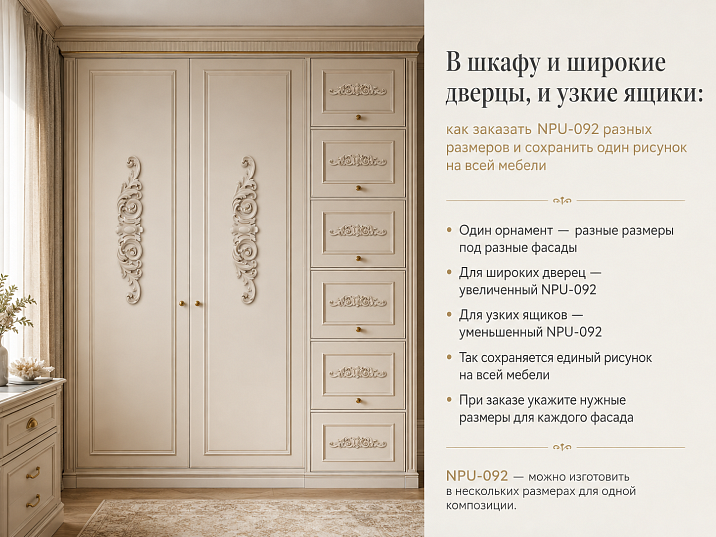
A wardrobe rarely consists of identical rectangles. In the center there may be two wide doors, on the sides narrow sections, at the bottom a row of drawers, nearby a dresser or nightstand from the same set. If you select a separate overlay for each surface, the furniture quickly turns into a collection of different ornaments. NPU-092 offers another path: one article number is available in four sizes at once, so the same decorative motif can be tried on facades of different scales.
The NPU-092 card lists four options: 293 × 50 × 10 mm, 352 × 60 × 12 mm, 469 × 80 × 15 mm, and 600 × 102 × 21 mm. All are made of polyurethane. This gives the buyer a rare opportunity in furniture decor to build not "identical overlays on all doors," but a family of related accents: a compact version for a narrow drawer, a medium one for a door, a large one for the central facade. At the same time, the article number and the character of the ornament remain the same.
This approach is especially convenient when the furniture is already designed and the facades have different widths. Instead of searching for four similar patterns, it is enough to select four scales of one model. But here you cannot buy "by name" and hope that one size will fit all the furniture. The article number is one, but there should be several order lines. This very idea becomes the basis of a correct specification.
If the task is to preserve one ornament on a wardrobe, dresser, or set, you can buy molded decor NPU-092 after each facade has already been assigned to its size group. Then the product card becomes not a place of random choice, but the last step after marking.

The four sizes of NPU-092 should be read as four scales of one task
At the first stage, it is useful to forget about the price and look only at the geometry.
| Variant NPU-092 | Size, mm | Price at the time of check | Preliminary fitting scenario |
|---|---|---|---|
| Small | 293 × 50 × 10 | 1 290 ₽ | Narrow drawers, compact doors, small panels |
| Medium | 352 × 60 × 12 | 1 690 ₽ | Medium-width drawers, small doors |
| Large | 469 × 80 × 15 | 2 280 ₽ | Wide doors, large furniture fronts |
| Maximum | 600 × 102 × 21 | 5 880 ₽ | Central wide fronts, large accent panels |
This table is not a standard. It cannot be claimed that any drawer must get 293 mm, and any door must get 469 mm. It only sets the order for the first fitting. The real choice depends on the width of the decorative field, the position of the handle, panel, molding, and how the front looks next to neighboring ones.
The price should not be the main filter either. At the time of writing the article, the card shows four values, but the cost may change. Before payment, it needs to be checked again. For design, something else is more important: how many elements of each size are needed so that all the furniture reads as one system.




The scale does indeed grow consistently, but there is no need to promise a mathematical 1:1 increase.
In the four variants, all three dimensions grow: length, height, and depth. This allows them to be used as scale-related versions of the same item. But the buyer should not assume that each next variant is an exact copy of the previous one, enlarged strictly by one coefficient.
For ordering, another fact is sufficient: one model NPU-092 exists in four factory sizes. If the exact geometric proportion of the pattern is critical, you need to compare the drawings of specific variants in the product card.
This approach is more honest and useful than promising that the pattern is simply scaled.
Our factory also produces:


Why one physical size for all furniture often looks worse than one ornament in several sizes
Imagine a cabinet three meters wide. In the center, two doors of 700 mm each, on the sides — doors of 450 mm, at the bottom — four drawers about 350 mm wide.
If you place NPU-092 with a length of 600 mm on every surface, the large element can work organically on the central door, but on the drawer it will physically not fit or will be disproportionate to the free space.
If, on the contrary, you take only the 293-millimeter version for all the furniture, it may be appropriate on narrow drawers, but get lost on the central facades.
This creates a paradox: the same size does not guarantee unity, and sometimes even destroys it.
Unity is easier to maintain through the same decorative language when changing the scale.
Get Consultation
First divide facades into groups, rather than choosing a size for each one
A customer often opens a product card and thinks: "Which version do I like more?" For a complex cabinet, the question is posed incorrectly.
First, you need to list all the facades and divide them into groups.
For example:
-
four narrow drawers;
-
two medium doors;
-
two wide flaps;
-
one central panel.
After that, each group is assigned a first candidate for fitting.
| Facade group | Quantity | What to try on first | Why |
| Narrow drawers | 4 | 293 × 50 mm | Most compact option |
| Medium doors | 2 | 352 × 60 mm | Next scale of the same item |
| Wide panels | 2 | 469 × 80 mm | More length and height |
| Central facade | 1 | 600 × 102 mm | Maximum version for the main field |
This is almost a finished list, but without an order yet. The next stage is a paper check.
Paper templates are better than any description of "suitable for a wide facade"
Cut out four rectangles at full size:
-
293 × 50 mm;
-
352 × 60 mm;
-
469 × 80 mm;
-
600 × 102 mm.
Label each one.
Now apply them to the furniture not one by one, but to the entire cabinet at once. Only this way can you see whether one ornament truly maintains the overall rhythm.
Why one template is not enough
If you apply 293 mm to a box separately, it may look good. 469 mm on a wide door will also be liked separately. But together, the sizes can create too sharp a jump.
Therefore, after local fitting, you need to take a general shot: all templates are secured with painter's tape, doors are closed, and the furniture is fully visible.
Only after this is the dimension system approved.
The order list should start with facades, not with the product
A good specification answers four questions:
-
which facade;
-
how many such facades;
-
which NPU-092 size is selected;
-
how many items are needed.
Example:
| Facade | Number of facades | Selected NPU-092 | Amount of decor |
| Narrow drawer | 4 | 293 × 50 × 10 mm | 4 pcs. |
| Middle door | 2 | 352 × 60 × 12 mm | 2 pcs. |
| Wide door | 2 | 469 × 80 × 15 mm | 2 pcs. |
| Central facade | 1 | 600 × 102 × 21 mm | 1 pc. |
Total: 9 NPU-092 items in four sizes.
The article number is the same, but the order should not turn into a single line “NPU-092 — 9 pcs.” Such a record loses critically important information.
One article number — multiple order lines
It is more correct to write like this:
NPU-092 293 × 50 × 10 mm — 4 pcs.
NPU-092 352 × 60 × 12 mm — 2 pcs.
NPU-092 469 × 80 × 15 mm — 2 pcs.
NPU-092 600 × 102 × 21 mm — 1 pc.
This seems obvious, but this is exactly where it's easy to make a mistake in the cart if the product card switches the size within a single SKU.
After approving such a table, you can order NPU-092 for furniture facades not just "for the cabinet in general," but by specific size rows.
The width of the facade itself does not determine the size of the overlay
A facade 600 mm wide does not mean that you automatically need to install an NPU-092 with a length of 600 mm on it.
Why? Because the door may have an inner frame, panel, handle, milling, or decorative edge. The free area will be smaller than the full width.
You need to measure exactly the placement area.
For a smooth door
You can use the entire facade as a reference, but still subtract the handle areas and edge fields.
For a paneled door
Count the inner panel if the overlay should be placed within it.
For a frame facade
Measure the distance between the inner edges of the profile.
For a drawer
Height is especially important. NPU-092 is an elongated horizontal decor, so a large option may fit in width but take up too much height.
Size comparison should be based on the proportion of the facade, not on a single number.
The size 293 × 50 mm has an elongated horizontal shape.
600 × 102 mm — also.
Together they help maintain one character on narrow and wide surfaces.
But facades should also be related in proportions. If one drawer is very low and another door is tall and narrow, the same horizontal overlay can be perceived differently.
Therefore, before ordering, evaluate three ratios:
-
length of the overlay to the width of the free field;
-
height of the overlay to the height of the field;
-
distance around the decor to adjacent borders.
There is no universal percentage here.
Four sizes: what role to give each in the furniture system
293 × 50 × 10 mm: compact fields and narrow drawers
The shortest NPU-092 has a length of 293 mm and a height of 50 mm.
It is convenient to first try it on:
-
narrow drawers;
-
small doors;
-
cabinet fronts;
-
side sections of a wardrobe;
-
compact panels.
But the word "small" should not be misleading. 293 mm is almost 30 cm in length. On a drawer 320–350 mm wide, such an overlay can occupy almost the entire free horizontal space.
Therefore, the template is mandatory.
352 × 60 × 12 mm: transitional scale between drawers and doors
The 352 mm version is interesting because it sits between compact and large scales.
It can be tried on where 293 mm looks too cautious, and 469 mm already takes up too much of the facade.
For example:
-
wide drawer;
-
small hinged door;
-
cabinet facade;
-
dresser section.
In a kitchen set, this size can become a "bridge" between lower drawers and large doors.
469 × 80 × 15 mm: scale for wide doors
469 mm is almost 47 cm.
On a facade of 550–700 mm, such an overlay can occupy a noticeable central field, keeping the edges free.
But if the door has a frame, the actual space needs to be calculated inside it.
This version is especially useful for medium and wide panels, when 352 mm seems too small.
600 × 102 × 21 mm: the maximum version for the main facade
600 mm is already a large horizontal decorative element.
The height of 102 mm and depth of 21 mm enhance its presence.
This size is worth trying on:
-
wide central doors;
-
large panels;
-
decorative cabinet facades;
-
large fronts of dressers and nightstands.
But you shouldn't automatically consider the maximum version as the "main" and most beautiful one. Sometimes it's better to keep the central facade at 469 mm if the furniture should look calmer.
One drawing does not require using all four sizes
This is a common mistake.
The NPU-092 has four options, but the headset may require only two or three.
For example:
-
293 mm — for drawers;
-
469 mm — for doors;
-
without 352 and 600 mm.
Or:
-
352 mm — for small flaps;
-
600 mm — for central ones;
-
the rest are not needed.
Unity is created not by the number of size versions, but by consistent logic.
How to understand how many size groups are really needed
First, count the types of facades.
If the furniture has only narrow drawers and large doors — two groups.
If there are also intermediate sections — three.
Four sizes are needed only where the furniture itself truly has four scales.
Don't artificially find a place for each version for the sake of a "full set."
Example of a cabinet: seven NPU-092, but three different sizes
Let's take a more compact project:
-
four narrow drawers;
-
two wide doors;
-
one central facade.
After template fitting, the following are approved:
-
293 × 50 × 10 mm — for drawers;
-
469 × 80 × 15 mm — for wide doors;
-
600 × 102 × 21 mm — for the central facade.
Bill of materials:
| Size NPU-092 | Quantity | Where it is installed |
| 293 × 50 × 10 mm | 4 pcs. | Four boxes |
| 469 × 80 × 15 mm | 2 pcs. | Two wide doors |
| 600 × 102 × 21 mm | 1 pc. | Central facade |
The result is 7 items of one article number, but three sizes.
This is the main commercial scenario of the theme. The buyer does not choose "one best NPU-092". He completes furniture by facades.
If the doors are the same, it is better to repeat the size of NPU-092 as well
Identical facades create an expectation of identical decor.
If two doors have the same width, height, frame, and handles, using different sizes of NPU-092 without a special intent will look random.
Therefore, within one group, a simple rule applies: the same facade — the same version of the overlay.
An exception is possible if the designer deliberately builds a hierarchy, for example, the central door should be the main one. But then the difference must be obvious and meaningful.
If the facades differ by only 30–50 mm, it is not necessary to change the size of the overlay.
The four factory sizes are spaced far enough apart. The transition from 293 to 352 mm is already a noticeable change.
Therefore, not every small difference in facades requires a separate version of NPU-092.
For example:
-
one door is 520 mm;
-
the adjacent one is 550 mm.
If the same template of 352 or 469 mm works well on both, it is better to keep the size the same. This way the rhythm will be calmer.
A size step should be introduced when the difference in facades truly changes perception.
Too frequent scaling makes furniture look "patchwork"
Technically, you can assign each facade its own variant: 293, 352, 469, 600 mm.
But if the facades are located close together and differ only slightly, the eye begins to notice not the overall pattern, but a constant change in scale.
One ornament stops unifying the furniture.
Therefore, a good specification aims to minimize the number of size groups while maintaining proportionality.
Large central facade: 600 mm is not always better than 469 mm
The central door can be wide, but the furniture does not have to become maximally decorative.
Compare two templates:
-
469 × 80 mm;
-
600 × 102 mm.
Look from a distance of 2–3 meters.
If 600 mm completely takes all the attention, and the other facades become more secondary than desired, 469 mm may give a more cohesive result.
The maximum size is a tool, not a reward for the widest facade.
Narrow drawers: 293 mm also needs to be checked against the real field
If the drawer is 320 mm wide, an overlay of 293 mm long will leave very small side margins.
If the handle is in the center, there will be even less free space.
Therefore, in some drawers even the shortest NPU-092 may be too long.
Then you need to either change the position of the decor or switch to a different article. You cannot trim a finished ornamental overlay in length like a regular molding without confirmation that this is possible.
NPU-092 and handles: the ornament must comply with furniture usage
On doors and drawers, the decorative composition works alongside the hardware.
Before ordering, apply not only the NPU contour to the template, but also the handle position.
Check:
-
whether the dimensions overlap;
-
whether the relief falls into the grip zone;
-
whether the visual center remains;
-
whether the "handle + overlay" combination looks the same on adjacent facades.
On small drawers, this issue is especially important: the handle can take up a significant portion of the free field.
A horizontal pattern helps connect doors and drawers
All four versions of NPU-092 are elongated horizontally.
This is useful for furniture sets where there are both tall doors and low drawers. The facade itself changes in height, but the horizontal pattern of the ornament remains recognizable.
On a drawer, it supports the natural horizontal line.
On a tall door, it becomes a transverse accent.
Due to this, one article can work in different types of facades without the feeling that each element is taken from a new collection.
But the installation height must be coordinated
If NPU-092 is repeated on several doors, it is useful to choose a single rule:
-
center of the free field;
-
fixed distance from the top edge;
-
alignment with the handle;
-
center of the panel.
A different rule may apply to drawers because their geometry differs. But within each group, the position should be repeated.
Cabinet with three rows of drawers: scale can be changed by width, not by height
Suppose the bottom drawers are wide, and the top ones are narrow.
It is not necessary to choose the NPU-092 size only by the height of the front. If the height is the same and the width differs greatly, the main parameter becomes the horizontal free field.
That is why the article does not provide a table like "facade 400 mm → size 293 mm". Such standards would be artificial.
Dresser and cabinet from the same collection: one article number helps link different items
A furniture set may consist not only of a single cabinet.
For example:
-
wardrobe with doors 600–700 mm;
-
dresser with drawers 350–450 mm;
-
nightstand with small fronts.
If different patterns are used on all three pieces, the connection between them will be weaker.
NPU-092 of different sizes allows building a common motif without needing to place the same 600-millimeter overlay everywhere.
For the chest of drawers, the medium size can become the main one
On the wardrobe, the main version can be 469 or 600 mm.
On the dresser — 352 mm.
This does not violate unity if the NPU-092 pattern is preserved and the scale corresponds to the facade area.
Thus, the set gets not a single repeated "stamp," but a whole dimensional system.
For a pedestal, 293 mm can be the maximum, not the minimum
On small furniture, 293 × 50 mm can become a large central element.
Therefore, the names "small", "medium", "large" are relative.
They describe the NPU-092 line, not the role on specific furniture.
Polyurethane furniture decor is convenient precisely where a repeating motif is needed
NPU-092 belongs to polyurethane decor for furniture. The card directly specifies cabinets, dressers, doors, and other furniture surfaces.
If a wider selection and Moldings for Furniture a different pattern are needed, the category of overlays allows comparing neighboring models. But for the scenario of "one ornament on facades of different widths," NPU-092 is interesting precisely because of its four size versions within a single article.
The sizes grow along with the depth — this affects the light and shadow
NPU-092:
-
293 × 50 × 10 mm;
-
352 × 60 × 12 mm;
-
469 × 80 × 15 mm;
-
600 × 102 × 21 mm.
Not only the length and height increase, but also the depth.
Therefore, the large version does not just take up more space. Its relief protrudes more strongly above the facade.
This is especially noticeable:
-
in side light;
-
on furniture painted in a single color;
-
next to the handle;
-
on a smooth facade without other carving.
One color for all the furniture helps to combine different sizes
If NPU-092 and the facades are painted in a single color system, the eye first sees the relief and the repetition of the ornament.
Then the change in scale from 293 to 600 mm is perceived more calmly.
Contrast painting, on the contrary, more strongly emphasizes the difference in sizes.
Therefore, in a multi-size scheme, color becomes part of the overall logic.
Contrast NPU-092 requires caution with the maximum version
600 × 102 × 21 mm in a contrasting color will become a very strong graphic element.
If small versions of 293 × 50 are nearby, and they are also contrast, the hierarchy will be sharp.
This may be intended, but it must be visible on the mockup before ordering.
A smooth facade shows the size system especially clearly
On smooth doors, there is no other relief that distracts attention.
Therefore, the difference between 293, 352, 469, and 600 mm is read immediately.
Advantage — one pattern truly connects the furniture.
The risk is that any random size step becomes noticeable.
Paneled furniture limits the choice to the inner field.
If NPU-092 is installed inside the panel, the door is not measured as a whole.
For example, a 700 mm wide leaf may have an inner field of only 500 mm. Then the 600 mm version no longer fits by size, although the full door seems wide enough.
469 mm may turn out to be a more reasonable choice.
A facade with a molding frame should be calculated after the frame.
If you first select NPU-092 and then add molding, the inner field will decrease.
Correct order:
-
determine the frame;
-
get its inner size;
-
apply NPU templates;
-
select version.
If the frame needs polyurethane moldings buy from the molding section, this is a separate product group, and its dimensions cannot be mixed with the overlay dimensions.
Do not confuse the length of NPU-092 with the width of the facade as equal values
A facade 600 mm wide and an overlay 600 mm long does not mean an exact match.
If the decor goes from edge to edge, there is no visual margin left, and a complex contour may extend beyond the intended area.
Therefore, the 600 mm option usually requires a facade wider than the element itself, unless the project is specifically designed to fit tightly.
But a universal minimum offset cannot be assigned.
How to compare two adjacent sizes on the same facade
If in doubt between 352 and 469 mm:
-
apply both templates along one axis;
-
take a photo;
-
step back to working distance;
-
evaluate the handle and frame;
-
compare with adjacent facades.
Choose not the one that “better fills the void,” but the one that supports the overall scale of the furniture.
When 352 mm is better than 469 mm on a wide door
For example, if:
-
the door is tall and narrow;
-
the handle is large;
-
inside there is a complex panel;
-
there are several decorative elements nearby;
-
the furniture should look calmer.
The door width allows 469 mm, but the composition does not.
When 469 mm is better than 352 mm
If the 352-millimeter template gets lost on a large smooth surface and seems like a random stripe, 469 mm can tie the facade together more confidently.
The solution is only visible on the mockup.
When 600 mm is justified
The maximum version is especially logical on the main wide facade if it should noticeably differ from the side ones while retaining the same ornament.
It is good for hierarchy:
-
600 mm — center;
-
469 mm — side wide flaps;
-
293 or 352 mm — drawers.
This is already a meaningful gradation.
When it is better not to use the maximum size at all
If the furniture has:
-
a small overall width;
-
a lot of active hardware;
-
complex panels;
-
large cornice;
-
carved legs;
-
other ornaments,
A 600-millimeter overlay can overload the center.
Then the whole system may stop at 469 mm as the maximum.
Two size versions often look more cohesive than four
For a cabinet with doors and drawers, the following may be sufficient:
-
293 mm for drawers;
-
469 mm for doors.
This is a pure two-level system.
Four sizes are needed not for catalog completeness, but only when the furniture itself requires a more complex hierarchy.
Example: a cabinet with four doors and six drawers
Suppose:
-
two central wide doors;
-
two side medium ones;
-
six identical drawers.
After templates selected:
-
469 mm — central doors;
-
352 mm — side ones;
-
293 mm — boxes.
Bill of materials:
| Size | Quantity | Purpose |
| 293 × 50 × 10 mm | 6 pcs. | Drawers |
| 352 × 60 × 12 mm | 2 pcs. | Side doors |
| 469 × 80 × 15 mm | 2 pcs. | Central doors |
Total 10 items.
600 mm is not needed in this project.
Example: walk-in closet with central panel
Available:
-
8 narrow drawers;
-
4 medium doors;
-
2 wide;
-
1 central decorative panel.
Possible layout after fitting:
-
293 mm — 8 pcs.;
-
352 mm — 4 pcs.;
-
469 mm — 2 pcs.;
-
600 mm — 1 pc.
Total — 15 items.
This is an example of a project where four sizes really make sense, because the furniture itself has four distinct scales.
Example: a chest of drawers with drawers of two widths
Let:
-
four narrow drawers;
-
two wide ones.
Instead of two different ornaments:
-
293 mm — 4 pcs.;
-
352 or 469 mm — 2 pcs. after the template.
One pattern connects the entire dresser.
How to count the quantity: size and pieces are two independent columns
The formula is simple:
Qᵢ = Fᵢ × Nᵢ,
Where:
-
Qᵢ — quantity of NPU-092 of a specific size;
-
Fᵢ — number of facades in this group;
-
Nᵢ — number of overlays per one facade.
If one overlay is placed on each front, Q equals the number of fronts.
But if two symmetrical NPU-092 are planned on a wide door, the formula changes.
Two overlays on one facade — that's a different scenario.
NPU-092 is stretched horizontally. On a very large panel, two identical overlays can be considered.
But then you need to check:
-
the distance between them;
-
total width;
-
the center;
-
handle;
-
whether the pattern turns into too dense a strip.
The article primarily focuses on one element per facade, but does not prohibit other layouts.
Do not buy a size "just in case"
If you're torn between 352 and 469 mm, it's better to resolve it with a template.
Buying both versions for each facade only for the sake of subsequent selection is a bad strategy for a large kitchen set.
A control purchase of one sample may be justified if the order terms allow, but a mass batch is better formed after the size is approved.
The price of the entire composition is calculated according to the list.
At the time of verification, the prices are as follows:
-
293 mm — 1,290 ₽;
-
352 mm — 1,690 ₽;
-
469 mm — 2,280 ₽;
-
600 mm — 5,880 ₽.
If the project contains multiple sizes, the cost is the sum of the lines.
For example, for a conditional list:
4 × 293 mm;
2 × 469 mm;
1 × 600 mm.
The cost is calculated separately for each line based on the current card price at the time of ordering.
Do not fix the total in the article, because the price may change. It is more important to show the calculation principle itself.
What to buy together: not a set for the sake of a set, but elements for a complete furniture scheme
NPU-092 can work independently on a smooth facade. But sometimes the ornament is part of a more complex composition: there is a molding frame around it, additional overlays, or a mounting compound is required.
| What to add to the order | Why | When needed | What to check |
| NPU-092 of selected sizes | Main repeating ornament | Always within the scope of this article | Size of each group and quantity |
| Other overlays | Compare scale or complement the composition | If NPU-092 does not cover the entire task | So that the drawings do not conflict |
| Moldings | Build frames around the decor | If they are present in the project | Inner margin after installation |
| Decor for moldings | Add corners or individual accents | Only according to the approved sketch | Scale and compatibility according to the drawing |
| Adhesive for stucco decor | Installation on the base | After selecting the facade and coating | Compatibility with polyurethane and surface |
If you want to expand the composition, decorative polyurethane elements should be selected only after approving NPU-092. Otherwise, additional ornamentation may ruin the main advantage of this theme — a unified pattern on the furniture.
It is better to assemble stucco decor for furniture from one main motif
In the large category Relief Decoration it is presented in many forms. This is useful when NPU-092 is not suitable. But if NPU-092 has already been chosen as the general motif of the set, each new ornament must have an explainable role.
In practice, it is easier to maintain style when:
-
NPU-092 sets the main repetition;
-
Moldings create frames;
-
handles perform a functional and decorative task;
-
Additional overlays are rarely used.
This way, the furniture looks more cohesive than when trying to fill every empty surface with a new pattern.
Why the query "buy polyurethane decors" should lead to a specification sheet, not a random cart
The buyer can open the catalog to Buy polyurethane decorations for the cabinet. But the right cart starts not with liked cards, but with facades.
For NPU-092 this is especially convenient: instead of several different models, you can keep one article number and only change the factory size.
As a result, the list is clear to the designer, the craftsman, and the buyer.
Adhesive for stucco decor is chosen after checking the facade coating
NPU-092 is made of polyurethane. The furniture base may be different:
-
painted MDF;
-
wood;
-
veneer;
-
film;
-
lacquer;
-
other decorative coating.
Therefore, one mounting compound cannot be prescribed based solely on the word "polyurethane."
Material molded decoration adhesive useful to study after the coating of a specific facade is known. For expensive finished furniture, a control test on an inconspicuous area or a technological sample is reasonable.
The very fact that NPU-092 can be painted does not negate the differences in depth
The card indicates the possibility of painting the polyurethane overlay. This is convenient for combining the decor with the facade in one color.
But after painting:
-
10 mm of relief remains 10 mm;
-
12 mm — 12 mm;
-
15 mm — 15 mm;
-
21 mm — 21 mm.
Therefore, the large version will produce more pronounced light and shadow and physically protrude more above the surface.
A single color unifies the design, but does not make all sizes equal in visual weight.
Different depths help hierarchy if not hidden
In a well-assembled typeface, this can be an advantage.
A small drawer gets a thinner relief of 10 mm.
The middle door — 12 mm.
The large one — 15 mm.
Central panel — 21 mm.
So not only the length, but also the volume gradually grows along with the furniture.
This does not mean that every project must use such a staircase. But it is precisely this that explains why the line can look natural on facades of different scales.
If the furniture is already painted, four paper templates are only the first stage
Paper shows the frontal size, but not the depth.
After selecting a candidate, it is useful to make a temporary three-dimensional mock-up: for example, place a material of similar thickness under the template without damaging the facade. This allows you to assess how much the 21-millimeter option protrudes next to the handle.
Such a check is especially useful for narrow passages and furniture used daily.
The handle may force you to choose a smaller size, even if the facade width allows a large one
Let's imagine a door of 700 mm.
In terms of width, the 600-millimeter NPU-092 seems possible.
But a long furniture handle is installed in the center. The free ornamental field is divided into two parts.
Then 469 or 352 mm may be more convenient based on the actual layout.
Therefore, the size choice is always made after the hardware, if its position is already known.
If the handles have not been chosen yet, design them together with NPU-092
This is the best scenario for new furniture.
Instead of first fixing the hardware and then "fitting" the decor into the remaining space, the designer can simultaneously set:
-
the handle axis;
-
the axis of NPU-092;
-
the distance between them;
-
the size of the overlay;
-
the repetition on adjacent facades.
Thus, both the functional and decorative parts appear as one system.
How not to confuse four versions of the same SKU
For NPU-092, the main danger is not a neighboring similar SKU, but the NPU-092 itself in a different size.
If the order only says:
NPU-092 — 7 pcs.
this is not enough.
You need to:
NPU-092 293 × 50 × 10 — 4 pcs.
NPU-092 469 × 80 × 15 — 2 pcs.
NPU-092 600 × 102 × 21 — 1 pc.
Size is part of the commercial identification of the item.
Do not shorten the designation to a single length if the order is complex
The phrase "NPU-092 293 mm" is usually clear, but in a work sheet it is better to keep the full dimensions.
Why? Because depth and height also change.
This is important for design, and when checking an order, the full size reduces the risk of confusion.
Price also helps catch a size error.
If the 293 mm version was planned in the cart, but the total corresponds to a much larger modification, that is a reason to open the parameters again.
Price should not be a way to choose, but it can serve as an additional control signal.
Before payment, it is useful to check four columns
| Article number | Full size | Quantity |
PriceMistakes that make a single ornament no longer unifiedMistake #1. Buying one physical size for all facades for the sake of "unity" Unity is created by the ornament and logic, not by absolute equality of millimeters. One 600-millimeter element on a large facade can look convincing, but on a drawer it may not fit. One 293-millimeter on a drawer works well, but on a wide central door it can get lost. Using different factory versions is exactly what helps preserve the motif without breaking the proportions of the furniture. Mistake #2. Assigning the size based on the entire door width The panel, frame, and handle reduce the actual field. Measure the place where the decor will actually be installed. Mistake #3: Using all four versions just because they exist The catalog is not a mandatory set. For a specific cabinet, two versions may be needed. Mistake #4: changing the size on each adjacent facade If the doors differ only slightly, changing the scale too often creates visual fragmentation. First, try combining them into one group. Mistake #5: not seeing the entire wardrobe when trying it on Each template individually may look good. Together — no. The overall view is mandatory. Mistake #6: assuming 600 mm is guaranteed to fit a 600 mm facade Equality of nominal length leaves no free margin and does not account for a complex contour. A real fitting is needed. Mistake #7: forgetting that depth also changes. The maximum version has 21 mm, the minimum — 10 mm. This is a noticeable difference. Mistake #8. Choosing by price per piece A cheaper small version won't help if it looks too weak on a wide facade. Conversely, an expensive large version is not needed where 352 mm works better. Mistake #9: recording the total quantity without breaking it down by size This is the most dangerous mistake when ordering one SKU in multiple variants. Mistake #10: not accounting for handles On furniture, decor lives next to the hand, not just on the designer's drawing. Mistake #11: gluing the frame first, then choosing the NPU The frame changes the inner field. The size of the overlay needs to be checked after its geometry. Mistake #12: considering all four variants as mathematically identical scaling One article number and sequential sizes allow building a unified system, but exact drawings are better checked separately. Mistake #13: using a different ornament for drawers just because NPU-092 seems large First check the 293-millimeter version. Perhaps changing the pattern won't be needed at all. Mistake #14: trimming the ornamental overlay like a molding NPU-092 is a ready-made decorative element. The possibility of changing its pattern or size should not be assumed without confirmation. Mistake #15: not considering the furniture series On one dresser, three sizes may look appropriate. On a set of five pieces, the same system may become too complex. You need to see the entire set. Mistake #16. Using a contrasting color without a full fitting The contrast enhances the difference in scale. Mistake #17. Considering a percentage allowance mandatory for piece overlays The quantity of NPU-092 is calculated by decorative items. Allowance is added only based on real risk or project requirements. Mistake #18. Not saving the final list after ordering It will be needed by the installer during assembly. Otherwise, boxes with the same article but different sizes can easily be mixed up on site. The installation list must match the order listIf the order contains three sizes, they also need to be separated across facades on site. Convenient scheme:
Marking facades and elements reduces the likelihood that a large version ends up on the wrong door. For a series of identical facades, one template per group is needed If four drawers are identical and received NPU-092 293 mm, do not measure the position again four times. Create a template-jig with reference to the facade edge and the decor axis. Same for doors 469 mm. This preserves not only one pattern, but also the same position. Different sizes may have different centers by height — this needs to be decided in advance If facades differ in height, placing all NPUs at the same absolute height from the floor may be illogical. On drawers, decor is more often anchored to the facade itself. On the doors — to the panel or decorative field. Therefore, a unified style does not mean one horizontal line across all furniture. It means a unified rule within each group. New custom furniture: NPU-092 is better included in the project before facades are manufactured.When furniture is not yet produced, you can agree on:
This is simpler than adapting a ready-made corpus after installation. Ready-made cabinet: working from existing constraints If the furniture is already in place, priorities change. Handles cannot be moved, frames or facade widths cannot be changed without additional work. Therefore, actual dimensions are taken first, then NPU-092 templates are matched to existing fields. Furniture restoration or update: one article helps avoid a 'mixed assortment' When updating an old set, different facades often have unequal proportions. Searching for similar overlays of different sizes may result in several ornaments. NPU-092 allows you to start with one line and check whether four sizes cover the entire set of facades. If they do, it is easier to preserve the overall pattern. For classic furniture, size gradation is especially natural. Classic furniture is often built hierarchically: large central panels, medium side panels, and small drawers. Different sizes of the same ornament support this hierarchy. But there is no need to add decor just for the sake of a classic style. If the facade is already rich with carving and moldings, NPU-092 may be redundant. A modern smooth facade requires stricter dosing. On minimalist furniture, every relief element is more noticeable. A single horizontal NPU-092 can become the main decoration. If dimensions change on adjacent facades, the gradation must be especially clean and logical. Commercial interior: specification matters more than individual improvisation. In a showroom, hotel, salon, or restaurant, dozens of facades may repeat. Here, NPU-092 is interesting not only externally, but also as a specification system. You can approve once:
From there, the quantity scales across the project without changing the ornament. How to buy NPU-092 at STAVROS: from a general idea to four precise linesThe purchase starts with the card of one product, but ends with an exact dimension sheet. If you need a general catalog and want to first to buy molding for furniture and interiors, NPU-092 should be considered as one of the options precisely after measuring the facades. If the motif is already selected, return to the NPU-092 card and for each group check:
Do not switch the size in the card automatically without checking against the specification sheet. When to buy molded decor of a different article instead of another size of NPU-092 Four versions cover a wide range, but not everything. Another product is needed if:
In that case Buy Molded Decoration a different scale is a more correct path than trying to force NPU-092 in. Buying polyurethane decor for a kitchen set is easier after one approved reference item If the set consists of a cabinet, a dresser, and a nightstand, it is not necessary to order the entire batch at once. First, assemble the layout on one item. Check:
After that buy polyurethane decor for the whole system, it's simpler without extra items. Buy polyurethane molded decor for furniture after the overall shot. Once the templates are placed, photograph the furniture as a whole. Do not make a final decision by looking only at a close-up of one facade. If after the overall shot the ornament reads uniformly, you can Buy Polyurethane Molded Decoration already use the calculated groups. Who NPU-092 of different sizes is especially suitable forSuch a scheme is useful if:
The main advantage here is not that there are four options, but that one article helps build a consistent system. When it's better not to build all furniture on NPU-092 NPU-092 can be a poor foundation if the furniture already contains several active ornaments, all facades are very narrow, the horizontal form conflicts with vertical geometry, or no factory size provides the needed scale. Also, you shouldn't use one article at any cost if the central facade requires a completely different decorative character. Unity should not turn into monotony. Practical scenarios: from a single wardrobe to a full kitchen setWardrobe with doors 720, 560 and drawers 380 mmLet the central doors be 720 mm wide, the side ones 560 mm, and the drawers 380 mm. The first fitting could be like this:
But this is only the start. If 600 mm looks too large, the central doors can get 469 mm, and the side ones — 352 mm. Then the system shifts one step down. Exactly four templates are needed for such a correction. Facades of different widths within one frameIf the cabinet has a common architectural frame, the NPU-092 scale should take into account not only individual doors, but also the entire facade pattern. Sometimes it is reasonable to keep one size on all doors, even if the central ones are wider. This preserves a strict rhythm within the common frame. Drawers of two sizes under one countertopA chest of drawers can have two narrow top drawers and three wide bottom ones. You can try:
The same model helps connect the dresser's tiers. Central facade without NPU-092Sometimes the best way to keep style is not to put decor on every surface. For example:
Unity does not disappear. Repetition on adjacent facades already sets the theme. Two NPU-092 on a very wide facadeIf the panel is much wider than 600 mm, you can consider two overlays of the same size. But then it is no longer an "increase in scale," but a repetition. You need to check the distance between the two elements and the common axis. Do not automatically place two 600-millimeter overlays just because the panel is wide. Final order checklist Before payment, check: 1. Article number. NPU-092 everywhere. 2. Full dimensions. Not just length A, but A × B × C. 3. Facade groups. Identical facades are combined. 4. Templates. All selected dimensions are applied to the furniture simultaneously. 5. Handles. The grip area is checked. 6. Frames and panels. The inner field is taken into account. 7. Quantity. Calculated separately for each size line. 8. Color. It is clear whether the decor will be matching or contrasting. 9. Installation. The facade base is known. 10. Final list. It is saved for installation. After this check, you can buy NPU-092 in sizes 293, 352, 469, or 600 mm in the modifications and quantities that are actually needed for the furniture. FAQ: NPU-092 in different sizes for cabinet, dresser, and furniture setWhat sizes of NPU-092 are available in the card? Four: 293 × 50 × 10 mm, 352 × 60 × 12 mm, 469 × 80 × 15 mm, and 600 × 102 × 21 mm. Do all four options have the same article number? Yes, in the product card they are presented as sizes of the NPU-092 model. What material is NPU-092 made of? made of polyurethane. Is NPU-092 suitable for furniture? Yes. The product card classifies the overlay as decor for cabinets, dressers, doors, and other furniture surfaces. Do I need to buy all four sizes for one cabinet? No. Use only the options needed for specific groups of facades. Which size should I choose for a narrow drawer? It is convenient to start trying with 293 × 50 mm, but the final decision depends on the actual free space and the handle. What size should be chosen for the middle door? You can first compare 352 and 469 mm. There is no universal standard for door width. What should be tried on a wide central facade? 469 and 600 mm. Sometimes 469 mm looks calmer even on a very wide door. Can 293 mm be used on a wide door? Yes, if exactly that scale matches the design. The facade size does not prohibit a smaller overlay. Can 600 mm be placed on a facade that is 600 mm wide? This should not be considered automatic compatibility. You need to check the actual contour, free margins, and hardware. How to keep one pattern on doors and drawers? Use one article NPU-092, select its factory sizes for facade groups, and repeat the same placement rule within each group. Does one article number mean that the pattern is scaled with mathematical precision? You don't need to assume that. For precise geometry, compare the drawings of specific variants. Why do larger variants have greater depth? These are the confirmed dimensions of the ruler. In the project, you need to account for the relief growing from 10 to 21 mm along with the overall scale. How do I calculate the quantity of each size? By the number of facades in the corresponding group, multiplied by the number of overlays per facade. If four drawers receive 293 mm, how many do I need to buy? Four pieces, if the scheme provides for one overlay per drawer. If two doors receive 469 mm, and the central one 600 mm? The list will include two pieces of 469 × 80 × 15 mm and one piece of 600 × 102 × 21 mm. Can I write in the order simply "NPU-092 — 7 pcs."? For a multi-size project, this should not be done. The full size and quantity of each modification must be specified separately. Is a percentage allowance needed? There is no universal percentage for piece overlays. The reserve is determined based on the specific project conditions. Can one size be used on doors of slightly different widths? Yes. If one template works well on both and the difference in facades is small, the same size can give a more cohesive rhythm. When should you move to the next size? When the current version clearly gets lost on a larger facade or disrupts the proportion relative to neighboring groups. What to do if 293 mm is too large for the drawer? Choose a different article of a smaller scale. There is no need to trim the ornamental overlay without confirmation of such possibility. What to do if 600 mm is too small for a huge panel? You can consider repeating several elements or using different decor. The solution depends on the overall sketch. Can NPU-092 be combined with moldings? Yes, if it is provided by the design. But the size of the overlay needs to be checked within the finished frame geometry. Can NPU-092 be painted? The card indicates that the polyurethane overlay can be painted. The finishing system is selected taking into account the facade. If all options are painted the same way, will they look the same? No. The color will unify them, but differences in length, height, and depth will remain. How does the 21 mm depth of the largest version affect things? It protrudes more from the facade and creates a more noticeable shadow, so checking near the handle is especially important. Do I need to account for the handle before ordering? Yes. On finished furniture, it is one of the key constraints on the free field. Can the NPU-092 be placed above the handle? Yes, if the layout does not interfere with use and looks proportional. Verification is done with a template on the specific facade. Should the overlay be centered on the facade or on the panel? If the decor is inside the panel, it is often more logical to work with its decorative field. The exact rule depends on the facade design. What to do if the facades are identical, but the handles are at different heights? First, determine what is more important for the composition: a single axis of decor or the connection with the handle. Such a case is better resolved on a mockup rather than changing dimensions randomly. Can the NPU-092 be used on doors? Yes, doors are listed in the card's purpose. Will the model fit a dresser? Yes, dressers are also directly mentioned in the application description. Can one style be assembled for a wardrobe and a nightstand? Yes. Different sizes of NPU-092 can be tried on the fronts of each piece, preserving the common ornament. What should be checked upon receiving an order? The article number, full size of each modification, quantity, and condition of the items. How to avoid mixing up boxes during installation? Label them by size groups and link them to the marking of the fronts in the installation sheet. Can one size be ordered first for testing? If the current card conditions allow piece-by-piece purchase, a trial fitting of the actual product may be useful before a large batch. Are the prices 1,290, 1,690, 2,280, and 5,880 ₽ always current? These are the card values at the time of checking. Before placing an order, the price of each modification must be checked again. If furniture has only two types of facades, what is the correct approach? Use two suitable versions of NPU-092. Four sizes are not a mandatory set. One article number, multiple scales, and one clear specificationThe strength of NPU-092 is revealed not when a buyer looks for the 'most beautiful' of the four versions. It is revealed on furniture where one pattern must pass through facades of different widths. Narrow drawers may suit 293 × 50 × 10 mm. Medium ones — 352 × 60 × 12 mm. Wide doors — 469 × 80 × 15 mm. The main panel — 600 × 102 × 21 mm. But this is not a ready-made matching table, but a sequence for fitting. A proper project starts with facades. They are grouped, the free field is measured, handles and frames are taken into account, four templates are applied, and only then are sizes assigned. As a result, one cabinet may get seven, nine, or fifteen NPU-092s, but in the cart they must be split by modifications. It is this split that maintains control over the order. The main principle can be formulated briefly: the same pattern does not necessarily mean the same physical size. On furniture of different scales, the size should obey the facade, and the ornament should tie the entire set together. STAVROS company offers NPU-092 in four sizes at once, so the buyer can build such a system within a single model without assembling similar motifs from random overlays. Before ordering, it is enough to do what really affects the result: sort the facades into groups, try on the sizes, check the fittings, count the quantity, and save the list for installation. Then a wide door and a narrow drawer do not argue with each other. They speak the same decorative language — just at a different scale. |