Article Contents:
- What is an end handle and what is its fundamental difference
- Where end handles are used: a complete application map
- End handle for kitchen
- For upper kitchen cabinets
- For lower drawers and cabinets
- For a hinged cabinet
- For chests and cabinets
- End handle for kitchen: design and practice
- End handle for MDF facade under enamel
- Surface-mounted end handle: easy installation without routing
- Flush end pull handle: maximum edge cleanliness
- Flush end pull handle for cabinet front: technical requirements
- Profile end pull handle: thin line along cabinet edge
- Profile end pull handle vs Gola system
- End pull handle colors: how to choose for your interior
- Black end pull handle: contrast and character
- Gold end pull handle: luxury without ostentation
- Chrome end pull handle: neutral classic
- Bronze and brass end pull handle: history and warmth
- White end pull handle: for light monochrome interiors
- End handle for a wardrobe in the hallway and bedroom
- End handle for a hinged wardrobe
- End handle for a wardrobe in a modern interior
- End handle and other types of hardware: comparison table
- How to properly install an end handle
- Materials of end handles: wood, metal, combinations
- Wooden end handles made of solid wood
- Aluminum end handles
- Stainless steel
- End handle for a kitchen with enamel facades: color solutions
- Common mistakes when choosing and installing a handle
- The handle in the furniture fittings system: its place among other types
- FAQ: answers to popular questions about handles
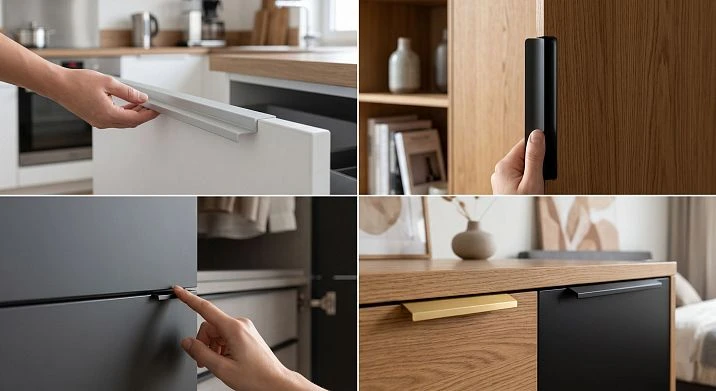
Imagine a kitchen where the fronts look like a single canvas — not a single protruding bracket, not a single visible button in the center of the door. The gaze glides over the smooth panels without catching on the fittings. And yet each door opens easily, with a natural hand movement. How is this achieved? The answer is — handle for furniture. It is this that allows you to maintain a clean front surface of the facade without sacrificing ease of opening.
The handle is not a trendy designer whim, but a well-thought-out functional solution with clear logic. The handle is attached not to the center of the front panel, like a bracket or button, but to the edge of the facade: to the top end, bottom end, or side edge. It is this placement principle that makes it a special tool in the arsenal of furniture fittings.
This article provides a complete practical breakdown: what a handle is, what its varieties are, where and how to use it, which colors to choose for different interiors, and what mistakes are most often made when purchasing.
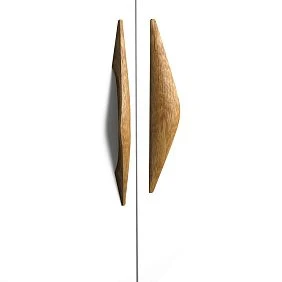
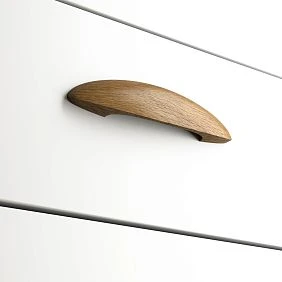
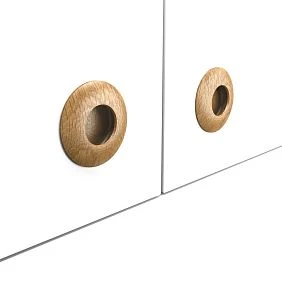
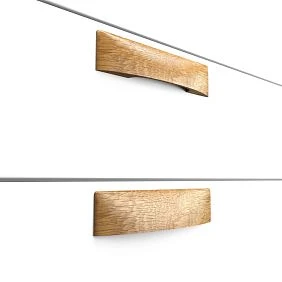
What is a handle and what is its fundamental difference
To understand the logic of a handle, you need to imagine the anatomy of a furniture facade. A facade is a panel with a front surface (what you see), a back surface (what is inside the cabinet), and four ends: top, bottom, left, right. A regular bracket is attached through two holes in the front surface — it protrudes in front of it and is always visible. End handle attaches to the end or along the edge of the facade — to its edge, without affecting the cleanliness of the front plane.
The result is fundamentally different: the front part of the facade remains untouched. No holes in the center, no protruding arcs, no noticeable hardware elements. The door opens by gripping the lower or side end — it's intuitive, convenient, and visually almost invisible.
That is why handle on the end of the facade is so popular in modern interiors with an emphasis on clean lines: minimalism, Scandinavian style, Japanese interior, contemporary. A furniture facade without a central handle is a different aesthetic, a different perception of space.
There are three main ways to implement the end principle:
-
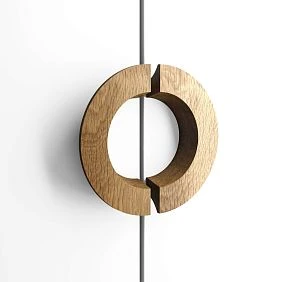
Surface-mounted end handle — a profile or strip that is placed on the end and fixed with bolts or screws;
-
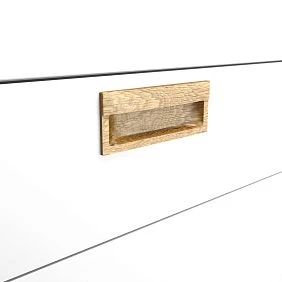
Recessed end handle — a groove is milled directly into the body of the end, and the insert handle fits into this groove;
-
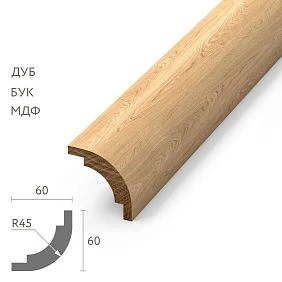
Profile end handle — a thin profile that is mounted along the lower or side edge of the facade.




Where end handles are used: complete application map
It is a mistake to think that an edge pull is exclusively a kitchen story. It is used much more widely.
Our factory also produces:
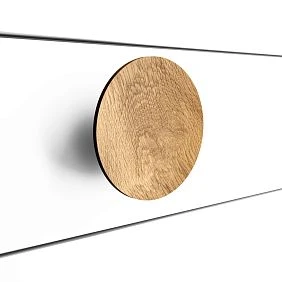
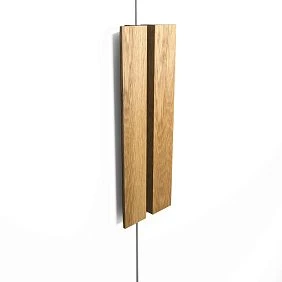
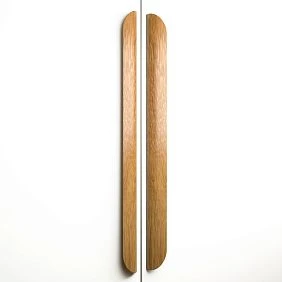
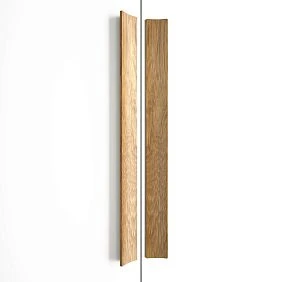
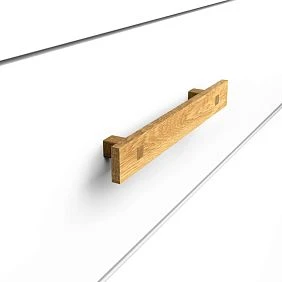
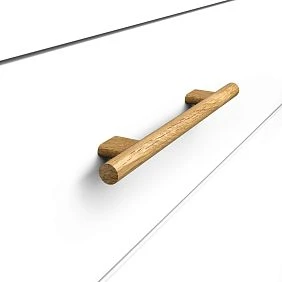
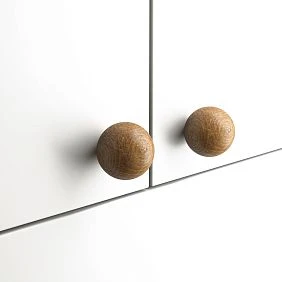
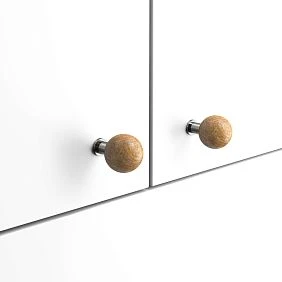
Edge pull for kitchen
The kitchen is the main area of application. Edge pull for kitchen cabinet door It is installed on the bottom edge of upper cabinet doors (grip from below when opening upward) and on the top edge of lower drawers (grip from above when opening downward). This creates a unified system where all fronts open with a motion 'from the edge' rather than 'from the center'.
For kitchens with smooth MDF fronts under enamel or film, edge pulls are ideal. They do not disrupt the surface uniformity, do not add 'spots' of hardware in the center, and do not compete with the front color. The front is perceived as a solid color panel — which is the design goal in most modern kitchens.
For kitchen fronts made of veneer or solid wood, a wooden edge pull creates a natural accent: the turn of the front edge becomes a design element, and the pull becomes a natural extension of the wood texture.
Get Consultation
For upper kitchen cabinets
On upper cabinets, the edge pull is mounted at the bottom — along the lower edge of the front. The hand goes under the edge from below and pulls the door down and toward you. This is ergonomic: the hand movement when opening an upper cabinet from below is natural and requires no effort. That is why the bottom edge pull on upper cabinets has now become almost a standard in designer kitchens.
For lower drawers and cabinets
On lower drawers, the handle is mounted on the top edge of the facade. When opening, the hand moves from top to bottom or slightly backward — also a natural movement. An important nuance: if the drawers are located low (the lower drawer of the cabinet), gripping the top edge may be less convenient. In this case, a wider profile is considered, or a different type of handle is used.
For a hinged wardrobe
End handle for cabinet In the hallway, bedroom, study — this is an expressive element. For a hinged cabinet, the end handle is installed on the side edge (the one closer to the door opening): the hand grips the edge and pulls the door to the side. This is a familiar gesture, convenient and intuitive.
For tall cabinet-penals (2.2–2.7 m), an end handle running along the side edge from top to bottom or over a significant portion of the height creates a powerful visual accent. This is an architectural technique that makes the cabinet part of the interior, not just a storage box.
For chests of drawers and cabinets
On chests of drawers, end handles are used less often than brackets or knobs, but in modern minimalist interiors, this is a perfectly organic solution. A handle on the bottom edge of each drawer creates a rhythmic repetition of horizontal lines — this is both beautiful and functional.
End handle for kitchen: design and practice
Why did the kitchen become the main niche for end handles? Because here two key demands coincide: the desire for clean, smooth surfaces and the need to open dozens of facades multiple times every day. The end handle addresses both demands simultaneously.
In a minimalist kitchen with facades without visible hardware, the end handle is a smart compromise between the Gola system (expensive, requires redesigning the cabinets) and regular surface-mounted brackets (protrude, "weigh down" the facade). The end handle is easier to install, more affordable, and provides a similar visual result.
For a kitchen set 3–4 m long, end handles create an expressive horizontal line running along the entire bottom edge of the upper cabinets and along the top edge of the lower drawers. This is rhythm, this is a system, this is interior logic — exactly what distinguishes a well-thought-out design from a random set of furniture.
handles for kitchen In an end version made of natural wood — a special class. A wooden edge on an MDF facade creates a contrast of materials that is a trend today: natural texture against a smooth film surface. This is lively, organic, and non-template.
End handle for MDF facade under enamel
MDF under enamel is one of the most common materials for kitchen facades. The surface is perfectly smooth, the color is rich, and maintenance is simple. For such facades, an end-mounted handle made of aluminum, matte steel, or painted metal is the optimal choice: it does not compromise the surface integrity, attaches precisely and reliably, and is available in any color to match the facade.
An important condition for MDF under enamel: when installing an end handle with bolt fasteners, you need to carefully drill the holes to avoid chipping the enamel on the edges. Use drills with undercuts and do not use the hammer mode of the drill.
Surface-mounted end handle: easy installation without routing
Among all options for end mounting Overlay handle the end mount is the most accessible and simplest to implement. The principle is simple: the handle profile is placed on the end edge of the facade from the outside and secured with bolts, screws, or special clamping elements.
A surface-mounted furniture handle on the end of the facade does not require routing—only precise drilling of holes for fasteners. This significantly simplifies installation: you can install it yourself in 15–20 minutes without professional tools.
The surface-mounted end handle comes in several structural types:
-
L-shaped profile—wraps around the edge of the facade, partially covering the front and back surfaces. Reliable fixation due to the wrap.
-
Flat strip on the edge—attached strictly to the end. Minimal protrusion, clean solution.
-
Profile with a protruding groove — has a small protrusion with a groove for finger grip. More comfortable to hold, slightly larger visually.
For most kitchen sets, the standard length of an overlay edge handle matches the facade width — 300, 400, 450, 500, 600 mm. This ensures a grip at any point along the width and creates a smooth horizontal line, uniform for all facades in a row.
Recessed edge handle: maximum edge cleanliness
If an overlay handle gives the visual result of a "handle along the edge," then a recessed edge handle gives the result of a "groove in the edge." The fundamental difference: a recessed handle goes inside the edge, leaving only a neat groove or indentation on the outside.
For a recessed edge handle, a groove of the required width, depth, and length is milled into the facade edge. The insert handle fits into this groove and is secured. Nothing is visible from the front side — only a neat edge line. From the end side — a groove for fingers.
Recessed handle in the facade edge is the "cleanest" solution among all edge options. It is used in high-end designer kitchens, premium dressing rooms, and furniture where the concept requires completely invisible hardware.
Recessed edge handle in the facade: technical requirements
A mortise end handle requires more careful preparation than a surface-mounted one. Key parameters:
Edge thickness. Standard edge materials (PVC, ABS, melamine) have a thickness of 0.4–2 mm. For mortising a groove, you need to work with the facade body itself — MDF, chipboard, or solid wood. The minimum facade thickness for bottom end mortising is 16 mm, optimal is 18–22 mm.
Groove depth and width. Standard groove for an end handle: width 14–20 mm, depth 10–15 mm. These parameters determine grip comfort: fingers should enter freely with clearance.
Tool. For precise routing of the end groove, a plunge router with a guide fence or a special stop is required. A chisel will give an uneven result that will be noticeable during use.
A wooden mortise end handle is a special option where the insert in the groove is made of solid wood. This creates an interesting 'wooden gap' effect in the facade edge — a thin strip of natural texture visible only when opening. For kitchens with wooden accents, this is an exceptionally organic solution.
Profile end handle: a thin line along the facade edge
A profile end handle is not just a handle, but a whole design concept. A thin elongated profile running along the bottom or side edge of the facade creates a horizontal or vertical line — neutral, clean, geometrically perfect.
In shape, the end profile handle usually has an L-shaped or U-shaped cross-section. One shelf of the profile is attached to the end or back side of the facade, the other forms a protruding 'visor' that the hand grips. The protrusion in front of the facade surface is minimal: usually 3–8 mm.
It is this small protrusion that makes the profile end handle so popular for kitchen sets in minimalist style. At arm's length — nothing is visible. Only smooth panels. You come closer — you notice a thin line along the bottom edge of the door. You grab it — you open it easily and smoothly.
End profile handle Made from natural wood — a wooden visor along the bottom edge of the facade is currently one of the most relevant trends in kitchen design. The combination of smooth MDF with a matte finish and a wooden end handle made of solid oak or ash is a contrast of textures, the warmth of natural material, and modern geometry.
Profile end handle vs Gola system
A common question: how does an end profile handle differ from the Gola system? This is an important distinction.
The Gola system is an integrated aluminum profile that is part of the cabinet structure itself: it is mounted between the top panel of the cabinet and the facade, creating a hidden grip groove. This requires special cabinet design considering Gola already at the furniture production stage.
An end profile handle is an overlay or inset element that is installed on a finished facade without redesigning the cabinet. This is much simpler: you can add an end handle to existing furniture, replace it if necessary, and apply it to any type of facade.
The Gola system provides a more concealed effect — the groove is almost invisible. An end handle provides a visible but very delicate element along the edge. For most buyers, the difference in practice is insignificant, while the cost of the solution is fundamentally different.
Colors of end handles: how to choose for the interior
One of the most practical questions: what color should you choose for an end handle? End handle today it is available in almost any color — and each option has its own logic of application.
Black end handle: contrast and character
The black matte end handle is the undisputed demand leader in recent years. Why? Because black works with any facade color. On white, it creates a clear graphic accent. On gray, it deepens the tone, adding depth. On beige or cream, it forms a restrained elegant contrast.
The black matte end handle is a choice for kitchens in contemporary, Scandinavian minimalism, loft, and monochrome interiors. The matte surface does not glare, does not attract unnecessary attention, and does not show fingerprints as noticeably as glossy. Practical and beautiful at the same time.
Gold end handle: luxury without ostentation
End handle gold — is a color for those who value warmth and expressiveness. A gold end handle on a white or cream facade creates a sense of wealth and taste without ostentation. This is a relevant choice for kitchens in modern classic, neoclassical, and art deco styles.
The matte gold end handle is a more restrained version. Without bright shine, with a muted metallic tone, it works in a wider range of interiors: from classic to contemporary. Matte gold pairs with wood, marble, dark blue, and emerald green facades.
Chrome end handle: neutral classic
The chrome end handle is a standard for kitchens where you want neutral hardware that does not draw attention. Chrome looks equally good on white, gray, beige, and wood facades. Polished chrome gives a mirror shine — it's festive, it's light. Matte chrome is a calmer, "workhorse" version.
For kitchen sets that already use chrome faucets, lights, and other metal hardware, an end handle in the same color creates a visual system. Unity of metals in the interior is a sign of professional design.
Bronze and brass end handle: history and warmth
Bronze end handle and brass end handle are a choice for those who are not afraid of character in furniture. These metals have historical depth, a warm yellow-brown tone, and a surface that ages beautifully. On dark facades — cherry, anthracite, dark blue — a bronze or brass end handle creates a luxurious contrast.
An important nuance: real brass darkens and develops a patina over time — this is a natural process that many consider an advantage. If you want to preserve the original color, choose brass with PVD coating or galvanic protection.
White end handle: for light monochrome interiors
A white end handle is a specific but very relevant option for kitchens in all-white or light colors. It blends into the facade, making the handle almost invisible. This is the most "weightless" solution, where the hardware completely recedes into the background.
Handles with Finish in the stavros.ru catalog are presented in several color options — this allows you to precisely match the color of the end handle to the specific color scheme of the interior.
End handle for a cabinet in the hallway and bedroom
A separate story is end handles for cabinets outside the kitchen. In the hallway, bedroom, study, or children's room, they solve different tasks than in the kitchen and require different approaches.
End handle for a hinged cabinet
For a hinged cabinet in the hallway or bedroom, the end handle is installed on the side vertical edge of the door — the one closer to the hinge or the free edge. If the cabinet opens to the right, the handle is on the right edge. If to the left, on the left edge.
The length of the end handle on a hinged cabinet door ranges from 300 mm to the full height of the door. For tall cabinet towers 2.2–2.7 m, a long vertical end handle along the entire side edge is both functional (grip at any point) and visually expressive.
This is the solution often called a "long handle for a cabinet": it runs vertically along the side edge of the door, from bottom to top, creating a strong vertical accent. A cabinet with such a handle is perceived as an architectural object, not just case furniture.
End handle for a cabinet in a modern interior
For a modern cabinet in a minimalist interior, an end handle is a way to avoid a "furniture" look and create an architectural one. When the cabinet is built into a niche from wall to wall and from floor to ceiling, its doors should look like part of the wall. An end handle on the side or bottom edge does not break this illusion.
Cabinet handles End handles made of natural wood — oak, ash, walnut — add natural warmth to a built-in cabinet that metal cannot create. This is especially valuable in a bedroom, where an atmosphere of comfort and coziness is important.
End handle and other types of hardware: comparison table
| Handle type | Installation | Position on the facade | Best scenario |
|---|---|---|---|
| End | Along the edge or end | Along the edge of the facade | Kitchen, cabinet, when the front surface should remain clean |
| Profile | On the end or on the front | Line along the edge or length | Minimalism, long fronts, modern kitchens |
| Overlay | On the front surface | On the center or edge | Classic, simple installation, decorative accent |
| Recessed | Milling in the body | On the end or front part | Wardrobe, sliding doors, concealed installation |
| Bracket | Two holes on the front | Centered on the facade | Heavy facades, kitchen, comfortable grip |
| Button | One hole | On the center or edge | Light facades, cabinets, decorative accent |
How to properly install an edge pull
Installing an edge pull is simple but requires precision. Let's go through the general algorithm for a surface-mounted edge pull — the most common option.
Step one: determine the position. A surface-mounted edge pull is usually centered along the length of the facade. If the facade is 600 mm wide, a 400 mm long pull is placed in the center — with a 100 mm offset on each side. For a pull spanning the full width of the facade — from edge to edge.
Step two: mark the holes. Mark the mounting points with a pencil through the end of the facade. Use a jig or template if it is included with the pull.
Step three: drilling. Drill perpendicular to the end face, strictly according to the markings. For MDF and chipboard — use a wood drill bit, without hammer mode. The hole diameter should match the mounting bolt from the kit.
Step four: fitting. Insert the bolts, put on the handle. Check the horizontal alignment and symmetry of the placement.
Step five: final tightening. Tighten the bolts evenly from both ends. Do not overtighten — excessive force will chip the edge of MDF or chipboard.
Step six: grip check. Open the cabinet door several times, ensure the grip is comfortable, that the handle does not shift, rotate, or create squeaks.
For a recessed end handle, the algorithm is supplemented with a routing step: a groove of the required size is cut into the end of the cabinet door using a router with a guide. This requires more precision, but the result is cleaner and neater.
Materials for end handles: wood, metal, combinations
The correct choice of end handle material depends on the cabinet door material, interior style, and operating conditions.
Wooden end handles made of solid wood
Wooden handle on the end of the facade made of solid oak, ash, or walnut — this offers natural tactility and aesthetic value. Wood is warm, non-slip, with a unique texture for each piece.
handles without coating made of solid wood allow the end handle to be finished to a specific shade — with oil, wax, or stain. This opens up the possibility of precise color matching: a wooden handle on a wooden cabinet door in a single tone creates a completely monolithic, naturally organic solution.
For the kitchen, it is recommended to treat the wooden end handle with oil with increased moisture resistance — the oil penetrates the wood structure, protects against moisture and grease, does not create a film on the surface, preserving the natural matte finish and texture.
Aluminum end handles
Aluminum is lightweight, durable, does not corrode, and can be well anodized in any color. It is the most common material for serial end handles. Anodized aluminum in black matte, silver, gold, bronze — a wide range for any interior request.
The aluminum end handle is practical for the kitchen: resistant to moisture, grease, and detergents. Easily cleaned with a soft cloth. Does not lose color with proper care.
Stainless steel
End handles made of stainless steel — maximum strength and durability. For kitchens with intensive use, for commercial facilities (restaurants, offices) — steel is preferred. Polished or matte steel looks good in minimalist and high-tech interiors.
End handle for kitchen with enamel facades: color solutions
Kitchens with enamel facades are always about color. Deep blue, rich green, terracotta, anthracite — bright facades require fittings that either blend into the color or create a bright, deliberate accent.
On dark enamel facades (black, anthracite, dark blue) — an end handle in gold or brass creates maximum contrast. This is luxurious, expressive, and memorable.
On bright colored facades (blue, green, terracotta) — an end handle in matte black adds restraint without overpowering the facade color.
On pastel and light facades — matte chrome or nickel; a wooden handle made of light wood (birch, beech); a white end handle for complete blending with the color.
Furniture Handles Made of natural wood in the stavros.ru catalog, it can be treated with tinting compounds in almost any color — which makes it possible to create a wooden end handle exactly matching the tone of the enamel facade. This is a rare flexibility that metal counterparts do not provide.
Common mistakes when choosing and installing an end handle
Let's break down the main mistakes encountered when choosing and installing end handles — so you don't repeat them.
Confusing an end handle with a regular surface-mounted handle. A surface-mounted handle can be attached to the center of the facade's front surface. An end handle is always along the edge or rim. These are different concepts, although both can be surface-mounted in terms of attachment method.
Not considering the thickness of the facade. The end handle is attached with bolts through the edge. For 16 mm chipboard — this is the minimum acceptable thickness: the bolt passes through the edge material and enters the body of the board. For thinner facades — the handle will be held unreliably.
Choosing too short a handle for a heavy door. An end handle 150 mm long on a cabinet door weighing 8 kg is uncomfortable. When opening, you need to apply force concentrated in a small section. For heavy doors, choose a handle no shorter than 400–600 mm or switch to a long profile along the entire height.
Not checking the convenience of gripping from below or from the side. An end handle on the bottom edge of an upper cabinet assumes a grip "from below." For people with limited hand mobility, this may be uncomfortable. Check the ergonomics of the grip in advance — preferably "test" the movement physically.
Not considering adjacent facades and gaps. If two facades are located close together (e.g., a cabinet near a wall), an end handle on the side edge of the door closest to the wall may hit the wall when opening.
Installing an end handle where it will catch. In narrow passages, an end handle on the bottom edge of lower drawers is a risk of hitting it with your foot. Evaluate the position of the handle from the perspective of daily movement in the space.
Choose the color of the handle separately from other fittings. The edge handle must be color-coordinated with hinges, dampers, and other visible hardware elements. A mix of metals in one set is a sign of an ill-considered choice.
Install the edge handle without a jig. A crooked handle, drilled "by eye," looks sloppy. Use a template or jig — it takes five minutes but guarantees an accurate result.
Edge handle in the furniture hardware system: its place among other types
The edge handle is not a replacement for brackets, knobs, or profiles. It is an independent tool for specific tasks. Understanding this helps avoid wavering between options and make a precise choice.
If you need the most comfortable grip for a heavy kitchen front, choose a bracket with a center distance of 128–160 mm. If you need a decorative detail on a small cabinet, consider a wooden or metal knob. If you need a clean front surface while maintaining functional opening, choose an edge handle. If you need concealed installation for a wardrobe, Inset handle or an edge handle in a groove.
Each type of handle is an answer to a specific question. The edge handle answers the question: "How to keep a clean front without sacrificing convenience?" And it answers it precisely and convincingly.
Full catalog furniture handles stavros.ru is a collection of solid wood products covering all main types: surface-mounted, inset, edge, and profile handles. Here you can choose a handle for a specific task with a clear understanding of its function, size, and application.
FAQ: answers to popular questions about edge handles
What is an edge handle for furniture?
This is a furniture handle that is attached not to the center of the front surface of the facade, but to its edge — to the top, bottom, or side end. End handle allows you to keep the front part of the facade clean while providing convenient opening.
How is an edge handle different from a surface-mounted handle?
Overlay handle can be attached to the front surface of the facade anywhere. An edge handle is installed exactly on the edge of the facade — on the edge or end. At the same time, an edge handle can also be surface-mounted in terms of attachment method (without routing).
Where is it best to use edge handles?
On kitchen facades, hinged cabinets, dressers, and nightstands — everywhere where it is important to keep the front part of the facade visually clean. Especially relevant for kitchen handles in minimalist, contemporary, and modern classic styles.
What is better: an edge handle or a Gola system?
Gola provides a more hidden effect but requires special cabinet design. An edge handle is easier to install on any ready-made facade, is easily replaceable, and is available in a wide range of shapes and colors. For most kitchen projects, an edge handle is a more flexible and affordable solution.
Can I install an edge pull on an already finished kitchen?
Yes, in most cases — you can. For a surface-mounted edge pull, you only need to drill mounting holes in the edge of the facade. For a recessed one, you need to mill a groove in the edge.
What color edge pull should I choose?
It depends on the color of the facade and the interior style. Black matte is universal and suits most colors. End handle gold — for classic and neoclassical kitchens. Chrome — for modern neutral interiors. Wood — for Scandinavian style and eco.
What is the optimal length for an edge pull?
For upper kitchen cabinets — at least 2/3 of the facade width. For lower drawers — similarly. For hinged cabinets on the side edge — from 300 mm for light doors to full height for heavy tall cabinets.
Where can I buy an edge pull made of natural wood?
handle for furniture Solid wood is available in the catalog at stavros.ru. Here are models made of oak and ash without coating — for self-finishing to match a specific facade color.