










































































Article Contents:
- Why the price of stucco is not calculated per single element
- What makes up the cost of polyurethane stucco
- Size and width of the profile
- Complexity of relief
- Purpose of the element
- Number of elements
- Cutting allowance
- How to calculate moldings for a wall
- How much does ceiling stucco molding cost
- Cornice around the perimeter
- Socket for chandelier
- Molding frame on the ceiling
- Decorative elements
- How much does wall decor with stucco cost
- Where You Can Save and Where You Shouldn't
- Where to save wisely
- Where saving is not possible
- What to buy together with stucco
- How to calculate a budget for facade decor
- How to calculate a budget: final algorithm
- How not to buy too much
- Where to buy polyurethane stucco
- Brief budget checklist
- FAQ: answers to popular questions about the price and calculation of stucco
- How much does polyurethane stucco cost?
- How to calculate moldings on a wall?
- What is more expensive: smooth molding or ornamented?
- How much margin to take for stucco?
- What to buy together with molding?
- Can you buy stucco molding in parts?
- How not to overpay for stucco molding?
- Do you need to hire a professional for stucco molding installation?
- About the Company STAVROS
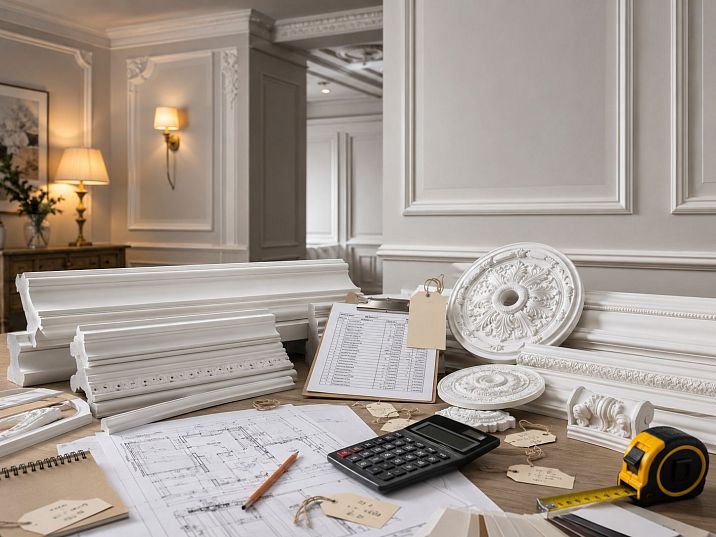
One of the most honest questions a person asks themselves before buying decorative decor: "How much will it actually cost?" Not one strip of molding, not one rosette in a beautiful photo — but the entire project, from the first molding to the last coat of paint. This is where most people make a mistake: they look at the price of one element, multiply by the approximate quantity, and get a number that later turns out to be half the real cost.
Moldings made of polyurethane — it's not a one-time purchase of a single decorative element. It's a system where moldings, cornices, rosettes, overlays, corner blocks, and consumables add up to a single budget. And to ensure this budget doesn't become a surprise, it needs to be calculated in advance — before browsing the catalog, before choosing a profile, before the first order.
That's exactly what this article is about. No fluff, no lengthy discussions about the history of decor. Just a concrete talk about money, quantity, calculation logic, and places where you can save without compromising the result.



Why the price of stucco molding is not calculated per single element
When a person sees a molding in the catalog for a conditional few hundred rubles per linear meter, the first reaction is understandable: "Well, that's not expensive at all." But behind this figure lies only one element of one system. The real budget is the sum of all components, and it's from their combination that the total cost of decorative finishing is formed.
What is included in the real budget for polyurethane molding?
-
Moldings — main linear elements for frames, panels, wall zoning
-
Cornices — ceiling profiles for finishing the wall-ceiling joint
-
Rosettes — individual elements for a chandelier or the center of a decorative frame
-
Decorative overlays — corner elements, ornamental blocks, inserts to enrich the system
-
Molding decor — locks, corner blocks, center inserts that complete frame systems
-
Construction adhesive — for fixing polyurethane elements
-
Acrylic sealant — for filling joints, gaps, and abutment areas
-
Primer — for paint adhesion to polyurethane and wall surfaces
-
Paint — one or two coats for final finishing of the entire system
-
Cutting allowance — at least 10–15% over the calculated length
-
Delivery — especially relevant for long linear elements
It may seem like a long list. But it is precisely the full accounting of all these items that gives an adequate budget. Those who only count moldings usually discover at the end of the project that they have spent one and a half to two times more than expected.




What makes up the cost of polyurethane stucco
Before moving on to calculations, it is important to understand which parameters affect the price of an individual element. This will help you consciously choose a profile, rather than buying "what you liked in the photo."
Our factory also produces:


Profile size and width
The most direct pricing factor: the wider, taller, and deeper the profile, the more material, the more complex the shape, and the more expensive the element. A narrow molding 20–30 mm wide will be several times cheaper than a cornice 120–150 mm wide. This does not mean one is better than the other—they solve different tasks. But when calculating the budget, it is important to understand: large-scale decor costs large-scale money.
For rooms with ceilings of 2.5–2.7 m, the right choice is lightweight profiles that neither visually overwhelm nor overload the budget. For high halls with ceilings of 3 meters or more, a large cornice looks organic and is justified both in design and price.
Get Consultation
Complexity of relief
A smooth molding with a simple angular profile is cheaper than an ornamented one with acanthus leaves, a braided pattern, or multi-level relief. The price difference can be significant even with the same width. This is explained by the complexity of the casting form and the detail of the relief.
If the budget is limited but you want a decorative effect, choose a laconic profile with a clear angular cross-section. With proper layout and painting, such a molding looks no less impressive than an ornamented one, especially in modern and neoclassical interiors.
Purpose of the element
Wall molding, ceiling cornice, Facade molding and the rosette are different elements with different costs. Facade decor is usually more expensive than interior decor: it is designed for higher loads and requires resistance to external environments. Rosettes are piece goods, and their price depends on the diameter and complexity of the pattern.
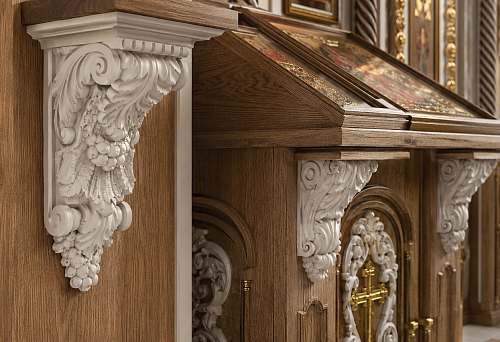
Polyurethane brackets are priced separately and counted individually: one bracket above a doorway or in a fireplace area is a separate line item in the estimate, not part of the linear footage.
Number of elements
Moldings and cornices are linear goods. Their quantity is measured in linear meters or planks. If the standard plank length is 2 meters, then for 12 linear meters of room perimeter, 6 planks plus a reserve are needed. Rosettes, overlays, decorative blocks, brackets are piece items added on top of the linear calculation.
The more frames on the wall, the more complex the layout scheme, the more corner and transition elements will be required. This is easy to forget during the initial budget assessment.
Margin for trimming
This is a separate item that is most often ignored. For straight sections without corners, a 10% reserve is the minimum acceptable. For rooms with many internal and external corners, non-standard niches, openings, and complex frame layouts, allocate 15% or more.
Cutting polyurethane always produces waste. Each 45° or 90° angle 'eats' part of the plank. A lock above the door, a corner block in the frame, a transition insert—all require precise cuts, meaning some material goes into scraps.
View Moldings made of polyurethane with different profiles and sizes can be found in the STAVROS catalog—there, plank lengths are also indicated, which will help immediately calculate the quantity including the reserve.
How to calculate moldings for a wall
A theoretical discussion about reserve and profiles is good. But it is much more useful to analyze a specific example. Let's take a typical task: a wall 3.6 m wide and 2.7 m high, the goal is to create three decorative frames.
Step 1: Determine the frame layout.
Three frames are arranged horizontally in a row. Each frame is 100 cm wide and 120 cm high. The gap from the ceiling cornice is 15 cm, from the floor baseboard is 15 cm, and between frames is 15 cm.
Step 2: Calculate the perimeter of each frame.
The perimeter of one frame 100 × 120 cm = (1.0 + 1.0 + 1.2 + 1.2) = 4.4 linear meters.
Three frames: 4.4 × 3 = 13.2 linear meters.
Step 3: Add allowance for trimming.
13.2 × 1.15 = 15.18 linear meters. Round up to 16 linear meters.
Step 4: Convert to planks.
If the standard plank length is 2 meters, then 16 ÷ 2 = 8 planks. Take 8–9 planks with a reserve.
Step 5: Calculate corner elements.
Each frame has 4 corners. Three frames — 12 corner points. If ready-made corner blocks are used decoration for moldings — that's 12 pieces as a separate item. If corners are cut at 45° — the allowance is already included in the footage.
Total for moldings: 8–9 planks + 12 corner blocks (when using ready-made elements).
This calculation gives a specific quantity and a specific budget. This is exactly how you should calculate, not "approximately 10 meters of molding per wall."
How much does ceiling molding cost
The ceiling is the most noticeable horizontal plane in a room. It creates a sense of completeness and scale. But ceiling stucco is not just one element. Let's consider what makes up a set for decorating the ceiling in a 20 sq. m room (5 × 4 m).
Cornice around the perimeter
Room perimeter 5 + 4 + 5 + 4 = 18 linear meters. Add 15% allowance = 20.7 m. Round up to 22 linear meters considering corner cuts. The cornice is the base of the ceiling system: it covers the joint, creates a horizontal rhythm around the entire perimeter, and sets the scale of the interior.
Choosing ceiling molding, consider the height of the cornice: for ceilings 2.6 m — profiles up to 80 mm wide, for 3.0 m and above — you can consider profiles 100–150 mm wide and larger.
Socket for chandelier
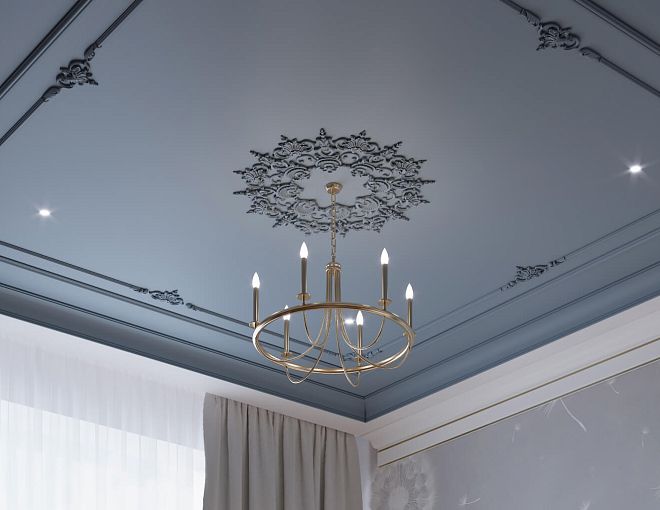
One rosette in the center of the ceiling — a piece item. Its diameter depends on the room area and the chandelier diameter. For a 20 sq. m room, rosettes with a diameter of 250–400 mm are optimal. Polyurethane ceiling rosettes — this is an independent decorative accent that is installed independently of the cornice.
Molding frame on the ceiling
If you want to divide the ceiling into zones or create a central decorative panel above the chandelier, you will need a molding frame. For example, a 2 × 1.5 m frame in the center of the ceiling requires (2 + 2 + 1.5 + 1.5) × 1.15 = 8.05 linear meters of molding plus corner elements.
Decorative elements
Additional Polyurethane decorative appliques can saturate the ceiling with ornamental accents: at the intersections of moldings, in the center of panels, at the corners of the frame. They are added to the budget per piece.
Final budget structure for a 5 × 4 m ceiling:
-
Cornice — 22 linear meters
-
Rosette — 1 piece
-
Molding frame — 8–9 linear meters (optional)
-
Corner blocks for the frame — 4 pieces (optional)
-
Decorative overlays — as needed
View polyurethane ceiling decor in the STAVROS catalog can be found broken down by categories: cornices, rosettes, ceiling kits, decorative elements.
How much does stucco wall decor cost
To understand the budget for wall decoration, let's consider three scenarios. They differ in the richness of decor and, accordingly, the final cost.
| Scenario | What's included | Character |
|---|---|---|
| Minimal | Thin moldings, simple frames without corner blocks | Clean lines, modern classic, minimalism |
| Medium | Moldings + ready-made corner blocks | Neoclassicism, modern classic |
| Expressive | Moldings + overlays + cornice + baseboard + molding decor | Classic, neoclassical with rich relief |
Minimum scenario — one wall 3.6 × 2.7 m, three frames made of moldings without additional elements. Corners are cut manually. The budget consists of the cost of molding linear footage with a margin.
Medium scenario — the same three frames, but the corners are decorated with ready-made corner blocks, which simplifies installation and gives a neater result. 12 corner elements are added to the moldings. The budget increases.
An expressive scenario — molding frames with corner blocks, above the frames — a ceiling cornice, below the frames — a decorative baseboard, in the center of each frame — a decorative overlay. This is already a full-fledged architectural system that creates the effect of a historical interior. Polyurethane wall decor in an expressive scenario gives maximum visual result — but the budget is corresponding.
It is important to understand: an expressive scenario is not an "expensive" option for the sake of being expensive. It is an architectural result that cannot be achieved with a minimal set of elements. If the goal is to create a classic or neoclassical interior with a deep decorative character, the investment is justified.
Where you can save and where you cannot
Saving on renovation and decor is reasonable. But it must be thoughtful, not random. Some solutions allow you to reduce the budget without losing quality, others create problems that will cost more in the end.
Where it is reasonable to save
Choose a smooth profile instead of an ornamented one. A clean geometric molding without a relief ornament costs less than a complex profile — and at the same time looks great in modern, neoclassical, and art deco interiors. Savings without compromising the result.
Reduce the number of frames. Three frames on a wall create rhythm. Six frames on the same wall create overload. Sometimes less is better both for the budget and for the design.
Use an accent zone instead of decor on all walls. One wall with a full decorative system works better than four walls with sparse elements. This is both cheaper and visually more convincing.
Abandon central overlays in frames. A frame made of of polyurethane moldings And even without the central overlay, it is already a finished element. The overlay adds luxury but is not mandatory.
Calculate the exact footage in advance. An extra 5 planks bought 'just in case' is wasted money. An accurate calculation with a 10–15% reserve ensures a purchase without excess.
Where you cannot save
On profile compatibility. A molding from one collection and a cornice from another may not match in scale, relief, and style. Incompatible elements are not saved money but spent twice: first on the purchase, then on replacement.
On reserve. Saving 5% on material reserve leads to an urgent reorder, installation delays, and the risk that the needed item is already out of stock. Reserve is insurance, not an extra expense.
On the quality of glue and sealant. Polyurethane Polyurethane moldings is held by glue. If the glue is of poor quality or unsuitable, the elements will start to peel off, and joints will open. Installation glue for polyurethane is not an item to look for the cheapest option.
On surface preparation. A wall with peeling paint or wet after renovation guarantees adhesion problems. No quality glue will hold the molding on an unsuitable surface.
On precise corner cutting. If the 45° angle is made inaccurately, the joint will be visible. Acrylic sealant helps, but a perfect joint is achieved only with precise cutting. This is a matter of tool and accuracy, not economy.
What to buy together with stucco
When budgeting for stucco decor, it is important to immediately include consumables — otherwise, a trip to the store for glue in the middle of installation will be an unpleasant surprise. Here is a complete list of what you need to buy along with the decorative elements:
Main decorative items:
-
Moldings made of polyurethane — molding for frames and panels
-
Cornices — ceiling molding along the perimeter of the room
-
Polyurethane ceiling rosettes — individually, in the center of the ceiling
-
Polyurethane decorative appliques — to enrich the system with decorative details
-
Decor for Molding — corner blocks, locks, inserts
Consumables and auxiliary materials:
-
Assembly adhesive compatible with polyurethane and wall/ceiling surface
-
Acrylic sealant for filling joints — not silicone! Acrylic can be painted, silicone cannot
-
Primer — for preparing the polyurethane surface for painting
-
Acrylic or water-based paint — for painting the entire system in a single color
-
Painter's tape — to protect adjacent surfaces during painting
-
Hacksaw with fine teeth or miter box — for precise cutting of corners and joints
None of these items will be superfluous. Missing sealant means gaps in joints. Missing primer means uneven painting with spots. Missing painter's tape means paint on the wallpaper.
Full range polyurethane products For decorative finishing — moldings, cornices, rosettes, overlays, brackets, decor for moldings — is presented in the STAVROS catalog. It is convenient that all categories are in one system, which allows you not just to buy "something similar," but to select a set coordinated in style and scale.
How to calculate the budget for facade decor
The facade is a separate story in the topic of stucco decor. Here the calculation is built differently than for the interior, because the tasks are different: not to create a system of frames on the wall, but to design the architectural elements of the building — windows, doors, cornices, piers.
Typical items in the facade decor estimate:
-
Window trims — window perimeter × number of windows + 15% margin
-
Window headpieces — individually, one per window
-
Corner pilasters — linear footage vertically
-
Facade cornices — linear footage horizontally
-
Decorative keystones above windows — individually
-
Design of the entrance group — brackets, pilasters, capitals
Polyurethane for the facade must be specifically intended for outdoor use — it is a moisture-resistant material with UV protection. Not all interior profiles are suitable for outdoors, so when choosing, you need to clarify the element's purpose.
Polyurethane brackets for facade tasks — a separate item with its own calculation. One bracket above the entrance group or under the cornice is an accent that changes the facade's appearance just as a properly selected molding changes the character of a wall in an interior.
How to calculate the budget: final algorithm
To avoid keeping all this in mind, use a simple step-by-step calculation scheme. It works for any room and any task.
1. Determine the decoration zones.
Wall, ceiling, facade, furniture, door — what exactly are we designing, in which room, and at what scale.
2. Create a layout diagram.
A hand-drawn sketch or in any program: where the frames are, how the cornice is positioned, where the rosette is, where the overlays are. Without a diagram, the calculation will be approximate.
3. Calculate the linear footage.
For each zone separately: frame perimeter, cornice length, baseboard length. We sum them up.
4. Add a margin.
For simple layouts — 10%, for complex ones with many corners — 15% and higher.
5. Count piece items.
Sockets, trims, corner blocks, locks, brackets — one by one according to the diagram.
6. Add consumables.
Glue, sealant, primer, paint — based on the installation area.
7. Compare with the catalog.
Open You can buy ready-made stucco matching the Baroque style. Calculate the quantity: linear meters of cornices and moldings, number of rosettes, pilasters, consoles, corner elements. Add a ten to fifteen percent allowance for trimming., find the needed items, check prices, calculate the total amount.
This algorithm provides an accurate budget in 20–30 minutes of working with the diagram and catalog. No "approximately," no "by eye" — only specific numbers.
How not to buy too much
Buying with a margin is correct. Overpaying for unnecessary items is not. Here are typical calculation mistakes that lead to extra costs or, conversely, to a shortage of material at the most inopportune moment.
Calculating only the wall length, ignoring the frame layout. "The wall is 3.6 meters, so the molding needs to be 3.6 meters" — this logic only works for one horizontal run. Three frames on the same wall require 13–15 linear meters.
Forgetting about corners. Every internal or external corner means a cut. Four corners of a frame = four cuts. Twelve frames = forty-eight cuts. Didn't count — ran out of material.
Buying moldings without a margin. Buying exactly as much as calculated almost guarantees you'll need to buy more. A 10–15% margin is not wasted money; it's insurance.
Mixing profiles from different collections. A molding with a "shelf" profile and a cornice with a "step" profile can visually conflict, even if each looks good individually. Always check the compatibility of elements.
Buying decor without a layout diagram. "I'll buy moldings and figure it out" is a classic mistake. Without a diagram, it's impossible to accurately calculate the quantity, and you'll end up either short or with leftovers.
Not considering ceiling height. A cornice 150 mm wide with a 2.6 m ceiling is neither beautiful nor comfortable. Ceiling height is not just an architectural parameter; it directly influences the choice of decor scale.
Choosing elements only from catalog photos. A photo can be misleading: the scale is not always obvious. Always look at the actual dimensions in millimeters — width, relief height, plank length.
More details about installation techniques, corner cutting, and working with joints can be found in the article installation of polyurethane molding. It covers all technical nuances, including working with corner joints and final painting.
Where to buy polyurethane stucco
If you need to calculate the budget in advance, it is more convenient to choose molding not by random individual items, but systematically: moldings, cornices, rosettes, overlays, and decor for moldings should match in style, size, and ornamental language. That is why choosing the source of purchase is as important a decision as choosing a specific profile.
-
Where there is a full range of all categories: moldings, cornices, rosettes, overlays, and facade decor — in a unified system
-
Where the dimensions in the product cards are clearly stated: width, profile height, plank length
-
Where you can see photos in completed projects, not just on a white background
-
Where elements from different categories are coordinated in style and scale within the collection
-
Where there is a division by purpose: for walls, for ceilings, for facades, for furniture, for doors
In the STAVROS catalog, you can select polyurethane elements for walls, ceilings, facades, furniture, and doors, and then calculate the quantity for a specific project — with clear dimensions, photos, and easy navigation by categories.
Quick Budget Checklist
| Decor Zone | What We Count | Unit |
|---|---|---|
| Walls | Frame Perimeter + 15% Reserve | Linear Meters |
| Ceiling cornice | Room Perimeter + 15% | Linear Meters |
| Rosette | By Number of Chandeliers | Pieces |
| Corner blocks | By Number of Frame Corners | Pieces |
| Overlays | By Layout Scheme | Pieces |
| Brackets | By scheme | Pieces |
| Glue | 1 tube per 4–5 linear meters | Tubes |
| Sealant | 1 tube per 10–15 m of joints | Tubes |
| Paint | By surface area of decor | Liters |
FAQ: answers to popular questions about price and calculation of stucco
How much does polyurethane stucco cost?
The cost depends on the type of element, its size, complexity of relief, quantity, and allowance for trimming. Moldings and cornices are calculated by linear meters, rosettes and overlays by piece. The final budget consists of the sum of all items plus consumables: glue, sealant, primer, paint.
How to calculate moldings on a wall?
Draw a diagram of the frames on paper or in any editor. Calculate the perimeter of each frame, add all perimeters, add 10–15% margin for trimming. Convert to planks based on standard length (usually 2 meters). Don't forget corner blocks — they are counted separately.
What is more expensive: smooth molding or ornamented molding?
As a rule, ornamented molding is more expensive: the shape is more complex, the relief detail is higher, and the production labor intensity is greater. A smooth profile with a clear angular section is a more affordable option without losing decorative effect when used correctly.
How much margin should be taken for stucco?
For simple straight sections — at least 10%. For rooms with many corners, non-standard walls, niches, arches, and complex layouts — 15% or more. It's better to take a slightly larger margin: reordering the exact same article can be difficult.
What to buy together with the molding?
Assembly adhesive (compatible with polyurethane), acrylic sealant for joints, primer for polyurethane, paint, masking tape, and trimming tools. These consumables are needed for any installation, regardless of project scale.
Can stucco be purchased in parts?
Theoretically — yes. Practically — not recommended. When reordering, there is a risk of batch differences, changes in the article, or temporary unavailability of the desired profile. It's better to calculate the entire set at once, buy with a margin, and store leftovers — they will always be useful for replacements or small adjustments.
How not to overpay for stucco?
Calculate the exact footage according to the diagram, choose a profile with a reasonable ratio of relief complexity and price, use accent zones instead of total decoration of all walls, do not buy more than the margin. Save on the number of frames and ornament complexity — but not on the quality of glue and precision of trimming.
Do I need to hire a master for installing stucco molding?
For simple systems — horizontal moldings, ceiling cornices, rosettes — installation is accessible to a person with basic construction skills. For complex systems with many corners, facade decor, or multi-level compositions — it's better to hire a specialist.
About the company STAVROS
Choosing a budget, calculating footage, and selecting a profile is much easier when the entire assortment is concentrated in one place and each category is clearly structured.
STAVROS is a catalog of decorative stucco molding, moldings, cornices, rosettes, overlays, brackets, and architectural decor made of polyurethane for interior and facade tasks. The catalog includes:
-
Moldings and cornices — from laconic to expressive profiles
-
Chandelier rosettes — diameter from 150 to 600+ mm
-
Decorative overlays and corner elements
-
Decor for moldings: locks, corner blocks, inserts
-
Brackets and linear elements for facade and interior tasks
-
Ceiling sets with coordinated elements
-
Decor for walls, ceilings, furniture, and doors
If you are selecting moldings for an interior, facade, furniture, or ceiling — start with the STAVROS catalog. There you can not only choose specific elements but also calculate a set for a real project with clear dimensions and a category system where moldings, rosettes, and overlays are coordinated with each other.
Go to the catalog and You can buy ready-made stucco matching the Baroque style. Calculate the quantity: linear meters of cornices and moldings, number of rosettes, pilasters, consoles, corner elements. Add a ten to fifteen percent allowance for trimming. for your project — with specific dimensions, photos, and a full range that allows you to build a system, not just a set of random parts.