Article Contents:
- Not a single strip, but a repeatable production component
- Why manual finishing ceases to be a minor operation
- Where the value of a finished series arises
- The cross-section remains 28 × 24 mm only until additional processing
- The profile from the card and the profile per technical specification are different order items
- What is called a rabbet
- Why the name doesn't set the size
- What happens if you mix up the concepts
- Frame furniture front
- Decorative frame on the facade
- Framing a furniture panel
- Cabinet Furniture
- Configuration of a serial project
- Production of furniture modules
- Furniture factory
- Carpentry workshop with a serial project
- Contract manufacturer
- Object outfitter
- Facade manufacturer
- Small production with a large single object
- When MDF is convenient for production
- What to check in the technical specification
- Why the 2600 mm length affects the batch
- When to choose beech
- What to include in the inspection
- When oak is justified
- Why an oak batch requires a well-thought-out cutting map
- What makes up the batch budget
- Example for 100 slats
- Example for 130 slats
- Why you can't just count 18,500 rubles
- Do you need to order exactly 100 pieces
- What to calculate for your own route
- What to calculate for a finished batch
- Where the economic effect most often occurs
- When in-house processing can be more rational
- Why function is more important than a beautiful cross-section
- 1. Article number
- 2. Material
- 3. Number of slats
- 4. Length of each plank
- 5. Drawing of the original profile
- 6. Quarter side
- 7. Rebate width
- 8. Rebate depth
- 9. Permissible deviations
- 10. Angle requirements
- 11. Surface requirements
- 12. Subsequent finishing
- 13. Application diagram
- 14. Labeling Requirements
- 15. Acceptance Procedure
- Specify the Datum
- Do Not Change Orientation Between Sheets
- Place Dimensions on the Section
- Add a Scaled Detail View
- Assign a Revision Number
- Checking a Specific Layout
- Vertical elements
- Horizontal elements
- Three levels of reserve
- Conditional facade with a perimeter of 1.6 m
- Conditional frame with a perimeter of 2.4 m
- Why calculating by finished products is useful
- Why multiple executions complicate production
- What to check on the control part
- Testing in a real assembly
- Too wide tolerance
- Too tight tolerance
- Different sizes — different tolerances
- Finish also part of the dimensional chain
- If the surface is glued
- If a panel is inserted into the rebate
- If the sample remains partially visible
- If the profile is fully painted
- What a single order provides
- What cannot be formally combined
- Document verification
- Packaging inspection
- Quantity check
- Length check
- Source profile check
- Quarter check
- Check on assembly template
- Result fixation
- Storage Organization
- Molding and batten
- Molding and casing
- Molding and baseboard
- Standard profile and processed
- Quarter and groove sampling
- Sampling and trimming
- Mistake 1. Order 100 pieces without a cutting map
- Mistake 2. Count only linear meters
- Mistake 3. Not accounting for different material lengths
- Mistake 4. Mixing materials in one line
- Mistake 5. Writing "standard quarter"
- Mistake 6. Not marking the profile face
- Error 7. Pass only width
- Error 8. Pass only depth
- Error 9. Not set tolerance
- Error 10. Demand unjustifiably tight tolerance
- Error 11. Not consider coating
- Error 12. Not check mating part
- Error 13. Change drawing after release
- Error 14. Use same name for different files
- Error 15. Not check technological rounding
- Error 16. Not specify surface quality of quarter
- Mistake 17. Considering 18,500 rubles as the full order price
- Mistake 18. Not comparing internal costs
- Mistake 19. Assuming external processing is guaranteed cheap
- Mistake 20. Not including trial parts
- Mistake 21. Setting the reserve as a random percentage
- Mistake 22. Not separating mirrored items
- Mistake 23. Mixing batches in the warehouse
- Mistake 24. Not checking the profile upon receipt
- Mistake 25. Starting mass cutting without an assembly test
- Mistake 26. Not accounting for the visible oak texture
- Error 27. Order exactly clean footage
- Error 28. Not agreeing on several quarter options
- Error 29. Not checking the packaging of a long-length batch
- Error 30. Not securing the acceptance procedure
- Step 1. Choose a standard profile
- Step 2. Determine the function of the quarter
- Step 3. Prepare the drawing
- Step 4. Calculate the cutting layout
- Step 5. Check the minimum
- Step 6. Calculate the processing
- Step 7. Add the profile cost
- Step 8. Submit the request
- Step 9. Agree on the technology
- Step 10. Lock the revision
- Step 11. Prepare the acceptance
- Step 12. Agree on the logistics
- Can I buy one MLD-046 with quarter sampling?
- Is the minimum batch 100 meters or 100 pieces?
- What is the cross-section of MLD-046?
- What is the length of the MDF molding?
- What is the length of beech and oak?
- Does the quarter have a standard size?
- What does quarter sampling mean?
- Is quarter sampling already included in the standard MLD-046?
- How much does the minimum processing of 100 planks cost?
- Does the 18,500 rubles include the molding itself?
- How can I find out the full price of MLD-046?
- Can I combine 50 MDF planks and 50 oak planks?
- Can I order two different quarters in a batch of 100 pieces?
- Do I need to attach a drawing?
- Is it enough to write the dimensions in the letter?
- What is considered the front side?
- Why show the furniture joint?
- How do I determine the depth of the quarter?
- Should the quarter exactly match the thickness of the insert?
- Can the size be specified as "approximately"?
- Who sets the allowable tolerances?
- Can a perfectly sharp internal corner be required?
- Does the rebate need to be sanded?
- Can the quarter be painted?
- What is better for a painted facade — MDF or beech?
- When to choose oak?
- Why does MDF yield more linear meters in a hundred slats?
- How to calculate the number of planks?
- Why can't the total length be divided by 2.4 or 2.6 m?
- Is a surplus needed beyond the calculated quantity?
- Can leftovers be used in the next batch?
- When is ready-made processing more profitable than your own?
- Can savings be guaranteed?
- What should be checked upon acceptance?
- Is it necessary to assemble a test unit?
- Can the entire batch be sent for cutting right away?
- How not to confuse a processed profile with a standard one?
- Where can I see drawings of molded products?
- Can MLD-046 be ordered for one large project?
- What types of production is such a batch suitable for?
- Can MLD-046 be used as a load-bearing part of a frame?
- Can a quarter be made only on part of the length?
- Can I order a non-standard length of the strip?
- How to submit a technical specification?
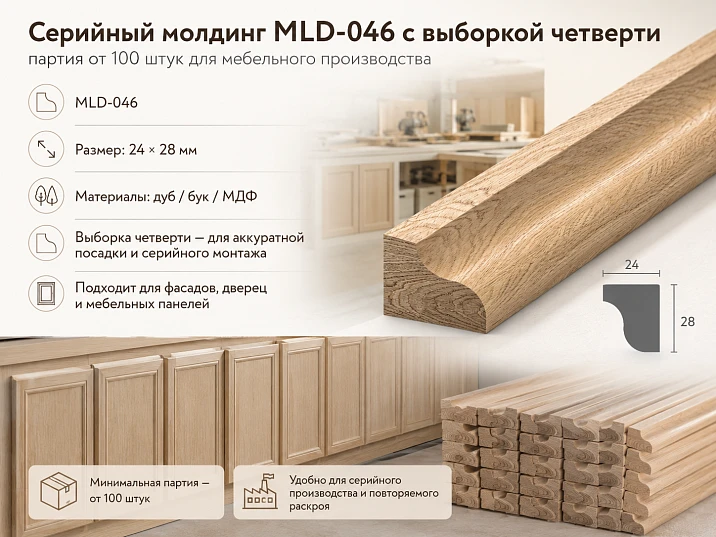
Ordering MDF moldings for furniture facades is easy when production needs a standard profile from the catalog. The task looks much more serious in a serial project: one side of the strip must receive a rabbet of a specified width and depth, and the geometry must be repeated not on two test pieces, but on the entire batch. A joinery workshop is no longer enough to get a regular MLD-046 and then manually refine each strip. A profile is needed that arrives at the workshop prepared according to a unified technical specification.
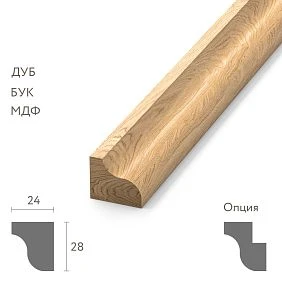
It is for such an order that MLD-046 with a cross-section of 28 × 24 mm is considered. The standard molding is produced from MDF in lengths of 2600 mm, as well as from beech and oak in lengths of 2400 mm. The additional rabbet is made not according to a conventional universal size, but according to the customer's drawing. The minimum batch for this service is 100 strips. Therefore, this is not about a one-time refinement for a single facade, but about a production order that needs to be calculated according to the specification, cutting plan, and furniture production schedule.
This approach has a different purchasing logic. The customer chooses not only the material and quantity. They need to determine the processing side, the width and depth of the rabbet, set allowable tolerances, describe the subsequent finishing, and show how the profile works in the finished furniture assembly. An error in one dimension will be repeated across the entire batch. However, a properly agreed technical specification allows obtaining a series of strips with the same cross-section and not occupying your own equipment with repeated processing of each element.
If the main parameters of the project are already known, you can order the MLD-046 molding with a rabbet, choosing MDF, beech, or oak and preparing a request for a batch of 100 pieces or more. Before transferring the order to production, it is worth checking not only the total footage, but also the cutting, the direction of the rabbet, finishing, production reserve, and acceptance procedure.
Not a single strip, but a repeatable production component
A retail buyer usually evaluates a molding by its appearance, length, and the price of a single item. Furniture production thinks differently. The profile is included in the materials list, takes a place in the technological map, affects assembly, finishing, packaging, and the cost of the finished product. One well-processed strip means nothing if the next ninety-nine differ in the depth of the rabbet or require manual adjustment.
In a serial order, MLD-046 becomes not just a decorative detail. It is a repeatable component that must meet pre-established parameters:
-
the same initial cross-section;
-
one side of the quarter location;
-
the specified rebate width;
-
the specified rebate depth;
-
agreed tolerances;
-
the selected material;
-
a uniform length of supplied slats;
-
surface requirements;
-
conditions for subsequent finishing;
-
application maps in furniture.
This order is intended for those who produce several identical products or regularly repeat one design: furniture factories, small batch production facilities, carpentry workshops, contractors for equipping facilities, assemblers, and companies assembling frame facades or decorative panels using one system.




Why manual finishing ceases to be a minor operation
Selecting a rabbet on one strip can be considered a local carpentry task. For a hundred strips, it is already a separate production process. It will require equipment setup, trial passes, organizing the feed of long parts, size control, marking, waste removal, and re-checking after readjustment.
The number of operations grows faster than it seems. If one strip passes through the machine in a short time, the following must be added to that time:
-
receiving the task by the master;
-
selecting the cutter;
-
setting the stops;
-
checking the processing side;
-
making a trial part;
-
sample measurement;
-
adjustment of settings;
-
feeding and receiving each plank;
-
surface inspection after the pass;
-
laying without damaging the profile;
-
sorting of parts;
-
correction of deviations;
-
equipment maintenance;
-
re-adjustment after a break or batch change.
For a small order, these actions can be considered an inevitable part of the work. In a series, they become a noticeable cost item in production. Therefore, furniture molding in batches of 100 pieces or more should reasonably be evaluated not by the cost of a single milling operation, but by the full route of the part within one's own workshop.
Our factory also produces:
Where the value of a finished series arises
The meaning of order MLD-046 with additional processing is not that the contractor does not need to hold a milling machine. The main value lies in repeatability. If the technical specification is correctly compiled and agreed upon before launch, the entire batch should be evaluated by the same parameters.
Production gets the opportunity:
-
include the profile in the specification of the finished product;
-
design the mating part in advance;
-
reduce the number of internal operations;
-
free up machine time;
-
reduce the movement of long strips around the workshop;
-
separate material acceptance from subsequent assembly;
-
use a single control template;
-
plan cutting before the batch arrives;
-
repeat the furniture model without a new profile search.
Finished processing does not cancel incoming inspection. It changes its nature. Instead of checking the result after each own operation, the enterprise accepts the batch according to the agreed geometry and then sends the profile to cutting, finishing, or assembly.
Get Consultation
What exactly is supplied under the article MLD-046
MLD-046 is a serial linear profile with a confirmed cross-section of 28 × 24 mm. The material affects the length of one strip: MDF is supplied at 2600 mm, beech and oak at 2400 mm. This difference has direct significance for the cutting map and the number of pieces in the order.
| Material of MLD-046 | Section | Length of one strip | Meterage in a minimum batch of 100 pcs. | What to consider when calculating |
|---|---|---|---|---|
| MDF | 28 × 24 mm | 2600 мм | 260 м | A longer strip length can reduce the number of joints and change the cutting pattern |
| Beech | 28 × 24 mm | 2400 мм | 240 м | The layout of segments is calculated based on a 2.4 m plank |
| Oak | 28 × 24 mm | 2400 мм | 240 м | In addition to cutting, the visible texture and direction of the finish must be taken into account |
A minimum of 100 pieces does not mean the same minimum footage for all materials. A batch of one hundred MDF planks contains 260 linear meters. One hundred planks of beech or oak give 240 linear meters. The difference is 20 meters, so the decision on the material cannot be made after calculating the need in conditional "one hundred pieces."
The cross-section remains 28 × 24 mm only until additional processing
The size 28 × 24 mm refers to the original geometry of MLD-046. After cutting the rabbet, part of the material is removed from the side specified in the technical specification. The external dimension of the profile may retain its original values, but the working shape of the cross-section changes.
The customer needs to describe not only the size of the rabbet itself, but also its position relative to the front surface. Two rabbets 10 mm wide and 5 mm deep can be completely different parts if one is made on the back side at the left edge and the other at the right edge.
That is why the wording "make a rabbet on the back" is not enough. For the craftsman, designer, and operator, the concepts of "back," "left," and "right" depend on how the profile is oriented. The working drawing must indicate the base surfaces and the orientation of the cross-section.
The profile from the card and the profile according to the technical specification are different order items
The standard MLD-046 is purchased in the form in which it is presented in the card. Such an order does not automatically imply a completed rabbet.
MLD-046 with a rabbet cut is a standard profile plus additional mechanical processing. It requires:
-
separate indication of the service;
-
batch of 100 slats;
-
unified technical specification;
-
agreed dimensions;
-
calculation of processing cost;
-
verification of technological feasibility;
-
confirmation of material and quantity.
You cannot order a regular MLD-046 without providing a drawing and expect the production to independently choose a suitable rabbet based on the intended application. The same molding can be used in different furniture components, so there is no universal rabbet size.
Rabbet cutting and quarter-round profile are not the same thing
In professional conversation, confusion can easily arise. The word "rabbet" may refer to a rectangular cutout on the edge, while the expression "quarter circle" refers to the shape of the convex front part of the profile. These are different geometric features.
What is called a quarter sample
A quarter sample is a longitudinal rectangular recess formed along one of the edges or sides of a plank. In cross-section, the removed area is usually defined by two dimensions:
-
width;
-
depth.
Additionally, the side of processing, orientation relative to the face, and requirements for the angle or surface after milling are specified.
Why the name does not specify the size
The word "quarter" does not mean that exactly one quarter of the cross-section needs to be removed. It does not automatically specify 7 mm, 10 mm, or half the thickness. The specific geometry is determined by the furniture joint.
In one project, the quarter holds an insert. In another, it helps seat a profile on the edge of a panel. In a third, it forms a joint overlap. In a fourth, it creates space for a mating strip. The dimensions will differ in all cases.
What happens if the concepts are confused
The customer may assume that the standard face shape MLD-046 already includes the required mounting quarter. Production will receive a regular profile, but during assembly it will be discovered that there is no seating recess.
A reverse error occurs when the application only states "make a quarter" but does not show the face side. The contractor may process the opposite edge. Geometrically, the size will be correct, but the part will be unsuitable for the specific facade.
In production documentation, it is better to use the full wording: "longitudinal groove of rectangular cross-section ___ mm wide and ___ mm deep on the ___ side relative to the face surface." A graphic cross-section should be attached after it.
For what tasks might production need a molding with a quarter
The same processed profile can be used in different structures. The article does not replace the calculation of a specific furniture unit, so applications should be considered as design scenarios rather than a universal instruction.
Framed furniture front
A quarter can be used for seating an insert, panel, fillet, or another mating part. The following become critical:
-
actual thickness of the insert;
-
installation clearance;
-
depth of its entry;
-
fixation method;
-
direction of the face surface;
-
processing of frame corners;
-
Allowance for finishing.
If the insert has a nominal thickness of 6 mm, this does not mean that the rabbet should be exactly 6 mm. The actual material thickness, coating, tolerance, and assembly method must be taken into account.
Decorative frame on the facade
The rabbet can help seat the molding on the edge of the base or hide the transition between surfaces. Here, not only mechanical dimensions matter, but also the visual line. Too deep a seating will change the profile's protrusion above the facade. Too shallow will leave a noticeable gap.
Framing of a furniture panel
In serial wall or furniture panels, the rabbet can form a place for a panel, mirror, glass, or decorative insert. The possibility of a specific application must be confirmed by the designer, taking into account the thickness and method of holding the material.
Case furniture
A profile with a rabbet can be used as a decorative and mounting element on dressers, cabinets, nightstands, display cases, and sideboards. But MLD-046 should not automatically be considered a load-bearing frame. Its function is determined by the project.
Configuration of a serial project
In hotels, restaurants, salons, residential complexes, and commercial interiors, dozens of identical furniture elements may be repeated. This is where a prepared batch is especially convenient: the rabbet in each strip is made according to one specification, and the cutting is distributed among the repeated items.
Production of furniture modules
If a company produces a single line of kitchens, cabinets, or panels, the processed MLD-046 can be incorporated into a repeatable design. For subsequent batches, it will be necessary to maintain the current version of the drawing and not mix it with previous revisions.
Who is the order of 100 slats intended for
The threshold of 100 pieces immediately separates a production service from a piecemeal purchase. The order makes sense where repeatability exists.
Furniture factory
The factory can include MLD-046 with a quarter in the permanent specification of the series. For it, supply stability, drawing version, unambiguous marking, and the ability to compare batches against a single template are important.
Carpentry workshop with a serial project
The workshop may not have a separate line for processing long-length moldings or may not want to occupy it with a repetitive operation. Ordering a finished batch frees up resources for cutting, assembly, and finishing of furniture.
Contract manufacturer
The contractor receives drawings from a designer, architect, or furniture brand. It is important for them to agree in advance on who is responsible for the geometry of the quarter, who approves the sample, and which version of the document is considered current.
Object assembler
The assembler combines furniture parts, moldings, finishing materials, and related items. For them, the overall list, packaging, labeling, and delivery sequence are critical.
Facade manufacturer
With a large number of frame parts, ready-made longitudinal processing can reduce operations to cutting and assembly. But the economic effect must be calculated based on specific equipment and labor costs.
Small production with a large single project
Even if the furniture model is not repeated in the future, one hotel, restaurant, or large house may require more than a hundred slats. In this case, the order remains serial in volume, although the project is unique.
For enterprises planning regular assembly, it is useful to study in advance working conditions for furniture manufacturers and agree on the format of requests, documentation, and delivery.
MDF, beech, or oak: the material changes not only the appearance
MLD-046 has three materials, but choosing them only by price is wrong. The material is linked to the length of the plank, subsequent finishing, the cutting map, texture visibility, and acceptance requirements.
MLD-046 made of MDF, 2600 mm long
MDF is considered in projects where a homogeneous surface for opaque finishing and repeatable serial geometry are required. For furniture facades, this material is convenient when the profile and base will be painted in one color.
The length of one plank is 2600 mm. A minimum batch of 100 pieces contains 260 linear meters of profile before cutting.
When MDF is convenient for production
-
the profile is painted with enamel;
-
natural wood texture should not remain visible;
-
facades are produced in a unified color system;
-
the 2600 mm plank needs to be used rationally;
-
the design is calculated specifically for the properties of MDF;
-
The terms of use correspond to the selected material.
What to check in the technical specification
In MDF, after routing, the processed surface of the material is exposed. The finishing system must account not only for the face side but also for the new edge of the rebate. If the recess remains visible or participates in bonding, this should be reflected in the surface requirements.
It is not enough to limit oneself to the phrase "MDF for painting." It is necessary to specify:
-
whether the rebate will be painted;
-
whether local preparation after cutting is allowed;
-
which surface is considered the face side;
-
whether sanding of the routed area is required;
-
whether the coating affects the seating dimension;
-
whether bonding is performed on the processed area.
Why does the length of 2600 mm affect the batch
Production can yield more usable parts from one plank than from material 2400 mm long, but only with a favorable layout. The extra 200 mm does not guarantee lower consumption: it all depends on the sizes of the cut pieces.
For example, two elements of 1300 mm each theoretically fill a 2600 mm plank without accounting for the cut and trimming. In practice, an allowance is required, so such a layout may not fit. The drawing calculation must account for technological losses.
MLD-046 made of beech, 2400 mm long
Beech suits projects where solid wood is required, and the profile is planned to be painted or finished according to the chosen system. Its texture is calmer than oak, so in an opaque color, the main focus remains on the shape of the molding.
The minimum batch of 100 planks gives 240 linear meters.
When to choose beech
-
furniture must contain elements made of solid wood;
-
a processed wooden profile is required;
-
opaque finishing is planned;
-
beech combines with other parts of the product;
-
cutting map is calculated for 2400 mm;
-
the customer understands the characteristics of natural material;
-
the quarter is included in the wooden, not panel, assembly.
What to include in control
Natural wood requires an agreed approach to visible surfaces. For beech, it should be determined which sides remain open after assembly, whether tinting will be applied, and whether differences in natural grain are acceptable.
One cannot expect absolute visual uniformity of MDF from solid wood. But the geometry of the cutout must be controlled according to agreed dimensions regardless of the natural grain.
MLD-046 made of oak, 2400 mm long
Oak is chosen when the wood texture should become part of the furniture design. After transparent or semi-transparent finishing, the grain remains visible, so visual sorting of parts within the project is added to geometric control.
The minimum batch is also 240 linear meters.
When oak is justified
-
the profile remains visible;
-
the furniture contains oak facades or panels;
-
the project provides for tinting;
-
the texture should emphasize the frame construction;
-
the customer is ready to distribute slats across visible areas;
-
the direction of the pattern is taken into account during cutting;
-
the finishing system is designed for oak.
Why an oak batch requires a well-thought-out cutting map
When cutting, not only the length but also the appearance of the elements is taken into account. For a frame facade, two adjacent slats may differ in pattern. If this is critical, sorting is done before final cutting.
The quarter is located on the back or mounting side according to the project, but an orientation error during cutting can bring the beautiful face surface to the inner side of the frame. Therefore, marking of the face and direction must be preserved after receiving the batch.
Before the final choice of material, it is useful to check materials and quality of molded products, then confirm the selected option in the request and specification.
Comparison of three materials for a production batch
| Criterion | MDF | Beech | Oak |
|---|---|---|---|
| Plank length | 2600 мм | 2400 мм | 2400 мм |
| Length of 100 slats | 260 м | 240 м | 240 м |
| Main visual character | Uniform surface | Calm wood texture | Pronounced wood texture |
| Typical design approach | Opaque painting | Painting or selected solid wood finish | Toning or transparent finish |
| Layout | Optimized for 2600 mm | Optimized for 2400 mm | Optimized for 2400 mm and visible pattern |
| Quarter control | Dimensions and surface quality | Dimensions, surface, natural features | Dimensions, surface, texture orientation |
| What is especially important | Consider coating on the sample | Do not mix different versions in a batch | Plan sorting of visible parts |
No material can be called the best without a project. MDF may be rational for painted serial facades, beech for wooden parts under enamel, oak for products with open texture. The decision is made before calculating the quantity, because the length of the strip changes the cutting map.
Standard MLD-046 or batch with additional processing
| Parameter | Standard MLD-046 | MLD-046 with quarter sampling |
|---|---|---|
| Original cross-section | 28 × 24 mm | 28 × 24 mm before processing |
| Additional quarter | No | Performed according to agreed technical specifications |
| Minimum for purchasing the profile itself | Specified based on the card and order conditions | For sampling service — from 100 slats |
| Quarter size | Not applicable | Width and depth are set by the customer |
| Processing side | Not applicable | Must be indicated on the drawing |
| Price | Price of selected MLD-046 | Profile price plus service cost |
| Documentation preparation | Selection of material, length, and quantity | Full technical specification |
| Primary buyer | Retail or manufacturing customer | Serial furniture production |
| Route in the workshop | Own refinement possible | Profile comes with an agreed sample |
| Control | Standard profile check | Check of profile and quarter parameters |
The standard option is suitable when the enterprise already has a configured milling process or a quarter is not needed at all. Ordering a processed batch makes sense when it is more profitable to outsource a repetitive operation from your own route.
Minimum batch and cost of additional processing
The quarter sampling service is provided for orders of 100 or more slats. The cost specified for the additional operation is 185 rubles per slat.
Minimum calculation:
100 × 185 = 18,500 rubles.
This amount applies only to the quarter sampling. The cost of the MLD-046 itself is calculated separately based on the selected material, quantity, and current card price.
What makes up the batch budget
The full budget can be represented by the formula:
Profile cost + cost of additional processing + accompanying materials + packaging and delivery + internal costs for cutting, finishing, and assembly.
Not all components are necessarily supplied by one vendor. The formula is needed for comparing production routes.
Example for 100 slats
Let the order consist of 100 slats MLD-046 of one material and one quarter finish.
Processing cost:
100 × 185 = 18,500 rubles.
Added to it:
-
cost of 100 slats of the selected material;
-
cost of finishing materials, if ordered together;
-
delivery;
-
internal cutting;
-
possible edge processing after cutting;
-
assembly of furniture units.
Example for 130 slats
130 × 185 = 24,050 rubles for additional processing.
The cost of the profile is calculated separately again.
Why you can't count only 18,500 rubles
Sometimes the minimum cost of a service is mistaken for the price of the entire batch. This leads to an erroneous budget. Processing does not replace the purchase of the molding itself. The company purchases 100 MDF, beech, or oak slats and additionally pays for quarter routing on each of them.
Do you need to order exactly 100 pieces
No. One hundred pieces is the lower limit for the service. The actual quantity is determined by the cutting map, reserve, and production schedule. If production requires 117 slats, you cannot round the order down to one hundred. If the calculation shows 94, you need to decide whether additional profile volume is needed or a different processing route.
How to compare ordering a finished batch with in-house processing
The statement "finished processing is always cheaper" would be incorrect. One enterprise has a free milling section and a low internal rate. Another has equipment occupied with main products, and long-length linear molding disrupts the flow. The economics need to be calculated based on your own data.
| In-house processing | Order MLD-046 with a ready quarter |
|---|---|
| Equipment setup is performed in the workshop | Parameters are transferred in a unified technical specification |
| Production processes each plank | A prepared batch arrives at the workshop |
| Own machine time is required | The machine remains occupied with the main product |
| An operator and a receiver are needed | Main control is shifted to incoming inspection |
| Differences may occur after readjustment | The batch is coordinated according to one geometry |
| Waste and shavings remain at the production site | Additional processing is performed before delivery |
| Parameters are flexibly changed during operation | Changes after launch require new approval |
| Less than 100 slats can be processed | The service is available from 100 pieces |
| Risks are controlled by our own technologist | The quality of the technical specification determines the accuracy of the order |
| Correction is possible before the end of the batch | An error in the technical specification can repeat across all planks |
What to calculate for your own route
-
setup time;
-
trial run time;
-
processing duration of one plank;
-
cost per hour of equipment;
-
operator labor cost;
-
inspection cost;
-
material losses during setup;
-
transportation and storage;
-
simple of another order;
-
risk of rework;
-
tool wear;
-
organization of waste removal;
-
packaging after the operation.
What to calculate for the finished batch
-
service price;
-
cost of the profile itself;
-
preparation of the drawing;
-
alignment;
-
incoming inspection;
-
delivery;
-
reserve;
-
risk of project changes after launch;
-
storing the full volume;
-
cost of capital invested in the batch.
Where the economic effect most often occurs
Finished processing is especially interesting when the internal machine is a bottleneck. Even if the own cost of one pass seems low, the freed-up time can be used for an operation with higher added value.
Another scenario is the lack of stable repeatability. If the craftsman adjusts the quarter manually and parts are processed in several shifts, the batch may get differences. A single external execution removes part of this risk, but only with a precise specification.
When own processing can be more rational
-
need less than 100 slats;
-
the project is still changing;
-
the quarter dimensions are refined after fitting;
-
production has free specialized equipment;
-
several different sampling options are required in small quantities;
-
strips are processed after individual cutting;
-
the technological process is linked to other operations on the same machine;
-
the customer needs to adjust parameters directly during production.
The technical specification begins with the function of the part
The drawing cannot be made in isolation from the furniture unit. First, the designer answers the question: why is the quarter needed?
Possible functions:
-
insert seating;
-
edge covering;
-
connection with the panel;
-
forming the frame;
-
hiding the joint;
-
fixing the decorative element;
-
creating an installation cavity;
-
ensuring the specified protrusion of the profile.
After determining the function, choose the width and depth. Not the other way around.
Why function is more important than a beautiful cross-section
If the quarter is drawn just because "that's how it's usually done," the finished profile may not match the insert thickness or leave insufficient material wall. The technologist must check whether the processed MLD-046 retains sufficient geometry for the specific application.
STAVROS considers non-standard serial orders taking into account production capabilities. Therefore, before launching, it is worth ordering wooden products according to technical specifications and convey not a verbal wish, but a complete set of source data.
What must be included in the technical specification
1. Article number
The document specifies:
MLD-046.
A name without an article number can be interpreted ambiguously, especially if the project includes several moldings.
2. Material
You need to choose one option:
-
MDF;
-
beech;
-
Oak.
If the project includes several materials, a separate line item and quantity are created for each. You cannot combine in one line “MLD-046, beech/oak, 100 pcs.” without distribution.
3. Number of slats
The exact quantity for each material is specified. For example:
-
MLD-046, MDF, 120 pcs.;
-
MLD-046, oak, 100 pcs.
The minimum of 100 pieces applies to the additional processing service. The possibility of combining different materials into one minimum volume cannot be assumed independently — it should be agreed upon before ordering.
4. Length of each slat
For standard options:
-
MDF — 2600 mm;
-
beech — 2400 mm;
-
oak — 2400 mm.
If a different length is required, you cannot simply change the value in the request. The possibility of non-standard manufacturing is considered separately.
5. Drawing of the original profile
The cross-section shows the external dimension of 28 × 24 mm and indicates the front surface. This creates a unified coordinate system for further dimensions.
6. Side of the quarter
It is necessary to show graphically:
-
the top;
-
bottom;
-
face;
-
back side;
-
left and right edges in the selected orientation.
It is better not to rely on the text "quarter on the right." After rotating the part, the right side changes.
7. Sample width
The dimension is specified from the selected base plane to the vertical boundary of the quarter.
8. Sample depth
The dimension is specified from the original surface to the bottom of the recess.
9. Permissible deviations
The tolerance must match the function. A seating area for an insert may require one range, a decorative overlap another. Specific values are determined by the customer and agreed with the manufacturer.
10. Angle requirements
It is necessary to clarify whether technological rounding from the tool is allowed or whether a different result is required. One cannot expect an absolutely sharp internal corner without specifying the requirement and agreeing on the possibility of achieving it.
11. Surface requirements
The document records:
-
whether tool marks are acceptable;
-
whether additional grinding is required;
-
whether the cutout will be visible;
-
whether gluing will be performed along it;
-
whether it is covered with enamel, varnish, or a tinting compound;
-
whether special preparation for finishing is needed.
12. Subsequent finishing
Finishing can change mounting dimensions. The coating thickness may be small, but it must be taken into account for a tight fit.
13. Application diagram
A fragment of the furniture assembly is attached to the profile drawing. It shows where the insert goes, how the profile is fastened, and which side remains the face.
14. Marking requirements
For a complex project, it is useful to specify:
-
item name;
-
material;
-
drawing number;
-
revision;
-
quantity;
-
face side;
-
batch.
15. Acceptance procedure
Before production, it should be determined what and where a quarter is measured, how many strips are checked, and which document is considered the basis.
How to specify a cross-section without ambiguity
The drawing can be simple, but it must answer all the operator's questions.
Specify the datum
For example:
-
datum A — rear plane;
-
datum B — bottom edge;
-
surface L — front.
The width and depth of the quarter are then set from the datums, not from a conditional position on the sheet.
Do not change orientation between sheets
On one sheet, the profile should not be shown face up, and on another — face down without a noticeable indication. In a series of several drawings, this creates a risk of mirror machining.
Put dimensions on the section
The width and depth of the cutout should be placed next to the quarter view. Do not hide them only in a text table.
Add a scaled detail of the joint
The profile section explains the geometry, but not always the function. The facade detail shows:
-
the thickness of the insert;
-
the depth of its insertion;
-
the gap;
-
the position of the glue seam;
-
the protrusion of the front part;
-
the assembly direction.
Assign a revision number
For example:
MLa:2:{s:4:"TEXT";s:65534:"a:2:{s:4:"TEXT";s:65534:"a:2:{s:4:"TEXT";s:70541:"
Example of calculating frame parts from MDF
Let's consider a conditional production example. It shows the methodology, not a ready consumption rate.
The batch includes 120 identical facades. For each, you need:
- two vertical parts of 600 mm each;
- two horizontal parts of 400 mm each.
For one facade, you need:
2 × 600 + 2 × 400 = 2000 mm.
For 120 facades:
2000 × 120 = 240,000 mm, or 240 m.
Theoretical calculation based on MDF strips 2600 mm long:
240 ÷ 2.6 = 92.31 strips.
By total length, 93 strips are sufficient. However, the selection service is available from 100 pieces, so the minimum order will still be 100 strips. The batch will yield 260 m of the original profile.
There remains 20 m of theoretical margin relative to the net length. However, it cannot be immediately considered free reserve. The following are deducted from it:
- cuts;
- trimming;
- test pieces;
- unused remnants;
- possible sorting;
- production stock.
Checking the specific layout
In a 2600 mm plank, you can try to fit:
- 600 + 600 + 400 + 400 = 2000 mm;
- remainder before accounting for cutting — 600 mm.
Theoretically, one plank provides a set for one facade and still a remainder. But for 120 facades, 120 planks would be needed, not 93. To get closer to the calculation by length, you need to combine parts between facades.
For example, in one plank you can place four parts of 600 mm:
600 × 4 = 2400 mm.
200 mm remains before accounting for cuts and trimming.
In another — six parts of 400 mm:
400 × 6 = 2400 mm.
Again, 200 mm remains.
For 240 vertical parts of 600 mm, 60 planks are needed. For 240 horizontal parts of 400 mm — 40 planks. Total exactly 100 planks before accounting for cuts. But the layout of 2400 mm inside a 2600 mm plank creates a 200 mm allowance, from which cuts and trimming are covered.
This example shows why a cutting map is more useful than simply dividing the total length.
Example of calculating a batch from beech or oak
We use the same 120 facades, but the length of the strip is 2400 mm.
The net requirement remains 240 m.
One hundred strips of 2.4 m give:
100 × 2.4 = 240 m.
On paper, the batch matches the net length without any remainder. In real production, such a calculation is insufficient because there are also saw cuts, trimming, and test pieces.
Vertical elements
Four pieces of 600 mm theoretically give exactly 2400 mm. But cuts are needed between them, so four clean 600 mm segments from one standard strip may not be achievable without reducing the length or adding an extra allowance.
Horizontal elements
Six pieces of 400 mm also give 2400 mm before cuts. The same problem arises.
So, the batch must be more than a hundred strips, or the design dimensions and cutting technology must allow a different scheme. The minimum service is not equal to a sufficient amount of material.
Production reserve: why you cannot assign one percent for everyone
The phrase "add 10%" is convenient, but not always reasonable. For long repeating parts, the allowance may be determined by one logic, for many short ones — by another.
The reserve is influenced by:
- cutting efficiency;
- cut width;
- need for end trimming;
- texture requirements;
- number of test pieces;
- surface visibility;
- corner complexity;
- project stability;
- risk of damage during finishing;
- possibility to reorder exactly the same batch;
- project duration;
- number of furniture modules;
- permissibility of using short remnants.
Three levels of reserve
It is useful for production to divide the stock not by one number, but by purpose.
Technological stock covers cuts, end trimming, and test operations.
Quality stock allows replacing a strip that is not suitable for the visible area or has been damaged.
Operational stock remains for repairs, warranty replacement, or subsequent series expansion.
The company determines percentages independently based on the cutting layout and project requirements.
How many finished products can be obtained from a minimum batch
The answer depends on the size of the furniture parts.
For MDF, the minimum batch contains 260 m. For beech and oak — 240 m. But the useful yield is determined by the layout.
A conditional facade with a perimeter of 1.6 m
If the net profile consumption per facade is 1.6 m:
- from 260 m theoretically you get 162.5 facades;
- From 240 m — 150 facades.
The actual yield will be lower due to cutting.
A conditional frame with a perimeter of 2.4 m
- 260 ÷ 2.4 = 108.33 frames;
- 240 ÷ 2.4 = 100 frames.
But a perimeter of 2.4 m does not mean that four parts are automatically cut from one strip. Layout is needed again.
Why calculating by finished products is useful
It helps to understand how the minimum batch corresponds to the production program. If a company produces only 20 facades and the profile is not used anywhere else, an order with a quarter can create a large surplus. If 300 facades are produced, 100 strips will be only part of the need.
One quarter for the entire batch or several variants
The basic logic of the service assumes a single technical specification for the processed series. If the project requires different depths, sides, or widths, these are already multiple executions.
Cannot transfer order:
- 30 slats with a quarter 8 × 4 mm;
- 30 slats with a quarter 10 × 5 mm;
- 40 slats with mirror finish —
and automatically assume that the total volume of 100 pieces satisfies the conditions of one serial service. The possibility of splitting the batch, the cost of changeovers, and minimums for each execution need to be agreed separately.
Why multiple executions complicate production
Each geometry requires:
- a separate drawing;
- its own setup;
- a trial part;
- markings;
- control;
- packaging without mixing.
If the differences are minimal, the risk of confusing items increases. The application must have different codes, for example:
- MLD-046-Q1;
- MLD-046-Q2;
- MLD-046-Q3-MIRROR.
Control sample: what to agree on before the entire series
The MLD-046 card confirms the sampling service according to the technical specification, but does not establish a universal procedure for manufacturing a control sample. Therefore, the customer should discuss in advance with the manager whether the following are possible:
- approval of the drawing without a sample;
- photograph of the control section;
- measurement protocol;
- sample before starting the batch;
- approval of the first part;
- another confirmation format.
It cannot be promised that a separate prototype is necessarily included in the service price. This issue relates to the terms of a specific production order.
What to check on the control part
- the material;
- external dimension 28 × 24 mm;
- width of the quarter;
- the depth;
- processing side;
- orientation relative to the face;
- bottom quality;
- edge condition;
- possibility of seating the mating part;
- influence of the coating;
- conformity to the drawing.
Test in a real assembly
Measurements with a caliper do not replace assembly verification. It is advisable to compare the control segment with the actual panel, insert, or frame. If the assembly is made with a coating, future finishing must be taken into account.
Tolerances: do not require "maximum accuracy," but set a working range
The phrase "make it as accurately as possible" is unsuitable for a contract and acceptance. Any processing has an allowable deviation. The designer's task is to determine the range within which the furniture assembly fits together and maintains the desired appearance.
Too wide a tolerance
The insert may be loose, the frames will differ in protrusion, and visible gaps will become uneven.
Too strict a tolerance
The order may become technologically more complex and expensive, although the furniture structure does not require such precision.
Different sizes — different tolerances
The width of the rebate can affect the insertion depth. The depth affects the position of the front surface. Straightness affects the assembly of a long frame. You cannot combine all requirements in one phrase.
Finishing is also part of the dimensional chain
If the rebate is painted, primer and enamel take up part of the seating space. If adhesive is applied to it, the contact area matters. The dimension is specified considering the finished assembly, not just raw wood or MDF.
Surface after routing: hidden does not mean unimportant
The back rebate may be invisible after assembly, but it performs a function.
If the surface is glued
Tool marks, dust, and coating can affect the joint. Preparation requirements are coordinated with the chosen adhesive system.
If a panel is inserted into the rebate
Irregularities can interfere with seating or scratch the finished surface of the insert.
If the sample remains partially visible
Requirements for sanding and finishing become higher. The visible area must be marked on the drawing.
If the profile is painted entirely
The inner corner and the bottom of the rebate must be accessible for preparation and coating application. A too thick layer reduces the useful size.
For equipping your own finishing section, you can Buy materials for installation and finishing, having previously matched them with MDF, beech, or oak and furniture production technology.
Finishing MLD-046 from MDF
With opaque painting, the front part and the rebate can be processed differently. The front surface is responsible for appearance, the rebate for fit and installation.
The production card must answer the questions:
- whether the rebate is primed;
- Is it sanded after priming?
- Is the finish coat applied?
- Is there room left for the insert?
- Is the bonding area protected from the coating?
- Is the profile painted before or after cutting?
- How are the ends treated.
If the profile is painted as a long plank, open ends will appear after cutting. If cutting is done first, the number of individual parts for finishing increases. Each route has its own costs.
Beech finishing
Beech can be used under an opaque or other agreed finish. In a production batch, color repeatability is especially important.
Production should:
- make a test drawdown;
- determine the degree of sanding;
- agree on the primer;
- check the rebate recess;
- protect the mounting surfaces;
- record the color sample;
- store the finishing system data together with the profile drawing.
Oak finish
Oak is often chosen for its texture. When tinting, different areas of the plank may absorb the compound unevenly. For visible frames, this is not a defect in itself, but a natural property that must be considered when sorting.
The oak cutting plan may include:
- selection of the front side;
- grain direction;
- distribution of strips between facades;
- marking of paired parts;
- test tinting;
- comparison under actual lighting;
- surface protection during assembly.
What to buy together with the serial batch
Delivery of MLD-046 rarely exists separately from the entire furniture project. The customer may need finishing materials, other moldings, and interior fitting elements.
| What to add to the order | Why | When it is especially useful | What to check |
| Standard or processed MLD-046 | Main profile of the series | Facades, frames, furniture panels | Material, length, quantity, and revision of the technical specification |
| Additional reserve MLD-046 | Replacement of damaged or test parts | Serial and project-based production | Storage and batch compliance |
| Mounting materials | Assembly of the furniture unit | When the profile is attached or glued | Compatibility with material and finish |
| Materials for painting | Final preparation | MDF and beech under enamel | Effect of coating on quarter |
| Materials for tinting | Preservation of texture | Oak and visible beech | Test swatch |
| Other moldings | Furniture series configuration | When a project contains multiple profiles | Compatibility of section and material |
| Wooden skirting board | Unified configuration of the object | Furniture and interior are ordered together | Material, length, and future finishing |
| Drawings and catalogs | Preparation of design documentation | Before issuing the technical specification | Current version of data |
| Packaging and delivery | Saving a long-length batch | Interregional delivery | Cargo size and unloading procedure |
Comprehensive supply of furniture and interior moldings
A furniture manufacturer can simultaneously produce cabinet products and equip the facility with decorative moldings. Then it makes sense to coordinate materials and finishes not only within the facade, but also between the furniture and the room.
For example, together with oak furniture moldings, you can buy wooden skirting board from a suitable material. This does not mean that the plinth and MLD-046 must have the same cross-section or perform the same function. The connection is based on material, tone, gloss level, and the overall finishing system.
What a single order provides
- fewer random differences in material;
- ability to coordinate finishing samples;
- single list of linear measurements;
- centralized delivery;
- clear responsibility of the completer;
- coordination of timelines for one object;
- reduction in the number of suppliers.
What cannot be formally combined
You cannot assume that an oak skirting board will automatically match an oak molding in shade after any tinting. The wood species is common, but the grain and color of individual pieces differ. A unified result is achieved through the finishing system and sample control.
How to accept a batch of MLD-046 with a quarter
Incoming inspection should be prepared before the cargo arrives. If the enterprise opens the drawing for the first time only during acceptance, disputed parameters will be interpreted from memory.
Document check
- article number;
- the material;
- quantity;
- length;
- technical specification number;
- drawing revision;
- quarter designation;
- agreed processing cost;
- associated items.
Packaging check
Before unpacking, visible damage, condition of long-length packages, and marking are recorded.
Quantity check
The number of slats is checked for each position. MDF, beech, and oak cannot be combined into one common line.
Length check
MDF slats must match the selected position with a length of 2600 mm, beech and oak — 2400 mm, unless the order contains a separately agreed non-standard execution.
Initial profile check
The external dimension is measured and compared with MLD-046 28 × 24 mm.
Quarter check
According to the agreed sample, the following are checked:
- width;
- the depth;
- side;
- orientation;
- the surface condition;
- repeatability;
- absence of mixing of mirror positions.
Check on assembly template
Several segments are placed in a control node. This helps identify a problem that is not visible from a single dimension.
Recording the result
Acceptance must be documented according to the enterprise's internal procedure. Photos, measurements, and package numbers are useful when analyzing discrepancies.
What volume to measure selectively
There is no universal number. The control plan depends on the criticality of the part, batch size, and enterprise requirements.
A combination can be used:
- checks of the first unpacked plank;
- several planks from different packages;
- beginning, middle, and end of the game;
- parts from different places in the package;
- additional measurements when a deviation is detected.
If a quarter participates in the precise fit of the insert, control should be stricter than for a hidden decorative overlap with a large allowance.
Tools for incoming inspection
For production verification, the following may be used:
- caliper;
- depth gauge;
- metal ruler;
- square;
- section template;
- reference insert;
- control frame fragment;
- flat surface for plank evaluation;
- marking sheet.
The choice of tool depends on the specified tolerance. If a dimension needs to be controlled with precision that a regular ruler does not show, the measurement method must be corresponding.
Storage of batch before cutting
A long profile must not be thrown into a common pile without marking. Mixing is especially dangerous:
- standard MLD-046;
- MLD-046 with quarter;
- mirror variants;
- different materials;
- different versions of the technical specification;
- remnants of the previous batch.
Storage Organization
- keep the batch designation;
- separate materials;
- mark the front side;
- protect the profile from mechanical damage;
- do not create conditions for deformation;
- store the drawing next to accounting documents, not inside the packaging;
- keep records of issued strips;
- Place the reserve separately.
Specific storage conditions are chosen based on recommendations for the material and internal enterprise standards.
Cutting after sampling or sampling after cutting
Order MLD-046 with a quarter involves processing the entire plank before delivery. In our own workshop, a different route is possible — first cut the blanks, then select the quarter on short elements.
| First the quarter on the long plank | First cutting, then the quarter |
| One longitudinal operation for the entire profile | Many short parts are processed |
| Convenient to order a ready-made series | Convenient to change parameters between elements |
| Cutting is performed on an already oriented profile | It is easier to work with short workpieces |
| A technical specification error affects the entire strip | An error may affect an individual part |
| It is necessary to monitor the side when cutting | Each part requires repeated feeding |
| Fewer internal longitudinal operations | More operations in the in-house workshop |
| Suitable for a single quarter | Suitable for various low-volume options |
The choice of route depends on the series. For hundreds of identical parts, long-length processing often seems logical. For one-off facades with different fittings, in-house work after cutting can be more flexible.
How not to confuse MLD-046 with other types of moldings
Molding and batten
A batten can have a simple rectangular cross-section. MLD-046 is a profile with its own face geometry. A rabbet cut does not turn it into a regular batten.
Molding and a casing
A casing is designed for framing an opening or another corresponding task. MLD-046 is chosen by its cross-section and project, not just by similar width.
Molding and baseboard
A baseboard solves the task of the wall-floor joint or another intended function. Furniture molding works as part of furniture or a decorative structure.
Standard profile and processed one
The same article number of the original product does not mean the same geometry after additional cutting.
Rabbet cut and groove
A groove is usually located inside the surface and is bounded by material on two sides. A rabbet is open to the edge. In the technical specification, the required shape must be correctly named and shown.
Sampling and trimming
Trimming changes the outer dimension of the edge. A quarter creates a stepped section. These operations cannot be mixed.
For comparison of MLD-046 with other sizes and shapes, you can buy wooden moldings for furniture after checking the section, material, length, and available processing options.
Mistakes that make a serial order expensive
Mistake 1. Ordering 100 pieces without a cutting plan
The minimum batch may be less than the actual need or create a large unusable remainder.
Mistake 2. Counting only linear meters
Total length is not enough without laying out specific segments.
Mistake 3. Not accounting for different material lengths
MDF is supplied in 2600 mm lengths, beech and oak in 2400 mm lengths.
Error 4. Mixing materials in one line
Quantity, length, and finish must be separated into separate items.
Error 5. Writing "standard quarter"
There is no fixed universal size.
Error 6. Not specifying the face of the profile
The quarter may end up on the mirrored side.
Error 7. Providing only the width
Without depth, the shape is undefined.
Error 8. Providing only the depth
Without width, the task is also incomplete.
Error 9. Not specifying a tolerance
Acceptance becomes subjective.
Error 10. Requiring an unjustifiably tight tolerance
The order becomes more complicated without benefit to the assembly.
Error 11. Not considering the coating
Primer, enamel, or varnish can change the fit size.
Error 12. Not checking the mating part
The nominal panel thickness may differ from the actual one.
Error 13. Changing the drawing after launch
The finished batch will match the previously agreed revision.
Error 14. Using the same name for different files
A manager or technologist can open the old version.
Error 15. Not checking the technological rounding
The internal corner after milling may differ from the drawn absolutely sharp corner.
Error 16. Not specifying the surface quality of the quarter
The result may not match the gluing or visible finish.
Error 17. Considering 18,500 rubles as the full order price
This is the minimum cost of additional processing of a hundred slats, not the cost of the moldings themselves.
Error 18. Not comparing internal costs
The decision to outsource processing cannot be made without your own calculation.
Mistake 19. Assuming external processing is guaranteed to be cheap
Savings depend on the equipment, workload, and logistics of a specific enterprise.
Mistake 20. Not including trial parts
The first pieces will be needed to check cutting, finishing, or assembly.
Mistake 21. Setting the reserve as a random percentage
The allowance should follow from the cutting map and project risks.
Mistake 22. Not separating mirrored positions
During assembly, it will turn out that half of the parts are oriented incorrectly.
Mistake 23. Mixing batches in the warehouse
Externally similar strips may have different quarters.
Error 24. Not checking the profile upon acceptance
The problem will be discovered after cutting, when the strip has already been modified.
Error 25. Starting mass cutting without an assembly test
Even correct dimensions need to be checked in a real joint.
Error 26. Not accounting for the visible oak texture
After cutting, the frames will be assembled from parts with random grain patterns.
Error 27. Ordering exactly the net footage
Saw cuts and trimming will create a shortage.
Error 28. Not agreeing on several quarter options
Different executions may require separate conditions and calculations.
Error 29. Not checking the packaging of a long-length batch
Damage will be detected too late.
Error 30. Not securing the acceptance procedure
The customer and manufacturer will interpret compliance differently.
When MLD-046 with a quarter is truly suitable
Such an order is worth considering if:
- a serial batch of at least 100 slats is required;
- the 28 × 24 mm profile fits the furniture project;
- MDF, beech, or oak is needed;
- the quarter is the same for the entire coordinated series;
- the dimensions are already determined by the designer;
- a working drawing exists;
- the processing side is clearly marked;
- the enterprise wants to reduce its own longitudinal operations;
- the cost of the external service is compared with internal costs;
- the cutting is calculated for 2400 or 2600 mm;
- the finish is known in advance;
- the batch will be accepted according to the established parameters;
- the profile is repeated in several furniture items;
- the customer is ready to approve the technical feasibility.
When is it better to buy a standard MLD-046
A standard profile without additional processing may be more rational if:
- a quarter is not needed;
- fewer than 100 strips are required;
- the sample size is still changing;
- each furniture part has its own geometry;
- the enterprise has free equipment;
- the profile is first cut into many different blanks;
- processing must be done after fitting;
- Several variants are needed in small quantities;
- The series is not confirmed;
- The design is at the prototype stage;
- The customer is not ready to define tolerances;
- The mating panels have not been selected yet.
When MLD-046 is not suitable at all
A different profile needs to be chosen if:
- The cross-section of 28 × 24 mm is too large or too small;
- The face geometry does not match the design;
- After a quarter, an insufficient working part remains;
- the design requires a deep groove, not an open rebate;
- a different length is needed without the possibility of coordination;
- the material is not suitable for the operating conditions;
- the profile must perform a load-bearing function for which it is not designed by the project;
- A flexible molding is required;
- the furniture has a curved surface;
- the quarter must vary along the length;
- local, not continuous, processing is needed;
- the project requires drilling, grooves, and other operations not included in the agreed service.
Production route for the STAVROS order
Step 1. Select a standard profile
Checking card MLD-046:
- cross-section 28 × 24 mm;
- the material;
- length;
- current price;
- availability;
- manufacturing conditions.
Step 2. Determine the quarter function
The constructor shows which part the profile mates with.
Step 3. Prepare the drawing
The drawing specifies width, depth, side, bases, tolerances, and surface.
Step 4. Calculate the cutting layout
The quantity is determined by actual segments, not just by length.
Step 5. Check the minimum
An additional selection requires a batch of at least 100 slats.
Step 6. Calculate processing
The quantity is multiplied by 185 rubles per plank at the specified service cost.
Step 7. Add profile cost
MDF, beech, and oak are calculated separately at current prices.
Step 8. Submit the request
The request includes a drawing, material, quantity, and contact details.
Step 9. Approve the technology
The manager and production assess the feasibility of execution.
Step 10. Lock the revision
After approval, the file cannot be changed without releasing a new version.
Step 11. Prepare acceptance
The customer creates a control template and measurement sheet in advance.
Step 12. Coordinate logistics
For long-length batches, packaging, address, unloading, and delivery conditions are checked. The current procedure can be clarified in the section payment and delivery of products.
Example of a serial processing request
Customer: ____________________.
Project: ____________________.
Article: MLD-046.
Material: MDF / beech / oak.
Standard cross-section: 28 × 24 mm.
Standard length: 2600 mm for MDF / 2400 mm for beech or oak.
Quantity: ______ slats.
Additional operation: longitudinal groove cutting.
Groove width: ______ mm.
Groove depth: ______ mm.
Processing side: according to drawing No. ______.
Face surface: marked with letter ______.
Width tolerance: ______.
Depth tolerance: ______.
Requirement for internal corner: ____________________.
Sample surface requirement: ____________________.
Subsequent finishing: enamel / varnish / tinting / other.
Purpose: ____________________.
Mating part and its actual thickness: ______ mm.
Need for a reference sample: to be agreed / not required.
Marking requirements: ____________________.
Delivery address: ____________________.
Production requirement deadline: ____________________.
The application is accompanied by a cross-section, a furniture unit fragment, and an application map.
FAQ: questions about MLD-046 with quarter sampling
Can I buy one MLD-046 with a quarter sample?
The additional sampling service is provided for batches of 100 slats or more. The standard MLD-046 can be considered separately under the card's terms.
Is the minimum batch 100 meters or 100 pieces?
The minimum is set in pieces — 100 slats. For MDF this corresponds to 260 m, for beech and oak — 240 m.
What cross-section does MLD-046 have?
The original cross-section is 28 × 24 mm.
What is the length of the MDF molding?
The standard length of MLD-046 made of MDF is 2600 mm.
What is the length of beech and oak?
The standard length of a beech or oak slat is 2400 mm.
Is there a standard size for the quarter?
No. The width, depth, and processing side are determined by the customer's technical specification.
What does quarter sampling mean?
This is a longitudinal rectangular recess open to one of the profile edges.
Is quarter sampling already included in the standard MLD-046?
No. This is an additional option that needs to be ordered separately.
How much does minimal processing of 100 planks cost?
At a cost of 185 rubles per plank, sampling for 100 pieces amounts to 18,500 rubles.
Does the 18,500 rubles include the molding itself?
No. This is the cost of additional processing. The MLD-046 itself is paid separately.
How can I find out the full price of MLD-046?
You need to select the material, check the current price of the profile, multiply it by the quantity, and add the cost of processing and delivery.
Can I combine 50 MDF slats and 50 oak slats?
Such a possibility cannot be assumed automatically. Different materials may be considered separate production items, so the terms need to be agreed upon.
Can I order two different quarters in a batch of 100 pieces?
These are several versions with separate settings. The possibility of splitting the batch and the cost are agreed upon before production starts.
Do I need to attach a drawing?
Yes. Without a cross-section, it is impossible to unambiguously determine the side, width, and depth of the quarter.
Is it enough to write the dimensions in the letter?
No. Text dimensions need to be supplemented with a drawing showing the face surface and reference points.
What is considered the face side?
The front side is assigned by the customer based on the profile's position in the furniture and is indicated on the drawing.
Why show the furniture joint?
It explains the function of the rebate and helps verify that the dimensions are chosen correctly.
How to determine the depth of the rebate?
It is calculated based on the thickness of the mating part, required fit, coating, and frame construction.
Should the rebate exactly match the thickness of the insert?
Not necessarily. A gap, coating, glue, or a different insert position may be required. The designer determines the dimension.
Can a dimension be specified as "approximately"?
No. Precise nominal dimensions and tolerances are required for serial processing.
Who sets the permissible deviations?
The customer defines the functional requirements, after which the parameters are agreed upon with the manufacturer.
Is it possible to require an absolutely sharp internal corner?
The requirement needs to be specified and agreed upon technologically. Milling can form a radius that depends on the tool.
Is it necessary to sand the recess?
This depends on its visibility, the method of bonding, and the finish. The requirement should be included in the technical specification.
Is it possible to paint the quarter?
Yes, if it is provided for by the technology. The coating thickness is taken into account when calculating the fit.
What is better for a painted facade — MDF or beech?
Both materials can be considered according to the project. MDF provides a uniform surface, beech allows the use of solid wood. The decision depends on the construction and finish.
When to choose oak?
When solid wood with a pronounced visible texture is required for a suitable finish.
Why does MDF give more linear footage in a hundred planks?
Because one MDF plank has a length of 2600 mm, while beech and oak have 2400 mm.
How to calculate the number of planks?
Make a list of all segments and distribute them across planks of the appropriate length, taking into account cutting, trimming, and reserve.
Why can't the total linear footage be divided by 2.4 or 2.6 m?
Such a calculation does not account for unusable remnants and the combination of specific lengths.
Is a surplus beyond the calculated quantity needed?
Yes, if the cutting map, trial assembly, finishing, and project risks require a reserve. Its size is determined by the enterprise independently.
Can remnants be used in the next batch?
Yes, if the material, cross-section, quarter, finish, and project requirements match, and the profile's condition remains suitable.
When is ready-made processing more advantageous than doing it yourself?
When the cost of the service is lower than the total costs for the machine, personnel, setup, control, waste, and loss of production time.
Can savings be guaranteed?
No. The economic result depends on the specific enterprise.
What should be checked upon acceptance?
Quantity, material, length, original cross-section, width, depth, and side of the rebate, surface, and compliance with the drawing revision.
Is it necessary to assemble a test unit?
Yes, especially if the rebate holds the insert or determines the position of the face surfaces.
Can the entire batch be sent for cutting immediately?
First, it is advisable to conduct incoming inspection and check the profile in a real furniture unit.
How not to confuse the processed profile with a standard one?
Use separate labeling, drawing number, and physically separate storage.
Where can I view drawings of linear products?
To prepare project documentation, you can open STAVROS catalogs and drawings and supplement the source data with your own quarter section.
Can I order MLD-046 for one large project?
Yes, if the required volume meets the conditions of serial processing and the technical feasibility is agreed upon.
What types of production are suitable for such a batch?
For furniture factories, carpentry workshops, facade manufacturers, assemblers, and contractors with a repeatable project.
Can MLD-046 be used as a load-bearing part of a frame?
The profile's function is determined by the constructor. It cannot be assigned a load-bearing role without calculating the specific joint.
Can a quarter be made only on part of the length?
The card confirms additional sampling per the technical specification, but specific local processing must be separately agreed upon. It cannot be considered a standard condition.
Can a non-standard strip length be ordered?
Standard lengths are confirmed as 2600 and 2400 mm. The possibility of other execution is considered as a separate production request.
How to submit the technical specification?
On the custom manufacturing page, you can attach a drawing, f