Article Contents:
- What is a carved wooden wall shelf and why it works differently
- What a carved shelf consists of
- Where to use carved wooden shelves: places, scenarios, tasks
- Carved shelves for the kitchen: decor and function in one item
- Carved shelves for the icon corner: tradition, form, meaning
- Carved shelves in the living room: an accent on the wall
- Study and library: a carved shelf as an element of business classics
- Hallway and niche: a shelf in a limited space
- How to choose the shape of a carved wooden shelf
- Straight wall shelf
- Corner carved shelf
- Shelf with carved sides and bottom ornament
- Shelf with brackets: decor as structure
- Carved brackets as part of a decorative system
- How to choose the size of a carved wall shelf
- Shelf width
- Shelf depth
- Mounting height
- Material and finish of carved wooden shelves
- Why wood is the only right choice
- Finish options for carved wooden shelves
- Carved shelves in different interior styles
- Style table
- Carved shelf in a classic interior
- Carved shelf for Provence
- Carved shelf in Russian style
- How to combine carved shelves with other decor STAVROS
- Shelf + brackets
- Shelf + moldings and trim
- Shelf + overlays and decorative elements
- Shelf + wall panels and boiserie
- Shelf + pilasters
- Mistakes when choosing a carved wooden shelf: what you need to know in advance
- Mistake 1: Choosing a shelf only by photo
- Mistake 2: Not considering the depth
- Mistake 3: Not checking the load capacity
- Mistake 4: Placing a large shelf in a small space
- Mistake 5: Buying a shelf without coordinating with brackets
- Mistake 6: Mixing different carving styles
- Mistake 7: Not planning the finish color before purchase
- Mistake 8: Using a kitchen shelf in an icon corner
- Where to buy carved wooden shelves STAVROS
- Frequently asked questions about carved wooden shelves
- About the Company STAVROS
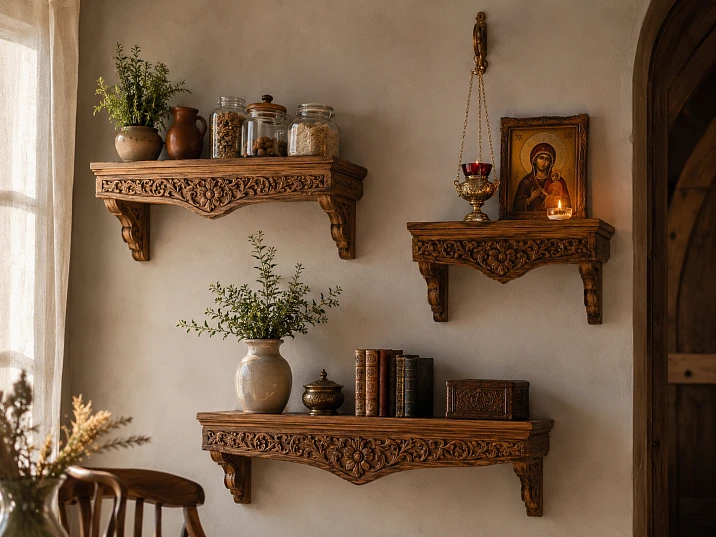
A shelf is, seemingly, a utilitarian object. Hang it, put something on it, forget about it. But this is only true until we talk about a carved wooden shelf. Here a different conversation begins. Because carved wooden shelves it is not storage. It is a statement. A focal point in the interior that holds the gaze, speaks of the owner's character, the style of the space, respect for the material and craftsmanship.
Buying carved wooden shelves today is not difficult. What is more difficult is choosing correctly. For a specific place: kitchen, icon corner, living room, study, hallway. For a specific size. For a specific carving style. With or without brackets. For painting or tinting. Paired with moldings or as a standalone element.
This article is about exactly that — in detail, truly usefully. No generalities. Only specific guidelines that will help you make the right decision.
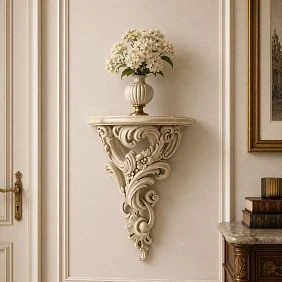
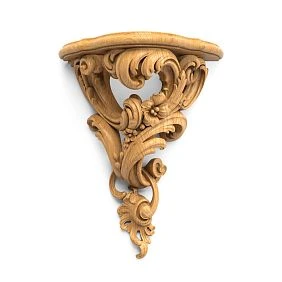
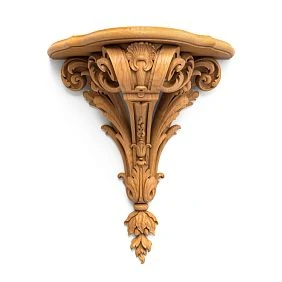
What is a carved wooden wall shelf and why it works differently
Buying a carved wall shelf means acquiring an object that is simultaneously a functional item and a decorative element of the interior. This is a fundamental duality that needs to be understood right away.
An ordinary wooden shelf performs one function: holds objects. A carved wooden shelf performs two: holds objects and decorates the wall. Moreover, the second function is often more important than the first. That is why carved wooden shelves often used in places where storage is secondary — in the icon corner, above the fireplace, in the living room pier, in a decorative niche.
The carving on the shelf is not a random ornament. It is a stylistic code that connects the shelf with the rest of the wooden decor in the space: moldings, brackets, overlays, pilasters. When this code is read, the interior looks planned. When it is not, it looks random.




What a carved shelf consists of
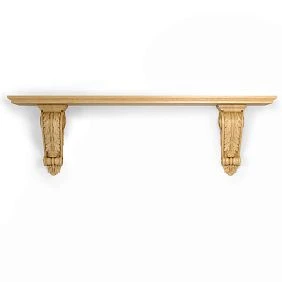
Structurally, a carved wooden wall shelf consists of several elements:
The horizontal plane — the actual surface on which objects are placed. It has a certain width, depth, and thickness. These parameters determine what will fit on the shelf and how it will look on the wall.
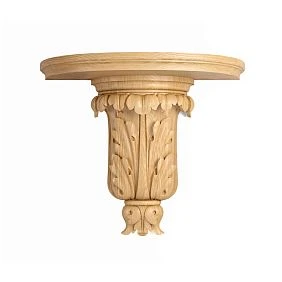
Side panels — vertical limiters at the ends of the shelf. They can be smooth or carved, straight or shaped. Shaped side panels are one of the main decorative "statements" of a carved shelf.
The lower frieze — a decorative carved strip along the bottom edge of the shelf plane. It is the "face" of the shelf when viewed from below. It is the frieze with ornamentation — through, openwork, relief — that creates the main visual impression.
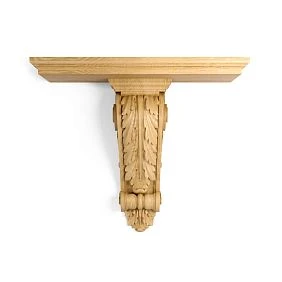
Brackets — support or decorative brackets under the shelf. They can be simple (a structural part) or elaborate carved elements that are themselves a decoration.
Back wall or back stop — present in some models; in most wall-mounted carved shelves it is absent, and the shelf is attached to the wall through the horizontal plane or through brackets.
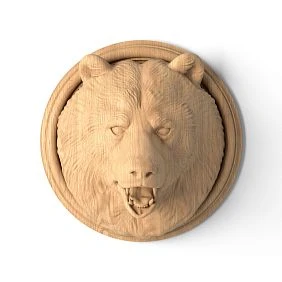
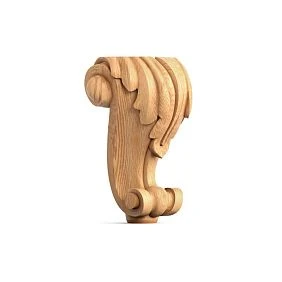
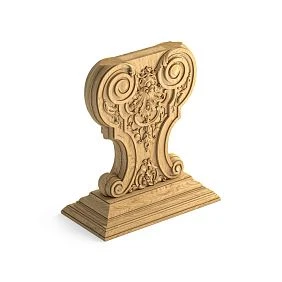
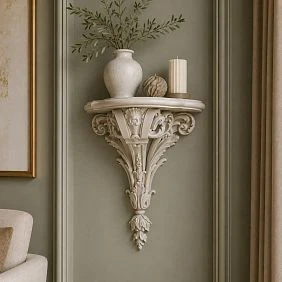
Our factory also produces:
Where to use carved wooden shelves: places, scenarios, tasks
Get Consultation
Carved shelves for the kitchen: decor and function in one piece
The kitchen is a paradoxical place for a carved wooden shelf. On one hand, practicality is needed here: the shelf must hold dishes, spices, decorative jars. On the other hand, it is in the kitchen that a carved wooden shelf works most vividly, because the kitchen is a space with character, with history, with daily life.
Wooden carved shelves for the kitchen are used in several scenarios.
Shelf above the work area. A narrow shelf at a height of 50–60 cm above the countertop — for spices, small decorative items, jars. Width — from 40 to 90 cm, depth — 10–15 cm. The carved lower frieze is always in view with this placement.
Shelf next to an open section or sideboard. In a classic kitchen with open sections, a carved shelf organically continues the decorative line: it is consistent in style with the cabinet cornice, wooden handles, and facade layout.
Wall-mounted carved shelves for dishes. A wider and deeper shelf for decorative dishes, platters, vases. Here, load is important: you need to check the load capacity and reliability of the fastening.
Decorative shelf in the dining table area. A small shelf at eye level of a seated person — for flowers, candles, decorative items. Creates a "warm" atmosphere of a home table.
Details on how carved shelves fit into the kitchen interior as a whole are described in STAVROS kitchen solutions.
Carved shelves for the icon corner: tradition, form, meaning
The icon corner is a place of special significance in a traditional home. And the requirements for the shelf here are different. Not "what you like," but "what is correct."
Buy carved shelves for icons means finding an element that is worthy of its purpose. Several things are important here.
Shelf shape. For the icon corner, corner or straight wall shelves with elaborate carved decor are traditionally used. A carved wooden corner shelf is placed in the corner of the room — the traditional location for the icon corner. The width of the corner shelf is from 20 to 40 cm on each side. A straight wall shelf is placed in the center of the wall.
Carved ornament. For the icon corner, ornament in the Russian or Orthodox style is traditional: geometric and plant motifs characteristic of Russian wood carving. Baroque or classical ornament of Western European origin is less organic.
Size. The shelf should be wide enough to hold icons securely. Depth — at least 10 cm. The height of the carved frieze should be sufficient for the shelf to be perceived as a "frame" for the icon.
Carved wooden corner shelves for icons are good because they face both sides of the room at once: when entering, the shelf is visible from the front, when moving around the room — at an angle. This is taken into account when choosing the shape.
Carved shelves in the living room: an accent on the wall
The living room is a space for living and for guests. Here, a carved wooden shelf works as a decorative accent: a point that organizes the wall space, adds volume to a flat wall, and creates a place for decorative items.
A shelf in a pier. Two windows — with a meter of wall between them. It is here that a carved wall shelf is placed as the "center" of the pier. Decorative objects, vases, small sculptures, candles — and the pier comes to life.
A shelf next to a mirror or console. The combination of console + mirror + carved shelf above the mirror is a classic decorative scheme for a living room or hallway. The shelf holds lightweight items, the mirror adds depth, and the console provides a work surface.
A shelf as part of a wall panel or boiserie. In a system of boiserie and wall panels a carved shelf can be integrated into one of the panel sections. It organically becomes part of the wall's architectural system.
A shelf for decorative objects. A collection of porcelain, small sculptures, decorative items with history — all of this lives on a carved shelf. At the same time, the shelf itself is no less interesting an object than what stands on it.
Study and library: a carved shelf as an element of business classic
In a study or home library, carved wooden shelves serve a more strict function. Here the aesthetic is restrained, intellectual, without excess.
A small carved shelf above the desk for a few books, folders, decorative objects — a signature element of a classic study. The carving here should be neat, without excessive ornament. The profile of the lower frieze should be expressive but not overloaded.
In a study finishing system, carved shelves are combined with wooden pilasters, wall panels, and wooden moldings. A uniform tinting of all wooden elements is a sign of a well-thought-out study interior.
Hallway and niche: shelf in a limited space
The hallway is a functional, often small space. But it is here that the guest sees the home for the first time. A carved wooden shelf in the hallway is the first decorative gesture of welcome.
Corner carved shelf — for hallways with corner space. Light, elegant, not taking up walkway area. A key holder, a small mirror, a decorative item — enough.
Shelf in a niche. If the hallway has a niche in the wall, a carved shelf fits into it as a 'decoration' of the niche. Here, precise adjustment of the shelf width to the niche width is important.
Shelf above a coat rack or console. Standard placement height: 150–180 cm from the floor. Not too high so items are accessible. Not too low so as not to interfere with clothes and shoes.
How to choose the shape of a carved wooden shelf
Shape is the first thing that determines whether a shelf suits a specific place. And here the choice is fundamentally more important than it seems.
Straight wall shelf
Classic option. A rectangular plane with straight or shaped ends. Universal in application: kitchen, living room, study, icon corner, niche.
A carved straight shelf differs in decorative accents:
-
Emphasis on the lower frieze — carved ornament along the entire length of the bottom edge. Visible from below, readable when moving around the room.
-
Emphasis on the sides — figured carved ends. Visible when viewed at an angle, work as shelf "ears".
-
Emphasis on the brackets — carved brackets under the plane. Visible frontally, create a sense of "support" and architecturality.
Corner carved shelf
Corner design — for placement in room corners. Traditional for an icon corner, also used in the living room and hallway.
Shape of the corner shelf in plan: triangle or pentagon. Triangular — more concise. Pentagonal (with a cut-off "nose") — more expressive, reads better frontally.
Important: the corner shelf must be aligned with the wall angle. In most cases, the angle is straight (90°), and a standard corner shelf fits. If the angle is non-standard — please specify.
Shelf with carved sides and bottom ornament
This is the most decoratively rich type. Figured sides are not just ends, but independent carved elements that "extend" below the shelf plane level. Inside the sides — through or relief carving.
Such shelves work best where they are visible from several sides: the pier between windows, living room, icon corner.
Shelf with brackets: decor as a structure
Carved wooden brackets — is a separate element that can be used both with and without a shelf. When the bracket and shelf are paired together, it is a complete decorative object.
The bracket supports the shelf plane from below. At the same time, it itself serves as decoration: its carved profile, the shape of the scroll or console, the ornament — all of this is visible from the front.
Carved brackets as part of a decorative system
A separate discussion — because there are many mistakes here.
Wooden brackets made from solid wood are of two fundamental types:
Structural bracket — holds the shelf. Its size is determined by the load and the depth of the shelf. Shelf depth = length of the horizontal part of the bracket (or slightly less). Load: for decorative items — 3–5 kg, for dishes — 8–15 kg depending on the design.
Decorative bracket — visually supports the shelf, but the main load goes into the wall mount. It 'shows' that the shelf rests on consoles — although structurally this is not necessarily the case.
How to match the bracket with the shelf in style:
-
The bracket ornament is from the same "vocabulary" as the shelf carving.
-
The bracket height is proportional to the shelf depth (usually 1.2–1.5 × depth).
-
The finish is uniform for both the bracket and the shelf.
It is especially important: the bracket cannot be chosen separately from the shelf. They must be one ensemble. A massive heavy shelf on thin light brackets looks unstable — even if structurally reliable. A small elegant shelf on monumental brackets looks crushed.
How to choose the size of a carved wall shelf
Size is not "what you like," but "what works." Let's break down the selection method.
Shelf width
The width is determined by two factors: the size of the wall (or niche) and the number of items to be placed.
For a wall section 80 cm wide: a shelf 50–60 cm wide leaves margins of 10–15 cm on each side. This is the correct ratio: the shelf "occupies" the wall section but does not completely "cover" it.
For a niche 50 cm wide: a shelf 45–48 cm wide fits flush against the niche walls. Here the margins are minimal, creating a sense of being "built-in."
For an icon corner: the width of a corner shelf is from 25 to 40 cm on each side. Less than 20 cm — the icon won't fit; more than 45 cm — the shelf will "protrude" into the room.
Shelf depth
Depth is determined by what is planned to be placed.
-
Spices, small jars: 8–10 cm
-
Decorative items, small vases: 12–18 cm
-
Dishes, plates: 20–25 cm
-
Icons: 10–15 cm
-
Books: 20–25 cm
Important rule: the depth of the shelf should not be less than the deepest item, otherwise things will "overhang" and create a risk of falling.
Mounting height
This is not a shelf parameter, but a mounting parameter — but it is critically important:
-
Kitchen above the work area: 50–70 cm from the countertop
-
Living room, decorative shelf: 150–180 cm from the floor (eye level of a standing person)
-
Icon corner: 180–200 cm from the floor (traditionally "above the head", a place of veneration)
-
Office above the desk: 40–60 cm from the desk surface
-
Hallway: 150–170 cm from the floor
Material and finish of carved wooden shelves
Why wood is the only correct choice
Carved wooden shelves — these are solid wood products. Only solid wood allows for through and relief carving with clear edges of the ornament that are not lost under paint.
MDF shelves with "imitation carving" are a milled profile without real carved ornament. The sharp edges of the ornament on MDF become rounded under paint, the relief "softens." Under humidity, MDF swells.
Solid beech for STAVROS carved shelves: dense, homogeneous wood. Thin elements of the ornament hold their shape. The surface accepts any finish well.
Finish options for carved wooden shelves
Enamel (white, cream, gray, colored). For kitchens, classic interiors for painting, Provence style. The shelf is painted to match the wall panels or furniture. The carving remains visible through the play of shadows.
Scheme: sanding → acrylic primer → 2 coats of finish enamel. Important: paint should not accumulate in the recesses of the ornament — otherwise the relief will become "muddy". Apply in thin layers.
Wood stain finish. For natural interiors, study classics, icon corner. Stain of the desired shade + varnish 2–3 coats. The stain reveals the structure of beech, adds warmth.
Dark stain finish. "Walnut", "wenge", "ebony" — for a study, library, strict classic interior. The contrast of dark wood and light wall is one of the most effective interior techniques.
Patina. Dark base stain + lightening of the protruding edges of the ornament. The relief of the carving is "revealed" to the maximum — it is patina that best demonstrates the skill of the carver. For Provence, Russian style, classic interior with "history".
Gilding. On the protruding points of the ornament — gold paste or gold leaf. Minimal and pointwise — only on capitals and accent elements. For a rich classic or baroque interior.
Carved shelves in different interior styles
Style table
| Style | Shelf shape | Thread | Finish | What to combine with |
|---|---|---|---|---|
| Classic | Straight with developed sides | Floral ornament, symmetry | Toning, patina | Brackets, baguette, pilasters |
| Russian style | Corner, straight with ornament | Geometric and plant carving | Natural wood, varnish | Icon corner, carved decor |
| Provence | Soft shape, figured sides | Light floral motif | White enamel with patina | Handles, decorative items |
| Neoclassical | Straight, neat carving | Restrained ornament | Enamel matching the interior | Moldings, boiserie, frames |
| Office | Straight, strict form | Geometric or calm profile | Dark tinting, varnish | Pilasters, moldings, panels |
Carved shelf in a classic interior
Classicism implies symmetry and hierarchy. A carved wooden shelf here is an accent that follows the overall decorative system. It should be coordinated with moldings, pilasters, and cornices.
For classicism, it is important: the shelf's ornament comes from the same "vocabulary" as the rest of the decor. Floral motifs, acanthus leaves, cartouches — all in a single stylistic register.
Carved shelf for Provence style
Provence is warmth, softness, "coziness." A shelf in Provence style: light or cream enamel with patina, soft floral ornament, figured side panels without sharp corners.
Particularly good wooden carved shelf for the kitchen in Provence style — with decorative items on it: clay jars, small vases, bunches of herbs.
Carved shelf in Russian style
Russian style — expressive carving, geometric and plant ornamentation. Shelves in this style are traditional for icon corners and walls with wooden panels. Toning to resemble natural wood or varnish without changing the color.
How to combine carved shelves with other STAVROS decor
A carved shelf is an independent decorative item. But it becomes part of something larger when integrated into a system.
Shelf + brackets
We already covered this above: the bracket and shelf are an ensemble, not two separate items. Carved brackets from the STAVROS catalog are designed in coordination with the shelves — in terms of ornament, proportions, and finish.
Shelf + moldings and trim
wooden moldings, cornices, and baseboards create a horizontal "frame" for the wall. A carved shelf placed in one of the zones of this frame looks integrated, not randomly hung.
For example: a horizontal molding at a height of 150 cm + a carved shelf slightly above the molding = a visual connection between the linear and volumetric wall decor.
solid wood millwork can frame the area above the shelf — creating a decorative "frame" around the place where the shelf hangs.
Shelf + overlays and decorative elements
Carved decorative inserts for furniture и wooden decorative elements can be placed on the wall around the shelf — as a "framing" of its space. A small socket above the shelf or corner decorative elements on the sides turn a "shelf on the wall" into a "wall decorative composition."
Shelf + wall panels and boiserie
In the system Boiserie a carved shelf fits into one of the panel sections. At the same time, it does not disrupt the rhythm of the wall system — but enriches it. The shelf becomes a "living" point in the geometric grid of boiserie.
wall decoration — this is broader than boiserie. These are all solutions for decorative wall finishing: moldings, frames, overlays, shelves, brackets. A carved shelf is an organic part of this system.
Shelf + pilasters
Wooden pilasters set the vertical rhythm of the wall or furniture. A carved shelf placed between two pilasters or next to a pilaster "fits into" this vertical system. Especially effective: a wall section with two pilasters on the sides + a carved shelf between them + a mirror or panel above the shelf.
Mistakes when choosing a carved wooden shelf: what is important to know in advance
Mistake 1: Choosing a shelf only by photo
The photo does not convey scale. A shelf that looks elegant in the photo may turn out to be bulky in real space. Always check the exact dimensions: width × depth × height of side panels and bottom frieze.
Error 2: Not considering depth
Shelf depth is a critical parameter for the kitchen and any practical application. An 8 cm deep shelf does not hold a standard spice jar (diameter 7–8 cm). A 25 cm deep shelf in a small hallway will be in the way.
Error 3: Not checking the load
A carved wooden shelf is a decorative item. But if it is planned to bear a load (dishes, heavy objects), you need to consider the load capacity of the shelf and brackets, as well as the reliability of the wall mounting.
Wall mounting is the buyer's responsibility. Dowels must match the wall material (concrete, brick, drywall). For heavy loads, use anchor fasteners.
Error 4: Placing a large shelf in a small space
A carved shelf 90 cm wide on a wall 80 cm wide is not a shelf that 'occupies' the wall. It is a shelf that 'overlaps' the wall. Leave margins of 10–20% of the wall width on each side of the shelf.
Error 5: Buying a shelf without coordinating with brackets
Brackets are not a mounting accessory, but part of the decor. A shelf and brackets that are not coordinated in style look like two randomly connected items. Choose them as a pair.
Error 6: Mixing different carving styles
Provence in the kitchen + a baroque shelf in the same room = conflict. The carving style on the shelf should match or organically complement the overall style of the space.
Mistake 7: Not planning the finish color before purchasing
If the shelf is meant to be painted, check that its color after painting matches the color of wall panels, moldings, and furniture. The difference in white shade ("warm white" vs "cool white") is clearly visible.
Mistake 8: Using a kitchen shelf in an icon corner
This is not "forbidden," but the functional requirements are different. A kitchen shelf may be too shallow for an icon or have too "utilitarian" an ornament for a spiritual purpose. Shelves for an icon corner are a special type with a characteristic shape and ornament.
Where to buy carved wooden shelves STAVROS
Carved wooden shelves STAVROS — these are shelves made of solid beech, with hand carving, without a finish coating (for the customer's finishing). A wide range of models: straight wall-mounted, corner, with brackets, for the kitchen, for the icon corner, for the living room and study.
Buy carved shelves made of STAVROS wood means choosing an item with guaranteed solid wood quality and precise dimensions.
Complete wooden decor system that pairs with shelves:
-
Carved wooden brackets — to shelves
-
Wooden brackets made from solid wood — second type of brackets
-
STAVROS carved decor — complete line
-
wooden decorative elements — rosettes, inserts
-
Carved decorative inserts for furniture — furniture overlays
-
wooden moldings, cornices, and baseboards — wall profiles
-
solid wood millwork — linear profiles
-
Wooden Picture Frame — frame profiles
-
wooden pilasters and columns — vertical architectural decor
-
Solid Wood Items — entire catalog
Contact us to confirm shipping to your destination. Warehouses in Moscow and St. Petersburg.
Frequently asked questions about carved wooden shelves
Which carved shelves are suitable for the kitchen?
For the kitchen, choose wooden wall shelves of suitable depth (from 10 to 25 cm depending on purpose). For spices — a narrow shelf 8–12 cm. For dishes — 20–25 cm. The carving style should match the kitchen set. Finish — paintable to match the kitchen or tinted to look like wood.
Can a carved shelf be used for an icon corner?
Yes, and this is one of the traditional uses. For an icon corner, it is better to choose a corner or straight shelf with ornamentation in the Russian style. The size should allow stable placement of an icon, a small lamp, and a candle.
How is a carved wooden shelf different from a regular one?
A carved shelf performs two functions: storage and decor. A regular wooden shelf only provides storage. The carving on the shelf matches the ornamentation of the rest of the room's decor: moldings, brackets, overlays.
How to choose the size of a carved shelf?
The width of the shelf is 60–80% of the width of the wall (or niche). The depth is for specific items (8–25 cm). The height of the decorative part (sides, lower frieze) is proportional to the width of the shelf: a large shelf requires elaborate decor, a small one requires concise decor.
Are brackets needed for a carved shelf?
It depends on the shelf design. Some attach to the wall through a horizontal plane — brackets are not needed. Others require brackets for structural support. In any case, carved brackets have decorative value: they enhance the shelf's effect as an architectural element.
Can carved wooden shelves be painted with enamel?
Yes, solid beech takes enamel well. The scheme: sanding → acrylic primer → 2 coats of finishing enamel. Important: apply in thin layers to avoid 'smearing' the carving relief.
What to pair STAVROS carved shelves with in an interior?
With carved brackets, wooden moldings, cornices, trim, baguettes, decorative overlays, pilasters, wall panels, and other solid wood products.
Which finish best reveals the carving on a shelf?
Patina is the best way to 'show' the carving to the fullest: dark recesses + light highlights. Tinting also works well. Enamel hides the wood structure but preserves the play of shadows from the relief.
About the company STAVROS
A carved shelf on the wall is not just 'somewhere to put things'. It is a point where craftsmanship becomes visible. Wood carving is a craft that requires material, knowledge, and patience. When all this comes together — the object becomes more than an object.
STAVROS is a Russian manufacturer of wooden furniture and interior decor from solid wood. Carved shelves, brackets, overlays, pilasters, moldings, cornices, trim, baguettes — a complete system for those who build an interior consciously. Production in Russia. Warehouses in Moscow and St. Petersburg. Delivery across the country.
STAVROS is a tree that can speak.