












































































Article Contents:
- MDF as a Material: Why It's Made for Slat Panels
- Structural Types of MDF Slat Panels: Four Options for Different Tasks
- Rigid Panels on MDF Backing for Painting
- Flexible MDF Panels on Fabric Base
- Panels Made from MDF Half-Round Molding
- Double-Sided and Acoustic MDF Panels
- Slat Profile: Three Geometries, Three Styles
- Rectangular Profile: Architectural Precision
- Semi-circular profile: softness without flabbiness
- Trapezoidal profile: dynamics and volume
- Color as the main argument in favor of MDF
- Monochrome: relief without color
- Tonal accent: panel slightly darker than the wall
- Contrast accent: panel as the main object
- Corporate RAL: branding through architecture
- Two-color system: slats and backing in different tones
- Where MDF slatted panels are used: eight specific scenarios
- Accent wall in the living room
- Bedroom: headboard zone
- Entry Hall
- Office and work area
- Kitchen and kitchen island
- Children's room
- Restaurant, cafe, bar
- Office, reception, meeting room
- How to choose MDF slatted panels: nine parameters
- Finishing system: MDF panels don't work in isolation
- Painting MDF slatted panels: a technology that cannot be ignored
- Installation of MDF slatted panels: step-by-step logic
- Five mistakes when buying MDF slatted panels
- Calculation: how many MDF slatted panels are needed
- About the Company STAVROS
- FAQ: Answers to Popular Questions

When an interior stops being just a 'renovated apartment' and becomes a space with character—there is almost always one surface that explains it. Not the entire renovation, not all the furniture, not all the details at once. Specifically one surface—with relief, rhythm, depth. Most often, it's a slatted wall. And most often, it's made of MDF.
Why MDF specifically? Why not wood? Not plastic? Not plaster? The answer isn't in price or availability. The answer is that MDF as a material for slatted panels provides something no other material in this segment does: absolute color freedom with impeccable geometric precision. Any RAL tone. Any NCS shade. Monochrome. Contrast. Corporate brand color. All of this—with a uniform, perfect surface that accepts paint in a way that neither drywall nor natural wood with its inherent variability can.
If you've typed 'buy MDF slatted panels' into a search engine—it means you already know what you want. All that's left is to understand how to buy correctly. This article is exactly about that: about parameters, selection logic, finishing systems, technical nuances, and what mistakes even experienced renovators make.


MDF as a Material: Why It's Made for Slatted Panels
Let's start with the material — because many buyers have a prejudice: 'MDF is not real wood.' That's true. But for slatted panels intended for painting, this is not a drawback but a structural advantage.
MDF (Medium Density Fiberboard) is produced by pressing finely ground wood fibers with added binding agents. The result is a uniform, dense, stable material without natural defects. No knots, resin pockets, fibrous protrusions, or areas of varying density — all of which are characteristic of natural wood and make its behavior when painting unpredictable.
ForMDF slatted panelsThis uniformity is critically important. Paint applies evenly across the entire surface of MDF, the color does not 'reveal' subsurface structure, and there are no areas with different absorption. This is precisely why MDF for painting delivers that clean, professional result, which is impossible to achieve on natural wood without serious additional processing.
The working density of MDF for slatted panels is 750–850 kg/m³. This is not a random parameter. At densities below 700 kg/m³, the material becomes loose: it holds fasteners worse, is less stable under humidity changes, and the edges are more hygroscopic. At 750+ density — it is a stable, rigid, reliable material that performs without surprises.




Structural Types of MDF Slatted Panels: Four Options for Different Tasks
Beforebuy MDF slatted panels— you need to understand which specific structural type solves your task. There are four, and they are fundamentally different.
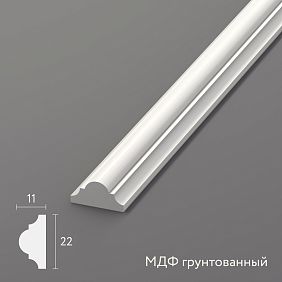
Our factory also produces:


Rigid Panels on MDF Backing for Painting
Classic and most common solution. MDF slats are factory-fixed with precision onto an MDF backing. The module is flat, rigid, and geometrically precise. Designed for flat surfaces: walls, furniture fronts, partitions.
Key advantage of the rigid construction — plane stability. The backing does not deform, maintains geometry regardless of the substrate quality (within reasonable limits). Seamless module joining with a factory gap of 0.5 mm — this is a product property independent of the installer.
The slat surface is sanded to Ra ≤ 1.6 µm — this is a ready base for painting without additional preparation (provided preliminary priming is done).
Get Consultation
Flexible MDF panels on fabric backing
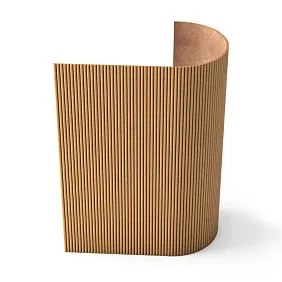
Innovative solution for curved surfaces. MDF slats are secured not to a rigid backing, but to a fabric mesh base. It allows the module to bend with a radius from 100–150 mm without deforming the slats or breaking the pattern.
If your project has columns, arches, rounded corners — flexible MDF panel on fabric backing is the only professional solution. A rigid MDF panel cannot be bent without damaging the backing. The flexible one provides a continuous, seamless slatted pattern even on complex geometry — and in any RAL color, just like the rigid one.
Panels made from semi-round MDF battens
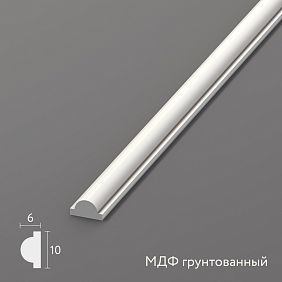
A separate category based on the slat profile. The semi-round cross-section of the batten diffuses light softly, without sharp linear shadows. The surface looks organic, natural, warm — even made from paintable MDF. Available in rigid (flat walls) and flexible (curved surfaces) versions.
Semi-round MDF profile — the right choice for living spaces with a cozy atmosphere: bedroom, living room, children's room. White or cream surface with semi-round slats — soft, delicate, natural — made from a fully engineered material.
Double-sided and acoustic MDF panels
Special designs for objects with sound insulation requirements or two-sided decorative finishes. Partitions in offices, meeting rooms, conference halls. Please check this type separately with the manufacturer.
Slat profile: three geometries, three images
The profile is what creates the character of the surface. Not the color, not the material, but precisely the profile determines how light interacts with the slat.
Rectangular profile: architectural precision
Sharp straight edges. With side or directional lighting — a clear, hard linear shadow. The surface is strict, geometrically precise, disciplined. Not a hint of softness or organic forms — only precise architectural graphics.
Rectangular MDF profile for painting — the right choice for minimalism, a study, an office, a loft, neoclassicism in a restrained interpretation, a meeting room. A white rectangular profile on a white wall in monochrome — is a sophisticated top-tier solution: the relief exists only through shadow, color dissolves into the surface.
Semi-circular profile: softness without weakness
Rounded edges. Light diffuses along the arc — shadows are smooth, without sharp boundaries. The surface is warm, natural, pleasing to the eye. The organic quality of the semi-circular profile in MDF panels for painting — is a visual paradox: an engineered material imitating natural plasticity.
Semi-circular MDF profile — ideal for a bedroom, a living room with a soft character, a child's room, a home library. In light tones (off-white, linen, sage) — it creates an atmosphere that is difficult to describe in words but easy to feel: warmth, coziness, tranquility.
Trapezoidal profile: dynamism and volume
Extension to the base. Multi-level, volumetric shadow. The surface is dynamic, with pronounced decorative weight. Used in commercial spaces with high decorative intensity: restaurant, showroom, boutique, lobby.
Color as the main argument in favor of MDF
Talking about color is talking about what exactly makes MDF indispensable in certain tasks. And this topic is worth fully exploring, because this is where MDF has no competitors.
Monochrome: relief without color
The panel is painted the same color as the wall. Color unites the surfaces—the relief exists only through shadow. Under frontal uniform lighting, the surface is almost homogeneous. Under side or directional light—it comes to life, 'opens up,' fills with depth. This is one of the most complex to execute and one of the most impressive interior techniques. A white MDF slatted panel on a white wall in a white interior—this is a level that looks more expensive than it costs.
Tonal accent: panel slightly darker than the wall
The wall is light. The panel is 2–3 tones darker. The relief is perceived both through shadow and through color. The look is restrained, mature, professional. This is a 'middle-ground' solution between monochrome and contrast: universal, foolproof, always looking appropriate.
Contrast accent: panel as the main object
Walls are neutral. The slatted panel is in a deep, saturated color. Anthracite, Bottle Green, Navy Blue, Burgundy, Terracotta. The panel comes to the foreground. Becomes the semantic center of the room. One bold color choice changes the entire atmosphere—without additional decor costs.
Corporate RAL: branding through architecture
The exact brand color of the company on the reception desk, in the meeting room, on the accent wall of the office lobby. MDF for painting is the only material that provides this with shade accuracy. This is not just a beautiful wall. It is a tangible expression of brand identity.
Two-color system: slats and backing in different tones
Slats in one color, backing (visible in the gaps) in another. White slats on a black backing: a maximally graphic look. Gray slats on a dark blue backing: unexpected depth. Beige slats on a dark terracotta base: warm earthy complexity. Two-color solutions are an advanced level of working with MDF slat panels, but their visual effect justifies the extra effort.
Where MDF slat panels are used: eight specific scenarios
Accent Wall in Living Room
Behind the sofa or in the TV area. Directional lighting or LED strip around the perimeter. One slatted plane gives the eye a focal point and transforms the entire interior without changing the other elements. An anthracite MDF panel behind the TV in a white interior is a powerful architectural image achieved with a single solution.
Bedroom: headboard zone
A delicate, cozy scenario. Semi-circular profile, neutral warm tone, moderate spacing. LED strip along the lower perimeter — soft upward glow emphasizes the relief. The result is an intimate atmosphere, comparable to a designer hotel, with quite affordable investments.
Entryway
The first architectural signal. An MDF slat panel on the main wall of the hallway instantly raises the perceived level of the entire interior. For a narrow corridor: horizontal slats on the end wall visually expand the space.
Office and work area
Wall behind the desk. Dark tone, rectangular profile — status and concentration. Excellent background for video calls. The slatted relief reduces acoustic reverberation: the voice on camera and in the room becomes clearer.
Kitchen and kitchen island
The lower part of the island with MDF slatted fronts painted to match the kitchen furniture. Horizontal orientation visually 'stretches' the island. Exact color according to RAL — consistency with fronts, backsplash, countertop.
Children's room
MDF for painting with non-toxic water-based enamels. Semi-circular profile without sharp edges — safety. Pastel for toddlers, more active tones for teenagers. The main thing: they grew up — repainted. Without dismantling.
Restaurant, cafe, bar
Atmosphere is what brings people back. Warm tone, vertical rhythm, directional lighting. MDF slatted panel for painting in the establishment's brand color — branding through surface.
Office, reception, meeting room
Corporate RAL. Business image. Acoustic diffusion. MDF slatted wall panels in the office — both aesthetics and function.
How to choose MDF slatted panels: nine parameters
Before making a final decision and buying MDF slatted panels — check nine parameters. This is not overcaution, it's saving.
MDF substrate density — not less than 750 kg/m³. Loose MDF is unstable, poorly holds fasteners, ends absorb moisture. Check with the manufacturer.
MDF slat density — same requirements. Thin slats made of loose MDF are fragile during installation.
Slat spacing accuracy — deviation no more than 0.5 mm. This is the condition for seamless joining. Ask directly.
End treatment — MDF ends are hygroscopic. Must be sealed with primer or film at the factory.
Primer layer — some manufacturers supply panels with a thin primer, ready for final painting. This saves your time.
Base type — MDF backing (straight walls) or fabric backing (curved walls). Do not confuse when ordering.
Slat profile — rectangular, semicircular, trapezoidal. Selected before ordering.
Slat orientation — vertical or horizontal. Affects spatial effect.
Trims system — whether the manufacturer has coordinated moldings, baseboards from the same production line.
Finishing system: MDF panels do not work in isolation
Professional result is a system. An MDF slat panel as part of a coordinated finishing system works significantly more convincingly than the same panel in a random environment.
Upper perimeter molding — a horizontal strip that completes the slat plane from above. Without it, the panel 'breaks off' into the wall.Wooden molding and cornicemade of MDF for painting in the same color — an architectural 'cap' that completes the system. In neoclassicism, molding is mandatory. In minimalism — architecturally precise.
Baseboard — the lower boundary of the system.Baseboard MDFfor painting in the same color as the slat panel: white panel + white baseboard = monolithic, clean, impeccably calibrated surface.buy MDF skirting boardfrom the same production program means obtaining a coordinated system without material conflicts.
Wooden battens for additional elements. Non-standard sections — corner transitions, slopes, window frames.Buy wooden slator MDF batten from the same program — an inconspicuous, organic addition.
Decorative overlays. In neoclassical and contemporary classic stylesDecorative Insertsaround the perimeter of the batten plane create a full-fledged architectural 'frame' — a panel system with horizontal and vertical framing.
Furniture handles. Batten furniture fronts for painting +Furniture Handlesin coordinated material = a complete furniture image where there are no random details.
Wooden floor skirting for mixed systems. If the MDF batten panel is accent, and the rest of the interior is maintained in natural wood,wooden baseboardfrom solid wood creates the correct transition between two material worlds.wooden skirting board purchasefrom solid oak means obtaining a natural lower accent next to a geometrically precise MDF surface.
Painting MDF Slatted Panels: A Technology That Cannot Be Ignored
Purchasing MDF slatted panels for painting is only the first step. The final result is determined by the painting. And here there are rules, the violation of which negates all efforts.
Priming the ends is mandatory. MDF ends are extremely hygroscopic—they absorb moisture and paint unevenly. Special shellac or acrylic primer in 2–3 coats with intermediate drying is not an additional option; it is a mandatory step.
Priming the front surface. Professional MDF primer evens out absorption and creates a uniform base. Without it, the finish paint applies unevenly, consumption increases, and the color looks 'muddy'.
Painting before installation, by spraying. The only way to achieve an even coating in the gaps between slats is to paint before installation, in a spray booth. Using a roller after installation results in unevenness in the gaps—this cannot be corrected. A professional result is only possible with spraying.
Paint selection. For residential spaces—water-based acrylic enamels: eco-friendly, quick-drying, easy to restore. For commercial spaces with high traffic—two-component polyurethane: abrasion resistance is incomparable.
Number of coats. Minimum: 1 primer coat + 2 finish coats. Optimum: 1 primer coat + 3 finish coats with intercoat sanding using P400. Intermediate sanding ensures adhesion and eliminates micro-irregularities.
Installation of MDF Slatted Panels: Step-by-Step Logic
Installation is not difficult—but requires adherence to sequence.
Surface preparation. Wall: dry, clean, degreased. Plane deviation up to 3–5 mm—adhesive installation. More than 5 mm—frame installation on metal profiles with a spacing of 400–600 mm. Drywall—priming is mandatory.
Adhesive installation. Mounting adhesive is applied in a serpentine or dotted pattern onto the substrate. The panel is pressed against the wall and held for 5–10 minutes. For reliability — finishing nails along the top and bottom perimeter in areas that will be covered by molding and baseboard.
Frame installation. CD-profile with a spacing of 400–600 mm is mounted on the wall. Panels are secured with self-tapping screws through the substrate into the profile. The plane is controlled with a laser level. A technical gap for concealed wiring or sound absorption is possible.
Module joining. Butt joint, without a gap and without decorative strips. With factory precision, the slats of one module continue the rhythm of the adjacent one without offset. The wall is monolithic.
After installation. Installation of molding along the top edge, baseboard at the bottom. Corner joints of trim — 45° on a miter box. Gaps at joints with smooth walls — acrylic sealant matching the coating color.
Five mistakes when buying MDF slatted panels
First mistake: choosing by price without checking density. Cheap MDF 650 kg/m³ — loose, unstable, with problematic edges. Rework costs more than the savings.
Second mistake: buying a rigid panel for a column or arch. Rigid MDF does not bend. For curved surfaces — only flexible panel on a fabric base.
Third mistake: not checking the pitch accuracy. Unstable pitch — visible joints. No installer can fix this.
Fourth mistake: planning lighting after installation. Slatted relief without side or directional lighting — invisible. Lighting is planned before installation.
Fifth mistake: not buying trim from the same production program. Incompatible baseboards and moldings next to the slatted panel destroy the material integrity of the system.
Calculation: How many MDF slatted panels are needed
The formula is simple. The surface area (excluding doors and windows) is divided by the area of one module. The result is rounded up, and 10–15% is added for cutting. Example: a wall 3.6 × 2.7 m = 9.72 sq.m. A module 0.6 × 2.4 m = 1.44 sq.m. Needed: 9.72 / 1.44 = 6.75 → 7 modules. With a 15% reserve = 9 modules. For multiple walls, calculate each separately — the cutting allowance is specific to each wall.
About the company STAVROS
The difference between 'just a slatted panel' and 'a slatted panel that works' lies in manufacturing precision. In the MDF density, which isn't visible in photos. In the slat spacing with a 0.5 mm tolerance, which can't be assessed in a catalog. In sealed ends that won't swell after six months. In a coating that lasts and doesn't peel.
STAVROS is a Russian manufacturer of MDF and solid wood products for interior finishing and furniture production. Slatted panels of all types and designs, a complete line of coordinated moldings, decorative overlays, stair elements, furniture decor and fittings. Over 4000 models, 20,000 modifications, 39 product groups.
MDF from European suppliers with a density of 750–850 kg/m³, wood drying climate chambers, two-level quality control system (Standard and Prestige), step accuracy control in each batch, manual processing of decorative elements. Shipping from one piece. Delivery across all of Russia. Specialist consultation before placing an order.
FAQ: Answers to popular questions
How do MDF slatted panels differ from oak slatted panels?
MDF — precise color to any RAL/NCS, uniform surface, repainting without dismantling. Oak — living natural texture, tactility, unique grain pattern. The choice is determined by the task: color freedom and monochrome — MDF; natural expressiveness and tactility — oak.
What is the minimum acceptable MDF density for slatted panels?
750 kg/m³ is the lower working limit. Optimum is 780–830 kg/m³. Density below 700 kg/m³ is a loose material, not recommended for slatted panels.
Can I buy MDF slatted panels already painted?
Some manufacturers supply panels with factory color coating. Clarify when ordering. The professional option is painting in a workshop to a specific project color according to RAL.
How to calculate the quantity of MDF slatted panels?
Wall area ÷ area of one module, round the result up, add 10–15% for cutting.
Do MDF slatted panels need additional priming before painting?
Yes, definitely—the edges and the front surface. Special MDF primer is applied in 1–2 coats. Without priming, the paint goes on unevenly, consumption increases, and the edges swell.
Can MDF slatted panels be repainted after several years?
Yes—and this is one of the main advantages of MDF. Light sanding with P400, priming, new color. Without dismantling.
Which slat profile should I choose for a bedroom?
Semi-circular—for soft, warm, organic light and shadow and a cozy atmosphere. Rectangular—if you need a more strict, modern, disciplined surface.


