










































































Article Contents:
- 635 mm is the supply size, not the mandatory width of the finished composition
- What you must not do here
- Practical marking
- Which five dimensions should be recorded
- Why you cannot "trim slightly from the top"
- When symmetrical trimming seems natural
- When mechanical bisection can fail
- Example for understanding the calculation only
- A paper template helps even before purchase
- Scenario 1. The frame is already assembled and is slightly narrower than 635 mm
- Scenario 2. The frame is significantly narrower than 635 mm
- Scenario 3. The width fits, but the frame height is too small
- Scenario 4. The frame is asymmetric relative to the wall
- Why it is useful to mark not only millimeters, but also the line status
- Two confirmation stages are better than one
- What is kept the same in a series
- When different shoulder lengths start to spoil the rhythm

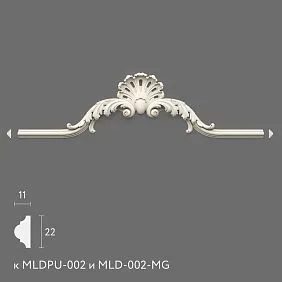
The frame on the wall is already marked out or even assembled from moldings. The inner decorative field turned out to be narrower than 635 mm. On the product card, NPU.VRS-001-1 caught my eye — a large horizontal ornamental belt made of polyurethane, measuring 635 × 168 × 22 mm. The first reaction is understandable: the product is longer than the finished space, so it doesn't fit. But it is this model that has a feature that changes the decision: NPU.VRS-001-1 comes with extended shoulders, designed for cutting to the required size.
This does not mean that the overlay can be shortened anywhere. The central relief pattern must remain intact, and the working area for adjustment is the side extensions provided for this purpose. Therefore, the correct question before purchasing is not "can you cut off as much as you want from 635 mm," but rather: what is the internal size of the finished frame, where does its axis run, how should the central ornament be positioned, and are the standard extended shoulders sufficient for the required adjustment.
This approach is fundamentally different from choosing a regular fixed-size overlay. Here, the supplied dimension of 635 mm is the initial length of the product, and the final length after professional adjustment may be less. But the allowable amount of cutting cannot be calculated from a single figure of 635 mm: it must be determined based on the geometry of the specific product, the drawing, and the project.
If the frame already exists and you need exactly the upper horizontal ornamental belt, you can buy the stucco decor NPU.VRS-001-1 after the finished size of the inner field has been measured and the trimming scheme is understood.
635 mm is the supplied size, not the mandatory width of the finished composition
The NPU.VRS-001-1 product card lists three main dimensions:
-
length — 635 mm;
-
height — 168 mm;
-
relief depth — 22 mm.
Material — polyurethane.
But the main technical fact for our topic is not in the dimensions line, but in the description: the product has elongated shoulders for cutting to the required size.
This gives the buyer important freedom. If the decorative field does not match the full length of 635 mm, the mismatch does not necessarily mean an order error. First, you need to understand how much narrower the field is and whether the required adjustment falls within the side zone provided by the design.




What not to do here
You cannot assume:
“I have a 500 mm frame, a 635 mm overlay, so we’ll just cut off 135 mm.”
Such arithmetic is not enough.
These 135 mm can be distributed between the two sides differently, and the allowable cutting zone depends on the shape of the shoulders and the position of the central ornament. If you start cutting without prior centering, you can get a symmetrical frame size but a visually shifted pattern.
The correct sequence is the reverse:
-
determine the center of the finished decorative field;
-
align the center of the ornament with it;
-
mark the actual side boundaries;
-
check where the lines of the intended cut pass;
-
only then make a decision about adjustment.
Our factory also produces:



What exactly the buyer receives when ordering NPU.VRS-001-1
| Parameter | Confirmed value | Practical Meaning |
|---|---|---|
| Article number | NPU.VRS-001-1 | Specific horizontal decor of the Versailles collection |
| Supply size | 635 × 168 × 22 mm | Original dimensions before fitting |
| Material | Polyurethane | Finished relief decorative element |
| Depth | 22 мм | Pronounced volume and chiaroscuro |
| Design feature | Extended shoulders | Fitting by sawing is provided |
| Main task | Horizontal ornamental belt | Used in wall compositions and frames |
| Collection | "Versailles" | Can be combined with other elements of the series |
| Price at the time of card verification | 8 170 ₽ | Price must be re-checked before purchase |
The most expensive mistake here is to perceive the string "635 mm" the same way as the length of an ordinary part without a fitting zone. In NPU.VRS-001-1, the design initially accounts for the need for a cut.
But the opposite extreme is equally dangerous — to assume that the presence of extended shoulders removes all restrictions. It provides the possibility of fitting, not cancels the geometry of the ornament.
Get Consultation
The central ornament is first placed on the axis, and only then do you think about the cut
Let's imagine a finished frame with a width of less than 635 mm. Inside it, you need to place NPU.VRS-001-1.
If you immediately apply a ruler to the edges of the product and decide "we'll remove the same amount of millimeters from each side," you can miss the main thing: the visual center of the pattern.
A classic ornament is not perceived as a rectangular strip. The eye notices the central mass, the direction of the curls, the balance of the left and right sides. Therefore, the axis of the composition is more important than the mechanical equality of the remnants.
Practical marking
On the wall, mark the vertical axis of the finished decorative field.
On the overlay itself, find the central axis of its ornamental composition according to the drawing and actual geometry.
Align the two axes.
After this, the actual protrusions of the shoulders beyond the frame boundaries become visible.
Now trimming can be discussed.
This method protects against a situation where the finished piece physically fits into the frame, but the pattern has "shifted" by several centimeters.
Do not measure only the external width of the frame
If the moldings are already installed, the customer needs the clean internal width of the decorative field.
This is the distance between the boundaries within which the ornament must be located.
The frame may have:
-
external size;
-
size along the molding axis;
-
internal clearance;
-
a separate size of the decorative zone if the molding has a complex profile.
For fitting NPU.VRS-001-1, the important size is the one into which the overlay must actually fit after cutting.
Which five sizes should be recorded
| Measurement | What we measure | Why |
| W1 | Internal frame width | Determines the target width of the zone |
| W2 | External frame width | Needed for the overall proportion |
| H1 | Free field height | Checks the 168 mm dimension |
| C | Central axis | Needed for the symmetry of the ornament |
| D | Distance to adjacent parts | Checks that the relief is not pinched |
If you record only W1, you can solve the length problem and create a new problem with height or adjacent elements.
A height of 168 mm may also not fit into the finished frame.
The topic starts with a length of 635 mm, but the buyer easily forgets the second major dimension.
NPU.VRS-001-1 has a height of 168 mm.
If the finished frame is only 150 mm high inside in the required area, trimming the side arms will not save the situation. We have no confirmation that the height of the central relief can be reduced without destroying the pattern.
Therefore, before ordering, be sure to check not only the width, but also the full height of the ornamental belt.
Why you can't "trim a bit from the top"
Because the stated adjustment capability applies to extended arms for cutting to the required size. This does not imply that you are allowed to arbitrarily cut off the top or bottom part of the relief.
If the 168 mm height does not fit, you need to choose a different composition or a different element.
The depth of 22 mm determines how the overlay will look next to the molding.
On a wall drawing, the depth is easy to forget.
But 22 mm is a noticeable relief.
If the frame is assembled from a thin molding with a small protrusion, NPU.VRS-001-1 can become the most voluminous part of the composition. This is not a drawback: a horizontal band can indeed serve as the main accent.
But its depth needs to be evaluated together with the molding.
If other overlays, central medallions, or furniture are located nearby, check whether an accidental competition in volume arises.
Elongated shoulders are a functional part of the product, not excess material.
At first glance, a buyer may decide that the side extensions are "too long" and get in the way.
In fact, their length is part of the product's logic.
The manufacturer leaves a zone that the craftsman can adjust to a specific decorative field. Thanks to this, the same ornament can be fitted into different projects without interfering with the central part.
That is why order NPU.VRS-001-1 made of polyurethane it is reasonable not based on one beautiful photo, but after measuring the frame and checking the drawing.
First, a mock-up without cutting
Even if the size is already known, you should not cut the product immediately after unpacking.
First, the overlay is applied to the place without glue.
Check:
-
whether the center matches;
-
whether the height is sufficient;
-
what the 22 mm depth looks like;
-
where do the frame edges run;
-
whether the left and right shoulders are perceived equally;
-
does the ornament not conflict with adjacent moldings.
After such a dry fit, the cut lines become meaningful.
Can NPU.VRS-001-1 be trimmed on only one side
A universal answer of "yes, always" would be incorrect.
If the project requires preserving the symmetry of the central ornament relative to the frame, one-sided reduction may shift the visual balance. In another project, the geometry of the shoulders or the position of the frame itself may require a different scheme.
Therefore, the specific trim distribution must be determined based on the drawing and the actual layout.
When symmetrical trimming seems natural
if:
-
the frame is symmetrical;
-
the ornament must be strictly centered;
-
the side shoulders have the same working logic;
-
there is no adjacency to a corner or another detail.
But even in this case, first inspect the product, then divide the difference in half.
When mechanical halving can let you down
if:
-
the frame is visually asymmetrical;
-
there is another decor nearby;
-
one shoulder must overlap the molding otherwise;
-
the pattern of the product itself has a feature that needs to be taken into account.
Under such conditions, a tape measure does not replace the project.
The trimming formula is useful only after checking the geometry.
For the symmetrical case, a reference point can be noted:
S = (L − W) / 2,
Where:
S — theoretical reduction value on each side;
L is the supplied length of NPU.VRS-001-1, 635 mm;
W — required final width.
But this is not a cutting instruction.
The formula only answers the question of what total excess length is obtained mathematically. It says nothing about whether the S line falls within the permissible part of the extended shoulder.
Example only for understanding the calculation
If the decorative field is conditionally 600 mm:
635 − 600 = 35 mm.
With strictly symmetrical distribution, mathematically it would be 17.5 mm on each side.
But before transferring 17.5 mm to the product, you need to make sure that this exact zone belongs to the shoulder and does not affect the central relief.
Otherwise, precise arithmetic will lead to incorrect trimming.
Why you cannot publish the "minimum allowable length" without a drawing
The buyer would really like to see a simple table:
635 mm → can be shortened to 600, 550, 500 mm.
But there are no such confirmed limits in the input data.
So, you cannot invent them.
The maximum cut is determined by the actual length of the working arms. If you need a significant transition from 635 mm to a much smaller size, it's safer to check the product drawing or agree on a specific scheme before purchasing.
The frame is already made: what to send to the master before ordering
One phrase "580 mm opening" is not enough.
A small data package is needed:
-
a frontal photo of the frame;
-
internal width;
-
inner height;
-
size at the center of the moldings;
-
vertical axis;
-
distances to adjacent parts;
-
desired position of NPU.VRS-001-1;
-
product drawing;
-
suggested trim lines.
After this, the master sees not an abstract wall, but specific geometry.
If the frame is only marked out, the buyer has more freedom
The best moment to choose NPU.VRS-001-1 is before the final cutting of moldings.
Then you can first set the size and position of the ornament, and then adjust the frame around it.
This is the opposite logic.
When the frame is ready, the decor is adjusted to the existing field.
When the frame is only being designed, the field can be adjusted to fit the decor.
Both schemes are acceptable, but they must not be confused.
Polyurethane moldings and the overlay should be designed as one plane.
NPU.VRS-001-1 rarely exists in a vacuum. More often it works inside or next to a molding frame.
If you need Moldings made of polyurethane, the profile should be chosen taking into account the height and relief of the overlay, not separately.
A thin molding and a 22 mm relief create one character.
A more massive profile creates another.
There is no universally correct combination here, but the scale of the two elements must be coordinated.
Why undercutting cannot be determined before the final position of the moldings
If the frame is only drawn in pencil for now, its clean inner opening may change after the profile is installed.
Even a few millimeters matter when the saw cut lines need to be symmetrical.
Therefore, either the frame is installed first and the final size is measured, or the geometry is calculated in advance based on the exact cross-section of the molding.
NPU.VRS-001-1 as a separate element of the Versailles collection
This overlay is used in ready-made compositions of the series, but it is also available for standalone use. This is important for a buyer with an existing frame: there is no need to purchase an entire set just for the top ornamental band.
В of the Versailles stucco decor collection you can see how horizontal ornamental elements combine with medallions, frame overlays, and other details of the series.
But a ready-made frame does not oblige you to copy one of the ready-made wall compositions entirely.
The separate NPU.VRS-001-1 can be considered as an independent purchase if it exactly solves your task.
When a separate overlay is more reasonable than a ready-made CPU set
A ready-made kit is convenient when the entire wall panel is designed from scratch and the buyer needs an already coordinated composition.
A separate NPU.VRS-001-1 is more logical if:
-
the frame already exists;
-
the other decorative elements are already selected;
-
only the horizontal top band is needed;
-
the field size requires adjustment;
-
the buyer does not want to change the entire wall for the sake of a single ornament.
This is not a question of "what is cheaper," but a question of project composition.
When a ready-made set, on the contrary, can be simpler
If there is nothing on the wall except empty markings and the buyer tries to independently select five or six ornaments at once, a ready-made system may turn out to be more rational.
It reduces the number of independent decisions regarding proportions.
But our topic is different: the frame already exists and the product must fit exactly into it.
Therefore, NPU.VRS-001-1 is considered primarily as a separate adjustable overlay.
NPU.VRS-001-1 and NPU.VRS-002-1: similar adjustment mechanics, different ornament
The collection has a neighboring horizontal element — NPU.VRS-002-1.
Its size is 645 × 153 × 22 mm.
The relief depth is the same — 22 mm.
It also features extended shoulders for cutting to the required size.
This makes NPU.VRS-002-1 a logical alternative if the buyer is comfortable with the idea of an adjustable horizontal belt but needs a different pattern or a slightly different height proportion.
| Parameter | NPU.VRS-001-1 | NPU.VRS-002-1 |
| Length | 635 мм | 645 мм |
| Height | 168 мм | 153 мм |
| Depth | 22 мм | 22 мм |
| Material | Polyurethane | Polyurethane |
| Extended shoulders | Yes | Yes |
| Possibility of cutting the shoulders | Provided | Provided |
| Role | Horizontal ornamental belt | Alternative horizontal belt |
If the main model visually does not fit the existing frame in terms of pattern, you can buy NPU.VRS-002-1 and check its proportions already.
But choosing NPU.VRS-002-1 just because it is 10 mm longer is pointless.
The fitting is still done through the working shoulders, and the central task is to choose an ornament that matches the wall composition.
When the lower height of NPU.VRS-002-1 really matters
The difference between 168 and 153 mm seems small — only 15 mm.
But in a narrow decorative field, these 15 mm can solve the problem.
If NPU.VRS-001-1 looks too dense in height inside the frame, the neighboring model can provide more free space at the top and bottom.
At the same time, the depth of 22 mm is preserved.
That is, NPU.VRS-002-1 does not become a "flat lightweight version." It simply has a different vertical proportion and a different ornament.
Do not turn comparing two models into a search for "which is better."
Each overlay has its own pattern.
They are not on the same quality scale.
The choice is made based on three questions:
-
which ornament suits the interior;
-
which height fits better into the finished field;
-
does the provided shoulder zone allow for the necessary adjustment.
If NPU.VRS-001-1 wins on all three points, the 635 mm length itself should not be intimidating.
The molded decor inside the frame should have free space around it
Even a perfectly trimmed overlay can look bad if the relief is squeezed by the molding on all sides.
The height of NPU.VRS-001-1 is 168 mm.
If the internal field is 175 mm high, formally only 7 mm of total air remains.
Technically, the element can fit, but compositionally it will look too cramped.
Therefore, the "fits / doesn't fit" measurement is only the first filter.
The second is visual.
A paper template helps even before purchase.
Make a rectangle of 635 × 168 mm.
If the frame is already narrower, mark the intended trim lines on the template.
Then hold it against the wall.
This flat mockup does not show the 22 mm relief and pattern, but it clearly shows:
-
height;
-
the future width;
-
center position;
-
the free margin;
-
connection with molding.
Why it is better to make the template at the original size of 635 mm
If you immediately cut out only the intended final length, you lose understanding of how much material goes into fitting.
It's better to make a full template of 635 mm and draw the cut lines on it.
This way the craftsman and the client see one picture:
full delivery size;
finish size;
left trimming zone;
right trim zone;
center.
What to do if the inner frame size is still changing
Do not fix the cut lines at an early stage.
First, complete the geometry of the frame.
The reason is simple: even a slight shift of one molding will change the clear opening.
If the cut has already been made, it is impossible to restore the length.
Therefore, the rule here is strict:
first the final size of the field — then the irreversible cut.
If the frame is crooked, fitting NPU.VRS-001-1 will not fix the geometry
The wall frame may have:
-
different diagonals;
-
non-parallel verticals;
-
deviation of the top molding;
-
different widths at the top and bottom edges.
There is no need to try to "save" such a frame with ornament.
A large central element, on the contrary, will emphasize the skew.
Before ordering, check the level, verticals, and diagonals.
The difference in diagonals is a signal to stop
For a rectangular frame, the two diagonals must match the design geometry.
If they differ noticeably, the central axis may be formally correct, but relative to the frame itself, the ornament will still look skewed.
First, correct the geometry.
Then the decor is adjusted.
Polyurethane wall moldings: first the frame, then the final size of the decor
If the frame is not yet assembled and you are just choosing a profile, polyurethane wall moldings should be calculated not only by the outer perimeter.
The profile has its own width.
It reduces the inner field.
The more massive the molding, the smaller the clean area for NPU.VRS-001-1 with the same outer frame size.
This is especially important when the decor is initially almost equal to the width of the field.
A 650 mm frame on the outside does not mean 650 mm on the inside
Suppose the external width of the frame is 650 mm.
If two vertical moldings take up part of this width, the inner opening will be smaller.
Therefore, you cannot compare 635 mm with the external size.
You need the clean inner dimension between the decorative borders.
The molding can be part of the composition, not just a border
If the relief NPU.VRS-001-1 is 22 mm and the molding profile is almost flat, the overlay will protrude significantly forward.
If the molding is more voluminous, the transition will become softer.
Before purchasing, it is useful to look at the two items from the side or in the drawings.
The combination of depths affects perception no less than width.
Decorative stucco should not touch the frame with a random edge.
There are two meaningful options.
The first is that free air remains between the overlay and the molding.
The second is that the composition is specially designed with a visual abutment.
The worst option is when, after trimming, the edge ends up 2–3 mm from the profile simply because that's how it turned out.
Such an area looks like a calculation error.
Can the shoulder be trimmed flush with the molding?
Only if such a scheme is confirmed by the project.
The very fact that the shoulders are cut does not mean they need to be brought flush to the frame.
The final position is determined by the pattern of the entire panel.
Polyurethane molding requires a clean cut, not rough chopping.
The article cannot provide a universal tool without considering the actual shape of the product and the manufacturer's recommendations.
But the principle is clear: the cut line must be precise, clean, and repeatable on both sides if the project is symmetrical.
An uneven cut is especially noticeable next to a straight molding.
Before cutting, mark the side that will remain visible.
When working with a relief overlay, it's easy to confuse the orientation of the part on the table.
Before moving the trim lines, sign:
-
the top;
-
bottom;
-
left side;
-
right side;
-
center.
This is a simple measure, but it protects against a mirror error.
Do not transfer the size from the wall with a single measurement.
It is better to take the internal width at least at several points.
If the frame is tall, the top and bottom widths may differ slightly due to installation.
For horizontal NPU.VRS-001-1, the width at the level of its future position is critical.
Centering relative to the wall and centering relative to the frame are different tasks.
If the frame itself is not centered on the wall, NPU.VRS-001-1 is most often centered within the frame.
Attempting to align it with the wall at the same time may lead to displacement within the decorative field.
Decide in advance what is the main coordinate system.
In most framed compositions, it is the frame itself.
When NPU.VRS-001-1 can be used without the full "Versailles"
The collection helps understand the origin of the ornament, but a separate overlay does not have to be accompanied by all related elements.
It can work:
-
on a mirror frame;
-
in the upper part of a decorative wall panel;
-
above a furniture composition;
-
in the center of a wide molding field;
-
as a horizontal accent in a classic interior.
The main thing is that the surrounding geometry supports its scale.
When a standalone overlay looks out of place
If the interior is entirely built on thin straight lines without plant decor, a rich ornament may turn out to be too active.
If the frame is very small, a height of 168 mm will take up almost the entire field.
If there are already many complex medallions around, another large band may overload the wall.
In these cases, the problem is not the possibility of cutting.
The problem is in the chosen product as an artistic object.
A wide catalog is useful only after the frame's constraints are known.
When for a finished wall you need to buy molding, it is more useful to open the wide catalog after measuring the frame.
But after measuring, the task becomes precise:
a horizontal ornamental element is needed;
height no more than the available field;
the center must align with the frame;
the length must allow adjustment;
the relief must match the molding.
With such a specification, the catalog becomes much more useful.
What to buy together with NPU.VRS-001-1
The NPU.VRS-001-1 itself solves only the ornamental part.
Depending on the project, moldings, mounting compound, and other elements of the series may be needed.
| What to add | Why | When needed | What to check |
| NPU.VRS-001-1 | Upper ornamental belt | Main article scenario | Frame size and shoulder area |
| Molding | Forms the frame geometry | If the frame is not yet assembled | Profile and internal clearance |
| NPU.VRS-002-1 | Alternative horizontal pattern | If 001-1 does not fit the ornament or height | Size 645 × 153 × 22 mm |
| Other elements of "Versailles" | Develop the composition | If you need not one belt, but a system | Do not overload the field |
| Mounting compound | Polyurethane mounting | After layout confirmation | Compatibility with the base |
| Finishing materials | Joints and painting | Per finishing project | Compatibility with polyurethane |
The table does not mean that you need to buy all items for one overlay.
If the frame is already ready and only the ornament is needed, the cart can consist of NPU.VRS-001-1 and the necessary materials for installation.
Decorative polyurethane elements — a backup route if the central belt is not suitable
If after the template it turns out that 168 mm is too high or the pattern is too busy, you can look at others decorative polyurethane elements.
But it is better to move to the category already with recorded restrictions:
-
maximum width;
-
maximum height;
-
desired depth;
-
type of ornament;
-
place inside the frame.
Otherwise, the choice again turns into comparing photos.
Why neighboring items should be chosen by function, not by collection
The very fact that two elements belong to "Versailles" does not mean they should stand next to each other.
Each detail has its own compositional role.
If only a horizontal band is needed, adding a medallion unnecessarily can ruin the empty space.
A collection is a language.
But a specific wall does not have to use all the words of this language at once.
Fitting and mounting are two separate solutions
First, the geometry is determined and a precise dry fit is performed.
Then the installation compound is selected.
You cannot compensate for a cutting error with a thick layer of adhesive or by trying to shift the piece on the wall.
The geometry must be correct before the glue.
The glue for decorative molding is chosen after checking the base
The wall may be painted, plastered, tiled, or have another finish coating.
Therefore, the question molded decoration adhesive is best resolved after the following are known:
-
the material of the overlay;
-
base;
-
weight and dimensions of the element;
-
room conditions;
-
the fixing scheme.
NPU.VRS-001-1 is made of polyurethane, but this fact alone is not enough to assign a universal composition for any wall.
Dry fitting after trimming is mandatory
Even if the cut lines are calculated perfectly, before applying the adhesive, the finished part is again applied to the frame.
Check:
-
final width;
-
the center;
-
horizon;
-
gaps;
-
height;
-
visual symmetry.
If an error is detected, a decision can still be made at the dry stage.
After gluing, the cost of correction becomes higher.
One millimeter in calculation and one millimeter in perception are not the same thing.
A large plant relief can visually hide small differences in the free field.
But a straight molding nearby, on the contrary, emphasizes the geometry.
Therefore, one should not discuss permissible deviations abstractly.
One needs to evaluate the specific combination of ornament and frame.
The narrower the field, the more important it is to leave the central pattern untouched.
When the customer needs to significantly reduce the original 635 mm, there is a temptation to cut deeper into the relief.
This is where one needs to stop.
Extended shoulders exist precisely to adjust the side part.
If the required line already intrudes into the central ornament, it is not a matter of "trimming a bit more," but a sign that the selected product likely does not fit the field.
How to explain to a craftsman the prohibition on trimming the central pattern
In the task, you can write literally according to the meaning:
'Preserve the central ornament NPU.VRS-001-1 entirely. Perform fitting only in the designated zone of extended shoulders after checking against the drawing.'
Such wording is better than "shorten to 560 mm."
It fixes not only the final size but also the boundary of the method.
What to do if the craftsman says: "I'll trim anywhere"
Do not agree to a solution without marking.
Professional confidence does not cancel the geometry of a specific product.
Ask to see the cut lines before starting work.
If they are part of the ornamental section, you need to return to the project.
Buying "with extra for trimming" does not mean buying two pieces.
The anchor and wording can be misleading.
When they say buy NPU.VRS-001-1 with extra for trimming, we are talking about the structurally provided extended arms of the product itself, not about the need to automatically take an additional overlay.
If the project needs one part, the quantity remains one.
Additional quantity reserve is discussed separately and only when there is a real need.
Do I need to buy a spare NPU.VRS-001-1?
There is no universal rule.
For a single complex fitting, a spare part can reduce project risk, but it's a matter of budget, the craftsman's experience, and product availability.
Such a recommendation cannot be turned into a mandatory norm.
The main protection against errors is not a spare piece, but an accurate layout and a verified cutting line.
Four practical scenarios: one model, different reasons for fitting
Theory becomes clearer in concrete situations. Below are not standards, but examples of what questions arise before ordering.
Scenario 1. The frame is already assembled and slightly narrower than 635 mm
This is the most favorable case.
The difference is small.
The height of 168 mm fits.
The central ornament looks good inside the field.
The task comes down to aligning the axes, checking the working shoulders, and determining the cut lines.
Here, the NPU.VRS-001-1 construction itself works for the buyer: the full length is greater than the clear field, but adjustment is provided.
Scenario 2. The frame is significantly narrower than 635 mm
For example, after measuring, it turned out that a significant reduction in length is required.
Mathematically, the difference is easy to calculate.
But this is exactly where you cannot draw conclusions based only on the formula.
You need to check whether the cut lines remain in the zone of the elongated shoulders.
If you have to go into the central relief to achieve the required width, it is better to look for another element or change the frame, if that is still possible.
Scenario 3. Width fits, but frame height is too small
The inner width allows placing 635 mm with almost no trimming.
But the height of the decorative field is less than 168 mm.
The elongated shoulders do not solve this problem.
This is exactly why the buyer must measure in two directions.
NPU.VRS-002-1 with a height of 153 mm may be more interesting, but it also needs to be tried on against the pattern and the actual field.
Scenario 4. The frame is asymmetrical relative to the wall.
Inside the frame, the overlay fits perfectly.
But the frame itself is closer to the corner or the door.
There is a desire to shift NPU.VRS-001-1 to the side to visually align the entire wall.
Such a decision should be made carefully.
If the ornament inside the frame stops being centered, the eye may notice the imbalance more strongly than the original asymmetry of the wall.
Frame above a console, sofa, or headboard: the center is set not only by the molding.
A wall panel often has a furniture context.
For example, the frame hangs above a console.
Or above a sofa.
Or behind the headboard of a bed.
In an ideal project, the axis of the furniture, the frame, and NPU.VRS-001-1 coincide.
But if the furniture is already not centered, a conflict arises.
Before trimming, you need to decide what the ornament is subordinated to:
-
in the frame;
-
furniture;
-
the entire wall.
This issue cannot be resolved after the shoulders have already been cut off.
A wide frame above the dresser: when NPU.VRS-001-1 becomes the top "crown"
The horizontal format 635 × 168 mm works well where the wall frame has a pronounced upper part.
The ornament can be perceived as a decorative finish.
In this scenario, it is especially important to leave space between the overlay and the top molding.
If the relief almost touches the frame, the "crown" effect disappears and a feeling of being
How not to confuse NPU.VRS-001-1 with NPU.VRS-001
The names are very similar.
But the products are different.
NPU.VRS-001-1 — horizontal element 635 × 168 × 22 mm with extended shoulders for cutting.
NPU.VRS-001 is another element of the collection, a central decorative piece of a different format.
When ordering, be sure to write the full article number with the ending. -1.
A missing part of the code changes the product.
How not to confuse NPU.VRS-001-1 with NPU.VRS-002-1
Here the error is even more likely, because both elements are horizontal and both have a depth of 22 mm.
The check is simple:
-
NPU.VRS-001-1 — 635 × 168 × 22 mm;
-
NPU.VRS-002-1 — 645 × 153 × 22 mm.
Write down the article number and size together.
How to place an order for a craftsman or assembler
Do not write:
“Versailles upper decor — 1 pc.”
Better:
NPU.VRS-001-1 — 635 × 168 × 22 mm — polyurethane — 1 pc. — adjustment for elongated shoulders after final frame measurement.
Such a line sharply reduces the risk of confusion.
The cutting list must be separate from the goods list.
The goods line records what to buy.
The installation line records what to do.
For example:
| Parameter | Value |
| Product | NPU.VRS-001-1 |
| Supply size | 635 × 168 × 22 mm |
| Clean field size | According to actual measurement |
| Axis | Centered on the frame |
| Left miter cut | After checking with drawing |
| Right miter cut | After checking with drawing |
| Central ornament | Do not touch |
| Final fitting | Mandatory before glue |
So the customer and the master speak the same language.
Mistakes when buying and fitting NPU.VRS-001-1
Mistake 1: Considering 635 mm as the final width without the possibility of adjustment.
This ignores the design of the extended shoulders.
Mistake 2: Assuming you can cut anywhere.
Adjustment must not destroy the central relief.
Error 3. Calculate the difference and immediately cut.
Arithmetic does not show the boundary of the working area of the arms.
Error 4. Measure the outer width of the frame instead of the inner field.
The overlay goes inside the composition, so a finished size is needed.
Mistake 5. Forgetting about the height of 168 mm.
The shoulders adjust the length, not confirm the possibility of reducing the height.
Error 6. Not accounting for the 22 mm depth.
The relief may turn out to be much more expressive than the neighboring molding.
Error 7. Centering on the wall when the frame is in a different center.
The ornament starts to 'float' inside the field.
Error 8. Trimming only one side without checking the composition.
One-sided fitting can shift the visual center.
Error 9. Working with one tape measure without a dry fit.
The actual pattern is perceived differently than a rectangle of dimensions.
Error 10. Trying to fix a crooked frame by trimming the overlay.
A large belt will only emphasize the imbalance.
Error 11. Choosing NPU.VRS-002-1 only because of the difference in length.
The main difference is not ten millimeters, but a different ornament and height.
Error 12. Buying the entire "Versailles" set when only one belt is needed.
If the frame is ready, additional elements may not be needed.
Error 13. Buying only the overlay when the frame is not yet designed.
In a new project, it is more convenient to review the entire set of geometry in advance.
Error 14. Not writing down the full article number.
NPU.VRS-001 and NPU.VRS-001-1 are different items.
Error 15. Finishing before the fitting check.
After painting, correcting the cut line is more difficult.
Error 16. Compensating for the gap with glue.
Mounting compound does not replace precise geometry.
Mistake 17. Invent an acceptable minimum length.
We do not have such a confirmed number.
Error 18. Considering elongated shoulders as a manufacturing defect or an extra protrusion.
This is a designed functional part of the product.
When NPU.VRS-001-1 is especially suitable
This model deserves a first fitting when:
-
There is already a molding frame;
-
a large horizontal top accent is required;
-
the central ornament of "Versailles" suits the interior;
-
the height of 168 mm fits within the field;
-
depth 22 mm aligns with other details;
-
the difference in length is potentially covered by the shoulders;
-
the craftsman can check the drawing before cutting.
In such a project, the ability to adjust becomes a real advantage.
When it is better to refuse NPU.VRS-001-1
If the height of 168 mm does not fit.
If the required reduction clearly affects the central pattern.
If the ornament is too busy for the interior.
If the frame is crooked and requires correction.
If a small compact accent is needed, not a large horizontal band.
If the 22 mm depth is excessive relative to the overall composition.
An honest refusal is better than trying to "squeeze" expensive decor into an unsuitable field.
For which wall is this overlay particularly convincing?
Large vertical panel.
Classic or neoclassical frame.
Composition above a console or fireplace.
Decorative field behind the sofa.
Formal entrance hall area.
Executive office.
Commercial interior where the wall panel should be noticeable from a distance.
In each case, the scale is checked first, then the style.
For a small apartment, the scale needs to be assessed especially carefully.
635 × 168 × 22 mm — a large decorative object.
Even after fitting, the central ornamental mass remains expressive.
In a small room, it can work great on one accent wall, but several identical panels can create excessive density.
For a long wall, one band can be repeated, but the rhythm changes perception.
One NPU.VRS-001-1 — an accent.
Three identical ones in adjacent frames — already an ornamental system.
If a series is planned, all frames should be laid out on the sketch.
Each trim must follow the same logic, otherwise identical elements will have different shoulders and the rhythm will become uneven.
A series of identical frames requires one control piece.
If four panels of the same size need to be finished, first one NPU.VRS-001-1 is fitted.
Check it on the wall.
After approval, the final size and cut lines can be transferred to the remaining copies, provided the frame geometry is identical.
But it is still useful to measure each frame.
If the frames differ in width
This is where elongated shoulders offer an interesting design opportunity.
One article number can be fitted to several close frame sizes, if each specific cutting line remains within the allowed zone.
But it cannot be promised in advance that the range will cover any difference.
Each width needs to be checked separately.
Is it worth using NPU.VRS-001-1 on furniture?
The large format allows for considering various interior surfaces, but for a furniture facade, the size 635 × 168 × 22 mm is very significant.
If the furniture is truly large and the ornament matches the project, the option is possible as a design task.
However, the article focuses on wall frames, where the logic of elongated shoulders is revealed most clearly.
Polyurethane stucco decor is convenient where a repeatable factory shape is needed.
Hand carving or hand molding would require separate production for a specific size.
Here the ornament already exists.
The customer works not with creating the design, but with integrating it into the finished geometry.
And this makes the shoulder fitting a key feature of the product.
If the frame does not exist yet, the molding profile must be chosen before the final calculation.
If the project is still on paper and the frame dimensions can be changed, Buy polyurethane wall moldings it is reasonable after the profile is selected and its width is known.
Then the clean field under NPU.VRS-001-1 is calculated correctly right away.
If the molding is already purchased, measure its actual profile, not rely on an approximate photo.
How to buy on STAVROS: from field size to a specific product card
The order should not be "liked — ordered — then we think about how to fit it in."
Better like this:
-
measure the finished frame;
-
mark the axis;
-
check the height of 168 mm;
-
compare the depth of 22 mm;
-
study the drawing;
-
determine the intended cut lines;
-
compare NPU.VRS-001-1 with the alternative pattern;
-
decide whether moldings and other elements are needed;
-
select the installation compound;
-
only then place the order.
If the main pattern is chosen correctly, the rest of the purchase becomes technically clear.
If the model does not pass the check, it is better to change the decor rather than break the frame.
If NPU.VRS-001-1 is not suitable, there is no need to redo the frame at any cost.
In the category, you can view another Relief Decoration and compare the sizes.
The main thing is not to lose the measurement data already obtained.
You already know the width, height, depth, and the required type of composition.
Trimming map for the craftsman: what should be marked before the first cut
NPU.VRS-001-1 has one feature that makes a simple note "shorten to the required size" insufficient. The overlay does not consist of an abstract strip with the same pattern along its entire length: it has a central ornamental part and elongated shoulders intended for adjustment. This means the craftsman must see not only the final size, but also the zone that is allowed to be used for correction.
A practical trimming map may contain five lines:
-
the central axis of the product;
-
the left border of the finished frame;
-
the right border of the finished frame;
-
the proposed cut line on the left;
-
the intended cut line on the right.
The map does not replace the manufacturer's drawing. It connects the drawing to the real object.
Why it is useful to mark not only millimeters but also the line status
Next to each line, you can write:
-
"axis";
-
"frame border";
-
"control";
-
"cut line after confirmation."
Then a random pencil mark will not be perceived as a command to cut.
For an expensive decorative element, such discipline is justified: one wrong cut is irreversible.
Two confirmation stages are better than one
The first confirmation is on a paper template.
The second is on the actual NPU.VRS-001-1 after a dry fit.
Only if both layouts match in center and finished width does the line become working.
A series of frames of different widths: one article number does not mean one finished size
Let's imagine a wall with three similar panels, but their internal dimensions differ slightly due to the room's architecture.
For example, the central frame is wider, while the side ones are narrower.
Theoretically, the same NPU.VRS-001-1 can be considered for all three, because the design allows for adjusting the shoulders.
But you cannot take the first ready-made cutting template and mechanically transfer it to the other parts.
Each frame is measured separately.
What is kept the same in a series
It is desirable to make the following the same:
-
installation height;
-
the position of the central axis relative to each frame;
-
the nature of the free field;
-
the painting principle;
-
the relationship of the ornament to the molding.
And the finished length of the shoulders after cutting may differ if the frames really have different sizes.
When different shoulder lengths start to ruin the rhythm
If one panel requires almost the full supplied size, and the neighboring one requires a very strong shortening, two identical central ornaments may be perceived differently due to the different lengths of the side extensions.
This is no longer a technical issue, but a compositional one.
Before purchasing a series, you need to make a general sketch of the entire wall and see three panels at once.
The joint of the trimmed shoulder and the adjacent molding should look intentional
After fitting, the edge of NPU.VRS-001-1 turns out to be closer to the frame.
Here three visual states are possible:
-
a confident free gap;
-
junction provided by the project;
-
random gap.
It is better to avoid the third option.
If after calculation there remains a very narrow space that looks like an error, you can change the finished size of the overlay within the permissible shoulder zone or reconsider the frame geometry itself if it is not yet final.
The trimmed edge should be evaluated after installation from a normal viewing point
At the table, the master sees millimeters.
On the wall, a person sees the ornament.
After a dry fitting, step back two to three meters and check whether differences in the shoulders are noticeable, whether the center is shifted, and whether there is a feeling that the pattern is "cut off."
Only after this should you proceed to installation.
What to check after cutting but before gluing
The checklist is short:
-
the overall size matches the specified one;
-
the central ornament is not affected;
-
both edges are processed neatly;
-
the element occupies the required axis;
-
the height of 168 mm does not conflict with the frame;
-
a depth of 22 mm does not create an unexpected junction;
-
the gaps on the left and right look meaningful;
-
the position has been confirmed from a distance.
If one item raises doubt, glue is not needed yet.
Why this article should not turn into a guide on working with a saw
The buyer's task is to understand whether it is possible to choose NPU.VRS-001-1 for an already finished field and what parameters to pass to the master.
The choice of a specific tool, blade, rotation speed, and cutting technique depends on the professional technology of working with the product and the manufacturer's recommendations. If such confirmed data is not available, it cannot be replaced with universal advice from other finishing practices.
For the buyer, it is much more important to correctly determine the boundaries of the fitting. It is the error in the boundaries that destroys the ornament even before the question of the quality of the cut itself arises.
FAQ: NPU.VRS-001-1 and fitting to a ready-made frame
What is the full size of NPU.VRS-001-1?
635 × 168 × 22 mm.
What material is the overlay made of?
made of polyurethane.
Can NPU.VRS-001-1 be shortened?
Yes, the design provides extended shoulders for cutting to the required size.
Does this mean you can cut off as much as you want?
No. The adjustment must remain within the intended area and not damage the central ornament.
What is the minimum length to which the product can be shortened?
There is no confirmed universal minimum in the input data. It cannot be invented; the limit must be determined from the drawing and the actual shoulders.
Is it necessary to cut equally on both sides?
It is not always possible to give such universal advice. For a symmetrical frame, symmetrical adjustment looks natural, but the specific scheme is checked against the project.
Can only one shoulder be cut off?
The specific solution depends on the geometry and required centering. Before cutting, check whether the ornament will shift relative to the frame.
What should be measured before ordering?
The inner width of the frame, the available height, the central axis, and the distances to adjacent parts.
Why doesn't the external frame width fit?
Because NPU.VRS-001-1 is located in the actual decorative field, which is usually smaller than the external dimensions.
What to do if the frame is not yet installed?
First, you can choose the decor, then calculate the frame around it taking into account the molding profile.
What to do if the frame is already ready?
Take the finished inner dimension and check whether the shoulder area allows the required fitting.
Can the height of 168 mm be reduced?
There is no confirmation of such an adjustment. The possibility of cutting applies to extended shoulders, so arbitrarily trimming the top or bottom is not allowed.
How noticeable is the depth of 22 mm?
This is a pronounced relief. It should be compared with the depth of moldings and other panel elements.
What is NPU.VRS-002-1?
The adjacent horizontal element of the collection measures 645 × 153 × 22 mm, also with extended shoulders for fitting.
Which model is better — NPU.VRS-001-1 or NPU.VRS-002-1?
There is no universally better one. The choice depends on the ornament, field height, and composition.
Can NPU.VRS-001-1 be purchased separately from the set?
Yes, NPU.VRS elements are available for independent purchase and use.
Is it mandatory to buy the entire "Versailles" set?
No. If you only need one horizontal trim, you can consider it separately.
When is a ready-made set more convenient?
When the entire wall composition is created from scratch and the buyer does not want to independently select all proportions.
Is molding needed?
Only if it is provided by your composition. If a frame already exists, new molding may not be necessary.
When to choose the adhesive?
After the base, size, installation scheme, and final layout are clear.
Can I first glue and then trim the edges?
For a precise frame composition, it is safer to first perform fitting and dry assembly, and only then install.
Is a paper template needed?
Yes. It helps to assess the height, center, and estimated finished width before purchasing and cutting.
How to check symmetry?
Mark the frame axis and align it with the center of the ornament before determining the miter lines.
What to do if after trimming there is too small a gap left to the molding?
Return to the composition and check whether such an abutment looks intentional. A random narrow gap is better not to leave.
Can the mistake be hidden with paint?
No. Paint unifies the finish but does not fix geometry or a shifted center.
Is a quantity allowance needed?
There is no automatic rule. Extended shoulders already create a constructive length allowance, and an extra piece is purchased only out of real necessity.
What to write in the order?
Full article number NPU.VRS-001-1, size 635 × 168 × 22 mm, material, quantity, and a note about fitting the shoulders after final measurement.
What is the most critical thing before the first cut?
Make sure the central ornament is on the correct axis, and the cut line passes through the designated shoulder area.
The frame can be narrower than 635 mm — and that is not a reason to give up on NPU.VRS-001-1
The main practical purpose of this model is revealed precisely in a situation where the finished decorative field does not match the supplied length.
NPU.VRS-001-1 arrives at 635 × 168 × 22 mm, but its extended shoulders are designed for cutting to the required size. Therefore, a slight mismatch in width should not automatically be perceived as a selection error.
But the freedom of adjustment has a clear limit: the central ornament cannot be turned into a sacrificial zone.
First, the clean opening of the frame is measured.
Then its axis is marked.
After that, the overlay is centered as a decorative element.
Only then is the excess length calculated and it is checked whether the intended cut lines fall within the working shoulders.
If they do, NPU.VRS-001-1 solves the task exactly as intended by the design.
If not, it is better to change the frame or choose a different decor than to ruin the pattern.
STAVROS company offers NPU.VRS-001-1 as an independent element of the «Versailles» collection, so a buyer with an already finished frame is not obliged to assemble a full wall set. You can choose one ornamental belt, supplement it with moldings and mounting materials only where truly needed, and get a composition designed for a specific wall.
This is the main advantage of a proper purchase: not forcing an existing frame to conform to a random size and not cutting the ornament for the sake of a few centimeters, but using the built-in adjustment capability exactly where it is provided.