












































































Article Contents:
- Slat panel PAN‑001: what sizes are actually available for repair
- 600 mm is damaged, but PAN‑001 has a length of 740 mm: what does the 140 mm margin give
- The main problem with local repair of PAN‑001 is the horizontal seam through vertical slats
- When a short PAN‑001 740 mm can really become a reasonable repair module
- When it is better to replace the full PAN‑001 2670 mm
- First diagnose the damage: a short panel is not needed for every scratch
- How the original installation method affects the ability to replace only the bottom
- How to design the horizontal seam of a short repair
- How to determine the horizontal repair line: do not cut exactly along the last scratch
- Can a horizontal joint be covered with a molding
- How to check the rhythm match between the short and installed PAN-001
- OPAN-001 sample: why it is useful before a repair order
- PAN-001 made of MDF: how to check if the color of the repaired area will match
- Why MDF PAN-001 740 mm cannot be used for repairing an oak wall just because the dimensions match
- If the damage crosses two original PAN-001 modules
- How many short PAN-001 units to buy when two modules are damaged
- Is it worth buying a short PAN-001 for repair stock during initial finishing
- How to safely check the possibility of transverse dismantling before purchase
- How to prepare the horizontal line so that the slats align after repair
- Can a horizontal butt joint be made without a decorative strip
- How to choose the repair height if furniture may be moved later
- How to check the repair in side light before gluing
- New PAN-001 and old batch: why the same SKU does not guarantee an absolutely identical appearance
- Can the entire slat wall be repainted after a short repair?
- Repair painting of MDF PAN-001: what to do before installation
- What to do if the damage is only in the lower 150–200 mm
- What to do if the damage has risen to 720 mm
- If the damage is above 950 mm
- Practical scenario: damage hidden behind a sofa 760 mm high
- Practical scenario: damage on an open wall opposite a window
- Practical scenario: two slats are damaged, the fabric is intact
- Practical scenario: damage to two modules at the same height
- Practical scenario: commercial hallway with regular cart impacts
- Price of short and long PAN-001: why the difference is attractive but does not settle the choice
- Decision tree: PAN-001 740 mm or full 2670 mm
- Procedure for local repair of one PAN-001 without unnecessary actions
- Procedure for full replacement of PAN-001 2670 mm
- If damage appears directly above the baseboard
- How to choose a horizontal molding for a seam without turning a renovation into a new design project
- When a horizontal seam can be turned into a lower protective belt
- How to check the damage width before buying a single panel
- How to check a new module for a width of 1010 mm
- Can a short PAN-001 be used as a source of individual repair strips
- What to do with the healthy upper part of an old module after a short repair
- How to check the base after removing the damaged bottom
- How to check the flatness of the upper and lower parts
- Is it worth doing a test horizontal seam on a separate stand
- What to send to the STAVROS manager before ordering PAN-001 for repair
- Where to buy a short PAN-001 for local repair
- When you don't need to buy a short PAN-001
- When a single PAN-001 1010 × 8 × 740 mm is the best choice
- Final specification for repairing one PAN-001 module
- Test case: the lower 600 mm of one module behind the sofa is damaged
- Is there a PAN-001 with a length of 740 mm?
- What material is the short PAN-001 made of?
- Will 740 mm be enough if the lower 600 mm are damaged?
- Will the horizontal joint be noticeable?
- When is it better to replace the entire 2670 mm module?
- Can I replace only one damaged rail?
- Does the profile of PAN-001 740 and 2670 mm match?
- Can the oak PAN-001 be repaired with a short MDF 740 mm?
- How to match the color of the repair section?
- How many panels are needed if two modules are damaged?
- Is it worth buying PAN-001 740 mm as a spare during a new renovation?
- Can the seam be covered with a molding?
- What matters more — price or the absence of a seam?
- How to know that the bottom of the old panel can be removed?
- Can OPAN-001 be ordered first?
- What to do if the damage is above 740 mm?
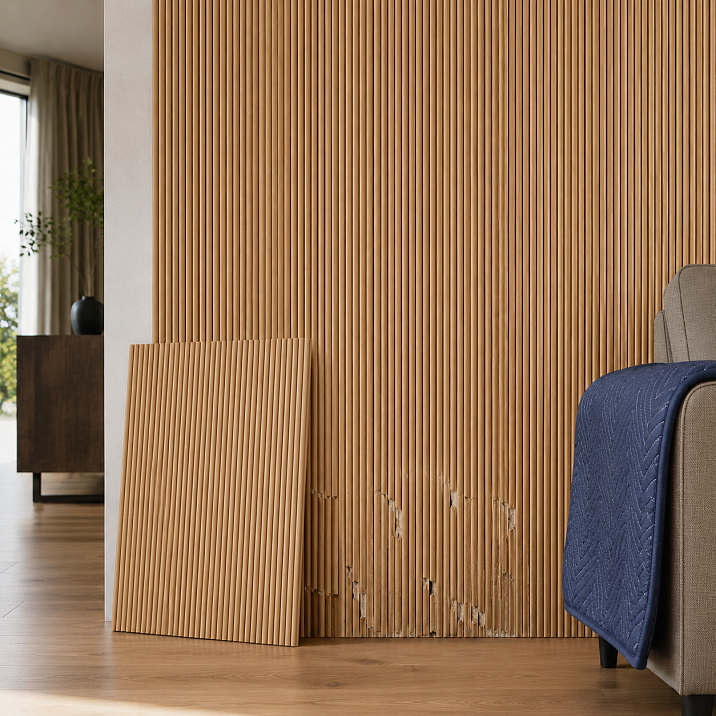
The slat wall is already assembled and painted. While bringing in the sofa, the lower part of one PAN-001 module was hit: several slats are scratched or chipped, with damage rising to about 600 mm from the floor. The remaining two-plus thousand millimeters of the same panel look fine. The PAN-001 card includes a short MDF modification of 1010 × 8 × 740 mm, and the first solution seems obvious: cut off the damaged bottom, install a new short fragment, and avoid buying a full 2670-millimeter panel.
In terms of material height, it is indeed sufficient: 740 − 600 = 140 mm of nominal margin. But this is where simple arithmetic ends. The long PAN-001 creates a continuous vertical rhythm from the floor upward. If only the lower part is replaced, a horizontal line will appear across the entire width of the module, crossing every slat and fabric base. On an open wall, such a seam may be more noticeable than the original damage itself.
Therefore, the correct answer depends not on whether 740 mm is enough, but on whether the horizontal repair boundary can be architecturally justified. If the joint is hidden by a sofa, cabinet, horizontal molding, or an existing wall division, the short PAN-001 can be a rational repair module. If the damaged area is on an open plane under side lighting, replacing the full 2670-millimeter panel often yields a cleaner result.
Before buying a panel, it is also worth assessing the extent of the damage. If only one or two individual slats or just the paint layer are affected, a whole short module may not be needed at all. For a new repair, you can Buy slatted panels for wall finishing, but in this article the task is already specific: to understand what exactly to put in the cart to restore the existing PAN‑001.

Slat panel PAN‑001: what sizes are actually available for repair
The current PAN‑001 card confirms several versions with the same width A=1010 mm and depth C=8 mm. For our scenario, two MDF positions are especially important — 740 and 2670 mm. This means that the short repair format does not differ from the long one in the base dimensions A and C, unlike some other series where short and long versions have different thicknesses.
| PAN‑001 version | Size | Material | Role in repair |
|---|---|---|---|
| Short module | 1010 × 8 × 740 mm | MDF | Candidate for local replacement of the lower zone |
| Short/medium | 1010 × 8 × 950 mm | MDF | Provides more height but leaves a larger remainder |
| Short/medium | 1010 × 8 × 950 mm | Oak / beech | Natural material, not equal to MDF in finish |
| Full-size | 1010 × 8 × 2670 mm | MDF | Replacement of the original long module without horizontal seam |
| Full-size | 1010 × 8 × 2400 mm | Oak / beech | Natural finishes |
The short 740-millimeter version is now confirmed to be MDF. If the original wall is made of MDF PAN-001 2670 mm, it is a logical candidate for a repair scenario in terms of material and profile size. If the original wall is oak or beech, buying MDF 740 mm just because the length is convenient cannot be considered an equivalent repair.
After checking the material and seam, you can slat panel PAN-001 1010×8×740 mm include it in the repair specification.




600 mm is damaged, and PAN-001 has a length of 740 mm: providing a margin of 140 mm
Net difference:
740 − 600 = 140 mm.
This is a good margin in workpiece height, but not permission to automatically cut a new panel exactly at 600 mm. The repair boundary should be determined not by the last scratch, but by the most favorable line for the future joint.
For example, the damage visually ends at 580 mm, but at a height of 700 mm there is already a furniture console or a horizontal decorative profile. In this case, it is more logical to replace the lower 700 mm and hide the seam under the existing line than to create a random transverse boundary at 600 mm.
| Repair zone height | Remainder from PAN-001 740 mm | Preliminary conclusion |
|---|---|---|
| 500 мм | 240 мм | Large reserve for choosing the joint line |
| 550 мм | 190 мм | You can look for an architectural boundary above the damage |
| 600 мм | 140 мм | Central scenario of the article |
| 650 мм | 90 мм | There is still freedom for trimming |
| 700 мм | 40 мм | An accurate joint map is needed |
| 720 мм | 20 мм | Dense repair |
| 740 мм | 0 мм | No allowance for final trimming |
If the damage is above 740 mm, the short version no longer covers it with a single piece. Then 950 mm or a full replacement of 2670 mm is considered, but the decision still depends on the visibility of the horizontal seam.
Our factory also produces:






The main problem with local repair of PAN-001 is the horizontal seam through the vertical slats
The original PAN-001 is designed as a set of semicircular glazing beads on a flexible fabric base. During installation of the long module, the vertical slats run continuously. The lower replacement cuts this pattern across.
At the repair site, several lines appear at once:
- the transverse end of each slat at the top of the repair fragment;
- the transverse end of each old slat at the bottom of the remaining long section;
- the line of the fabric base;
- possible difference in paint or gloss;
- micro-gap between the old and new parts.
Even if the batten spacing matches perfectly, the human eye easily notices a horizontal interruption of long vertical lines. Side lighting makes such a line even more noticeable.
Why a vertical factory joint and a horizontal repair joint are different tasks
The PAN-001 card allows individual panels to be joined together. But the standard logic of modular cladding is primarily designed for continuing the batten rhythm with adjacent modules across the width. A horizontal replacement of the lower section cuts across the battens themselves and visually works differently. It cannot automatically be considered "seamless" just because PAN-001 generally allows modular connections.
Why a mismatch of a few millimeters is especially noticeable
If the upper and lower fragments are shifted horizontally, each batten forms a small step. One step is almost invisible, but repeated across dozens of vertical elements, it turns into a pronounced line.
Get Consultation
When a short PAN-001 740 mm can actually be a reasonable repair module
A short panel is justified when the horizontal boundary can be integrated into the wall's architecture. Then the repair no longer looks like a patch.
The joint is hidden behind a sofa
If a new sofa covers the wall up to 750–800 mm and access to the lower zone is not required, a horizontal seam at 650–700 mm may not be in the field of view at all. In that case, there is no point in dismantling the intact upper 2 meters of the panel just for an invisible line.
The joint is behind a console or cabinet
The furniture forms a natural horizontal boundary. The short PAN-001 becomes a repair module in a hidden area.
There is already a horizontal molding on the wall
If the interior is initially divided into a lower and upper belt, the repair line can be tied to this division. Then the ends of the slats are hidden by an architectural element.
The lower panel area is provided by the design
For example, at the bottom there is a separate protective or furniture panel 700 mm high. The short module can end behind it or above it.
The commercial space has a replaceable lower belt
In a cafe, store, hallway, or other place with a high probability of impacts, the lower zone can be deliberately made repairable. But this is already a design solution, not a random repair after damage.
When it is better to replace the full PAN-001 2670 mm
Full replacement is more rational if the main wall is open from floor to ceiling and the transverse line will be constantly visible.
Strong arguments in favor of 2670 mm:
- The wall is fully visible from the entrance;
- A side window or linear light runs along the slats;
- The damage affects many adjacent glazing beads;
- There is no furniture or molding behind which the repair can be hidden;
- The interior is minimalist, and any transverse line is perceived as a defect;
- The original panel is relatively new, and the color is easy to reproduce entirely;
- Only one panel is being repaired, not a large area of the wall.
In such a scenario, a short module saves material but reduces the quality of the result. For a feature wall, it is better not to turn savings into a permanent visual compromise.
First, diagnose the damage: a short panel is not needed for every scratch
Before purchasing PAN‑001 740 mm, you need to determine what exactly was damaged. Externally, "the lower 600 mm are damaged" may mean completely different repair tasks.
| Damage type | What was damaged | Is a full short PAN-001 needed |
|---|---|---|
| Surface scratch | Only paint layer | First try local coating restoration |
| Chip on one slat | One glazing bead, base intact | Check possibility of local slat replacement/repair |
| Chip on several adjacent slats | Several glazing beads | Compare local repair with a short module |
| Tear or delamination of the fabric backing | Panel construction | Local replacement of a section becomes more likely |
| Strong impact across the entire width of the module | Many slats and a base | Compare short and full panel |
| Damage to two adjacent modules | Width greater than one PAN-001 | Count two repair zones or a full replacement |
If only the paint is damaged
For MDF for painting, card PAN-001 involves priming and subsequent application of suitable paints. A minor coating defect does not automatically require cutting out 600 mm of wall. First, you need to understand whether the primer and enamel can be locally restored without a noticeable spot.
If one or two glazing beads are broken
The general STAVROS material on slat walls describes local replacement of a damaged glazing bead in the context of oak panels under oil. This is a useful repairability principle, but it cannot be automatically transferred to a specific MDF PAN-001 without checking the method of slat adhesion, finish, and availability of a repair part. The manager should ask a direct question: is local replacement of individual glazing beads possible specifically in your PAN-001 configuration.
If the fabric backing is torn
The damage already relates to the module, not just the slat surface. In this case, separate touch-up painting will not restore the structure, and the choice between a short section and a full panel becomes relevant.
How the original installation method affects the ability to replace only the bottom
Card PAN-001 recommends fixing with contact adhesive and allows additional mechanical fastening with micro-pins. Therefore, "cutting off the bottom 600 mm and removing them" may be significantly more difficult than it looks in the diagram.
If the panel is mounted only with adhesive
During dismantling, the adhesive may hold the fabric base across the entire area. Removing the lower fragment can damage the wall or pull the remaining part. Before cutting, you need to determine which composition was used and how it behaves after full curing.
If micro-pins were used
Additional attachment points may run through the lower zone and interfere with careful dismantling. Their location is not always visible after painting.
If the installation method is unknown
This is an argument for a trial opening on a small hidden area rather than an immediate transverse cut across the entire width. If the lower part does not separate in a controlled manner, a short PAN-001 may be technically inconvenient to repair, even if the seam can be visually hidden.
For general technology, useful Advice on finishing and installation, but the specific dismantling of an existing panel must take into account the actual adhesive, fasteners, and the condition of the substrate.
How to design a horizontal seam for a short repair
How to determine the horizontal repair line: do not cut exactly along the last scratch
Damage up to 600 mm does not mean the seam must be at a height of 600 mm. The repair boundary is better chosen according to the wall's architecture.
A convenient sequence:
- measure the maximum damage height;
- find the nearest natural horizontal line above it;
- check if the short PAN-001 740 mm covers it;
- assess the visibility of the line from the main points of the room;
- only after this assign the cut height.
Example: damage up to 580 mm, the sofa covers the wall up to 720 mm
Instead of a random seam at 600 mm, it is more logical to perform repairs up to 700–720 mm if it is completely hidden by the sofa. PAN-001 740 mm in height allows such a scheme, leaving a small margin for trimming.
Example: damage up to 620 mm, molding at 680 mm
If there is already a horizontal molding on the wall, the repair line can go behind it. Then the short module is not read as an "insert," and the joint becomes part of the original composition.
Can the horizontal joint be covered with molding
Yes, this is one of the most logical ways to turn a repair line into an architectural division, if such an element truly suits the interior. But the molding should not appear only to mask an error without any connection to the rest of the room.
Before deciding, you need to check:
- its height relative to the furniture;
- its thickness relative to the 8-mm PAN‑001;
- the joint at the corners;
- how it will pass through adjacent modules;
- whether the horizontal line will require continuation along the entire wall.
If hiding one repair seam requires adding molding to the entire room, the economic sense of the short panel should be compared with a full replacement of 2670 mm.
How to check the rhythm match between the short and installed PAN‑001
The width and depth of the short and long MDF PAN‑001 match according to the card — 1010 × 8 mm. This is a good sign, but the exact match of the slat rhythm needs to be physically verified.
Align the first batten
The short panel is placed against the installed one without glue so that one vertical axis matches. Then check whether the remaining glazing beads align across the entire width.
Check the last element
If the first edge matches but accumulated difference appears on the right edge, the horizontal joint will become noticeable. It cannot be corrected by stretching the fabric backing without confirmed technology.
View from working distance
The joint is assessed not only from 20 cm but also from 2–3 meters — from the entrance, sofa, hallway, and other key points.
Turn on side lighting
Vertical battens create shadows, so misalignment is easier to see with lighting along the wall. What looks acceptable under frontal light may become a noticeable horizontal line in the evening.
Profile, material, and color of new PAN‑001
Sample OPAN‑001: why it is useful before a repair order
The current OPAN-001 has dimensions of 196 × 8 × 310 mm and is available in MDF, oak, and beech. Unlike the short PAN-001, it is too small to replace damaged 600 mm sections, but it is convenient for checking profile, material, and color.
You can Sample slat panel OPAN-001 Use for:
- comparing the 8-millimeter depth with the installed wall;
- test painting;
- evaluating gloss;
- checking color under daylight and artificial lighting;
- approving the finish before purchasing a full repair panel.
But the sample does not show the real horizontal joint with a width of 1010 mm. For this, a short panel or a full-size mock-up is needed.
PAN-001 made of MDF: how to check if the color of the repair area will match
Even with the same RAL code, local painting may differ after several years. Reasons:
- another enamel manufacturer;
- a different degree of gloss;
- a different batch of paint;
- the old coating has faded;
- the wall is unevenly lit;
- the primer or number of layers has changed;
- the old surface already shows signs of wear.
Why "the same RAL" is not enough
RAL describes a color reference, but not texture and gloss. A matte and satin finish of the same color on a textured wall are perceived differently.
How to do a test
On OPAN‑001 or a preserved offcut, perform a full cycle of primer and painting, then apply it to the wall. Inspect in daylight and evening light.
When it's easier to repaint the entire module
If the new short panel noticeably differs in color, sometimes it's more rational after repair to repaint the full width of one 1010-mm module up to the natural vertical joints. This reduces the risk of a local color patch, although it doesn't eliminate the horizontal geometry.
Why MDF PAN‑001 740 mm cannot be used for repairing an oak wall just because of matching dimensions
The short 740 mm modification in the current product card is MDF. Oak and beech are available starting from 950 mm. If the original wall is made of natural oak with tinting or oil, an MDF panel will not reproduce the wood texture.
Even if 1010 × 8 mm match, the visual material will be different. Painting MDF to look like oak does not become a natural continuation of solid wood.
For an oak wall, first check the possibility of:
- replacing individual damaged glazing beads;
- repairing with a coating;
- using oak PAN‑001 950 mm;
- complete replacement of the long oak module;
- architectural separation of the wall with a different material.
The short MDF 740 mm makes sense specifically in MDF wall repair or in a project where changing the material is a deliberate design choice.
Damage to several modules and repair stock
If the damage crosses two original PAN‑001 modules
The width of one module is 1010 mm. If the impact hits the vertical joint of two original panels and affects both sides, one short PAN‑001 may not be enough in width.
For example, 400 mm of the left module and 300 mm of the right module are damaged. The total damaged area horizontally is 700 mm, but it belongs to two different modules. Theoretically, you can cut a single fragment from one 1010-mm panel, but it will cross the existing vertical modular seam and create a new joint structure.
More often it is more logical to repair each original module within its boundaries: two short panels or two local inserts. This preserves the vertical pitch and does not tie two modules together with one repair piece.
How many short PAN‑001 to buy when two modules are damaged
| Damage | Preliminary repair | What to Check |
|---|---|---|
| One module, up to 600 mm | 1 × PAN‑001 740 mm | horizontal seam and color |
| Two adjacent modules, same height | 2 × PAN‑001 740 mm | Single horizontal line |
| Two modules, different damage height | align the repair boundary or replace full modules | do not create a stepped seam |
| Damage above 740 mm | 950 mm or full replacement | seam visibility |
A stepped line looks especially bad: on one module, repair up to 600 mm, on the adjacent one up to 680 mm. If a short repair is still chosen, it is better to make the horizontal boundary uniform across the entire affected area.
Is it worth buying a short PAN-001 as a repair spare during initial finishing
For some facilities, this is reasonable. A 740 mm panel can be stored as a repair module from the same batch, especially if the lower wall area is prone to impacts.
When spare stock is justified
- entryway with active furniture movement;
- children's room or play area;
- home with large animals;
- commercial space;
- rental interior;
- wall behind the sofa, which is periodically moved.
When the stock is excessive
In a calm bedroom or on a decorative wall that no one touches, a separate short panel can sit unused for years. Moreover, if future repairs will still require full replacement due to the horizontal seam, such a stock provides no real advantage.
Short 740 mm or full 2670 mm: comparison not only by material price
At the time of checking the PAN‑001 card, the short MDF panel 1010 × 8 × 740 mm in the «Prestige» finish is noticeably cheaper than the long 1010 × 8 × 2670 mm. This naturally pushes toward local repair. But a proper estimate must account not only for the cost of one panel.
Short repair introduces additional operations:
- precise marking of the horizontal cut;
- controlled dismantling of the old lower fragment;
- preparation of two transverse ends;
- rhythm alignment;
- possible installation of molding or another horizontal boundary;
- selection and local painting;
- risk of rework if the seam becomes visible.
Full replacement of a long module requires more material and larger dismantling, but allows preserving continuous vertical slats. Therefore, "short panel is cheaper" and "short repair is cheaper" are not the same thing.
How to compare two estimates
| Expense item | Short repair 740 mm | Full replacement 2670 mm |
|---|---|---|
| Panel | Less material | More material |
| Dismantling | Point but complex transverse | Full module |
| Seam | Horizontal, requires solution | No transverse seam |
| Color selection | New lower section next to old one | Can repaint the entire module |
| Risk of visual rework | Higher on an open wall | Below with exact SKU replacement |
| Material balance | Small | May be significant after trimming |
If the horizontal seam is hidden by furniture, a short layout almost always becomes more attractive. If the seam is fully exposed, the risk of visual rework should be included in the decision as seriously as the panel price.
Dismantling and inspection of the horizontal joint
How to safely check the possibility of cross-dismantling before purchase
Do not first order a short PAN-001 and then find out that the lower part of the old module cannot be separated without damaging the wall. The check is performed on the existing cladding.
Find a hidden or least visible edge
If the module fits against a baseboard, furniture, or corner, the mounting design can be assessed in such an area without interfering with the center of the visible plane.
Determine the location of electrical utilities
Before any cross cut, you need to know whether there are cables, outlet routes, or other utilities behind the panel. An 8 mm thick panel is not protection against incorrect tool depth. Repair must be performed by a specialist who understands the wall construction.
Understand how the fabric backing separates
If the backing is glued very firmly, attempting to remove 600–700 mm may pull above the repair line. Then local removal loses its advantage.
Do not make the final horizontal cut as the first action
First, confirm the removal technique on an edge or sample. Only after that, set the final line across the full 1010 mm width.
How to prepare the horizontal line so that the slats align after repair
If a short repair is approved, the line must be as precise as possible. Even a slight tilt becomes noticeable because it crosses the parallel vertical rhythm.
Practical checks include:
- laser horizontal;
- control mark on both edges of the module;
- check against the floor and furniture;
- dry fitting of the new fragment;
- comparison of each slat in the joint area.
Why the level line may differ from the furniture line
The floor or the top of the sofa may be slightly uneven. If the joint is to be hidden behind furniture, it is more important to ensure that it actually remains below the furniture's upper edge across the entire width, rather than just being mathematically horizontal.
Can a horizontal butt joint be made without a decorative trim
This option can be considered if the line is hidden or if a test assembly shows an acceptable result. But on an open wall, a perfect match requires simultaneously a precise cut, identical color, identical texture, and a nearly invisible gap.
The slatted surface itself emphasizes the transverse seam: each vertical shadow is interrupted at the same level. Therefore, a butt joint is the most demanding option.
When a butt joint is acceptable
- it is below the sofa back;
- it is hidden by furniture;
- the wall is illuminated frontally, not along;
- the color matches completely;
- the repair line is short and does not pass through multiple modules.
When is it better to add an architectural boundary
If the line is open, but the interior allows a horizontal molding, decorative batten, console countertop, or another element, the physical joint can be hidden under it. Then the requirements for the micro-gap are reduced.
How to choose the repair height if the furniture may later be rearranged
Hiding the seam behind the current sofa is convenient, but the sofa may change. If the repair line of 700 mm is today fully covered by a backrest of 750 mm, a new sofa with a low backrest of 620 mm will expose it.
Therefore, it is necessary to decide whether the furniture is a permanent part of the project. For a built-in console or a stationary cabinet, hiding is more reliable. For a regular sofa, a short repair remains dependent on the future layout.
How to check the repair in side light before gluing
The new fragment is temporarily installed without final glue or simulated with a full-size mockup. Then the lights that actually work in the room in the evening are turned on.
Light directed along the slats is especially revealing. It highlights:
- differences in depth;
- a step between the top and bottom;
- paint mismatch;
- uneven horizontal gap;
- displacement of individual glazing beads.
If the seam is noticeable in the worst lighting, it will not become less noticeable after permanent installation.
Matching old and new finishes
New PAN-001 and old batch: why the same SKU does not guarantee an absolutely identical appearance
For MDF, the base geometry is standardized, but the actual appearance of the finished wall is determined not only by the panel. Between the initial and repair order, the following could have changed:
- paint;
- soil;
- painting technology;
- operating conditions;
- degree of fading;
- contamination of the old coating.
Therefore, the original order date and the preserved sample are especially useful. If there is a leftover of the original PAN‑001, the new panel is compared first with it, and then with the wall itself.
Can the entire slat wall be repainted after a short repair
Yes, if the composition of the old coating and the surface condition allow repainting. This approach helps unify the color of the new and old areas, but does not eliminate the geometric horizontal seam.
If color was the main difference, a full repaint can solve the problem. If a transverse line of the ends is noticeable, new paint will not remove it.
Repair painting of MDF PAN‑001: what to do before installation
The PAN‑001 card recommends priming MDF before painting. For a short repair fragment, this is especially convenient: the main preparation can be done outside the finished room.
Before installation:
- dimensions are checked;
- perform final trimming;
- process open ends;
- prime according to the selected system;
- make a test coat;
- compare with the old wall;
- only after confirmation, perform the main finish.
In the section Mounting and finishing materials you can look at related products, but specific compounds are chosen based on the existing substrate and old finish.
Damage height: 150, 600, 720, or more than 950 mm
What to do if the damage is only in the lower 150–200 mm
The smaller the damage, the less convincing it is to replace entire 600–740 mm just to use a short format. In this case, first check:
- local repair of the covering;
- replacement of individual slats;
- bottom plinth or protective panel;
- architectural modification of the lower zone.
If the damage has affected the fabric base across the entire width of the module, the height of the defect becomes secondary — a structural replacement of the section is needed.
What to do if the damage has risen to 720 mm
The short PAN‑001 740 mm leaves only 20 mm of nominal reserve. This is already a borderline situation. If the repair line must pass at 725–730 mm, very little remains for final trimming.
In such a scheme, it is worth comparing the 950-mm MDF PAN‑001, which retains the 1010 × 8 mm base geometry and gives more freedom in height. But the horizontal seam does not disappear — only the material allowance changes.
If the damage is above 950 mm
Short repair modifications no longer solve the task. Buying several fragments one above another cannot be considered a rational repair: two or more horizontal lines will appear. In such a situation, a full replacement of the long 2670-mm module is usually more logical.
Care and repair of a slat wall: when to use general material instead of this article
If the task is not related to a specific PAN‑001 740/2670 mm, but you need to understand general care, cleaning, minor scratches, or principles of restoring different materials, it is better to use the existing material Care and repair of a slat wall.
The current article answers a narrower question: whether to create a transverse repair module from a short PAN‑001 or preserve vertical continuity with a full replacement.
Practical repair scenarios for PAN‑001
Practical scenario: damage hidden behind a sofa 760 mm high
The damage rises to 600 mm. The sofa covers the wall up to 760 mm. A short 740 mm panel allows a repair line at 700–720 mm, i.e., completely below the backrest.
Provided the color and rhythm match, this is a strong scenario in favor of a single PAN‑001 740 mm. A full 2670 mm replacement adds cost and dismantling but provides no noticeable visual advantage while the furniture remains in place.
Practical scenario: damage on an open wall opposite a window
The lower 600 mm are damaged, there is no furniture, and the window provides side light along the slats. Here, a horizontal seam will be under the most unfavorable conditions.
Even a precise short insert can read as a repair. If this is the main decorative wall, a full PAN-001 2670 mm is a higher-quality solution.
Practical scenario: two slats are damaged, the fabric is intact
Buying 1010 × 740 mm without diagnostics is premature. First, you need to find out from the manufacturer or installer whether individual glazing beads can be replaced in this particular MDF configuration. If so, a local repair will be significantly less noticeable because it does not create a horizontal line across the entire module.
Practical scenario: damage to two modules at the same height
If two adjacent modules are damaged up to 550–600 mm, two short PAN-001 panels can form a single lower belt 2020 mm wide. Such a line already looks more like a deliberate horizontal division, especially if there is molding or furniture above.
But if the repair belt covers only part of a large wall, its side boundaries also need to be architecturally finished.
Practical scenario: a commercial hallway with regular cart impacts
If the lower zone is constantly damaged, replacing the full 2670 mm module once is not enough—the problem will recur. In this case, it is wiser to change the wall design: make the lower belt repairable, add a protective element, or design a replaceable module in advance.
The short PAN-001 740 mm becomes especially useful when such a repair principle is provided by the system, not invented after the first impact.
Price of short and long PAN-001: why the difference is attractive but does not decide the choice
At the time of checking the MDF panel PAN-001 1010 × 8 × 740 mm card, the "Prestige" option is shown cheaper than the full-size 1010 × 8 × 2670 mm. This is expected: the material is almost four times shorter in length. But in the article, the price is used only as the second step of the decision.
First, we answer: will a short repair be technically and visually acceptable? Only if yes, we compare the cost. If the answer is "no," the low price of the short panel does not make a bad horizontal joint good.
Before publishing or ordering, the current price must be re-checked in the card: availability and cost change.
Short 740 mm or full 2670 mm: final decision tree
Decision tree: PAN-001 740 mm or full 2670 mm
| Question | If "yes" | If "no" |
|---|---|---|
| Is the original wall MDF PAN-001 1010 × 8? | Check the type of damage | Do not use 740 mm automatically |
| Is the fabric base/damaged slats? | Consider modular repair | First, local restoration |
| Is the repair height less than 740 mm with margin? | Check the seam location | 950 or 2670 mm |
| Can the horizontal seam be hidden/justified? | Check dismantling | Full replacement is preferable |
| Is the old bottom dismantled in a controlled manner? | Check rhythm and color | Full replacement may be safer |
| Do rhythm and color match? | Short repair is justified | Compare full replacement |
This algorithm does not give an automatic advantage to either 740 or 2670 mm. It shows at which stage each scheme becomes rational.
Local repair and full replacement: two work orders
Order of local repair of one PAN-001 without unnecessary actions
If the short scheme has passed all checks, the working sequence should be known to the installer in advance.
- Record the original wall with photos and dimensions.
- Determine the maximum height of damage.
- Choose an architecturally justified seam height.
- Check utilities behind the cladding.
- Set the method of initial attachment.
- Perform a trial disassembly on the hidden edge.
- Dry-fit the new PAN-001 and check the rhythm.
- Make a test paintout.
- Only after this, set the final horizontal line.
- Disassemble the damaged lower part.
- Prepare the base.
- Trim the repair panel to fit as needed.
- Protect the edges and perform the finishing.
- Fit again without final fixation.
- Assemble and check the seam under work lighting.
In this order, purchasing the panel is closer to the middle of the process rather than at the very beginning. This reduces the likelihood of buying a short module for a repair that is technically impossible to perform neatly.
Procedure for full replacement of PAN‑001 2670 mm
Full replacement looks more extensive, but is geometrically simpler: you need to remove the damaged
If the damage appeared directly above the baseboard
Impact from a sofa often hits the lower 200–400 mm. If the baseboard already covers part of the area, first assess whether only individual slats above it can be repaired. Creating a horizontal seam at 600–700 mm for a small chip near the floor may be excessive.
How to choose a horizontal molding for the seam without turning the repair into a new design project
If the molding is needed only for masking, it should logically continue along the wall or end at a natural point — a corner, furniture, or a doorway. You cannot place a short strip only across the width of one module in the middle of a large wall if such an insert has no compositional justification.
Checked:
- the material;
- thickness;
- width;
- color;
- joint with adjacent panels;
- visibility of ends.
If selecting a separate molding becomes more complex and expensive than replacing one long PAN‑001, a short repair loses its meaning.
When a horizontal seam can be turned into a lower protective belt
Damage from furniture shows that the lower zone of the wall is vulnerable. Instead of restoring the original appearance, you can deliberately change it: make the lower belt 600–740 mm high repairable or more impact-resistant.
This solution is especially justified in hallways, commercial spaces, and near movable furniture. Then the short PAN‑001 is used not as a random patch, but as a module of the lower belt.
Repair width, base, and control stand
How to check the damage width before purchasing a single panel
PAN‑001 has a width of 1010 mm. If the damage is visually "within one module," you need to confirm that it indeed does not extend beyond its vertical boundaries.
Mark the factory/installation seams of existing modules and measure:
- distance from the left seam to the damage;
- distance from the right seam;
- are there chips on the slats of the adjacent panel;
- has the fabric base at the vertical joint not separated.
If the adjacent module is also damaged, one 1010 mm panel is no longer a complete specification.
How to check a new module for a width of 1010 mm
Even with the same catalog size, do not start installation with trimming. Apply the full width of the new module to the old wall and check the vertical joints on the left and right.
If the original panel was trimmed in width during initial installation, the repair module will also need to be adjusted. In this case, a side offcut may remain from the new PAN-001, which is worth keeping as a repair sample.
Can a short PAN-001 be used as a source of individual repair slats
This is a potentially useful scenario, but it needs to be coordinated. If the individual beads of the short panel are identical to the installed PAN-001 and the manufacturer allows local replacement, one 740-millimeter panel can become a donor of several slats and a fabric fragment.
However, the article does not state that slats can always be safely separated from a new panel and glued into an old one. This depends on the design, adhesive, and the desired visual result.
What to do with the healthy upper part of the old module after a short repair
The main advantage of the local scheme is that it stays on the wall. There is no need to dismantle the intact 1900–2000 mm above. This reduces interference with the cornice, ceiling, adjacent modules, and painted surface.
But the remaining part must be securely fastened after the transverse cut. If the cut disrupts the tension or fixation of the fabric base, the installer must provide for its fastening. The mere presence of adhesive above the line should not be taken as sufficient without verification.
How to check the base after removing the damaged lower part
Before the new PAN‑001, the wall must be suitable for reattachment. Old adhesive, pieces of fabric base, putty, or chips may remain on it.
You need to:
- remove loose residues;
- do not damage the upper panel;
- restore the flatness;
- check the strength;
- ensure that the new adhesive is compatible with the prepared base.
Do not install a new repair module over thick, uneven residues of old adhesive: the lower part will protrude in front of the upper one, and the horizontal seam will become even more noticeable.
How to check the flatness of the top and bottom parts
After dry installation, apply a long straightedge across the joint. The new bottom and old top should be in the same plane. If the new piece protrudes by 2–3 mm, the shadow will emphasize the line even with a perfect color match.
The cause may be:
- residue of old glue;
- too thick new adhesive layer;
- uneven wall;
- deformation of the fabric backing.
Is it worth making a test horizontal seam on a separate stand
For an expensive open interior — yes. From a scrap of the old panel and new OPAN/PAN‑001, you can assemble a small mock-up: old top, new bottom, the same paint, and the chosen joint scheme.
Such a stand shows how noticeable the line is at different light angles. If the result is unsatisfactory on the sample, on a wall several meters wide it will only be more noticeable.
How to place order PAN-001 for repair
What to send to manager STAVROS before ordering PAN-001 for repair
To get a useful answer, send not only the phrase "need a short panel". You need:
- article number PAN-001;
- source material;
- source size;
- photo of the entire wall;
- large photo of the damage;
- defect height;
- defect width;
- number of affected modules;
- code and type of old coating;
- date of initial order, if known;
- photo of preserved offcut/sample;
- question about possibility of local replacement of individual glazing beads;
- question about matching of short and long PAN-001 according to current geometry.
Where to buy short PAN-001 for local repair
If MDF wall, horizontal seam, dismantling and color are confirmed, you can order short slat panel PAN-001 1010 × 8 × 740 mm as repair module.
If short seam is not suitable, it is better buy slat panels for interior wall finishing in the required full format and restore the module without a transverse boundary.
Before payment, it is useful to check payment and delivery terms, especially if the object is in another city and reordering one panel will be expensive.
Errors when repairing PAN‑001 with a short 740 mm panel
Mistake 1. Assuming that 740 mm automatically solves damage of 600 mm
The height margin is sufficient, but the horizontal seam can spoil the appearance.
Mistake 2. Cutting exactly along the last scratch
The repair boundary must be architecturally justified.
Mistake 3. Not diagnosing individual slats
For minor damage, a whole panel may not be needed.
Mistake 4. Buying MDF for an oak wall
Matching dimensions does not replace material and texture.
Mistake 5. Not recognizing the original installation method
A glued and additionally nailed bottom may not come off cleanly.
Mistake 6. Making a cross cut without checking utilities
Cables may run behind the cladding.
Mistake 7. Not checking the rhythm of the entire width
Matching the first batten does not guarantee matching the last one.
Mistake 8. Comparing color only by RAL code
Gloss, age, and paint batch also affect the result.
Mistake 9. Creating a stepped line on two modules
Horizontal repairs are better combined into a single mark.
Mistake 10. Add molding only at 1010 mm in the middle of the wall
A short decorative insert can look like masking an error.
Mistake 11. Buying a second short panel "just in case" without a scenario
A repair reserve is not needed for every object.
Mistake 12. Painting the repair PAN-001 before final trimming
After cutting, the ends will still need to be prepared again.
When you don't need to buy a short PAN-001
A short repair panel should not become an automatic reaction to any damage in the lower zone. It is better to avoid it if:
- the scratch affects only the coating;
- one or two individual slats are damaged and local restoration is possible;
- the original wall is made of oak or beech, and 740 mm is available as MDF;
- the horizontal seam will be on the visible wall;
- the bottom of the old panel cannot be removed without destroying the remaining part;
- the damage is above 740 mm and the short format leaves no margin;
- the new insert noticeably differs in color;
- the repair involves several modules with a complex stepped boundary.
In these situations, the short PAN‑001 saves material, but does not necessarily save the repair.
When one PAN‑001 1010 × 8 × 740 mm is the best choice
The short modification is especially convincing if the original wall is MDF PAN‑001 2670 mm, one module is damaged, the defect is below 600–650 mm, the seam can be hidden by furniture or an architectural line, and the removal of the lower part is confirmed by a test.
Additional signs of a good script:
- there is source code for coloring;
- a sample or trim is preserved;
- the new module matches the rhythm;
- the repair line is uniform and horizontal;
- the lower zone remains hidden or serviceable in the future.
Final specification and test case
Final specification for repairing one PAN-001 module
| Parameter | What to fix |
|---|---|
| Original product | PAN‑001 |
| Original version | MDF 1010 × 8 × 2670 mm |
| Repair candidate | MDF 1010 × 8 × 740 mm |
| Damage height | at the maximum point |
| Selected repair line | according to the project, not automatically 600 mm |
| Damage width | within one/multiple modules |
| Original installation method | glue / micro-pins / combination |
| Horizontal seam | hidden / exposed / under molding |
| Rhythm match | verified by dry fitting |
| Color | trial paint-out confirmed |
| Base after dismantling | smooth and sturdy |
| Quantity | 1 pc. for one module, if the scheme is confirmed |
Control example: the lower 600 mm of one module behind the sofa is damaged
The original wall is MDF PAN-001 1010 × 8 × 2670 mm. The damage occupies the lower 580–600 mm of one module. The sofa covers the wall up to 760 mm. Inspection shows that the short PAN-001 matches the rhythm, the color can be reproduced, and the lower fragment of the old panel is removed without damaging the top.
Instead of the 600 mm line, the repair is scheduled at 700 mm. The short panel of 740 mm leaves 40 mm of total allowance for final trimming. The horizontal seam is completely hidden behind the sofa. In this scenario, one short PAN-001 is a logical repair order.
If the same defect is on a bare wall opposite the window, the conclusion changes: the seam is exposed, the side light is strong, and a full 2670 mm replacement may be more reasonable.
FAQ about repairing PAN-001 with a short panel
Is there a PAN-001 with a length of 740 mm?
Yes. The current product card shows MDF PAN-001 1010 × 8 × 740 mm.
What material is the short PAN-001?
In the current card, the 740 mm version is listed as MDF.
Will 740 mm be enough if the lower 600 mm are damaged?
In height, yes: the nominal allowance is 140 mm. But the final decision depends on the location of the horizontal seam.
Will the horizontal joint be noticeable?
On an open slat wall, it is likely more noticeable than a regular vertical modular joint. It needs to be physically checked under raking light.
When is it better to replace the entire 2670 mm module?
When the seam cannot be hidden, the wall is in a visible area, the rhythm must remain continuous, or short-term repair is technically difficult to dismantle.
Can only one damaged slat be replaced?
This possibility needs to be confirmed for the specific configuration. General STAVROS materials describe local replacement of the glazing bead for some wooden panels, but this is not an automatic instruction for MDF PAN-001.
Does the profile of PAN-001 740 and 2670 mm match?
According to the current card, both MDF versions have A=1010 and C=8 mm. The actual rhythm should still be verified with a dry fit.
Can the oak PAN-001 be repaired with a short MDF 740 mm piece?
Not as an invisible replacement: the material and texture differ. For an oak wall, the appropriate material or a different repair scheme is needed.
How to choose the color of the repair area?
Use the original code and type of coating, make a test patch and compare it with the wall under real lighting.
How many panels are needed if two modules are damaged?
Usually one repair module per original PAN-001, if a single bottom belt is chosen. But the final scheme depends on the width of the damage.
Is it worth buying PAN-001 740 mm as a spare for a new repair?
In areas with a high probability of impacts — sometimes yes. For quiet rooms, this is not a mandatory purchase.
Can the seam be covered with a molding?
Yes, if the horizontal division matches the interior and does not look like a random insert.
What is more important — price or the absence of a seam?
For a feature wall, usually the visual result. For a hidden area, a short repair can be significantly more rational.
How can you tell if the bottom of an old panel can be removed?
You need to determine the original adhesive, check for micro-pins, and do a test on a hidden area before making the final cross cut.
Can OPAN-001 be ordered first?
Yes, a sample is useful for checking the profile, material, and color, but it does not show a full-size horizontal seam.
What to do if the damage is above 740 mm?
Consider PAN-001 950 mm or a full 2670 mm replacement. Do not assemble a repair from several short fragments in height.
Summary: the short PAN-001 740 mm is suitable for repair only when the horizontal seam does not become a new defect.
For damage to the lower 600 mm of an MDF wall, the short PAN-001 1010 × 8 × 740 mm indeed has sufficient height and matches the long MDF PAN-001 2670 mm in base dimensions A=1010 and C=8. The nominal margin is 140 mm.
But the main selection criterion is not the margin. Local replacement creates a horizontal seam across vertical slats. If this seam is hidden by a sofa, cabinet, molding, or an existing architectural band, a short panel may be the best repair solution. If the line remains visible on a feature wall, a full 2670 mm replacement often looks more professional.
Before purchasing, you need to diagnose the defect itself, rule out the possibility of repairing one or two slats, determine the original installation method, check the removal of the lower section, align the slat rhythm, do a test paint-out, and evaluate the seam under side lighting.
The correct sequence: diagnostics → selection of the repair line → checking the dismantling → dry fitting → color → seam assessment → only then the decision of 740 or 2670 mm. This way, the short PAN-001 becomes a real repair module, not a cheap patch that will forever remain visible on the slat wall.