










































































Article Contents:
- First, don't choose a size — measure what's already above the door
- Door leaf width
- Outer width over the trim
- Height of the free area above the trim
- Distance to side obstacles
- 600 mm works well with limited height above the door
- 600 mm is suitable when the door should not become the main object of the room
- 600 mm is a good option for a first step instead of a portal
- If 700 seems small, move up to 800
- If 700 is already cramped, go back to 600
- 700 mm is especially appropriate with pronounced trim
- The big wall can accommodate 800 mm more easily than a narrow pier
- A height of 279 mm requires a separate check
- 800 mm is suitable when an architectural top accent is specifically needed
- First, write down the dimensions
- Then, exclude the clearly too tall option
- After that, compare&Don't look at them one by one
- Don't look at them one by one
- Only after that, look at the price
- Can you really finish a door with only one NPU-095?
- What size of NPU-095 should I choose for an 800 mm door?
- Does NPU-095 800 mm mean it is designed for an 800 mm door?
- How do the three versions differ besides width?
- Which NPU-095 is the most versatile?
- Can I install NPU-095 flush against the trim?
- How much free space is needed up to the ceiling?
- If there is a ceiling cornice above the door, which size is better?
- Do I need to buy two NPU-095s for one door?
- Are moldings needed together with NPU-095?
- What should I use to glue NPU-095?
- Can NPU-095 be used over an already painted wall?
- How can I check the size without buying three options?
- Is it worth getting 800 mm if there is enough space?
- Can NPU-095 be used in a narrow hallway?
- What to do if the door is almost at the corner?
- Will NPU-095 fit for two identical doors next to each other?
- Can different sizes of NPU-095 be installed in one apartment?
- What to choose if 600 and 700 mm look equally good?
- What to choose between 700 and 800 mm?
- Can NPU-095 be used instead of a door portal?
- What is better to buy first — NPU-095 or moldings?
- Do I need to replace the platbands?
- How to understand that NPU-095 is too big?
- How to understand that NPU-095 is too small?
- Can I buy only one NPU-095?
- Where can I see all options for polyurethane molding if NPU-095 did not fit?
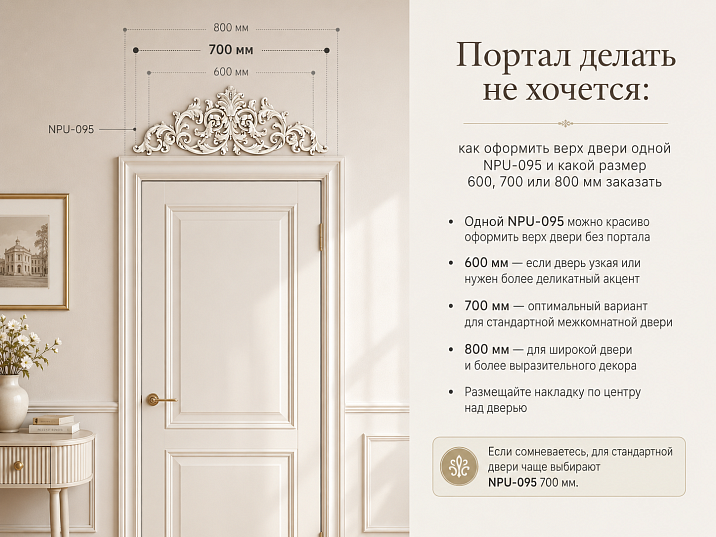
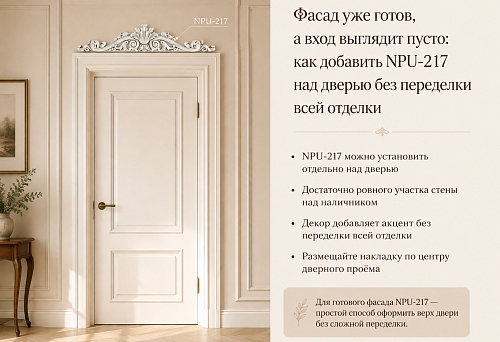
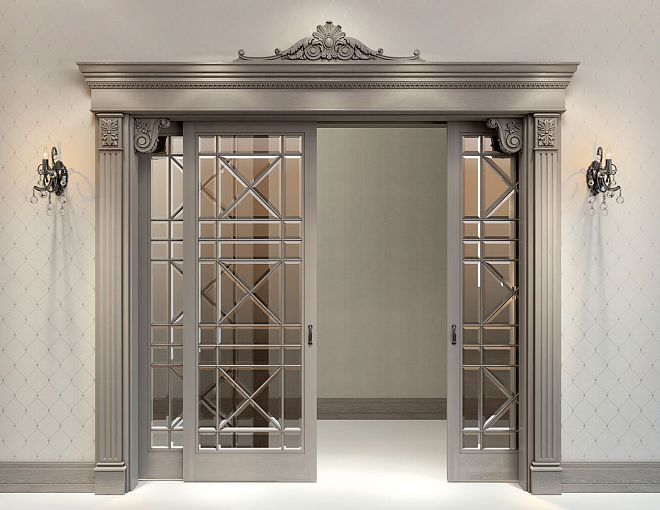
The door is already installed. The platbands are in place. There is no desire to redo the entire opening, add side pilasters, complex moldings, and assemble a full stucco portal. But the top of the door still seems empty — especially if the interior already contains classic or neoclassical details. In such a situation, a logical question sounds much simpler: can I place one NPU-095 above the opening and stop there?
Yes. The polyurethane molding NPU-095 is produced in three sizes at once — 600 × 209 × 12 mm, 700 × 244 × 13 mm, and 800 × 279 × 14 mm, so the decorative top of the door can be selected without necessarily assembling a complex portal. The main thing is not to choose the option based only on the number 'door width 800 mm, so I take NPU-095 800 mm'. This is not how the size of the above-door decor is determined.
You need to choose based on the entire visible area: the width of the door leaf, the trim, the free wall on the right and left, the distance from the top trim to the ceiling or cornice, adjacent furniture, and the overall scale of the opening. That is why before you buy the decorative molding NPU-095, it is more useful to spend ten minutes on measuring than to later try to make an overly large or overly small overlay look appropriate.
NPU-095 does not have a single 'correct' width. The 600 mm version is not a reduced secondary option, and the 800 mm is not automatically the best and more expressive one. These are three scales of the same decorative solution. One can neatly finish a regular interior door, the second can support a wide trim, and the third can occupy a sufficiently large field above a massive opening.
It is this choice that needs to be made before placing the order.

First, do not choose the size — measure what is already above the door
The buyer usually knows the width of the door leaf. For example, 700 or 800 mm. But for NPU-095, this number alone is not enough.
Why? Because the overlay will not be on the leaf, but above the door opening. It is surrounded by trim, wall, and ceiling. In the field of view, they are perceived together, so the decorative element must relate to the finished framing, not just to the internal width of the door.
Before choosing NPU-095, you need to take four measurements.




Door leaf width
This is the initial value. It helps understand the scale of the door, but does not provide a ready answer.
A leaf 800 mm wide can come in very different trims. One door has narrow casings, another has wide ones. In the first case, the entire visible structure is relatively compact. In the second, it can be noticeably wider.
Therefore, a "800 mm leaf" is only the starting point of measurements.
Our factory also produces:


Outer width across casings
For the top decorative trim, this dimension is often more informative than the width of the leaf itself.
Measure the distance from the outer edge of the left casing to the outer edge of the right one. It is this horizontal line that the eye most often reads as the overall width of the finished door.
If NPU-095 turns out to be almost equal to this width, one effect is achieved. If it is noticeably narrower, another.
And neither of them is automatically wrong. The question is about proportion.
Get Consultation
Height of the free area above the casing
This measurement is especially important because the three versions of NPU-095 differ not only in width.
The 600 mm size has a height of 209 mm.
The 700 mm version is 244 mm.
The 800 mm version is already 279 mm.
The difference in height between the smallest and largest variant is 70 mm. On paper, this seems like a small change, but in the narrow space between the top trim and the ceiling, it can make all the difference.
If the free strip is low, the NPU-095 800 mm can physically fit in width, but may look too cramped vertically.
Distance to side obstacles
On the left, there may be a wall corner. On the right, a tall cabinet. Nearby, a second doorway. Sometimes the door is placed almost flush against the wall.
In such a case, the central position of the NPU-095 relative to the door does not guarantee that the composition will be perceived well relative to the entire wall.
Therefore, separately check how much free space remains to the right and left of the future overlay.
The decor should not look randomly pressed against the cabinet or corner just because the mathematical center of the door is found correctly.
NPU-095 in three sizes: one model, but three completely different scales
Before discussing proportions, it is useful to see all options side by side.
| Option NPU-095 | Size | Material | Current price in the card | What changes visually |
|---|---|---|---|---|
| Compact | 600 × 209 × 12 mm | Polyurethane | 8 680 ₽ | More restrained top accent |
| Medium | 700 × 244 × 13 mm | Polyurethane | 10 340 ₽ | More noticeable decoration above the door |
| Large | 800 × 279 × 14 mm | Polyurethane | 15 890 ₽ | Maximum scale of the three options |
Prices are as shown on the product card at the time of preparation. Before placing an order, it is better to check the current price directly on the NPU-095 page.
Note one pattern: as the width increases, both the height and thickness increase.
That is, moving from 600 to 800 mm is not just "stretching the same pattern sideways." The larger option takes up more of the wall as a whole and protrudes more above the base.
This is why the choice cannot be reduced to a rule:
narrow door — 600, medium — 700, wide — 800.
Sometimes a medium-width door is in a very spacious opening and accepts 800-millimeter decor well. And a wide door may sit almost under the ceiling cornice, in which case the smaller NPU-095 will be compositionally calmer.
Why you don't need to automatically buy the NPU-095 800 mm for an 800 mm door
This is perhaps the most obvious trap.
Two numbers matched:
-
canvas — 800 mm;
-
NPU-095 — 800 mm.
It feels as if the manufacturer deliberately created this overlay for the "800-mm door."
But the decorative width and the canvas width serve different purposes.
The canvas determines the passage.
The overlay determines the upper decorative part of the entire visible door.
Between them are the architraves. It is they that expand the architectural frame. If you take an element exactly the width of the canvas, above the door it may look quite large or, on the contrary, completely natural — depending on the width of the architraves and the free wall.
Therefore, matching numbers is not a criterion for compatibility.
Similarly, NPU-095 with a width of 600 mm is not intended exclusively for 600-mm doors.
It is much more sensible to first look at the entire opening from the front and determine its visual width.
Guideline 50–70%: a useful check, but not a hard rule
For an above-door decorative element, you can use an approximate guideline: its width takes up a significant, but not the entire, portion of the visual width of the finished opening. General recommendations for door overlays mention a range of about 50–70%.
But it should not be treated as a construction standard.
This is a way to do a first check of proportions.
Suppose we take the actual width of the entire visible door along the outer edges of the trim and want to understand in what range a specific NPU-095 will occupy roughly from half to 70% of that width.
The following approximate ranges result:
| Overlay size | If it takes up about 50–70% of the visual width of the door, the door itself with trim is approximately |
|---|---|
| 600 мм | from 857 to 1200 mm |
| 700 мм | from 1000 to 1400 mm |
| 800 мм | from 1143 to 1600 mm |
How were the figures obtained?
For the lower bound, divide the decor width by 0.7.
For the upper bound, by 0.5.
For example:
600 ÷ 0.7 ≈ 857 mm.
600 ÷ 0.5 = 1200 mm.
That is, an NPU-095 with a width of 600 mm falls within the approximate range of 50–70% when the total visual width of the finished opening is approximately 857–1200 mm.
But here the main point emerges: the ranges overlap.
An opening with a total width of 1150 mm can accommodate both 600 and 700, and with certain architecture may even require trying an 800-mm option.
Therefore, percentages help eliminate clearly unsuitable solutions, but the final choice is made through a full-size fitting.
A paper template will tell you more about a door than ten interior photos.
The NPU-095 has a rare advantage for pre-selection: the dimensions are known exactly.
This is worth taking advantage of.
There's no need to print the ornament itself at full size. Take paper, cardboard, or several connected sheets and make a rectangle of the required format.
For the 600 mm version:
600 × 209 mm.
For 700:
700 × 244 mm.
For 800:
800 × 279 mm.
Secure the template with painter's tape above the door and step back.
Not by twenty centimeters.
Look from the distance from which the door is usually seen in the interior.
From the hallway.
From the sofa in the living room.
From the opposite wall of the bedroom.
From the entrance to the room.
Often the solution becomes obvious right away.
600 mm may unexpectedly turn out to be enough.
700 — exactly hits the proportion.
And 800, which seemed the most striking on the product page, may literally "lie" on the trim and ceiling, leaving no free space.
Sometimes the opposite happens: a small pattern looks lost, while a large one finally ties the door to the scale of the wall.
Such information cannot be obtained from the dimensions of the door leaf.
When to choose NPU-095 with a width of 600 mm
The size 600 × 209 × 12 mm is not an option "for those who want something smaller." It has its own scenario.
It is especially interesting where the door already has finished casings and only the top needs to be completed.
Imagine a regular interior door. The leaf itself does not look massive. The wall around it is not very wide. The ceiling is relatively close. A full portal here would indeed look excessive.
One top element with a width of 600 mm can provide exactly the degree of decorativeness that is missing.
600 mm works well with limited height above the door
The height of the element is 209 mm.
This is the lowest NPU-095 of the three.
If the space between the top casing and the ceiling cornice is limited, the reduction of 35 or 70 mm compared to the larger versions becomes a noticeable advantage.
But you can't simply compare 209 mm with the free height.
If there is 215 mm of free space, the part mathematically fits, but visually it does not. The ornament will end up squeezed between two lines.
Free space is needed.
Its size cannot be assigned a universal number, because everything depends on the relief of the casing, the color of the wall, the ceiling design, and the width of the opening.
This is exactly why the template helps again.
600 mm is suitable when the door should not become the main object of the room.
Sometimes the door needs to be supported decoratively, but not turned into a compositional center.
For example, in a bedroom, the main object is the headboard.
In a living room, it's the fireplace, the sofa area, or a large wall composition.
In the hallway — a mirror or a console.
If you make the top decor above the door too large, attention will unexpectedly shift to the opening.
The 600 mm version allows preserving the decorative language of the interior without giving the door the main role.
600 mm is a good option for the first step instead of a portal.
If the owner doubts whether complex polyurethane door decor is needed at all, starting with a single overlay is more reasonable than immediately building a system of several elements.
You can order NPU-095 made of polyurethane in the size of 600 mm, if this exact scale fits the measurements, and leave the existing trims unchanged.
As a result, only the upper part of the opening changes.
This is a completely different nature of renovation than redoing the entire door.
When 700 mm becomes the most balanced option
Average size — 700 × 244 × 13 mm.
It has an interesting position within the lineup. It is noticeably larger than the 600-millimeter one, but it still doesn't take up as much wall space in height and width as the 800-millimeter one.
That's why 700 mm often turns out to be the first size worth trying on doors of medium and large visual scale.
Not because it's universal.
There is no universal size here.
But because it sits in the middle of the range and helps you understand where to go next.
If 700 seems small — move up to 800
Don't reason abstractly.
Hang up a 700 × 244 mm template.
If there's too much empty space around, the trims look significantly wider in scale, and the top of the door seems to demand a longer horizontal line, try 800 × 279 mm.
If 700 feels too tight, go back to 600
Another scenario: the template almost touches adjacent architectural lines, and the 244 mm height takes up too much free wall space.
Then 600 × 209 mm might be more accurate.
This creates a normal selection process: not "I like the middle one, so I take the middle one," but a sequential comparison in the actual room.
700 mm is especially suitable with pronounced trims
Wide framing increases the visual size of the door.
A small top detail above such an opening can sometimes start to look like a random decoration.
NPU-095 700 mm provides a more confident horizontal line and more strongly connects the top of the door to its overall width.
But here too, it's not the size name that decides, but the fitting.
When it makes sense to order NPU-095 800 mm
The largest version is 800 × 279 × 14 mm.
It requires more attention precisely because it has the maximum scale.
This is no longer a small decorative touch. An element 80 cm wide becomes a full-fledged architectural detail above the door.
A large wall can accommodate 800 mm more easily than a narrow partition.
If there is enough free wall around the doorway, the large overlay gets space.
Especially if the door is in the center of a wide wall and is perceived as part of the room's symmetrical architecture.
The same NPU-095 looks completely different next to a corner.
Suppose the right casing is almost flush against the wall. Then the decor, centered above the door, may approach the corner and create a feeling of the entire composition shifting.
The 800 mm size in such a situation needs to be checked against the entire wall.
The height of 279 mm requires a separate check.
A buyer can spend a long time comparing 600, 700, and 800 horizontally, but forget about the vertical.
Namely, the height of 279 mm often becomes a limitation.
If there is already a wide ceiling cornice, a decorative frieze, or a low ceiling above, there may not be enough space.
There is no need to try to "squeeze in" the NPU-095 just because it looks convincing in width.
800 mm is suitable when an architectural upper accent is specifically needed.
There are interiors where one large overlay can replace a much more complex system.
Wide trims remain.
Side pilasters are not added.
Additional capitals are not needed.
Above the door, the NPU-095 800 mm appears.
It turns out not a portal in the classical sense, but a pronounced above-door decor.
It is precisely for such a scenario that it makes sense to buy NPU-095 with a size of 600, 700, or 800 mm, choosing a specific modification after trying it on.
One NPU-095 or a full portal: where the line is drawn
Not every decoratively designed doorway has to become a portal.
This is fundamental.
A full portal is usually built as a single architectural system. The top is connected to the side elements. The framing is perceived not as several separate decorations, but as a structurally constructed frame around the opening.
One NPU-095 solves a different task.
It does not turn trims into columns and does not try to imitate a full architectural structure. It simply makes the top of the door more expressive.
| What is required | One NPU-095 | Full decorative framing |
|---|---|---|
| Keep existing architraves | Yes | Sometimes the composition needs to be extended |
| Add only the top element | Yes | No, the system is usually wider |
| Minimal intervention in the finished door | Yes | More work |
| Form the side architecture of the opening | No | Yes |
| Get a transom accent | Yes | Yes |
| Make the opening the main decorative object of the wall | Possibly with a large size | Fits better |
| Select one product | Yes | Several elements will be needed |
If your thought starts with the words “I don’t want to make a portal,” there’s no need to force the interior to move in the opposite direction.
Start with one NPU-095.
Look at the result in scale.
Only if the top decor after trying it on looks detached from the trims does it make sense to discuss additional elements.
Trims are already installed: do you need to add molding
Not necessarily.
This is one of those situations where the buyer easily starts buying extra items.
Since NPU-095 belongs to molded decor, there is a desire to immediately add moldings, corners, additional inserts, and side elements.
But the task of the article is different: to decorate the top of an existing door as cohesively as possible with a single piece.
If the trims themselves form a sufficient frame, molding may not be needed at all.
First, try the composition:
door + existing trims + one NPU-095.
If it looks complete, stop there.
If the connection between the top overlay and the trims is too weak, then you can explore which Buy polyurethane moldings for additional decoration.
But the molding must solve a specific problem.
For example, continue the top horizontal line.
Connect the decor with the wall frame.
Support the room's existing molding system.
Simply adding it because "stucco is usually done as a set" is not necessary.
If the door is already beautiful, NPU-095 should not argue with it.
The most complex case is not a simple door, but one that is already decoratively finished.
The door leaf may have several panels.
The casings are shaped.
A cornice is located above the opening.
Wall moldings are used nearby.
Then another expressive element needs to be introduced especially carefully.
The main question is not "does classic decor suit a classic door."
This is too general a level.
Look at the density of details.
If the bottom and side parts of the opening are already saturated, a large NPU-095 800 mm can make the top too heavy.
If the door, on the contrary, has a calm geometry, the top overlay can give it the needed decorative center.
That is why the category stucco decoration is useful not only as a place to buy. There you can compare the scales of different overlays and understand how large the NPU-095 is relative to other decorative elements.
Door next to a corner: the size is chosen asymmetrically to the wall, but symmetrically to the door
Let's imagine a real hallway.
The door is located 250 mm from the corner of the wall.
On the other side, there is a free meter and a half.
The door itself is centered within its opening, but not within the wall.
What to do with NPU-095?
The first impulse is to shift the trim toward the free space.
But then it will no longer be connected to the door.
Usually, the above-door element should maintain its axis relative to the opening itself.
Therefore, the problem is solved not by shifting, but by choosing the scale.
If 800 mm visually "cuts into" the corner, try 700.
If 700 still feels too wide — try 600.
And only if even the compact version doesn't leave enough space, it's worth giving up on NPU-095 in that particular spot and looking at other options decorative polyurethane elements.
Not every beautiful product suits every wall. That's a normal result of a smart choice.
Two doors side by side: one trim above each or nothing
A hallway with two adjacent doors is a separate situation.
If you install NPU-095 above only one door without a clear reason, the second one may start to look unfinished.
So first, determine the hierarchy.
If one door is truly the main one—for example, it leads to the living room, and the second is significantly narrower and secondary, the difference can be justified.
If the openings are identical and located side by side, it makes more sense to treat them as a pair.
Then the sizes of NPU-095 should match or deliberately differ according to architectural logic.
But buying two pieces automatically isn't necessary either.
Make two paper templates.
Place them at the same time.
It is the simultaneous fitting that will show whether the corridor becomes overly saturated.
There is already a ceiling cornice above the door: vertical tightness matters more than width
Often the buyer thinks:
“There is plenty of space, the wall is wide, I’ll take 800 mm.”
But a massive ceiling cornice runs along the top.
Only a narrow strip of the wall remains.
In this situation, the main parameter becomes not the width of the NPU-095, but its height.
209, 244, and 279 mm are three completely different scenarios.
If a large overlay is too close to the cornice, the two relief elements will begin to compete.
Instead of an expressive door, you'll get a dense area of several decorative layers.
Sometimes reducing NPU-095 from 800 to 600 mm immediately brings air back to the composition.
And sometimes there is so little free space that it's better to leave only the casing above the door altogether.
You don't need to decorate every possible surface.
Can NPU-095 be used in a modern interior?
The overlay's shape itself is decorative and expressive. So the question shouldn't be framed as "can or cannot."
It's much more useful to ask: is there at least one other element in the interior that explains the appearance of such a relief?
If the entire apartment is built on absolutely smooth surfaces, hidden doors without casings, and strict minimalist geometry, a single ornamental NPU-095 may look random.
But a modern interior doesn't necessarily mean the absence of classic details.
In neoclassicism, modern eclecticism, interiors with wall moldings, or decorative furniture, such a door top can work naturally.
Especially if it is painted and integrated into the overall wall architecture without excessive colorfulness.
When a wider range of wall solutions is needed, it is useful to look Polyurethane wall decor and assess how the over-door detail will relate to the rest of the room's decor.
Living room: the door can become part of the overall wall architecture
In the living room, the opening is often visible from a great distance.
Here, small decorative details are perceived weaker, while large ones read better.
If the door is on a long free wall, NPU-095 700 or 800 mm can get enough space.
But you need to take into account neighboring objects.
Television zone.
Fireplace.
Large mirror.
Wall panels.
Furniture.
If there is already a strong compositional center nearby, the door should not compete with it.
In that case, a more restrained NPU-095 600 mm can support the style without drawing too much attention.
Bedroom: the calmer the wall, the more precise the scale should be
In the bedroom, the decorative top of the door may be visible directly from the bed.
This means that a mistake in scale will constantly be in the field of view.
Here it's better to avoid the decision of "I'll take a larger one so it's more noticeable."
Make three templates and compare them in the evening under normal room lighting.
Relief is perceived differently when light comes from the side and shadows become more noticeable.
Even a flat template will help you understand how much of the wall the chosen size occupies.
Hallway: close distance enlarges decor
Hallways and corridors are often narrow.
A person sees the door from a distance of one to two meters, sometimes even closer.
At such a distance, NPU-095 800 mm is perceived as significantly larger than in a spacious living room.
Therefore, a compact size of 600 mm here may turn out to be quite expressive.
This is a good example of why you can't choose only by the width of the panel.
The same 800 mm door in a large living room and a narrow hallway requires a different assessment.
Study and home library: the top of the door can support furniture
If the room has classic wardrobes, bookshelves, panels, or decorative facades, NPU-095 gets a visual explanation.
It no longer looks like a solitary ornament.
But here too, the scale should be tied to the furniture.
Tall cabinets and large architectural elements allow for larger decor.
A small study with low doors more often requires a more restrained size.
Commercial interior: repeating several NPU-095 units should be designed as a system
In a salon, showroom, hotel, or representative space, there may be several identical doors.
Then the task changes.
It is no longer a single overlay for a home doorway that is purchased, but a repeating decorative element.
Before ordering a batch, it is reasonable to check one opening at full scale.
If 700 mm is chosen, make a template of 700 × 244 mm and repeat it over several doors in photos or directly in the room.
Sometimes a single element looks good, but five identical ones in a row create excessive density.
Quantity enhances the decorative effect.
Therefore, the scale for a series of doors is often chosen more subdued than for a single accent one.
Material NPU-095: what a buyer really needs to know
The confirmed material of all three options is polyurethane.
For the task above the door, this means that NPU-095 belongs to the same group as the other polyurethane moldings.
But the material does not eliminate the need to check the base.
The overlay can be installed on different surfaces only after it is clear what exactly the mounting compound will work with.
A painted wall and an untreated base are not the same thing.
A smooth dense surface and crumbling plaster also require different approaches.
Therefore, you don't need to buy a random universal adhesive together with NPU-095 just because the packaging says "mounting."
It's better to first understand the substrate, and then select a compatible compound.
What to glue NPU-095 with
Since we are talking about polyurethane decorative molding, a suitable adhesive compound is required for installation.
But an article about choosing the size of NPU-095 should not turn into an encyclopedia of adhesives.
For the buyer, the following logic is sufficient here:
-
determine the material of NPU-095;
-
determine the substrate above the door;
-
check the condition of the surface;
-
select a compatible mounting compound;
-
perform a dry fit;
-
only after that proceed to the final fixation.
If the installation issue requires separate consideration, it is useful to read in advance the material about which molded decoration adhesive to use and how to account for the base.
The main idea is simple: the adhesive is chosen after understanding the material and surface, not before.
A dry fit is mandatory even after a paper template
A paper rectangle helps to choose the size.
But the actual relief has thickness:
-
12 mm;
-
13 mm;
-
14 mm.
After receiving the product, it is useful to hold it up to the location again without glue.
Check:
-
central axis;
-
distance to the upper trim;
-
visual distance to the ceiling;
-
position relative to the side trims;
-
connection with other wall elements.
Only after such a trial fitting does it make sense to mark the exact position.
This is especially important for the 800-millimeter version: its height error is more noticeable due to the larger overall scale.
At what height to place the NPU-095 above the trim
There is no universal number here.
You can't say, "leave 50 mm" or "always place it flush."
Too much depends on the shape of the trim and the wall itself.
If the top trim is wide and ornate, close proximity to the NPU-095 can create a feeling of one dense mass.
If the trim is very simple, a small gap can visually separate two levels of decoration.
So again, the mockup works.
Draw the central axis of the door.
Mark several positions of the template by height.
Photograph each one.
Very often, a difference of just a few centimeters noticeably changes perception.
This is a more reliable method than looking for a universal gap size.
Should the NPU-095 be centered relative to the door leaf or the trim?
If the door and trim are installed symmetrically, their central axes coincide.
Then the issue is resolved simply: the NPU-095 is placed along the central axis of the entire door.
But non-standard situations occur.
For example, the trim on one side is visually wider due to an adjacent decorative element.
Or the door is located next to a panel.
In such cases, do not shift the NPU-095 by eye.
First, draw the actual axis of the opening itself.
It is the connection with the door that should remain primary.
It is better to account for the surrounding asymmetry with the size of the element and the overall wall design, rather than by breaking the central placement above the door.
What to buy together with NPU-095
One of the strong points of this scenario is the short shopping list.
If a portal is really not needed, the order does not have to grow to ten items.
In the simplest version, it is enough:
NPU-095 + suitable mounting compound.
Moldings and additional decorative elements appear only when there is a specific need.
| What to add | When required | What for | What to check before ordering |
|---|---|---|---|
| NPU-095 | Always | Main above-door decor | Choose 600, 700, or 800 mm |
| Mounting compound | For installation | Attachment to the base | Compatibility with polyurethane and surface |
| Molding | If one trim is not enough to connect with the casings or wall system | Continue the design lines | Profile and proportions |
| Decor for moldings | If the door is part of a more complex wall composition | Connect the details | Do not overload the top of the opening |
| Other overlays | Only if the project requires multiple accents | Expand composition | Size and stylistic compatibility |
| Wall decor | When the entire wall is designed as a single unit | Connect the doorway with the interior | General layout before purchase |
If after trying on one NPU-095 you realize that additional elements are not needed, you should not add them just for the sake of quantity.
And conversely: if the door is already inside a large molding system, you can check in advance which decorative polyurethane elements will support the existing lines.
When it is enough to buy only NPU-095
There are five signs that a portal is really not needed.
First: the platbands already look finished.
They do not require side reinforcement.
Second: it is the area above the door that seems empty.
Not the side parts.
Not the whole wall.
Only the top.
Third: the door should not become the main architectural object of the room.
Fourth: after fitting, NPU-095 visually connects with the trim without additional details.
Fifth: you want to minimally interfere with an already completed renovation.
If all five conditions match, one overlay is not a compromise. It is an independent solution.
When one overlay is still not enough
The opposite result also happens.
You apply NPU-095, and it looks like a separate decoration accidentally placed above the door.
Why?
Perhaps the platbands are too simple and narrow compared to the large overlay.
Perhaps the entire wall already has molding architecture, and the door is not connected to it in any way.
Perhaps an 800-millimeter size was chosen, and the side parts of the opening are visually too light.
In this case, there is no need to immediately buy several more overlays.
First, see if a simple molding will help.
A section where you can Buy polyurethane molding, is useful precisely for this second stage: not instead of NPU-095, but to create a connection between it and the existing geometry.
If that is still not enough, then it makes sense to study a separate material about Polyurethane door decoration and decide whether the opening needs a full architectural scenario.
How not to confuse NPU-095 with molding, platband, and portal
All these items can be located near the door, but they serve different purposes.
NPU-095 is a standalone decorative element of a specific shape and size.
Molding is a profile used to create long lines and frames.
Casing is the framing of the edge of a doorway.
A portal is a more complex architectural system around the door.
If you want "something nice on top," you don't automatically need to look for a portal.
If you want a frame around the entire door, one NPU-095 won't be enough.
If you want to draw a line along the wall, molding is required.
If you need to close the joint between the door frame and the wall, that's the function of the casing.
Separating these tasks helps avoid buying unnecessary parts.
How to avoid mistakes with size: a ready sequence before the cart
Suppose the door is already in front of you.
What to do?
First, write down the dimensions
You need:
-
door leaf width;
-
outer width including casings;
-
height from the top point of the casing to the nearest upper architectural boundary;
-
distance from the door axis to obstacles on the right and left.
Then exclude the obviously too tall option
If the free space above the door is small, the first limitation becomes the heights of 209, 244, and 279 mm.
Do not choose by width until the vertical is checked.
After this, compare&Do not look at one
A good trick is to photograph the door with each template from the same point.
Then compare the three photos side by side.
This way, the difference is much clearer.
Only after this, look at the price
Price is an important part of the purchase, but it should not determine the size.
If 600 mm is small, buying a more affordable version will not solve the problem.
If 800 mm is large, a high cost does not make it more suitable.
First, the proportion.
Then the basket.
Mistake No. 1: "I have an 800 mm door — I order NPU-095 800"
The main problem with this logic is already clear: values that describe different elements are being compared.
An 800 mm door leaf is not equal to the entire visible width of the opening.
First, measure the trims.
Then, the free wall.
Then do a fitting.
Mistake #2. Looking only at the width
NPU-095 has three heights:
209, 244, and 279 mm.
Sometimes they are exactly what determines the choice.
Especially with a low ceiling or a wide ceiling cornice.
Mistake #3: Taking 800 mm because "bigger looks more expensive"
Size is not an indicator of quality or status.
Too large a pattern looks not richer, but disproportionate.
Exact scale is always more convincing than maximum.
Mistake #4: Buying moldings in advance
First, check one overlay.
It may fully cover the task.
Only after a trial fit can you understand whether additional lines around the opening are needed.
Mistake #5: Not considering furniture near the door
A tall cabinet placed flush against the opening can disrupt the perception of the large NPU-095.
Therefore, the composition should be viewed in the context of the wall, not separately from the room.
Mistake #6. Gluing immediately after unpacking
Even if the size is chosen correctly, first do a dry fit.
Check the center.
The height.
The distances.
Only then secure it.
Mistake #7. Choosing glue without considering the base
Polyurethane overlay — one side of the connection.
The second is the actual wall surface.
It is the pair of "product + base" that should determine the mounting composition.
Mistake No. 8. Thinking that one NPU-095 is definitely not enough
It is not little if the task is a single top accent.
The completeness of the design depends not on the number of details, but on how precisely they are connected to the door.
Mistake No. 9. Making a portal contrary to your own task
If you initially do not want to redo the entire opening, there is no point in gradually adding elements until one trim turns into a complex system.
Stop where the problem is solved.
Mistake No. 10. Buying decor before taking measurements
This is the most expensive sequence of actions.
The simpler one is:
measure → template → compare → choose size → order.
Who this “one NPU-095 above the door” scenario is especially suitable for
This approach is worth considering if the renovation is already finished.
If you don't want to replace the trim.
If the wall above the door seems empty.
If you need a classic or neoclassical accent.
If you want minimal installation work.
If a full portal seems too massive.
If the interior already contains stucco or furniture decor that can be supported with a single top element.
This scenario is especially convenient for a person who does not want to turn a small decorative task into a new renovation.
When it's better to choose another solution
The NPU-095 may not be suitable.
For example, if there is almost no free wall above the door.
Even if the size of 600 × 209 mm seems too large.
If the door is flush against a corner.
If the interior is built on a completely different aesthetic and the ornament seems out of place.
If you need not a top accent, but full decoration of the sides of the opening.
If a very small insert is required.
Then it is better to look at the entire section, where you can Buy Molded Decoration, and choose a different shape or scale.
A good purchase is not necessarily buying the exact product you started searching for. Sometimes a careful fitting shows that another model solves the task more precisely.
NPU-095 and wall moldings: how to connect a door with an already decorated wall
If the room already has rectangular molding frames, the door does not exist separately from them.
The above-door NPU-095 can either support the existing system or destroy it.
Look at the top horizontals.
If the frames end at approximately the same height as the door decor, a connection emerges.
If NPU-095 intrudes into a neighboring frame or is too close to its line, the composition needs to be reconsidered.
In some cases, it is better to change the size of the overlay rather than redo the entire wall layout.
For example, 800 mm conflicts with the vertical moldings on the sides of the door.
700 mm already fits between them.
600 mm leaves too much empty space.
Then the average option is chosen not "by door width", but by the existing wall architecture.
This is practical selection.
If there are no moldings yet: first the door, then the wall scheme
During a new renovation, the order can be reversed.
First, choose the size of NPU-095.
Then determine its position.
After that, design the adjacent molding frames.
This is easier because the large decorative element sets a fixed geometry, and the length of the moldings can already be adjusted.
If planning comprehensively buy polyurethane decorit is useful to define the hierarchy before ordering:
the main element is NPU-095;
supporting lines are moldings;
small decor — only where it is really needed;
a free wall is a mandatory part of the composition.
Empty space also works.
There is no need to fill every area with relief.
How to buy NPU-095 on STAVROS without extra items in the order
In the product card, you need to select a specific size modification.
Before this, you should already have:
- measurements;
- selected template;
- quantity;
- understanding the base;
- decision on additional moldings.
If you need one element, order one.
Having three sizes does not mean you need to buy several for fitting.
A full-size paper template allows you to pre-screen unsuitable options.
For a complex opening, you can check the drawing and specifications in the card again or contact a STAVROS manager.
Do not rely on random photos of another door: even identical panels may have different trims, ceiling heights, and surroundings.
Price for 600, 700, and 800 mm: when the difference really matters
At the time of writing, prices are distributed as follows:
- 600 × 209 × 12 mm — 8,680 ₽;
- 700 × 244 × 13 mm — 10,340 ₽;
- 800 × 279 × 14 mm — 15,890 ₽.
There is a noticeable difference between versions, especially between 700 and 800 mm.
But choosing a size to save money is only worth it after a visual check.
If 600 fits, there is no reason to overpay for a larger size.
If 600 looks small, the lower price does not compensate for the wrong proportion.
Likewise, there is no point in taking 800 mm just because it is the most expensive version.
In decorative design, cost does not fix scale.
Before purchasing, the current price should be checked in the product card, as the cost of the item may change.
One size for all doors in the apartment — a good idea or not
Not always.
Let's imagine an apartment where the door leaves are the same, but the conditions around the doors differ.
One door is located in a long hallway.
The second is on a spacious wall in the living room.
The third is next to a wardrobe.
The fourth is close to a corner.
Although the doors are the same, the same size NPU-095 can be perceived differently.
So first decide whether absolute unification is needed.
If all doors are visible at the same time, the same size really helps create a system.
If they are in different rooms, it is acceptable to choose the scale on site.
The main thing is not to create a random mix without logic.
What to do if both 600 and 700 mm fit
This is a normal situation.
The proportion ranges overlap intentionally — an interior is not calculated like fitting a bolt into a hole.
If both sizes physically fit, decide based on the character of the door.
Choose 600 mm if you want a lighter upper accent.
700 mm — if you need to emphasize the opening more strongly.
Then look at the height.
209 versus 244 mm can make a more obvious difference than 100 mm in width.
And again, photograph the two templates.
Side-by-side comparison usually removes doubt.
What to do if 700 and 800 mm both fit
Here, the decision often depends on the scale of the wall.
800 mm requires more free space around it.
If the door is on a long wall and the top decor should be readable from afar, the larger version may be more convincing.
If the room is small or there is already a cornice above the door, 700 mm can look more cohesive.
The price also differs more noticeably, so it is especially important not to overpay for a scale that the interior does not require.
And if 600 mm still seems huge
You don't need to convince yourself that "this is how stucco should look."
If the smallest NPU-095 is excessive, then this particular model is most likely not suitable for this opening.
Look for another one Relief Decoration of a smaller scale.
This is better than installing a large piece just because you liked it in a photo.
Is a spare needed when buying one NPU-095
For a single appliqué, the logic of spare differs from moldings.
Molding is cut, joined, and calculated by length.
NPU-095 is purchased as a ready-made element of a specific size.
If you need one door, you initially need one decorative element.
Buying a second one "just in case" without a specific reason is usually not required.
If several identical openings are being designed, the quantity is determined by their number and the approved scheme.
What to check right before payment
Before finally putting NPU-095 into the cart, check not the memory, but the recorded numbers.
SKU: NPU-095.
Material: polyurethane.
Required size: one of three.
600 × 209 × 12 mm.
700 × 244 × 13 mm.
800 × 279 × 14 mm.
Next:
- quantity;
- current price;
- order conditions;
- characteristics of the selected modification;
- mounting compound;
- additional decor only if necessary.
This check takes a couple of minutes and protects against the most common mistake — selecting the wrong size in the product card, different from the one you tried on with the template.
FAQ: questions about NPU-095 above the door
Can you really finish a door with only one NPU-095?
Yes, if the goal is specifically a top decorative accent, and the existing trims already look finished.
A full portal is not required for this. First, try on one NPU-095 at full scale, and only then decide whether additional details are needed.
What size of NPU-095 should I choose for an 800 mm door?
The size cannot be determined by the width of the door leaf alone.
Measure the outer width of the door including the trims, the height of the free wall above, and the space on the right and left. Then compare the 600 × 209, 700 × 244, and 800 × 279 mm templates.
Does NPU-095 800 mm mean it is designed for an 800 mm door?
No.
800 mm is the size of the decorative overlay itself, not an indication of the door leaf standard. The decor is chosen based on the overall architecture of the opening.
What distinguishes the three versions besides the width?
Three parameters change at once.
600 × 209 × 12 mm.
700 × 244 × 13 mm.
800 × 279 × 14 mm.
That is, the width, height, and thickness all increase.
Which NPU-095 is the most versatile?
There is no universal size.
700 mm is convenient to use as a middle starting point for fitting, but a specific door may be significantly better suited by 600 or 800 mm.
Can NPU-095 be installed flush against the casing?
The possibility depends on the shape of the casing and the overall pattern of the door.
It's better to first try a few positions on the template. Sometimes a small gap helps separate elements, sometimes a tighter arrangement looks more cohesive.
How much free space is needed up to the ceiling?
There is no single mandatory value.
You need to consider the height of the specific NPU-095 and leave a visually sufficient gap to the ceiling or cornice. It's easier to check this with a full-size template.
If there is a ceiling cornice above the door, what size is better?
First, compare the heights.
The 600-millimeter version has a height of 209 mm, the 700-millimeter one is 244 mm, and the 800-millimeter one is 279 mm.
With a small free field, a smaller size often turns out to be calmer, even if 800 mm can fit in width.
Do I need to buy two NPU-095 for one door?
No.
For regular top decoration, one central overlay is needed.
Additional elements are purchased only if the project specifically provides for a more complex system.
Are moldings needed together with NPU-095?
Not necessarily.
If the existing trims bond well with the top overlay, a single piece may be sufficient.
Moldings are added only when it is necessary to continue lines on the wall or connect the door to the overall wall composition.
What should be used to glue NPU-095?
An installation compound compatible with polyurethane and the specific substrate is required.
Before purchasing the adhesive, determine the material of the surface above the door and its condition. For a detailed selection, you can separately review recommendations for adhesives for polyurethane decor.
Can NPU-095 be used over an already painted wall?
The possibility of installation depends on the condition of the coating and the chosen installation compound.
Before fixing, you need to ensure that the base is solid and the coating itself is not peeling. The specific technique should be chosen based on the surface.
How to check the size without buying three variants?
Make paper or cardboard templates.
This is the simplest way.
The sizes are known exactly, so you can compare three rectangles on the real wall before placing the order.
Is it worth taking 800 mm if there is enough space?
Not necessarily.
Physical availability of space does not mean the correct proportion.
Compare 700 and 800 mm on the wall. Sometimes a more compact version connects better with the door.
Can the NPU-095 be used in a narrow hallway?
Yes, if the specific size does not overload the space.
Due to the short viewing distance, large decor in the hallway is perceived more strongly, so a preliminary try-on of the 600-millimeter version is especially useful.
What to do if the door is almost at the corner?
First, center the template relative to the doorway.
If the large size fits too close to the corner, switch to the smaller one. Don't shift the NPU-095 just to fit a wider version.
Will the NPU-095 fit for two identical doors next to each other?
Yes, but it's better to try both trims at the same time.
A single template may look calm, but two large elements side by side can be too busy.
Can different sizes of NPU-095 be installed in the same apartment?
Yes, if the doors are in different rooms and the conditions around them differ.
If several openings are visible at the same time and should be perceived as a system, the same size usually gives a more cohesive result.
What to choose if 600 and 700 mm look equally good?
Look at the desired role of the door.
600 mm will give a more restrained upper accent.
700 mm will emphasize the opening more strongly.
Also compare the heights of 209 and 244 mm — sometimes it is this that decides the choice.
What to choose between 700 and 800 mm?
Assess the free width of the wall and the vertical space.
The 800 mm version has a stronger impact on the entire wall architecture. If a calmer result is needed, 700 mm may be more accurate.
Can NPU-095 be used instead of a door portal?
If by "instead of a portal" you mean making only the top of the door expressive — yes.
But one overlay does not reproduce a full architectural framing with side elements. This is a different design scenario.
What is better to buy first — NPU-095 or moldings?
If NPU-095 should be the main element above the door, first determine its size and position.
After that, it will become clear whether moldings are needed at all and which lines they should continue.
Do I need to replace the architraves?
No, if the existing architraves are suitable in condition and appearance.
The whole idea of the scenario with a single NPU-095 is precisely the ability to decorate the top of the door without necessarily redoing the entire opening.
How to understand that NPU-095 is too large?
There are several signs.
The overlay almost touches the ceiling cornice.
It comes too close to the corner.
Its width conflicts with the adjacent door or furniture.
The top of the door looks heavier than all other details in the room.
In that case, try the next smaller size.
How to tell if the NPU-095 is too small?
The template looks lost relative to wide trim.
There is too much empty space left between the edges of the overlay and the overall width of the opening, making the element appear as a random small insert.
Then you need to compare the next size.
Can I buy just one NPU-095?
Yes. For one above-door accent, one piece is enough.
The quantity is not tied to a set or portal.
Where can I see all the polyurethane molding options if NPU-095 didn't fit?
You can open the general section, which presents molding — buy and choose other polyurethane products, and then go to overlays of the desired scale.
This is more reasonable than trying to make the unsuitable NPU-095 work on too small an opening.
A portal is indeed not mandatory: first solve one specific task
An empty area above the door does not mean the opening needs to be completely redecorated.
If the trims are already installed, the door suits you, and you just want to finish its top more expressively, one NPU-095 might be exactly the amount of intervention you need.
All the complexity here is not in the installation or even in the choice of ornament. The main question is 600, 700, or 800 mm.
Decide it not by the door leaf number and not by the principle "the larger, the more impressive."
First, measure the outer width along the trim.
Check the height of the free wall.
Look at the distance to corners, furniture, and adjacent openings.
Make three full-size templates.
Photograph the door from a normal viewing point.
And only after that choose the NPU-095 modification.
For a compact design, a size of 600 × 209 × 12 mm is suitable, if it better maintains the proportion of the opening. For a larger scale, you can move to 700 × 244 × 13 mm. And 800 × 279 × 14 mm should be chosen when the wall and the entire door can truly accommodate a large architectural top element.
There is no need to build a portal just because it is about stucco decor. And there is no need to add moldings if one overlay already completes the door.
In the STAVROS catalog, you can first select the buy the decorative molding NPU-095 the right size, and only then — if truly necessary — choose moldings, additional decor, or mounting materials. This path is simpler and more accurate than randomly buying a set: you start not with the number of elements, but with the specific task of the existing door.
And in this case, a good result is determined not by how complex the design turned out, but by how precisely one chosen detail fell into place.