Article Contents:
- The photo shows the ornament but hides the scale
- Why millimeters need to be transferred to the real plane
- Width and depth work together
- Viewing distance changes the decision
- Small furniture door
- Narrow drawer
- Frequent frame grid
- Neighborhood with a large overlay
- When 14 mm is not enough
- Medium-sized cabinet door
- Chest of drawers and cabinet
- Large kitchen door
- Framing a mirror or decorative insert
- Why 22 mm is sometimes not the best compromise
- Tall cabinet and bookshelf
- Door portal
- Wall panel and boiserie
- Wide console or large headboard
- Where a large profile becomes a mistake
- The 'small — medium — large' scheme
- Why you can't mix sizes without a scheme
- One material or different materials
- One level of preparation
- Where to apply the sample
- Check next to the handle
- Checking under different lighting
- Check from a distance
- Checking the photo of the entire composition
- What to write down after the fitting
- Beech for a calm surface
- Oak for a pronounced wood theme
- The material must match the adjacent parts
- Why you cannot choose the wood species based on a small picture
- When "Standard" is justified
- When "Prestige" reduces risk
- Why quality cannot be mixed in one frame
- Under enamel is a preparation characteristic, not a finished color
- Furniture door
- Cabinet
- Commode
- Kitchen
- Interior door
- Portal
- Wall panel
- Console and bed
- How not to confuse K-004 with regular molding
- How not to confuse size A with depth C
- How not to confuse 300 mm with the main order length
- First, a parts map is made
- The total footage formula is only the first check
- Example of calculating four doors
- Different cross-sections are calculated separately
- Corners and pattern
- Short leftovers
- When one more plank is more profitable
- Configuration standards depend on the cross-section
- What to check upon receipt
- Why you shouldn't throw away the marking immediately
- Storage until installation
- Acclimatization and technological sequence
- Choosing a size based on a large photo
- Considering 22 mm universal for everything
- Placing 30 mm next to a massive handle without an offset
- Using 14 mm as the main belt of a large portal
- Mixing beech and oak in one visible frame
- Mix "Standard" and "Prestige"
- Ordering only the total footage
- Do not account for the cut and test angle
- Place the short remainder in the center of the visible side
- Order 300-millimeter pieces instead of long lengths
- Do not finalize the full specification
- Start finishing without a test assembly
- K-004 is worth considering
- Better to look for another option
- Correct order line
- What to check before payment
- Can one size of K-004 be used on all furniture?
- Which K-004 should I choose for a small door?
- Will K-004 22 × 14 mm fit a cabinet?
- When is K-004 30 × 19 mm needed?
- Why buy a length of 300 mm?
- Can a large frame be assembled only from 300 mm fragments?
- How to calculate the number of two-meter planks?
- Is a spare needed?
- Should I choose beech or oak for enamel?
- How does "Standard" differ from "Prestige"?
- Will K-004 arrive already painted?
- Can 14, 22, and 30 mm be combined in one project?
- How not to mix up sizes when receiving?
- Is K-004 suitable for a wall panel?
- Can K-004 be installed on an already painted facade?
- How is K-004 different from a picture frame molding?
- Where can I see other models with a similar ornament?
- What to do if 14 mm is too little, but 22 mm is already too much?
- How to choose K-004 for a portal?
- What should I send to the STAVROS manager for an accurate calculation?
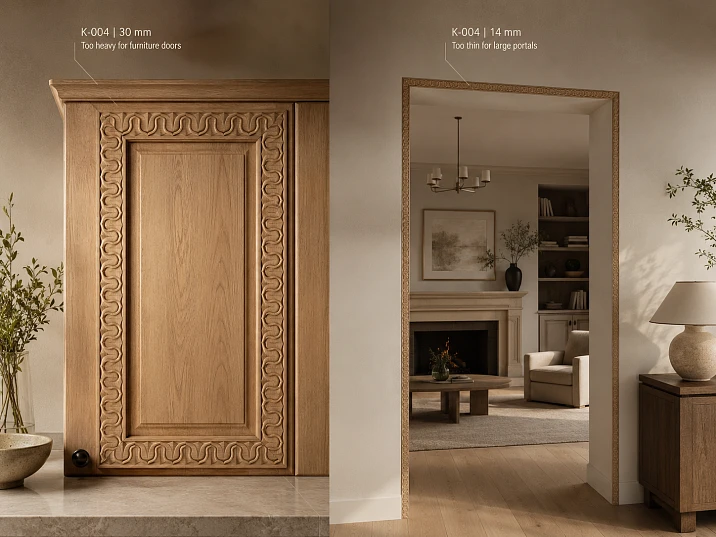
In the photo, three variants of the same ornament may seem almost identical. The carved pattern is readable, the wood looks expressive, the profile seems neat — and the buyer is already ready buy wooden baguette K-004. The error is discovered later, when the chosen strip ends up next to a real door, drawer, tall cabinet, or door portal. A cross-section of 30 × 19 mm, striking in a large frame, takes away too much free space from a small facade. The thin option of 14 × 7 mm, which looked delicate on a cabinet, almost disappears on a tall architectural composition.
K-004 has one recognizable ornament, "swamp leaf," but three scales. It is the scale, not just the beauty of the pattern, that determines the result. For a narrow drawer, one line strength is needed; for a standard cabinet door, another; for a wall panel or portal, a third. Therefore, the question "which K-004 to order" cannot be reduced to choosing between small, medium, and large. You need to compare the profile width, relief depth, free field dimensions, distance to the handle, furniture height, number of repeating frames, and the point from which a person will view the finished composition.
A practical route starts not with a large footage. The card provides a length of 300 mm — such a fragment is convenient to apply to the facade, look at it in daylight and side light, photograph it together with the handle, and only then calculate two-meter strips. The buyer does not try to guess the scale from the screen but makes a decision on a real surface. After the fitting, it becomes clearer whether to keep one size for the entire project or distribute 14, 22, and 30 mm across different levels of one composition.
This article helps choose a specific version of K-004, order a control fragment, calculate the footage, and prepare a specification without accidentally mixing sizes, materials, and preparation quality. General queries like "buy wooden molding" lead to a large catalog. Here the task is narrower: not to search for a baguette in general, but to precisely determine which scale of one ornament is needed for furniture or an interior.
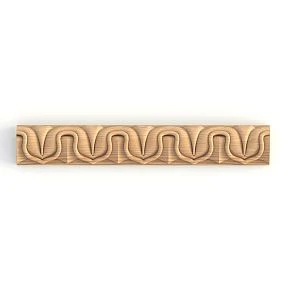
The photo shows the ornament but hides the scale
A large product shot conveys the shape of the leaf, the depth of the cut, and the character of the wood well. It answers the question of proportion worse. On screen, a profile 14 mm wide can take up almost as much space as a 30 mm variant: the camera has zoomed in on each sample, the background is neutral, and there is no door handle, panel, baseboard, or wall nearby. The brain fills in sizes based on familiar objects, but there are no familiar objects in the frame.




Why millimeters need to be transferred to a real surface
The difference between 14 and 30 mm is 16 mm. In isolation from furniture, the number seems small. On a facade 300 mm wide, two vertical sides of the frame take up 60 mm instead of 28 mm. The free field shrinks not by 16, but by 32 mm in width, because the profile is present on both sides. If the frame is closed, the same logic applies to height.
Let's take a conditional door 300 × 500 mm. With a K-004 frame 14 mm wide, the inner field without indentation will be approximately 272 × 472 mm. With a width of 30 mm, it will be about 240 × 440 mm. The area of the visible center changes noticeably. The handle, central overlay, or panel remain the same, but around them it becomes tighter. Therefore, the phrase "30 mm looks heavy" refers not to the baguette itself, but to its relation to a specific field.
On the portal, the opposite happens. A post more than two meters high, a wide opening, a large base, and an upper part require a line that reads from a distance. A narrow profile can be well cut and neatly painted, but its pattern will dissolve into the overall architecture. It will remain a thin shadow, whereas the project needs an independent decorative belt.
Our factory also produces:
Width and depth work together
K-004 differs not only in width. Sections 14 × 7, 22 × 14, and 30 × 19 mm change the protrusion above the surface. The 14 × 7 mm option creates a thin contour and a small shadow. The medium 22 × 14 mm is noticeably more separated from the facade. The large 30 × 19 mm forms a volume that is perceived almost as a separate architectural layer.
With frontal uniform light, the difference may seem calm. Side light enhances shadows. On a kitchen facade opposite a window or on a wall panel next to a sconce, a profile with a depth of 19 mm will look more active than in the catalog. This is not a drawback. Such relief is needed for large surfaces. But on a small door, an active shadow can compete with the handle and central decor.
Get Consultation
Viewing distance changes the decision
The facade of a cabinet is viewed from a distance of about one meter or closer. The 14 mm carving reads as a neat handcrafted detail. A tall cabinet or portal is seen from three to five meters. At such a distance, a fine contour is perceived more weakly. The choice of width should be checked not only while standing in front of the sample, but also by stepping back to where the item is usually seen in the room.
That is why a short fragment is more valuable than an enlarged photo. You can order a sample of wooden baguette, attach it to the surface and assess the scale without guessing. For K-004, a 300 mm format is available directly in the product card; it is suitable for such a check by length and allows you to see the real profile, material, and quality of preparation.
K-004 in numbers: what to record before choosing
Before design considerations, it is useful to gather facts into a single table. It does not replace the product card, because current options and prices need to be checked before ordering, but it protects against the main mistake — mixing sizes and finishes in one specification line.
| Parameter | Confirmed options | What this changes for the buyer |
|---|---|---|
| Article number | K-004 | Allows distinguishing the profile from other moldings with a similar floral pattern |
| Ornament | "Swamp leaf"; in the site filter — "Swampweed" | Provides the ability to select neighboring models of the same ornamental group |
| Section 1 | 14 × 7 mm | Thin contour for small fields, repeating frames, and delicate decor |
| Section 2 | 22 × 14 mm | Medium scale for wardrobe doors, dressers, nightstands, and furniture panels |
| Section 3 | 30 × 19 mm | Expressive profile for tall fronts, portals, wall panels, and large frames |
| Length | 300 or 2000 mm | 300 mm is convenient for preliminary fitting; 2000 mm for the main footage |
| Material | Beech or oak | Affects texture, visual character, and finishing solution |
| Sanding quality | "Standard" or "Prestige" | Determines the degree of preparation of the carved surface before painting or other finishing |
| Preparation | The card includes an option for enamel | Must be specified in the order along with material and surface quality |
| Standard packaging quantity | 14 × 7 mm — up to 100 pcs.; 22 × 14 mm — up to 35 pcs.; 30 × 19 mm — up to 30 pcs. | For large orders, it helps to discuss the number of packaging units and transportation in advance |
| Transportation | The card indicates the addition of a rigid packaging frame | Long carved moldings need to be considered not only by length, but also by packaging |
After the table, the main thing is clear: "K-004" is an insufficient entry for an order. A combination of at least five parameters is needed: cross-section, length, material, sanding quality, and preparation. The line "K-004, 10 pcs." leaves too much room for error. The line "K-004, 22 × 14 × 2000 mm, oak, "Prestige", selected preparation, 10 pcs." already allows the delivery to be checked against the project.
Three cross-sections — three roles of one ornament
It is impossible to declare one option universal for any furniture. The medium profile indeed covers more scenarios, but even it sometimes turns out to be too active for a number of small drawers or too calm for a large portal. It is more convenient to think not "which size is better", but "what role should the baguette play".
| Cross-section K-004 | Visual role | Where to check especially carefully | Main risk |
| 14 × 7 mm | Thin decorative line | Small doors, narrow drawers, frequent repeating frames | Get lost on a large flat surface or after painting in a color close to the background |
| 22 × 14 mm | Confident medium-scale framing | Cabinet doors, dressers, nightstands, large kitchen fronts | Become a compromise where the project needs a deliberately light or architecturally large line |
| 30 × 19 mm | Standalone decorative belt | Tall cabinets, libraries, portals, boiserie, wide panels | Reduce the free field of a small door and overload the proximity to the handle |
This table describes practical perception, not a strict manufacturer rule. A large profile can work on small furniture if the entire composition is built as a rich classical miniature. The thin K-004 can be appropriate on a portal as an internal second contour next to a larger external frame. The decision is determined by the whole system, not by a single number.
K-004 14 × 7 mm: when a thin line is stronger than a large relief
The narrowest option is useful where the decorative pattern should be visible but not take space away from the facade. The 14 mm width allows drawing a frame close to the edge, leaving enough field around the handle, and repeating one motif on several small elements.
Small furniture door
On the door of a cabinet or narrow cupboard, a large profile quickly takes up a significant portion of the area. K-004 14 × 7 mm maintains a sense of lightness. The floral pattern adds handcrafted detail, but the center of the facade remains free. This is especially useful when there is already a panel, decorative insert, or expressive handle in the middle.
Before ordering, not only the dimensions of the door are measured. Four distances are needed: from the edge of the facade to the intended frame, from the frame to the handle, the width of the inner field, and the distance between the frame and the central decor. If these zones become too cramped after layout, even a thin profile needs to be shifted or the additional overlay should be abandoned.
Narrow drawer
The height of the drawer can be small, while the width can be significant. A wide molding along the top and bottom edges visually compresses the facade. Thin K-004 leaves room for gripping the handle and does not turn the drawer into a dense ornamental strip. For a series of identical drawers, this is especially important: one profile is repeated many times, so its visual weight is multiplied by the quantity.
Frequent grid of frames
In a kitchen or library, there can be twenty or more facades. Even a calm profile, repeated twenty times, becomes an important motif. The 14 × 7 mm profile allows creating a common rhythm without the feeling that each facade is enclosed in a heavy frame. Here, thinness is not a drawback but a way to hold the system together.
Adjacency to a large overlay
If the central part of the door is decorated with a carved overlay, the molding should support it, not compete with it. A thin frame outlines the field and directs the eye inward. A large K-004 can create two equal accents: a strong contour and a strong center. Such a solution can be appropriate but requires more free area.
When 14 mm is not enough
On a facade two meters high, a thin ornament may only be readable from a close distance. After painting in the color of the door, the contrast will become even weaker, and on a large portal the line risks turning into a barely noticeable shadow. If the profile should form the architecture rather than just mark the edge, it is better to check 22 or 30 mm.
For a buyer who is not yet sure about the scale, it is reasonable to first order K-004 300 mm for a trial. A short piece is applied both to a small facade and to the largest plane of the project. The same sample quickly shows where the thin contour works and where it disappears.
K-004 22 × 14 mm: a medium size without the automatic label of "universal"
The 22 × 14 mm cross-section often comes first into the selection field. It is more noticeable than the thin version, but does not have the architectural massiveness of the 30 × 19 mm profile. On a standard wardrobe door, dresser, or nightstand, such a scale can provide a clear frame and retain enough free space.
Medium-sized wardrobe door
On a facade 450–600 mm wide, the 22 mm profile is already perceived as a deliberate frame. It does not just emphasize the edge, but creates a second layer of the surface. At the same time, the two vertical sides take up 44 mm, which usually leaves enough room for the center. The exact conclusion depends on the offsets and the handle, but visual balance is achieved more easily than with a width of 30 mm.
In the section where you can choose a carved baguette for a wardrobe based on ready-made ideas, it is useful to look not only at individual elements, but also at the density of the decor of the entire piece of furniture. If the wardrobe already has a cornice, plinth, pilasters, and overlays, the medium K-004 can become a connecting contour. On a calm smooth facade, it will itself become the main ornament.
Chest of drawers and bedside table
A dresser consists of several horizontal facades. The 22 mm profile gives a more confident pattern than the thin version, especially if the drawers are wide. But it is necessary to check the height of each drawer. On the upper small drawer, the medium baguette may feel cramped, while on the lower large ones it may be appropriate. One ornament allows different scales within the same piece of furniture: 14 mm on the upper drawers and 22 mm on the lower ones.
Large kitchen door
On the kitchen, the medium profile works well when the facades are large enough and the handles are not too massive. Side light from the window makes the 14 mm depth noticeable, so the pattern does not look flat. However, near the sink, stove, and work areas, the material, finish, and operating conditions must be coordinated in advance with the project technologist. Card K-004 confirms the solid wood product and preparation options, but does not replace the calculation for a specific kitchen or verification of the final finish.
Framing of a mirror or decorative insert
K-004 can be used as a decorative contour around the insert if the structure and mounting method are designed for the project. The medium scale helps separate the central plane from the body. Here, not only the external width is critical, but also the actual seating geometry. A carved baguette cannot automatically be considered a ready-made frame with a selected rabbet: before ordering, the drawing must be checked and the installation method of the profile determined.
Why 22 mm is sometimes not the best compromise
A compromise is good when the project truly needs a medium line strength. If the task is an almost invisible inner contour, 22 mm will be excessive. If the portal should look monumental, the medium version may seem cautious. It cannot be chosen just because it falls between two other numbers.
The solution is verified in scale. Attach a fragment, step back two to three meters, cover the adjacent decor with your hand, then uncover it and evaluate the system as a whole. The profile should either support the composition or consciously dominate. An uncertain "seems to fit" often means its role is not defined.
K-004 30 × 19 mm: a profile that requires space
The largest K-004 variant works not as a thin frame, but as an independent architectural detail. The 30 mm width and 19 mm depth create a pronounced shadow. The ornament is visible from a greater distance, and the line can connect a tall cabinet, door portal, or large wall panel.
Tall cabinet and library
Tall furniture has a vertical scale. A thin frame may seem random, especially if there is a developed cornice on top and a high plinth below. K-004 30 × 19 mm supports the weight of these elements. A belt appears on the facade that does not get lost among the large parts of the body.
But even a tall door can be narrow. Then the profile on two sides reduces the central field by 60 mm. Before purchasing, you need to draw the frame in real size or attach a sample. Height alone does not guarantee that a large section will fit.
Door portal
The portal is perceived as part of the room's architecture. Its width, height, bases, posts, and top finish create a large system. Here, K-004 30 mm can become a readable belt or internal framing. The thin version can also be used, but as a secondary line, not the main profile.
To find a suitable composition, it is useful to choose a baguette for furniture and interior doors among ready-made ideas. These pages do not replace the K-004 drawing, but they help to see how carved molding interacts with overlays, moldings, and large door surfaces.
Wall panel and boiserie
On the wall, the baguette is viewed from a distance. The surface can be several meters wide, and the frames can be taller than a person. The 30 × 19 mm section gives a shadow that holds the contour under frontal and side lighting. For such tasks, you can view and order a wooden baguette for a wall panel, having previously compared the scale with other boiserie elements.
The large K-004 does not necessarily have to be repeated on every small frame. It can frame the central panel, while secondary fields get 14 or 22 mm. One ornament maintains kinship, and different sections create hierarchy.
A wide console or a large headboard
On a long horizontal plane, a large profile helps hold the line. If the console has massive legs, carved aprons, or a developed tabletop, a 30-millimeter baguette looks proportionate. On a headboard, it can outline the central field. However, one must account for soft upholstery, radii, mounting, and base thickness — these parameters are not determined by a single baguette card.
Where a large profile becomes a mistake
On a door 250–350 mm wide, K-004 30 × 19 mm may leave too little calm center. Near a large handle, competition will arise. On a series of small facades, a repeating deep relief will create fragmentation. In a narrow corridor, side light will intensify shadows, making the furniture visually heavier.
Does this mean 30 mm is forbidden for small furniture? No. In a rich historical stylization, a large contour can be intentional. But the decision must be visible on the layout before ordering, not discovered after cutting two-meter planks.
One ornament in three scales: how to assemble a project without inconsistency
The buyer often thinks that a unified interior requires a single cross-section. In practice, unity is created not by the same width of each detail, but by a repeating language: ornament, material, finish character, and a clear hierarchy. K-004 offers a rare opportunity to change scale while preserving the "marsh leaf" pattern.
The "small — medium — large" scheme
In one cabinet or interior project, the profile can be distributed as follows:
-
14 × 7 mm — on small drawers and internal frames;
-
22 × 14 mm — on main cabinet and nightstand doors;
-
30 × 19 mm — on the portal, central panel, or large upper belt.
This distribution does not have to become a ready-made recipe. It shows the principle: the cross-section should match the scale of the surface. The ornament remains common, so the composition does not fall apart into three random decorations.
Why you cannot mix sizes without a scheme
If 14, 22, and 30 mm are distributed only based on leftover availability, the eye does not understand the hierarchy. On one identical door, a thin frame appears; on the neighboring one, a wide frame, although their functions are the same. This looks not like a well-thought-out gradation, but like a configuration error.
Before placing an order, a facade list is compiled. Each group receives its own rule. For example: all drawers up to 220 mm high — 14 × 7; all main doors — 22 × 14; portal — 30 × 19. The rule is recorded next to the quantity and length. The installer does not choose the size on site and does not change it for the sake of a convenient leftover.
One material or different materials
Mixing beech and oak in one ornamental contour without a separate design task is risky. Even after painting or tinting, the behavior of the texture may differ. If all elements should look like a unified system, the material is fixed for each visible group. When the project deliberately shows natural wood of different species, the solution is checked on samples and coordinated with the finisher.
One level of preparation
"Standard" and "Prestige" are not just two price lines. The depth of surface preparation differs. If two identically painted facades stand side by side, but the baguette is prepared differently, the finish may reveal uneven smoothness of the carving. Therefore, the quality of sanding should be assigned not randomly by items, but based on visibility and finishing requirements.
In the section about quality of wooden baguette preparation you can check how processing categories differ. For large relief that is viewed up close and painted with a thin layer, surface requirements are especially noticeable. For a project with opaque finish, the decision is still coordinated with the painter: the coating does not cancel the geometry of the carving.
First 300 mm, then 2000 mm: fitting that saves rework
The short K-004, 300 mm long, does not replace a full calculation and does not show all future joints. Its value lies elsewhere: it allows checking scale, depth, material, and proximity to real parts before ordering long strips.
Where to apply the sample
The profile should be checked not in hands and not on a table, but at the future installation point. For a furniture facade, the fragment is applied to the edge of the intended frame. For a portal, to the post at eye level and to the top part. For boiserie, to the center of one of the main panels and to the narrow gap between frames.
If the project includes multiple scales, one fragment of each section is applied to its own groups of surfaces. Comparing 14 and 30 mm side by side on one small facade is useful but not sufficient. The large version needs to be seen where it is actually planned.
Checking next to the handle
A furniture handle has its own visual weight. A calm field should remain between it and the frame. Apply the baguette, then temporarily secure or mark the handle with painter's tape. See if the two accents do not merge into a dense knot. Sometimes the problem is solved not by changing K-004, but by changing the handle position. Sometimes the handle is already set by holes, and then the frame width has to be changed.
Checking under different lighting
Frontal light smooths the relief. Side light emphasizes every cut. Take photos in the morning, in the evening, and with artificial light on. For 30 × 19 mm, the side angle is especially important: the 19 mm depth creates an expressive shadow. For 14 × 7 mm, make sure the pattern does not disappear after painting in the facade color.
Checking from a distance
Step back to the usual viewing distance. A small cabinet is evaluated from about one to two meters, a tall cabinet from the opposite side of the room, a portal from the hallway or adjacent room. If the ornament is only readable up close, but the project requires a noticeable architectural line, the profile is too small.
Check in a photo of the entire composition
A close-up leans toward finer details: they look elegant. A wide shot shows whether they get lost. Shoot the entire wall, not just the sample. A black-and-white version of the photo helps evaluate light and shadow and visual weight without the influence of wood color.
What to record after the fitting
The result should not remain the phrase "liked the middle one." In the log, record:
-
article K-004;
-
cross-section 14 × 7, 22 × 14, or 30 × 19 mm;
-
length 300 mm for control fragments or 2000 mm for the main order;
-
material — beech or oak;
-
sanding quality — "Standard" or "Prestige";
-
preparation for the selected finish;
-
position purpose: boxes, doors, portal, wall panel;
-
Quantity.
After the sample is approved, you can view the price of K-004 and order the desired version. The price depends on the selected combination, so comparing it without section, length, material, and surface quality is meaningless.
Beech or oak: the material is chosen together with the future finish
The K-004 card offers beech and oak. The choice cannot be reduced to a general rule of "beech for paint, oak for transparent coating." This route is often logical, but the final decision depends on the project, the desired texture, neighboring furniture, and the finishing technology.
Beech for a calm surface
Beech is often chosen when a more even visual background is needed and the carved ornament should play the main role. Under an opaque enamel, the material allows the composition to be built on form and shadow. However, the very possibility of an enamel option does not mean that the profile can be painted without preparation. The selected sanding quality, primer, compatibility of the coating system, and the finisher's recommendations must be taken into account.
Oak for a pronounced wood theme
Oak is appropriate when the natural texture should participate in the image. On a tinted or transparent surface, the fibers add a second pattern to the carving. For the large K-004 30 × 19 mm, this can enhance the architectural feel. On a small door, the combination of active texture and large relief can sometimes become excessive, so the sample is checked especially carefully.
The material must match the adjacent parts
If K-004 continues a wooden cornice, trim, plinth, or handle, it is advisable to agree on the wood species and finish in advance. Even an identically named shade can be perceived differently on different materials. When the entire set is painted with an opaque enamel, the difference in texture becomes weaker, but issues of adhesion, preparation, and substrate stability remain technological, not just design-related.
Why you cannot choose a wood species based on a small picture
Screen color, photo lighting, and monitor settings do not convey real wood. It is better to compare beech and oak on a physical fragment in the future room. If a natural finish is needed, the sample is finished with the same system as the entire order. Unprocessed wood and a finished surface can look completely different.
"Standard" or "Prestige": where surface quality becomes noticeable
On the STAVROS page, "Standard" is described as milling and machine sanding, while "Prestige" is described as machine and detailed hand sanding, including hard-to-reach areas. For a carved profile, the difference is important: the ornament consists of recesses, transitions, and small areas where grain and processing marks are more noticeable after coating application.
When "Standard" is justified
This option may suit a project that includes a professional cycle of further preparation, dense opaque finishing, and the possibility of local touch-ups before painting. It can also be rational for less visible areas viewed from a distance. But the decision is not made only by the purchaser. The finisher must assess the scope of work, because a more affordable option may require additional preparation time.
When "Prestige" reduces risk
If the molding is installed on expensive furniture, viewed up close, coated with a thin layer, or left with visible texture, more thorough preparation reduces the amount of manual touch-up on site. This is especially relevant for 14 × 7 mm: small carving requires precision, and rough additional sanding can soften the pattern. For 30 × 19 mm, the deep relief areas are important, where the finish collects shadow.
Why quality cannot be mixed in one frame
If one side of the frame is made to the "Standard" and the other to "Prestige", after finishing the difference may show in light reflection and the cleanliness of fine relief. Even when the installer can refine the surface, this creates an unpredictable amount of manual work. For one visible group, it is better to order a single quality.
Under enamel is a preparation characteristic, not a finished color
The phrase "under enamel" does not mean that K-004 will arrive painted in the chosen color. It refers to the preparation of the blank. The finishing system, color, gloss level, and application technology must be agreed separately. In the order, you cannot write just "white K-004" if the card does not confirm a finished painted version.
Where each K-004 size works more convincingly
The same profile changes depending on the surface. Below is not a list of "allowed/forbidden", but a check map.
Furniture door
For a small door, they often start with 14 × 7 mm. For a standard one, with 22 × 14 mm. For a tall and wide one, they compare 22 and 30 mm. Most important is the inner field after installing the frame, the handle position, and repetition on adjacent fronts.
In the selection, you can view molding for furniture doors and order a suitable scale, based on the density of decor in ready-made solutions. Do not copy someone else's layout without recalculating: the proportions of your door may differ.
Wardrobe
The wardrobe combines doors, cornice, plinth, and side elements. The medium K-004 often becomes the main door profile, the thin one — the inner contour, the large one — part of the portal or upper belt. If the wardrobe is built up to the ceiling, the profile is evaluated together with the wall architecture, not just the facade.
Chest of drawers
On a dresser, the horizontal rhythm is important. Several drawers create many parallel lines. A large baguette on each facade can make the furniture fragmented. It is reasonable to check the thin version or combine 14 mm on drawers with 22 mm on doors of side sections.
Kitchen
A kitchen set consists of many facades of different sizes. One K-004 on all surfaces does not always give a uniform result. Upper small doors, wide lower drawers, tall cabinets, and an island require separate layouts. The ornament can be kept common, changing the cross-section by groups.
Interior door
A door leaf is larger than a furniture door and is viewed from a distance. A cross-section of 22 or 30 mm usually needs to be checked first, but the result depends on the width of the leaf, trims, central overlays, and the number of frames. If the door has several small panels, a thin K-004 can work as an inner contour.
Portal
A portal requires connection with posts, bases, and the top finish. A large profile can become the main belt. A thin one — a secondary line. The cross-section is chosen after building the facade view of the entire opening, otherwise the baguette will either be weak or start to argue with capitals and carved elements.
Wall panel
For boiserie, the room height, panel size, frame frequency, and lighting are key. On a large central panel, 30 × 19 mm is appropriate, on a repeating grid — 14 or 22 mm. If frames are closely spaced, a depth of 19 mm creates dense shadows and requires more distance between contours.
Console and bed
On a console, the profile can run along the apron or drawer front. On a bed — along the headboard or footboard. Here, the shape of the base and construction are more important than a general recommendation. K-004 should not cover fasteners, interfere with soft upholstery, or extend beyond the radius of the part. A drawing is needed before ordering.
Baguette for furniture and baguette for pictures: the same word, different tasks
A customer enters the query "buy wooden baguette" and sees frames, interior moldings, profiles for furniture, and decorative slats. This does not mean that any baguette can be equally installed around a picture and on a wardrobe facade.
In the material about, how a furniture baguette differs from a picture frame baguette, it is useful to compare the purpose, profile, and method of application. For a picture, the seating rabbet for the image, glass, and backing may be critical. In furniture decor, K-004 works as an applied carved contour. One should not attribute constructive functions of a frame profile to it without checking the drawing.
How not to confuse K-004 with a regular molding
Molding is often used as linear decor on a wall or facade. K-004 is a carved trim with a specific ornament and three cross-sections. In a closed frame, it is perceived as a baguette, but it can also be used linearly. The choice is determined not by the section name, but by the pattern, cross-section, length, and installation method.
How not to confuse size A and depth C
In the card, dimensions are given as A × C × L. For K-004, A is the width of the front part, C is the depth, and L is the length. A buyer sometimes perceives the entry 30 × 19 as two width options. This is one cross-section: 30 mm in width and 19 mm in depth. An error changes the entire calculation of the protrusion above the facade.
How not to confuse 300 mm with the main order length
The short format is convenient for fitting and small areas, but the main long position is 2000 mm. One cannot calculate a large portal based on the assumption that all parts will be assembled from 300-millimeter fragments, unless the project involves many joints. After approving the scale, proceed to the cutting map of two-meter strips.
How to calculate K-004 with a length of 2000 mm without excess footage and random joints
After selecting the profile, the second part of the purchase begins — calculation. You cannot simply add up the perimeters of all frames and divide the result by two meters. The total in linear meters may seem sufficient, but the actual pieces will not distribute across the parts. The reason is the same as with baseboards: each side of the frame has its own length, corners require cutting, and the remainder from one piece does not always fit another.
First, a parts map is created
For each frame, the outer or installation length of the four sides is recorded according to the chosen scheme. You cannot mix the facade dimension and the baguette cut length in one table. If the frame is set back 50 mm from the edge, its dimensions are smaller than the facade. If the joint is made at an angle, the technologist determines which line to measure each workpiece along.
Example of a statement:
| Element | Quantity | Top/bottom, mm | Side pieces, mm | Cross-section K-004 | Material |
| Upper drawer | 2 | 420 | 140 | 14 × 7 mm | Beech |
| Main door | 4 | 480 | 760 | 22 × 14 mm | Beech |
| Central panel | 1 | 1100 | 1900 | 30 × 19 mm | Beech |
This table shows why the total length is insufficient. For the central panel, the side piece of 1900 mm almost fully uses one two-meter plank. The remainder of about 100 mm will not cover any significant side. The top piece of 1100 mm leaves 900 mm, which can be used on another part only if the profile, material, quality, grain direction, and joint requirements match.
The total length formula is only the first check
For a rectangular frame, the base perimeter is:
P = 2 × (W + H),
where W is the length of the horizontal side, H is the length of the vertical side.
For a series of identical frames:
Ptotal = N × 2 × (W + H),
where N is the number of frames.
This formula shows the volume of material without cutting. Then each side is distributed across planks 2000 mm long. Only after layout does the number of pieces become clear.
Example calculation for four doors
Suppose each door requires two horizontal pieces of 480 mm and two vertical pieces of 760 mm. For four doors, you need:
-
8 pieces of 480 mm;
-
8 pieces of 760 mm.
The total length is 9.92 m
Different cross-sections are calculated separately
It is not possible to add the footage of K-004 14 × 7 and 30 × 19 mm into a single number, even if the ornament is the same. The remainder of a thin strip does not replace a large profile. Separate calculation lines are needed for each combination:
-
cross-section;
-
material;
-
sanding quality;
-
preparation;
-
length.
If the project includes 14 mm on drawers, 22 mm on doors, and 30 mm on the portal, three independent cutting maps are formed. The same rule applies when separating beech and oak.
Corners and pattern
A corner joint requires precise cutting. Before serial cutting, it is reasonable to make a test corner on control pieces and check how the ornament aligns. K-004 has a repeating floral pattern, so the position of the motif on adjacent parts affects the neatness of the frame. It is impossible to promise a complete pattern match without preliminary layout and evaluation of specific strips.
Short remnants
The remainder can be transferred to a small door, drawer, or inner part of the composition if the length is sufficient after end processing. It cannot be automatically inserted into the center of a visible long side. An additional joint may be more noticeable than the material savings. The cutting priority is as follows: first, solid visible sides, then short elements, then hidden or less visible areas.
When an additional strip is more advantageous
Sometimes an additional two-meter strip reduces the number of joints, provides a reserve for a test cut, and allows selecting better wood sections for visible sides. This is not "extra footage" if it protects the project from inserting a short piece in the center of the portal. The decision is made based on the cutting map, not on the desire to get a minimal arithmetic number.
What to order together with K-004 so that the profile does not remain a separate purchase
A baguette rarely completes a project on its own. Samples, materials for installation and finishing, an agreed storage scheme, and sometimes additional carved elements from the same ornamental group are needed. You don't need to buy everything. An accompanying item is justified only when it solves a specific task.
| What to add to the order | Why is this needed | Commercial route | What to check |
| Fragment K-004, 300 mm long | Check the scale of 14, 22, or 30 mm on a real surface | Order K-004 for fitting | Cross-section, material, sanding quality, and future finishing |
| Wooden baguette samples | Compare several profiles or materials before the batch | Buy wooden baguette samples | The length of the sample and its correspondence to the required card |
| Molding with the "Bolotnik" ornament | Select adjacent profiles of the same ornamental group | Select and buy a baguette with the "Bolotnik" ornament | Do not mix similar ornament with another article without comparing cross-sections |
| Materials for installation and finishing | Assemble a technological kit for the base and finish | Choose and order materials for installation and finishing | Compatibility of adhesive and coating with the base, wood, and project conditions |
| Door solutions | See the density of carved decor on large panels | View and select a baguette for doors | Door size, number of frames, adjacent overlays and trims |
| Solutions for cabinets | Compare K-004 with cornice, plinth, and facades | Select a carved baguette for the cabinet | Scale of each facade group and handle placement |
| Solutions for boiserie | Check the profile on a large wall surface | View and order baguette for boiserie | Room height, frame spacing, lighting, and relief depth |
The table does not mean that all items must be purchased together with K-004. For a simple cabinet, a control fragment and agreed mounting materials may suffice. For a portal or panel wall, a project, cutting plan, and several related decor groups will be needed.
Packaging, receiving, and storage: a two-meter carved profile requires discipline
The K-004 card specifies the addition of a rigid packaging frame for safe transportation. This is not a decorative option, but part of the logistics for long carved moldings. A 2000 mm long strip is sensitive to end impact, bending, and improper storage.
Configuration standards depend on the cross-section
For 14 × 7 mm, the card indicates a norm of up to 100 pcs., for 22 × 14 mm — up to 35 pcs., for 30 × 19 mm — up to 30 pcs. For a large batch, you need to clarify in advance how many packaging units will result, how they will be labeled, and how the variants will be separated. Thin profile cannot be accepted under the same scheme as large: the number of slats in a group differs.
What to check upon receipt
Do not start by unpacking the entire batch and immediately cutting. First, compare the documents and labeling:
-
article K-004;
-
cross-section;
-
length;
-
material;
-
sanding quality;
-
preparation;
-
quantity;
-
integrity of the packaging.
Then inspect the ends, front ornament, and geometry of several slats from each group. If the order has three cross-sections, they are laid out separately and labeled by purpose. A similar pattern should not lead to the installer taking 22 mm instead of 14 mm.
Why you cannot immediately discard the labeling
Until the project is completed, packaging designations and the specification are kept. If a shortage is found or an additional item is needed, an accurate record will help repeat the execution. The phrase "the same baguette, just medium" is not suitable for a reorder.
Storage before installation
Wood is sensitive to environmental conditions. On the STAVROS page, you can check storage rules for wooden decor. Slats are not left near heating appliances, in a damp area, or under direct sunlight. They are stored with support that prevents sagging and point loads. Site conditions must be agreed upon before opening the packaging and finishing.
Acclimatization and technological sequence
The duration and method of conditioning depend on site conditions and recommendations from the manufacturer or technologist. You cannot invent a universal number of days. What matters is this: do not move cold or damp material directly to painting and installation without assessing its condition. The finisher checks the wood and substrate, then approves the sequence of work.
Mistakes that make beautiful K-004 look random
Choose the size based on a large photo
The frame shows the pattern but not the proportion. The fix is simple: order 300 mm, hold it against the surface, and take a full shot.
Treating 22 mm as universal for everything
An average cross-section does not have to work equally well on a small box and a large portal. Divide the surfaces into groups and check each one.
Placing 30 mm next to a massive handle without a gap
Two large accents create a tight cluster. You need to measure the free field, not hope that the parts will 'settle down' after painting.
Using 14 mm as the main belt of a large portal
A thin profile can get lost with distance. On the portal, it is better to check it as an inner contour or compare it with 22 and 30 mm.
Mix beech and oak in one visible frame
After finishing, material differences may show in texture and tone. One frame must have a consistent finish unless mixing is intended deliberately.
Mix "Standard" and "Prestige"
Different preparation creates uneven finishing volume and may show after painting. Order a visible group in one quality.
Order only total linear footage
Linear meters do not guarantee cutting layout. A parts map and 2000 mm strips are needed.
Do not account for the saw kerf and test corner
A layout that fills the strip to the last millimeter is usually not feasible. Leave a technological reserve per the master's calculation.
Place a short leftover in the center of the visible side
Saving one strip can add a noticeable joint. First preserve solid main sides, then use leftovers on short sections.
Order 300-millimeter pieces instead of long lengths
Short format is useful for fitting and small details, but a large frame made of many fragments will have extra joints. The main footage is calculated in 2000 mm planks.
Not fixing the full specification
An article without cross-section, length, material, and preparation quality is insufficient. Before payment, each line must be unambiguous.
Starting finishing without a test assembly
Color can hide or enhance the relief, but after painting it's too late to change the scale. First, check the dry layout, corners, and adjacency of parts.
Who K-004 suits, and who should choose a different profile
K-004 is worth considering
The profile suits a buyer who likes the plant ornament "swamp leaf" and needs one decorative language for surfaces of different scales. It is useful for a project with small drawers, standard doors, and a large portal, because three cross-sections allow preserving the pattern and changing visual strength.
K-004 is also convenient for those who want to physically verify the choice: the 300 mm length allows fitting before the main order. Beech and oak, "Standard" and "Prestige" expand the choice by material and preparation.
Better to look for another option
If the project requires a smooth geometric line without a floral pattern, K-004 should not be chosen solely because of the suitable size. A different profile is needed. If the design requires a special seating quarter, radius execution, or confirmed outdoor use, the applicability must be checked separately; the K-004 card does not provide a basis for automatically promising these properties.
Another baguette is also needed when none of the three sections matches the proportions of the surface. You cannot force 14 mm to work where a profile of about 40–50 mm is needed, just to preserve the ornament. In the category, you can select and buy wooden baguette by the meter among other models.
How to place an order for K-004 without ambiguity
The commercial route consists not of a single click, but of several checks. First, the intended section is selected. Then a short 300 mm fragment is ordered or used. After fitting, the material, preparation quality, and finish are approved. Only then is a cutting map for two-meter planks compiled.
Correct order line
The wording should look approximately like this:
K-004, 22 × 14 × 2000 mm, oak, "Prestige", selected preparation, 12 pcs., purpose — main cabinet doors.
For another group, a separate line is created:
K-004, 14 × 7 × 2000 mm, oak, "Prestige", selected preparation, 6 pcs., purpose — boxes.
This way, the manager, picker, finisher, and installer see one system. You cannot combine items with the phrase "18 K-004 planks total."
What to check before payment
-
Whether the article number matches.
-
Whether the cross-section of each item is specified.
-
Whether lengths 300 and 2000 mm are not mixed up.
-
Whether the material is recorded.
-
Whether the sanding quality is selected.
-
Whether the preparation is clarified.
-
Does the quantity match the cutting layout?
-
Are control fragments taken into account?
-
Is the packaging of long lengths clear?
-
Is the final specification preserved?
After this check, you can buy K-004 in the selected size or coordinate the order with a STAVROS manager. Current price, availability, and ordering terms are reviewed directly in the product card and section payment and delivery.
FAQ: questions before purchasing wooden baguette K-004
Can one size of K-004 be used on all furniture?
Yes, if the surfaces are similar in scale and a test fitting confirms the proportion. For a project with small drawers, tall doors, and a large portal, one size may look uneven, so it is better to compare several profiles.
Which K-004 should I choose for a small door?
First, check 14 × 7 mm. It preserves more free space. But the decision depends on the door size, handle, offsets, and central decor.
Will K-004 22 × 14 mm fit for a cabinet?
It often fits medium-sized doors, but there is no universal guarantee. Attach a fragment to the facade, evaluate the inner field, and look at the cabinet from a normal distance.
When is K-004 30 × 19 mm needed?
When the profile should read as an independent architectural band: on a tall cabinet, portal, large panel, or boiserie. On a small door, it may be too heavy.
Why buy a length of 300 mm?
To check the real scale, depth, material, and surface quality before ordering a batch. This is especially useful when the photo does not allow choosing between 14, 22, and 30 mm.
Can a large frame be assembled only from 300 mm fragments?
The technical solution should be determined by the designer, but many short pieces will create extra joints. For the main footage, the card offers a length of 2000 mm, which is used in the cutting map.
How to calculate the number of two-meter planks?
First, make a list of all sides of each frame, then distribute the segments among 2000 mm planks, taking into account cuts, ends, and test connections. Simply dividing the total perimeter by two is not enough.
Is a reserve needed?
A technological reserve is needed, but its size cannot be set the same for all projects. It depends on the cutting map, the number of corners, the width of the cut, pattern selection, and the possibility of using leftovers.
Should I choose beech or oak for enamel?
Both materials are available in the card, and the final decision depends on the finishing technology and neighboring elements. Under a covering enamel, a calmer base is often chosen, but the choice should be coordinated with the finisher.
How does "Standard" differ from "Prestige"?
The depth of surface preparation differs. "Prestige" includes more detailed manual sanding. For close viewing and a thin finish, this can reduce the amount of finishing work.
Will K-004 arrive already painted?
The card confirms preparation options, including for enamel, but this does not automatically mean a ready color. The final painting, tone, and gloss level need to be clarified separately.
Can 14, 22, and 30 mm be combined in one project?
Yes, if each scale is assigned a clear role. For example, a thin profile for drawers, a medium one for doors, and a large one for the portal. It is better to keep the material and finish consistent.
How not to mix up sizes upon receipt?
Check the marking and measure the cross-section before cutting. Sort the three sizes into separate groups and label the purpose of each batch.
Is K-004 suitable for a wall panel?
It may be suitable as a decorative contour, especially in sections 22 × 14 and 30 × 19 mm. It is necessary to check the panel size, frame spacing, base, and installation method.
Can K-004 be installed on an already painted facade?
The possibility depends on the coating, base, adhesive system, and preparatory work. A universal answer cannot be given without assessing the surface. Coordinate the installation with a technologist.
How is K-004 different from a picture frame molding?
K-004 is a carved molding for decorative use. The structural properties of the profile for frames, including the seating of glass or backing, need to be checked separately. The name "baguette" does not make all models interchangeable.
Where can I see other models with a similar ornament?
In the filter, you can select a baguette with the "Bolotnik" ornament. Compare not only the pattern, but also the cross-section, length, and available finishes.
What to do if 14 mm is too little, and 22 mm is already too much?
First, change the frame offset and evaluate the profile after the intended painting. If the proportion still doesn't work, it's better to choose a different model rather than force K-004 to work against the scale of the facade.
How to choose K-004 for a portal?
Build a facade view of the entire opening, including posts, bases, and the top finish. Compare 22 and 30 mm from the viewing distance. The thin 14 mm can be checked as an additional inner contour.
What to send to the STAVROS manager for an accurate calculation?
You need surface dimensions, frame layouts, the number of identical facades, selected profiles, material, preparation quality, intended finish, and notes where joints are undesirable. The more accurate the initial data, the more useful the specification check.
K-004 is chosen not by the size of the pattern, but by its role in the project
The three versions of K-004 do not compete for the title of "the most correct one." The 14 × 7 mm profile creates a thin contour and preserves the free field of a small facade. The 22 × 14 mm size provides a confident framing for medium-scale furniture. The 30 × 19 mm profile becomes an independent architectural line on a tall cabinet, portal, or wall panel.
Before purchasing, you need to check four things: the scale on the actual surface, the proximity to the handle and other decor, the future finishing, and the cutting of strips 2000 mm long. A 300 mm fragment turns the choice from a guess into a fitting. The full specification protects against mixing sections, materials, and sanding quality.
The STAVROS company allows you to go through this route within a single product system: order wooden baguette K-004, compare other profiles in the category, select solutions for doors, cabinets, and boiserie, and also supplement the order with materials for installation and finishing. The main thing is to buy not an abstract footage of a beautiful ornament, but a precisely selected scale calculated for a specific door, furniture, or portal.