Article Contents:
- Minimal Ornament for Modern Interiors: Less is More
- Philosophy of Restraint
- Geometry Instead of Vegetation
- Profile Matters
- Scale and proportions
- Rhythm of Decor Placement
- White Palette and Tones: Monochrome Symphony
- Basic Shades of White
- Tone Play
- Textures as Part of Color
- Lighting and Perception of White
- Combination with Accent Colors
- Light Points and Polyurethane Outlets: Function and Decoration
- Outlet Typology
- Size and Scale
- Ornament: From Baroque to Minimal
- Installation and Integration of Lighting
- Outlets Without Chandeliers
- Multiple Outlets
- Wall Frames vs. Smooth Walls: Philosophy of Choice
- Arguments for Smooth Walls
- Arguments for Wall Frames
- Types of Wall Compositions
- Wall Moldings: Choosing the Profile
- Color Solution for Frames
- Filling Frames
- Care Practice: Maintaining Whiteness and Freshness
- Care for Polyurethane Moldings
- Caring for wooden skirting boards
- Prevention of Yellowing
- Dust Control
- Care Features in Different Rooms
- Professional Cleaning
- Combinations and Variations: Expanding the Range of Possibilities
- Adding Wall Moldings
- Pilasters and Half Columns
- Curtain Cornices
- Consoles and Brackets
- Color Inserts
- Stylistic Variations of Soft Classic
- French Soft Classic
- Scandinavian Soft Classic
- English Soft Classic
- American Soft Classic
- Seasonal Changes and Interior Adaptation
- Summer Freshness
- Autumn Warmth
- Winter Luxury
- Spring Refreshment
- FAQ: Answers to Popular Questions
- Conclusion: The Eternal Relevance of Classic
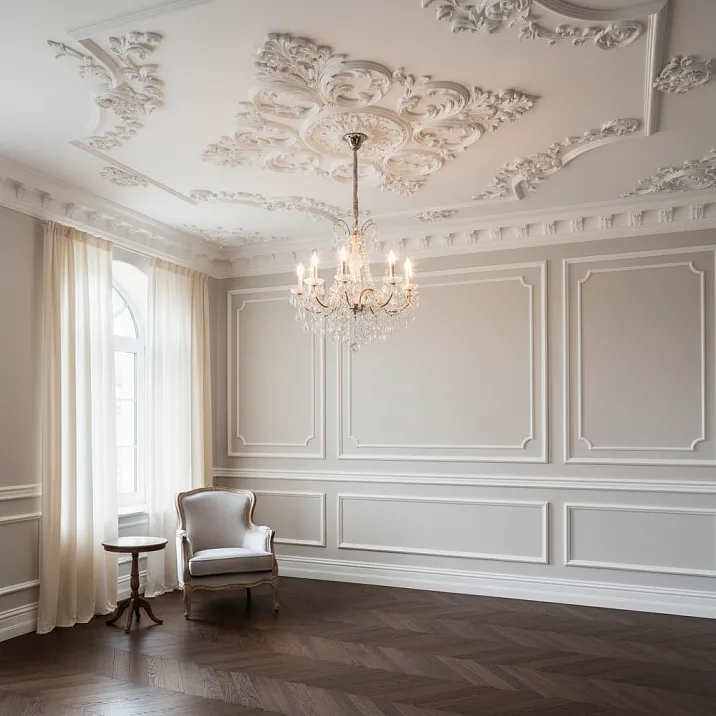
The classic interior is experiencing a renaissance, but in a new, lighter format. Forget heavy baroque excesses, golden scrolls, and pompous Empire. Modern interpretation of classicism is about elegance whispered, nobility without shouting, sophistication that doesn't announce itself at the door. This is what professionals call "soft classic" — a style where historical decorative elements exist in minimalist packaging.
At the heart of this aesthetic are two key elements:Ceiling moldingandwhite wooden skirting board. It seems like a simple combination. But precisely in this apparent simplicity lies a complex architectural philosophy, where every detail matters, every millimeter of relief is thought out, and every shade of white is calibrated with the precision of a clockwork mechanism.
Why exactly these two elements? Because they create a vertical frame for the space. Ceiling molding marks the upper boundary of the wall, skirting board — the lower. Between them — a clean field for interpretation, for color, for life. This frame does not press or restrict, but rather structures the space, making it complete and visually clear.


Minimal Ornament for Modern Interiors: Less is More
Ornament in a modern interior — a delicate topic. Too much — and the room becomes a museum exhibit, where it’s uncomfortable to live. Too little — and the very "soul" of the space, provided by historical continuity, is lost. The golden middle — minimal ornament, where decorative elements are present point by point, creating accents but not overwhelming visual perception.




Philosophy of Restraint
Soft classic rejects the principle "the more, the better". Here, another logic applies: one elegant cornice is worth ten mediocre ones. One perfectly matched ceiling rose is more valuable than a scattering of small ornaments. This is the collector’s approach, preferring one Rembrandt painting over an entire gallery of reproductions.
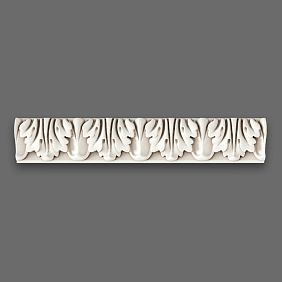
Ceiling moldingIn the concept of minimal ornament, it plays the role of a punctuation mark in an architectural sentence. It does not shout over the space, but delicately organizes it. A slender cornice 80-120 mm wide with barely noticeable relief, a rose 400-500 mm in diameter with classic but not overloaded ornament, angular elements of simple geometric forms — this is the toolkit of modern soft classic.
Our factory also produces:


Geometry Instead of Vegetation
Traditional classical molding is rich with vegetal motifs: acanthus, grapevines, roses, laurel wreaths. Minimal ornament prefers geometry. Straight lines, circles, ovals, rhombuses, strict meanders — these elements read as classical, but do not look outdated.
Geometric ornament has an important advantage: it is universal. Plant motifs are easily perceived as "antique," whereas geometry is eternal. A Greek meander is equally suitable for an ancient portico and a modern living room. A circular rosette with radial rays works both in a palace hall and in a minimalist bedroom.
Get Consultation
Profile matters
Consider ceiling height, room size, interior style, and functionality.ceiling moldingsThe profile of an element is critically important. In soft classicism, preference is given to smooth, flowing forms without sharp transitions or deep cuts. The relief should be expressive but not dramatic — 15–25 mm for cornices, 10–15 mm for moldings.
A classic cornice profile includes several elements: a straight plank (the shelf), a concave part (the ogee), a convex part (the ovolo), and a lower support (the foot). In a minimalist version, these elements are present but simplified, lightened, and devoid of excessive ornamentation.
Scale and proportions
Modern apartments rarely boast palace-like ceiling heights. Standard 2.7–3 meters — this is reality, with which one must work. Heavy moldings are inappropriate here — they visually "consume" precious centimeters of height, making the ceiling feel oppressive.
For standard ceilings, cornices 60–100 mm high are optimal. They are expressive enough to structure the space, yet not so heavy as to overwhelm it. For high ceilings (from 3.2 m), larger elements — up to 150–200 mm — can be used, but even here, moderation is key.
Important rule: the width of the cornice should not exceed 1/20 of the room’s height. For a 2.7 m ceiling, this is a maximum of 135 mm. For a 3 m ceiling — 150 mm. This is not a rigid standard, but a guideline to avoid disproportionate proportions.
Rhythm of decorative placement
In minimalist ornamentation, not only the shape of individual elements matters, but also the logic of their placement. A ceiling rosette should not hang randomly in the middle of the ceiling — it should be anchored to a function (light fixture, chandelier) or to the compositional center of the room. Corner elements emphasize the room’s geometry, but do not overload every corner.
Rule of good taste: one central accent is better than many small ones. If a luxurious rosette is placed under a chandelier in the living room, the rest of the ceiling can be simply framed by a cornice along the perimeter. If the cornice has a complex ornamental profile, the center of the ceiling remains clean.
White palette and half-tones: symphony in monochrome
White is not merely the absence of color, but a full palette with many shades. From cool Arctic white with a blue undertone to warm cream with a slight yellow tint — the range is vast. In the concept of soft classicism, understanding these nuances is critically important.
Basic shades of white
Pure white (cold white) — the brightest, with a slight blue undertone. Creates a feeling of freshness, purity, and modernity. Suitable for well-lit rooms facing south. In northern rooms, it may appear cold and unwelcoming.
Antique white — with a warm cream undertone. Creates a soft, cozy atmosphere. Ideal for classic interiors where historical authenticity is needed. Works well in rooms with warm artificial lighting.
Ivory — white with a slight yellow tint. Elegant and noble, softens contrasts. Excellent choice for bedrooms and living rooms where a calm atmosphere is important.
Snow white — dense, matte white without undertones. A neutral option that works in most situations. Does not conflict with other colors, creating a universal background.
Play of half-tones
The secret of an exquisite monochrome interior — variation in shades and textures of white.White Wooden BaseboardWalls may be half a tone warmer than the ceiling cornice. Walls are one tone lighter than decorative elements. This play of half-tones creates depth and volume without breaking monochrome harmony.
Imagine: ceiling molding painted in pure white (cold white), walls in antique white, wooden skirting board covered with white enamel with a slight cream tint. Three different whites, yet they do not conflict, but create a subtle gradation that makes the space lively and interesting.
Texture as part of color
White on a smooth glossy surface is perceived differently than white on a matte textured surface. Polyurethane molding usually has a smooth, slightly glossy surface after painting. Wooden skirting, even painted white, retains a light wood texture unless deeply sanded and filled.
This difference in texture adds richness to perception. Light reflects differently from various surfaces, creating a complex interplay of highlights and shadows. Glossy molding is brighter and more active, while matte skirting is calmer and more noble.
Lighting and perception of white
The color white critically depends on lighting. Under cool daylight, warm white tones appear yellowish; under warm evening light, cool whites appear gray. This must be considered when choosing shades.
The optimal strategy — test colors under different lighting. Paint test patches and observe them throughout the day: in the morning under natural light, during the day under bright sunlight, and in the evening under artificial lighting. What looks perfect in a store under fluorescent lamps may disappoint under real conditions.
Combination with accent colors
White base — ideal background for color accents. Soft classicism allows introducing color, but sparingly. Favorite combinations: white + gray-blue, white + dusty rose, white + gray-green, white + warm gray (taupe).
Color accents are introduced through textiles, furniture, and decor, but not through architectural elements. Moldings and skirting boards remain white — this is an unbreakable rule of soft classicism. They create a neutral frame within which one can experiment with color.
Ceiling rose - one of the oldest elements of architectural decoration. In classical interiors, it served a dual function: concealing the point where a chandelier chain exits and acting as a decorative accent on the ceiling. In modern soft classicism, these functions are preserved but acquire a new interpretation.
Ceiling rose - one of the oldest elements of architectural decoration. In classical interiors, it served a dual function: concealing the point where a chandelier chain exits and acting as a decorative accent on the ceiling. In modern soft classicism, these functions are preserved but acquire a new interpretation.
Rose types
Ceiling molding decorationPresented in a variety of rose forms:
Round roses - the classic of the genre. Diameter from 300 to 800 mm. Ornament can be radial (rays from the center), concentric (circular bands), or mixed. Suitable for most interiors, universally styled.
Oval roses - a more refined option. Ideal for elongated rooms where a circle would appear disproportionate. Length from 400 to 1000 mm, width 20-30% less.
Square and rectangular coffered panels - geometrically strict forms for modern classicism. They create a clear structure, emphasizing the architectural composition of the space.
Corner elements - small decorative inserts for ceiling corners. Used instead of a central rose or in addition to it, creating a rhythmic structure.
Size and scale
Choosing the size of the rose is a matter of beauty mathematics. Too small a rose will disappear on a large ceiling, too large a rose will overwhelm the space. There is a simple formula: the diameter of the rose should be 1/5-1/6 of the smaller side of the room.
For a 4x5 m room (smaller side 4 m = 4000 mm), the optimal rose diameter is: 4000/5 = 800 mm or 4000/6 = 667 mm. That is, a range of 650-800 mm. For small rooms (3x3 m) - roses 500-600 mm. For large living rooms (6x8 m) - 1000-1200 mm.
Ornament: from baroque to minimalism
Modern soft classicism prefers restrained ornamentation. Forget lavish floral garlands, cherubs, and intricate scrolls. In trend: strict geometric patterns, minimalist botanical motifs (but highly stylized), alternating convex and concave elements creating play of light and shadow.
The ideal rose for soft classicism has 2-3 concentric ornament bands: central circle (smooth or simple relief), middle band (main decorative element), outer circle (border). This is enough to create a striking accent without overloading.
Installation and lighting integration
The rose is installed before mounting the chandelier or light fixture. It is important to precisely calculate the position: the center of the rose must coincide with the chandelier mounting point. Polyurethane elements are lightweight, attach with special adhesive, and do not require additional fasteners.
Modern technologies allow integrating hidden LED lighting into the rose. The LED strip is placed around the rose perimeter, creating an eye-catching glow of the decorative element. Especially impressive with lace roses, where light passes through the relief.
Roses without chandeliers
Who said a rose must always accompany a chandelier? In modern interiors, built-in spotlights or track lighting systems are often used. But decorative roses are not abandoned - they remain purely decorative elements, marking the compositional center of the ceiling.
In this case, the rose serves as a medallion, a painting on the ceiling. You can even place a small mirror in its center, creating an optical illusion of depth, or hand-paint it, transforming it into a unique art object.
Multiple roses
In large rooms (from 25-30 sq. m), a single central rose may appear isolated. The solution is to use several smaller roses, creating a rhythmic composition. Three roses in a line (in the dining room above the dining table), four in the corners of a square room, five in a checkerboard pattern - there are many options.
Important: when using multiple roses, they must be of the same size and design. Variation creates chaos. Exception - intentional use of one large central rose and several smaller auxiliary roses.
Wall frames vs. smooth walls: philosophy of choice
The wall in a soft classic interior is a canvas that can be either plain or structured with decorative frames. Both approaches are valid; the choice depends on the space’s concept, its size, its function, and personal preferences.
Arguments for smooth walls
Visual purity - modern aesthetics value minimalism. A smooth wall is space for the eye, free from visual clutter. In small rooms, this is especially important: every additional element 'eats' space.
Universality - a neutral wall allows changing the ambiance, hanging paintings, photos, mirrors, without worrying about existing decorative frames. Today it’s a painting, tomorrow a shelf, the day after tomorrow a TV. The wall doesn’t dictate, it submits.
Budget - less decoration means fewer costs. If the budget is limited, it’s better to do quality finishing with minimal elements than mediocre finishing with excessive decoration.
Accent on ceiling and floor - when the upper and lower boundaries of space are expressively decorated (moldings + baseboards), walls can remain neutral. This creates balance: not all surfaces are active simultaneously.
Arguments for wall frames
Space structuring - a large blank wall may look unfinished, especially in high rooms. Decorative frames divide the plane, create scale, and make the space more human.
Historical context - wall panels and frames are a classic feature of palace interiors. If the goal is to create a genuine classical atmosphere, they are indispensable.
Wall protection - a practical function, especially relevant in hallways, corridors, and children's rooms. Projecting moldings absorb impacts and scratches, protecting the wall itself.
Masking defects - if walls are not perfect (unevenness, cracks, stains), decorative frames can mask problems by dividing the plane into sections and diverting attention from flaws.
Types of wall compositions
Boiserie - classic French paneling. The lower part of the wall (usually up to 90-120 cm) is treated as a single panel with vertical and horizontal divisions. The upper part remains smooth or minimally decorated.
Symmetrical frames - rectangular or square frames made of moldings, symmetrically placed on the wall. Classic approach: two or three frames in a row, all the same size. Inside the frames: patterned wallpaper, contrasting paint, or decorative plaster.
Vertical division - the wall is divided vertically into three to five sections by moldings. Creates a colonnade effect, visually raising the ceiling. Suitable for narrow, high rooms.
Horizontal division - one or two moldings run horizontally at heights of 70-100 cm and 150-180 cm, dividing the wall into bands. Makes the room appear wider but lower. Suitable for low-ceilinged spaces with excessive height.
Wall moldings: profile selection
To create wall frames, use flat moldings 30-80 mm wide. The profile should be sufficiently expressive to create clear lines, but not overly bulky to avoid dominating the space.
The optimal choice for soft classicism - a molding with two or three grooves, creating a subtle play of light. Relief depth 5-10 mm, width 50-60 mm. This is enough for the element to be readable from a distance without appearing bulky.
Frame color solutions
Frames in wall color - create a delicate relief and textural effect. Frames are visible due to light and shadow play, not color contrast. An elegant, unobtrusive solution.
White frames on colored walls - a classic approach. Clear graphics, emphasized structure. Works with any colors: grays, blues, greens, beige. Just avoid overly bright, glaring shades.
Colored frames on white walls - a bolder solution. Frames are painted in contrasting or accent colors, becoming a standalone decorative element. Requires good color sense and restraint.
Gilding and patina - for lovers of traditional luxury. Frames are coated with gold, silver, or bronze paint, possibly with artificial aging. Avoid overdoing it: such decoration suits formal areas but is excessive in bedrooms and children's rooms.
Filling the frames
Empty frames - it's a matter of taste. Some prefer clean geometry, others want to fill the interior space. Options:
-
Contrasting paint - the wall inside the frame is painted in another shade
-
Patterned wallpaper - delicate damask, stripes, geometric patterns
-
Decorative plaster - creates rich texture
-
Fabric upholstery - a luxurious approach, suitable for bedrooms and boudoirs
-
Mirror inserts - optically expand the space
Practical care: maintaining whiteness and freshness
A white interior is about cleanliness and freshness. But white has a tendency to stain, yellow, and accumulate dust. Proper care turns this potential problem into a minor inconvenience.
Care for polyurethane molding
Polyurethane is a forgiving material in care. It doesn't fear moisture, doesn't absorb dirt, and is easy to clean.
Regular cleaning:
-
Dry cleaning with a soft brush or furniture attachment vacuum cleaner - once a month
-
Wipe with slightly damp cloth - every 3-4 months
-
For hard-to-reach areas (deep ornament grooves) - soft brush
Stain removal:
-
Dust - dry cloth or vacuum cleaner
-
Greasy stains - mild detergent (dish soap), diluted with water
-
Soot (relevant for kitchens) - weak soda solution
-
Insect marks - alcohol or alcohol-containing wipes
Prohibited:
-
Abrasive cleaners - scratch the surface
-
Solvents and acetone - may damage polyurethane
-
Stiff brushes — leave scratches
-
Excess water - may seep under molding and weaken adhesive bond
Care for wooden skirting boards
White wooden skirting boardCoated with enamel, requires gentle handling. Wood under paint may react to humidity, temperature, and mechanical impacts.
Regular cleaning:
-
Wipe with dry or slightly damp cloth - weekly (skirting board actively collects dust)
-
Wet cleaning with mild detergent - once a month
-
Special attention to corners and joints - dirt accumulates there
Protection against damage:
-
Use soft vacuum cleaner attachments
-
Careful handling when moving furniture (scratches from legs)
-
Immediate removal of spilled liquid
-
Check lacquer coating condition once a year
Restoration:
-
Minor scratches - touch-up pencil in matching color
-
Scuffs - local touch-up with white enamel
-
Deep damage - wood putty + painting
-
Complete coating renewal - every 5-7 years (sandpapering + new enamel layer)
Prevention of yellowing
White color may gradually acquire a yellowish tint over time. Causes vary: ultraviolet light, tobacco smoke, kitchen vapors, poor-quality paint.
Preventive measures:
-
Use UV-resistant paints for coloring
-
Protection from direct sunlight (curtains, blinds)
-
Quality ventilation in kitchens
-
No smoking indoors
-
Regular wet cleaning
If yellowing has occurred:
-
Light yellowing - wipe with hydrogen peroxide solution (carefully!)
-
Strong yellowing - repaint elements
-
Local spots - spot touch-up
Dust control
Relief moldings - magnets for dust. Grooves of ornament, protruding elements - all of these accumulate dust, which over time embeds and damages the appearance.
Effective methods:
-
Antistatic cloths - dust does not scatter but is attracted to the fabric
-
Vacuum cleaner with soft attachment - for regular cleaning
-
Wet cleaning - every few months for deep cleaning
-
Air purifiers - reduce the overall amount of dust in the room
Care specifics for different rooms
Living room - minimal dirt, sufficient regular dry cleaning.
Kitchen - high humidity, grease, soot. Requires frequent wet cleaning with degreasing agents.
Bathroom - high humidity, limescale. Wipe after each use of the bathtub/shower, weekly - thorough cleaning.
Children's room - mechanical dirt (fingerprints, toys). Weekly wet cleaning, spot removal of stains as they appear.
Entryway - outdoor dust, dirt from shoes. Daily dry cleaning, weekly wet.
Professional cleaning
Every few years, it makes sense to conduct professional cleaning of all decorative elements. Specialists use professional tools and products capable of restoring the original freshness to elements without risking damage.
Combinations and variations: expand the range of possibilities
The basic formula "ceiling molding + white baseboard" allows numerous variations and additions without deviating from the concept of soft classicism.
Adding wall moldings
A vertical ceiling-to-floor wall can be enhanced with horizontal moldings on the walls. Classic scheme: molding at 70-90 cm (conditional boundary between baseboard and main wall surface) and molding at 180-200 cm (ceiling frieze).
These elements create additional horizontal lines, structuring the space, especially if the walls are high. It is important to coordinate the profile of wall moldings with the ceiling cornice - they should speak the same language, even if not identical.
Pilasters and half-columns
For large rooms (from 30 sq.m) vertical accents - pilasters or half-columns - are appropriate. These elements are placed in room corners or frame door and window openings, creating a miniature classical order system.
Important: in soft classic, pilasters should be minimalist, without excessive decoration. A simple shaft with minimal capital, possibly with several flutes (vertical grooves).
Curtain valances
Window and door openings also require framing. Polyurethane valances (do not confuse with curtain valances!) above windows and doors create architectural detailing of openings, transforming them from utilitarian holes into decorative elements.
Such a valance can be a continuation of the ceiling valance, descending down the wall above the opening, or a standalone element, selected in a unified style.
Consoles and brackets
Small but expressive details. Consoles — decorative brackets imitating support for a valance or shelf. In soft classic, they are used minimally, point by point, as refined accents.
For example, at room corners or where ceiling valances meet, small corner consoles can be placed. They do not serve a structural function, but add completeness and elegance.
Colored inserts
Basic white palette allows for selective introduction of color. One approach is to paint parts of elements in pastel tones. For example, the ceiling rose remains white, while the valance is painted in soft gray-blue or dusty rose.
Or vice versa: all decor is white, but the inner part of the rose (central circle) is painted in gold or silver, creating a delicate accent.
Stylistic variations of soft classic
Soft classic is not a monolithic style, but a family of closely related directions. Each has nuances that are important to understand during design.
French soft classic
Characteristic features:
-
Elegance and lightness of forms
-
Preference for oval and curved elements
-
Pastel shades (gray-blue, dusty rose, lavender)
-
Plant motifs, but strongly stylized
-
Abundance of textiles and soft textures
Moldings: thin valances with elegant profiles, oval roses, decorative corner elements with plant ornament.
Skirting board: high (120-150 mm), with classic profile, must be white or ivory.
Scandinavian soft classic
Characteristic features:
-
Maximum simplicity of forms
-
Priority of functionality
-
Light wood species
-
Minimal ornamentation
-
Emphasis on natural lighting
Moldings: simple geometric valances without ornament, minimalistic roses or absent altogether.
Skirting board: medium height (80-100 mm), simple rectangular profile, matte white enamel.
English soft classic
Characteristic features:
-
Refined restraint
-
Quality of materials is more important than quantity of decoration
-
Warm tones (cream, ivory, warm gray)
-
Wooden panels and moldings
-
Classic proportions
Moldings: medium-weight cornices with a classic profile, round traditional-design rosettes.
Skirting board: high (140-180 mm), substantial, made of natural wood with white enamel finish, possibly with decorative milling.
American soft classic
Characteristic features:
-
Comfort and practicality
-
Large forms and scale
-
Neutral colors (white, beige, gray)
-
Symmetry and order
-
Mix of classic and modern
Moldings: wide cornices with simple profile, large geometric-design rosettes.
Skirting board: high (120-150 mm), wide, simple profile, white semi-matte enamel.
Seasonal changes and interior adaptation
White interior of soft classic is an excellent base for seasonal changes. Unchanging architectural base (moldings + skirting) allows changing the mood of the space through textiles, decor, and lighting.
Summer freshness
Summer is the time of lightness and coolness. The white interior base is enhanced by:
-
Light linen curtains in white or light-gray shades
-
Transparent tulle, maximum natural light
-
Textiles with nautical motifs (stripes, anchors, shells)
-
Fresh flowers in white vases
-
Mirrors enhancing the sense of space
Autumn warmth
Autumn requires coziness and warmth. Warm accents are introduced into the white interior:
-
Textiles in terracotta, mustard, brick tones
-
Velvet cushions and throws
-
Candles in candlesticks
-
Dried flower compositions
-
Warm light from lamps with yellowish tint
Winter Luxury
Winter is the time for noble textures and rich accents:
-
Heavy velvet or jacquard drapes
-
Fur throws and cushions
-
Silver and golden accents
-
Crystal chandeliers with maximum light
-
Winter compositions with evergreen and pinecones
Spring refreshment
Spring - time for freshness and blooming:
-
Light pastel-colored drapes
-
Floral prints in textiles
-
Live flowers - tulips, narcissus, hyacinths
-
Green accents in decor
-
Maximum natural light, open windows
FAQ: Answers to popular questions
Should polyurethane molding be painted or is it sold pre-painted?
Polyurethane elements are usually supplied in a basic white color, requiring final painting. This allows you to match the exact shade of white to your interior. Painting is done with water-emulsion or acrylic paint in 1-2 coats after installation.
Can wooden baseboard be installed on uneven walls?
Wooden baseboard is less flexible than MDF or plastic, so it requires relatively smooth walls. Permissible unevenness is up to 3-5 mm per linear meter. For significant defects, it's better to level the walls beforehand or choose a more flexible material.
How often should white paint on molding be refreshed?
With proper care and quality paint, refreshment is needed every 7-10 years. In rooms with higher contamination (kitchen, children's room), it may be required more frequently - every 5-7 years.
What height of baseboard is optimal for standard apartments?
For ceilings 2.7 m high, the optimal baseboard height is 100-120 mm. For higher ceilings (3 m and above), baseboards 140-180 mm can be used. Too low a baseboard disappears, too high looks disproportionate.
Is it necessary to use a ceiling rose if there is no chandelier?
No, a ceiling rose is an optional element. In modern interiors with built-in lighting, it can be omitted. A ceiling rose is used where a decorative accent on the ceiling is desired or where a traditional chandelier is planned.
Can polyurethane molding be combined with wooden moldings on walls?
Yes, this is a common practice. The key is to coordinate the style and scale of the elements. Polyurethane and wood appear visually similar under white paint, creating a unified composition.
Which cornice to choose for a room 2.5 m high?
For low ceilings, cornices 50-70 mm high with a simple profile are suitable. Heavy elements visually lower the ceiling even more. An alternative is to omit the cornice entirely and use only baseboard.
Is it necessary to prime the ceiling before installing molding?
Yes, definitely. Primer improves adhesive bond, removes dust from the surface, and prevents molding elements from peeling. Use a deep-penetration primer.
How to care for molding in the kitchen, where there is a lot of grease and soot?
Wipe monthly with a damp cloth and degreaser. Perform deep cleaning every six months. Good ventilation significantly reduces contamination.
How long does it take to install molding in a 20 sq.m. room?
An experienced craftsman installs a cornice around the room perimeter in 4-6 hours, a rosette in 1-2 hours. Plus time for surface preparation, joint puttying, and painting. Overall, 2-3 working days for the room.
Conclusion: The eternal relevance of classic design
Soft classicism is not a fashion trend, but a return to timeless architectural values. Proportions, symmetry, noble restraint — these principles worked in ancient temples, work in modern interiors, and will continue to work for decades, because they are based on fundamental laws of beauty that humanity discovered thousands of years ago and which never become outdated.
Ceiling moldingandwhite wooden skirting boardThese are not merely decorative elements, but architectural tools for creating harmonious space. They structure the room, create visual framing, and provide completion. Without them, a room is simply a box with furniture. With them, it becomes an interior with character, history, and soul.
White base color — a brilliant solution. It is universal, timeless, suitable for any lifestyle. It creates a sense of cleanliness, spaciousness, and light — qualities that are valuable in any era. At the same time, a white background allows experimenting with accents, changing the mood of the space, without affecting the architectural foundation.
STAVROS Company offers a full range of elements for creating interiors in the style of soft classicism.Ceiling molding decorationCornices, rosettes, polyurethane moldings, wooden skirting boards of various profiles and sizes — everything needed to realize the most refined projects. High-quality materials, precise execution, reasonable prices, and professional consultations will help create an interior that will delight for years.
Soft classicism is an investment in enduring beauty. It is the choice of those who value quality over quantity, elegance over extravagance, the eternal over the fleeting. Create your ideal interior, where past and present meet in harmony, where every detail is in its place, where an atmosphere of noble restraint and impeccable taste reigns.