Article Contents:
- MLD-003: why a single SKU is not enough for a wholesale order
- Minimum set of purchasing lines
- Why identical cross-section does not prevent mix-ups
- How to use total linear meters correctly
- When total linear meters are especially risky
- Why surface condition matters for the work schedule
- Reverse error
- Why a similar name does not mean warehouse interchangeability
- When a substitution can be considered
- What the buyer must know
- What the buyer must not invent
- Why such a breakdown is not bureaucracy
- Working nomenclature
- Example of a 900 mm part
- Why 1000 mm cannot be issued "instead of 2400"
- Where the one-meter length is especially strong
- Example of a 2100 mm vertical
- Example of a 1450 mm vertical and an 850 mm horizontal
- Why total footage says nothing about length structure
- Which table to pass to production
- What proper receiving looks like
- Why such a mismatch cannot be fixed "on the spot" with a single label replacement
- How to synchronize documents
- Example of a single code system
- Why two white profiles cannot be mixed automatically
- When a code can be unified
- Three things are checked
- If regular MDF has already been purchased
- If primed MLD-003-MG has already been purchased
- How to lock a revision
- Why the MLD-003-MG sample cannot be automatically applied to solid wood
- Why a beech sample does not replace an oak sample
- Why the species should still be retained with opaque enamel
- Why the separation is even stricter with a clear finish
- Why photos are not enough
- Repeat order after a few months
- What cannot be promised
- Example of a 900 mm part
- Example part 2350 mm
- Why three lengths are an advantage only with a correct cutting list
- Which feature is considered the main one
- When two zones can be combined
- N-500 and MLD-003
- MLD-003U
- Why the straight strip and the decor must have the same finishing system
- When should accompanying decor be considered a separate purchase
- Why replacing a straight MLD-003 may affect the entire set
- Warehouse marking should show more than just the SKU
- Why length should be a large field
- Receiving a mixed batch
- What exactly to check on a primed batch
- What to do with damaged primer
- Transfer to the painting shop
- Why control samples also consume material
- Separate reserve
- The reserve must be stored by length structure
- Correct reorder
- Why reordering should begin with inventory
- Practical calculation: when one-meter strips actually reduce purchasing
- Boundary scenario: 980 mm parts and a one-meter strip
- Practical calculation for 2600 MDF: when length provides a solid vertical
- Why the surface condition must be preserved even after cutting
- How to organize transfer to the painting shop
- Why a primed part with damage cannot be “converted” into regular MDF with one entry
- Scenario: after ordering a primed profile, the painting shop changes the technology
- When a regular MLD-003 and MLD-003-MG can be functionally interchangeable but not logistically
- How to use 1000 mm together with 2400 mm remnants without double counting
- Why returning one-meter strips to the warehouse should be accounted for separately
- Reverse check from zone to material
- Reverse check from warehouse line to rooms
- When 1000 mm footage can be more expensive logistically, even if it reduces waste
- How to store the remnant between queues
- What to do if a regular MLD-003 arrived instead of MLD-003-MG
- What to do if a primed MLD-003-MG arrived instead of a regular MLD-003
- Why repackaging is especially risky for MLD-003-MG
- Why the price of the primed version should be checked immediately before ordering
- How to calculate the cost of an additional operation if standard MDF has to be additionally primed on site
- When standard MDF may be more cost-effective than primed
- When MLD-003-MG is operationally stronger
- Summary decision matrix by version
- 15 typical mistakes
- Checklist before payment
- When MLD-003 should not be purchased at all
- Product links
- General B2B requests in a large order
- Final algorithm
- Can I simply order the entire MLD-003 in a length of 2400 mm?
- When is meter-long beech or oak truly cost-effective?
- Can MLD-003-MG be replaced with standard MLD-003 MDF?
- Can standard MDF be replaced with primed?
- Which option is better for a clear finish — beech or oak?
- Can leftover beech 1000 and 2400 be combined?
- What should I write in the additional order?
- When should the order be stopped?

On a large project, a single MLD‑003 profile can be used simultaneously on wall panels, furniture, doors, and decorative frames. But beneath one visual profile lie several genuinely different procurement variants: MDF 2600 mm long, primed MDF MLD‑003‑MG 2600 mm, beech 1000 and 2400 mm, oak 1000 and 2400 mm. If everything is reduced to the line “MLD‑003 — 500 meters,” the specification loses the material, length, surface condition, and production purpose.
Correct wholesale logic begins not with the total meterage, but with separating the variants:
SKU → material → length → surface condition → future finish → zone → finished parts → cutting → packaging → finishing flow → reserve → repeat order.
Main principle:
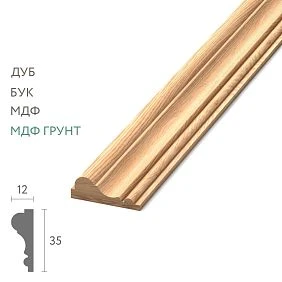
MLD‑003 ≠ a single product item. The same 35×12 mm cross-section does not make MDF 2600 mm, primed MLD‑003‑MG, beech 1000/2400 mm, and oak 1000/2400 mm interchangeable.
MLD-003: why one SKU is not enough for a wholesale order
The current STAVROS product page shows several MLD‑003 variants at once with the same 35×12 mm cross-section.
| Material | Size | Length | Condition / quality |
|---|---|---|---|
| Beech | 35×12 mm | 1000 мм | «Prestige» |
| Oak | 35×12 mm | 1000 мм | «Prestige» |
| MDF | 35×12 mm | 2600 мм | “Prestige” / “Prestige primed” |
| Beech | 35×12 mm | 2400 мм | «Prestige» |
| Oak | 35×12 mm | 2400 мм | «Prestige» |
Separately, the catalog includes MLD‑003‑MG — primed MDF 35×12×2600 mm, listed as a separate product card.
For procurement, this means: the line “MLD‑003” does not determine what exactly should arrive.




Minimum set of purchasing lines
- MLD‑003 / beech / 35×12×1000;
- MLD‑003 / oak / 35×12×1000;
- MLD‑003 / beech / 35×12×2400;
- MLD‑003 / oak / 35×12×2400;
- MLD‑003 / MDF / 35×12×2600 / standard version;
- MLD‑003‑MG / MDF / 35×12×2600 / primed.
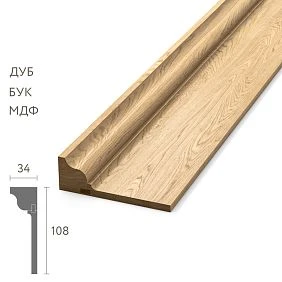
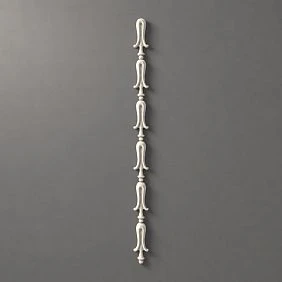
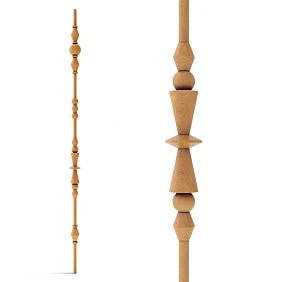
Our factory also produces:



Why the same cross-section doesn't protect against mix-ups
All these items visually belong to the same profile system, but physically differ in length, material, or surface preparation. The mistake may not show up during unloading, but it will immediately affect cutting, painting, or the appearance of natural wood.
Get Consultation
The first mistake is writing “MLD-003 — 500 meters”
The total linear meters are needed for the budget, but not for the order. From the figure of 500 m, it is impossible to tell:
- how much MDF;
- how much solid wood;
- how much beech and oak;
- how many one-meter strips;
- how many 2400-millimeter ones;
- how much standard MDF;
- how much primed MLD‑003‑MG;
- which items will go to the paint shop;
- which will remain with visible wood;
- where short parts are needed and where long ones are.
A project may have 500 m of net demand and at the same time five different production flows. If they are not separated before ordering, the separation will have to be done manually after delivery, when some of the data is already lost.
How to use the total linear meters correctly
It remains a checksum:
Standard MDF + primed MDF + beech 1000 + beech 2400 + oak 1000 + oak 2400 = total net volume of the project.
But payment, acceptance, warehouse, and reserve must be tracked line by line.
When the total footage is especially dangerous
If several versions have the same cross-section and a similar appearance without a finish. An employee sees "the same MLD-003" and considers the material universal, although one batch was prepared for a painting operation and the other for a different production scenario.
Even "MLD-003 MDF — 200 pcs." is still not enough
Within MDF there are at least two surface states: standard version and primed. Therefore, the line:
MLD-003 / MDF / 2600 / 200 pcs.
does not indicate what the painting shop should receive.
At minimum, it is necessary to specify:
- 35×12×2600 mm;
- standard or primed version;
- which coating system is assigned;
- which zone of the object uses the material;
- how many planks belong to each queue.
Why surface condition matters for the work schedule
If the workshop is expecting an already primed profile but regular MDF arrives, an additional preparation operation appears. This affects the timeline, the loading of the painting area, and the finishing sequence.
Reverse error
If the object's technology provides for its own preparation of regular MDF, and procurement without approval replaces it with primed MDF, this is also a change to the production process. It may be acceptable, but it must be checked by the finishing technologist, and not accepted by the storekeeper on the principle of "primed is even better."
MLD-003-MG should be tracked as a separate code
Primed MLD‑003‑MG has the same basic geometry of 35×12×2600 mm and an MDF base, but in the catalog it is listed as a separate product with the quality "Prestige primed."
For the project, it is better not to hide it inside the "MLD‑003 MDF" line.
Working note:
MLD‑003‑MG / MDF / 35×12×2600 / primed / E‑01 / corridor.
And separately:
MLD‑003 / MDF / 35×12×2600 / standard version / E‑02 / furniture.
Why a similar name does not mean warehouse interchangeability
For the project, not only the geometry matters, but also the condition of the supplied surface. If the paint map is tied to MLD‑003‑MG, replacing it with a regular MLD‑003 changes the process chain.
When a replacement can be considered
If the finishing technologist confirms that the new surface preparation is compatible with the adopted system and the site is ready to perform the missing operations. After that, the specification revision changes. Until such confirmation, the items are considered different.
What “primed” means for the procurement specification
The buyer does not need to turn the article into a chemical description of the primer. The practical meaning is simpler:
primed MLD‑003‑MG is a profile that is supplied at a different stage of surface preparation than standard MDF.
Therefore, this stage must be preserved in the specification.
What the buyer must know
- which SKU is ordered;
- 35×12×2600 mm;
- what MDF this is;
- that the finish is primed;
- which finish code comes next;
- which zone and queue use the profile.
What the purchaser must not invent
- primer composition;
- layer thickness;
- number of intermediate sandings;
- compatibility with a specific enamel without a process chart;
- whether standard MDF can be replaced with primed MDF or vice versa.
These parameters relate to the finishing technology and are confirmed by the project/coating manufacturer.
It is convenient to divide the project into three basic groups, and the solid wood group into four more
For bulk purchasing, it is useful to first create three consolidated branches:
M1 — MLD‑003 / MDF / standard version.
M2 — MLD‑003‑MG / MDF / primed.
S — MLD‑003 / solid wood.
Then divide the solid wood group:
- beech 1000;
- beech 2400;
- oak 1000;
- oak 2400.
If there are different finishes within a single material, the groups are split further: beech E-01, beech E-02, oak T-01, oak T-02, etc.
Why this splitting is not bureaucracy
Each line answers a separate production question:
- which strip to take;
- what length it should be;
- whether preliminary preparation is needed;
- which workshop to send it to;
- which finish to apply;
- where to return after processing.
If these answers do not fit on one line, the position is too general.
Working nomenclature
| Internal code | SKU | Material | Length | Condition |
|---|---|---|---|---|
| M3‑MDF | MLD‑003 | MDF | 2600 | Standard |
| M3‑MDF‑G | MLD‑003‑MG | MDF | 2600 | Primed |
| M3‑B1000 | MLD‑003 | Beech | 1000 | «Prestige» |
| M3‑B2400 | MLD‑003 | Beech | 2400 | «Prestige» |
| M3‑D1000 | MLD‑003 | Oak | 1000 | «Prestige» |
| M3‑D2400 | MLD‑003 | Oak | 2400 | «Prestige» |
Why 1000 mm length is a standalone procurement tool
MLD-003 comes in one-meter versions in beech and oak. For a wholesale project, this is not a "shortened leftover" or an accidental extra length, but a full-fledged product configuration.
It is especially useful where finished parts are systematically shorter than a meter:
- furniture horizontals;
- short sides of frames;
- decorative inserts;
- small door elements;
- short side sections of panels.
Example of a 900 mm part
From a 1000 mm strip, about 100 mm remains before accounting for the cut.
From a 2400 mm strip, after one 900 mm part, about 1500 mm remains. This leftover can be useful — but only if the project has a specific part of similar length.
If there is no second use, a one-meter strip may be more rational economically and logistically.
Why 1000 mm cannot be issued "instead of 2400"
The warehouse may see the same code MLD-003 and consider the lengths interchangeable. But a long vertical of 1800 mm cannot be made solid from a single one-meter strip. It can only be assembled from two parts if such a joint is provided for by the project.
Where the one-meter length is especially strong
In serial furniture. If 120 fronts have horizontals of 860 mm, a separate one-meter flow reduces the number of large remnants and simplifies kitting.
Where 1000 mm creates a problem and why long parts are reserved first
A one-meter strip is not suitable for solid parts of 1100, 1500, 2100 mm. There are many such sizes on wall panels, doors, and tall furniture fronts.
Therefore, the solid wood cutting map is built in two stages:
- parts that require a 2400 mm strip are reserved;
- short parts are distributed between the remnants of the long cutting and separate 1000 mm strips.
Example of a 2100 mm vertical
Out of 2400 mm, about 300 mm remains. This is almost a whole plank for one long part.
Trying to assemble 2100 mm from two 1000 mm pieces and a short filler creates two additional joints and requires a design decision. Mathematically, the length is achievable; architecturally and technologically, it is not necessarily so.
Example of a 1450 mm vertical and an 850 mm horizontal
from 2400 mm:
1450 + 850 = 2300 mm.
Such a combination is potentially very efficient. If instead the 850 mm horizontal is pre-made from a separate one-meter plank, the long 2400 mm plank will lose its ideal "partner" for the 1450 mm vertical.
Therefore, having a 1000 mm length does not mean that all short parts must automatically be moved to the one-meter flow. The decision is made by the overall cutting map.
An order is built from the parts list, not from linear meters
For each material group, the finished parts are collected first.
For example, beech:
- vertical V1 — 2100 mm × 40;
- vertical V2 — 1450 mm × 60;
- horizontal H1 — 850 mm × 120;
- horizontal H2 — 620 mm × 80;
- extension piece D1 — 420 mm × 40.
After this, it becomes clear which parts require 2400 mm, which are best obtained from one-meter strips, and which from the leftovers of long cutting.
Why total linear meters say nothing about length structure
Two sets of 100 m each can yield a completely different number of source strips.
Set A: almost all parts are 900 mm.
Set B: many parts are 2100–2300 mm.
In the second set, each long part practically blocks a separate 2400 strip.
Which table to send to production
| Part code | Material | Finished length | Quantity | Source length candidate |
|---|---|---|---|---|
| V1 | Beech | 2100 | 40 | 2400 |
| V2 | Beech | 1450 | 60 | 2400 |
| H1 | Beech | 850 | 120 | 1000 / remainder 2400 |
| H2 | Beech | 620 | 80 | 1000 / remainder |
| D1 | Beech | 420 | 40 | Remainder |
Practical example of a mixed order for 330 strips
Let's take a planned order:
- 120 MLD‑003 / MDF / 2600 / standard finish;
- 80 MLD‑003‑MG / MDF / 2600 / primed;
- 60 MLD‑003 / beech / 1000;
- 40 MLD‑003 / beech / 2400;
- 30 MLD‑003 / oak / 2400.
Overall total:
330 planks.
But the warehouse document “MLD‑003 — 330 pcs.” destroys almost all the useful information in the order.
What proper receiving looks like
| Group | Should be | In fact | Deviation |
|---|---|---|---|
| M3‑MDF | 120 | 120 | 0 |
| M3‑MDF‑G | 80 | 75 | −5 |
| M3‑B1000 | 60 | 65 | +5 |
| M3‑B2400 | 40 | 40 | 0 |
| M3‑D2400 | 30 | 30 | 0 |
The total quantity is still 330. Receiving by total count alone will not detect that five primed MDF planks have been replaced with five one-meter beech ones.
Why such a mix-up cannot be fixed “on the spot” with a single label replacement
The material, length, and surface preparation stage are different. These are not two identical packages that ended up in the neighboring bin. You actually need to deliver the missing MLD‑003‑MG and decide what to do with the extra beech.
The product card and the painting specification must speak the same language
Weak procurement communication:
"We need MLD‑003 MDF."
The painting shop, meanwhile, expects:
MLD‑003‑MG / primed / E‑01 / ready for finish coating according to the facility's process card.
The warehouse receives a standard MLD‑003, and the shop discovers the difference right before painting. Formally, the SKU series is the same, the 35×12×2600 geometry matches, but the production stage is different.
How to synchronize the documents
Both documents must match in:
- SKU;
- the material;
- size;
- the surface condition;
- future finish code;
- area;
- quantity;
- revision.
Example of a single code system
E‑01 — white corridor coating system.
E‑02 — alternative opaque system for offices.
T‑01 — transparent/semi-transparent oak finish.
Therefore, MLD‑003‑MG / E‑01 cannot be confused with standard MLD‑003 / E‑02 just because both groups later become white.
One finish code should mean one approved system
The word “white” is too weak for a large project. White enamel can vary in shade, gloss, manufacturer, and preparation technology.
Therefore, it is useful to use internal codes:
- E‑01;
- E‑02;
- T‑01;
- T‑02.
The code links the physical sample, the technical data sheet, the packaging, and the zone.
Why two white profiles cannot be automatically mixed
Standard MLD‑003 MDF and MLD‑003‑MG may end up painted in a similar white. But if their surface preparation and subsequent technology differ, combining them in the warehouse breaks the production sequence.
When the code can be unified
If the site's technologist has confirmed the same finishing system, and the supplied surface states allow a single process. This decision is made before mass material issue, not after.
What to do if the painting technology changed after ordering
A change in the paint system after delivery of MLD‑003 is not uncommon on long projects. First, a primed profile was ordered, then the contractor changed the paint system. Or vice versa: standard MDF with on-site preparation was planned, but the new painting contractor wants a factory-primed profile.
The two options cannot be automatically considered interchangeable.
Three things are checked
- compatibility of the new system with the preparation already performed;
- necessary additional operations;
- impact on the schedule and finish quality.
If regular MDF has already been purchased
The technician determines whether it can be brought to the required level of preparation on site. If yes, the production route changes. If not, the material is redistributed to another area or kept as a reserve.
If primed MLD-003-MG has already been purchased
It is necessary to check whether the factory primer is compatible with the new system. It should not be sanded or overcoated "out of habit" without an approved technology.
How to record a revision
| Code | Revision | Condition | Finish | Zone |
|---|---|---|---|---|
| M3‑MDF‑G | R01 | primed | E‑01 | Corridor, floors 2–3 |
| M3‑MDF | R02 | Standard | E‑02 | Corridor, floors 4–6 |
The old version remains in the history if rooms have already been completed according to it.
A control sample is needed for every real production scenario
Before placing a bulk order, it is useful to check not only the profile but also the final system.
For primed MDF:
- real MLD‑003‑MG;
- real paint;
- real preparation between primer and topcoat;
- approved color and sheen.
For oak:
- real MLD‑003 made of oak;
- selected stain/oil/lacquer;
- approved physical sample;
- check next to an adjacent wooden element.
Why the MLD-003-MG sample cannot be automatically transferred to solid wood
The substrate is different. MDF and solid wood interact differently with the coating, and wood adds natural texture and color. White opaque enamel on primed MDF is not proof that the same system will produce an identical process and result on beech or oak.
Why a beech sample does not replace an oak sample
Even with the same clear finish, species differ in texture and base color. For visible wood, this is fundamental.
Beech and oak should be treated as separate groups even with the same length of 2400 mm
The same cross-section and commercial length do not make species into one material.
For purchasing:
M3‑Б2400 ≠ M3‑Д2400.
Even if both groups:
- 35×12 mm;
- 2400 mm;
- go into the same room;
- will be painted in the same color.
Why you should still record the species even with opaque enamel
Although the final texture may be hidden, the material remains part of the specification, pricing, production records, and reordering. A month later, the phrase "we need 8 more MLD-003" doesn't answer whether it's beech or oak.
Why separation is even stricter with a clear finish
Visible wood becomes part of the design. Leftover beech cannot be used in an oak frame just because the length fits.
A clear finish makes the batch origin especially important
For a clear or semi-transparent finish, it's useful to store:
- physical sample;
- tone code;
- breed;
- production batch number/date, if it is used in documentation;
- zone;
- remainder of whole planks.
Why photos are not enough
The screen does not convey the exact shade and sheen. A photo is useful for context, but not as the sole reference for reordering.
Repeat order after several months
A new batch of oak may have natural visual variability. Before a bulk reorder of clear finish, it is better to make a new control sample next to the saved reference.
What cannot be promised
Photographic identity of natural wood from different batches cannot be guaranteed. The goal of control is to maintain a visually consistent range and the approved technology.
Cutting of 1000, 2400 and 2600 mm is built after separating the materials
You cannot first build one common map by finished lengths and then substitute materials.
Correct order:
- separate MDF, beech, oak;
- separate the primed MDF;
- separate 1000 and 2400 within the solid wood;
- assemble the parts of each group;
- only then optimize the cutting plan.
Example of a 900 mm part
From 1000 mm:
1000 − 900 = 100 mm.
From a 2400 mm board, one such part leaves 1500 mm. If there is a 1450 mm part, the combination 900 + 1450 = 2350 mm is potentially more efficient than using a separate one-meter strip.
Example of a 2350 mm part
Requires almost the entire 2400 mm solid wood board. The one-meter version is useless. MDF 2600 gives a different remainder.
Why three lengths are an advantage only with the correct cutting list
The extra 1000 mm length can reduce waste, but it can also worsen the cutting plan if short parts are taken from the one-meter strips, depriving the long 2400 mm parts of suitable pairs for combined cutting.
You cannot optimize the cutting plan before determining the surface finish
Two 2600 mm MDF boards are mathematically identical. But if one is a standard MLD‑003 and the other is MLD‑003‑MG, they may belong to different production streams.
The cutting program sees:
35×12×2600.
The project sees:
M3‑MDF / E‑02
и
M3‑MDF‑G / E‑01.
If they are combined for a better mathematical coefficient, you can get a perfect cutting map and an incorrect painting set.
Which attribute is considered the main one
Full production identity: SKU/version, material, length, surface condition, and finish code.
When two zones can be combined
If all these parameters match. The purpose of the rooms can be kept as a separate field for logistics.
MLD-003 is often purchased as part of a system, but the accompanying decor should not blur the main specification
MLD‑003 is used not only as a straight strip. In the STAVROS system, decorative elements are associated with it, including the corner element MLD‑003U and N‑500. This is important for completeness, but the new article should not turn into a calculation of decorative corners.
The practical meaning for wholesale purchasing is this: if the straight profile changes material, finish, or surface preparation condition, the associated elements must also be checked for compatibility in appearance and finish.
N-500 and MLD-003
STAVROS separately specifies N‑500 as a special decorative element for MLD‑003. If the frame is built with N‑500, you cannot order a straight profile in oak T‑01 and leave the decorative element in a different species or a different finish without a deliberate decision.
MLD-003U
The corner element MLD‑003U belongs to the same series of decorative frames. Its quantity depends on the actual composition: four corners, two accent corners, or another scheme. You cannot automatically multiply the number of frames by four if the project uses combined corner solutions.
Why the straight bar and the decor must have the same finish system
If MLD‑003 is going under white enamel, while N‑500 or MLD‑003U have a different surface preparation, you need to check in advance that the final finish will give a consistent result. This is especially important when combining MDF, solid wood, and polyurethane/carved decor.
When to count accompanying decor as a separate purchase
Always, if it has a different SKU, material, or price. The system links the elements architecturally, but does not turn them into a single product line.
Why replacing the straight MLD-003 can affect the entire set
If the project suddenly switches from oak to primed MDF, you need to check:
- corner element compatibility;
- visual texture match;
- finish;
- thickness/fit;
- overall frame logic.
You cannot change a straight profile in isolation if it functions as part of a finished decorative system.
Marking, acceptance, reserve, and reorder: the final operating system of MLD-003
Warehouse marking must show more than just the SKU
Bad:
MLD‑003.
Good:
MLD‑003 / MDF / 2600 / STANDARD / E‑02 / FURNITURE.
MLD‑003‑MG / MDF / 2600 / PRIMED / E‑01 / CORRIDOR.
MLD‑003 / BEECH / 1000 / E‑03 / FURNITURE.
MLD‑003 / OAK / 2400 / T‑01 / REPRESENTATIVE AREA.
Such a line works without verbal explanations.
Why length should be a prominent field
Beech and oak both come in 1000 and 2400 mm. If the warehouse sees only “MLD‑003 beech,” the one-meter and long strips can end up in the same bin. After that, quick material picking for a floor becomes a source of mix-ups.
Receiving a mixed batch
Check:
- SKU;
- cross-section 35×12 mm;
- the material;
- length 1000/2400/2600;
- quality/surface condition;
- finish/purpose code;
- quantity for each line;
- obvious transport damage.
The total number of pieces does not confirm completeness.
What exactly to check on a primed batch
There is no need to invent your own standard for primer thickness or chemical composition. For acceptance, the following matter:
- compliance with the ordered item MLD‑003‑MG;
- compliance with the size 35×12×2600;
- surface integrity;
- absence of obvious damage that would hinder further finishing;
- quantity.
If a dispute arises about primer quality, the decision is made based on the manufacturer's documentation and the site technology, not on a homemade standard.
What to do with damaged primer
Do not mix the damaged strip with ordinary unprimed MDF and do not assume that the workshop will “somehow fix it.” The damaged item goes into a separate status: inspection/repair/reject. The finishing technologist determines whether the preparation can be restored.
Transfer to the paint shop
The issue sheet must match the warehouse line. If the warehouse issued MLD‑003‑MG / E‑01, the shop must not return a generic "white molding 35×12".
Return sheet:
- ISSUED;
- painted;
- defect;
- rework;
- remaining stock;
- control samples.
Why control samples also consume material
If 300–500 mm is cut from each batch for test paint-outs and this is not recorded, entire planks disappear over a long project. Samples are best tracked as a separate line or made from pre-selected short offcuts of the required group.
Separate reserve
Prohibited:
MLD‑003 reserve — 20 pcs.
You need to:
- M3‑MDF — reserve;
- M3-MDF-G — reserve;
- M3-B1000 — reserve;
- M3-B2400 — reserve;
- M3-D1000 — reserve;
- M3-D2400 — reserve;
- separate finishing groups within them.
The reserve must be stored by length structure
| Group | Whole | 1800+ | 800–1799 | 300–799 |
|---|---|---|---|---|
| M3-MDF-G / E-01 | ___ | ___ | ___ | ___ |
| M3-B2400 / E-03 | ___ | ___ | ___ | ___ |
| M3-D2400 / T-01 | ___ | ___ | ___ | ___ |
The total remaining linear meters without lengths does not show whether the future vertical of 2100 mm can be covered.
Correct reorder
Bad:
“15 more MLD‑003.”
Good:
MLD‑003‑MG / MDF / 35×12×2600 / Prestige primed / E‑01 / hallway / 15 pcs.
Or:
MLD‑003 / oak / 35×12×2400 / Prestige / T‑01 / office / 8 pcs.
Why a reorder should begin with an inventory check
Before a new order, check:
- whole strips of the required group;
- long usable offcuts;
- one-meter strips;
- material already issued to the contractor;
- operational reserve;
- defects/rework;
- remaining stock after the paint shop.
Only then is a new cutting plan built.
Practical calculation: when one-meter strips actually reduce purchasing
Let's consider the beech group, where the following are needed:
- 80 parts of 900 mm;
- 40 parts of 1450 mm;
- 40 parts of 850 mm.
Net length:
80×0.9 + 40×1.45 + 40×0.85 = 72 + 58 + 34 = 164 m.
If everything is calculated only from 2400 mm, the mathematical minimum is:
164 / 2,4 ≈ 68,34.
That is, no fewer than 69 strips. But the structure of lengths matters more than division.
For 40 parts of 1450 mm, a rational combination is:
1450 + 850 = 2300 mm.
This immediately covers:
- 40 long parts 1450;
- 40 short parts 850;
- uses 40 strips 2400.
After that, only 80 parts of 900 mm remain.
Option 1 — make them from 2400 mm:
900 + 900 = 1800 mm.
The third part of 900 no longer fits. For 80 parts, 40 strips of 2400 are needed, and the total remainder will be large — about 600 mm each before accounting for the cut.
Option 2 — use one-meter strips:
80 parts × one 1000 mm strip = 80 one-meter strips with a small remainder of about 100 mm on each.
Which option is more advantageous cannot be decided by quantity alone. You need to compare:
- the price of the 1000 and 2400 strips;
- the availability of useful 600 mm parts for the remnants of long strips;
- the logistics of two lengths;
- warehouse remnants after a series.
If the project also has 40 parts of 580–600 mm, the long 2400 ones may prove more efficient: from one strip you can get two 900 mm parts and one filler of about 600 mm. If there are no such fillers, the one-meter length may be more rational.
Conclusion for purchasing: having 1000 mm is not an automatic saving. It provides an additional optimization option that needs to be checked against the full parts list.
Boundary scenario: 980 mm parts and a one-meter strip
A finished part of 980 mm seems ideal for a product 1000 mm long. But there is only about 20 mm left before accounting for the cut width, trimming, and technological allowance.
Therefore, one cannot automatically write:
1000 → part 980.
It is necessary to confirm the technological production margin. If it is insufficient, the meter-long plank may turn out to be unsuitable for such a finished length, despite the arithmetic.
This is a good example of the master prompt rule: mathematics says "it fits," practice may say "no."
Practical calculation for MDF 2600: when the length allows a solid vertical
Suppose the wall system contains 60 verticals of 2480 mm and 120 horizontals of 620 mm.
For MDF 2600:
2480 mm can be obtained from a single plank, leaving about 120 mm before accounting for the cut.
60 verticals require a minimum of 60 whole planks.
Horizontals:
620 × 4 = 2480 mm.
Theoretically, four horizontals of 620 mm can be obtained from one 2600 plank, leaving about 120 mm before accounting for three cuts. Technologically, the combination needs to be checked, but roughly 120 horizontals will require about 30 planks.
This comes to approximately 90 source planks before reserve and adjustment for the actual cut.
If the same project is switched to beech/oak 2400, a vertical of 2480 mm can no longer be solid. This means not only the number of source planks changes — the architectural scheme of the vertical itself changes. A joint, a different frame height, or a different material may be required.
Why the surface condition must be preserved even after cutting
In production, a long molding is often first cut into parts and then sent to finishing. If, after cutting, the parts lose their original code M3-MDF or M3-MDF-G, the paint shop receives a set of identical profiles without information about their preparation.
Therefore, the code must be inherited:
M3-MDF-G → V1-01 → E-01.
M3-MDF → H2-04 → E-02.
That is, the finished part retains a link to its original finish.
How to organize transfer to the paint shop
Instead of a general invoice “MDF molding — 180 parts,” a picking list is used:
| Part code | Source group | Length | Quantity | Finish | Zone |
|---|---|---|---|---|---|
| V1 | M3‑MDF‑G | 2480 | 60 | E‑01 | Corridor |
| H1 | M3‑MDF‑G | 620 | 120 | E‑01 | Corridor |
| V2 | M3‑MDF | 2100 | 40 | E‑02 | Furniture |
The shop returns the same codes with statuses:
- done;
- under rework;
- defect;
- control sample;
- remaining stock.
This way, production accounting remains end-to-end.
Why a primed part with damage cannot be "converted" into regular MDF with a single entry
If the primer layer on MLD‑003‑MG is damaged, the physical base remains MDF, but the surface condition no longer matches either a standard new plank or a serviceable primed one.
A separate status is needed:
M3‑MDF‑P / damage / technologist's decision.
After repair, the technologist can return the part to the primed group. If the primer is removed and a full new preparation is performed, this must be documented as a change to the production route.
Scenario: after ordering a primed profile, the paint shop changes the technology
Suppose 80 MLD‑003‑MG are ordered for E‑01. Before painting begins, the new contractor requires a different preparation system.
Correct steps:
- stop the automatic dispensing of all 80 strips;
- take 1–2 actual samples from the batch;
- test the new technology on the existing primer;
- record the result;
- determine whether MLD‑003‑MG remains in the production flow or whether the standard MLD‑003 is needed;
- issue a new revision of the specification;
- recalculate the remaining stock/reorder.
If the new system is suitable, the batch continues to be used. If not, another route must be found rather than applying incompatible layers to the entire volume.
When regular MLD-003 and MLD-003-MG may be functionally interchangeable but not logistically interchangeable
After the technical check, it may turn out that both items are acceptable for the same final enamel with different preparatory operations. But that is still not a reason to mix the warehouse stock.
Logistically useful to keep:
- regular MDF — requires operation A;
- primed — goes straight to operation B.
Otherwise the workshop will stop understanding which parts have already been prepared.
How to use 1000 mm together with 2400 mm remnants without double counting
Cutting is done in a single beech or oak map, but each short part must get only one source.
For example, 20 parts of 850 mm each are needed.
The map contains:
- 8 remnants of 900–950 mm after long parts of 2400;
- 12 one-meter strips of 1000 mm.
Correct calculation:
- 8 parts are covered by remnants;
- 12 — by one-meter strips.
Spreadsheet error — simultaneously counting 20 one-meter strips as a purchase and another 8 remnants as "savings," effectively overstating the stock. Each part needs a specific source.
Why returning one-meter strips to the warehouse must be accounted for separately
After a run, the following may remain:
- 15 full 1000 mm;
- 3 full 2400 mm;
- 6 remnants of 1200–1600 mm.
The total linear meters seem large. But a future batch with 2100 mm verticals can use only three full 2400-millimeter strips. The one-meter stock does not cover long parts.
Reverse check from zone to material
Before closing the order, it's useful to go through each zone:
Corridor → E‑01 → MLD‑003‑MG → 2600 → quantity.
Furniture → E‑02 → MLD‑003 MDF → 2600 → quantity.
Study → T‑01 → MLD‑003 oak → 2400 → quantity.
If a zone doesn't expand down to a specific product line, the specification is incomplete.
Reverse check from warehouse line to rooms
And vice versa:
M3‑D2400 / T‑01 → rooms 201–220 → parts V3/H3 → balance → reserve.
This makes it easy to spot that one group was accidentally counted twice or isn't linked to any room.
When a 1000 mm length can be more expensive logistically, even if it reduces waste
Additional length creates:
- one more warehouse cell;
- a separate receiving line;
- separate reserve;
- risk of mixing up 1000/2400;
- additional floor-by-floor assembly.
If material savings are minimal, the project may deliberately forgo the one-meter length and work only with 2400 mm. This is a normal compromise: not only is it optimized
You cannot automatically order a second set of 30 strips. First, a parts list for floors 4–5 is compiled. If four whole strips and some long offcuts cover eight future parts, the actual reorder is reduced.
But the remainder of regular MLD‑003 MDF is not automatically included in this calculation: it has a different surface condition.
How to store the remainder between batches
Separately:
M3‑MDF‑G / E‑01 / whole 2600 — 4 pcs.
M3‑MDF‑G / E‑01 / 1200–1800 — 6 pcs.
And separately, standard MDF.
So the next queue starts with the actual resource of the required group.
What to do if a regular MLD-003 arrived instead of MLD-003-MG
There are three possible scenarios, and none of them should be chosen by the warehouse on its own.
Scenario A — replace the delivery.
If the factory-primed version is critical for the project, regular MDF is recorded as non-conforming and returned/replaced under the terms of the contract.
Scenario B — prepare regular MDF on site.
This is only possible if the painting technology and the responsible specialist confirm this route. Then additional operations, timelines, and costs arise.
Scenario C — redistribute regular MDF to another zone.
If the project includes standard M3-MDF, an extra batch can cover its future demand. But the warehouse balance and the next order need to be adjusted so the material isn't purchased twice.
In all cases, the error is first recorded against a specific SKU/finish, not as "MDF arrived, so everything is fine."
What to do if primed MLD-003-MG arrived instead of regular MLD-003
Here, too, you can't automatically declare the delivery "upgraded."
Checked:
- compatibility of the primer with the project system;
- whether the original unprimed surface is needed for another operation;
- cost/contract;
- whether the primed profile can be redistributed to zones E-01;
- whether the future reorder will change.
If the primed version is suitable, the decision is documented. If not, the delivery is considered non-conforming, despite the identical dimensions.
Why repackaging is especially dangerous for MLD-003-MG
Factory packaging carries product identity. On site it is often opened and divided by floor. If the new bundle is labeled only:
MLD‑003 / floor 4,
the word “primed” disappears. After a few days the material may get mixed with regular MDF.
After any repackaging, the label must repeat:
- MLD‑003‑MG;
- MDF;
- 2600;
- primed;
- E‑01;
- floor/zone;
- quantity.
Why the price of the primed version must be checked immediately before ordering
At the time of material preparation, different current STAVROS pages show different price values for the primed version 35×12×2600. Therefore, it is better not to hard-code a single figure as a constant in the working article.
For a commercial calculation, the correct approach is:
- open the specific product page MLD‑003‑MG;
- verify the current price;
- compare it with the main product page MLD‑003;
- if there is a discrepancy, confirm the price with STAVROS before payment;
- lock in the price in the invoice/commercial offer.
This does not prevent the article from addressing the main objective: identity and production stage matter more than the temporary price.
How to calculate the cost of an additional operation if standard MDF has to be primed on site
The article does not invent a universal priming price. But the commercial model must account for:
- primer material;
- labor;
- sanding between operations, if provided for by the technology;
- drying;
- occupancy of the painting area;
- additional logistics;
- risk of defects.
After that, they compare not only the price of one plank MLD‑003 and MLD‑003‑MG, but the full cost of bringing them to the same stage of readiness.
When standard MDF may be more cost-effective than primed
If the facility already has its own well-established preparation line and priming is part of the overall painting process for furniture/panels, standard MLD‑003 may be more rational. But this is the conclusion of a specific technology, not a universal recommendation.
When MLD-003-MG is stronger operationally
If the workshop wants to receive the profile at an already specified stage of preparation, reduce the number of operations at the facility, and work with a repeatable primed surface. Again, the decision is confirmed by the chosen painting system.
Summary decision matrix by version
| Question | If "yes" | If "no" |
|---|---|---|
| Need MDF? | Standard / primed selection | Moving on to beech/oak |
| Is the painting process waiting for factory primer? | MLD‑003‑MG | Check standard MLD‑003 |
| Part longer than 1000 mm? | Solid wood 2400 or MDF 2600 | Check one-meter solid wood and remnants |
| Is the wood texture visible? | Beech/oak according to the reference sample | Material is selected according to the project and technology |
| Is there a suitable leftover from the same group? | Use in cutting | Add source strip |
15 typical mistakes
1. Order MLD‑003 only by meters. Reason — the estimate already contains the total volume. Consequence — material, length, and preparation get mixed up. Prevention — product groups before calculation.
2. Do not separate 1000, 2400, and 2600 mm. Reason — the profile is the same. Consequence — meter-long strips are issued instead of long ones. Prevention — length in the SKU line and on the label.
3. Do not separate MDF, beech, and oak. Reason — the same cross-section. Consequence — a different material ends up in the wrong finish. Prevention — separate codes.
4. Mixing regular and primed MDF. Reason — the geometry 35×12×2600 is the same. Consequence — the painting process is disrupted. Prevention — MLD‑003 and MLD‑003‑MG as separate items.
5. Treating MLD‑003‑MG as simply a new name for MLD‑003. Reason — similar article number. Consequence — the warehouse does not store surface condition. Prevention — separate code M3‑MDF‑G.
6. Not specifying surface condition in the request. Reason — they expect the supplier to understand the technology themselves. Consequence — the wrong preparation arrives. Prevention — an explicit “standard / primed” field.
7. Issuing a primed profile into the wrong production flow. Cause — externally it is the same 35×12. Consequence — additional operations or incompatibility with the technology. Prevention — finish code and painting schedule.
8. Using 2400 mm for short parts before calculating meter-length strips. Cause — long items are stored closer in the warehouse. Consequence — later there are not enough long blanks. Prevention — first the parts schedule and overall cutting plan.
9. Assembling a long vertical from meter-length parts without a project. Cause — there is a large stock of M3‑B1000. Consequence — additional visible joints. Prevention — meter-length parts only where the length allows it.
10. Making a common reserve. Cause — one number is convenient. Consequence — “there is a reserve,” but not of the required finish. Prevention — separate bins.
11. Mixing different finishes. Cause — the same material. Consequence — a reorder/repair receives the wrong finish. Prevention — E‑01/E‑02/T‑01 in separate groups.
12. Not accounting for compatible decor. Cause — only the straight molding is calculated. Consequence — the frame is incomplete or the finishes do not match. Prevention — N‑500/MLD‑003U are checked as separate lines.
13. Making a reorder only by SKU. Cause — the employee writes “MLD‑003.” Consequence — ambiguity of material and length. Prevention — the full original line.
14. Accepting a mixed batch by total quantity. Cause — the total 330 matched. Consequence — misgrading within groups remains unnoticed. Prevention — line-by-line acceptance.
15. Changing the painting technology after purchase without verification. Cause — the contractor or coating material changed. Consequence — the already purchased preparation does not match the new process. Prevention — technological review and a new version of the specification.
Checklist before payment
| Check | Status |
|---|---|
| MLD‑003 and MLD‑003‑MG are separated | ___ |
| Section 35×12 confirmed | ___ |
| MDF 2600 highlighted separately | ___ |
| Beech 1000/2400 separated | ___ |
| Oak 1000/2400 separated | ___ |
| Surface condition specified | ___ |
| Finish codes assigned | ___ |
| Painting map approved | ___ |
| Control samples completed | ___ |
| Parts list ready | ___ |
| Long parts reserved | ___ |
| 1000 mm used deliberately | ___ |
| Cutting maps are divided into groups | ___ |
| Associated decor has been verified | ___ |
| Warehouse marking approved | ___ |
| Acceptance is line by line | ___ |
| Reserve is divided | ___ |
| Reorder format approved | ___ |
| Specification revision is specified | ___ |
When MLD-003 should not be purchased at all
MLD-003 should not become a universal profile just because many lengths and a primed version exist for it. It is better to choose another molding if:
- 35×12 mm is too large for the frame;
- a thinner relief is needed;
- the project is designed for a different compatible angle;
- a different profile depth is required;
- the meter/2400-millimeter structure does not help real parts;
- the existing decor system belongs to a different series.
Product links
The base product is wooden molding MLD‑003.
The primed version is a separate primed molding MLD‑003‑MG.
For a general selection, you can use wooden trim catalog. If you need a broad wholesale context covering several profiles, this article is useful linear products wholesale.
General B2B requests in a large order
If the purchase is placed as building materials Moscow wholesale, via finishing material suppliers, large supplier of building materials, building material suppliers, Wholesale building material suppliers or wholesale building material suppliers, the technical breakdown of MLD‑003 is still preserved.
The same rule applies to wholesale purchase of building materials, wholesale purchase of building materials, building materials at wholesale prices, construction materials wholesale, building materials wholesale from the manufacturer, delivery of finishing materials, finishing materials wholesale и materials in bulk. A general contract must not erase the differences between M3‑MDF, M3‑MDF‑G, M3‑B1000, M3‑B2400, M3‑D1000, and M3‑D2400.
Final algorithm
CONFIRM MLD‑003 → COLLECT ALL AVAILABLE VARIATIONS → SEPARATE MLD‑003‑MG → SPLIT MDF, BEECH AND OAK → SPLIT 1000, 2400 AND 2600 → RECORD SURFACE CONDITION → ASSIGN FINISH CODES → AGREE PAINTING TECHNOLOGY → MAKE REFERENCE SAMPLES → COMPILE FINISHED PARTS LIST → RESERVE LONG PARTS → DECIDE WHERE 1000 MM STRIPS ARE ADVANTAGEOUS → BUILD SEPARATE CUTTING MAPS → CHECK N‑500/MLD‑003U IF AVAILABLE → COUNT WHOLE STRIPS → CREATE SEPARATE RESERVE → LABEL BUNDLES → ACCEPT DELIVERY BY GROUPS → ISSUE TO WORKSHOP BY FULL LINE → TRACK RETURNS AND SAMPLES → REORDER ONLY BY FULL CONFIGURATION.
Can I simply order the entire MLD-003 in 2400 mm length?
Only if the parts map shows that the one-meter options provide no advantages and MDF 2600 is not needed. Having a 1000 mm length is an optimization tool, not a mandatory part of every project.
When is one-meter beech or oak actually advantageous?
When there is a large series of 850–950 mm parts and the leftovers from long strips do not cover them more efficiently.
Can MLD-003-MG be replaced with regular MLD-003 MDF?
Not automatically. First, the painting technology and surface preparation need to be checked.
Can regular MDF be replaced with primed MDF?
Also only after agreeing on the technology. The geometry matches, but the production stage does not.
Which option is better for a clear finish — beech or oak?
This is a designer's choice, not a universal recommendation. Different species produce different textures and base colors. A physical sample is required.
Can leftover beech pieces of 1000 and 2400 be combined?
The material is the same, but length groups serve different purposes. A short 900 mm leftover can replace a separate one-meter strip, but a one-meter strip does not replace a long vertical. Inventory tracking must preserve lengths.
What should be written in the reorder?
SKU, material, 35×12, length, surface condition, finish code, zone, and quantity. For the primed option — MLD‑003‑MG/“Prestige primed.”
When should the order be stopped?
If the painting technology has not yet been selected, the project has not determined standard or primed execution, or it is unclear which parts require 1000/2400/2600 mm. At this stage, a budget can be estimated, but bulk purchasing is premature.
After handover of the facility to the operations service, it is useful to provide not only several spare strips but also a table of their identity: MLD‑003 or MLD‑003‑MG, material, length, finish code, and application zone. Then, a year later, repairing a wall panel begins not with searching for a “similar 35×12 molding,” but with precisely identifying the required execution. For clear oak, a physical reference sample is additionally retained; for primed MDF, the data of the current coating system. Such an archive is especially important for a mixed batch, where the same profile section exists in several lengths and surface preparation stages at once.
After such preparation, buying MLD-003 molding wholesale means ordering not abstract hundreds of meters of a single profile, but a manageable set of executions: standard MDF 2600, primed MLD‑003‑MG, beech and oak in 1000/2400 mm — each with its own cutting maps, production flows, labeling, reserve, and reproducible reorder.