Article Contents:
- Why choosing a stucco store is more important than choosing a specific element
- What distinguishes a professional stucco catalog from an ordinary one
- STAVROS catalog sections: navigation by zones and functions
- Main section: polyurethane products
- Wall Decor
- Ceiling decor
- Moldings, cornices, and baseboards
- Decor for moldings: corners, inserts, accents
- Polyurethane outlets
- Ready-made collections: when the style is already selected
- Neoclassical collection
- Japandi collection
- Versailles collection
- How to choose stucco molding in an online store: step-by-step logic
- Catalog of stucco molding: what should be in a complete order
- Ready-made set or individual selection: what to choose
- How not to make a mistake with size: a practical guide
- Cornice and baseboard: proportion to ceiling height
- Molding: width depending on frame size
- Ceiling rosette: ratio with chandelier and ceiling area
- Overlays for furniture and doors
- How to choose the style of stucco decor in the store
- Neoclassicism: balance of architecture and modernity
- Classic: order system and ornamental richness
- Modern interior: geometry without ornament
- Baroque and Versailles: scale and expressiveness
- Pricing for stucco: what makes up the cost of an order
- Stucco for an apartment and for a house: different tasks, different approach
- Typical mistakes when choosing stucco in an online store
- Where to buy polyurethane stucco: navigation through STAVROS sections
- FAQ: answers to popular questions about the stucco store
- About the Company STAVROS
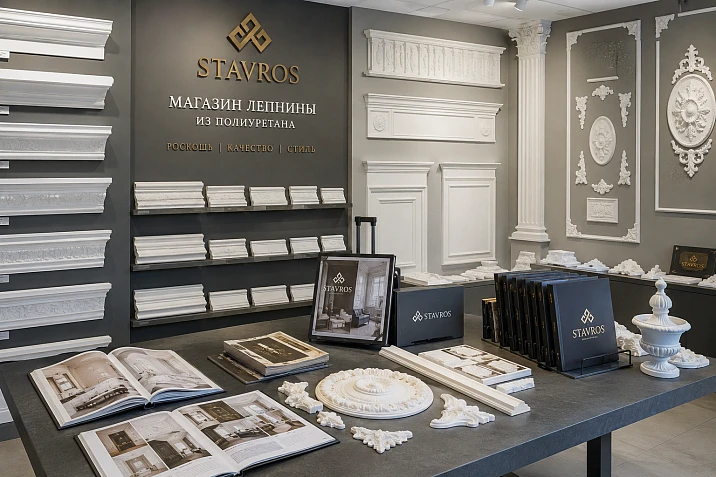
Finding a stucco store is not difficult. It is more difficult to find one that has a real catalog with sections by zones, ready-made sets for interior style, and a clear selection logic from first viewing to placing an order. This is the task most people face when they are looking not for one ceiling rosette, but for a full system of stucco decoration for a living room, bedroom, hall, or study. In this article, we will analyze how a well-designed a polyurethane molding store, what to look for when choosing a catalog, how ready-made collections work, how polyurethane outperforms other materials, and how to assemble an order in STAVROS step by step — from basic moldings to decorative accents.


Why choosing a stucco store is more important than choosing a specific element
Here's a paradox that everyone who deals with stucco decor for the first time faces: a person goes to an online store, sees a beautiful rosette or molding, buys it — and gets disappointed. Not because the product is bad. But because it doesn't fit into the interior: wrong scale, wrong style, no compatible corner elements, no cornice in the required profile, no understanding of how it all should work together.
A good Online store of polyurethane molding solves exactly this problem — even before the buyer puts the first item in the cart. Dividing the catalog by application zones, ready-made collections with coordinated elements, clear sizes and style descriptions, internal links between moldings, corner inserts, and rosettes — all this turns the catalog from a list of SKUs into a design tool.
When a stucco and decor store is organized correctly, the buyer doesn't guess — they choose. They see how elements combine, understand what is needed for walls, what for the ceiling, what for framing a doorway. This is exactly the approach implemented in STAVROS: the catalog moldings is divided into specific product sections by zones and functions, and the assortment covers all levels of interior kit — from linear moldings to ornamental overlay elements.




What distinguishes a professional stucco catalog from an ordinary one
The difference between a professional stucco decor catalog and an ordinary set of items is roughly the same as between an architectural project and a list of building materials. Both contain useful information, but only one helps make a decision.
Signs of a well-organized stucco catalog:
-
Sections by application zones: walls, ceiling, moldings, overlays, decor for frames
-
Ready-made collections or style groups — when elements are already coordinated by profile and scale
-
Photos in the interior, not just an isolated shot of an element on a white background
-
Exact dimensions: length, width, relief height, diameter
-
Connection between elements: molding + corner insert + central rosette
-
Breakdown by style: classic, neoclassical, modern interior, Japandi, Versailles
-
Related materials: glue, primer, installation recommendations
-
Ability to assemble a kit in one order without switching between different stores
In the STAVROS catalog polyurethane products is built exactly on this principle: each section covers a specific task, and the user can sequentially go from basic cornices to fine decorative accents without losing context and without being overloaded with unnecessary options.
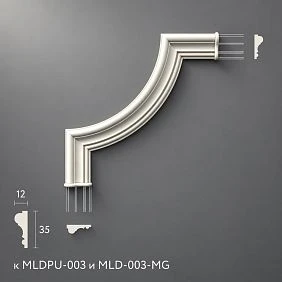
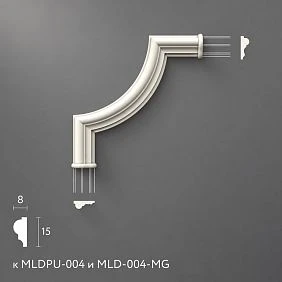
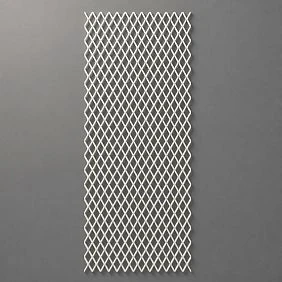
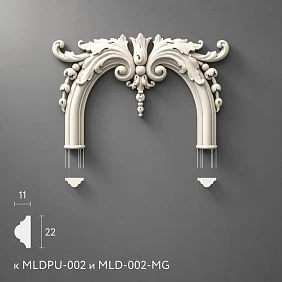
Our factory also produces:

STAVROS catalog sections: navigation by zones and functions
Before moving on to specific collections and ready-made kits, it is useful to understand the architecture of the STAVROS catalog. Each section solves a separate task, and knowing this structure significantly speeds up the selection process.
Get Consultation
Main section: polyurethane products
Main entry point — section polyurethane molding decoration, which contains the full range: overlays, ornaments, medallions, geometric motifs, decorative rosettes, and panels. This is where you start exploring the assortment if you haven't yet decided on a specific application area and want to see the possibilities in general. STAVROS polyurethane products are lightweight, accurately reproduce complex reliefs, and are easily cut at any angle — from 22.5 to 90 degrees.
Wall decor
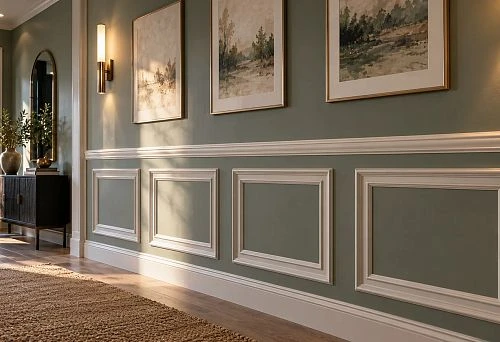
Polyurethane wall decor — section for those planning wall moldings: frame panels, pilasters, overlay ornaments, decorative inserts for piers. This section is the basis for a living room, bedroom, and hall set. Wall molding decor here is grouped so that you can select both individual elements and a complete wall composition.
It is in the wall decor section that the collections are placed — more on this in the next block.
Ceiling decor
Polyurethane Ceiling Moldings — rosettes, ceiling moldings, corner elements, decorative cassettes. This is the second most important area for most interior projects. The section features rosettes from compact to large diameters, ceiling plinths with various widths and profiles, as well as special corner elements for joining cornice lines.
Ceiling moldings are not only aesthetic but also a functional system that masks the wall-ceiling joint, hides seams, and sets the scale of the entire space.
Moldings, cornices, and baseboards
Polyurethane moldings and cornices — this is the skeleton of any molding set. Linear moldings set the geometry: horizontal lines on walls, cornice strip on the ceiling, baseboard at the bottom. Without this base, any decorative accents will look disconnected from the space. The moldings and cornices section offers a wide selection of profiles: from thin 30mm moldings for modern interiors to wide 15cm cornices for classic and formal spaces.
Decor for moldings: corners, inserts, accents
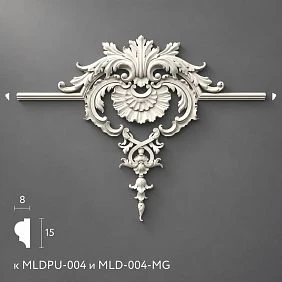
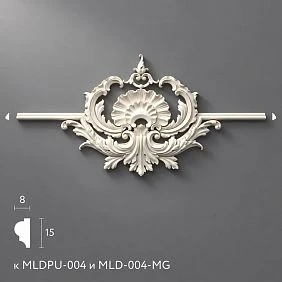
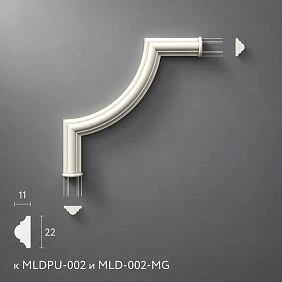
Decor for Molding — these are the elements that complete the frame. Corner inserts eliminate the need for precise 45-degree miter cuts: instead, the molding is cut at a right angle, and the corner is covered with a decorative element featuring an ornament or geometric motif. Central rosettes for frames, decorative inserts on straight sections of molding, finishing capital elements — all are gathered in one section and allow creating complex frame compositions without professional equipment.
Polyurethane rosettes
Polyurethane Rosettes — a separate section for ceiling and wall accent elements. Here, rosettes are classified by diameter and style, simplifying selection for a specific room size and lighting type. STAVROS rosettes are compatible with cornices and moldings from the same line, allowing you to assemble coherent ceiling compositions.
Ready-made collections: when style is already curated
One of the most powerful tools of a well-managed stucco shop is ready-made collections. They are needed by those who do not want or do not have time to independently coordinate moldings, inserts, rosettes, and cornices in terms of style and scale. Within a collection, all elements are already coordinated by the designer: in terms of pattern, profile, and assembly logic.
STAVROS offers several thematic collections of wall stucco decor.
Neoclassical Collection
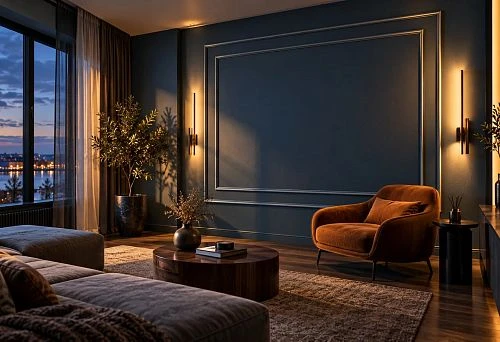
Neoclassical stucco collection is oriented towards modern interiors with an architectural foundation: thin moldings, calm symmetrical frames, moderate ornamentation. This is the optimal choice for living rooms and bedrooms that combine a classic structure with clean contemporary surfaces. The collection's elements pair well with white or pastel walls, as well as deep neutral tones — gray, anthracite, dark blue.
Neoclassicism in stucco decor is not baroque ornamentation or palace scale. It is architectural precision, moderate relief, and visual restraint that make the interior more 'mature' and complete without overloading with details.
Japandi Collection
Japandi stucco collection is created for interiors at the intersection of Japanese minimalist aesthetics and Scandinavian functionality. Soft geometry, calm horizontal and vertical lines, minimal ornamentation, no curls or baroque motifs. Japandi-style decor works to create a sense of order, tranquility, and mindful space.
Stucco for this style is primarily not decoration, but surface structuring. Thin frames of moldings, horizontal lines on walls, a calm ceiling border without heavy profile. All of this is present in the Japandi STAVROS collection.
Versailles Collection
Versailles Stucco Collection — for those creating a grand interior without compromise. Large ornamental elements, expressive reliefs, vertical panels, decorative medallions, rich cornice profiles. The collection is designed for large rooms with high ceilings, where large-scale decor does not overwhelm but sets the tone for the entire interior.
The Versailles style requires correct scale calculation: the higher the ceilings and the more spacious the room, the more elements and larger reliefs can be used. In apartments with ceilings below 2.8 m, elements of the Versailles collection are used selectively — in one accent area or on one formal wall.
How to choose stucco in an online store: step-by-step logic
When the catalog is open and the assortment is clear, the next question arises: where to start? Chaotic browsing of product cards leads to overload and the feeling that "everything is the same." A systematic approach eliminates this.
Step 1. Determine the application area.
Ask yourself one question: what am I decorating — walls, ceiling, doorways, furniture, or everything at once? The answer determines which section to start browsing the catalog from. For walls — go to Polyurethane wall decor. For ceiling — go to Ceiling decorationFor the linear geometry of the entire room — in Moldings and cornices.
Step 2. Define the style.
Classic, neoclassical, modern interior, Japandi, Versailles — these are not just words. Each style sets specific requirements for the molding profile, relief depth, ornament character, and element scale. If you are unsure about the style, start with ready-made collections — it's faster and safer.
Step 3. Choose the baseline.
The baseline is the cornice and baseboard. They create the vertical proportions of the room and are the foundation on which all other elements are placed. Do not start with a rosette — start with the line.
Step 4. Add accents.
Once the basic geometry is defined, add accent elements: molded decoration made of polyurethane in the form of applied ornaments, rosettes, decorative inserts. Remember: an accent only works against a structural background, not in a void.
Step 5. Check compatibility and dimensions.
Each element in the STAVROS catalog has precise dimensions. Match the molding width to the ceiling height, the rosette diameter to the chandelier size, the applique size to the facade area. Scale incompatibility is the most common mistake when selecting independently.
Step 6. Add mounting materials.
Polyurethane stucco is glued using mounting or acrylic adhesive. Before placing an order, make sure you have a suitable adhesive. More details on selection can be found in the article what to glue polyurethane molding with. The installation technology is described in detail in instructions for installing polyurethane molding.
Stucco catalog: what a complete order should include
A well-planned order from a stucco store is not just one element or even a set of three or four items. A complete set for one room includes several categories of products, each performing its own function in the interior decor system.
Let's break down what is included in a complete stucco catalog:
Moldings are linear profile elements for creating frames, horizontal and vertical wall divisions, and contour lines on the ceiling. They are sold by linear meter. Profile width: from 20 mm to 120 mm or more, depending on the scale of the interior.
Cornices are transition elements between the wall and ceiling. They mask the hard line of the corner and add volume. The width of the cornice is chosen proportionally to the ceiling height.
Baseboards are the lower boundary of the wall surface. In a stucco set, the baseboard repeats the style of the cornice, creating a visual "frame" for the entire room.
Ceiling rosettes are central accent elements of the ceiling. Diameter from 15 to 100+ cm. They are installed in the area of a chandelier, a point light source, or as an independent ceiling accent.
Wall sockets and medallions — decorative accent elements for centers of frame fields, above furniture, near mirrors, in niches. They serve as the final accent in a wall composition.
Decorative overlays — ornamental, geometric, and figured elements to enrich flat surfaces: doors, furniture facades, piers, slopes. Wide range in the section polyurethane molding decoration.
Pilasters — vertical column imitations suitable for tall rooms with ceilings from 3 meters. They set the scale and architectural monumentality.
Decor for moldings — corner inserts, central rosettes for frames, ornamental inserts for straight sections. They assemble frame fields into complete structures without complex miter cuts.
Glue, primer, putty — without mounting materials, stucco won't hold. Before ordering, be sure to check for a compatible adhesive.
Samples — for large orders or complex projects, it is recommended to order samples of several profiles to evaluate the relief and scale in person before purchasing the main volume.
Ready-made set or individual selection: what to choose
This is one of the main questions when working with a stucco catalog. The answer depends on several factors: the presence of a clear design project, experience in selecting decor, time resources, and specific interior tasks.
| Selection option | When justified | Key advantage |
|---|---|---|
| Ready-made set from the collection | No design project, need quick results | Elements are already coordinated in style and scale |
| Individual selection | Have an exact project with a drawing | Full flexibility in size and layout |
| Socket + cornice (minimum set) | Quick ceiling update without wall work | Minimal labor with maximum effect |
| Moldings + corner inserts | Wall frames, accent wall | You can choose any frame configuration |
| pilasters + capitals + cornice | High ceiling, grand hall | Architectural scale and monumentality |
| Overlays + moldings on furniture | Updating cabinet, dresser, and door fronts | Without replacing furniture — a new character for the space |
For those working with a designer or implementing a project from a drawing, individual selection from the catalog is the only correct option. For those doing renovations on their own and not wanting to delve into the theory of decor, a ready-made collection solves the problem in one visit to the catalog.
How to avoid mistakes with size: a practical guide
Incorrect size is the most costly mistake when ordering moldings. Fixing it after installation is difficult, and in some cases, you will have to dismantle the entire decor and order it again. To avoid this, check every parameter before placing your order.
Cornice and baseboard: proportion to ceiling height
There is a simple rule: the width of the cornice in centimeters should be approximately 3–5% of the ceiling height. For ceilings of 2.5 m, this is 7.5–12.5 cm. For ceilings of 3 m, it is 9–15 cm. For heights from 3.5 m, it is 10–18 cm or more.
The baseboard is typically made 20–30% narrower than the cornice. This creates a proper sense of lightness in the space: the "cap" is less heavy than the "base."
Molding: width depending on frame size
The width of the molding for frame fields is selected as follows: the height of the frame should be at least 8–10 times the width of the molding. That is, with a molding width of 4 cm, the frame should be no lower than 32–40 cm. Otherwise, the molding will "eat up" all the internal space of the frame.
The distance between adjacent frames should be at least one width of the molding. A smaller distance makes the wall look "sewn up" and heavy.
Ceiling rosette: ratio to chandelier and ceiling area
Quick calculation: the diameter of the rosette should be 1.5–2 times larger than the diameter of the chandelier shade. If the chandelier is 40 cm in diameter, the rosette should be 60–80 cm. Another guideline: the area of the rosette should not exceed 10% of the ceiling area, otherwise it will feel oppressive.
For rooms up to 12 sq. m — rosette 25–40 cm. 12–20 sq. m — 40–60 cm. 20–35 sq. m — 60–85 cm. More than 35 sq. m — from 85 cm to 120 cm or more.
Furniture and door overlays
The decorative overlay on the facade should occupy 50–70% of the facade area. An element that is too small gets lost on a large surface. One that is too large overloads and "covers" the facade. Leave equal margins on all sides.
How to choose the style of stucco decor in a store
The style of stucco is not just a matter of taste. It is a requirement of a specific interior direction that cannot be violated without losing the integrity of the space. Let's consider the main scenarios.
Neoclassicism: a balance of architecture and modernity
Neoclassical stucco decor is the most popular in modern city apartments. Thin moldings with a moderate profile, calm symmetrical frames, small rosettes without heavy ornamentation. Decorative inserts are restrained, geometrically clean. Stucco in this style does not shout—it organizes.
The style works well in rooms with a neutral palette: white, gray, cream, light green walls. For this task, a ready-made Neoclassical stucco collection in the Stavros catalog.
Classic: the order system and ornamental richness
Classic stucco decor requires more volume: cornices with ornamentation, pilasters with capitals, large ceiling rosettes, frame fields with corner ornamental inserts. Here, the rhythm of repetition and strict symmetry are important. A mistake is to place one classic element on a wall without the others: it will look like an artifact from another era, not part of a well-thought-out decor.
For classic style, a ceiling height of at least 2.8 m is required. With ceilings of 2.5 m, classic decor is used selectively—for example, only a ceiling rosette with a cornice, without voluminous pilasters.
Modern interior: geometry without ornament
Stucco in a modern interior is geometry, not decoration. Straight-line moldings, thin horizontal lines, smooth frames without ornamental inserts, a laconic ceiling border. The color of the stucco often matches the color of the walls: a monochrome technique makes the decor textural rather than a color accent.
This style is suitable for Japandi collection: soft horizontal lines, minimal relief, calm geometry.
Baroque and Versailles: scale and expressiveness
This is a style for the bold. Large relief, ornamental overlays with scrolls and acanthus leaves, heavy cornices, medallions, vertical panels with framed fields — all this creates the feeling of a palace space. Full implementation requires high ceilings (from 3 m) and spacious rooms. In compact rooms, only one accent element is used — for example, a ceiling rosette or a decorative panel above the fireplace.
Versailles Collection in the STAVROS catalog — this is a ready-made solution for those who choose this particular path.
Pricing for stucco: what makes up the cost of an order
One of the most common questions in a stucco store is why the same type of element can cost differently. The price range is explained by a set of specific factors that affect the cost of production, packaging, and delivery of the product.
Type of element. A linear molding with a simple profile is significantly cheaper to produce than an ornamental overlay with deep relief and a complex shape. Linear elements are calculated in meters, piece elements are calculated individually.
Size. A wider cornice, a larger diameter rosette, a larger ornamental overlay — all of this requires more material and more complex tooling.
Relief complexity. A smooth geometric profile and an ornamental element with multi-tiered relief are different categories of production complexity. This is reflected in the price.
Number of elements in the order. A large order is generally more cost-effective per unit — especially in terms of delivery and logistics.
Ready-made set or piece-by-piece purchase. Ready-made collections often offer more favorable terms than selecting the same elements separately.
Delivery. For large-sized elements (wide cornices, long moldings), the delivery cost is higher. Keep this in mind when placing your order.
Allowance for trimming. Professionals always add 10–15% extra material for cutting corners, correcting mistakes, and unforeseen situations.
Painting. White base molding is the most economical option. Molding in gold, silver, patina, or tinting in a complex color requires additional materials and labor for painting.
Current exact prices for all items are listed in the product cards of the STAVROS catalog.
Molding for an apartment and for a house: different tasks, different approach
Buyers of the molding store are a very diverse audience. Some are decorating a standard apartment with 2.5 m ceilings and want to add an architectural 'touch'. Others are building a private house with high ceilings and open stairwells, where a large-scale decorative system is needed.
For an apartment with ceilings up to 2.7 m, the priority is lightness and moderation. A thin cornice, a small ceiling rosette, one framed accent wall. The Neoclassic and Japandi collections are designed specifically for this.
For a house with ceilings of 3 m and higher, the possibilities expand dramatically. Here, wide cornices, pilasters along high walls, rosettes with a diameter of 60 to 100 cm, and full panel fields around the entire perimeter of the living room are justified. For these tasks, the Versailles collection and a wide range of classic elements are suitable.
Stucco for the hallway in a private house often becomes the hallmark of the entire interior: high vertical moldings, decorative openings, a ceiling rosette above the central light fixture, a connection with the cornices in the living room — all this forms the first and most important impression of the house.
Stucco for a study is another special scenario: strict panel fields on the lower part of the walls, a wide molding without ornament, dark wall coloring with white or gold stucco decor. It is this combination that creates an atmosphere of business concentration and status.
Typical mistakes when choosing stucco in an online store
Experience working with customers shows that most mistakes when ordering stucco are repeated time after time. Knowing them in advance makes it easy to avoid them.
Buying one element without an overall scheme. One rosette, one molding, or one cornice is not yet decor. Interior stucco works as a system. Start by understanding the entire area you plan to decorate.
Not checking dimensions before ordering. A molding 6 cm wide in a room with a 2.5 m ceiling will look rough and heavy. A cornice 5 cm wide in a grand hall with 4 m ceilings will be lost and go unnoticed.
Mixing styles. A Baroque rosette on the ceiling and minimalist straight-profile moldings on the walls are an incompatible combination. The style should be unified within a single room.
Not accounting for a cutting allowance. For moldings and cornices, always add 10–15% over the calculated quantity. Cutting at corners is inevitable.
Ordering without installation materials. This is a typical mistake that forces you to wait for a second package and delays installation. Include glue in your order right away.
Choosing facade elements instead of interior ones. Facade stucco has a different scale and texture. In an interior, it will look rough and out of place.
Not reading the product card. STAVROS product cards include exact dimensions, profile descriptions, and application recommendations. Ignoring this information means buying blindly.
Where to buy polyurethane stucco: navigation through STAVROS sections
Let's summarize the practical outcome. If you are ready to proceed with selection and want to go directly to the right section, here is a direct navigation map of the catalog.
To Buy molding and see the entire assortment — start with the main section. All categories are collected here: from moldings and cornices to rosettes, overlays, and ready-made collections.
For wall stucco decor — moldings, pilasters, panels, overlay elements, and ready-made collections — go to the section interior stucco for walls.
For the ceiling — rosettes, ceiling cornices, and corner elements — section of polyurethane ceiling moldings.
For basic geometry — linear moldings, cornices, baseboards, linear moldings — section polyurethane moldings and cornices.
For corner inserts, ornamental accents, and decorative frame inserts — section decoration for moldings.
For overlay elements on doors, furniture, niches, and openings — section polyurethane molding decoration.
For ceiling and wall rosettes — section polyurethane rosettes.
For quick style matching — ready-made collections: Neoclassical, Japandi, Versailles.
FAQ: answers to popular questions about the stucco store
How is a stucco store different from a regular online decor store?
A specialized stucco store offers a full range for complete interior decoration: moldings, cornices, rosettes, overlays, frame decor. It has sections by application area, ready-made collections, and technical data on sizes. A regular decor store often offers unrelated items without the ability to assemble a complete set.
Can I buy stucco myself without a designer?
Yes. The ready-made collections in the STAVROS catalog are designed specifically for self-selection: the elements are already coordinated in style and scale. For more individual solutions, use the step-by-step selection logic from this article: zone → style → baseline → accents → sizes → installation.
Is polyurethane stucco durable?
Yes. Polyurethane does not crack with temperature changes, does not crumble upon impact, and is not afraid of moisture. Products retain their shape for many years without deformation or yellowing. With proper installation and painting, polyurethane decorative molding is practically indistinguishable from plaster molding to the eye and significantly surpasses it in practicality.
How do I know which molding is right for my room?
Focus on ceiling height. For ceilings 2.5 m — molding width 3–5 cm. For 2.7–3 m — 4–7 cm. For 3 m and above — from 6 cm and more. Check that the selected molding is compatible with corner inserts from the same style range.
Can I buy only a ready-made set without selecting individual elements?
Yes. The STAVROS catalog has ready-made collections by style: Neoclassic, Japandi, Versailles. Each of them contains coordinated elements for a wall decorative system. To complement with ceiling decor, use the corresponding section.
Is delivering molding difficult?
Polyurethane products are lightweight, so transportation is easier than for plaster molding. Long linear elements are packaged in a special way. When ordering, check the delivery conditions on the product card or on the order placement page.
How to calculate the required amount of molding for a room?
Measure the perimeter of all walls where installation is planned. For cornices — this is the perimeter of the room. For wall frames — calculate the perimeter of each frame and multiply by the number of frames. Add 10–15% for trimming. Corner inserts are counted separately: 4 pieces for each rectangular frame.
What glue to use for polyurethane molding?
Acrylate mounting adhesives, specialized polyurethane glue, and solvent-free liquid nails are suitable. The choice depends on the surface type. Details are in the article what to glue polyurethane molding with.
About the company STAVROS
STAVROS is a professional online store of polyurethane stucco with a full catalog of products for interior decor. The company works with private customers, designers, and architects throughout Russia, offering a wide range stucco decoration of European production — from thin moldings for modern interiors to grand collections in the Versailles style. In the STAVROS catalog, each section is structured so that the buyer can independently assemble a complete set of decor: for walls, ceiling, doors, and furniture — without losing style coherence and scale. This is not just a store of items — it is a tool for creating complete, architecturally thought-out interiors.