










































































Article Contents:
- What is the round wooden handrail PR-004
- When to choose a round profile
- For stair railings in the house
- For a handrail along the wall
- For high-traffic areas
- For interiors where soft tactility is important
- For classic and calm modern solutions
- For railings
- For stairs
- For wall mounting
- Determine the scenario: railings, wall, or stairs
- Check compatibility with balusters and posts
- Evaluate length and joining
- Consider the Interior Style
- Consider the finish
- First check the wall base
- Select brackets for the handrail and wall
- Mark the height before installation
- Plan the joints and endings
- Check the rigidity after installation
- Choosing only by shape
- Not checking compatibility with fasteners
- Not considering the length of the stair flight
- Forgetting about the finishing touch
- Use a round profile where a complex decorative look is needed
- Do not compare the round and profile options before purchase
- Which handrail is more comfortable: round or profile?
- When should you buy a round wooden handrail for railings?
- Can PR-004 be used as a wall-mounted handrail?
- How to attach a handrail to a wall?
- How to attach a wooden handrail to a wall on a staircase?
- How does a round wooden handrail differ from a profiled one?
- Is a round handrail suitable for a classic interior?
- Is a round handrail suitable for a modern interior?
- What to check before buying PR-004?
- Can I buy PR-004 for railings?
- Where to buy a round wooden handrail PR-004?
- What to choose if the round profile seems too simple?
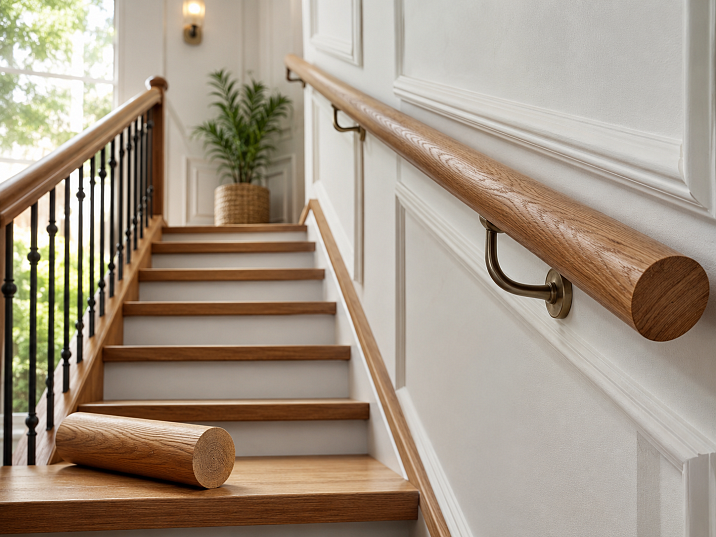
It is worth buying a round wooden handrail for railings when not only the appearance of the staircase is important, but also a comfortable grip, calm geometry, and natural material. The round profile is perceived as softer than complex shaped handrails, fits well in the hand, and is suitable for different scenarios: stair railings, a wall-mounted handrail along the flight, a walk-through area in the house, a neat railing in a classic or calm modern interior.
The round wooden handrail PR-004 is a specific profile that can be considered for railings, stairs, and walls. Its task is not just to close the top line of the railing, but to make movement on the stairs more convenient and visually assemble the structure. The handrail is constantly in contact with the hand, so when choosing, you cannot look only at decorativeness. The shape, size, compatibility with the fastening, length of the section, quality of processing, and how the part will combine with balusters, posts, wall, and finish are important.
If you need not an abstract wooden profile, but a ready-made selection point, you can buy the round wooden handrail PR-004 and before ordering, check the current parameters in the product card. To compare with other shapes and options, it is worth additionally opening the section wooden stair handrails.
This article helps to understand when a round profile is truly convenient, how it differs from a profiled handrail, where to use PR-004, how to approach wall mounting, what mistakes most often occur when choosing, and why before purchasing you need to evaluate not only the shape but the entire stair assembly.


What is the round wooden handrail PR-004
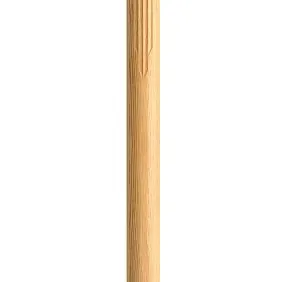
The round wooden handrail PR-004 is a wooden profile of rounded shape for stair and railing solutions. It can be considered for cases where an upper railing part with a clear grip and a calm line is needed. Unlike complex shaped profiles, the round form does not require active decorative interpretation: it works through convenience, simple geometry, and a soft tactile feel.
A handrail is not just a decorative strip. It participates in a person's movement on the stairs. People hold onto it when climbing, descending, turning, moving between floors, or moving along a wall. Therefore, a round profile is often chosen where versatility is important: the hand easily wraps around the surface, the shape has no sharp corners, the line looks calm and does not conflict with balusters or posts.
PR-004 should be considered as a specific product, not as a general idea of a "round handrail." Before ordering, you need to open the card, check the current characteristics, size, material, purpose, and compatibility with the project. If the handrail is being selected for a complex staircase, a long wall section, or a railing with several turns, it is better to plan the joints, fastening, and finishing in advance.
| Parameter | What is important to understand | Why the buyer needs this |
|---|---|---|
| Model | PR-004. | You can select a specific card rather than manually searching for a similar profile. |
| Profile type | Round wooden handrail. | Suitable when a universal grip and soft line are needed. |
| Purpose | Railing, staircase, wall section. | Helps choose a handrail for the actual installation scenario. |
| Material and dimensions | Current parameters should be checked in the product card. | Size, material, and length affect installation, joints, and appearance. |
| Where to look | buy the round wooden handrail PR-004 | The product card helps transition from selecting a form to placing an order. |




When to choose a round profile
A round profile is chosen not because it is "the best," but because it solves a specific problem. It is convenient where the handrail should be intuitive, pleasant to grip, and visually calm. This shape works well in private homes, on stairs between floors, along walls, in walk-through areas, and on railings where you don't want to overload the structure with a complex decorative profile.
Our factory also produces:



For stair railings in the house
On a home staircase, the handrail is used every day. It is judged not only for style but also for comfort. The round profile provides even contact with the hand and does not tie the staircase to a too rigid decorative image. It can be combined with wooden balusters, posts, simple railings, and more subdued modern solutions.
When a buyer searches for a round wooden handrail for railings to buy, most often they need exactly this balance: wood, a clear shape, a comfortable grip, and the ability to integrate the profile into the stair railing without unnecessary visual complexity.
Get Consultation
For a handrail along the wall
A wall-mounted handrail is needed where the staircase runs along a wall or additional support is required when moving. Here, the round profile is especially convenient: it is easy to grasp, does not look like a heavy decorative detail, and can run in a long, calm line along the flight.
In wall mounting, not only the shape of the handrail is important, but also the fastening. You need to understand in advance how to attach the handrail to the wall, what brackets will be used, whether the base can withstand the load, and how the fixation points will be positioned.
For walk-through areas
In walk-through areas, the handrail should be comfortable and not obstruct movement. A round profile does not create a sharp visual protrusion and feels softer. This is especially important on narrow stairs, in corridors, in multi-level homes, on transitions between floors, and in places where the handrail is frequently used by children, elderly people, or guests.
For interiors where soft tactility is important
A round wooden handrail is chosen not only with the eyes. It is constantly touched by hand. Therefore, tactility is more important here than for many other interior details. The round shape gives a feeling of softness and naturalness. Wood adds warmth, and the simple geometry does not distract from the staircase itself.
For classic and calm modern solutions
PR-004 can be considered for both classic and modern interiors if the goal is to maintain a clean line. In a classic setting, a round handrail can support wooden elements without excessive carving. In a modern interior, it adds naturalness but does not conflict with the simple geometry of the space.
Round handrail vs. profiled handrail: what's the difference
Round and profiled handrails cannot be compared on the principle of 'one is right, the other is wrong.' They simply solve different problems. A round profile is chosen when a universal grip and a calm line are needed. A profiled handrail is appropriate where a more expressive shape, decorative geometry, or precise alignment with the staircase style is important.
| Criterion | Round handrail | Profiled handrail |
|---|---|---|
| Grip | More versatile and uniform. | Depends on the profile shape. |
| Visual effect | Soft, calm, neutral. | More pronounced geometry or decorative line. |
| Scenarios | Wall, staircase, railing, passage area. | More often stylistically defined staircases and decorative railings. |
| Strong point | Convenience, simplicity of form, versatility. | Expressiveness, decorativeness, connection to a specific style. |
| Risk of error | May be too simple for a complex classical staircase. | May be less versatile in grip and too visually active. |
If the staircase itself is richly decorated, a profiled handrail can support its decorative character. If the main goal is convenience, a calm line and natural wood without unnecessary complexity, the round wooden handrail PR-004 should be considered first.
Where to use PR-004: railings, wall, staircase
PR-004 can be considered in three main scenarios: as a top rail for railings, as a handrail for stairs, and as a wall-mounted handrail. In each case, the selection logic changes. For railings, compatibility with the balustrade is important. For stairs, the length of the flight, joints, and ease of movement matter. For walls, brackets, base, and attachment points are key.
For railings
If you need to buy a round wooden handrail for railings, start by evaluating the balustrade itself. What are the posts like? Are there balusters? What is the width of the staircase? What is the style of the house? A round profile looks good where the top line should be soft and not overload the structure.
Buying a round wooden handrail for railings is especially reasonable if the railings already have expressive vertical elements, and the top should not add extra relief. A round profile can become a calm connecting line between balusters, posts, and the stair flight.
For a staircase
When a buyer wants to buy a round wooden handrail for a staircase, it is important to look not only at the shape but also at the length of the flight. The staircase can be straight, turning, with a landing, or with multiple sections. The handrail should be comfortable along the entire path, not just on one short segment.
Buying a round wooden handrail for a staircase is worth it when the project requires a natural detail that feels comfortable in the hand and does not visually weigh down the staircase. But before ordering, it is important to understand how joints, ends, turns, and fastening will be handled.
For wall mounting
A wall-mounted handrail is needed not only on stairs without a railing. It is also used as an additional support along the wall, especially if the stairs are frequently used by children, elderly people, or guests. In this case, a round profile is convenient because the hand grips it naturally.
The question "how to attach a wooden handrail to the wall" cannot be solved after purchase. First, you need to check the wall base, select brackets, determine the height, mark the attachment points, and understand where the joints will be. The handrail itself and the fasteners must work together.
How to choose a round wooden handrail for railings
The choice begins with the purpose. One handrail is installed on the railing, another goes along the wall, and a third is used on a staircase with several turns. The shape may be the same, but the requirements for installation and length will be different.
Determine the scenario: railing, wall, or staircase
For railings, the handrail must match the posts and balusters. For the wall, it must match the brackets and base. For the staircase, it must match the length of the flight, installation height, and ease of movement. If this scenario is not determined immediately, you might buy a beautiful profile that turns out to be inconvenient to install.
Check compatibility with balusters and posts
The handrail does not exist separately from the railing. It must visually and structurally connect with the vertical elements. If the balusters are expressive, a round profile can provide a calm top. If the posts are simple, a round handrail will support the minimalist character of the staircase.
To compare other solutions, you can open the section wooden stair handrails and see what shapes are available for different staircase tasks.
Assess the length and joining
A staircase rarely consists of a single perfectly straight section. Often there is a turn, a landing, an abutment to a wall, the start and end of a flight. Therefore, before ordering, you need to understand what length of handrail is needed, where the joints will be, and how they will look after installation.
If the section is long, it is especially important to plan the connections in advance. A poorly placed joint can ruin even a good profile. It is better to resolve this issue before purchase, rather than on site on the day of installation.
Consider the interior style
A round wooden handrail is versatile but not faceless. In a classic interior, it can support natural wood and the soft line of the railing. In a modern one, it can add warmth without complex ornamentation. In a country house, it can match wooden steps, walls, balusters, and other elements.
If the interior is built on intricate carving, massive details, and rich profiles, a round handrail may be too understated. If the interior is minimalist, on the other hand, it may be exactly the option that does not overload the staircase.
Consider the finish
The handrail is in constant contact with the hand. Therefore, the finish should be pleasant to the touch, resistant to regular use, and match the interior. It is better to select the color of the handrail together with the steps, balusters, doors, flooring, and furniture.
The exact options for material and finish should be checked in the product card or clarified with a STAVROS manager. You should not choose a shade separately from other wooden elements: the handrail is visible along the entire length of the staircase.
How to attach a wooden handrail to a wall
The question 'how to attach a handrail to a wall' is important for those considering PR-004 as a wall-mounted profile. Here, you cannot limit yourself to choosing beautiful wood. The wall-mounted handrail must be securely fastened, conveniently positioned in height, and able to withstand real use.
First, check the wall base
The wall can be wooden, brick, concrete, drywall, paneled, or composite. The fastening depends on the base. If the fastening is chosen incorrectly, the handrail may wobble, pull away from the wall, or fail to bear the load.
Therefore, before purchasing and installing, you need to understand what the wall is made of and where brackets can be placed. Pay special attention to areas on the stairs where a person will lean on the handrail when going up and down.
Choose brackets for the handrail and wall
The brackets must fit the round profile and the wall base. They should hold the handrail at the required distance from the surface, not interfere with the grip, and look neat. If the bracket is too massive, it may clash with the wooden profile. If too weak, it won't provide the necessary rigidity.
It is best to select fasteners and brackets together with a specialist, especially if the staircase is long or the wall has a complex base. The handrail itself in such a system only works in conjunction with proper fixation.
Mark the height before installation
The height of the handrail affects convenience. If it is too low, it is uncomfortable to use. If too high, the hand will be in an unnatural position. It is better to do the marking before drilling and installing brackets, taking into account the stair flight, user height, and overall movement ergonomics.
Plan the joints and ends
If the wall-mounted handrail consists of several sections, the joints must be neat. They should not interfere with the hand, snag, or look accidental. The ends are also important: an abrupt end can look unfinished, especially in a visible area of the staircase.
Check the rigidity after installation
After installation, the handrail should feel secure. It is checked not only visually but also by hand: for any play, vibration, weak spots, or uncomfortable joints. If the handrail is used as a support, such a check is mandatory.
What to buy together with a round handrail
A handrail is rarely purchased as a completely standalone part. It is connected to the staircase, railings, balusters, posts, brackets, trim, and other wooden elements. Even if a buyer chooses a specific PR-004, it is useful to compare it with neighboring models and understand in advance which parts are needed for the entire stair assembly.
| What to look at | Why this is needed | When it is especially important |
|---|---|---|
| buy the round wooden handrail PR-004 | Select a specific round profile for railings, walls, or stairs. | When a soft grip and a calm wooden line are needed. |
| wooden stair handrails | Compare PR-004 with other profiles and choose a shape to match the interior. | If you need to understand whether a round or profiled option is better. |
| Brackets and fasteners | Needed for wall mounting and secure fixation. | When installing the handrail along the wall. |
| Balusters and posts | Help to assemble a complete railing. | If the handrail is used not on the wall, but in the railing. |
| Finish | Protects the wood and sets the external shade. | For any handrail that will be used regularly. |
How not to confuse PR-004 with similar products
Handrails, moldings, trims, slats, and other wooden profiles may look similar in shape, but they have different purposes. A mistake occurs when a buyer sees a round wooden profile and thinks that any such element will work for a staircase. The handrail must be specifically designed for grip, installation, and use in the staircase area.
| Similar product | Why this is not the same | What to Check |
|---|---|---|
| Regular round molding | May be a decorative profile, not a handrail. | Purpose, size, and applicability for stairs. |
| Profile handrail | It has a different grip shape and a different visual character. | Hand comfort, stair style, compatibility with the railing. |
| Rail | The rail often works as a decorative or structural strip, rather than a part for gripping. | Can it be used as a handrail — usually not without confirmation of purpose. |
| Baluster | This is a vertical railing element, not a top handrail. | How the baluster will combine with the handrail. |
| Decorative molding | Molding decorates the surface but is not intended for hand support. | Purpose of the product and installation method. |
Mistakes when choosing a round handrail
Choosing only by shape
The round shape is convenient, but by itself does not solve the entire project. You need to understand where the handrail will be placed: on railings, on a wall, on a flight of stairs, or in a walkway area. The mounting, length, joining, and adjacent elements depend on this.
Not checking compatibility with fasteners
This mistake occurs especially often during wall mounting. The buyer chooses a beautiful wooden handrail but does not think about the brackets. As a result, the fasteners may not fit in terms of shape, distance from the wall, or appearance. It is better to address this issue before purchasing.
Not considering the length of the flight of stairs
A short handrail and a long flight require different approaches. On a long section, joints, support, placement of fasteners, and visual continuity of the line are important. If all this is not thought through, the handrail may look like it is assembled from random parts.
Forgetting about the finish
A wooden handrail is constantly touched by hand. The surface should be pleasant, protected, and suitable for the interior. You cannot choose only the shape without thinking about the future coating and color.
Using a round profile where a complex decorative look is needed
If the staircase is richly decorated, has carved balusters, complex posts, and classical architecture, a simple round handrail may look too neutral. In such a situation, it is worth comparing PR-004 with other profiles in the section wooden stair handrails.
Do not compare the round and profiled options before purchasing
Sometimes a buyer is initially sure they need a round handrail, but after comparison realizes that a profiled option suits the staircase better. The opposite also happens: a complex profile looks beautiful in a photo, but in a real interior, the round one appears calmer and more comfortable. Comparison helps avoid a hasty decision.
Who is the round wooden handrail PR-004 suitable for
PR-004 is suitable for those looking for a wooden handrail with a soft grip and a calm line. It should be considered for private homes, staircases between floors, wall-mounted sections, walk-through areas, and railings where the naturalness of wood needs to be preserved without an overly complex decorative profile.
Such a handrail is especially appropriate if the interior is built around wood but does not require overload. It can complement a classical staircase if the overall composition is calm enough. It can also work in a modern home if you need to add a warm wooden detail without sharp geometry.
PR-004 may not be suitable if you need an expressive profiled line, complex decorative classicism, a non-standard staircase unit without preliminary calculation, or a solution where the handrail should become the main relief accent. In such cases, it is better to compare several models and choose the shape for the specific staircase.
Why PR-004 is worth considering for the project
PR-004 is worth considering for those who want to start their selection with a clear, specific product card. This is especially convenient when the buyer has already decided they need a round profile but still wants to understand if it is suitable for railings, walls, or stairs. The product card helps move from an idea to parameters: view the profile, check specifications, and prepare for ordering.
The round shape is universal in terms of grip. It does not overload the staircase and works well in long lines. Wood adds tactile warmth and visual softness. Therefore, PR-004 can be a good option for a project where the handrail should be comfortable, clear, and not overly decorative.
Before purchasing, it's worth not only opening the product card buy the round wooden handrail PR-004, but also comparing it with other options in the section wooden stair handrails. This makes it easier to understand whether a round profile is needed or if a more pronounced shape is better.
Where to buy the round wooden handrail PR-004
If you need to buy a round wooden handrail for railings, start with the PR-004 card. On the product page, you can study the profile and proceed to order. Before purchasing, it's important to check the current dimensions, material, purpose, possible finishes, and compatibility with your staircase project.
To compare other solutions, use the general section wooden stair handrails. This is useful if you are still choosing between a round and a profiled handrail, or want to select a shape to match balusters, posts, walls, and interior style.
For complex installation, long stair runs, wall mounting, or non-standard railings, it's better to clarify details with a STAVROS manager in advance. The handrail should be chosen together with the mounting, joints, installation height, and final finish — then it will not just be a beautiful wooden profile, but a comfortable part of the staircase.
FAQ
Which handrail is more comfortable: round or profiled?
A round handrail is more often chosen for a universal grip and calm geometry. A profiled handrail is appropriate when you need to emphasize the shape, staircase style, or decorative line of the railing.
When should you buy a round wooden handrail for railings?
A round wooden handrail is worth considering for stairs, railings, and wall sections where a comfortable grip, natural material, and visually soft profile are important.
Can PR-004 be used as a wall-mounted handrail?
Yes, a round wooden handrail can be considered for wall mounting if you select suitable brackets, check the wall base, and plan the attachment points in advance.
How to attach a handrail to a wall?
Usually, first mark the layout, then select brackets for the wall base, secure the fasteners, and check the rigidity of the installation. For a wooden handrail, it is important to plan the attachment points and joints in advance.
How to attach a wooden handrail to a wall on a staircase?
You need to consider the height of the flight, the wall base, the placement of brackets, and the comfort of the grip. On a long section, additionally plan the joints and uniformity of attachment.
How does a round wooden handrail differ from a profiled one?
A round handrail has a uniform shape and a neutral visual rhythm. A profiled handrail may look more expressive but depends more on the style of the staircase and the decorative task.
Is a round handrail suitable for a classic interior?
Yes, if the classic staircase does not require an overly complex decorative profile. A round wooden handrail can support a calm classic line and natural material.
Is a round handrail suitable for a modern interior?
Yes. In a modern interior, a round wooden profile helps add a warm natural detail without overloading with complex relief.
What to check before purchasing PR-004?
You need to check the current dimensions, material, purpose, installation method, compatibility with fasteners, length of the staircase section, joints, and future finishing.
Can I buy PR-004 for railings?
Yes, PR-004 can be considered as a round wooden handrail for railings. Before ordering, you need to assess compatibility with balusters, posts, and the overall railing structure.
Where to buy the round wooden handrail PR-004?
You can buy the round wooden handrail PR-004 through the STAVROS product card. To compare similar products, it is also worth opening the section of wooden handrails for stairs.
What to choose if a round profile seems too simple?
It's better to compare PR-004 with other wooden handrails. If the staircase requires a more decorative line, a profiled handrail from the general handrail section for stairs may be suitable.
Conclusion: a round handrail is chosen for a comfortable grip and a calm line
The round wooden handrail PR-004 is suitable for cases where the handrail should be comfortable, pleasant to the touch, and visually calm. It can be considered for railings, stairs, and wall mounting, if you check the fastening, section length, compatibility with balusters or brackets, and future finishing in advance.
A round profile does not always replace a profiled handrail. In a complex decorative staircase, a more expressive shape may be needed. But if the main goal is a universal grip, natural wood, and soft geometry, PR-004 is worth including in the selection.
At STAVROS you can buy the round wooden handrail PR-004 or go to the section wooden stair handrailsto compare shapes, choose the appropriate profile, and prepare an order for specific railings, wall, or stairs.