








































































Article Contents:
- Attaching table legs at a 10° angle: how to choose a mounting plate for wooden furniture supports
- Why attaching table legs is a load-bearing unit, not a small fastener
- When a mounting plate for furniture legs is needed
- Attaching table legs at a 10° angle: which projects it suits
- Where angled installation is used
- How angled attachment differs from straight attachment
- Straight, angled, and threaded attachment: how to choose the right option
- Straight mounting plate
- Corner plate 10°
- Metal reinforced plates FUR-034 and FUR-035
- Attachment to the apron
- Mounting without apron
- Attaching legs to tabletop: checklist before purchase
- Tabletop parameters
- Leg parameters
- Load parameters
- Installation angle
- How to choose a mount for wooden table legs
- Turned round legs
- Square and tapered legs
- Massive legs for dining tables
- Which STAVROS mounting plates to use: line overview
- FUR-017: mounting plate 10°, wood
- FUR-020: mounting plate, wood
- FUR-031: mounting plate
- FUR-034 and FUR-035: reinforced mounting plates
- Comparative table of STAVROS plates
- Typical mistakes when installing table legs
- Mistake 1: choosing a straight plate for angled installation
- Mistake 2: not checking the thread before installation
- Error 3: placing legs too close to the edge
- Error 4: not accounting for the weight of the tabletop
- Error 5: mixing different types of plates on one table
- Error 6: not making preliminary markings
- Error 7: not checking the symmetry of the tilt during angular installation
- Error 8: overtightening the fasteners
- Error 9: not installing a support pad
- What to buy together with the mounting plate: complete assembly kit
- Wooden furniture legs and fittings: a systematic approach
- Where to buy table leg brackets at a 10° angle
- About the Company STAVROS
- FAQ: Answers to Popular Questions
- When is a 10° mounting plate needed?
- How is the 10° plate (FUR-017) different from a straight plate?
- Can wooden legs be attached to a tabletop without a plate?
- Which plate should I choose for a heavy tabletop?
- How to avoid leg misalignment?
- Is FUR-017 compatible with STAVROS legs?
- Is a foot pad needed when installing legs at an angle?
- Where to buy a 10° mounting plate in Moscow and St. Petersburg?
- What is a threaded insert and why is it needed?
- Can the mounting plate be installed by yourself?
Attaching table legs at a 10° angle: how to choose a mounting plate for wooden furniture supports
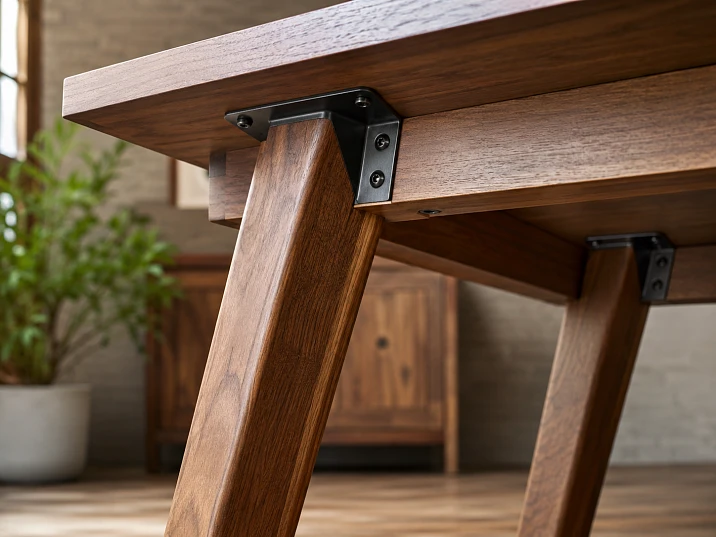
The table wobbles. The leg is skewed. The joint is loose. Sound familiar? And it's almost never the leg itself — it's how it's attached. The fastening joint between a wooden support and the tabletop is not a trivial matter that can be solved with a couple of screws "by eye." This is a load-bearing joint that determines the table's stability, the durability of the connection, and whether your product will stand level in a year — or wobble with every movement.
If you are looking for leg mounting hardware for the table — especially for angled installation at 10° — this article will guide you through all key decisions: from load physics to specific mounting plates with part numbers and links.




Why attaching table legs is a load-bearing joint, not minor hardware
Let's be honest: most people buy table legs and think about the legs. Shape, height, wood species, finish tone — all of this is discussed, chosen, compared. But the hardware — "I'll pick something on the spot."
And that's where the problems begin.
Attaching a leg to the tabletop is the point where all load is concentrated. The weight of the tabletop, dynamic loads (leaning, bumping, moving), the weight of items on the table — all of this is transmitted through four small fastening joints. If each works correctly, the table lasts for years. If not, play appears within a few months, and within a year the legs start to "wander" with every touch.
Joints are especially vulnerable when:
-
Legs are installed at an angle (angled installation).
-
The tabletop is made of solid wood or a heavy material.
-
No crossbar — legs are attached directly to the tabletop.
-
Incorrect hardware is used that is not designed for lateral load.
The conclusion is one: choosing the attachment must be approached as carefully as choosing the legs themselves.
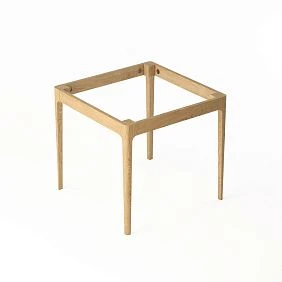
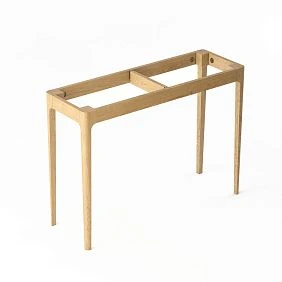
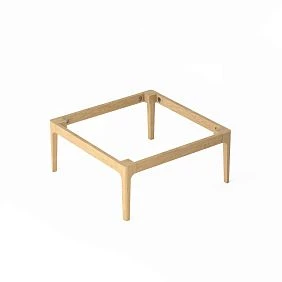
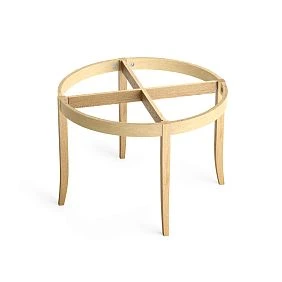
Our factory also produces:

When a mounting plate for furniture legs is needed
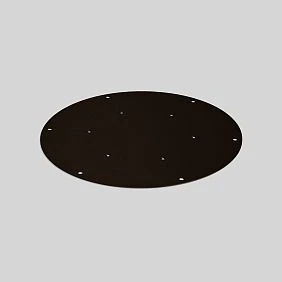
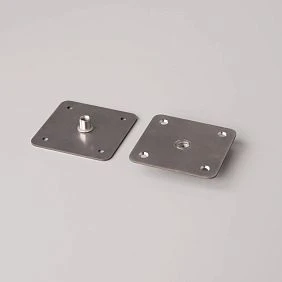
A mounting plate is a transition element between the leg and the tabletop. It takes the load from the leg and distributes it over a larger surface area of the tabletop, ensures the correct angular position of the leg, hides the threaded joint, and simplifies installation.
Why is a plate needed if you can screw the leg directly?
Direct screwing works when the leg is small, light, and the load is minimal. As soon as there is real weight, dynamic loads, or an angled installation — a plate is indispensable. Here's why:
Load distribution. The plate takes the force from the leg over an area of 60–100 sq. mm (or more) instead of the point contact of a single stud. This reduces the load on the wood fibers and decreases the risk of splitting the tabletop.
Angle control. A plate with a specified angle (e.g., 10°) ensures that all four legs are set at the same tilt. Without it, maintaining symmetry of tilt during manual installation is practically impossible.
Removable connection. If the leg is installed via a stud and plate, it can be removed without damage. This is important for transportation, moving, or replacing legs.
Neat mounting unit. Fasteners are hidden under or inside the plate. Only the leg is visible from the outside.
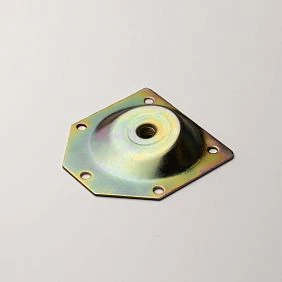
Mounting Plate FUR-031 from STAVROS — this is exactly such an element: designed for attaching furniture legs to tabletops, it takes the load from the wooden support and ensures a reliable connection without play.
Get Consultation
Attaching table legs at a 10° angle: which projects it suits
Straight vertical leg installation is the simplest option. But it is the angled legs that create the visual effect that makes the table interesting: a feeling of lightness, dynamics, and design precision.
A 10° angle is a moderate tilt. It is noticeable, creates character, but does not compromise the stability of the structure. This angle is the most common in furniture where the tilt of the supports is part of the design, not a structural extreme.
Where angled installation is used
Coffee table. Low, horizontal, often with a small tabletop — this is where angled legs are especially expressive. They add lightness to the silhouette and do not "clutter" the space under the tabletop.
Kitchen table. In the kitchen, legs at a slight angle improve accessibility of the space under the table for legs, especially when there is no apron. This is both practical and aesthetic.
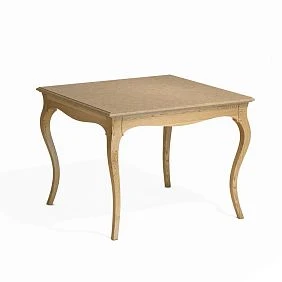
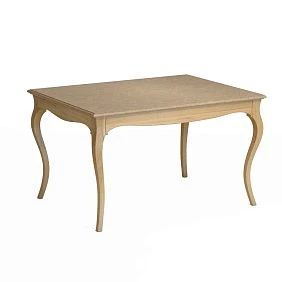
Dining table. For a spacious dining room, angled solid wood legs create a Scandinavian or neoclassical accent. The shape of the leg retains its character — turned, tinted, made of oak or beech.
Console table. Wall consoles often use angled rear legs as a structural solution: they expand the support base when there are no rear supports.
Designer furniture for the project. When furniture is created according to an individual sketch, slanted legs are one of the basic tools of visual language. And here, precise hardware is critical.
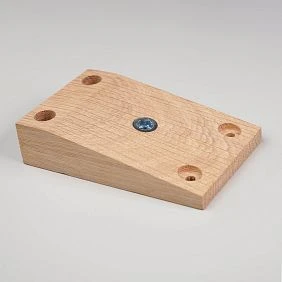
To implement an angled installation, you need 10° Mounting Plate, Wood, FUR-017 — a product that sets the specified angle between the leg and the tabletop surface. It solves the problem that no straight plate can solve.
How angled mounting differs from straight mounting
In straight mounting, the leg is perpendicular to the tabletop. Vertical load is transmitted along the leg's axis — this is a "convenient" mode for wood. With angled installation, the load is decomposed into axial and lateral components. Lateral load creates a bending moment at the mounting point. That is why, with angled installation, the correct plate is especially important: it must withstand this moment without deformation.
The FUR-017 plate is designed specifically for this scenario — the 10° angle is structurally built-in, and the mounting assembly operates in the calculated mode.
Straight, angled, and threaded mounting: how to choose the right option
The market offers several approaches to mounting table legs. Let's analyze them honestly — with pros, cons, and application scenarios.
Straight mounting plate
A flat metal or wooden plate with holes for screws and a central hole for a stud or bolt. It is installed horizontally on the underside of the tabletop.
Advantages:
-
Ease of installation.
-
Removable leg.
-
Good load distribution.
Disadvantages:
-
Prevents leg tilting.
-
Requires reinforcement under lateral load.
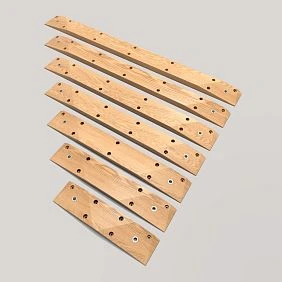
Mounting plate FUR-020 — wooden mounting plate for direct leg installation. Suitable for tables with wooden legs where eco-friendliness and material unity are important.
Angle plate 10°
Plate with an inclined mounting surface for the stud. The 10° angle is built into the design — the plate is installed parallel to the tabletop, and the leg automatically gets the required tilt.
FUR-017 — this exact option.
Reinforced metal plates FUR-034 and FUR-035
For heavy solid wood or slab countertops, for dining tables with high load, for furniture in commercial spaces — plates with increased load-bearing capacity are needed.
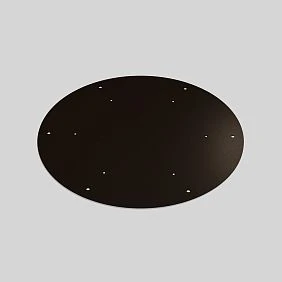
Mounting Plate FUR-034 и Mounting Plate FUR-035 — reinforced options for such tasks. The metal structure withstands significantly greater load than a wooden plate.
Attachment to the apron
If the table has a classic frame with aprons — the legs are attached to it, not directly to the tabletop. The apron takes on lateral loads and redistributes them across the entire frame.
When using an apron, the mounting plate for the leg is installed on the lower end of the apron or on the corner bracket. Attaching table legs to aprons is a reliable method for a traditional dining table design.
Attachment without apron
When there is no apron (modern minimalist table, console, coffee table without a frame) — everything is held by the mounting plate. In this case, the plate should be more powerful, and the screws longer and positioned closer to the edges of the plate for maximum moment of resistance.
Attaching legs to tabletop: checklist before purchase
Before choosing a specific plate or fastener, answer these questions. They will save you time and prevent mistakes.
Tabletop parameters
-
Tabletop thickness. For thin tabletops (18–25 mm), use screws with a small thread pitch and limited length. For massive tabletops (40–60 mm), use longer fasteners with increased pitch.
-
Tabletop material. Solid wood, laminated chipboard, MDF — different materials provide different load-bearing capacity. Solid wood holds the load best, MDF is weaker, laminated chipboard is worse at attachment points.
-
Distance from the edge. Legs should not be placed too close to the edge — the minimum distance from the center of the leg to the edge of the tabletop is usually 50–80 mm. With a smaller distance, there is a risk of material delamination.
Leg parameters
-
Leg shape. Round turned, square, conical, straight — each requires its own fit into the plate.
-
Diameter or cross-section at the top. This determines the size of the bushing and stud.
-
Thread type. The standard for furniture legs is an M8 stud. Ensure the plate and leg are compatible in thread.
Load parameters
-
Tabletop weight. Light tabletop (up to 15 kg) — standard plates. Heavy (30–60 kg or more) — reinforced plates FUR-034, FUR-035.
-
Dynamic loads. If the table will be moved regularly or children will sit at it — plates with a load margin are needed.
Installation angle
-
Vertical installation: plate FUR-020 or FUR-031.
-
Inclined installation 10°: plate FUR-017.
-
Non-standard angle: consult with a manager.
How to choose a mount for wooden table legs
Wooden legs for table — it's not just aesthetics. It also involves specific requirements for fasteners. Wood is a living material, it reacts to humidity, load, temperature. And the fastening unit must take this into account.
Turned round legs
for mounts for round table legs the standard method is an M8 stud screwed into the end of the leg (through a ferrule or directly into the wood), and a mounting plate with a socket for the stud. This creates a rigid but detachable connection.
Round turned legs often have a conical top end — this must be considered when choosing a plate: the mounting plane under the end should be flat, otherwise the leg will be installed with a skew.
Square and conical legs
Square legs with a flat top end are easier to install — the plane of the end fits well against the plate. Conical legs (wider at the tabletop, narrower at the floor) give a beautiful silhouette, but require precise positioning of the plate so that the cone's slope does not conflict with the plate's angle.
Massive legs for dining tables
For heavy solid oak supports — especially if the leg itself is massive and heavy — a reinforced fastening unit is needed. Here, the FUR-034 or FUR-035 plate combined with an M8 stud and a properly chosen threaded insert provides the required load-bearing capacity.
Which STAVROS mounting plates to use: product line overview
Let's break down specific items from the catalog STAVROS fittings and explain what each one is for.
FUR-017: mounting plate 10°, wood
Mounting plate 10° FUR-017 — a key product for angled leg installation. A wooden structure with a fixed 10° angle between the mounting plane and the tabletop attachment plane.
For whom:
-
Designers who create furniture with angled legs.
-
Craftsmen who make coffee and kitchen tables with a characteristic tilt of the legs.
-
Anyone who wants to get a precise and identical angle on all four legs without complex calculations.
Advantages:
-
The angle is built into the design — no need to calculate and maintain it manually.
-
The wooden structure is compatible with wooden tabletops in terms of thermal conductivity and vibration characteristics.
-
Easy installation: the plate is attached to the tabletop, the leg via a stud to the plate.
FUR-020: mounting plate, wood
FUR-020 — wooden mounting plate for direct vertical installation of legs. Optimal for tables made of natural wood where angled installation is not required.
For whom:
-
Solid wood furniture manufacturers who want to maintain material unity in the joints.
-
Projects where eco-friendliness and naturalness of all components are essential.
FUR-031: mounting plate
Mounting Plate FUR-031 — universal plate for attaching furniture legs to tabletops and other supporting structures. Suitable for most standard tasks of attaching wooden furniture supports.
For whom:
-
Wide range of applications: kitchen tables, coffee tables, consoles.
-
Good load-bearing capacity under standard loads.
FUR-034 and FUR-035: reinforced mounting plates
FUR-034 и FUR-035 — plates with increased load-bearing capacity. Metal construction, increased mounting area, designed for heavy tabletops and intensive use.
For whom:
-
Dining tables made of slab or solid wood (from 30 kg and more).
-
Furniture for commercial spaces: restaurants, cafes, offices.
-
Projects where a safety margin is critical.
Comparison table of STAVROS plates
| Article | Type | Angle | Material | Application |
|---|---|---|---|---|
| FUR-017 | Mounting plate 10° | 10° | Wood | Angled leg installation |
| FUR-020 | Mounting plate | 0° | Wood | Straight installation, solid |
| FUR-031 | Mounting plate | 0° | Metal/combo | Universal application |
| FUR-034 | Reinforced plate | 0° | Metal | Heavy tabletops |
| FUR-035 | Reinforced plate | 0° | Metal | Commercial use |
Typical mistakes when installing table legs
This is where most of the practical problems are concentrated. Every mistake is real — and each one can be avoided if you know in advance.
Mistake 1: choosing a straight plate for an angled installation
This is the most common and most costly mistake. If you want legs at a 10° angle and the plate is straight — the leg will simply sit crooked or skewed. Result: wobbling and uneven load. Solution: FUR-017 with a pre-set 10° angle.
Mistake 2: not checking the thread before installation
An M8 stud screwed into the leg must match the plate socket. If the plate thread is M6 and the stud is M8 — the connection either won't go in or will have play. Check the thread on all components before assembly.
Mistake 3: placing legs too close to the edge
If the distance from the center of the leg to the edge is less than 40–50 mm — especially in MDF and particleboard — material splitting under load is possible. For solid wood, a minimum of 50–60 mm from the edge.
Mistake 4: not accounting for the weight of the tabletop
Light wooden plates FUR-017 and FUR-020 are designed for standard load. If the tabletop is a slab weighing 50–70 kg — FUR-034 or FUR-035 are needed. Using a plate with insufficient load capacity leads to deformation of the fastening assembly over time.
Mistake 5: mixing different types of plates on one table
If FUR-017 (angle 10°) is on three legs and a straight plate is on the fourth, the table will be skewed. All four legs must use identical plates.
Error 6: not making preliminary markings
The placement of plates on the tabletop must be marked before installation. Asymmetrical leg placement is the main cause of visible table skew. Use a measuring tool, not "by eye."
Error 7: not checking tilt symmetry during angled installation
Angled legs must be tilted in one direction — outward from the center of the tabletop. If one leg is tilted inward, the table will become unstable. When installing FUR-017, it is important to orient the plate correctly: the angle should be directed away from the center.
Error 8: overtightening the fasteners
Excessive tightening of self-tapping screws in a wooden tabletop destroys fibers at the attachment point and reduces holding force. The screw should be tightened until the plate fits snugly — without "squeaking" force.
Error 9: not installing a foot pad
After installing the legs, be sure to install foot pads — they protect the floor from scratches and allow you to adjust the table's level. Adjustable D25 Foot FUR-029 и glide D32 FUR-030 — this is the final point that allows you to level the table on an uneven floor.
What to buy together with the mounting plate: complete assembly kit
The plate is the central element of the fastening assembly, but not the only one. For a complete installation, you need a kit:
Mounting plate (selected by angle and load): FUR-017, FUR-020, FUR-031, FUR-034 or FUR-035.
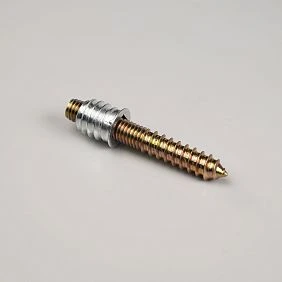
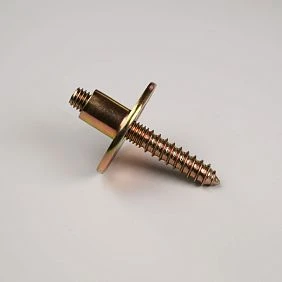
Stud M8 — standard element for connecting the leg to the plate. Screwed into the end of the leg. Length is selected based on the height of the plate's mounting socket plus 10–15 mm allowance.
Threaded insert — metal insert with M8 thread, installed into the end of a wooden leg. Provides a reliable socket for the stud and prevents the thread from cutting into the wood over time.
Screws — for attaching the plate to the tabletop. Length is selected based on the tabletop thickness: the screw must penetrate at least 2/3 of the thickness, but not go through.
Foot cap — adjustable or non-adjustable, on the lower end of the leg. Protects the floor and allows leveling the table. The foot cap size is selected according to the diameter of the lower part of the leg: FUR-029 — D25, FUR-030 — D32.
Wooden plugs — for hiding screw heads if they are visible from the tabletop side or during decorative installation.
All of these are STAVROS furniture fittings in a single catalog: no need to search for fasteners from different suppliers and check compatibility manually.
Wooden furniture legs and fittings: a systematic approach
The plate does not live without the leg. The leg does not work without the plate. And the foot cap completes the result. Therefore, the right approach is to select the entire set as a system, rather than buying parts separately.
In the section STAVROS furniture legs and supports feature turned wooden legs made of solid oak and beech in various profiles and heights. Many of them are designed for installation via an M8 stud — meaning they are fully compatible with FUR series mounting plates.
If you are buying Legs for tables and plan to install them at a 10° angle — add the FUR-017 plate, M8 studs, threaded inserts, and suitable foot caps to your order. This is a complete set that covers the task from leg to floor.
Where to buy table leg mounting at a 10° angle
Buy table leg mounting STAVROS means getting hardware that is designed in tandem with STAVROS wooden furniture legs and is compatible with them in terms of threads, dimensions, and design solutions.
In the furniture hardware features all items: mounting plates, foot caps, studs, additional hardware. Order via the website, Contact us to confirm shipping to your destination., pickup in St. Petersburg and Moscow.
For complex projects with non-standard angles or high loads — consult with a manager before ordering.
About the company STAVROS
STAVROS is a St. Petersburg manufactory of wood and MDF products, founded in 2002. Production covers solid wood furniture legs, stair components, decorative elements, fittings — and all these categories are designed as a single system of compatible products.
STAVROS fittings are not "hardware from a store." They are elements specially designed for STAVROS wooden furniture legs, tested for compatibility and calculated for real loads. Mounting plates FUR-017, FUR-020, FUR-031, FUR-034, FUR-035 — each was created for a specific scenario, not as "universal" hardware for any task.
Showrooms in St. Petersburg and Moscow. Delivery across all of Russia. Online store at stavros.ru.
FAQ: Answers to popular questions
When is a 10° mounting plate needed?
When table legs should be at an angle rather than strictly vertical. The 10° angle is standard for coffee tables, kitchen tables, and designer tables with a characteristic silhouette of inclined supports.
How is the 10° plate (FUR-017) different from a straight plate?
For FUR-017, the angle between the mounting plane for the stud and the plane of attachment to the tabletop is 10°. This design solution means no need to cut a wedge or add shims — the angle is set automatically.
Can wooden legs be attached to a tabletop without a plate?
Yes — if the leg is light and the load is minimal. For real tables with load, a plate is mandatory: it distributes the force and reduces the risk of loosening.
Which plate to choose for a heavy tabletop?
For countertops weighing from 25–30 kg, reinforced metal plates FUR-034 or FUR-035 are recommended.
How to avoid leg misalignment?
Use identical plates on all four legs, pre-mark, check symmetry of placement, and avoid different angle directions.
Is FUR-017 compatible with STAVROS legs?
Yes. The plate is designed for an M8 stud, which is the standard for STAVROS wooden furniture legs.
Is a foot pad needed when installing legs at an angle?
Yes. When installed at an angle, the bottom end plane of the leg is tilted relative to the floor. The adjustable foot pad levels this angle, ensures full contact with the floor, and prevents slipping.
Where to buy a 10° mounting plate in Moscow and St. Petersburg?
In STAVROS showrooms in both cities and via the website stavros.ru with Contact us to confirm shipping to your destination.
What is a threaded insert and why is it needed?
A threaded insert is a metal threaded bushing installed into the end of a wooden leg. It creates a reliable socket for the stud and prevents thread damage in the wood during repeated disassembly.
Can I install the mounting plate myself?
Yes. Installation does not require special equipment: the plate is attached to the tabletop with self-tapping screws, and the leg is attached to the plate via a stud. If the markings are followed and the components are correctly selected, the result is accurate and reliable.