Article Contents:
- Short answer: when it's better to add one plank right away
- What is confirmed in the KZ-012 card
- Why KZ-012 cannot be considered as a regular thin batten
- The room perimeter does not equal the number of whole planks
- First the list of sections, then the cart
- The finished length is not the size from the old drawing
- The type of ends determines the consumption
- A solid section is assigned in advance
- Step 1. Select the material
- Step 2. Sort the sections from longest to shortest
- Step 3. Mark mandatory solid sections
- Step 4. Add technological loss
- Step 5. Check the orientation of the remnants
- Step 6. Assign a reserve
- Direction error
- Re-fitting
- Array chip
- Unsuccessful end painting
- Remote object
- Many external corners
- Oak for tinting
- Installation is performed for the first time
- Tight schedule
- Four MDF planks
- Three solid wood planks
- Complex painting
- Simple rectangular room
- Experienced installer
- Long useful leftover
- Local pickup
- Small object without urgent schedule
- Expensive oak and low risk
- Pre-painting
- Painting after cutting
- Do not save balances
- What dimensions does KZ-012 have?
- What is the length of KZ-012 made of MDF?
- What is the length of beech and oak?
- How many planks should be ordered for a room?
- Can the perimeter be divided by 2600 mm?
- What percentage should be added as a reserve?
- Is one spare plank needed?
- Why is a rigid packaging frame needed?
- How many slats are included in the frame?
- Will I have to pay for packaging again when reordering?
- Can I mix MDF and oak in the same room?
- Can I buy additional oak from a different batch?
- How should I store KZ-012?
- Can I use KZ-012 above a cabinet?
- Where can I buy KZ-012?
- Why might a 700 mm remainder turn out to be useless?
- Do I need to calculate the external corner separately?
- What is more advantageous: reserve or reorder?
- Can I return an unused reserve plank?
- When to choose MDF?
- When to choose oak?
- Can the seller cut the plank for me?
- Do I need to buy a reserve for a simple room?
- How to know if the remainder is useful?
- Why are four MDF planks a special case?
- Why do three oak planks require a separate packaging calculation?
- Can I use one reserve plank for multiple rooms?
- What to do if the last cornice was not enough?
- Can KZ-012 be used as a curtain rod?
- Why MDF and solid wood cannot be counted together?
- Do I need to keep the cutting map after installation?
- When can the reserve be used at another site?
- Why you can't just add up the points
- Why you can't mix planks right away
- Combined reserve works only when parameters match
- When each room needs its own reserve
Three walls are already finished. The cornice is painted, the cuts are assembled, and the top line of the room finally looks solid. One external corner and a short return to the built-in wardrobe remain. The installer picks up the last plank, makes a trial marking—and it turns out there isn't enough leftover. Sometimes the reason is trivial: the direction was mixed up during the first cut. Sometimes the wood has a chip that can't be left on a visible edge. It also happens that the calculation by total perimeter was formally correct, but the needed long section can't be cut from the remaining scraps.
Now only one plank KZ-012 is required. At first glance, the problem is small: open the card and buy an additional wooden cornice. But a long-length profile isn't shipped like a regular small parcel. A new delivery again requires order processing, rigid packaging, shipping, receiving, and storage space. If it's beech or oak, there's another risk: a plank from a different batch may differ in pattern and shade, especially under a clear or semi-transparent finish. Stopping the installers also costs money, though a universal downtime amount can't be specified in advance.
Therefore, the question 'is a reserve plank needed' can't be resolved mechanically. There's no honest rule like 'always add ten percent' or 'take one spare for any room.' For KZ-012, you first need to choose the material, because the MDF version has a length of 2600 mm, while beech and oak are 2400 mm. Then the room is divided into separate sections, a cutting map is built, each wall is assigned a specific whole plank, the corners are checked, and only then two scenarios are compared: adding a reserve to the first delivery or accepting the risk of a separate reorder.
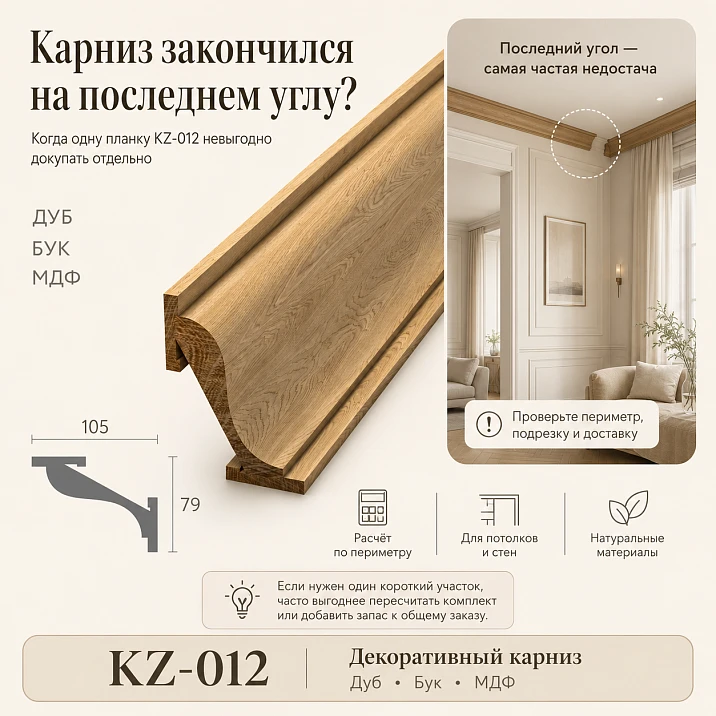
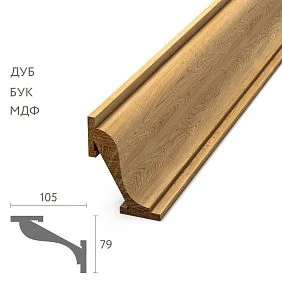
The wooden cornice KZ-012 is a large profile with a cross-section of 79 × 105 mm. It is used in the ceiling transition and in the upper part of the furniture composition. It shouldn't be confused with a curtain rod: it's architectural molding that forms a decorative line, not a system for hanging curtains. For a buyer who plans to buy a wooden cornice KZ-012 with quantity calculation, not only the total linear meters are needed. What's needed is a wall list, a corner diagram, useful leftovers, packaging standards, and an understanding of the full order cost.
This article examines precisely the last angle — the moment when an error in one detail suddenly triggers a second delivery of a long-length item. We will not retell the general textbook on wooden cornices. Instead, we will sequentially calculate whole planks KZ-012, break down MDF, beech, and oak, show why the total perimeter is misleading, and determine when a reserve is truly cheaper than a re-order.
Short answer: when it's better to add one plank right away
An additional whole plank KZ-012 is usually justified when several conditions coincide at the same time:
-
the room has external corners, niches, short returns, or complex cuts;
-
the installer is working with the 79 × 105 mm profile section for the first time;
-
the site is far from the warehouse, or delivery of long-length items significantly affects the budget;
-
the cornice made of beech or oak is planned to be tinted while preserving the wood grain pattern;
-
the order almost fills the packaging standard, and an additional plank does not create another frame;
-
installation is carried out under tight deadlines, and stopping the crew is critical;
-
after the cutting map, no long usable offcut remains;
-
The profile must be ordered in one batch for several rooms;
-
On site, there is a risk of chipping, incorrect sawing direction, or damage during fitting.
The reserve may be unnecessary in a simple rectangular room without external corners, when each section is distributed across planks, installation is performed by an experienced specialist, and after cutting, a full-length long piece remains, suitable for repairing the last joint. But even in such a case, the decision is made not by feel, but according to the cutting map.
The main idea is this: the reserve is assessed not as a percentage of the perimeter, but in whole planks, useful leftovers, and the cost of repeat logistics.




What is confirmed in card KZ-012
Closer to the beginning of the calculation, accurate initial data are needed. They determine the number of whole products, the length of offcuts, and packaging.
| Parameter | MDF | Beech | Oak |
|---|---|---|---|
| Article number | KZ-012 | KZ-012 | KZ-012 |
| Cross-section | 79 × 105 mm | 79 × 105 mm | 79 × 105 mm |
| Standard length | 2600 мм | 2400 мм | 2400 мм |
| Sanding quality | «Prestige» | «Prestige» | «Prestige» |
| Preparation | For enamel | The option is specified in the card | The option is specified in the card |
| Primary application | Ceiling, furniture | Ceiling, furniture | Ceiling, furniture |
| Specified packaging standard | Up to 5 slats | Up to 2 planks | Up to 2 planks |
| Rigid packaging frame | Added to the order | Added to the order | Added to the order |
| Current frame cost | Checked in the product card before payment | Checked in the product card before payment | Checked in the product card before payment |
| Price, availability, delivery time | Change and are checked before ordering | Change and are checked before ordering | Change and are checked before ordering |
At the time of verification, the product card indicated the cost of a rigid packaging frame as 390 rubles. This figure cannot be turned into a permanent product characteristic: before publishing, adding to the cart, and paying, it must be re-verified. The same applies to slat prices, availability, and delivery times.
The wording "up to five MDF slats" does not mean that in any situation exactly five items will necessarily be placed in one frame. The standard shows the limit for a typical order, but mixed materials, shipping specifics, and other conditions are clarified with the manager.
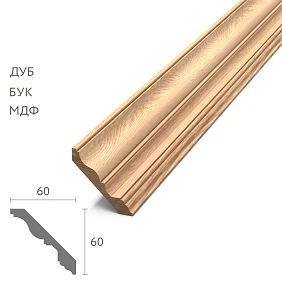
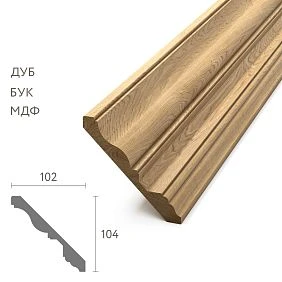
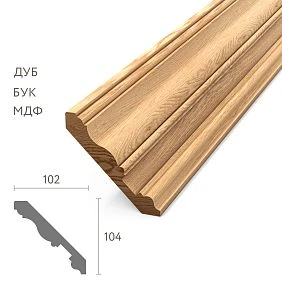
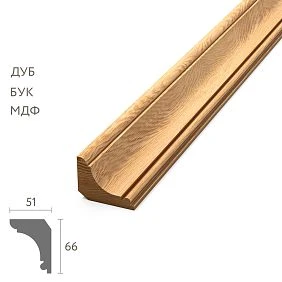
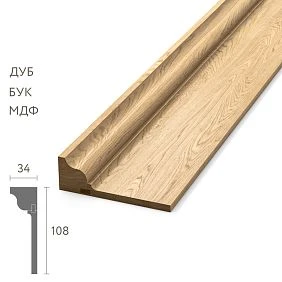
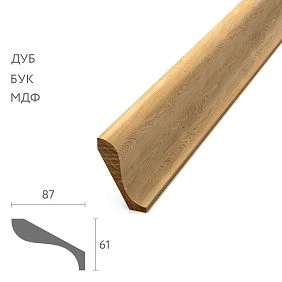
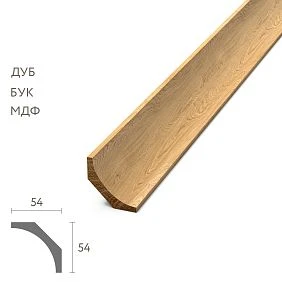
Our factory also produces:
Why KZ-012 cannot be considered as a regular thin batten
The cross-section of 79 × 105 mm makes KZ-012 a prominent architectural profile. It has a pronounced projection and height, so cutting errors are more visible than on a simple rectangular slat. The more complex the relief and the larger the profile, the more factors affect cutting:
-
direction of the front side;
-
top and bottom of the profile;
-
orientation of the left and right cuts;
-
depth of entry into the miter box or miter saw system;
-
likelihood of chipping on protruding edges;
-
accuracy of pattern alignment;
-
length lost during re-fitting;
-
possibility of using the remainder in another section.
A 500 mm offcut is not always a full reserve. If it already has a left internal cut, and the last section requires a right external cut, the useful length and direction may not match. If the edge is chipped, part will have to be removed. If the profile is painted after cutting, re-fitting will require restoring the end finish.
That is why when purchasing it is useful to check the KZ-012 packaging simultaneously with size and material. Packaging here is not a secondary service, but part of the route of a long product from the warehouse to the room.
Get Consultation
The perimeter of the room is not equal to the number of whole planks.
The most common formula looks convincing:
total perimeter ÷ length of one plank = number of planks.
The problem is that the cornice is not mounted in abstract linear meters. Each plank must fit on a specific wall or group of short sections. The total sum does not show where the joint will be, what remainder will be left after cutting, and whether it can be transferred to another side of the room.
Let's imagine a room with the following lengths:
-
wall A — 3180 mm;
-
wall B — 2450 mm;
-
wall C — 3180 mm;
-
wall D — 1920 mm;
-
Return near the cabinet — 310 mm;
-
Niche — three sections 620, 840, and 620 mm.
The total length is 13,120 mm. If you choose KZ-012 from MDF with a length of 2600 mm, simple division gives 5.05. After rounding, you get six planks. It seems the problem is solved.
But walls of 3180 mm are not covered by one plank. Each requires a main piece and an extension. A wall of 2450 mm almost completely takes up a separate plank, leaving a short remainder that may not fit the cut direction. The niche contains several corners. The 310 mm return is short in length but requires two neat ends. As a result, six planks may be sufficient, or they may not fit — it all depends on the layout.
For solid wood with a length of 2400 mm, the situation will change even more. You cannot replace MDF with oak after a completed calculation and keep the same number of items.
First the list of sections, then the cart
The room plan needs to be turned into a table. One row — one installation section.
| № | Section | Finish length | Left end | Right end | A solid piece is needed | Plank |
| 1 | Wall A, main part | Internal corner | Joint | Yes | ||
| 2 | Wall A, extension | Joint | Internal corner | No | ||
| 3 | Wall B | Internal corner | External corner | preferably | ||
| 4 | Return | External corner | Straight end | can be from the remainder | ||
| 5 | Niche, left side | Internal corner | Internal corner | No | ||
| 6 | Niche, back part | Internal corner | Internal corner | preferably | ||
| 7 | Niche, right side | Internal corner | Internal corner | No | ||
| 8 | Area above the cabinet | Straight end | Straight end | As per project |
In the "Plank" column, numbers will appear later: M1, M2, M3 for MDF or D1, D2, D3 for oak. This marking helps not to lose the purpose of each product on the site.
Finish length is not the size from the old drawing
The wall is measured after leveling, installation of panels, cabinets, and other elements that affect the geometry. If the cornice ends near a built-in cabinet, the actual junction point is taken into account, not the design width of the furniture.
The type of ends determines the consumption
A section with two straight ends is easier to use as a "receiver" for the remainder. A segment between two external corners is much more demanding: an error at one end can ruin the entire workpiece.
A solid section is assigned in advance
You cannot rely on the installer to "somehow distribute" on site. If a long visible wall should look without a joint, the corresponding plank is reserved before cutting short pieces.
How to build a cutting map KZ-012
A cutting map is the distribution of all sections across whole planks, taking into account direction, cuts, and remainder.
Step 1. Select the material
First, MDF, beech, or oak is fixed. The length of the plank depends on the material:
-
MDF — 2600 mm;
-
beech — 2400 mm;
-
oak — 2400 mm.
Mixing calculations is not allowed.
Step 2. Sort the sections from long to short
Long walls are assigned first. Short returns and niches are attempted to be placed in the leftovers.
Step 3. Mark mandatory solid sections
These are visible walls, areas above furniture, sections between noticeable corners, and places where a joint is undesirable.
Step 4. Add technological loss
The exact value cannot be set universally: it depends on the tool, the type of angle, the complexity of the profile, and the installer's experience. But zero allowance for the cut is a mistake. A working margin is left on the layout, not placing parts "to the millimeter."
Step 5. Check the orientation of the offcuts
The KZ-012 has a top, bottom, and front side. The offcut cannot be arbitrarily flipped if the profile must continue the pattern.
Step 6. Assign a reserve
Only now it becomes clear whether a full-length piece remains or an additional strip is needed.
Example of cutting MDF 2600 mm long
Consider a simplified set of sections:
-
2500 mm;
-
2300 mm;
-
1800 mm;
-
760 mm;
-
620 mm;
-
420 mm;
-
310 mm.
Sum — 8710 mm. Dividing by 2600 gives 3.35, that is, arithmetically four strips are needed. Now let's distribute:
| Plank | Purpose | Used | Theoretical remainder |
| M1 | 2500 мм | 2500 мм | 100 мм |
| m² | 2300 мм | 2300 мм | 300 мм |
| M3 | 1800 + 760 mm | 2560 мм | 40 мм |
| M4 | 620 + 420 + 310 mm | 1350 мм | 1250 мм |
Four planks are enough in length, and a segment of about 1250 mm remains before accounting for cuts. It can become a reserve. But the type of ends needs to be checked. If parts 620, 420, and 310 mm contain many angles, each cut eats part of the length. If the M4 remainder has an unsuitable end or damage, its usefulness decreases.
Conclusion: in such an example, the fifth plank is not automatically mandatory. First, it needs to be proven that the M4 remainder is indeed suitable for correcting the most likely error.
The same object in beech or oak with a length of 2400 mm
We take the same sections:
-
2500 mm;
-
2300 mm;
-
1800 mm;
-
760 mm;
-
620 mm;
-
420 mm;
-
310 mm.
A section of 2500 mm cannot be obtained from a single standard plank of 2400 mm. A joint or a change in the design layout will be required. Already at this stage, the quantity and composition change.
Possible option:
| Plank | Purpose | Used | Remainder before accounting for cuts |
| D1 | 2300 мм | 2300 мм | 100 мм |
| D2 | 1800 + part of the extension | By scheme | By scheme |
| D3 | main section 2400 mm wall 2500 | 2400 мм | 0 мм |
| D4 | extension 100 + 760 + 620 + 420 + 310 | 2210 мм | 190 мм |
In total, four planks may seem sufficient, but the joint on the 2500 mm wall, the direction of the cuts, and the many short pieces make the layout risky. Sometimes a fifth plank is needed not as a "waste percentage," but to avoid a bad joint or to have a full reserve.
Why percentage-based allowance works poorly with whole planks
Suppose the total calculation gives 18 linear meters. Ten percent is 1.8 meters. But KZ-012 cannot be ordered as a separate 1.8-meter piece: the standard product has a length of 2.4 or 2.6 meters.
So the real choice is binary:
-
do not add a whole plank;
-
add 2400 or 2600 mm.
The percentage is useful as a signal that stock is needed, but not as a final quantity. The cutting map answers a more precise question: what specific error can an additional plank cover?
If a spare plank can replace a long visible section, its value is high. If an identical long piece already remains after cutting, the additional product may be redundant.
External corner — the main consumer of reserve
The internal corner also requires precision, but the external one more often remains fully visible. On it, the following are noticeable:
-
mismatch of relief;
-
gap;
-
chip;
-
wrong direction;
-
different profile height;
-
insufficient length after re-cutting;
-
Finish defect at the top.
Direction error
The profile is marked considering the left and right parts. If the strip is placed in the tool the other way, a mirrored cut will result. Fixing requires a new end and reduces the length.
Re-fitting
On the first try, the wall angle may not match expectations. Repeated adjustment gradually shortens the part. On a short return this is tolerable, on a long wall it is critical.
Chip in the array
Beech and oak require sharp tools and proper support. A chip on a visible protrusion cannot always be hidden by finishing.
Unsuccessful end painting
Even a precise angle can look bad if the end color differs or light wood remains.
If there are several external corners in the room, a spare strip gains practical justification.
Internal corners also cannot be considered free
At an internal corner, two parts meet. Even if a standard 45° cut is used, the actual wall geometry may require adjustment. An error leads to a gap or a step in the relief.
For the complex profile KZ-012, it is useful to determine in advance:
-
which part goes first;
-
where adjustment is allowed;
-
which edge remains visible;
-
whether a short leftover can be used;
-
how the profile will continue after the corner;
-
where painting will be done.
Short returns: few meters, lots of risk
A return of 250–400 mm in length seems insignificant. But it often has an external corner on one side and an abutment to a cabinet or wall on the other. A small piece requires two precise cuts, and an error quickly eats up the entire length allowance.
Short returns are better grouped separately in the map. You cannot automatically assume they will always be cut from any offcuts.
Niches and bay windows increase the number of cuts
A niche adds not only meters but also corners. Three short sides may require more attention than one long wall. Each corner creates a new point of risk.
When calculating a niche, specify:
-
depth;
-
the width of the back wall;
-
the type of each corner;
-
the visibility of joints;
-
the possibility of a whole segment;
-
the direction of the profile;
-
tool access.
Area above the built-in wardrobe
KZ-012 can be used as a curtain rod for furniture. Then not only the walls matter, but also the geometry of the wardrobes.
Check:
-
width of each module;
-
position of side panels;
-
protrusion of facades;
-
gap to the ceiling;
-
presence of fillers;
-
joint between cabinets;
-
possibility to remove the cornice;
-
material matching with furniture;
-
finishing of ends.
If the profile runs over several cabinets, it is better to decide in advance where joints are acceptable. They should not accidentally fall over a narrow door or near the central axis of the composition.
MDF 2600 mm: when greater length helps
The MDF strip is 200 mm longer than solid wood. On one piece the difference seems small, but in a room it can eliminate a joint or allow cutting out a short return.
MDF under enamel is convenient when:
-
opaque painting is needed;
-
natural texture is not the goal;
-
a length of 2600 mm is important;
-
several identical strips are required;
-
The wood grain pattern does not need to be coordinated;
-
The interior is built around a smooth painted profile.
However, MDF cannot be considered invulnerable. Edges and relief require careful transportation. Therefore, a rigid packaging frame remains a significant part of the order.
Beech 2400 mm: calm wood for painting
Beech has a dense, more uniform structure. It is often chosen for enamel. Compared to MDF, it retains the properties of solid wood, but the standard length of KZ-012 is 2400 mm.
When reordering beech, the following should be considered:
-
possible difference in wood;
-
preparation for finishing;
-
matching of enamel color;
-
method of repainting;
-
length of 2400 mm;
-
packaging standard of up to two planks.
If the entire batch is stained at the same time, achieving a uniform surface is easier than when reordering a single piece.
Oak 2400 mm: batch and texture become part of the calculation
Oak is chosen for its pronounced texture and noble pattern. That is why a separate late reorder is especially risky.
A new plank may differ:
-
direction of fibers;
-
width of annual rings;
-
porosity;
-
natural shade;
-
reaction to stain;
-
oil intensity;
-
the amount of light and dark areas.
This is not a defect of natural wood, but its property. However, on a long ceiling line, a random transition may be noticeable.
For an oak cornice, a spare plank from the first batch has additional value: it can be tinted together with the main volume and used in case of damage.
Comparison of MDF, beech, and oak in the reserve task
| Criterion | MDF | Beech | Oak |
| Standard length | 2600 мм | 2400 мм | 2400 мм |
| Main finishing scenario | Enamel | Enamel or another confirmed option | Tinting, oil, transparent finish |
| Risk of difference in a new batch | Below in the pattern | Present | Most noticeable under transparent finish |
| Packaging standard | Up to 5 slats | Up to 2 planks | Up to 2 planks |
| Reserve value | Reducing risk of repeat logistics | Uniform color and batch | Uniform texture, shade, and finish |
| Main calculated plus | Length 2600 mm | Solid wood with calmer structure | Expressive natural surface |
| Main limitation | Requires edge protection | Plank shorter than MDF | Plank shorter than MDF, batch is especially important |
For a broad comparison, you can choose a cornice made of MDF, beech, or oak, but the final calculation of KZ-012 is performed only after selecting a specific material.
What does a rigid packaging frame mean
A long profile experiences loads not only during transportation. It is moved in the warehouse, loaded, secured in the vehicle, unloaded, and carried into the premises. At a length of 2400–2600 mm, an accidental impact can damage the edge, and bending can disrupt the geometry.
The rigid frame performs several tasks:
-
limits bending;
-
protects the protruding profile;
-
joins several slats;
-
reduces the risk of end impact;
-
helps safely move long items;
-
creates a base for securing the load.
Therefore, packaging does not seem like a pleasant expense item, but it relates to the safety of the goods. More details can be seen, why a long curtain rod needs protective packaging.
How to read the norm "up to five MDF slats"
The word "up to" sets an upper limit, not a promise. In the standard version, one frame can be designed for a quantity of one to five MDF slats. But the exact calculation depends on the order details.
Example:
-
four MDF strips can fit into one frame;
-
the fifth spare strip potentially also remains within the specified norm;
-
the sixth may require a new frame;
-
mixed orders of MDF and solid wood are clarified separately.
If the initial calculation gives four MDF strips, adding a fifth may be especially rational: the spare does not necessarily create a new packaging unit. But this needs to be confirmed before payment.
How to read the norm "up to two solid wood strips"
For beech and oak, the card indicates up to two strips.
Example:
-
one solid wood strip still requires packaging;
-
two can be combined according to the card norm;
-
the third potentially triggers another frame;
-
the fourth can fill the second frame;
-
the exact number is confirmed in the order.
If initially three oak planks are required, the question of reserve is especially interesting. The fourth plank may be logical if it does not increase the number of packaging units and is needed for complex corners. But the price of the oak product itself is higher, so the decision is compared by the full estimate.
The price of an additional order is not just the price of one plank
For an honest comparison, the formula is used:
Total cost of additional order = plank price + new packaging + delivery + unloading + carrying in + re-finishing + organizational expenses + crew downtime.
Not all components are always present. Self-pickup can remove delivery. An in-house workshop does not count crew downtime the same way a contractor does. Enamel may remain in stock, or it may require a new color match.
But these costs cannot be ignored. Sometimes an extra plank in the first order is more expensive in product price, but cheaper in the final project budget.
Comparison table of two scenarios
Fill it with real numbers.
| Consumption | Reserve in the first delivery | Late additional order |
| Additional strip | ___ RUB | ___ RUB |
| Additional frame | ___ RUB | ___ RUB |
| Delivery | ___ RUB | ___ RUB |
| Unloading and carrying in | ___ RUB | ___ RUB |
| Repeated color selection | 0 / ___ rub. | ___ RUB |
| Repeated painting | 0 / ___ rub. | ___ RUB |
| Technician visit | 0 / ___ rub. | ___ RUB |
| Object downtime | 0 / ___ rub. | ___ RUB |
| Risk of batch difference | Low | Higher |
| Completion deadline | according to the main schedule | depends on new delivery |
| TOTAL | ___ RUB | ___ RUB |
Numbers should not be approximate from the internet. Use the current price of KZ-012, packaging, delivery, and terms of your contractor.
When a reserve plank is especially rational
Remote site
Repeat delivery of a long profile to another region can exceed the expected savings from skipping the reserve. The farther the site, the more important it is to compare not the price of the plank, but the entire repeat logistics.
Many external corners
Each external corner increases the chance of ruining a long workpiece. If the room has a bay window, column, niche with returns, or a complex cabinet line, the risk quickly accumulates.
Oak for tinting
A reserve from the same batch is easier to match for pattern and shade. A later plank may be fine on its own but differ from the already installed line.
Installation is being done for the first time
Even an experienced carpenter may work with KZ-012 and its relief for the first time. A control cut reduces the risk but does not eliminate the possibility of error.
Tight schedule
If painting, furniture installation, or project handover begins after the cornice, a reorder disrupts the sequence. This causes not only a wait for the product but also a repeat visit by specialists.
Four MDF strips
The fifth potentially remains within the specified norm of "up to five," although manager confirmation is mandatory. In this configuration, the reserve may not increase the number of frames.
Three solid wood strips
The fourth may logically fill the second packaging unit if needed according to the risk map. But the decision depends on the material price and actual packaging conditions.
Complex painting
Replicating patina, multi-layer enamel, or non-standard tinting later is more difficult. A reserve painted with the main batch reduces the risk of difference.
When an extra strip may be unnecessary
Simple rectangular room
Four walls, only internal corners, clear layout, and no short returns reduce risk.
Experienced installer
The contractor is familiar with the profile, uses precise tools, and checks corners with templates in advance.
Long useful leftover
After cutting, a segment remains that can replace the most risky area. Its length and direction are confirmed on the map.
Local pickup
Repeated pickup does not create a large logistical burden, and the product is available nearby.
Small project without an urgent schedule
Stopping work does not trigger a chain of additional costs.
Expensive oak and low risk
If the cutting map is reliable and there is only one external corner, the cost of a whole spare oak plank may be unjustified.
The reserve must have a purpose
Bad wording: "we take one extra just in case."
Good wording: "plank P1 is reserved for replacing wall B with a length of 2280 mm or for re-cutting the external corner; after installation is complete, the usable remainder is kept for repairs."
A designated reserve can be accounted for in marking and storage. An unnamed "extra plank" is easily used up on short pieces, and by the last corner there is no reserve again.
How to mark planks on site
Before the first cut, each plank is assigned a number.
Example:
-
M1 — wall A;
-
M2 — wall B;
-
M3 — niche;
-
M4 — short returns;
-
M5 — reserve;
-
O1 — useful remainder from M1;
-
O2 — useful remainder from M2.
On a paper or digital map, indicate:
-
length;
-
material;
-
profile side;
-
the purpose;
-
type of first cut;
-
type of second cut;
-
remainder;
-
storage location.
Marking is done on the protective tape or in the invisible zone, without damaging the front surface.
Why all planks cannot be cut at once without a trial assembly
Even an accurate plan needs verification. First, assemble one control corner and evaluate:
-
match of the relief;
-
actual wall angle;
-
cut quality;
-
amount of adjustment;
-
edge condition;
-
influence of the finishing layer;
-
repeatability of the result.
If the first node required more length than was allocated, the layout is adjusted before cutting the remaining pieces. This approach preserves not only material but also reserve: it remains a reserve rather than turning into compensation for a systemic error.
Paint before cutting or after
There is no universal answer: the technology depends on the coating and the organization of work.
Pre-painting
Advantages:
-
convenient to evenly coat a long plank;
-
less risk of staining the ceiling;
-
the entire batch is processed together;
-
easier to control the overall shade.
Limitations:
-
the ends after cutting require restoration;
-
fitting errors damage the coating;
-
the difference of new ends may be noticeable;
-
additional trimming complicates local repair.
Painting after cutting
Advantages:
-
ends are included in the general cycle;
-
it is easier to eliminate minor defects;
-
color connects the assembled unit;
-
fitting places can be restored.
Limitations:
-
access to the installed profile is needed;
-
it is more difficult to protect walls and ceiling;
-
Coverage in corners requires care;
-
Different stages may produce a slight difference in gloss.
The decision is made before ordering, because the finish affects the value of the reserve plank and the lead time for reordering.
Beech and oak are better ordered in one batch
Natural wood does not repeat like a printed pattern. That is why it is valued, but that is also why a late replacement may differ.
To reduce the risk:
-
order the main volume and reserve simultaneously;
-
keep documents and the batch number;
-
finish the planks in one cycle;
-
do not mix leftovers from different objects without checking;
-
match the texture on visible walls;
-
store the spare under the same conditions;
-
before installation, compare parts under real lighting.
If an oak cornice runs around the entire perimeter of the room, it is better not to insert a new strip into the most noticeable center. If an additional order is unavoidable, it is placed in a less lit or shorter section, but such a rearrangement must be re-checked against the cutting plan.
Storage of KZ-012 before installation
A long profile cannot simply be leaned against a wall. Under its own weight and with uneven support, it may deform.
Proper organization includes:
-
a horizontal, level base;
-
several support points;
-
a dry room;
-
stable temperature;
-
protection from direct sunlight;
-
no contact with wet screed;
-
keeping the packaging until acceptance;
-
acclimatization according to project rules;
-
prohibition on stacking heavy objects on top.
Practical issues of transportation and storage are covered in more detail in the material about how to check packaging, delivery, and storage of long-length products.
Path of entry: will a 2600 mm plank fit into the room
The length of the product affects not only cutting. Before ordering, check the route:
-
freight or passenger elevator;
-
cabin height;
-
diagonal;
-
stair landings;
-
turns;
-
door openings;
-
corridors;
-
temporary partitions;
-
unpacking area.
An MDF plank 2600 mm long may be more convenient for cutting, but harder to bring in. It cannot be pre-cut at the entrance if the layout requires a continuous section.
If the elevator is not suitable, the stair route is measured. Sometimes a long item can only be brought up after installing a temporary partition or furniture. This means the delivery schedule becomes part of the project.
How to accept KZ-012 after delivery
The packaging is inspected before opening. A damaged frame, impact marks, or severe bending are recorded with photos.
After careful opening, check:
-
article number;
-
material;
-
cross-section;
-
length;
-
quantity;
-
condition of the relief;
-
end faces;
-
straightness;
-
sanding;
-
absence of chips;
-
batch match;
-
Do not keep leftovers
A short, intact piece may be useful for local repairs after installation.
Who KZ-012 suits
The profile is worth choosing when:
-
an expressive top cornice is required;
-
a cross-section of 79 × 105 mm is suitable;
-
there is room for a 105 mm extension;
-
a version made of MDF, beech, or oak is needed;
-
lengths of 2400/2600 mm are taken into account in the cutting;
-
the site allows safe delivery of long items;
-
the budget includes packaging;
-
the material and finish are coordinated;
-
the installer understands working with complex profiles;
-
the quantity is calculated by sections.
When it's better to choose a different cornice
Another profile may be more reasonable if:
-
KZ-012 is too large for the room height;
-
The protrusion interferes with furniture or light fixtures;
-
The standard plank length creates too many joints;
-
The complex relief does not match the style;
-
The delivery path does not allow the product to be delivered in one piece;
-
The budget does not account for packaging and finishing;
-
A curtain rod is needed;
-
A flexible profile is required;
-
The project assumes a wet or outdoor environment without confirmed execution;
-
The cutting layout shows too much waste.
Before rejecting KZ-012, you can compare KZ profiles by size and choose the cross-section that best matches the room geometry.
How to order KZ-012 from STAVROS
The commercial path must be sequential:
-
Take the finished dimensions.
-
Divide the room into sections.
-
Mark the internal and external corners.
-
Select the material.
-
Set the length of the plank.
-
Build a cutting map.
-
Assign useful offcuts.
-
Determine the risk.
-
Resolve the spare plank issue.
-
Clarify the number of packaging frames.
-
Calculate delivery.
-
Check the entry path.
-
Prepare storage.
-
Verify price and availability.
-
Place the order in one batch.
In the card, you can View price for KZ-012, but the full project cost appears only after adding packaging, delivery, finishing, and installation.
If the cornice is planned for several rooms at once, do not combine all sizes into one line of "total footage." Create a separate card for each room, then compile the overall product list. One reserve can serve multiple rooms only when the material, finish, and length match, and the purpose of the spare plank is predetermined.
Order sheet KZ-012
Field What to specify Article number KZ-012 Material MDF / beech / oak Cross-section 79 × 105 mm Plank length 2600 / 2400 mm Quantity per cutting ___ pcs. Reserve ___ pcs. Total ___ pcs. Packaging standard Confirmed Number of frames ___ Frame cost ___ RUB Delivery ___ RUB Address ___ Delivery route Checked Finishing ___ Batch number Save Storage location prepared Installation date ___ Cutting map attached The statement is useful for the buyer, the manager, and the installer. It eliminates the situation where one participant counts the quantity by perimeter, the second by planks, and the third learns about the external corner only on site.
How to distribute one reserve across multiple rooms
Suppose KZ-012 made of MDF is used in the living room, study, and hallway. All rooms have the same enamel, and installation is done by one crew.
One common reserve plank can be considered if:
-
the maximum risky section is shorter than 2600 mm;
-
the profile and preparation are the same;
-
the reserve is not consumed until all control corners are completed;
-
its storage location is marked;
-
the map shows which sections it can replace;
-
Finishing is done in one cycle.
If the living room has oak and the study has MDF, a single reserve is impossible. The materials differ in length, appearance, and finish.
Calculation for a room with one niche: a detailed example
Let's take a room with finished dimensions:
-
long wall — 4120 mm;
-
opposite wall — 3980 mm;
-
short wall — 2860 mm;
-
wall with door — two sections 940 and 1120 mm;
-
niche — 520, 980, and 520 mm;
-
wardrobe return — 360 mm.
The total length is 14,400 mm. For MDF, the arithmetic shows:
14 400 ÷ 2600 = 5,54.
After rounding — six planks. But now let's distribute the sections.
The long wall of 4120 mm requires 2600 + 1520 mm. The wall of 3980 mm — 2600 + 1380 mm. The short wall of 2860 mm — 2600 + 260 mm. Three almost full planks are already taken. The remaining extensions of 1520, 1380, and 260 mm, along with the door sections, niche, and return, need to be laid out across the remaining pieces.
Possible layout:
Plank Segments M1 2600 mm — long wall m² 2600 mm — opposite wall M3 2600 mm — short wall M4 1520 + 940 mm M5 1380 + 1120 mm M6 980 + 520 + 520 + 360 + 260 mm By clean lengths, M6 contains 2640 mm and no longer fits into the 2600 mm plank, and cuts are not yet accounted for. So six planks are not enough. A seventh or a different arrangement is needed.
This example shows why the total footage gave false confidence. The problem was not due to the reserve percentage, but due to the combination of extensions and short sections.
Can a different layout bring the number back to six?
Sometimes yes. For example, part of the wall with a door can be obtained from the remainder of the main plank if the end directions match. But such a possibility must be proven with a drawing.
When trying to fit into six items, check:
-
whether there are any too short technological remnants;
-
whether unwanted joints have appeared;
-
whether one segment has been used twice in the calculation;
-
are the cuts accounted for;
-
does the orientation match;
-
is the reserve not reduced to zero;
-
is the possibility of re-fitting preserved.
Saving one plank is justified only when the map remains realistic for installation.
Packaging calculation in the same example
If the final order is seven MDF planks, the specified norm "up to five" means that more than one packaging unit will be required. You cannot automatically write "two frames" without confirmation, but it is obvious that one standard norm has already been exceeded.
If the map shows six planks and the buyer is thinking about a seventh spare, you need to compare:
-
the number of frames for six;
-
the number of frames for seven;
-
cost of the plank;
-
reorder risk;
-
delivery;
-
usefulness of leftovers.
Sometimes the reserve does not change the number of frames, sometimes it does. That is why packaging is calculated before payment, not after adding the item.
The cost of downtime cannot be invented, but it also cannot be ignored
For private repairs, one day of waiting may not have a direct price. For a commercial facility or a team with a schedule, the delay creates expenses.
Ask the contractor:
-
is a repeat visit paid;
-
how much does additional assembly cost;
-
who is responsible for an erroneous cut;
-
Is it possible to move on to other works?
-
Will re-protection of the premises be required?
-
Will the deadline change?
-
Who pays for the storage of furniture or equipment.
This data is entered into the comparison of the reserve and the reorder. You cannot use an average amount that does not relate to your contract.
What to do if one plank has already run out
If an error has occurred, do not rush to order a new KZ-012 right away.
First:
-
Stop further cutting.
-
Collect all the leftovers.
-
Write down their length and type of end.
-
Check the uncovered areas.
-
Try rebuilding the map.
-
Check if the joint can be moved.
-
Save the finishing sample.
-
Find the documents for the first batch.
-
Clarify the material and length.
-
Calculate new packaging and delivery.
-
Only after that, place the additional order.
Sometimes the problem is solved by moving a short leftover. Sometimes a whole plank is really needed. The main thing is not to buy another piece and ruin it again due to the same mistake in the diagram.
Can the joint be moved to a less visible wall?
Yes, if the new layout does not disrupt the geometry and appearance.
The joint can be considered:
-
above the tall cabinet;
-
in the short wall section;
-
behind the decorative column;
-
in a less lit corner;
-
next to a natural division;
-
on an area partially covered by furniture.
The joint cannot be moved to a place where it interferes with fastening, coincides with an external corner, or creates too short a filler piece. The decision is made for the entire room.
Checklist before payment
-
main card KZ-012 is open;
-
Material selected;
-
length confirmed;
-
section 79 × 105 mm fits;
-
all walls measured;
-
niches entered;
-
returns entered;
-
external corners marked;
-
solid sections assigned;
-
cutting map ready;
-
cuts accounted for;
-
useful remnants determined;
-
the reserve has a purpose;
-
the packaging rate is verified;
-
the number of frames is confirmed;
-
the packaging cost is current;
-
delivery is calculated;
-
the entry is checked;
-
storage is prepared;
-
Finishing agreed upon;
-
the array batch is ordered simultaneously;
-
the installer received the card;
-
the order documents are saved.
FAQ: questions about KZ-012, stock, and reorder
What are the dimensions of KZ-012?
The confirmed cross-section is 79 × 105 mm. The length depends on the material.
What is the length of KZ-012 made of MDF?
The standard length for the MDF version is 2600 mm.
What is the length of beech and oak?
The beech and oak versions have a length of 2400 mm.
How many slats should I order for a room?
The quantity is calculated for each wall, niche, and return. Simply dividing the perimeter is not enough.
Can I divide the perimeter by 2600 mm?
Only for a preliminary estimate. The final order is based on the cutting plan.
What percentage should I add as a reserve?
There is no universal percentage. KZ-012 is ordered in full strips, so a specific reserve is assessed.
Is one spare strip needed?
It is rational for complex angles, expensive repeat delivery, remote sites, or arrays under transparent finishing.
Why is a rigid packaging frame needed?
It protects the long profile from bending, impacts, and damage during transportation.
How many strips are included in the frame?
The card indicates up to five MDF strips and up to two solid wood strips. The exact calculation is confirmed with the manager.
Will I have to pay for packaging again when reordering?
A new separate order requires a new packaging calculation. Current terms need to be clarified.
Can MDF and oak be mixed in one room?
Technically, a project can combine materials, but their length, finish, and appearance differ. The decision must be deliberate.
Can I buy additional oak from another batch?
You can place a new order, but the pattern and shade may differ. The plank needs to be matched with the first batch and the finish.
How to store KZ-012?
Horizontally on a flat support in a dry room, away from sun, moisture, and heavy objects on top.
Can KZ-012 be used above a cabinet?
Yes, the card indicates furniture use. You need to check the cross-section, fastening, and geometry of the furniture.
Where to buy KZ-012?
The product is ordered in the confirmed STAVROS card after calculating the material, quantity, and packaging.
Why might a 700 mm remainder turn out to be useless?
It may have an unsuitable cut, a damaged edge, or insufficient length after re-fitting.
Should the external corner be counted separately?
Yes. The external corner increases the risk of error and may require a full replacement of the long part.
What is more profitable: reserve or additional order?
Compare the total cost: product, packaging, delivery, finishing, installer visit, and work delay.
Can I return an unused reserve plank?
Return conditions depend on the product condition, order, and seller's rules. They need to be clarified before purchase.
When to choose MDF?
MDF is convenient for enamel and provides a length of 2600 mm. The choice depends on the project and required finishing.
When to choose oak?
Oak is chosen for its pronounced texture under transparent or semi-transparent coating. Batch and reserve are especially important.
Can the plank be cut by the seller?
The product card and site FAQ do not promise cutting service for custom sizes. Cutting is planned on site or in a workshop.
Do I need to buy a reserve for a simple room?
Not necessarily. If the cutting map is accurate and a useful long segment remains, an additional strip may be unnecessary.
How to determine if the remainder is useful?
Compare its length, profile direction, type of already finished end, and the most risky section.
Why are four MDF strips a special case?
The fifth reserve strip potentially remains within the norm of "up to five," but this is confirmed during processing.
Why do three oak strips require a separate packaging calculation?
The solid wood norm is up to two strips. A third may already require a second frame, and a fourth could potentially fill it.
Can one reserve strip be used for multiple rooms?
Yes, if the material, finish, and profile match, and the reserve length covers the risky section. The purpose is recorded in the overall map.
What to do if the last cornice was already insufficient?
Stop installation, save remnants and batch number, measure the missing section, check possible reconfiguration, and only then place a reorder.
Can KZ-012 be used as a curtain rod?
No. It is a decorative architectural and furniture profile, not a rod or track for curtains.
Why can't MDF and solid wood be counted together?
They have different standard lengths, packaging norms, finishes, and behavior in the project.
Do I need to keep the cutting map after installation?
Yes. It helps understand the origin of remnants, order replacements, and restore damaged sections.
When can the reserve be used on another site?
Only after the first installation is completed and when the article, material, length, batch, and finish fully match.
Risk matrix: when the decision to keep a reserve becomes obvious
Instead of general advice, the project can be assessed by four groups of factors. Each group is assigned a conditional level: low, medium, or high. This is not an engineering standard or an automatic calculator, but a way to see the set of reasons why one additional plank becomes rational.
Factor Low risk Medium risk High risk Geometry Rectangular room, only internal corners One niche or one external corner Bay window, columns, several external corners and returns Material MDF under simple enamel Beech under complex painting Oak under transparent tinting Logistics Pickup near the warehouse Delivery within the city Another region, complex delivery, limited schedule Installation Familiar profile and precise template First object with KZ-012 Tight deadlines, complex cuts, multiple crews Useful leftovers There is a long confirmed reserve The remainder covers only a short section Remainders are short, with pre-made cuts or damage Packaging The reserve creates a new expensive frame Clarification required The reserve is included in an already necessary packaging unit Cost of delay Work can be continued A repeat visit will be required Delivery of the object or installation of furniture is stopped If almost all rows are in the left column, the reserve strip may be unnecessary. When medium risk prevails, the decision is made after estimating two scenarios. Several factors from the right column make refusing the reserve more dangerous.
Why you can't just add up the scores
Factors have different weights. One external corner is not equal to delivery to another region. A small risk of cutting may be acceptable if the warehouse is nearby. But even simple geometry requires caution when oak is tinted in a rare shade and a new batch may visually differ.
The matrix is needed for conversation between the buyer, designer, supplier, and installer. Everyone sees not an abstract "let's take more," but specific grounds for the decision.
General order for three rooms: count together, cut separately
A large project often includes a living room, study, and hallway. The buyer adds up all perimeters and gets one quantity. This approach helps estimate the budget but does not determine the cutting.
Suppose for three rooms made of MDF the following results are obtained:
-
living room — seven planks per map;
-
study — four planks;
-
hallway — three planks;
-
reserve for living room — one plank;
-
reserve for study and hallway — one shared.
Total required is sixteen planks. Now packaging is calculated for the overall order, but cutting maps are kept per room.
Why planks cannot be mixed immediately
If a installer takes a piece assigned to the long wall of the living room and cuts it into short parts for the hallway, the total material amount does not change, but the main map is destroyed. Therefore, marking begins already at receiving:
-
G-M1 — living room, main plank No. 1;
-
G-M8 — living room reserve;
-
K-M1 — study;
-
H-M1 — hallway;
-
CR-M1 — common reserve for study and hallway.
The common reserve works only when parameters match
All rooms must match:
-
article number;
-
material;
-
length;
-
preparation;
-
color;
-
gloss level;
-
batch;
-
finishing technology.
If the study is finished in oak, and the living room in MDF, one plank cannot cover both rooms.
When each room needs a separate reserve
Separate reserves are justified if installation happens at different times, rooms are on different sites, or finishes differ. Also, a separate plank is needed for a room with a long risky section that is not covered by the common remainder.
Useful leftovers after installation: throw away or store
After the work is completed, pieces of different lengths remain. Not every one needs to be stored for years, but some may be useful for local repairs.
The remainder is kept if it:
-
has an intact face surface;
-
matches the batch;
-
is already painted in the desired color;
-
is long enough for likely repairs;
-
is not deformed;
-
is labeled;
-
can be stored horizontally.
The label indicates the article number KZ-012, material, room, date, color, and length. Without marking, after a year it is impossible to prove which profile the wooden part belongs to.
A short offcut of 80–100 mm can serve as a sample of color and profile, even if it is not suitable for installation. It is useful when ordering a new batch, choosing paint, or comparing profiles.
A spare plank after successful installation
If the whole spare plank was not needed, there are several options:
-
keep it for repairs;
-
use it in another room of the same project;
-
agree on its use above furniture;
-
clarify the return conditions before breaking the packaging and finish;
-
hand it over to the client as an on-site spare.
The decision is made in advance. If the spare was painted, unpacked, and stored on site, the possibility of return may change. Therefore, the buyer must know the conditions before ordering.
For a commercial space, an on-site spare is especially useful. The cornice may be damaged during furniture rearrangement, repair of engineering systems, or sign replacement. A plank from the original batch allows restoring the section without a noticeable difference.
Control sample of the cut before using up the main material
It is useful for the installer to have a short training piece of the same profile. It can be obtained from a pre-assigned offcut, rather than cutting it from a long wall.
The sample is checked for:
-
position of the profile in the tool;
-
direction of the angle;
-
cleanliness of the edge;
-
saw setting;
-
quality of the masking tape;
-
behavior of MDF, beech, or oak;
-
method of restoring the end;
-
alignment of the two halves.
The test joint should be assembled before cutting the main planks. A few minutes of checking often saves the entire piece.
Transferring the cutting map to the installer
The map should not remain in the designer's correspondence. It is printed or transferred in a clear digital format.
It indicates:
-
room number;
-
wall layout;
-
length of each section;
-
source plank;
-
the direction of the profile;
-
corner type;
-
acceptable joint location;
-
reserve number;
-
leftovers that cannot be used;
-
installation sequence.
The installer confirms that the layout is clear up to the first cut. If a different geometry is found on site, work is paused and the map is corrected, rather than forcing all parts to fit the old numbers.
Final conclusion: the allowance is planned not by fear, but by the cutting layout.
The last corner rarely remains empty due to a shortage of a few centimeters of the total length. The real reason is deeper: the planks were not assigned to specific walls, the external corner did not receive a separate allowance, a short return consumed usable leftover, or the material was changed after the calculation.
KZ-012 requires respect for its length. MDF 2600 mm and solid wood 2400 mm give different maps. The 79 × 105 mm profile makes an error noticeable. The packaging standard ties the reserve to logistics. Natural beech and oak add the question of batch and finish.
Before placing an order, do four things: choose the material, compile a list of sections, distribute them across whole planks, and compare the cost of the reserve with the full cost of a reorder. Only after this does an extra plank turn from a "waste of money" into a justified insurance — or is honestly excluded as unnecessary.
STAVROS company offers the option to choose KZ-012 from MDF, beech, or oak, view current parameters, and place the entire volume in one batch. But the accuracy of the order begins not in the cart, but on the room plan. A good cutting map preserves not only the cornice, but also the renovation schedule, the finish, and the buyer's peace of mind.
-