


























Article Contents:
- What is a chair frame and why is it bought separately
- How this article differs from other materials about STAVROS furniture
- STAVROS chair frames: what exactly is in the catalog
- Chair frame as an independent product category
- STU-003 chair frame: flagship model
- How to choose a chair frame by purpose
- For an upholstered chair in a residential interior
- For furniture restoration
- For custom furniture and designer projects
- For commercial interiors: hotel, restaurant, office, lounge
- How to choose the frame material: beech or oak
- How an armchair frame differs from a chair frame
- What to check before buying an armchair frame
- Armchair frame and upholstery scheme: what a craftsman needs to know
- Where to buy a STAVROS armchair frame: direct route
- Why STAVROS: not just production, but a story
- Mistakes when choosing an armchair frame
- Frequently Asked Questions (FAQ)
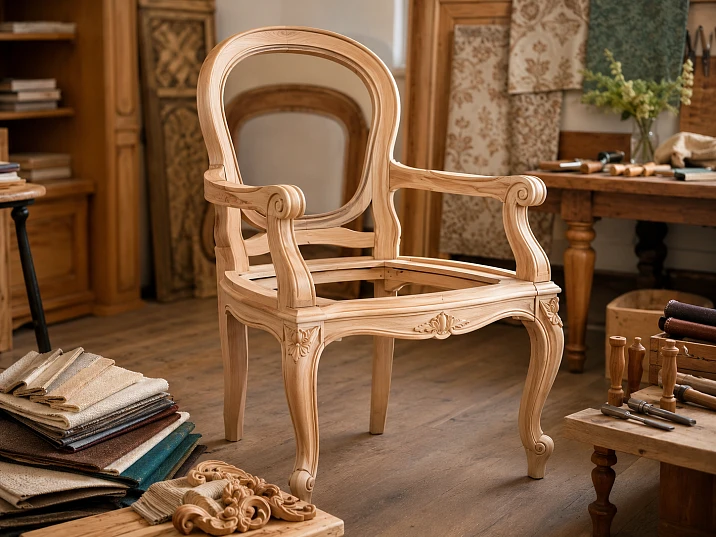
Let me start with a question that seems obvious but is rarely asked: what makes an armchair an armchair? Not the fabric. Not the foam. Not the hand embroidery on the cushion. What makes an armchair is the frame. It sets the shape, proportions, seat height, the feel of touching the armrest, how the back contacts the backrest. Everything else is layers applied on top. So, a correctly chosen armchair frame is not an auxiliary element of the project. It is its foundation.
In the STAVROS catalog buy armchair frame can be a separate product group: wooden frames made of solid beech and oak, designed for upholstery, restoration, custom production, and commercial interior projects. This is not about a ready-made chair with an "all-inclusive" price tag. It's about the entry point into a furniture project — where the real work of a craftsman, designer, or simply someone who wants a chair not from a shopping mall catalog but tailored to themselves begins.
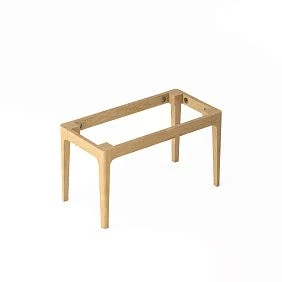
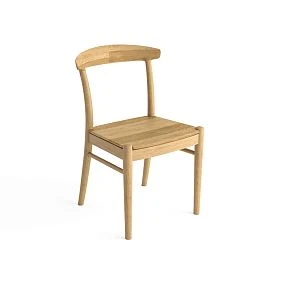
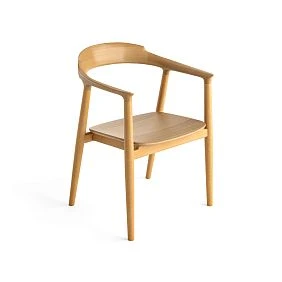
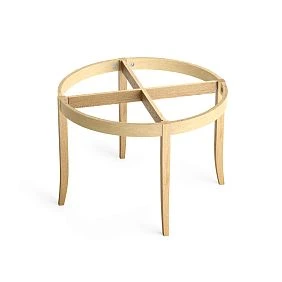
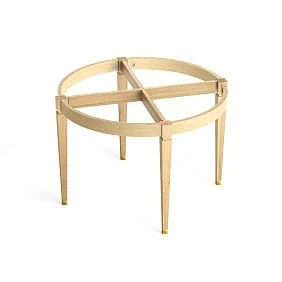
What is a chair frame and why is it bought separately
A chair frame is a prefabricated or monolithic wooden structure that determines the geometry of the future product: seat width, backrest angle, armrest height, leg character. Essentially, it's the architectural form of the chair before materials — webbing, springs, felt, foam, fabric — are applied.
Why is it bought separately? There are several reasons, and all of them are quite specific.
The first reason is custom production. Furniture workshops, restorers, small joinery studios use ready-made wooden frames as a basis for their own products. Producing a frame independently is labor-intensive, requires specialized equipment and a powerful joinery base. Buying a ready-made frame from a professional manufacturer is rational both economically and technologically.
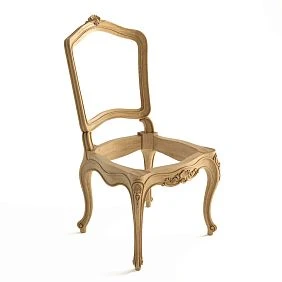
The second reason is restoration. An old chair with a worn, broken, or dried-out frame is not a reason to throw it away. Sometimes it's enough to replace the wooden base, preserving the fabric or decor. Sometimes an analogue of a historical shape is needed — and here a carved Armchair frame STU-003 in the Louis XV style fulfills the request without the need to order custom fabrication from scratch.
The third reason is a design project. An interior designer creating custom furniture for a client often works specifically with the frame. They choose the shape, proportions, style — and then turn to an upholsterer who executes the fabric part. The division of labor allows for the most precise result without compromises.
The fourth reason is furnishing hotels, restaurants, lounge areas. Commercial interiors require large batches of identical items. Buying frames in series, upholstering them locally — a standard scheme for the HoReCa sector.
In all these scenarios Buy chair frame From a professional manufacturer's array, this is a choice for quality, predictability, and technological compatibility with further finishing.
How this article differs from other materials about STAVROS furniture
Important clarification. On the STAVROS website, there are materials about chairs in general, classic furniture, carved decor, and individual interior items. This article is fundamentally different.
There will be no discussion here about ready-made chairs, facade and wall decor, stucco, underframes, ottomans, or stools. The focus is strictly one: how to choose a wooden chair frame as a separate product unit — for upholstery, restoration, or an author's project.
If you are interested in Solid wood furniture frames in a broader sense — besides chairs, you will find frames for stools, ottomans, consoles, and underframes. These are adjacent sections. But each has its own logic, its own proportions, its own application scenarios. In this article — only the chair.
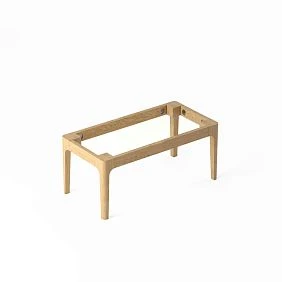
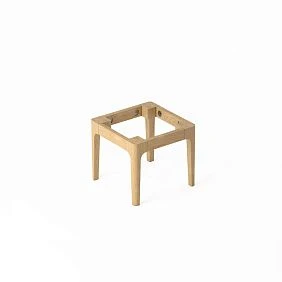
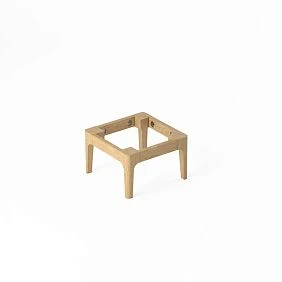
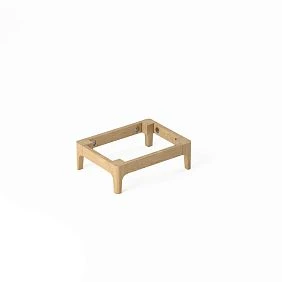
Our factory also produces:
STAVROS chair frames: what exactly is in the catalog
Get Consultation
Chair frame as an independent product group
Go to the section buy a chair frame — and you will see that STAVROS offers wooden chair bases made of beech and oak. The products are supplied unassembled or assembled depending on the model, all surfaces come sanded and ready for final finishing — priming, painting, tinting, or varnishing.
All frames are manufactured using tenon joints with polyurethane glue — this is a traditional joinery technology that ensures strength comparable to a monolithic product. The wood undergoes chamber drying to a moisture content of 8–12%, which eliminates deformation and cracking during operation — especially important for intensive use in commercial spaces.
What does "ready for upholstery" mean? The seat, backrest, and armrests of the frame have upholstery fields — flat or curved areas where the soft filling is built: webbing, Nosag springs, or independent spring units, foam layers, synthetic padding, fabric. This is a standard furniture scheme that all professional upholsterers work with. The presence of clearly defined upholstery fields is a sign of a professionally designed frame.
Buy wooden chair frame STAVROS can be ordered from 1 piece, delivery — throughout Russia and the CIS via CDEK and DPD. In-stock items are shipped within 3 business days; custom orders take 5–10 business days.
Chair frame STU-003: flagship model
Deserves separate and detailed consideration Armchair frame STU-003 — the main model in this group, made with artistic and historical accuracy.
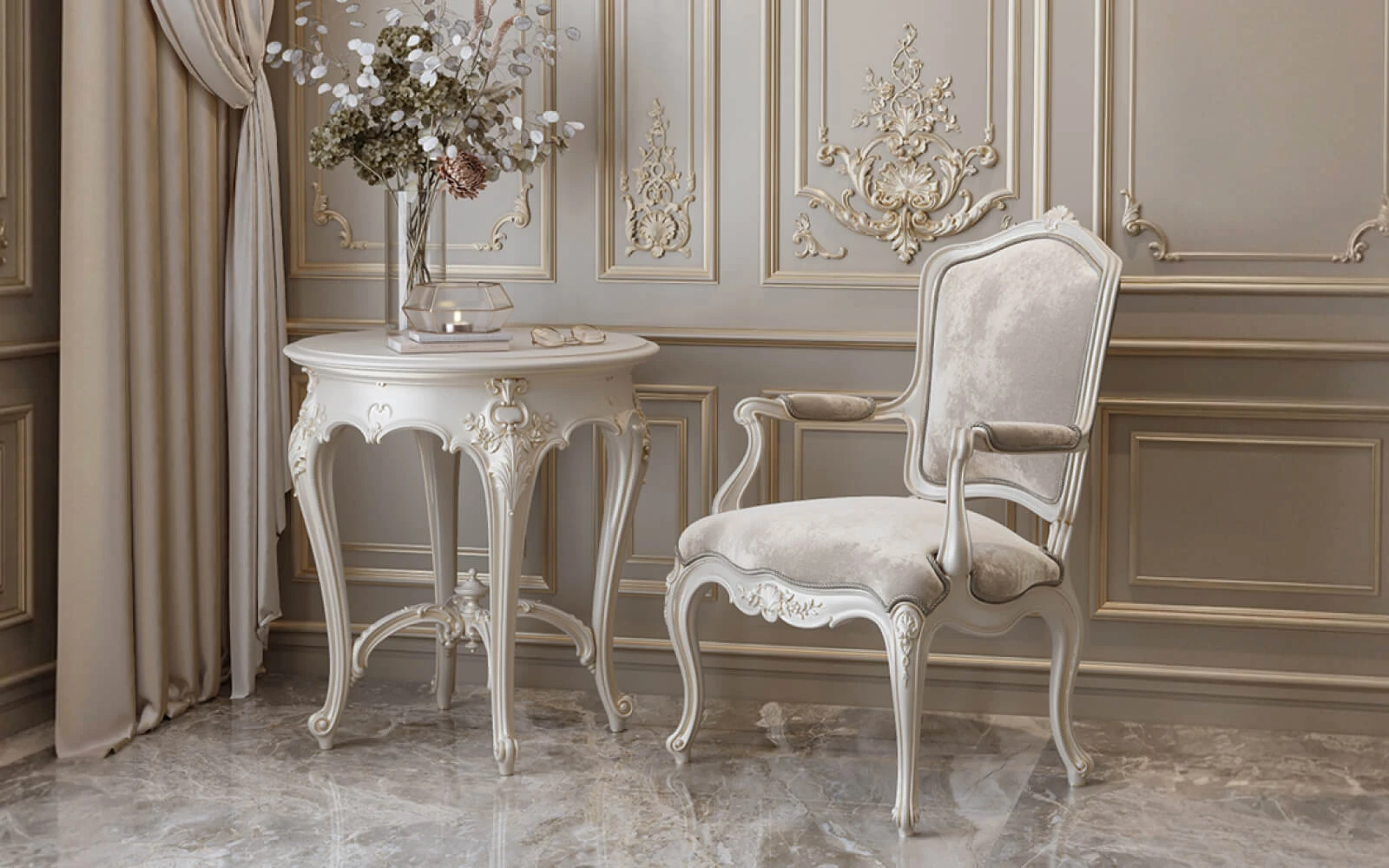
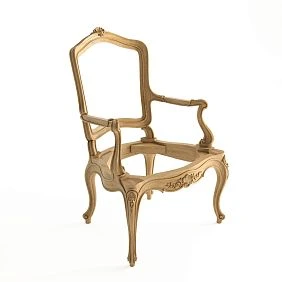
STU-003 is a carved cabriole chair frame in the Louis XV style. This definition encompasses a lot. The Louis XV style is the mid-18th century, the peak of French Rococo: curved forms, smooth transitions, carved relief of acanthus leaves, rocaille, and floral garlands. This was a period when furniture ceased to be merely functional and became a full-fledged work of decorative and applied art.
What is the structural design of STU-003?
Legs — S-shaped cabriole with a double curve, splayed outward. "Cabriole" is not just a shape, it's a whole system: the S-curve distributes load differently than a straight leg, creating stability without additional crossbars. The aprons between the legs are profiled, with carved decoration.
Armrests — open, in the "en arbalète" technique (stylized crossbow), splayed outward. They connect the seat to the backrest and provide structural rigidity. The armrests have bordered areas for creating rolls during upholstery.
The backrest is concave. This is an important detail. A straight backrest requires a lumbar support pillow. A concave one naturally hugs the back, following its shape. This is 18th-century ergonomics that remains relevant today.
The upper part of the backrest is rounded and decorated with carved ornamentation. The entire piece is a unified decorative composition with no random forms. Each detail flows plastically into the next, creating an organic whole.
Material: solid beech or oak, optional. Supplied assembled in a rigid box. Tenon-groove joint with gluing — just like in classic joinery production.
Which finish is STU-003 suitable for? White enamel — if you want a light chair in the style of Provence or Louis XVI. Tinting — if you want dark walnut, cherry, or antique. Semi-transparent varnish — if you want to keep the wood texture visible. The frame is supplied in 'white wood' and is ready for any of these scenarios.
This is not simply chair frame for upholstery. This is an artistic piece that, after upholstery, turns into a museum-class chair — with the right fabric choice and professional upholsterer work.
How to choose a chair frame by purpose
Need determines choice. Before browsing the catalog, it's worth clearly answering the question: what exactly is this frame needed for?
For an upholstered chair in a residential interior
This is the most common scenario. A person wants a chair — for the living room, bedroom, study, reading area. Ready-made options in stores don't satisfy in terms of shape, color, or quality. And then the idea arises: buy a frame, order upholstery from a craftsman — and get exactly what you need.
Buy a frame for an upholstered chair at STAVROS means getting a professional wooden base with ready-made upholstery fields. Next — choosing fabric, choosing filler, choosing a craftsman. The result is a custom chair that is not in any catalog.
For a living room with a classic or neoclassical interior, STU-003 is optimal: its proportions and style organically fit into a space with moldings, cornices, parquet with a border, and heavy curtains. For a more modern interior — check with the STAVROS manager for the availability of other models in the current assortment.
What you need to know before ordering for a residential interior:
-
Room dimensions and chair placement — to avoid mistakes with scale
-
Seat height — the ratio of seat height to user height
-
Interior style — to choose the appropriate frame shape
-
Type of finish to be applied to the frame — beech or oak, enamel or tinting
For furniture restoration
Restoration is a separate world. An antique chair with beautiful fabric and a destroyed frame, or vice versa — a durable wooden base with faded, moth-eaten upholstery. In the first case, a new frame is needed, as close to the historical original as possible.
Buy a wooden chair frame in the French Rococo style — exactly what STU-003 offers. For a professional restorer, this is a ready-made base for upholstery with period fabric or a high-quality modern analogue of historical fabrics. The cabriole chair shape with a concave back and carved legs is a historically accurate type well known to any specialist working with 18th–19th century furniture.
An important nuance for restoration: before ordering, it makes sense to compare the dimensions of STU-003 with the dimensions of the original. If the piece needs to be reproduced in a non-standard scale — STAVROS works with custom orders in batch production. You can clarify the terms with the manager.
For restoration projects, the finishing issue is important: beech wooden chair frame under white enamel — for French Rococo interiors. Oak under tinting — for English or Dutch tradition. The choice of wood species here is not arbitrary but dictated by historical logic.
For custom furniture and design projects
This is an area where the chair frame becomes the starting point for creating a collectible piece. A designer or craftsman takes a ready-made wooden base, adds non-standard upholstery — embroidery, print, hand-woven custom fabric — and gets a one-of-a-kind item.
Solid wood furniture frames STAVROS frames are suitable for such work: high surface quality, correct geometry, predictable wood behavior during painting and tinting. The craftsman does not waste time fixing crooked corners and unsanded areas — he works with a ready-made, professionally manufactured base.
For custom projects, the ability to choose the wood species and glue type is especially valuable: "under enamel" or "under tinting." This directly affects how the frame surface will look after coating. If legs or armrests will be visible from under the fabric — their finish must be flawless.
A designer's approach to choosing a frame is always looking from the end to the beginning: first imagine the finished chair, then determine what the frame should be like.
For commercial interiors: hotel, restaurant, office, lounge
A commercial interior is a different scale. Here, you need not one piece, but a batch. And each unit has increased requirements for wear resistance.
A wooden frame made of solid beech or oak is the right choice for HoReCa. Why?
First, durability. Beech and oak are hardwoods with above-average density. Legs and joints withstand loads during intensive use without deformation.
Second, repairability. A wooden frame, if damaged, can be restored: the tenon can be reglued, the side rail replaced, the surface resanded. A metal or plastic frame with similar damage most often goes for complete replacement.
Third, aesthetics. For a classic hotel, historic restaurant, meeting room, or executive office, a wooden chair in a classic style creates the right visual context. It speaks of status, tradition, quality.
For commercial projects buy a chair frame in a batch — the optimal scheme: uniformity of form, simultaneous delivery to the site, possibility of local upholstery by the contractor.
How to choose the frame material: beech or oak
This is not a matter of taste in the usual sense. It is a technological choice that determines the final result.
Beech is a dense, non-porous wood. Its structure is fine-grained, and the surface after sanding is even and smooth. Beech is easy to mill and carve, allowing for complex decor with clear, thin lines. Its main use in the context of chair frames is for painting with enamel. Enamel lays evenly on beech, without sinking into pores or surface surprises. The result is a uniform coating, like on painted MDF, but alive: the relief of the carving is visible in the half-light.
Beech is not recommended for clear varnishes and tints: its natural pattern is inexpressive and does not give an "expensive" texture effect. If you want visible wood, choose oak.
Oak is a dense, porous wood. Large fibers with a pronounced pattern, dark pores. Under clear varnish or semi-transparent tint, oak looks lively, deep, and noble. Tints like "antique", "walnut", "tobacco", "dark cherry" are all classics for oak frames. Oak is stronger than beech, heavier, and more expensive to process. Under the same load, an oak frame will last longer.
Oak is also used for enamel painting, but it is labor-intensive: the pores require multi-layer priming before the final coating. This makes sense if the design specifically requires oak under enamel, but as a rule, it is simpler and cheaper to use beech for this task.
Practical rule:
-
White, cream, colored chair → beech under enamel
-
Dark, tinted, with visible texture → oak under tint or varnish
Also, in the product card, pay attention to the "lamination type" parameter:
-
Under enamel — lamellas are selected without regard to color and texture. The surface may have contrasting areas — this is not a defect, but normal for a product under an opaque coating.
-
Under tint — lamellas are selected with regard to texture and color. For open wood surfaces under a clear or semi-transparent coating.
How the frame of an armchair differs from the frame of a chair
A question that arises for those encountering this product group for the first time. The explanation is simple but important.
| Parameter | Armchair frame | Chair frame |
|---|---|---|
| Seat depth | More — for comfortable relaxation | Less — for upright sitting |
| Seat height | Lower — relaxed posture | Standard dining height |
| Armrests | As a rule, there is | As a rule, absent |
| Purpose | Living room, study, bedroom, lounge | Kitchen, dining room, workspace |
| Upholstery | Soft, multi-layered | Often minimal or absent |
| Scale | Larger, wider | More compact, lighter |
| Back shape | Often concave or slanted | More often vertical or straight |
These are fundamental differences — not stylistic, but structural. Confusing a chair frame with an armchair frame means getting a product that won't function as intended.
If your project involves several types of products — chairs, armchairs, benches — refer to the relevant sections:
-
Chair Frame — for dining and work chairs
-
Banquette Frame — for horizontal seats without a backrest
-
Console Frame — for wall-mounted decorative tables
-
solid wood pedestals — for tables of various formats
Each group has its own logic, its own dimensions, its own scenarios. Do not mix them.
What to check before buying an armchair frame
The list is specific. Read it carefully — especially if you are buying a frame for the first time.
1. Dimensions. Seat width, seat depth, seat height from the floor, backrest height, width across armrests. All these parameters must be coordinated with the installation location and the user's height/build. The standard seat height of a classic chair is 40–45 cm. The standard depth is 50–60 cm.
2. Presence of armrests. There are models with open armrests, closed armrests, or without them. For a living room or office chair, armrests are important. For a chair in a waiting area with frequent turnover of people, it is sometimes more convenient without them.
3. Backrest shape. Straight, concave, reclining. A concave backrest, like the STU-003, is more ergonomic for prolonged use.
4. Material. Beech or oak. Determined by the type of planned coating (see above).
5. Type of gluing. For enamel or for tinting — depending on the finish coating.
6. Quality of sanding. STAVROS offers two options: "Standard" (machine sanding, more affordable price) and "Prestige" (detailed hand sanding, products require no finishing work). For custom and designer projects, choose "Prestige".
7. Compatibility with upholstery. Ensure that the frame has upholstery fields of sufficient size for the planned soft filling.
8. Style. STU-003 is Rococo, Louis XV. If your interior is strict Classicism, Empire, or Modern Classic, a different shape may be needed. Check with your manager.
9. Production time. In-stock items — shipment within 3 business days. Made-to-order — 5–10 business days. If the project is urgent, check stock availability.
10. Delivery. Contact us to confirm shipping to your destination. via CDEK and DPD. The cost is calculated automatically when placing an order.
Chair frame and upholstery scheme: what a master needs to know
This section is for those who not only buy the frame but will also upholster it — either by themselves or by a hired upholsterer.
The classic upholstery scheme for a chair with a wooden frame is built in several layers:
First layer: base preparation. Cross-lacing tapes (jute or polypropylene) are attached to the upholstery field to create an elastic base. An alternative is a Nosag spring block (zigzag) for seats requiring a soft response.
Second layer: padding. Hair or coconut padding is attached over the tapes, creating the primary seat profile. On top — foam rubber of the required firmness and thickness. For a classic chair, the standard is foam rubber 40 kg/m³, 80–100 mm thick.
Third layer: synthetic padding and batting. They create softness of the final layer, hide transitions between layers, and give the shape roundness.
Fourth layer: fabric or leather. It is stretched and fastened with a stapler or nails with decorative heads — depending on the design.
Important for frame STU-003: the armrests have edged sections for bolsters — this is a characteristic element of a classic Rococo chair. The upholsterer must take this into account when cutting the fabric.
The backrest of STU-003 has a concave shape — upholstery here is slightly more complex than on a flat one. The fabric should be without stiff pile, well-stretching in the desired direction. Velvet, velour, tapestry are classic choices for such a chair. Linen and cotton fabrics — for a more modest, 'country' option.
Where to buy the STAVROS chair frame: direct route
For those ready to move from reading to action.
Section chair frames in the STAVROS catalog — the main page for selection. Here is the entire current product group, prices, stock availability, filters by material and shape.
Specific model — Armchair frame STU-003 — carved wooden base in the style of Louis XV, made of beech or oak, with a concave back, cabriole legs, and open armrests.
If you need related products: Chair Frame, Banquette Frame, Console Frame or solid wood pedestals — each section has its own page.
Entire section solid wood furniture frames — if you need an overview of the entire category before making a decision.
Contact the manager: by phone +7 (800) 55-46-75 (toll-free in Russia), by email [email protected], in WhatsApp or Telegram @STAVROS_manager. Showrooms are in St. Petersburg and Moscow.
Why STAVROS: not just production, but a story
Behind every STAVROS frame is a production history of more than twenty years and real experience working with historical interiors. The company was founded in 2002 by two artists — and within a year participated in the reconstruction of the Constantine Palace in Strelna. Then came the Hermitage, the Alexander Palace, the Trinity-Izmailovsky Cathedral, and the Sheremetev Mansion.
This experience is directly related to the STU-003 frame. The cabriole chair in the style of Louis XV is not a fantasy on a classical theme, but an exact reproduction of a historical form, verified based on work with authentic samples. The carving on the legs, the profile of the aprons, the shape of the armrests — all of this is done according to the rules, not "inspired by."
For the buyer, this means: Buy a wooden chair frame STAVROS — means getting a product that is created by people who understand what classical form is from the inside. This is not a conveyor belt imitation "antique-style." This is real joinery and artistic work.
Mistakes when choosing a chair frame
Let's break down typical mistakes — so you don't make them.
Mistake 1: Choosing a frame based on a photo without checking the dimensions. A photograph can be misleading: a wide-angle lens distorts proportions. Always look at the dimensions in the product card and compare them with the actual installation location.
Error 2: Ordering beech when you need oak — or vice versa. If you plan to tint the frame and leave exposed wooden surfaces visible — choose oak. If you will paint with opaque enamel — beech. Mixing them up means wasting time and money on corrections.
Error 3: Choosing "Standard" sanding for a custom project. For items where exposed wooden surfaces will be visible — legs, armrests — you need "Prestige". Machine sanding leaves marks that are noticeable under varnish.
Error 4: Not accounting for the upholstery scheme when choosing dimensions. Foam, webbing, fabric — these add a few centimeters to each dimension. If you need a chair 70 cm wide — the frame should be narrower, about 65 cm. Discuss with the upholsterer before ordering.
Error 5: Ordering a single frame for a commercial project. For a restaurant or hotel, you need a batch. Check: STAVROS works with bulk orders for custom finishes, while standard models are shipped from 1 piece. Clarify conditions for large volumes with a manager.
Error 6: Not checking the compatibility of the frame style with the interior. STU-003 is Rococo. This is a rich, decorative style. In a minimalist modern interior, it will look like an alien element. The reverse situation is also true: a laconic frame without carving in a classic living room will get lost against the background of wall decor and stucco.
Error 7: Buying a frame without consulting an upholsterer. A professional upholsterer is your main ally in this project. Before ordering a frame, talk to them: they will assess the shape, point out nuances of upholstering a specific model, and help with fabric selection.
Frequently Asked Questions (FAQ)
Where to buy a STAVROS chair frame?
In the section chair frames on the STAVROS website. Contact us to confirm shipping to your destination. and the CIS.
Is there a specific chair frame model?
Yes. The flagship model is — Armchair frame STU-003 — a carved cabriole chair in the Louis XV style, made of beech or oak.
Is this article about a finished chair?
No. The article is about the chair frame as a wooden base for further upholstery, finishing, or restoration. A finished upholstered chair is already the result of the master's work on top of the frame.
Is this a duplicate of the article about furniture frames in general?
No. The focus here is strictly on one product group — the chair frame. Other frames (chair, bench, console, table base) are in the corresponding sections of the catalog.
Can STU-003 be used for restoring an antique chair?
Yes, if the shape and proportions match the original. STU-003 corresponds to the historical type of the Louis XV period cabriole chair. For an exact match — compare the frame dimensions with the original's parameters.
Which wood is better for the frame — beech or oak?
Beech — for painting with enamel (white, colored chair). Oak — for tinting or clear varnish, when the wood texture should be visible.
What is the delivery time?
In-stock items — shipped within 3 business days. Made-to-order — 5–10 business days. Delivery via CDEK and DPD, cost is calculated automatically on the website.
Can I order a frame of a non-standard size?
Yes, STAVROS manufactures custom products according to individual projects, but only accepts bulk orders for production. Details — from the sales department manager.
What are "Standard" and "Prestige" in sanding?
"Standard" — machine sanding, more affordable price. "Prestige" — detailed hand sanding, the product is ready for finishing without additional work. For exposed wooden surfaces and custom projects, "Prestige" is recommended.
Are frames sold from 1 piece?
Yes. STAVROS ships all products from 1 piece.
How to contact a manager for a consultation?
By phone +7 (800) 55-46-75, by email [email protected], in WhatsApp or Telegram @STAVROS_manager. Showrooms are in St. Petersburg and Moscow.
Can I see the chair in person before ordering?
Yes. In STAVROS showrooms, you can see the products in their natural form. Addresses are on the website in the contacts section.
Is a design project needed to order a frame?
Ideally, yes, especially for complex projects. To order a single frame, it is enough to know the required model, material, and type of sanding. For a small number of items, a company manager can help.