








































































Article Contents:
- What the user is looking for with the query "buy solid wood kitchen fronts"
- Which STAVROS products are suitable for designing kitchen fronts
- Carved overlays for kitchen fronts
- Wooden moldings and baguettes for the kitchen
- Mascarons, rosettes and brackets as point accents
- Wooden handles for kitchen fronts
- How to assemble a decorative program for kitchen fronts: selection logic
- Selection table: task — solution — link
- Oak kitchen decor and beech kitchen decor: what is the fundamental difference
- How STAVROS decor works with different kitchen styles
- Mistakes when decorating kitchen fronts with decor
- How to update kitchen fronts without full replacement
- STAVROS carved decor: why it is not just hardware
- How to make a classic kitchen from neoclassicism: practical transformation
- Where to look and what to order: a complete route through the STAVROS catalog
- Frequently Asked Questions (FAQ)
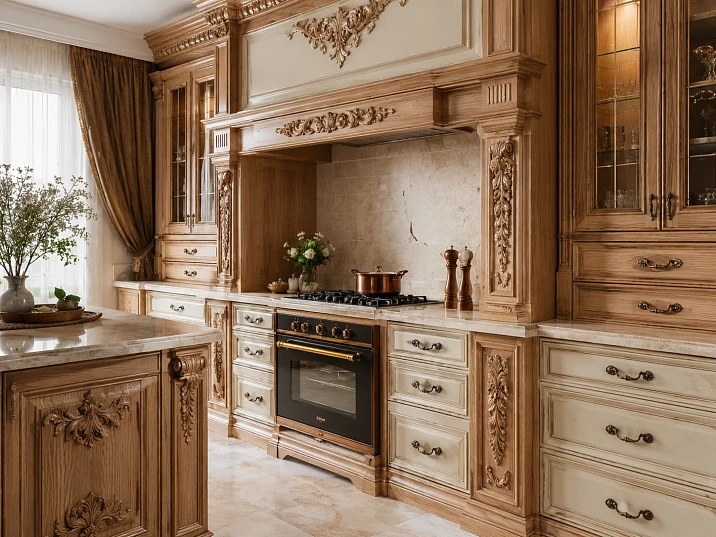
The kitchen is the only place in the home where function and aesthetics clash head-on every day. You have to cook, wash, and store here. And at the same time — live, look, breathe. That is why kitchen cabinet fronts are not just planes behind which pots are stored. They are the face of the entire space. And what is written on that face — carved decor, overlays, moldings, handles — determines the character of the interior for years to come.
This article is not about the general theory of a classic kitchen. Only a specific commercial route: which STAVROS products help to design solid wood kitchen fronts in a classic, neoclassical, or baroque style, and exactly where to go in the catalog to choose the desired product.
What the user is looking for with the query "buy solid wood kitchen fronts"
Let's be honest. The query "buy solid wood kitchen fronts" is searched about 80 times a month. But what exactly the person means is a question worth analyzing before moving on to products.
Part of the audience is looking for ready-made fronts: that is, individual doors for kitchen cabinets made of natural wood, which can be bought individually and installed on a ready-made cabinet. This is a real need that exists in the market.
Another part of the audience — and this is a significant portion — is looking not for the fronts themselves, but for what to decorate these fronts with: overlays, carved elements, molding, handles. These people already have a kitchen — or ordered it from a manufacturer — and want to make it beautiful. They want to turn ordinary MDF fronts into something resembling classic kitchens with rich carved decor.
STAVROS is the second scenario. The company produces and sells decorative products made of solid beech and oak: carved overlays, moldings, mascaron brackets, rosettes, furniture handles. All of these are real products with real cards, real prices, and real functions. They are glued, attached, installed on fronts and turn the kitchen from a functional box into a space with character.
This article is for those who are looking for exactly the second. For those who want decor for wooden kitchen fronts — overlays, molding, handles — and not an abstract answer "buy a new kitchen".




Which STAVROS products are suitable for decorating kitchen fronts
Before moving on to each group of products, it is important to understand the logic. The design of a kitchen facade is built on a multi-level system:
-
The first level is the central accent on the facade door. This is a large carved overlay in the center or vertical side elements that define the panel's appearance.
-
The second level is horizontal lines — moldings, cornices, and trims that decorate the upper parts of cabinets and create a finished look.
-
The third level is point accents — mascaron brackets, rosettes. These are what make the interior elegant, not just decorated.
-
The fourth level is hardware — handles. They are the last to be installed, but they are the ones the owner touches daily and must match everything else in material and color.
Let's look at each level separately.
Our factory also produces:
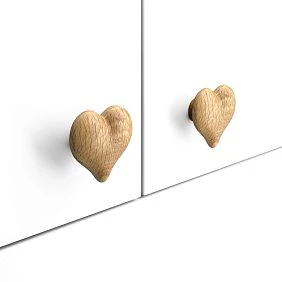
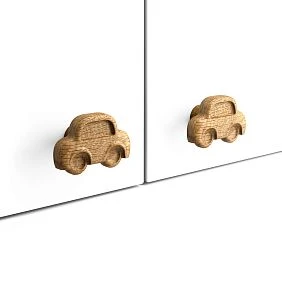
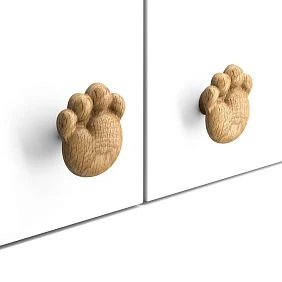
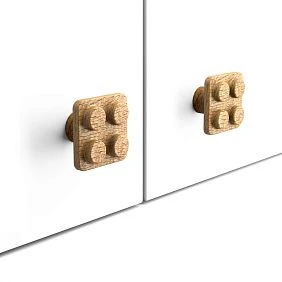
Carved overlays for kitchen facades
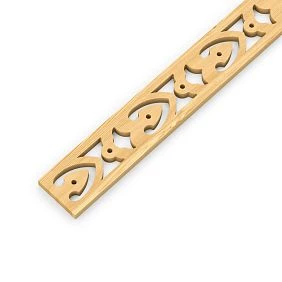
Carved decor for kitchen facades — the basis of a classic kitchen. In the STAVROS catalog, the carved overlays section contains more than 400 models made of beech and oak wood. This is no exaggeration: among them are central accent overlays, corner elements, symmetrical pairs, asymmetrical details, modular constructors, and ornamental panels.
Why so many options? Because a kitchen is not a uniform object. A facade 720 mm high and 400 mm wide requires one scale of overlay. A corner tall cabinet 2100 mm high requires a completely different one. A small dishwasher door requires a third. And each product has its own proportions, its own pattern, its own artistic language.
The key principle for choosing an overlay: it should occupy 50–70% of the visible facade area. If the overlay is too small, it gets lost on the surface and looks like a random detail. If it's too large, the facade appears overloaded. A properly chosen overlay "fills" the facade and makes it visually complete.
For kitchen facades made of beech wood — under enamel — overlays without a pronounced wood texture are better suited: when painted, they will give a smooth, uniform relief without fiber "noise." For oak facades — overlays with coarser, more pronounced carving: the oak texture enhances the feeling of handcrafted work.
The STAVROS range includes Solid wood overlays in various executions: from small elements costing from 920 rubles to large ornamental panels and decor sets costing from 31,540 rubles. This allows you to choose decor for any budget — from a point accent to a complete kitchen design.
The author's collection "Summer Garden" deserves special attention: carving in the form of plant motifs with a unique artistic interpretation. Living curved branches, open buds, leaves with detailed vein elaboration — these are products that are recognized by the eye of a person who understands handcrafted work. They are mounted on the facades of kitchen upper and lower cabinets, on the doors of corner sections, and on the central tall cabinet.
Options for using carved overlays in the kitchen:
-
Central overlay on the lower cabinet facade — accent of the main work area
-
Symmetrical pair of overlays on the upper cabinet doors — unity of the horizontal line
-
Corner overlays at the intersection points of the horizontal profile and the vertical of the facade
-
Ornamental overlay on the island facade — the main accent of the kitchen
-
Carved detail on the dishwasher or refrigerator facade — integration of appliances into the style
For order overlays for kitchen fronts must be specified when ordering: wood species (beech or oak), need for coating (painted or uncoated), orientation (left/right mirror image for symmetrical pairs). Items are purchased from 1 piece, which is important for those who are not designing the entire kitchen at once, but adding decor step by step.
Get Consultation
Wooden moldings and baguettes for the kitchen
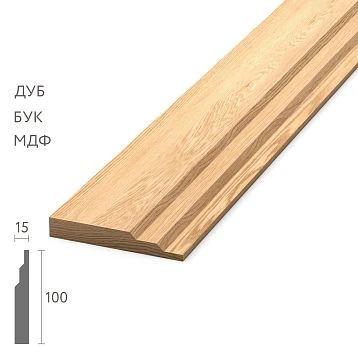
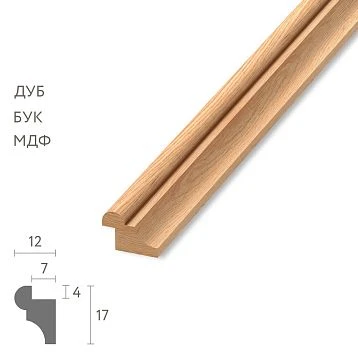
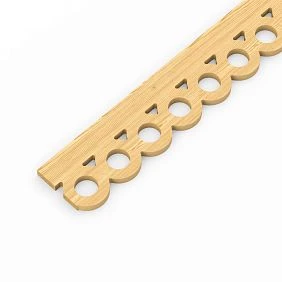
If overlays are accents, then wooden moldings for the kitchen is the skeleton of the decorative program. Moldings set horizontal lines, frame transitions, create cornices above upper cabinets. Without them, even the most beautiful overlays look like decorations without a frame — separate, not as a unified system.
What are moldings in relation to the kitchen? These are profiled strips made of solid wood, cut to length and mounted horizontally. They are used in several areas:
Cornice above upper cabinets. The upper cornice is the most noticeable horizontal line of the kitchen. A properly selected profile makes the top of the cabinets complete: they look like a single architectural element, not a set of separate boxes. The cornice profile in a classic kitchen has a shaped cross-section — several belts, chamfers, and coves. The richer the profile, the more luxurious the result.
Under-cabinet profile (cove molding). The transition between lower cabinets and the floor or base. A small profiled strip that covers the joint and gives the lower part of the kitchen a finished look.
Horizontal molding on the facade. A wooden profile that divides the facade into zones — for example, a horizontal strip in the middle of the door, creating the illusion of a double door. This is a classic technique that adds depth and architectural character to the facade.
Island design. If the kitchen has an island — its side panels and lower front are often trimmed with molding along the perimeter. This "frames" the island and makes it look like a piece of furniture, rather than a structural element.
In the STAVROS catalog Pogonazh iz massiva is available in several profile types for different tasks. These are beech and oak products sold by linear meter. They are purchased in the required quantity with allowance for joints and trimming. For proper calculation, measure all horizontal lines of the kitchen where molding is planned, and add 10–15% for corner trimming.
An important point: the molding must be from the same wood species as the overlays if they are to be painted together. Beech with beech, oak with oak — only then will the paint lay evenly and the surfaces look like a single material.
For those who want buy solid wood kitchen fronts as a complete project — it's worth starting with the decorative program: first determine what and where will be placed, then calculate the linear footage of molding and the number of overlays. This avoids overpaying for extra meters and prevents running out of molding for the final cabinet.
Mascarons, rosettes, and brackets as point accents
If overlays are the "canvas" and molding is the "frame," then mascarons, rosettes, and brackets are the "jewelry details." Their function is to create focal points, place accents in the right spots, and add to the interior what cannot be described in words but is immediately visible: a sense of luxury.
Mascarons. These are decorative faces — relief images of faces, masks, heads. In classical and Baroque traditions, they were used as protective talismans and symbols. In a modern interior, a mascaron is an accent that speaks to a high level of decorative program. In the kitchen, they are installed:
-
In the center of the exhaust hood portal
-
On corner sections
-
Above the central decorative cabinet
-
On the island as a point accent
Mascarons for kitchen decor STAVROS — products made from beech or oak solid wood. The shape is typically symmetrical about the vertical axis. Size varies from small details to large reliefs. It is important to choose a mascaron in proportion to the area of application: a small mascaron on a large range hood portal will be lost, a large one on a small section will overwhelm.
Rosettes. These are round or oval decorative elements with radial ornamentation. In the kitchen, rosettes are used as:
-
Intersection points of vertical and horizontal moldings (in frame corners)
-
Accent details at molding intersections
-
Central details on shallow doors
In a classic system, rosettes work in pairs and symmetrically. If you place a rosette on one corner of a frame, it should be on all four. This is a rule, and breaking it is always visible to the naked eye.
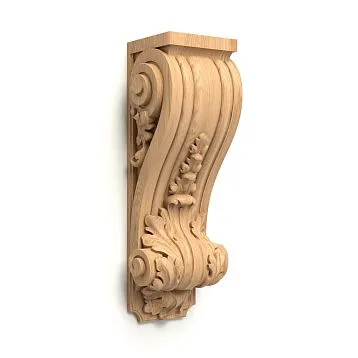
Brackets. These are decorative console elements with a C-shaped or S-shaped profile. In the kitchen, they perform three functions at once: decorative, structural (supporting the upper slab or cornice), and zoning (marking the transition between sections).
Brackets for kitchen decor STAVROS — solid wood products with carved or profiled decor. They are installed in pairs at transitions between the hood portal and side cabinets, on corner posts, at the boundary of the work area and storage area. In Baroque projects, the brackets are richly decorated with acanthus leaves. In Neoclassical ones, they are more laconic, with geometric profile moldings.
Wooden handles for kitchen fronts
The handle is the last element to be put in place and the first one to be picked up every day. It is the point of contact between a person and the furniture, and it must be right: in shape, size, weight, and color.
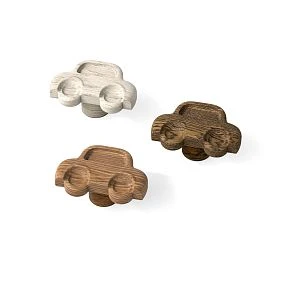
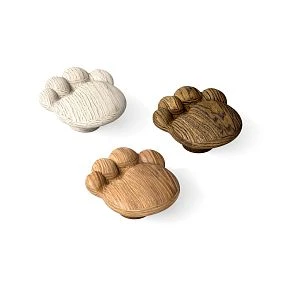
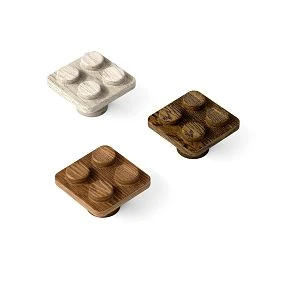
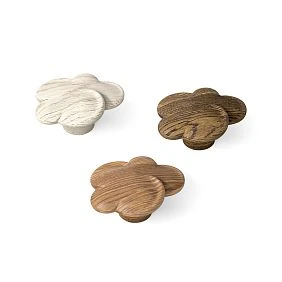
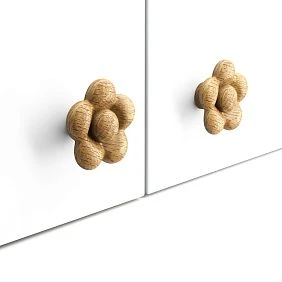
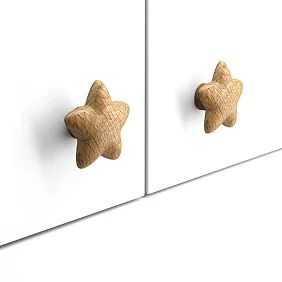
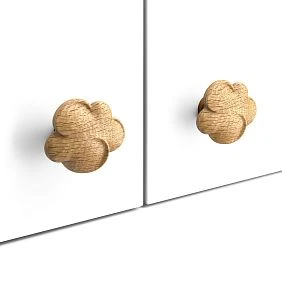
In STAVROS, wooden handles for kitchen fronts are presented in the section furniture handles of two main types: handles with coating and handles without coating.
Handles with coating. Handles with Finish — these are products made of solid beech or oak that are already painted or finished with varnish. The coating can be solid (matching the color of the fronts), transparent (preserving the wood texture), or tinted. Such handles are convenient because they require no additional treatment: they are ready for installation immediately after unpacking. Suitable for kitchens where all fronts are already painted in a specific color.
Handles without coating. handles without coating These are items in "white wood," ready for painting. They are chosen when you need to paint the handle to match the exact color of the facade — for example, so the handle visually blends with the surface and is only visible as a shape, not as a separate element. Or, conversely, when a contrasting color is needed — then the handles are painted separately in the desired shade.
For a kitchen made of tinted oak — handles made of unfinished oak, which are tinted together with the facades. For a kitchen made of beech under white enamel — handles made of unfinished beech, which are painted in the same color. This creates the feeling of a single product, where the handle is not an insert part, but a part of the facade.
Types of handles by shape:
-
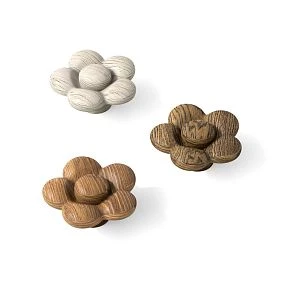
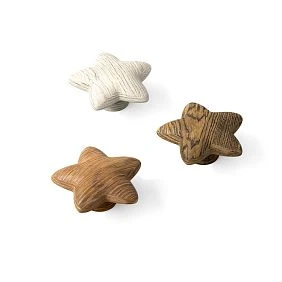
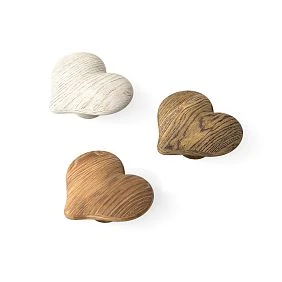
Knob handles (buttons). Small surface-mounted handles without through fastening. They are installed on a screw from the front side. They work well on small facades: drawers, dishwasher fronts, doors of narrow cabinets.
-
Bail handles. Horizontal or vertical brackets with two attachment points. Most convenient for daily use. The size of the bracket is selected according to the width of the facade: narrow facades — short brackets, wide ones — long brackets.
-
Rail handles. Long horizontal handles that occupy almost the entire width of the facade. They are more characteristic of modern styles, but in versions with end threading, they are also used in classic kitchens.
In a classic kitchen, medium-length brackets with carved overlays on the ends or a figured base profile are most organic. A wooden bail handle next to a carved overlay made of the same wood and the same color is a system that works as a single whole.
How to assemble a decorative program for kitchen facades: the logic of selection
Choosing decor for kitchen facades is not about "getting a little bit of everything." It is a systematic process that builds from large to small.
Step 1: Determine the style. Classic, neoclassical, Provence, Baroque, Russian classicism — each style has its own rules of ornament, proportions, and scale. A Rococo-style overlay on a kitchen in the spirit of strict classicism will create a stylistic conflict. Start by defining the style — and then choose specific items for it.
Step 2: Determine the dominant material. Beech under enamel or oak under tinting. The choice of wood species for all decorative elements depends on this: overlays, moldings, handles. They must all be from the same species so that the surfaces are uniform when painted or tinted.
Step 3: Arrange the hierarchy of accents. The main accent of the kitchen is one. As a rule, this is the hood portal or the central section. The entire remaining decorative program is built around it. If the main accent is decorated with a mascaron and brackets, the side facades receive more modest overlays. If the main accent is a large carved overlay in the center of the section, the brackets can be minimal.
Step 4: Calculate the footage and quantity. Linear meters — in meters, with a 10–15% margin. Overlays — individually, considering mirror pairs. Handles — by the number of facades. Mascarons, brackets, rosettes — pointwise according to the project.
Step 5: Order as a set, not separately. If you order overlays today, linear meters in a month, and handles two months later, there is a high risk of mismatch in color and tone between batches, even with the same wood species. Ideally, order all decor in one order: then it is made from one batch of material and painted in one go.
Selection table: task — solution — link
| Task | What to choose | Link |
|---|---|---|
| Design the central kitchen facade | Carved overlay | carved inserts for kitchen |
| Make a classic cabinet top | Wooden molding | Pogonazh iz massiva |
| Add an accent to the hood or portal | Mascaron | Mascarons for decor |
| Mark transitions and zones | Brackets | STAVROS brackets |
| Select handles for facades | Wooden handles | Furniture Handles |
| View ready-made design ideas | Kitchen decor ideas | STAVROS kitchens |
Oak kitchen decor vs. beech kitchen decor: what's the fundamental difference
This is a question asked less often than it should be. There is a fundamental difference between beech and oak as materials for kitchen decor, and it affects not only the appearance but also the behavior of the product in kitchen conditions.
For tinting, beech gives a more neutral result: its natural pattern is unattractive and inexpressive. Therefore, beech tinting is usually covered with opaque varnishes or enamels.
Oak — for tinting. Oak is a porous species with a pronounced natural pattern. Large fibers, dark pores, textured relief — under a transparent or semi-transparent varnish, this looks lively, deep, and expensive. Tinting oak to walnut, cherry, antique, tobacco — these are classic solutions that never look banal.
For enamel, oak is also used, but rarely: its pores require additional priming and several layers of putty before painting. This is labor-intensive and expensive. Therefore, if you need a white kitchen, choose beech. If you need a kitchen with wood texture, choose oak.
For enamel, oak is also used, but rarely: its pores require additional priming and several layers of putty before painting. This is labor-intensive and expensive. Therefore, if you need a white kitchen, choose beech. If you need a kitchen with wood texture, choose oak.
In the STAVROS catalog, overlays, moldings, and handles are available in both wood species. When ordering, you must explicitly specify: beech or oak. These are not the same product at different prices — they are different products with different surface properties.
How STAVROS decor works with different kitchen styles
Carved solid wood decor is a materially determined choice specifically for classic styles. But the range of these styles is wider than it seems at first glance.
Classics of the 17th–18th centuries (Baroque, Rococo). The most decor-saturated style. All tools are appropriate here at once: large carved overlays with floral garlands and acanthus leaves, brackets with rich relief, mascaron on the hood portal, cornices of complex profile, handle-brackets with carved overlays on the ends. Overload in this style never happens by definition: the richer, the more correct.
Buy kitchen facades from solid oak in the Baroque spirit means building a hierarchy of decor so that each element 'works' for the overall theme. The hood portal is the main accent. Side sections support it with large overlays and cornices. Lower cabinets close the system with a horizontal molding and profiled base.
Neoclassicism. Stricter than Baroque, softer than Empire. In a neoclassical kitchen, decor is restrained, not excessive. The principle of 'one main accent' works: either a rich upper cornice with brackets, or carved overlays on central facades — but not everything at once. Mascarons here are point-based, with a stricter pattern (meander, palmette, laurel branches). Handles are brackets with moderate decor or knobs with a classic profile.
Provence. The most 'homey' version of classics. Here, overlays feature floral motifs, light and unobtrusive. Moldings are without excessive pomp, a modest cornice with a simple profile. Handles are small, with patina or in the color of the facade. The overall atmosphere is warm, slightly aged, cozy. Beech under white enamel with a light nude undertone is the ideal material for a Provence-style kitchen.
Russian classicism. Strict symmetry, military precision of proportions, minimum of extras. Here, decor is reduced to profiled lines: cornices with geometric pulls, handles without carving, overlays if present — then with geometric ornament, without natural motifs. This is a complex style requiring a precise understanding of the laws of classical architecture.
Mistakes when decorating kitchen facades with decor
Talking about mistakes is useful: they happen not because of ignorance of good taste, but because of ignorance of the rules. So — directly and specifically.
Mistake 1: Buying decor of different styles. A rococo overlay with a rocaille curl next to an Empire-style bracket with a geometric ornament is a stylistic conflict. Within one kitchen, all decorative elements must belong to the same artistic period.
Mistake 2: Choosing decor of the wrong proportion. An overlay that is too small on a large facade will get lost. One that is too large will overwhelm it. The golden rule: the overlay should occupy 50–70% of the visible field of the facade. Before ordering, measure the facade and compare it with the product dimensions in the listing.
Mistake 3: Mixing wood species without a system. Beech and oak next to each other are not a problem if both are painted with opaque enamel. But if part of the decor is for tinting (oak) and part for enamel (beech) — both of which imply an open texture — the result will be uneven. One species — one finish.
Mistake 4: Ordering molding without a reserve. Molding is cut at corners at 45 degrees. Each joint results in a loss of at least 5–10 cm. With long runs, this adds up. Without a 10–15% reserve, you risk running out for the last section.
Mistake 5: Installing handles before painting. Handles without a coating need to be painted before installation. If you paint an already installed handle, you will get drips in the gap between the handle and the facade and poorly painted ends. The correct order: paint, dry, install.
Mistake 6: Not checking the mirroring of overlays. A symmetrical pair of overlays consists of left and right versions. If you order two identical ones (both left), you won't get a pair. Always check in the product listing: whether a mirrored version exists and which one you need for your task.
Mistake 7: Decorating only visible facades. If the kitchen has an end panel, it should also be decorated. If there is an island side wall, it is also visible. Decor only on front facades with open ends creates a feeling of incompleteness.
Mistake 8: Behaving like a gallery, not a project. Selecting decor "by beauty" is not a method. Buying one beautiful element, then another, then a third — and ending up with an incoherent set. The right approach: first a concept, then a list, then a purchase.
How to update kitchen facades without a full replacement
One of the most popular scenarios in this topic is renovation. A person has a kitchen. Maybe it's five years old, maybe ten. The facades are still sturdy, but they look outdated or simply boring. Replacing the entire kitchen is expensive and troublesome. But adding decor is a completely different story.
The scenario goes like this: you sand the old facades (or paint over them), add carved inserts for kitchen, replace the handles with wooden ones from the same system, install a cornice above the upper cabinets — and the kitchen transforms beyond recognition. This isn't just cosmetics; it's a real change in the character of the space.
This approach is rational both economically and ecologically. MDF or particleboard facades that still hold their shape and haven't swollen can easily last another ten years — if you repaint them and decorate them with the right decor.
Wooden decor for kitchen facades STAVROS is ideal for this scenario. Overlays are glued with liquid nails or epoxy compound, moldings are attached with finishing nails and glue, handles are replaced with standard fasteners. No complex carpentry, no special tools. With experience in minor repairs, this is a weekend job.
STAVROS carved decor: why it's more than just hardware
STAVROS is a manufacturing company that has been working with wood since 2002. Its history began with the restoration of palace interiors: the Konstantinovsky Palace, the Hermitage, the Alexander Palace. This is not a random background — it's hands-on experience with authentic historical pieces, which shaped the standards of precision and quality in decor.
When STAVROS makes a carved overlay in the Rococo style, it is made according to the rules of that style, not just "roughly similar." The proportion of rocaille and floral garland, the depth of relief, the character of the acanthus leaf — all of this is calibrated against historical examples. This is not just "beautiful carving" — it's decor with historical context.
For the buyer, this means one thing: products from the STAVROS catalog will look on the kitchen like genuine historical decor, not an imitation. Neighbors and guests may not know it's STAVROS. But they will feel the difference between "authentic" and "vintage-style."
A wide range — over 400 overlay items — allows you to assemble a decorative program for any kitchen: from a small city apartment to a country mansion with a kitchen-dining area of 60 square meters. All products are manufactured in Saint Petersburg, with Contact us to confirm shipping to your destination. and the CIS.
How to make a classic kitchen from neoclassicism: a practical transformation
Suppose you have a kitchen in modern neoclassicism: white MDF facades with a milled profile, chrome handles, minimal decor. You want to add 'depth', make it more classic, more 'expensive' to the eye. What exactly to do?
The first step is the cornice. You buy Wooden trim a suitable profile, paint it the same white as the facades, and mount it on top of the upper cabinets. This alone is a significant change. The top of the kitchen gains architectural completeness.
The second step is the central overlay. You choose a large overlay for the widest or most visible door — for example, for the refrigerator facade or the central cabinet above the stove. Paint it the same white. Mount it with liquid nails. And there you have an accent.
The third step is the handles. You replace chrome with wooden ones Handles with Finish in white or cream color. Wood next to wooden overlays is a unity of material that is immediately felt.
The fourth step is point accents. If there is a hood in a niche or a portal, you add Maskaron or brackets on the sides. This is already a kitchen of a different level.
Four steps. No replacement of cabinets, no new kitchen set. Only properly selected decor from the right catalog.
Where to look and what to order: a complete route through the STAVROS catalog
For those who want to move from reading to action — here are direct routes:
If you want to see ready-made kitchen decor ideas — start with the "Kitchens" section on the STAVROS website. It features projects with real examples of decor application: how exactly a kitchen looks with overlays, cornices, brackets, and mascaron in a single ensemble.
If you already know you are looking for overlays — go to the section of carved overlays. There are over 400 models, filter by size and shape for your facade.
If needed Solid wood overlays — a separate section with products made of solid beech and oak.
If needed molding and wooden cornice — in the molding section you will find the desired profile.
For maskerons — to the corresponding overlays section with a filter by product type.
For brackets — a separate section.
For handles for kitchen fronts — to furniture handles: there you will find handles with and without coating.
All products are purchased from 1 piece, Contact us to confirm shipping to your destination. via CDEK and DPD. Consultation — by phone 8 (800) 555-46-75 or through the form on the website.
Frequently Asked Questions (FAQ)
Can this article link to "buy solid wood kitchen fronts"?
Yes — but with an honest explanation of the scenario. STAVROS sells not bare facades, but decorative products for facade design: carved overlays, moldings, mascaron brackets, and furniture handles. The links in the article lead to these products.
Which STAVROS products should be used for designing kitchen facades?
Carved overlays, wooden moldings, mascaron brackets, rosettes, and furniture handles. All of them are presented in the catalog with real product cards and prices.
Is this a duplicate of the article about facade materials?
No. The article does not analyze materials — MDF, chipboard, solid wood — as such. The focus is on what to buy at STAVROS for decorating facades that already exist or are only planned.
Is this a duplicate of the "Kitchens" page?
No. The "Kitchens" page is a gallery of ideas and inspiration. This article is a commercial selection of specific product groups with direct links to the catalog.
Which wood is best for decor under a white kitchen?
From solid beech. Beech has a fine, non-porous structure that perfectly accepts enamel coating — the surface becomes smooth and uniform.
Which handles are suitable for a kitchen made of oak with tinting?
Uncoated oak handles — they are tinted together with the facades in one batch, ensuring a uniform color and tone.
Can I buy decor separately without replacing the entire kitchen?
Yes. Overlays, moldings, mascaron handles, and handles are purchased individually and mounted on existing facades. This is a standard kitchen renovation scenario without a full replacement.
Where can I see projects with carved decor for the kitchen?
On the page ideas for STAVROS kitchen decor — there are real projects using decor from the catalog.
Does STAVROS have decor for kitchens made of ash or pine?
The main catalog features decor made of beech and oak. To check availability of items from other wood species, contact the manager by phone or through the form on the website.
How much does a minimum decor set for one kitchen cost?
It depends on the project scale. A small carved overlay starts from 920 rubles. A full set with moldings, overlays, handles, and mascaron handles for an average kitchen ranges from 15,000 to 80,000 rubles, depending on the decor density.
Does STAVROS have a showroom where I can see the decor in person?
Yes. STAVROS showrooms are located in Saint Petersburg and Moscow. Addresses and working hours are on the stavros.ru website in the contacts section.
Is a designer needed for selecting decor?
Not necessarily. If you have kitchen plans with facade dimensions and an understanding of the style, the STAVROS manager will help you choose the right products. If the project is complex, consultation with an interior designer is recommended.