Article Contents:
- What is considered a long furniture handle
- How a handle-bracket differs from a knob and a recessed model
- Knob handle
- Bracket handle
- Recessed handle
- Profile handle
- Shell handle
- First, determine the working area
- Leave calm margins to the edges
- Compare the handle with the width of the front
- Check the entire series
- Make a full-size template
- How to measure holes on a removed handle
- How to measure the front
- Why you cannot rely on the external length
- What to do if the holes do not match
- One long handle
- Two short handles
- What to choose for the kitchen
- Vertically on a tall facade
- Horizontally on a wide drawer
- Horizontally on a hinged door
- Combination of orientations in one set
- Kitchen tall cabinet
- Wide kitchen drawer
- Wardrobe and closet in the bedroom
- Commode
- Cabinet
- Entry Hall
- Bathroom furniture
- Commercial furniture
- When to choose a handle without coating
- When ready-made coating is more convenient
- Project price
- Repairability
- Beech for enamel
- Oak for tinting
- For enamel and for tinting are not the same thing
- Material of the entire set
- Enamel
- Toning
- Oil
- Clear varnish
- Test swatch
- Remove one old handle
- Measure the thickness of the facade
- Check the diameter of the holes
- Compare the inner side
- Do a trial installation
- If the holes do not match
- Use the template
- Check the axis with a level
- Do not drill through two doors at once
- Protect the face surface
- First secure without final tightening
- Create a layout
- Divide models by lengths
- Is a spare handle needed
- Check sides and orientation
- Furniture bracket and door handle
- Long bracket and profile handle
- Long bracket and railing
- Bracket and button
- Surface-mounted and recessed handle
- Need a long handle for a tall kitchen cabinet
- Need to replace the handle on a wide drawer
- Handles must match the kitchen color
- Need a ready-made black set
- Need to emphasize natural oak
- Handle needed for hallway cabinet
- Need to update an old dresser
- Need handles for custom furniture
- Selection only by overall length
- Buying one model for all facades without a layout
- Ignoring height C
- Incorrect orientation
- Drilling before receiving the item
- Buying an unpainted handle without a finishing plan
- Attempt to match white color from photo
- Mixing beech and oak under a transparent coating
- Screw too long
- Screw too short
- Attempt to reach handle to unsuitable holes
- Lack of checking internal shelves
- Too many different designs
- Ordering exact quantity without reserve
- Where to buy long wooden handles for furniture?
- What is considered a long furniture handle?
- What is the center-to-center distance?
- Can I choose a handle only by overall length?
- Will a 300 mm handle fit a kitchen cabinet door?
- Should I install one long handle or two short ones on a wide drawer?
- How to position a handle on a tall cabinet door?
- Can a long handle be installed horizontally?
- How is HL-003 different from HL-003M?
- Which wood species to choose for enamel?
- Can the handle be painted to match the facade color?
- Can I replace an old handle without drilling?
- What should I do if the holes don't match?
- How to choose the screw length?
- Which handle is suitable for a pencil case cabinet?
- Will Xylon HL-056-1M fit a modern kitchen?
- How many handles to buy for the kitchen?
- Can a furniture bracket be used as a door handle?
- How to care for a wooden handle?
- Do I need to order a sample?
- Assemble a test facade
- Test the handle in daily use
- Look at the entire row
- Align the fasteners before drilling
- Write down the finish recipe
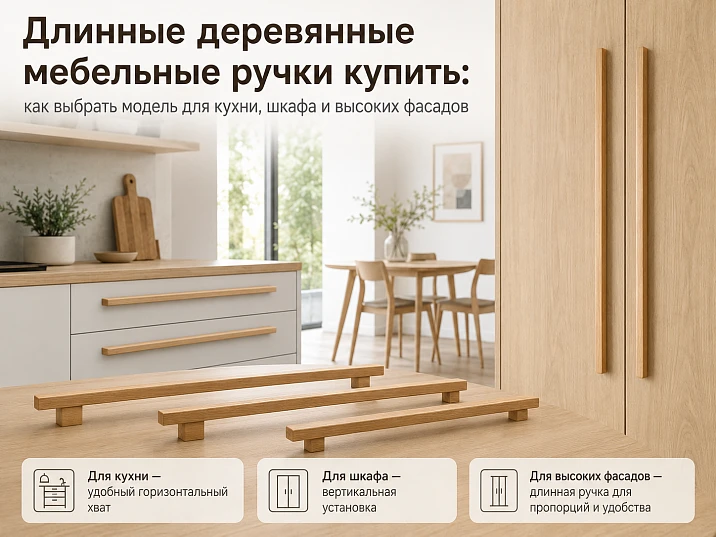
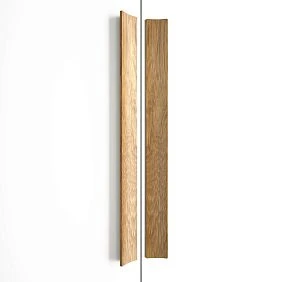
Long wooden furniture handles are bought not only for a noticeable decorative touch. An elongated handle bracket helps to confidently open a tall cabinet, a wide kitchen drawer, a swing wardrobe facade, or a heavy dresser door. It sets a clear grip point, emphasizes the vertical or horizontal line of the furniture, and can completely change the perception of a simple smooth facade. But you cannot choose such a handle only by its overall length: two models measuring 300 mm may have different center-to-center distances, heights, thicknesses, and mounting methods.
The main risk arises when replacing old hardware. The buyer sees a long wooden handle in the photo, compares it with the old one by external size, and only after delivery discovers that the mounting holes do not match. With new furniture, the error manifests differently: a too short bracket gets lost on a tall facade, an excessively long one comes close to the edge, conflicts with shelves, or looks heavier than the cabinet itself. Therefore, before ordering, you need to measure not only the door but also the distance between the centers of the holes, the thickness of the facade, and the free space on the inside.
In the STAVROS catalog you can Buy wooden furniture handles of different types: knobs, surface-mounted and recessed models, profiles, shells, and brackets. For tall doors and wide drawers, the Lagom HL-003 and HL-003M with length options of 200, 300, and 400 mm, the Palmer HL-054 with a range from compact size to very long versions, and the Xylon HL-056-1M with a ready decorative finish are especially interesting.
Below we will break down what is considered a long furniture handle, how a bracket differs from a knob and a recessed model, how to choose the length for the facade, why you need to check the center-to-center distance, when it is more profitable to buy an unpainted handle, and when a model with a ready-made coating. We will separately consider vertical and horizontal installation, replacing old hardware without new holes, calculating the quantity for the kitchen, and the practical purchase route at STAVROS.
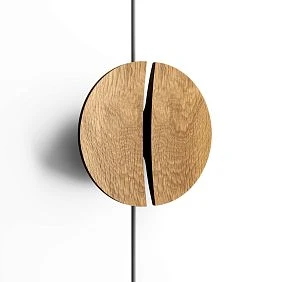
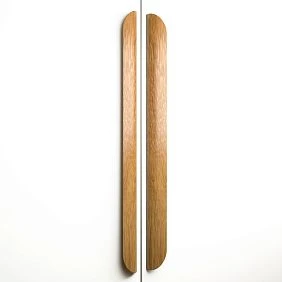
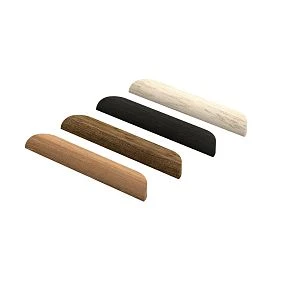
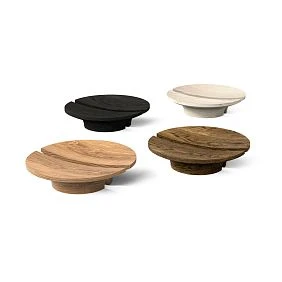
What is considered a long furniture handle
There is no single boundary in furniture hardware after which a handle officially becomes long. For a small drawer, a model 200 mm long already looks elongated, while on a cabinet facade over two meters high, it is perceived as compact. Therefore, the length is evaluated relative to the furniture and the task.
In everyday selection, a long handle is usually called a surface-mounted bracket handle that is noticeably extended along the facade and is attached at least at two points. It is convenient to grasp not with two fingers but with the whole hand. This shape is suitable for doors that are used frequently, for heavy or tall facades, as well as for furniture where the handle should support the overall geometry.
It is important to distinguish between overall length and center-to-center distance. The overall length shows how much space the handle occupies on the facade. The center-to-center distance determines where the mounting holes should be located. For the Lagom HL-003 with a length of 300 mm, the distance between mounting centers is 160 mm. For the 400 mm long version, it is 256 mm. For the Palmer HL-054, a length of 350 mm is combined with a center-to-center distance of 256 mm, while the 1050 mm long model has a distance of 320 mm. These examples show why the external length does not allow guessing the fit.
A long handle does not necessarily have to run almost the entire height of the door. Sometimes its task is to create a comfortable grip zone in the central part. In another project, the handle is indeed stretched along a significant part of the cabinet to emphasize the vertical. The correct option is determined by the proportions of the facade, the location of adjacent handles, the opening method, and the overall composition of the kitchen set.
For initial selection it is convenient buy wooden pull handles for furniture through a separate category where models can be compared by length, thickness, height, and article number. Such a filter immediately separates pull handles from knobs and other types of hardware.




How a pull handle differs from a knob and a recessed model
Our factory also produces:
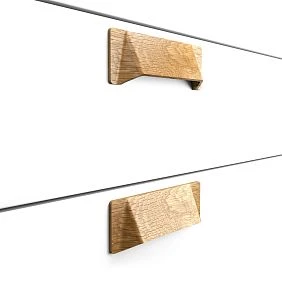
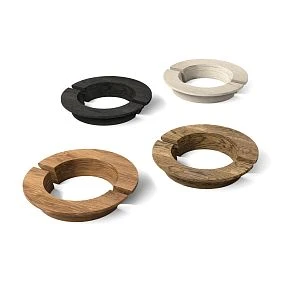
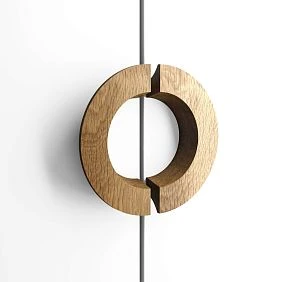
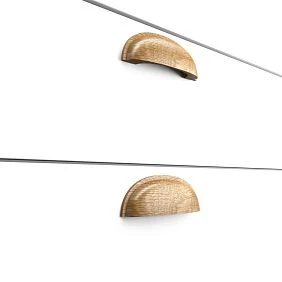
Knob handle
A knob is attached at a single point and takes up little space. It is well suited for small drawers, lightweight doors, and facades where a delicate accent is needed. On a tall cabinet, one small knob can sometimes look random and provide a less secure grip. Two knobs can fix the situation, but then the opening method changes and the number of mounting points increases.
Get Consultation
Pull handle
A pull handle has two mounting points and free space between the handle and the facade. It is convenient to grip from above, below, or in the center. A long wooden pull handle distributes the visual accent across most of the door, so it works especially well on smooth modern facades, tall cabinets, tall units, and wide drawers.
At the same time, a pull handle imposes more requirements on marking. The two holes must be on the same axis and exactly match the center-to-center distance. A slight deviation can skew the handle or prevent the fastener from being inserted without force.
Mortise handle
The mortise model partially sinks into the facade and barely protrudes outward. It is convenient in narrow passages and minimalist interiors, but requires preparation of the mounting seat. A long surface-mounted bracket is easier to install if holes are already provided in the facade, and has a greater impact on the furniture's appearance.
Profile handle
The profile runs along the edge of the facade or forms a continuous line. It is chosen when you want the hardware to be almost hidden. A wooden bracket, on the other hand, remains a separate item that a person touches every day. It adds natural material and can create a contrast with enamel, veneer, or a stone countertop.
Cup handle
The cup handle creates a closed or semi-closed grip and is most often installed horizontally on drawers. It is suitable for classic and vintage furniture. A long bracket is more versatile in orientation: the same model can be considered vertically for a cabinet and horizontally for a drawer, if the drawing and facade design allow such positioning.
Confirmed models and sizes
| Model | Dimensions A × B × C × D, mm | Material and finish | What choice is it useful for |
|---|---|---|---|
| Lagom HL-003 |
200 × 14 × 36 × 128; 300 × 14 × 36 × 160; 400 × 14 × 36 × 256 |
Unfinished handle made of beech or oak. The final finish is selected according to the project. | Kitchens, cabinets, chests of drawers, and tall cabinets when a size of 200, 300, or 400 mm and a custom color are needed. |
| Lagom HL-003M |
200 × 14 × 36 × 128; 300 × 14 × 36 × 160; 400 × 14 × 36 × 256 |
Oak with ready-made coating: white, brown, transparent or black options from the «Prestige» series. | Projects where a ready-made handle is needed without independent selection of enamel or tinting. |
| Palmer HL-054 |
90 × 16 × 37 × 16; 250 × 16 × 37 × 160; 350 × 16 × 37 × 256; 670 × 16 × 37 × 288; 1050 × 16 × 37 × 320 |
Beech or oak; options for enamel and tinting depend on the selected option. | Very tall fronts, tall cabinets, and projects where the handle length should become part of the furniture architecture. |
| Xylon HL-056-1M |
190 × 28 × 33 × 128; 286 × 28 × 33 × 224 |
Wood finish options: walnut, rosewood, zebrano, and wenge; metal elements in brass or stainless steel finish. | Ready-made expressive bracket with a combination of wood and metal parts. |
In the table, A is the total handle length, B is its thickness, C is the height above the front, D is the distance between mounting centers. Before ordering, the designations should be double-checked against the drawing of the selected card. This is especially important for Palmer HL-054: at lengths of 670 and 1050 mm, the center distance increases significantly less than the overall size. This design creates a long line on the front, but the fastening remains assembled closer to the central zone.
How to match the handle length to the front size
There is no simple universal formula. The same handle 300 mm long can look large on a drawer 450 mm wide and restrained on a tall cabinet. The choice depends on orientation, grip location, adjacent fronts, and furniture style.
First, determine the working area
On a hinged door, the handle is usually placed closer to the free edge opposite the hinges. On a drawer, along the central vertical axis. On a tall cabinet, the bracket can occupy the middle part or stretch along a significant height. Before evaluating the length, mark the place where the hand naturally grips the front.
Leave calm fields up to the edges
The handle should not come close to the top, bottom, or side edge. A free field helps the facade look assembled and reduces the risk of drilling errors. The longer the model, the more noticeable the difference in offsets. If the top end is 80 mm from the edge and the bottom is 45 mm, the misalignment will be immediately visible.
Compare the handle with the width of the facade
For a horizontal wide drawer, the handle may occupy a noticeable part of the width, but does not have to almost completely match it. On a drawer with a panel, the bracket must fit within the free central plane and not extend onto the frame profile. On a smooth facade, there are fewer restrictions, but the size has a greater impact on style.
Check the entire series
A kitchen or cabinet rarely consists of a single door. Handles need to be evaluated across the entire layout. A 300 mm model may look great on tall cabinets but be excessive on small upper cabinets. There are three working approaches: use one series in several lengths, choose long brackets only for large facades, or install the same length on all elements if the furniture geometry allows.
Make a full-size template
Cut strips of cardboard 200, 300, and 400 mm long or mark them with painter's tape. Apply them to the facade vertically and horizontally. The mockup immediately shows which model supports the proportions and which looks too short or heavy.
Is a 300 mm handle suitable for a kitchen facade
The 300 mm length is a convenient intermediate option. It is more noticeable than a standard compact bracket but does not yet turn into an almost full-size rail. Lagom HL-003 and HL-003M in this size have a thickness of 14 mm, a height of 36 mm, and a center distance of 160 mm.
On a tall kitchen cabinet, a 300 mm handle can be installed vertically. It creates a clear grip zone and does not require distributing fasteners across the entire height of the door. On a wide lower drawer, the same size works horizontally, especially if the drawer is about the width of a medium or large kitchen module. But the final decision is made based on a template, not on a conditional furniture category.
When replacing an old handle, the key value is 160 mm between centers. If the facade already has holes with a different pitch, the total length of 300 mm does not solve the problem. You will have to choose a model with a matching D, close the old holes, or professionally redo the facade.
A buyer who needs a model for self-painting can buy a wooden handle Lagom HL-003 300 mm long. For a ready-made version in the same proportions, the HL-003M version with a coating is intended.
Why center distance is more important than overall length when replacing
Center distance is the gap between the centers of the mounting holes. It is not measured from edge to edge or between the inner sides of the holes. The measurement is taken from the centers, otherwise even a small error will prevent installing the new bracket.
How to measure holes on a removed handle
If the old handle is preserved, measure the distance between the centers of its mounting posts. It is more convenient to use a caliper or a precise ruler. Then compare the result with the D size in the STAVROS card.
How to measure the facade
On the inside of the door, screw heads are usually visible. Measure the distance between their centers. If the holes are enlarged or the screw is misaligned, additionally check the front side. Old hardware may have been installed inaccurately.
Why you cannot rely on the external length
The Lagom HL-003, 400 mm long, has a center-to-center distance of 256 mm. The Palmer HL-054, 350 mm long, has the same value of 256 mm. With nearly identical mounting, the overall silhouette differs by 50 mm. The difference is even greater for the Palmer, 1050 mm long: the mounting centers are spaced 320 mm apart. Therefore, a long line does not mean an equally long mounting base.
What to do if the holes do not match
The first option is to find a handle with a suitable D. The second is to close the old holes and make new ones if the facade will be repainted or restored. The third is to use decorative overlays only when they are provided by the design and do not look accidental. Do not tighten screws at an angle, trying to "force" the handle into unsuitable holes: this creates stress in the wood and facade.
One long handle or two short ones
On a very wide drawer, you can install one central long pull or two short ones on the sides. Both solutions are valid, but they provide different mechanics and visual patterns.
One long handle
A central pull creates a clean horizontal line and allows opening the drawer with one hand from the middle. It suits a modern facade where you want to reduce the number of details. The wider the drawer, the more carefully you should evaluate the rigidity of the facade and the ease of grip.
Two short handles
A pair creates symmetry and allows pulling a heavy drawer with two hands. This solution is closer to classic furniture and large chests of drawers. However, four holes appear instead of two, and the slightest difference in height becomes noticeable.
What to choose for the kitchen
For a regular wide kitchen drawer, one model of 300 or 400 mm often looks calmer. For a very large drawer with heavy contents, the issue needs to be coordinated with the design of the guides and the front. The handle should not be used to compensate for improperly adjusted furniture: if the drawer moves stiffly, first adjust the mechanism.
Vertical or horizontal installation
Orientation affects not only style but also convenience. A long handle emphasizes the direction of the front: a vertical one visually elongates the cabinet, a horizontal one makes the drawer appear wider.
Vertically on a tall front
On a tall cabinet, swing door, and high kitchen door, the handle is placed closer to the free edge. The center of the handle is positioned in the natural grip zone, not necessarily at the geometric center of the entire height. If the door reaches almost to the ceiling, a strictly centered handle may be inconveniently high.
For paired doors, handles are placed mirror-symmetrically and the distance to the central gap is checked. Models that are too long should not collide, catch on each other, or interfere with opening the adjacent section.
Horizontally on a wide drawer
The handle is aligned along the central vertical axis. On a paneled front, it should be within the flat area. If the handle is placed on a relief, the posts will not receive even support.
Horizontally on a hinged door
This position is used less often, but it is suitable for low wall cabinets, drop-down fronts, and furniture with a pronounced horizontal architecture. Before ordering, you need to check the door movement and hand access.
Combination of orientations in one set
In the kitchen, vertical handles can be installed on doors, and horizontal ones on drawers. To make the set look cohesive, keep the same series, color, and thickness. Different orientations do not break the system if the position relative to the edges is repeated.
For which fronts is a long handle especially convenient
Kitchen tall cabinet
A tall door requires a noticeable and comfortable grip area. A bracket 300 or 400 mm long is suitable for most calm compositions, while the Palmer HL-054, 670 or 1050 mm long, turns the handle into an architectural vertical. Before choosing an extra-long model, you need to check if it comes too close to the top and bottom edges and if it conflicts with a neighboring refrigerator or wall.
Wide kitchen drawer
A long horizontal handle helps to perceive the front evenly and is convenient when opening from the center. The size is correlated with the width of the drawer and countertop. A bracket that is too short gets lost, one that is too long leaves little free space.
Wardrobe and closet in the bedroom
On tall smooth doors, wood adds a warm texture. A vertical model can match the shade of the floor, bed, or bedside furniture. For a painted cabinet, it is convenient to choose an unpainted handle and make it the color of the front or use a ready-made contrasting HL-003M.
Chest of drawers
On the chest of drawers, handles are repeated in several horizontal rows. A long bracket emphasizes the width of the drawers. It is important to check that the repetition does not become too heavy. Sometimes long models suit the lower large drawers, while shorter ones from the same series suit the upper small ones.
Cabinet
For a compact cabinet, a long handle can become the main decorative element. It is appropriate on a wide drawer, but on a narrow door it requires a full-size template. The handle should not protrude beyond the furniture's dimensions in the passage.
Hallway
Wardrobes in the hallway are often located close to the entrance and walls. Here, height C is especially important — the distance the handle protrudes above the facade. A model that is too deep can catch on clothing. A long vertical bracket is convenient if there is free passage around it.
Bathroom furniture
A wooden handle can only be considered with suitable protective coating and under normal operating conditions. An unpainted blank cannot be installed in a moisture-prone area without final treatment. It is better to clarify the current compatibility of the coating with the room before ordering.
Commercial furniture
In a showroom, hotel, salon, or restaurant, a long wooden bracket helps to repeat the brand material and facilitates gripping large doors. With intensive use, the quality of installation, regular checking of screws, and the ability to order an identical set for all facades are important.
Lagom HL-003: long handle for custom finishing
Lagom HL-003 is a minimalist handle bracket in three lengths: 200, 300, and 400 mm. Thickness B is 14 mm in all variants, height C is 36 mm. Center-to-center distances D are 128, 160, and 256 mm.
The model is available in beech and oak in the section of unpainted handles. This allows you to link the hardware to a specific project: paint it to match the facade color, make it contrasting, emphasize the natural texture, or coordinate the tint with furniture legs and countertops. The exact finishing route depends on the chosen material and the card option.
The 200 mm version is suitable for relatively small doors and drawers. The 300 mm size becomes a universal long model for the kitchen, wardrobe, and chest of drawers. The 400 mm option is more noticeable and requires a large facade. All three versions maintain the same shape, so they can be used in one set, selecting the length for different modules.
An unpainted handle requires additional work but gives control over the color. Before mass finishing, make one sample. Check the shade not only in daylight but also near the kitchen's work lighting. Matte enamel, clear oil, and tinting reveal the wooden surface differently.
You should choose this model before drilling the facade. First, determine the length and D, then prepare a template. If the handles are installed on a ready-made kitchen, compare the center distance with the existing holes.
Lagom HL-003M: the same geometry with a ready-made coating
Buy the Lagom HL-003M handle with a ready-made coating convenient when you don't want to separately order sanding, test coatings, and final finishing. The geometry matches HL-003: lengths 200, 300, and 400 mm, height 36 mm, thickness 14 mm, center distances 128, 160, and 256 mm.
HL-003M is made of oak. The card presents white, brown, clear, and black variants of the "Prestige" coating. The clear finish preserves the natural wood grain, the brown enhances the warm tone, the black creates a graphic contrast, and the white helps match the handle with light-colored furniture.
The ready-made coating reduces the number of operations but does not eliminate the need to check a sample. The white color of the handle may differ from the white facade in tone and gloss level. A black bracket on a matte kitchen can appear more saturated or, conversely, softer depending on the light. Before a large order, it is useful to see a real sample next to the furniture.
The model is suitable for new furniture and quick replacement of fittings if the center distance matches. For a kitchen with several dozen facades, a ready-made coating makes it easier to achieve a uniform result: there is no need to manually repeat the color on each handle.
HL-003 or HL-003M: what to choose
| Criterion | Lagom HL-003 without coating | Lagom HL-003M with coating |
|---|---|---|
| Dimensions | 200, 300 and 400 mm | 200, 300 and 400 mm |
| Material | Beech or oak | Oak |
| Finishing | Selected and applied per project | White, brown, transparent or black |
| When more convenient | Need an exact facade color, custom tinting, or unified finish with other wooden parts | Need a ready-made set without separate painting work |
| What to check | Material, preparation quality, and compatibility of the finishing system | Match of the finished color with the facade and actual availability of the required size |
Both models have the same mounting geometry, so the choice is mainly determined by material and finish. For a custom kitchen where handles must exactly match green, blue, or complex gray enamel, HL-003 is more rational. For a ready-made cabinet with natural oak or contrasting black hardware, HL-003M is more convenient.
Palmer HL-054: from compact bracket to handle 1050 mm long
In the current product card, the item is called Palmer HL-054, although the page URL retains a different series name. For publication and ordering, you should refer to the current card title and article HL-054.
View the long wooden handle HL-054 is suitable for customers who find the 200–400 mm range insufficient. The model is available in lengths of 90, 250, 350, 670, and 1050 mm. The thickness is 16 mm, height is 37 mm.
The 250 mm size has a center distance of 160 mm, the 350 mm size has 256 mm. These options can be compared to Lagom in terms of fit, but the silhouette will be different. The 670 and 1050 mm versions are intended for very tall fronts, with center distances of 288 and 320 mm respectively. The handle forms a long wooden line, with the mounting located closer to the central part.
This technique is especially expressive on a tall cabinet, wardrobe door, and large built-in front. However, the extra-long model should not be chosen based solely on an impressive photo. You need to check the flatness of the front, clearances, hand access, internal shelves, and the ability to open adjacent doors.
HL-054 is available in beech and oak. The card presents options for enamel and tinting. This allows the handle to be almost invisible in the color of the front or to preserve the natural texture. For a series of tall cabinets, it is useful to order a sample or one model in advance and check the proportions in the actual room.
Xylon HL-056-1M: ready-made bracket with wood and metal accent
Buy the wooden bracket handle Xylon HL-056.1M is available in two sizes: 190 × 28 × 33 × 128 mm and 286 × 28 × 33 × 224 mm. It is noticeably thicker than Lagom and has a different decorative character.
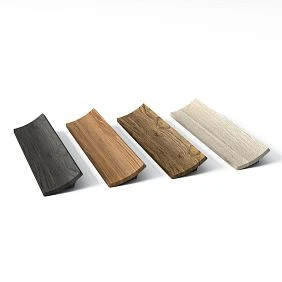
The card presents wood finish options: wenge, zebrano, walnut, and rosewood, while metal elements can be chosen in brass or stainless steel finishes. This combination suits furniture where the handle should connect natural texture with metal hinges, lights, or plumbing fixtures.
The 190 mm size with D 128 mm is suitable for medium doors and drawers. The 286 mm model with D 224 mm looks longer and fits well on large facades. Before replacing old hardware, both center-to-center distances must be measured carefully: they differ from the Lagom 300 mm length.
Xylon HL-056-1M is supplied as a model with a ready finish, so self-painting is not its primary scenario. The color is chosen based on existing furniture. The contrast of dark wood and brass creates a more decorative look, while the combination with stainless steel appears more restrained and easily ties in with a modern kitchen.
Unpainted handle or model with a ready finish
The choice of finish affects budget, timeline, and color accuracy. An unpainted handle offers freedom but requires technical preparation. A ready model moves to installation faster, but the color cannot be endlessly adapted.
When to choose an unpainted handle
This option is needed for a non-standard color facade, furniture restoration, combination with wooden legs and moldings, or a project where all parts are painted with one system. You can buy unpainted wooden handles for enamel or tinting, then make a test sample and process the entire set at once.
When a ready finish is more convenient
Ready-made HL-003M and Xylon HL-056-1M reduce the number of operations. They are suitable for quick handle replacement, small orders, and furniture whose color already matches well with available options. The buyer immediately sees the final texture, although the monitor screen does not replace a real sample.
Project price
You should compare not only the price of one handle. For an unpainted model, primer, paint, oil or tinting compound, labor and drying time are added. A finished handle is usually more expensive per unit but does not require separate finishing. For a large kitchen, the calculation is made for the entire set.
Repairability
A self-painted handle is easier to refresh with the same compound if the material is preserved. It is better not to repair a finished coating with random paint: the shade and gloss may differ. In case of damage, it is worth clarifying the appropriate restoration method.
Beech or oak: how to choose the material
Beech for enamel
Beech has a calm structure and is often chosen for opaque painting. If the handle should be white, gray, green, or match the facade, the material under enamel allows focusing on the shape rather than the grain pattern.
Oak for tinting
Oak is valued for its more pronounced texture. Transparent varnish, oil, or tinting compound preserves the grain and helps match handles with oak countertops, facades, doors, or flooring.
Under enamel and under tinting are not the same
A blank for opaque finishing may have natural differences in lamellas, which are completely hidden by enamel. For translucent finishing, selection by shade and texture is important. In the product card, you need to choose the option corresponding to the future coating.
Material of the entire set
It is better to use handles of the same wood species and preparation on one set. If half are oak with clear lacquer and half are beech with a similar stain, the difference will show after finishing. The exception is a deliberate project where the material contrast is repeated in the furniture.
Enamel, tinting, oil, or clear lacquer
The finish is chosen not only by color. It affects tactility, grain visibility, and maintenance. The exact compositions must be compatible with the wood and usage conditions.
Enamel
An opaque coating unifies the handle with the facade. A white long pull on a white kitchen remains noticeable due to shadow and shape. A contrasting black enamel turns the handle into a graphic line. Before mass painting, adhesion and interlayer preparation are checked.
Staining
Stain or other semi-transparent composition changes the color while preserving the grain. On ends and recesses, the shade may become darker. All handles are processed using the same technique and preferably from the same batch of material.
Oil
Oil finish provides a natural tactile feel and highlights the wood. For kitchen furniture, a suitable system must be used and renewal recommendations followed. Not every oil treatment can be considered universally resistant to water and household chemicals.
Clear varnish
Lacquer protects the surface and preserves the natural color. The gloss level affects the appearance: a matte option is calmer, while a glossy one shows fingerprints and minor preparation defects more.
Test paintout
One sample saves more time than repainting the entire set. Look at it next to the facade, countertop, and lighting. Wood, MDF, and metal reflect light differently even with the same color code.
How to replace an old long handle without new holes
The main condition is an exact match of the center-to-center distance. The overall length, shape, and color may differ. If the D of the new model matches the old one, the handle can usually be installed into the existing holes after checking the fastener diameter and facade condition.
Remove one old handle
Do not order the entire set based on a front-side measurement. Remove the hardware, inspect the holes, and measure the center-to-center distance. Check for decorative covers hiding enlarged holes.
Measure the thickness of the facade
The mounting screw passes through the door and into the handle post. A screw that is too short will not secure the bracket, while one that is too long will hit the interior or prevent tightening. The length depends on the facade thickness and the handle design.
Check the diameter of the holes
The old handle may have used different fasteners. The new model should not wobble freely in an overly wide hole. If the facade is damaged, repair is needed, not just a larger washer.
Compare the inner side
Nearby on the door there may be a hinge, shelf, pull-out mechanism, or metal profile. The new handle's screw must not conflict with them. Pay special attention to tall cabinets where the shelf is close to the grip area.
Perform a test installation
First install one handle without overtightening. Check the position, comfort, and fit of the posts. Only then order or install the entire set.
If the holes do not match
On the facade being painted, old holes can be professionally closed, the surface prepared, and drilled again. On natural veneer or ready-made enamel, such an operation is more difficult and may remain noticeable. In this case, it is more reasonable to choose a handle with a compatible D.
How to choose the length of the mounting screw
The screw must pass through the facade and securely enter the threaded part of the handle without hitting it prematurely. For calculation, it is not enough to know only the door thickness: washers, decorative caps, and thread depth are taken into account.
Before ordering, measure the facade with a caliper. If it consists of a frame and a panel, measure the installation location specifically. Do not install the handle on a thin central part if the fastener is designed for a denser base.
For different modules of the same kitchen, the thickness may vary. For example, cabinet facades and a decorative panel look the same but have different bases. The set of screws must be checked for each type.
Tighten the fasteners evenly from both sides. Excessive force can dent the enamel, deform the wooden post, or damage the thread. If the handle wobbles after normal tightening, look for the cause in the hole, screw length, or fit, rather than endlessly increasing the force.
Installation without skew
Use a template
For a kitchen and cabinet with multiple facades, a rigid template is needed. It marks the distance from the edge and the center-to-center distance. The template is flipped for right and left doors, maintaining a mirror position.
Check the axis with a level
The longer the handle, the more noticeable the deviation. For the Palmer HL-054, 1050 mm long, an error of a few millimeters creates a clear tilt. The marking is controlled with a level or laser, especially on a row of tall cabinets.
Do not drill through two doors at once
Even paired fronts may have a slight tolerance. Each door is marked separately using a template. Drilling in a "stack" increases the risk of chipping and incorrect hole exit.
Protect the front surface
Cover the drilling spot with masking tape, use a sharp tool and a backing on the reverse side. The specific method depends on the front material. For finished enamel or veneer, it is better to entrust the work to a furniture maker.
First, secure without final tightening
Insert both screws, align the handle, then tighten alternately. If you fully tighten one side immediately, the second bracket may shift.
How to calculate the number of handles for a kitchen or cabinet
Counting only the doors is not enough. You need to account for drawers, drop-down fronts, built-in appliances, decorative panels, and a possible reserve.
Create a layout
Mark each opening facade. For paired doors, a separate handle is usually needed for each leaf. For a wide drawer, one long handle or two short ones, if specified in the project.
Divide the models by lengths
For example, tall cabinets get Lagom 400 mm, regular doors get 300 mm, small upper cabinets get 200 mm. Record the quantity for each SKU and size to avoid mixing variants with different D.
Is a spare handle needed
For a large kitchen, it is useful to consider one spare model of each main size, especially if an individual tint is used. It is finished together with the entire set and stored with a color label. But the reserve should not replace an accurate calculation.
Check the sides and orientation
The brackets under consideration are symmetrical, but the overall furniture may include right and left handles of other types. In the specification, indicate
What to buy together with long handles
The main purchase is the handles themselves, but for the finished result, finishing materials, suitable fasteners, and a sample may be needed. In the provided scheme, only links to categories and handle cards are confirmed, so additional URLs cannot be invented. The set is formed based on the selected model.
| What to add to the purchase | Why this is needed | What to Check |
|---|---|---|
| unpainted wooden handles | Allow you to assemble a set of different sizes with one individual finish. | Breed, preparation for enamel or tinting, and the same batch. |
| Handles with a ready-made coating | They reduce preparation time and allow for faster replacement of fittings. | Color, gloss, availability of the required size, and matching with all furniture. |
| Mounting screws of suitable length | They secure the handle taking into account the thickness of the facade. | Diameter, length, thread depth, and no conflict with shelves. |
| Materials for finishing | Needed for HL-003 and other unpainted models. | Compatibility with wood and furniture operating conditions. |
| One spare handle of the main size | Makes replacement easier in a large handle set with individual color. | Store together with the composition record and finish code. |
How not to confuse a long furniture handle with similar products
Furniture bracket and door handle
STAVROS handles from this category are intended for furniture fronts. A full handle for an interior or entrance door works with a lock, escutcheon, or separate massive mounting and experiences different loads. You cannot transfer a furniture model to a door leaf just because the query contains the word 'bracket'.
Long bracket and profile handle
A bracket is attached at separate points and protrudes above the surface. A profile usually runs along the edge or a significant length of the front. For a minimalist kitchen, a profile may be less noticeable; a wooden bracket creates an independent line and tactile accent.
Long bracket and rail
A metal rail often consists of a thin tube and posts. A wooden model has a warmer surface and a different visual scale. Mounting dimensions cannot be considered identical even with a similar overall length.
Bracket and knob
A button requires one hole, a pull requires two. When replacing, you cannot install a pull without additional drilling if the facade only had a button. The exception is a complete restoration and new layout.
Surface-mounted and mortise handle
A surface-mounted pull only covers the mounting points and does not require a long routing. A mortise model is set into the facade. Switching from one type to another almost always involves reworking the surface.
Practical selection for specific situations
Need a long handle for a tall kitchen cabinet
Make templates of 300, 400, 670, and 1050 mm. Check the comfortable grip height and distance to the edges. For a restrained solution, Lagom is suitable; for an almost full-size vertical, Palmer HL-054. The center-to-center distance is fixed before drilling.
Need to replace the handle on a wide drawer
First, measure the existing D. If it is 160 mm, you can compare Lagom 300 mm and Palmer 250 mm: the mounting matches, but the overall length and shape differ. This choice allows you to change the appearance without new holes.
Handles must match the kitchen color
Choose HL-003 or another unfinished beech model for enamel. Make a test paint and paint the entire set in one batch. Do not rely only on the color code: the gloss level and primer change the perception.
Need a ready-made black set
Consider the HL-003M in black finish. Check how the black color matches the hinges, faucet, appliances, and lighting fixtures. On a small kitchen, long black lines can become very active.
Need to emphasize natural oak
An oak unfinished handle for tinting or HL-003M with a clear finish will work. For an exact match with the facade, compare real wood samples.
A handle is needed for a wardrobe in the hallway
Evaluate the C protrusion and the passage width. A long vertical model is convenient, but should not catch on clothing. On a narrow door, it is better to choose a less deep bracket.
Need to update an old dresser
Measure the D of the old hardware and the condition of the holes. If the facade will be repainted, the placement can be changed. If natural veneer is preserved, it is better to look for a compatible center distance.
Need handles for custom furniture
Select one series in several lengths, prepare a drawing and specification. Order a sample before launching all facades. This makes it easier to coordinate ergonomics, color, and scale.
Mistakes when buying long handles
Selection only by overall length
This is the most common mistake. Size A shows the silhouette, but not the fit. For replacement, D becomes key. First measure the holes, then choose the external size.
Buying one model for all facades without a layout
A 400 mm handle may look good on a tall cabinet and be excessive on a small drawer. Divide the facades into groups and compare several lengths.
Ignoring height C
Two handles of the same length can protrude differently over the furniture. In a narrow passage, a high bracket catches clothing, and on a heavy drawer, too small a height makes gripping difficult.
Incorrect orientation
Vertical installation on a drawer or horizontal on a tall cabinet can be a design technique, but must be justified. Check the hand movement and the direction of adjacent handles.
Drilling before receiving the product
Even with dimensions in the product card, it is better to get the handle or an exact template. A mistake in marking finished enamel costs more than waiting.
Buying an unpainted handle without a finishing plan
The wood cannot be left untreated accidentally in an actively used kitchen. Before ordering, determine the composition, color, craftsman, and drying time.
Attempt to match white color from a photo
White coatings have warm and cool shades, different gloss and coverage. Order a sample or choose an unpainted model for precise facade enamel.
Mixing beech and oak under a transparent coating
Wood species differ in grain. The same stain does not make them visually identical. Use consistent material for a single set.
Screw too long
It may hit the handle and cause play, damage the thread, or protrude inside the furniture. The length is calculated based on the actual facade thickness.
Screw too short
Insufficient engagement weakens the fastening. A long handle creates noticeable leverage, so both screws must be securely installed.
Attempt to force the handle onto mismatched holes
Fastening at an angle creates stress. The wooden post or facade may crack. If D does not match, choose another model or have the holes professionally redone.
Lack of checking internal shelves
A screw or bracket may enter the area of the shelf, hinge, or pull-out mechanism. Inspect both sides of the facade before drilling.
Too many different designs
On one kitchen, Lagom, Xylon, knobs, and metal rails appear simultaneously. Without a common logic, the furniture looks assembled from different sets. It's better to use one series or repeat the material and shape.
Ordering an exact quantity without a reserve
For a large kitchen with custom tinting, one spare handle may be useful. A later purchase may differ in wood grain or finish batch.
Who long wooden handles suit
- owners of kitchens with tall tall cabinets and wide drawers;
- projects with smooth facades that need an expressive line;
- cabinets, wardrobes, and built-in furniture;
- chests of drawers and cabinets with large drawers;
- interiors where it is important to add natural wood;
- furniture for custom enamel or tinting;
- restoration, if a compatible center distance is found;
- commercial projects with serial facades;
- custom furniture where the handle participates in the overall architecture.
When it is better to choose a different handle
- the facade is too small for the selected length;
- in a narrow passage, the protruding bracket obstructs movement;
- fully concealed hardware is needed;
- there is only one button hole and rework is impossible;
- the center distance does not match, and the facade cannot be re-drilled;
- the handle conflicts with the hinge, shelf, or adjacent door;
- the furniture is in conditions for which the wood finish is not agreed;
- the customer is looking for a handle for an interior door, not a furniture front.
How to buy long wooden furniture handles on STAVROS
Start with the general category to compare types of fittings and understand if a bracket is really needed. Then go to the section of unpainted bracket handles and use filters by length A, thickness B, and height C.
For sizes 200–400 mm, open the cards for Lagom HL-003 and HL-003M. Choose not only the length but also the center distance D. If a handle of 670 or 1050 mm is required, study Palmer HL-054. For a ready decorative combination of wood and metal, compare Xylon HL-056-1M.
Before ordering, prepare a short specification:
- article and commercial name;
- size A × B × C × D;
- quantity;
- beech, oak, or confirmed material option;
- for enamel, for tinting, or ready coating;
- facade thickness;
- required fastener length;
- vertical or horizontal installation;
- photo of the furniture and existing holes when replacing.
Current prices, availability, configuration of mounting hardware, and lead times should be checked in the active option of the card. If the handle is being selected for ready-made furniture or old holes, it is better to send the dimensions to the STAVROS manager in advance. This approach is more reliable than buying based on a single photo.
FAQ: questions about long wooden furniture handles
Where to buy long wooden handles for furniture?
In the STAVROS catalog, there is a separate category of furniture handles and a section of pull handles. To purchase, you need to select the model, size A and center distance D, material, and finish option.
What is considered a long furniture handle?
There is no single boundary. The length is evaluated relative to the facade. For a small drawer, 200 mm is already a noticeable size; for a tall cabinet, a model of 400–1050 mm may be considered long.
What is center-to-center distance?
This is the distance between the centers of two mounting holes. In the cards of the models under consideration, it is indicated by size D. It is D that is checked when replacing an old handle.
Can I choose a handle only by overall length?
No. You need to check the thickness, height, center-to-center distance, facade thickness, and screw length. The overall length mainly affects the external scale.
Will a 300 mm handle fit a kitchen facade?
It often fits a tall cabinet or a wide drawer. The Lagom 300 mm long has a D of 160 mm. The solution is checked with a full-size template on a specific door.
Should I install one long handle or two short ones on a wide drawer?
One creates a clean horizontal line and is convenient for central grip. Two provide a symmetrical classic pattern and four attachment points. The choice depends on the furniture design and style.
How to position a handle on a tall facade?
Usually vertically near the free edge. The center is placed at a comfortable hand height, not necessarily exactly in the middle of the door. On paired facades, the position is mirrored.
Can a long handle be installed horizontally?
Yes. This position suits wide drawers, low wall cabinets, and facades with a pronounced horizontal line. Check the center and free margins to the edges.
How does HL-003 differ from HL-003M?
The geometry and dimensions are the same. HL-003 is sold without a finished coating and is available in beech or oak. HL-003M is made of oak and comes in ready white, brown, clear, or black options.
Which wood species should I choose for enamel?
Beech with preparation for opaque coating is often chosen. The exact option should be checked in the product card. For visible texture and tinting, oak is usually considered.
Can the handle be painted to match the facade color?
Yes, if an unpainted model with suitable preparation is selected. First, make a test coat, then process the entire set with one system.
Can an old handle be replaced without drilling?
Yes, when the center distance of the new model exactly matches, and the holes and facade are in good condition. Also check the fastener diameter and screw length.
What to do if the holes don't match?
Look for a model with a suitable D or professionally close old holes and drill new ones. Do not install screws at an angle.
How to choose the screw length?
Measure the thickness of the facade and check the thread depth of the handle. The screw should be securely fastened but not bottom out prematurely. Verify the configuration in the product card or with a manager.
Which handle is suitable for a tall cabinet?
Lagom 300 or 400 mm creates a restrained vertical line. Palmer HL-054 with a length of 670 or 1050 mm is suitable for an architectural accent on a very tall facade.
Is Xylon HL-056-1M suitable for a modern kitchen?
Yes, especially when you need to connect wood with metal parts. Available in sizes 190 and 286 mm, with wood options and metal finishes in brass or stainless steel.
How many handles to buy for a kitchen?
Count all opening facades, divide them by sizes and article numbers, account for drawers and tall cabinets. For a large set with custom finish, you can include one spare handle.
Can a furniture pull be used as a door handle?
No. A furniture handle is designed for cabinet facades, drawers, and base units. An interior door requires a different construction and mounting.
How to care for a wooden handle?
Care depends on the coating. Usually, the surface is wiped with a soft, slightly damp cloth without abrasives, then dried thoroughly. For oil, enamel, and varnish, follow the recommendations of the chosen system.
Is it necessary to order a sample?
For a large kitchen, complex color, or extra-long handle, a sample is useful. It allows you to check the scale, texture, color, and compatibility with holes before purchasing the entire set.
Summary: first the center-to-center distance, then the length and finish
A long wooden handle helps open a large facade and simultaneously shapes the furniture's geometry. But a successful purchase starts not with a photo or the overall length. First, measure the center-to-center distance, facade thickness, and available space, then choose the size, material, and finish.
Lagom HL-003 is suitable for individual painting or tinting, HL-003M for ready-made white, brown, transparent, or black finishes. Palmer HL-054 allows you to transition from a compact bracket to a handle 670 or 1050 mm long. Xylon HL-056-1M combines a wooden part with metal components.
At STAVROS you can choose a long handle for a cabinet and kitchen, open the drawing of the desired model and check A, B, C, and D before ordering. An informed choice allows you to install handles evenly, preserve existing holes when replacing, and assemble a kitchen or cabinet without random differences in length, material, and color.
Additional project check before mass ordering
When handles are ordered for a single cabinet, the mistake is usually noticeable quickly. For a kitchen, wardrobe, or hotel furniture, the consequences are larger: an incorrect center-to-center distance repeats on dozens of facades, and an unsuitable color becomes part of the entire wall. Therefore, before mass ordering, it is useful to conduct a check on one complete furniture module.
Assemble the test facade
Choose a medium-sized door and install a real handle on it. Check the grip from different sides, opening, distance to the adjacent facade, and screw behavior. The paper template shows proportions but does not convey height C or tactile feel.
Test the handle in everyday use
Open the door several dozen times. Try doing it with a wet hand, two fingers, and the whole palm. For a kitchen, assess whether it is comfortable to grab the handle when a person stands to the side of the drawer. For a tall cabinet, check accessibility for an adult and a teenager.
Look at the entire row
Install temporary templates on adjacent facades and step back. Long handles create strong lines. On one module, the model may seem calm, but in a row of eight doors, it may appear too active.
Coordinate the fasteners before drilling
Even if the card specifies hardware, the thickness of a particular facade may require a different screw. Record the appropriate length in the specification. Do not mix screws of different sizes in one box without labeling.
Record the finish recipe
For unpainted handles, save the primer name, color, number of layers, application method, and finish. This will allow repeating the result for a spare part. The sample is labeled and stored with the furniture documentation.
The test module does not increase project timelines pointlessly. It allows you to check four main parameters before ordering a large set: fit, comfort, scale, and color.