Article Contents:
- What is the Plane HL-011 furniture handle
- Ten sizes and ten center-to-center distances
- Why the full handle length does not equal the center-to-center distance
- Why one model in different lengths is better than a random set of handles
- Sizes 180 and 260 mm: drawers, cabinets, and small doors
- Sizes 400–600 mm: dressers, kitchens, and standard wardrobes
- Sizes 700 and 900 mm: tall wardrobe fronts
- Sizes 1200–1800 mm: the handle as an architectural line
- Practical matrix: how to assemble one set for kitchen, dresser, and wardrobe
- How to determine handle size before purchase
- Replacing old handles: when holes can be preserved
- Vertical or horizontal: one handle, two ways to build a facade
- Vertical installation
- Horizontal installation
- Need to furnish a new dresser
- Need to choose handles for the kitchen
- Need to arrange a swing wardrobe
- Need to update ready-made furniture
- Need to assemble unified furniture for several rooms
- Need a handle for painting in the color of the facade
- Need a handle with visible wood texture
- Kitchen
- Walk-in closet
- Bedroom
- Entry Hall
- Office
- Commercial interior
- Selection only by overall length
- One size for all facades
- Ordering paired handles at different times
- Lack of opening check
- Drilling without a template
- Ignoring facade thickness
- Finishing before checking the kit
- Mixing beech and oak without intent
- Choosing a long handle without a full-size trial
- Incorrect storage of long parts
- Lack of marking after finishing
- What sizes are available for Plane HL-011?
- What is more important when replacing an old handle — A or D?
- What is the center-to-center distance for Plane HL-011 with a length of 500 mm?
- What is the center-to-center distance for a 600 mm handle?
- Can one model be installed on both a dresser and a tall cabinet?
- Can the handle be installed vertically?
- Which handle is suitable for a floor-to-ceiling cabinet?
- Is Plane HL-011 sold painted?
- What to choose: beech or oak?
- Is the mounting hardware included in the set?
- Can I use the old holes?
- How to check the length before ordering?
- Do paired handles need to be ordered at the same time?
- How to count the number of handles?
- What to do if none of the D's match the old holes?
- Can different lengths be used on one dresser?
- Is a spare set of handles needed?
- How to store 1500 and 1800 mm handles before installation?
- Where can I see all sizes and the current price?
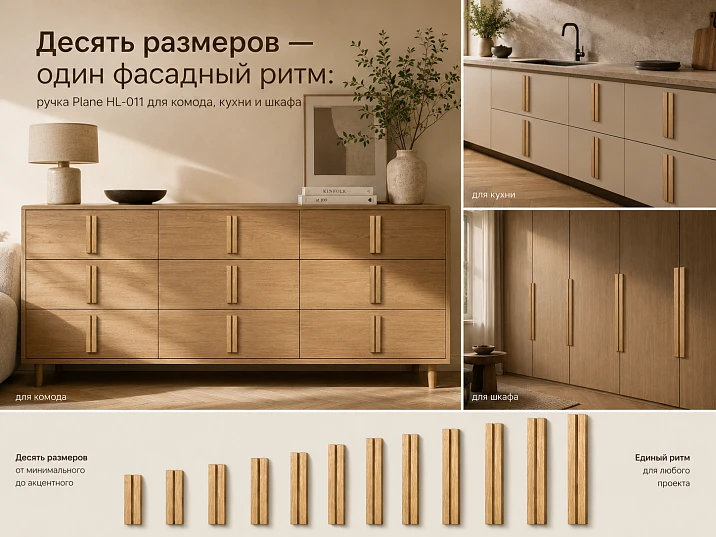
The main reason to choose Plane HL-011 is the ability to assemble a furniture collection without visual inconsistency. A compact handle suits a small drawer, a medium one supports the proportions of a dresser or kitchen door, and a long one becomes an expressive vertical line on a wardrobe or cabinet. At the same time, the profile shape, material, and method of future finishing remain coordinated.
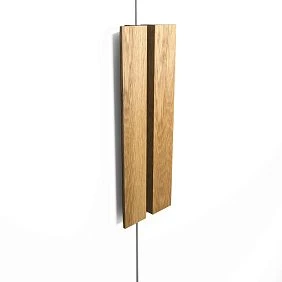
Advantages of Plane HL-011
- Ten lengths in one model. The size range from 180 to 1800 mm covers tasks for small boxes, wide fronts, cabinets, and tall tall units.
- Uniform appearance of furniture. No need to mix handles from different series, cross-sections, and shapes to find the right length.
- Precise center-to-center distances. Each size has its own distance between the centers of mounting holes — from 128 to 1728 mm.
- Choice of beech or oak. The material can be matched with the front, trim, countertop, and future finish.
- Unpainted version. The handle can be included in the general furniture finishing cycle and finished with enamel, tinting, or another coating compatible with the selected wood species.
- Mounting hardware is included in the set. The buyer receives not only the wooden profile but also the fasteners specified on the product card; before installation, it is still necessary to check the facade thickness and the design joint.
Buy Plane HL-011 in beech or oak
Select size and check the price of Plane HL-011
Furniture sets rarely have identical facades. The top drawer of a dresser may be low, the bottom one wide, a kitchen door medium height, and a tall cabinet or wardrobe almost up to the ceiling. When one short handle is placed on all these surfaces, large facades look unfinished. When a completely different model is chosen for each module, the furniture loses its coherence. Plane HL-011 solves this problem differently: the length changes, but the geometry remains the same.
This approach is especially useful when designing a kitchen, wardrobe, bedroom, or hallway as a single set. The handle ceases to be random hardware chosen at the last moment. It becomes part of the facade proportions. The buyer compares the part length, center-to-center distance, orientation, material, and quantity in advance. This reduces the risk of extra holes, mismatched paired elements, and unsuccessful replacement after furniture finishing.
However, one line does not mean that any size automatically fits any facade. The full handle length is not equal to the center-to-center distance. The choice is influenced by the dimensions of the door or drawer, hinge positions, distance to the wall, adjacent facades, grip height, and the ability to open the furniture without parts colliding. Therefore, the correct purchase begins not with a product photo but with a design check.




What is the furniture handle Plane HL-011
Plane HL-011 is a surface-mounted wooden profile handle with rectangular geometry. Its width is 40 mm, and its projection is 25 mm. These two parameters remain constant across the entire line, while the length varies from 180 to 1800 mm. Thanks to the constant cross-section, short and long versions are perceived as parts of one series, not as randomly selected hardware.
The card shows options in beech and oak. The handle comes without a finish, so the choice of wood should be linked to how the entire furniture will be finished. Beech is often chosen when the handle is planned to be coated with opaque enamel or to achieve a calm, uniform surface. Oak is appropriate when a noticeable wood texture needs to be preserved under a transparent or semi-transparent finish. This is not a rule that one wood is better than another, but a practical connection between the material and the project.
Mounting hardware is included, but this does not eliminate the need to check the thickness of the facade, the length of the fastener, and the position of the holes. Even a complete set cannot account for every furniture construction. On a thin facade, a massive door, a framed structure, or a multi-layer panel, the mounting assembly may differ. Before ordering and especially before drilling, the handle drawing should be compared with the furniture drawing.
| Characteristic | Confirmed value | What this gives the buyer |
|---|---|---|
| Model | Plane HL-011 | One series for facades of different sizes |
| Type | Surface-mounted wooden profile handle | Pronounced linear geometry on the facade |
| Total length | From 180 to 1800 mm | Compact, medium, and very long versions can be selected |
| Center-to-center distance | From 128 to 1728 mm depending on length | Allows correct marking of holes or checking the replacement of an old handle |
| Profile Width | 40 мм | Same cross-section across the entire size range |
| Projection | 25 мм | Consistent grip depth and uniform character of the series |
| Material | Beech or oak | Handles can be matched with the wood species and future finish |
| Finish | Unfinished | Handles are included in the overall furniture finishing cycle |
| Mounting | Included in set | Main fasteners are provided, but compatibility with the facade is checked during design |
| Product card | Plane HL-011 handle in ten sizes | Selection of length, material, and current order conditions |
Our factory also produces:
Ten sizes and ten center-to-center distances
The Plane HL-011 size range should not be perceived as a list of nearly identical options. Each length has its own center-to-center distance. It determines the position of the centers of the mounting holes. For a new facade, this affects layout and the mounting template. For replacing old hardware, it affects the ability to use existing holes.
| Overall length A | Center-to-center distance D | Indicative application scenario |
|---|---|---|
| 180 мм | 128 мм | Small boxes, cabinets, compact doors |
| 260 мм | 192 мм | Dresser drawers, upper kitchen fronts, hallway furniture |
| 400 мм | 320 мм | Wide drawers, dresser doors, kitchen fronts |
| 500 мм | 384 мм | Wide drawers, lower kitchen modules, standard doors |
| 600 мм | 512 мм | Swing wardrobe doors, kitchen tall cabinets, large fronts |
| 700 мм | 576 мм | Tall cabinet doors, walk-in closets, built-in furniture |
| 900 мм | 768 мм | Tall swing fronts, wardrobes and kitchen columns |
| 1200 мм | 1120 мм | Tall cabinet, floor-to-ceiling wardrobe |
| 1500 мм | 1440 мм | Large wardrobe fronts and tall furniture doors |
| 1800 мм | 1728 мм | Very tall fronts, furniture partitions, handle almost full height |
The scenarios in the table serve as a guide, not as a manufacturer's specification. The Plane HL-011 400 mm handle may look appropriate on one kitchen front and too long on another. The 1200 mm size may work well on a tall cabinet but conflict with an adjacent wall or opening area. Therefore, the table helps narrow down the options, but the final decision is made after checking the scale.
After comparing sizes, it is useful to go to the product page and view the dimensions and center-to-center distances of HL-011. It is necessary to verify not only the length of A, but also D, the profile width, the overhang, and the position of the handle relative to the edges of the front.
Get Consultation
Why the full handle length is not equal to the center-to-center distance
One of the most common mistakes when buying a long furniture handle is using the overall length as the drilling size. Full length A shows how much space the part occupies on the front. Center-to-center distance D shows the distance between the centers of the mounting holes. There is a difference between these parameters because the ends of the handle extend beyond the mounting points.
For example, the Plane HL-011 with a length of 500 mm has a center-to-center distance of 384 mm. If you transfer two points 500 mm apart onto the front, the holes will not align with the mounting. For a handle with a length of 600 mm, distance D is 512 mm. The difference varies from size to size, so you cannot derive a single universal offset and apply it to the entire line.
For new furniture, this problem is solved with a drawing and a mounting template. First, mark the axis of the future handle on the front, then transfer exactly the centers of the mounting holes. For replacing old handles, the procedure is different: first measure the existing center-to-center distance, then look for a matching option. The overall length of the new handle may be greater than the old one if D matches and the increased size does not interfere with opening.
D should be measured between the centers of the holes, not between their nearest or farthest edges. With an inaccurate tape measure, it is convenient to insert two suitable pins or screws into the holes and take the measurement between their axes. On paired fronts, the measurement is taken several times: even a small error becomes noticeable when two long handles are placed side by side.
Another reason to separate A and D is preparing the specification. The order should clearly show that it refers, for example, to the Plane HL-011 700 mm with a center-to-center distance of 576 mm, not to a handle "approximately seven hundred millimeters." Such a record allows the cabinetmaker, finisher, and installer to work with the same information.
Why one model in different lengths is better than a random set of handles
Furniture sets are often assembled gradually. First, the kitchen is designed, then a wardrobe is added to the hallway, a chest of drawers, or a walk-in closet. If handles are chosen separately for each piece, differences gradually accumulate: one model has a rounded cross-section, another is rectangular, a third protrudes more, and a fourth is finished in a different tone. Even high-quality parts begin to clash with each other.
The Plane HL-011 allows you to build a system. A short size is used on a small drawer, a medium one on a wide drawer, and a long one on a tall cabinet. At the same time, the width of 40 mm and the projection of 25 mm are maintained. The hand feels one geometry, and the eye sees the repetition of one line. This is especially valuable for open-plan layouts where the kitchen, hallway, and built-in furniture are all in view at once.
A single model simplifies not only the design but also the specification. The order records one article number, the selected material, and a list of lengths. It is easier for a furniture workshop to coordinate the finish, carry out quality control of the set, and prepare templates. It is easier for the buyer to order a replacement in the future, since they know the model, size, and center-to-center distance of each handle.
A system based on a single model helps maintain proportions. A short handle does not have to be repeated on every facade just for the sake of unity. Unity is created by the shape, profile width, projection, wood species, and finish. The length can then be scaled. This approach is similar to using one font in different sizes: the character is preserved, and the size is subordinated to the task.
| Approach | Advantages | Risks |
|---|---|---|
| One Plane HL-011 in different lengths | Same shape, cross-section, material, and grip character | Need to carefully select the length and D for each facade |
| One short size for all furniture | Simple purchasing | A short handle can get lost on a tall or wide facade |
| Different models for each module | You can freely choose locally | High risk of visual inconsistency and mismatch of finishes |
| Handles only according to old holes | Sometimes it is possible to avoid new drilling | The choice is limited by the center distance, not by the proportions of the furniture |
Sizes 180 and 260 mm: drawers, cabinets, and small doors
Short versions of Plane HL-011 are suitable for places where a long handle would cover a significant part of the facade or be too close to the edges. These can be drawers of a bedside table, small drawers of a chest of drawers, upper kitchen doors, narrow hallway modules, and compact office furniture.
A handle 180 mm long has a center distance of 128 mm. The 260 mm size has 192 mm. This difference is important when replacing common short handles: visually, the new part may seem suitable, but the old holes may have a different D. Before purchasing, measure the existing unit or plan new holes.
On a drawer, the handle is usually placed horizontally. However, the center across the width of the front does not always coincide with a comfortable grip height. If the drawer is deep, the handle may be slightly shifted upward within the design solution. On a framed front, it is necessary to ensure that the mounting points fall into a sufficiently strong part, not into a thin panel or profile transition.
For small fronts, trying with a strip of painter's tape is especially useful. A 180 or 260 mm segment quickly shows how well the handle matches the scale. This method does not convey the 25 mm protrusion, but it demonstrates the length, position, and distance to neighboring elements well.
If a dresser has several drawers of the same width, repeating one length creates a calm order. If the upper drawers are narrower than the lower ones, you can use 180 mm on top and 260 or 400 mm below. The transition will look deliberate because the Plane shape remains the same.
Sizes 400–600 mm: dressers, kitchens, and standard cabinets
The middle part of the line covers many everyday tasks. The Plane HL-011 400 mm has a center-to-center distance of 320 mm, the 500 mm model has 384 mm, and the 600 mm size has 512 mm. These versions can be considered for wide dresser drawers, lower kitchen fronts, standard-height hinged doors, and kitchen tall cabinets.
On a wide drawer, the handle is installed horizontally and helps distribute the visual weight of the front. A too-short piece in the center of a large drawer looks like a random point. A longer line connects the left and right parts of the front, but it should not approach the edges so closely that the fastening ends up in a weakened area.
On a hinged door, the same handle can be placed vertically. In this case, the length is evaluated relative to the height of the front, and the position relative to the opening edge. The handle cannot be placed too close to the edge: space must be left for mounting and the front construction must be considered. Shifting too much toward the center, on the contrary, worsens convenience and increases the lever arm when opening.
In the kitchen, collision with neighboring fronts is additionally checked. Two perpendicular doors in a corner may open toward each other. The 25 mm protrusion must be considered together with the front thickness, opening angle, and the position of the neighboring handle. The presence of a long profile makes such checks especially important.
On a wide pull-out drawer, not only the appearance should be checked, but also the convenience of applying force. The handle should be located where the user naturally grabs it with both or one hand. If the drawer is heavy, the construction of the front and guides is evaluated by a furniture specialist; the article does not replace the calculation of the assembly.
Sizes 700 and 900 mm: tall cabinet fronts
Handles with lengths of 700 and 900 mm already noticeably influence furniture architecture. They are often considered for tall hinged wardrobes, walk-in closets, kitchen columns, built-in furniture, or hallway cabinets. The center-to-center distances are 576 and 768 mm, respectively.
On a tall facade, the handle should be comfortable for people of different heights. It is not necessary to position it strictly at the vertical center of the door. A range where the hand naturally grips the profile while standing is more commonly chosen. At the same time, the upper and lower parts of the handle form noticeable boundaries, so the position is better checked on a full-size layout.
For a paired cabinet, two handles must be installed mirror-symmetrically. The alignment of the top and bottom points matters more than it seems: a discrepancy of even a few millimeters is noticeable on a long vertical line. The mounting template must be based on the same reference edge of each facade. The second door cannot be marked "by eye" based on the already installed first one.
If a more general analysis of long forms and placement is needed, it is useful to study general rules for choosing a long handle for a hinged wardrobe. In this article, the main focus remains on the specific Plane HL-011 line and the use of ten sizes of one article.
The 700 mm size can be transitional between a regular furniture handle and a pronounced architectural line. It is already quite noticeable, but usually does not occupy almost the entire door height. The 900 mm size more strongly emphasizes the vertical, so it requires more precise alignment with the facade height, plinth, and mezzanine.
Sizes 1200–1800 mm: handle as an architectural line
Plane HL-011 with a length of 1200, 1500, or 1800 mm ceases to be perceived only as hardware. On a floor-to-ceiling facade, such a handle becomes a vertical line that emphasizes the height of the cabinet, kitchen tall unit, or furniture partition. The center-to-center distances for these models are 1120, 1440, and 1728 mm.
The large size increases the requirements for the project. First, it is checked whether the handle fits on the front surface with the necessary clearances. Then the door is opened in the model or on site, and the distance to the wall, trim, adjacent cabinet, countertop, and another handle is assessed. A profile with a length of 1800 mm cannot be considered as an enlarged short handle: the potential contact area is much larger.
A separate issue is transportation and finishing. A long wooden part must be protected from bending, impacts, and uneven storage. If handles are finished together with furniture, a work area is needed where they can be prepared and dried without resting on the front surface. The specification should note in advance the number of long elements and how they are packed within the project.
On a tall front, the wood texture is especially noticeable. If oak with a transparent finish is chosen, the direction and character of the grain become part of the appearance. If an opaque enamel on beech is planned, uniform preparation of the entire batch is critical. Therefore, long handles should preferably be ordered at the same time, rather than assembling the set one piece at a time at different times.
A size of 1200 mm may be suitable on a tall cabinet where the handle should not reach the plinth or the top edge. Options of 1500 and 1800 mm more often require a very tall front. To avoid mistakes, a full-size strip is glued to the door, marking not only the edges but also the mounting centers. Then it is checked whether the handle is convenient to use in the lower, middle, and upper parts.
The geometry of the room also needs to be assessed. A tall handle near a wall may hit the trim when fully opened. In a corner kitchen, it may intersect with the adjacent front. On a cabinet next to a door casing, it may reduce the opening angle. These limitations are not visible on a separate product card because they depend on the specific project.
Practical matrix: how to assemble one set for a kitchen, dresser, and wardrobe
The meaning of the Plane HL-011 line is revealed not in buying one arbitrary size, but in creating a coordinated matrix. The buyer distributes fronts by type, selects a length for each group, and fixes the center-to-center distance. This forms a specification that can be checked before drilling and finishing.
For example, small upper drawers may get handles of 180 mm, wide dresser drawers — 400 or 500 mm, standard hinged doors — 600 or 700 mm, a tall kitchen cabinet — 1200 mm, and a floor-to-ceiling wardrobe — 1500 or 1800 mm. This is not a mandatory manufacturer scheme, but an example of logic. In a real project, sizes depend on fronts and convenience.
| Furniture element | Possible size of Plane HL-011 | What to Check |
|---|---|---|
| Small drawer | 180 or 260 mm | Front width, frame construction, existing D |
| Wide dresser drawer | 400 or 500 mm | Centered position, edge offsets, grip comfort |
| Lower kitchen front | 400–600 mm | Opening of adjacent doors and drawers, kitchen corner |
| Cabinet swing door | 600–900 mm | Grip height, hinge position, mirroring of the pair |
| High tall cabinet | 900–1200 mm | Opening trajectory, wall, and adjacent module |
| Floor-to-ceiling cabinet | 1500 or 1800 mm | Full height, transportation, and installation accuracy |
The design matrix is also useful for counting. Instead of writing "kitchen handles," an exact list appears: Plane HL-011 180 mm — so many pieces, 500 mm — so many, 1200 mm — so many. Material, coating, and center distance are recorded alongside. Such a list reduces the likelihood of mixing up lengths upon delivery and installation.
In one kitchen, you can deliberately use two or three lengths. For example, short for upper cabinets, medium for lower modules, and long for tall cabinets. In a dresser, there can be one size for all drawers or a gradual increase in length from bottom to top. The main thing is that the system is defined before ordering, not randomly assembled during installation.
If furniture is located in different rooms, a zone code is added to the matrix: kitchen, hallway, bedroom, walk-in closet. This way, identical sizes do not get confused during distribution. For a large project, a table with the facade number, length A, D, material, finish, and quantity is useful.
How to determine the handle size before purchasing
The first step is to measure the facade. For horizontal installation, the width is important; for vertical, the height. However, simply dividing the facade size by a conditional coefficient is not enough. You need to see the handle in real scale and understand where your hand will be when opening.
- Measure the width and height of each facade.
- Mark the intended handle axis.
- Apply a strip of painter's tape equal to the full length of the selected Plane HL-011.
- Open adjacent doors and drawers.
- Check whether it is comfortable to pull the facade by the selected area.
- Compare vertical and horizontal orientation where both options are acceptable.
- Verify the center-to-center distance D.
- Check the drawing and the mounting unit.
- Only after this, place the order.
Painter's tape is useful because it can be quickly repositioned. For a long handle, it is better to use not just one continuous strip, but also two marks for the hole centers. This way, both the overall dimension and D are checked simultaneously. On a paired cabinet, the marking is done on both doors to assess the distance between the handles.
Full-size fitting is especially important for sizes 1200–1800 mm. On screen, a long handle may look slim and light, but on a real facade it occupies significant space. Checking with tape shows whether the line comes too close to the ceiling, plinth, mezzanine, or door edge.
To check the grip, you can temporarily attach a wooden batten of similar cross-section or a mock-up to the facade. It does not replace the product, but helps to feel the projection and hand position. The mock-up is not used for marking holes: final centers are verified against the drawing and the actual handle.
On kitchen facades, fitting is carried out not only with the furniture closed. You need to open the drawer, remove internal trays, open the adjacent door, and stand in the usual working position. Sometimes a handle looks correct from the front, but interferes with movement in the corner or catches clothing when passing by.
Replacing old handles: when holes can be preserved
When replacing old hardware, the choice starts with the center distance. If D matches one of the Plane HL-011 options, the new handle can potentially use existing holes. But the word "potentially" is crucial: you need to check the fastener diameter, facade thickness, hole condition, screw length, and the overall dimension of the new part.
Matching D does not guarantee that the long handle will not overlap the decorative frame or extend beyond the facade boundaries. For example, the old handle might have had short ends beyond the mounting points, while Plane has a more pronounced overall dimension. Therefore, after measuring the holes, the full length A is transferred to the facade.
If the center distance does not match, the solution depends on the condition of the furniture. Possible options include new holes and neat filling of old ones, a decorative strip, changing the handle position, or updating the facade coating. On finished enamel, such work is noticeable, so sometimes it is more rational to choose another model from catalog of wooden furniture handles, than redoing an expensive facade.
You cannot drill new holes until the handles are received and checked against the actual set. The drawing is needed for design, but the mounting template is better confirmed against the product and fastening. This is especially important on a series of facades: one mistake repeated ten times turns into a serious rework.
The condition of old holes also matters. If the material around the fastening is damaged, simply installing a new handle in the same spots is not enough. The assembly must be assessed by a craftsman. A long handle creates noticeable leverage, so the base must confidently hold the fastening.
When replacing on a framed facade, you need to understand where the old holes are located. If one of them is on the frame and the other on the panel, a new long model may require a different solution. The article helps choose the size, but structural suitability is determined by the specific door.
Vertically or horizontally: one handle, two ways to build a facade
Plane HL-011 can work horizontally on drawers and vertically on doors. The cross-section remains the same, but the perception of the furniture changes. A horizontal line emphasizes the width of a dresser or kitchen module. A vertical one enhances the height of a cabinet and makes the facade slimmer.
Vertical installation
Vertical placement suits hinged cabinets, tall cabinets, high kitchen columns, and floor-to-ceiling facades. The handle is placed on the opening side, but not flush against the edge. You need to account for the door construction, distance to hinges, grip comfort, and strength of the fastening area.
On paired doors, the handles form a central pair. Their top and bottom points must align. The distance between profiles is chosen so that fingers freely reach the handle and parts do not collide when opening. If the doors open at a wide angle, the mutual position of the handles is additionally modeled.
A vertical handle does not have to start at the bottom edge. It can be raised to a comfortable zone while maintaining equal offsets on paired facades. On very tall doors, the position is determined not only by symmetry but also by ergonomics: the user must confidently grip the profile without bending or excessive arm raising.
Horizontal installation
The horizontal position is typical for wide drawers, chests of drawers, lower kitchen modules, and some flap fronts. Centering by width creates calm symmetry, but on a very long drawer it is sometimes useful to assess whether a larger handle is needed so that the force is applied closer to the center.
On several drawers in one column, the handles should form even horizontal lines. If the heights of the fronts differ, you can keep one size or choose several Plane lengths. The decision depends on the concept: the same length creates a strict repetition, while scaling emphasizes the difference between drawers while maintaining the shape of the series.
On a flap front, you should check whether the profile hits the adjacent surface when fully opened. A long horizontal handle may protrude beyond the area usually occupied by compact fittings. Therefore, the trajectory is checked before drilling.
Beech or oak: the material is chosen together with the finish
The Plane HL-011 is available in beech and oak. You should not choose the wood species only by name. The main questions are what the furniture is made of, what coating is planned, whether the texture should be noticeable, and what wooden elements are already in the room.
Beech is often used under opaque enamel. It can be included in the painting along with the fronts or a separate handle color can be selected. With this approach, the shape of the profile remains expressive, and the natural wood grain does not become the main element. Beech is also suitable for projects where a calm and visually uniform surface is needed.
Oak is chosen when you want to preserve the natural texture. Oil, varnish, or semi-transparent tinting can emphasize the wood grain. An oak handle looks especially convincing next to oak fronts, countertops, plinths, or other wooden decor. But the shade and character of the finish need to be coordinated in advance.
It is also useful to read, how wooden handles for cabinets, chests of drawers, and kitchens differ. General properties of wooden fittings help understand the material, and the current article shows how to build a set specifically for Plane HL-011.
| Criterion | Beech | Oak |
|---|---|---|
| Typical visual result | Calm, uniform surface | Pronounced wood texture |
| Frequent finishing scenario | Opaque enamel or even tinting | Oil, varnish, transparent or semi-transparent tinting |
| Combination | Painted facades, beech furniture | Oak facades and other elements with visible texture |
| What to check | Surface preparation and coating compatibility | Matching tone, pattern, and test sample |
If the handles must match the front exactly in color, a single record of the enamel name is not enough. A test coating is needed on the same wood species and with the same preparation. Wood and panel material can absorb primer and reflect light differently, so the same paint does not always produce the same perception.
For a clear finish on oak, the entire batch should be assessed before applying the coating. The natural pattern of each part is different. On paired doors, handles that look harmonious next to each other can be selected in advance. This does not mean artificial uniformity, but it helps avoid sharp contrast.
Unpainted handle: the advantage and responsibility of the project
The absence of a coating gives freedom. The handle can be made contrasting, matched to the color of the front, or kept in the natural character of the wood. But an unpainted version means that the finishing stage cannot be left without a plan. It is necessary to understand in advance who prepares the surface, what coating is used, and how a consistent result is controlled across all sizes.
Short and long parts should look like part of one series not only in shape, but also in color. If handles are painted in batches at different times, the shade and degree of gloss may differ. With a clear finish, the natural pattern also differs. Therefore, it is more advantageous to form the set at the same time and carry out a test coating before the final treatment of the entire batch.
Before finishing, the handles are laid out by size and the quantity is checked. Then they are marked so that the positions are not mixed up after painting. The fastening areas are protected in accordance with the workshop technology. The finished surface must not be used as a support during drying, especially on long elements.
To compare options, you can open the section unfinished wooden handles. If profile geometry is specifically needed, it is also useful to look at wooden profile handles.
The advantage of the unfinished version is especially noticeable in a complex furniture project. Handles can be finished simultaneously with decorative moldings, baseboards, or other solid wood parts. Then the color and degree of gloss are controlled as a single system, rather than being matched approximately after assembly.
Responsibility lies in following the technology. You cannot apply a random coating without checking compatibility. You need to take into account the preparation of the wood, primer, interlayer treatment, and drying mode. The specific technology is determined by the finisher and the manufacturer of the chosen coating.
How to calculate the number of handles
The quantity is counted not by pieces of furniture, but by individual opening facades. One hinged door usually gets one handle. A paired wardrobe gets two. Each drawer gets its own. A pencil case and a mezzanine have different facades, so they need separate items, even if visually they form one vertical line.
First, a list of all facades is compiled. Then, next to it, the orientation and the selected size of Plane HL-011 are indicated. The third column is the center-to-center distance. The fourth is the material and finish. Such a list is more useful than a note like "ten handles for the kitchen" because it eliminates mixing lengths.
For a large project, it is reasonable to consider a spare handle of each mass-used size. The decision depends on the budget and quantity. One spare part is especially useful where identical handles are installed on dozens of drawers: in case of damage, you won't have to re-approve the material and finish years later.
| Facade | Number of facades | Recommended specification entry |
|---|---|---|
| Single hinged door | 1 | 1 handle of the selected length |
| Paired wardrobe | 2 doors | 2 identical handles with mirrored installation |
| Chest of drawers with four drawers | 4 | 4 handles; size may vary by drawer width |
| Pencil case with mezzanine | 2 facades | Two separate items, possibly of different lengths |
| Series of identical kitchen modules | As per actual | Base quantity plus justified reserve |
Paired handles are counted in pairs, even if the total quantity is shown in the final table. This helps during acceptance: each pair must match in length, material, and finish. For several identical cabinets, it is convenient to assign numbers to the sets.
If two handles are specified on one facade in the design, this is also recorded separately. You cannot automatically count one door as one handle without checking the drawing. In custom furniture, the number of grip points is determined by the designer and engineer.
What to buy and prepare together with Plane HL-011
The mounting is included in the kit, so there is no need to automatically add random screws. However, the buyer will still need to prepare the design node, installation template, and finishing materials. The accompanying set depends on whether the handles are installed on new or existing furniture.
| What to prepare | Why it's needed | What to pay attention to |
|---|---|---|
| Facade drawing | To select length, orientation, and position | Specify edges, frames, hinges, and adjacent modules |
| Mounting template | For accurate transfer of D to a series of facades | Check the template against the actual handle |
| Finishing materials | For enamel, tinting, oil, or varnish | Compatibility with beech or oak and test coating |
| Protective and packaging materials | To avoid damaging long parts before installation | Do not store with a bend and do not lean against a finished surface |
| Other wooden handles | If Plane does not fit individual facades | choose wooden handles for furniture |
| Other profile models | For comparison of cross-section and scale | Compare profile handles for a cabinet |
The mounting template is especially important when there are many identical facades. It should rest on stable base edges and prevent error accumulation. Before serial drilling, the template is checked on a sample or an inconspicuous test piece.
Finishing materials are purchased after agreeing on the technology. Different systems may be used for beech and oak, and the required volume depends on the area, number of layers, and application method. The article does not replace the coating process sheet.
Packaging is needed not only for delivery. Long handles may be stored on site until the renovation is complete. They should be kept in a dry place, protected from impacts, and not leaned in a way that causes constant bending of the part.
How not to confuse Plane HL-011 with similar solutions
Plane HL-011 is precisely a wooden surface-mounted profile handle with rectangular geometry, a constant width of 40 mm, and a projection of 25 mm. It cannot be selected solely from a photo next to other long handles. Similar models may have a different cross-section, grip method, projection, fastening, and center distance.
The first indicator is the article number HL-011. The second is the specific length A. The third is the corresponding D. The fourth is the material: beech or oak. The fifth is the absence of coating. All five parameters must be present in the order. The entry "long wooden handle" does not allow unambiguous identification of the product.
The surface-mounted profile handle should not be confused with an integrated profile that is recessed into or becomes part of the facade edge. Plane is installed as a separate part. This affects the projection, visible shape, and installation. If the project involves hidden routing, a different construction is needed.
If no HL-011 size fits in terms of proportions or center distance, it is better to compare Plane HL-011 with other handles, rather than trying to adapt the facade to an unsuitable part.
The name Plane is checked separately. Similar verbal designations from other manufacturers or series may appear in furniture documentation. The full article number HL-011 and a link to the specific STAVROS product card are always kept within the order.
Practical selection for different tasks
A new dresser needs to be designed
Start with the drawer widths. For compact sections, 180 or 260 mm can be tried, for wide ones — 400 or 500 mm. If the drawers have different widths, different lengths of the same series are acceptable. The material and finish should remain common unless the project provides for contrast.
Need to select handles for the kitchen
Divide the facades into upper, lower, wide drawers, and tall cabinets. For each type, perform a fitting. Pay special attention to corner modules and adjacent doors. On a tall cabinet, a vertical Plane can be used, and on drawers — a horizontal one.
Need to design a swing wardrobe
First, select a range of 600–900 mm or longer options for a tall front. Then determine the grip height, distance from the edge, and position of the paired handle. Be sure to check mirroring and opening angle.
Need to update finished furniture
Measure the existing D. If there is no match, assess the possibility of new holes and restoration of the finish. Do not buy a handle just because its full length covers old points: the mounting design must still be reliable.
Need to assemble unified furniture for multiple rooms
Use Plane as a repeating element, but not necessarily one size. Create a general matrix by rooms. Check that the material and finish match each group of fronts. If oak texture is not suitable everywhere, consider beech under a common enamel.
Need a handle for painting in the color of the front
Consider beech and make a test paint sample. The same color code does not guarantee an identical result on different substrates. Compare samples under daylight and artificial lighting.
Need a handle with visible wood texture
Consider oak and a transparent or semi-transparent finish. Select paired parts before coating and coordinate the tone with other oak furniture elements.
Mounting logic: what to check before drilling
Even a correctly chosen length does not guarantee a successful result if the handle position is determined without reference to the facade construction. Before drilling, you need to see the inner side of the door or drawer: frames, reinforcing elements, hinges, guides, and fasteners of adjacent hardware. Points D must fall into an area that can reliably hold the fastening.
On a flat facade, the task is usually simpler, but even here, holes cannot be placed too close to the edge. The specific allowable offset depends on the material and construction. On a framed facade, the Plane profile may cross decorative transitions. Sometimes a visually good position turns out to be structurally inconvenient, so the design axis is adjusted together with the cabinetmaker.
Before serial installation, it is useful to install one handle on a test facade or sample. Check the grip, protrusion, door operation, absence of contact with neighbors, and appearance at different angles. Only after this is the template used on all furniture.
Long handles require careful, even fastening. You cannot first fully tighten one edge, leaving the other loose and creating a skew. The specific sequence is determined by the craftsman, but the general principle is to align the part without tension and not try to pull it to incorrectly marked holes.
If the holes do not match even slightly, they cannot be enlarged without assessment. Such correction can weaken the facade and lead to play. It is better to stop the installation, check the template, model, and length. An error on the first part is cheaper than redoing the entire set.
Plane HL-011 in different rooms
Kitchen
In the kitchen, one series helps tie together upper cabinets, lower drawers, and tall pantry units. Short sizes can work on compact facades, medium ones on wide pull-out modules, and long ones on columns. A unified form reduces visual noise, especially when there are many facades.
The kitchen places increased demands on checking opening. Handles of adjacent modules, corner doors, dishwasher, and pull-out drawers may intersect. Fitting is carried out in real scenarios, not just on a frontal diagram.
Wardrobe
In a walk-in closet, Plane can become the main vertical line on tall doors. Sizes 700–1800 mm allow you to match the scale to facades of different heights. If there is a dresser with drawers nearby, short versions of the same model tie it to the wardrobes.
For a dressing room, it is important to check the passages. A long protruding profile should not catch clothing or narrow the movement between cabinets. The 25 mm protrusion is taken into account together with the passage width and the opening angle.
Bedroom
In the bedroom, Plane can be repeated on bedside tables, a dresser, and a wardrobe. Here, the consistency of material and finish is especially noticeable. Beech under enamel allows the handles to become part of colored furniture, while oak preserves a warm texture.
Hallway
The hallway often combines narrow cabinets, drawers, and a tall pencil case. Different lengths of the same model help avoid fragmenting a small space with many forms. At the same time, long handles are checked for contact with the entrance door, wall, and passage.
Cabinet
In the study, short and medium Plane handles are suitable for cabinets, dressers, and wardrobes. The rectangular geometry supports a calm working character. If there is a tall bookcase, longer versions can connect it with low modules.
Commercial interior
In a showroom, salon, or office, a unified series facilitates repetition on a large number of facades. Precise specification and a reserve of common sizes are especially important. The finish is coordinated with the intensity of use and the overall furniture technology.
Typical mistakes when buying and installing
Selection only by overall length
The buyer sees 600 mm and transfers this size to the holes. As a result, the mounting does not match because D equals 512 mm. The fix is to always record A and D together.
One size on all facades
The same length seems like a simple solution, but a short handle can get lost on a wardrobe, while a long one can overload a small drawer. The point of Plane is the same shape with different lengths.
Ordering paired handles at different times
On adjacent doors, the difference in shade or wood grain is more noticeable. Paired and repeating elements are best ordered in one batch and finished simultaneously.
No opening check
A long profile may hit a wall, another door, or an adjacent handle. Before drilling, open all related fronts to their full range.
Drilling without a template
A small error on one handle is sometimes hard to notice, but on paired tall fronts it becomes a crooked vertical line. The template sets a consistent base and spacing.
Ignoring the front thickness
The mounting hardware is included, but the project must confirm compatibility with the specific front. You cannot use the same joint for a thin panel and a massive door without checking.
Finishing before checking the kit
First, check the dimensions, quantity, material, and appearance of the entire batch. Only then is the kit sent for final finishing. Otherwise, a detected error will require re-finishing.
Mixing beech and oak without intent
Different wood species can be used deliberately, but random mixing destroys unity. In the specification, the material is fixed for each size.
Choosing a long handle without a full-size fitting
In an image, 1500 or 1800 mm may look proportional, but on a real facade they can take up too much space. A tape or template allows you to see the scale before ordering.
Incorrect storage of long parts
Handles are left leaning at an angle or without protection on a construction site. For a long wooden profile, this is a risk of damage. Storage should be dry, level, and safe.
Lack of marking after finishing
After painting, similar lengths can be confused. Each item must maintain a connection with the facade and specification. Marking is organized so that it does not damage the coating.
Who is Plane HL-011 suitable for, and when is another model needed
Plane HL-011 is suitable for a buyer who designs furniture with facades of different scales and wants to maintain a single linear geometry. The model is especially appropriate in a modern kitchen, walk-in closet, built-in wardrobe, dresser, and hallway, where handles should connect several modules.
It is useful when ordering new furniture, because holes can be planned for specific D. It is also suitable for updating ready-made facades, if the center distance matches or the project allows new drilling and finishing.
The model is worth considering for those who want to use natural wood, independently choose the coating, and coordinate handles with other solid wood details. Ten sizes allow you to create a set without giving up a single form due to different facades.
A different model should be chosen if a rounded grip, metal surface, hidden integration, different offset, or a size not available in the lineup is needed. Also, Plane may not suit an existing facade if the current holes cannot be modified and none of the D dimensions match.
Very long sizes should not be chosen just for a striking look. In a small space or narrow facade, a large line can be excessive. In this case, it is better to keep the Plane shape but choose a shorter version, or open catalog of wooden furniture handles and compare alternatives.
Plane should not be used as a way to hide structural flaws in the facade. If the base is not strong enough, the holes are in the wrong place, or the door is warped, the structural issue should be resolved first. Hardware does not replace furniture repair.
How to buy Plane HL-011 on STAVROS
It is convenient to start the purchase with a list of facades. For each, specify the width, height, handle orientation, and desired length. Then check D against the table, choose beech or oak, and determine the overall finish. After that, you can go to the product page and check the price of Plane HL-011.
In the order, it is useful to write the item in full: "Plane HL-011, length 500 mm, center distance 384 mm, oak, no coating — 4 pieces." This wording is better than "four medium handles" because it allows you to verify the set at every stage.
For one kitchen set, it is better to order sizes at the same time. This simplifies control over material, finish, and distribution of parts. Before installation, sort the handles into groups, check them against the facades, and label them. After final finishing, the labeling must maintain an unambiguous link to the installation location.
If the choice between two lengths remains unclear, don't guess. Make two full-size strips, place them alternately, and photograph the facade from a normal viewing point. Compare not only the beauty, but also the convenience, indents, and opening.
Current price, availability, and ordering conditions should be checked in the product card. The article does not fix these parameters because they may change. The card remains the point of choice for a specific length and material.
Order a set of Plane HL-011 handles
Buy Plane HL-011 and choose the length
Frequently asked questions about Plane HL-011
What sizes of Plane HL-011 are available?
The line includes ten full lengths: 180, 260, 400, 500, 600, 700, 900, 1200, 1500, and 1800 mm. Each length has its own center-to-center distance.
What is more important when replacing an old handle — A or D?
For matching existing holes, D — the distance between their centers — is more important. The full length A is also checked to ensure the new handle fits on the facade and does not interfere with opening.
What is the center-to-center distance of Plane HL-011 with a length of 500 mm?
For the 500 mm length variant, D is 384 mm. Drilling holes at a distance of 500 mm is not allowed.
What is the center distance for the 600 mm handle?
For the Plane HL-011 with a length of 600 mm, the center distance is 512 mm.
Can one model be installed on both a dresser and a tall cabinet?
Yes, that is the advantage of the line. For a dresser, choose a compact or medium length, for a tall cabinet — a longer one, while maintaining the same cross-section and shape.
Can the handle be installed vertically?
Yes. Vertical placement is suitable for cabinets, tall units, and tall hinged fronts. Horizontal is more often used on drawers and dressers.
Which handle is suitable for a floor-to-ceiling cabinet?
Options to consider include 1200, 1500, or 1800 mm, but the final size is chosen after a full-size fitting, checking clearances and the opening trajectory.
Is the Plane HL-011 sold painted?
According to the provided data, the handle is supplied without coating. This allows it to be included in the general furniture finishing cycle.
What to choose: beech or oak?
Beech is often chosen for opaque enamel and a uniform surface. Oak is chosen when it is important to preserve a pronounced wood texture. The decision is related to the facade material and coating.
Is the mounting included in the kit?
Yes, the mounting hardware is included in the set. However, before installation, it is necessary to check the thickness of the facade and the compatibility of the assembly with the specific furniture.
Can I use the old holes?
Yes, if the center-to-center distance matches and the new handle fits in overall dimensions, mounting hardware, and position on the facade. Matching only the overall length is not sufficient.
How to check the length before ordering?
A strip of masking tape equal to the full length of the handle is applied to the facade, the centers of the holes are marked, and the opening of adjacent elements is checked.
Do I need to order paired handles at the same time?
It is advisable. This makes it easier to obtain a consistent material, finish shade, and identical appearance on adjacent doors.
How to count the number of handles?
Count each opening facade: each door, drawer, shelf, and tall cabinet. Then distribute the quantity among the selected lengths.
What to do if none of the D dimensions match the old holes?
Assess the possibility of new drilling and sealing the old holes. If rework is undesirable, it is better to choose another model with a suitable center-to-center distance.
Can different lengths be used on the same dresser?
Yes, if the drawers have different widths and the scaling looks intentional. The shape, material, and finish of Plane maintain unity even when the lengths differ.
Is a spare set of handles needed?
For a large project, it is reasonable to consider a spare part of the commonly used size. The quantity of reserve is determined by the scale of the order and the budget.
How to store handles of 1500 and 1800 mm before installation?
In a dry, protected place, without constant bending, impacts, or support on the finished face surface. Keep the packaging until the finishing or installation stage.
Where can I see all sizes and the current price?
All available options should be checked in on the card of the Plane HL-011 handle.
Pre-order checklist
- The article number Plane HL-011 is specified.
- For each facade, the full length A is selected.
- For each length, the center distance D is recorded.
- The orientation is checked: horizontal or vertical.
- A full-size fitting is performed.
- The opening of adjacent doors and drawers is checked.
- The material is selected: beech or oak.
- The future finishing has been agreed upon.
- The quantity for each size is calculated.
- Paired handles are included in one batch.
- The thickness and construction of the facade have been checked.
- The mounting template has been prepared.
- Current conditions have been verified in the product card.
This list is useful to attach to the furniture drawing. It connects design, order, and installation. The longer the handles and the more facades, the more important unified documentation is. Plane HL-011 offers a wide range of sizes, but the buyer must correctly distribute its capabilities across the furniture.
Plane HL-011 helps assemble furniture as a unified system
Plane HL-011 should be purchased not just as a separate long handle, but as a system of ten sizes. It allows connecting small drawers, a dresser, kitchen facades, hinged wardrobes, and tall cabinets with a single rectangular geometry. The buyer changes the length depending on the scale of the facade, but maintains the 40 mm width, 25 mm projection, material, and character of the piece.
A conscious choice begins with two parameters: total length A and center distance D. Then orientation, position on the facade, opening of adjacent elements, beech or oak, future finish, and quantity are checked. This order protects against unnecessary holes and accidental selection of incompatible hardware.
The main advantage of the line is manageable diversity. Handles do not have to be the same length for the furniture to look cohesive. They remain one series due to geometry and material, while the scale follows the specific facade. This way, a small drawer is not overloaded, a tall cabinet does not look empty, and the entire collection reads as a single project.
Before ordering, compile a specification for each facade, perform a full-size fitting, and check the product card. On STAVROS you can buy Plane HL-011 in beech or oakchoose lengths from 180 to 1800 mm and assemble a matched set for all furniture.