Article Contents:
- Why wooden handles look more expensive: it's not about the price
- What types of wooden furniture handles exist: a complete overview of types
- Bracket handles
- Knob handles and button handles
- Long Wooden Handles
- Recessed wooden handles
- Figural and carved handles
- How to choose handles for a wardrobe: a practical breakdown
- Built-in wardrobe in the hallway
- Sliding wardrobe
- Classic wardrobe
- Wardrobe with tall doors
- How to choose handles for a chest of drawers and a nightstand
- Small drawers
- Wide facades
- Chest of drawers in classic style
- Bedside table
- Wooden handles for the kitchen: a separate discussion
- Why wood is appropriate in the kitchen
- Which kitchen styles suit wooden handles
- Shape of the kitchen handle
- Handles with or without coating: what to choose
- Coated handles
- Uncoated handles
- How to choose the size of a wooden handle: parameters and logic
- Center-to-Center Distance
- Handle length
- Protrusion from the facade
- Size selection table
- How to match the color of a wooden handle to the interior
- Color coordination strategies
- Systematicity rule
- Wooden handles in different interior styles
- Classic Interior
- Jatoba
- Scandinavian Style
- Country house and Russian style
- Children's room
- Modern interior with wooden accents
- Mistakes when choosing furniture handles: speaking frankly
- What to buy together with wooden furniture handles
- How to buy wooden furniture handles without mistakes: an algorithm
- About the Company STAVROS
- FAQ: Answers to Popular Questions
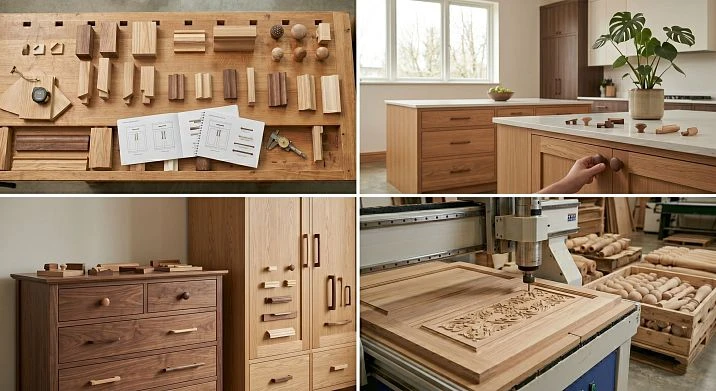
There are details that change furniture beyond recognition — not repainting, not replacing facades, but simply changing the handles. It sounds implausible until you try it. Put properly selected solid wood handles on an ordinary dresser — and the piece suddenly becomes more expensive, warmer, more distinctive.
Furniture handles are the first thing hands touch when opening a cabinet, drawer, or kitchen facade. Every day, several times. And that is why choosing them is not a trifle. Shape, grip comfort, wood color, finish, size — all of this simultaneously affects the feel of the furniture and its visual appearance.
This article provides a systematic, honest, and practical analysis: how to choose wooden furniture handles for cabinets, dressers, kitchens, nightstands, and built-in furniture. By type, size, style, common mistakes, and the correct purchasing algorithm.
Why wooden handles look more expensive: it's not about the price
Let's be honest: a wooden handle is not always more expensive than a metal one. But almost always it looks more expensive — and that's the key point.
Wood is a living material. It has texture, shade, and tactile warmth. When you grasp a wooden handle, your hand feels something fundamentally different from cold chrome or plastic imitating metal. This tactile experience instantly shapes the perception of the entire furniture's quality.
That is why wooden furniture handles work more effectively than one might think:
-
Natural texture softens the facade. A matte wooden element on a painted facade creates a contrast of materials — always more interesting than a uniform surface.
-
Wood harmonizes with wood. If the interior has a wooden floor, solid wood baseboard, doors, trims, slats, or Trim — handles made from the same material create a system, not a collection of random details.
-
Universal style compatibility. Wooden handles look organic in classic, neoclassical, Japandi, Scandinavian, country, Russian country interior, and modern minimalism with natural accents.
-
Ability to coordinate color. handles without coating allow you to tint the part to the desired shade yourself — exactly matching the facade, floor, or doors.




What types of wooden furniture handles exist: a complete overview of types
Before going to the catalog, you need to understand what exactly you are looking for. There are significantly more types of wooden handles than it seems at first glance.
Our factory also produces:
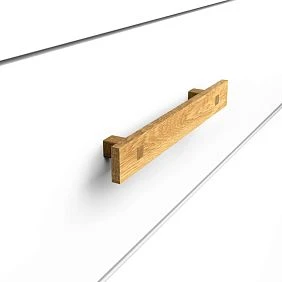
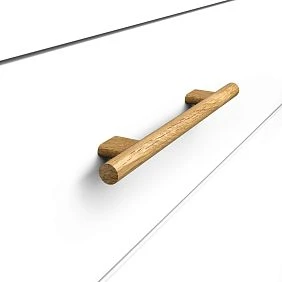
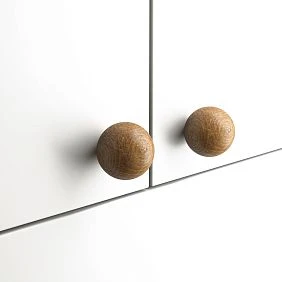
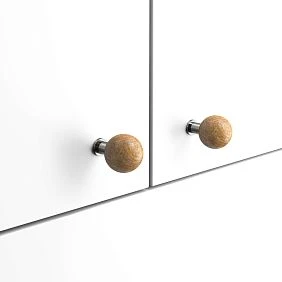
Pull handles (bail handles)
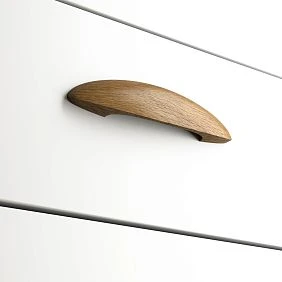
The most common type. A bracket is an arched handle with two attachment points. It is comfortable to grip with your hand, holds well on the facade, and allows you to confidently open heavy drawers and doors.
A wooden bracket handle can be:
-
With a straight crossbar — a strict, modern option.
-
With a curved crossbar — a softer, slightly classic look.
-
With a carved or turned profile — for classic and neoclassical furniture.
The bracket size is determined by the center distance: 32 mm, 64 mm, 96 mm, 128 mm, 160 mm — standard steps. Before purchasing, be sure to measure the distance between existing holes if you are replacing handles on ready-made furniture.
Get Consultation
Knob handles and bit handles
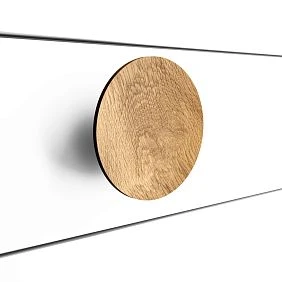
Round or mushroom-shaped handles with a single attachment point. Compact, neat, look good on small drawers, cabinets, chests of drawers.
A wooden knob handle is a minimalist choice. It does not protrude far from the facade, does not catch on clothing, and does not create "noise" on the surface. Especially suitable for children's furniture, small-format cabinets, and decorative elements.
Long wooden handles
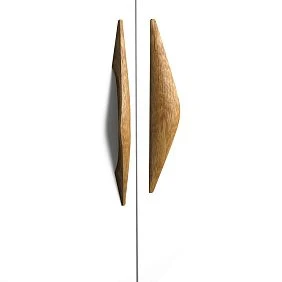
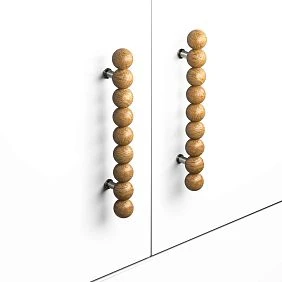
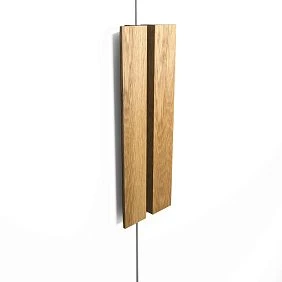
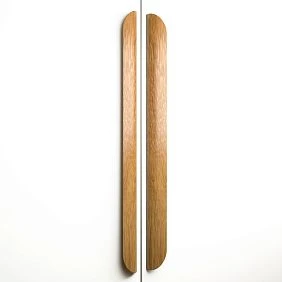
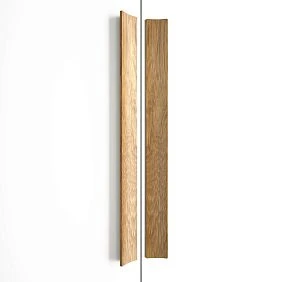
Long handles (from 120 to 300 mm and more) are an expressive option for tall cabinet fronts, kitchen drawers, and built-in furniture. They visually "elongate" the facade vertically, creating a sense of elegance.
For built-in wardrobes with tall doors, a long wooden handle of the right scale becomes an architectural detail, not just a functional element.
Flush-mounted wooden handles
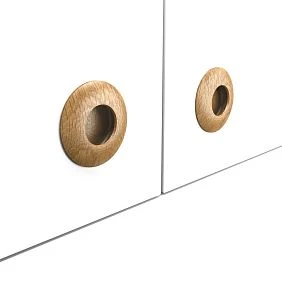
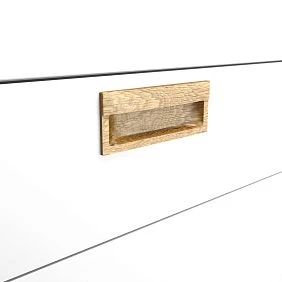
Inset handles — are installed flush with the facade surface. They do not protrude, do not create volume. A modern, clean, laconic option.
Inset wooden handles are the ideal choice for:
-
built-in wardrobes in the hallway, where the handle should not obstruct passage;
-
kitchen fronts in minimalist and Japandi style;
-
furniture with thin fronts, where an overlay handle would look heavy.
Curly and carved handles
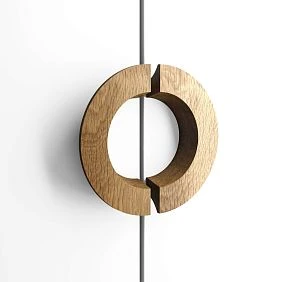
For classic furniture, baroque cabinets, neoclassical chests of drawers — handles with turned or carved profiles. They carry a decorative load: an ornamental motif, an expressive silhouette, consistent with carved inlays и with matching legs.
How to choose handles for a cabinet: a practical breakdown
A cabinet is the largest piece of furniture in most rooms. The handles on it are seen first and affect the perception of the entire space. Let's break it down by scenarios.
Built-in cabinet in the hallway
For a built-in cabinet in a narrow hallway, the handle should not obstruct the passage. The best choice is a flush wooden handle or a compact knob that does not protrude far from the facade.
Color: matching the facade or matching the wooden details of the hallway — baseboard, door, slats. A single wooden note unifies the space.
Sliding wardrobe
For a sliding wardrobe, handles are installed on sliding profiles or directly on the facade. A comfortable grip area for opening the door is important. A long horizontal handle or bracket is a practical and visually correct choice.
Classic cabinet
For a classic wooden wardrobe, a more expressive handle shape. A wooden bracket with a turned profile, a handle with decor, or Handles with Finish in a coordinated finish. In a classic wardrobe, the handle is a detail coordinated with legs, overlay panels и the carved decor of the facade.
Wardrobe with tall doors
A tall door requires a long handle located at a comfortable height — usually at waist level or slightly lower. One long wooden handle in the center of the facade is a more modern solution. Two knobs or buttons are more classic.
How to choose handles for a chest of drawers and a cabinet
A chest of drawers is an item where the potential of the right handles is especially visible. A good chest of drawers with bad handles looks unfinished. A simple chest of drawers with the right handles looks finished and expensive.
Small drawers
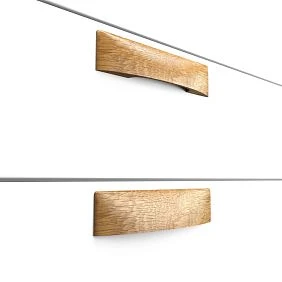
On a drawer 8–10 cm high, a large handle is not needed. A wooden button or a compact bracket with a center distance of 32–64 mm is a proportionate choice.
Wide fronts
On a wide drawer of a chest or nightstand, you can use:
-
a long pull with a center-to-center distance of 128–160 mm;
-
two symmetrically placed knob handles;
-
one central handle with an expressive profile.
Principle: the handle should be proportionate to the front. A handle that is too small gets lost on a wide drawer. One that is too large dominates where it shouldn't.
Classic style chest of drawers
For a classic chest — handles in the same style as wooden legs и carved inlays. A wooden handle with a profiled body, tinted to match the furniture. This is a system.
Nightstand
For a nightstand, an easy grip in the dark is important: the handle shape should be recognizable by touch. A pull or knob is a practical choice. A recessed handle is less convenient here.
Wooden kitchen handles: a separate topic
Kitchen handles are the most heavily used hardware in the home. They are used dozens of times a day: opening lower drawers with wet hands, grabbing upper cabinet handles with clean or not-so-clean hands. For the kitchen, not only appearance matters, but also practicality.
Why wood is suitable for the kitchen
Many people doubt: won't a wooden handle suffer from moisture and grease? With proper coating — no. Handles with lacquer or oil-wax coating are resistant to everyday kitchen loads, easy to clean with a damp cloth, and maintain their appearance for years.
A wooden handle softens kitchen facades — especially where painted MDF or matte film surfaces are used. Natural material adds warmth to a space that often risks looking cold and technocratic.
Which kitchen styles suit wooden handles
Japandi. Natural wood is the main material in this style. Wooden handles of simple shape, possibly without coating or with oil, are an ideal solution.
Scandinavian style. White facades + wooden details. Long wooden handles, light wood pull handles are the standard for a Scandinavian kitchen.
Country and Provence. Wooden handle with an expressive shape, possibly with slight decoration. Warm shades: oak, walnut, cherry.
Neoclassicism. Handles with a turned profile, Handles with Finish in a matching tone, coordinated with wooden skirting board the doors.
Modern interior. Mortise wooden handles or minimalist brackets made of light wood.
Handle shape for the kitchen
In the kitchen, a comfortable grip area is important. The handle should not catch on clothing — this means the bracket's projection from the facade must be sufficient for a free grip (minimum 25–30 mm). Sharp or too thin handles are less comfortable with repeated use.
For lower drawers (opened frequently, up and down) — a horizontal bracket is more convenient than a vertical one. For upper cabinets (opened less often) — any shape can be used.
Handles with or without coating: what to choose
This choice depends on how exactly you work with furniture.
Handles with coating
Wooden handles with coating — a ready-made solution. The coating can be:
-
varnish (matte or glossy);
-
tinting to a specific wood species or shade;
-
oil-wax impregnation — for a natural look and tactile warmth.
Advantages: require no additional processing, ready for installation immediately, stable color. Well suited when you need to quickly install handles and not spend time on finishing.
Handles without coating
uncoated wooden handles — material for independent work. They are tinted, painted, coated with varnish or oil — exactly to the shade needed for a specific project.
Advantages: maximum flexibility in color, ability to match the tone of facades, flooring, doors, and wooden moldings. Good for workshops, design projects, and anyone wanting perfect color coordination.
| Handles with coating | Uncoated handles | |
|---|---|---|
| Ready for installation | Immediately | Requires finishing |
| Color flexibility | Limited by palette | Unlimited |
| Application | Ready-made solution | For your own project |
| Labor costs | Minimal | Time-consuming |
How to choose the size of a wooden handle: parameters and logic
Handle size is not one parameter, but three: center-to-center distance (for brackets), handle length, and projection from the facade.
Center-to-center distance
For pull handles — the distance between the centers of two mounting holes. Standards: 32, 64, 96, 128, 160, 192 mm. The most important parameter when replacing handles: if you want to avoid new holes — measure the existing ones.
Handle length
The total length of a pull handle is greater than the center-to-center distance (usually by 30–60 mm). A long handle (200–400 mm) — for tall or wide fronts. A short one (80–130 mm) — for small drawers.
Projection from the front
The distance the handle protrudes above the surface. Too small a projection (5–10 mm) — uncomfortable grip. Optimal projection for a comfortable hand — 25–35 mm. For flush handles — zero: flush.
Size selection table
| Furniture type | Recommended center-to-center distance | Handle type |
|---|---|---|
| Small drawer (10–20 cm) | 32–64 mm or knob | Knob, pull |
| Medium drawer (20–40 cm) | 64–96 mm | Bracket |
| Wide drawer (40–80 cm) | 96–128 mm or long | Bracket, long |
| Tall cabinet door | Long 200–400 mm | Long handle |
| Built-in hallway cabinet | Compact, recessed | Recessed, button |
How to match the color of a wooden handle to the interior
The question of color is one of the most subtle. And one of the most often ignored. "I'll take wooden handles — they're wooden, so they'll fit" — doesn't work if the wood in the interior is of different shades.
Color matching strategies
Matching the facade. A handle in the same shade as the facade creates a monolithic look. The handle seems to "dissolve" into the furniture. Suitable for minimalist interiors where handles are a function, not an accent.
Matching the floor plinth or floor. The handle connects the furniture to the floor through a common wood tone. This is an architectural approach. Works well when solid wood baseboard and the doors have a pronounced wood tone.
Contrasting with the facade. A dark handle on a light facade or vice versa. Contrast emphasizes the handle as a design element. This approach is popular in Scandinavian style and Japandi.
Natural wood tone as an accent. Light natural wood on a painted white facade is a very popular and expressive technique. The handle becomes a natural accent in a geometrically clean space.
The rule of consistency
The main rule: do not mix several different wood tones in one room without logic. If the kitchen has light oak on the floor, dark walnut on the doors, natural birch on the handles, and dark cherry on the plinth — this is not "material richness," it is chaos.
Choose one or at most two wood notes for the room. Let the handles support one of them.
Wooden handles in different interior styles
Classic interior
For classic style — wooden handles with a turned profile, expressive shape, matched with carved furniture overlays и wooden legs. Tinting to match the furniture — warm walnut, dark oak, cherry.
Handles in a classic interior are part of a unified decorative program. They are coordinated with moldings, baseboard and the floor wood.
Japandi
Natural untreated or softly tinted wood. Simple shape — without ornament, without decor. A bracket handle or a long handle made of light oak or ash. Minimalism, naturalness, silence of form.
Scandinavian style
White or light gray facades + wooden handles. Simple brackets, long handles, round knobs. Light wood — birch, ash, light oak. Tinting is not needed — the natural shade works better.
Country house and Russian style
Wooden texture, connection with nature, reference to folk aesthetics. Massive brackets, handles with ornament, warm wood tones. They work well with carved decoration, plinth and wooden panels.
Children's room
For a children's room — a safe shape without sharp elements, a comfortable grip for small hands. A wooden knob or a small bracket is an ideal option. Light tinting or painting in a cheerful color — optional.
Modern interior with wooden accents
Mortise wooden handles or minimalist brackets with clean geometry. Wood here is a natural contrast to neutral walls, concrete surfaces, and metal.
Mistakes when choosing furniture handles: let's talk straight
Choosing handles only by photo. The photo is taken at a different scale, in different lighting, on a different facade. Always check the dimensions.
Not checking the center-to-center distance. When replacing handles on ready-made furniture, first measure the distance between the holes, then choose. Otherwise, you'll have to drill new ones.
Putting too small a handle on a large facade. A small knob on a large cabinet facade looks like a randomly attached element.
Choosing an uncomfortable shape for a heavy drawer. A thin decorative handle on a heavy lower kitchen drawer is inconvenient and not durable. Heavy facades need a good grip.
Not considering the coating. Handles without coating in a kitchen without additional finishing will darken from grease and moisture. In the kitchen, coating is needed.
Mixing different wood shades. Light handles, dark baseboard, medium shade on doors — without a system, it looks random.
Not coordinating handles with legs and trims. If the furniture has carved legs и Decorative Inserts, the handles should support the same style.
Buying without a reserve. Take +10–15% — in case of defects, drilling errors, or future furniture expansion.
Do not check the ease of opening. Before ordering a large batch, order a sample and check how the handle feels in your hand.
What to buy together with wooden furniture handles
Properly selected handles are only part of a complete furniture look. If you want the furniture to look truly finished:
-
Solid wood furniture legs — define the character of the base part.
-
Carved decorative inserts for furniture — add decorative relief to the facades.
-
Furniture decor from carved wood — for classic and style solutions.
-
Wooden moldings — for wall and facade decoration.
-
Pogonazh iz massiva — profiles for baseboards, cornices, and frames.
-
solid wood baseboard — for the lower architectural line of the room.
-
Solid Wood Items — a complete catalog of wooden parts for furniture and interiors.
How to buy wooden furniture handles without mistakes: an algorithm
1. Determine the type of furniture: wardrobe, chest of drawers, kitchen, cabinet, built-in furniture.
2. Measure the facades — height and width of each.
3. If replacing handles — measure the existing holes.
4. Choose the handle type: bracket, knob, long, recessed.
5. Check the size: center-to-center distance, length, projection.
6. Decide if you need Handles with Finish or without.
7. Coordinate the color with facades, floor, doors, and baseboard.
8. For a comprehensive design, select Legs и applique in the same style.
9. Add 10–15% margin to the estimated quantity.
10. Go to the catalog STAVROS furniture handles — choose the right part for your project.
About the company STAVROS
A handle is a small detail with a big personality. STAVROS produces Wooden furniture handles in a full range: handles without coating, Handles with Finish, Mortise wooden handles, and also Furniture legs, carved appliqués, decor for furniture, Moldings, Pogonazh iz massiva and the entire range of solid wood for furniture and interiors.
STAVROS has been operating since 2002. Production in Saint Petersburg, own turning and milling workshop. Shipment from 1 piece. Contact us to confirm shipping to your destination. Custom shapes and sizes made to order.
FAQ: Answers to popular questions
Which furniture handles are best to choose?
Focus on the type of furniture and the size of the fronts. For cabinets — long handles or pulls. For dressers — pulls or knobs proportionate to the drawer. For the kitchen — a comfortable shape with a practical coating.
What are the advantages of wooden furniture handles?
Wood is warmer and more natural than plastic and metal. Wooden handles blend organically with solid wood furniture, wooden baseboards, doors, slats, and interior decor.
Which handles to choose for a cabinet?
For a tall cabinet — long handles or convenient brackets. For a built-in cabinet in the hallway — recessed or compact ones that do not obstruct passage.
Are wooden handles suitable for the kitchen?
Yes. Choose handles with a coating — varnish or oil-wax. They are resistant to moisture and frequent use, easy to clean.
What's better: handles with coating or without coating?
Handles with coating — ready color, quick installation. Handles without coating — maximum flexibility in matching the shade with facades, floor, doors, and baseboard.
How to correctly measure a handle before purchasing?
For brackets — the center-to-center distance between mounting holes. For knobs — diameter and height. Projection — the distance from the facade to the bridge. All three parameters are important.