Article Contents:
- Why wooden handles are more than just hardware
- Where wooden handles are used: from kitchen to bedroom
- Kitchen fronts
- Chests of drawers
- Cabinets and display cases
- Chests of drawers
- Interior Doors
- Solid wood furniture
- Restoration of old furniture
- Types of wooden handles: form and function
- Bracket handle
- Knob handle
- Long Wooden Handles
- Recessed handles
- Round handles and knobs
- Carved wooden handles
- How to choose the size of a wooden handle: practical guidelines
- Principle of proportion
- Handle for a small drawer
- Dresser handle
- Cabinet handle
- Kitchen cabinet handle
- Interior door handle
- Handles with or without coating: what to choose and when
- Coated handles: convenience out of the box
- Uncoated handles: freedom of choice
- How to coat wooden handles yourself
- Wooden handles and different interior styles
- Classic interior: richness of details
- Neoclassicism: rigor with a nuance
- Scandinavian style: simplicity as a principle
- Modern minimalism
- Country house and wooden interior
- Restoration: consistency with the era
- How to combine wooden handles with other interior elements
- Handles and furniture legs
- Handles and decorative overlays on furniture
- Handles and wooden moldings
- Handles and frames for pictures and mirrors
- Handles and baseboards
- Technical parameters: what you need to know before buying
- Center-to-Center Distance
- Mounting pin diameter
- Depth of the hole in the facade
- Load and strength
- Mistakes when choosing wooden handles
- Too small handle on a large facade
- Uncomfortable grip
- Different wood shade
- Unsuitable coating for the application area
- Too simple handle for rich furniture
- Active form in a minimalist interior
- Purchase without considering the center distance
- FAQ: Answers to Popular Questions About Wooden Handles
- Which wooden handles to choose for a cabinet?
- Which handles are best for drawers?
- What is better: a handle with a coating or without?
- Which wood is best for wooden handles?
- Can wooden handles be used for interior doors?
- How to choose handles to match the color of the furniture?
- Where to buy wooden handles for furniture?
- About the Company STAVROS
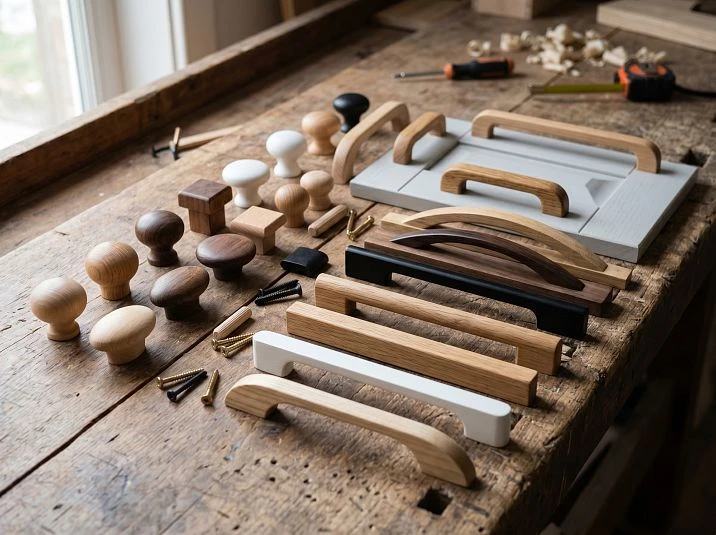
There are things that go unnoticed — until they are wrong. The handle on a dresser drawer. The pull on a cabinet door. The knob on a small cabinet front. As long as they are in their place — they are not seen. But as soon as you choose the wrong shape, the wrong size, the wrong color — the entire interior starts to "not sound right." Something is off, but it's hard to say exactly what.
That is why choosing wooden handles is not a trifle, but a full-fledged design task. And this is true for a simple kitchen front, an expensive classic dresser, and an interior door in a country house.
wooden furniture handles — this is a category that hides more options than it seems at first glance. Pulls and knobs, long models and compact ones, with and without coating, for lacquer and for enamel, for classic furniture and for modern minimalism. The right choice requires understanding several parameters — and we will break them down here sequentially, precisely, and without fluff.

Why wooden handles are more than just hardware
Before moving on to selection parameters, let's focus on a fundamental question: why wood? After all, there are plenty of metal, ceramic, glass, and plastic handles on sale — often cheaper and with a wider range.
There are several reasons, and each one is significant.
Warmth of the material. Wood is tactilely warm — in the literal sense. A metal handle in cold weather unpleasantly chills the hand. A wooden one is neutral. This is especially important for furniture in the bedroom, children's room, or country house.
Natural aesthetics. A wooden handle carries a living texture — the grain pattern, a subtle play of shades. No imitation reproduces it exactly. In an interior with wooden elements (parquet, doors, moldings, solid wood furniture), a wooden handle creates unity — a continuation of one theme.
Possibility of precise color matching. uncoated wooden handles it can be painted, tinted, coated with oil, wax, or varnish exactly to match the furniture. This is a level of consistency that metal cannot provide.
Durability. A high-quality wooden handle made of hardwoods (oak, beech, walnut) lasts as long as the furniture itself. It does not rust, oxidize, or lose its shine from household chemicals.
Connection with other interior elements. A wooden handle is a detail that 'communicates' with classic furniture, with wooden moldingswith frames and baseboards — creating that very integrity of space that is hard to explain but easy to feel.




Where wooden handles are used: from kitchen to bedroom
A wooden handle is appropriate where wood already exists — or where you want to add it. Let's consider specific areas of application.
Our factory also produces:
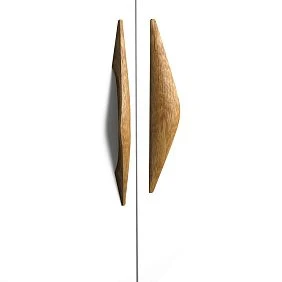
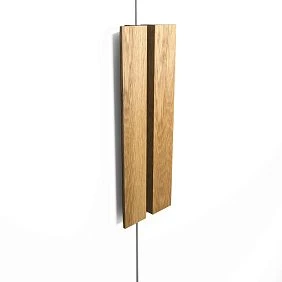
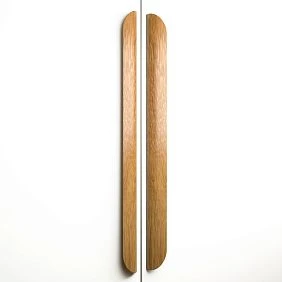
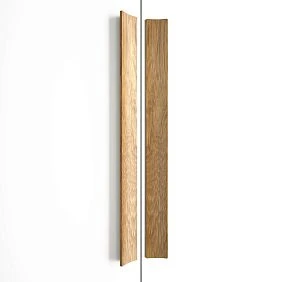
Kitchen fronts
The kitchen is the most "handle-intensive" space in the home. Dozens of cabinet fronts, drawers, ovens, dishwashers — and each has a handle. The choice of wooden handles for kitchen fronts determines the overall feel of the kitchen.
For a classic or neoclassical kitchen — wooden handles with a pronounced profile, brackets, or long models matching the facades. For a modern kitchen — minimalist wooden brackets or long rail handles.
An important nuance for the kitchen: handles must withstand regular contact with moisture, grease, and household chemicals. This requires a quality protective coating: varnish or oil-wax with water-repellent properties.
Get Consultation
Chests of Drawers
A chest of drawers is furniture that is interacted with daily, sometimes several times a day. The handles on the drawers should first and foremost be comfortable: the right size, a good grip, and reliable fastening.
For chests of drawers in a classic interior — knob handles with a pronounced shape or brackets with an elegant curve. For Scandinavian — simple straight brackets made of light wood.
Cabinets and display cases
A cabinet with hinged doors requires handles that are convenient for a pulling motion. For tall cabinet fronts — long wooden handles that visually elongate the vertical and provide a comfortable grip along the entire height.
wooden furniture handles on display doors — a decorative accent. They should be aesthetically perfect: a display case is always an object that is looked at.
Nightstands
Bedside tables, TV cabinets, bathroom and hallway cabinets — small furniture where compact knob handles or short pulls look proportionate. Overloading a small facade with a large handle is a common mistake.
Interior doors
Wooden door handle — this is a different level of load. A door handle is opened and closed hundreds of times a day, experiencing forces in different directions. Therefore, for interior doors, both aesthetics and structural strength are important.
Wooden handles for interior doors come in push (lever type) and turn (round knobs) styles. For classic doors with panels and moldings — handles with a pronounced shape that matches the decorative language of the door.
Solid wood furniture
Furniture made of solid wood — cabinets, sideboards, tables, beds — requires handles of the same class. A wooden handle on solid wood furniture creates material unity. A metal or plastic handle on such furniture is always a step down in quality.
Restoration of old furniture
Replacing handles is one of the fastest and cheapest ways to change the character of furniture. An old Soviet-era chest of drawers with new uncoated wooden handles, painted to match the furniture color — is already a different item.
During restoration, it is important to match the center-to-center distance (the distance between the handle attachment points) with the existing holes in the facade.
Types of wooden handles: form and function
Classification of handles by shape is the first step to making the right choice. Each shape creates its own visual effect and provides a specific type of grip.
Bracket handle
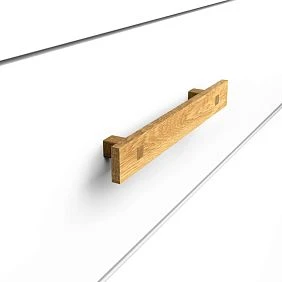
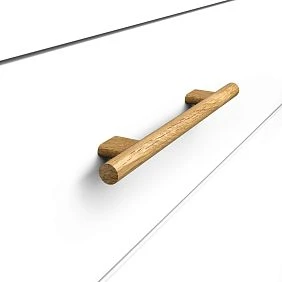
Bracket — the most common type of furniture handle. An arched or straight bridge resting on two pins screwed into the facade.
Advantages of the bracket:
-
Comfortable grip for pull-toward-you movements
-
Reads well on the facade, creates a striking horizontal or vertical accent
-
Size range: from 32 mm center-to-center distance for small drawers to 256 mm for tall cabinet doors
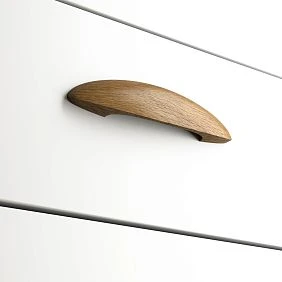
wooden hook handle — a variant that works in almost any interior: both classic and modern. The only question is the size and profile of the arch itself: curved, with a twisted pattern — for classic; straight, with a clear cross-section — for modern style.
How to choose the center-to-center distance:
| Front size | Center-to-center distance of the bracket |
|---|---|
| Small drawer (up to 300 mm) | 32–64 mm |
| Medium drawer (300–600 mm) | 64–128 mm |
| Cabinet door | 96–160 mm |
| Tall cabinet door | 160–256 mm |
Knob Handle
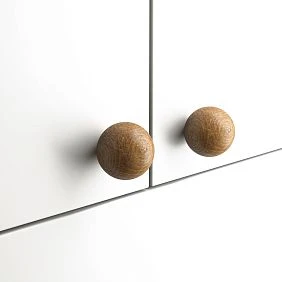
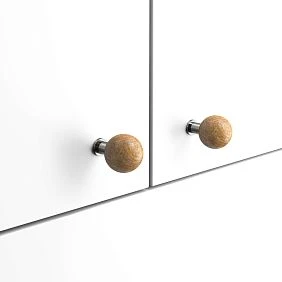
A knob is a single-point handle: one pin, one grip element. It is compact, minimalist, and works well where a pull would be too large.
Where knobs are used:
-
Drawers of small cabinets
-
Drawers of compact dressers
-
Internal doors of sideboards and display cabinets
-
Accent decor on small facades
Wooden knobs can be round (spherical), mushroom-shaped, with a flat head, or with carved ornamentation. For classic furniture — a knob with a voluminous shape and details. For Scandinavian style — a flat knob with minimal relief.
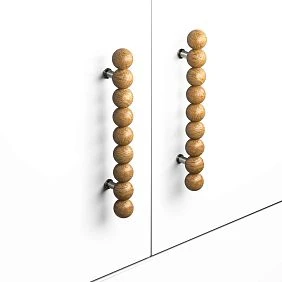
Long wooden handles
Long handles — from 300 to 500–600 mm — are a horizontal or vertical "rod" on the facade. They create a strong linear accent and work well on tall cabinet doors, kitchen cabinet facades, and side panels.
A long wooden handle on a tall cabinet facade is a technique that is both convenient (the handle is accessible from any height) and beautiful (emphasizes the vertical). In a modern interior, this is one of the most expressive furniture accents.
For long handles, proper installation is important: three to four attachment points instead of two to prevent deflection under lateral force.
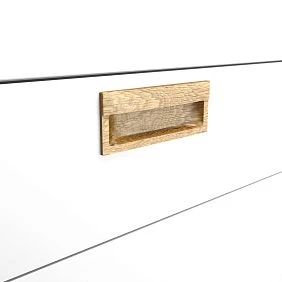
Recessed handles
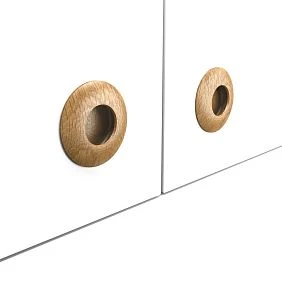
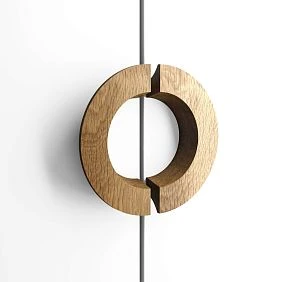
A recessed handle is mounted flush with the facade — there is no protruding part, only a recess for gripping. This is the most neat, "invisible" solution.
Recessed handles are good for minimalist interiors: the facade looks clean, without protruding elements. They are also used for sliding structures — where a protruding handle would interfere with panel movement.
Round handles and knobs
A round handle ("knob") is a spherical or cylindrical element that is grasped with the fingers. This involves a twisting motion, making knobs inconvenient for heavy facades but ideal for lightweight doors and drawers.
A wooden knob in a classic interior is a point that completes the facade: small, elegant, with visible wood texture. It looks especially good on display doors with glazing.
Carved wooden handles
carved wooden handles — a separate category for classic, baroque, and ornate furniture. The ornament on the handle body, turned profile with changing cross-section, decorative ends on the bracket — this is already a handle as a work of art.
A carved handle requires an appropriate context: furniture with carved facades, Decorative Inserts with ornament, Classic Furniture with rich finishing.
How to choose the size of a wooden handle: practical guidelines
The size of the handle is not just centimeters. It is a proportion: the ratio of the handle to the facade on which it is located.
Principle of Proportion
The handle should be neither too small nor too large relative to the facade. A small handle on a large facade gets lost — it is uncomfortable to grip, it looks out of place. A large handle on a small drawer overwhelms the facade — the handle 'dominates' the item.
Practical rule: the length of the handle (or the center-to-center distance of the bracket) is about 1/4–1/3 of the facade width. For a drawer 400 mm wide — a handle with a center-to-center distance of 96–128 mm. For a cabinet door 600 mm wide — a center-to-center distance of 128–192 mm.
Handle for a small drawer
For drawer units, bedside tables, small chests — buttons with a diameter of 30–40 mm or brackets with a center distance of 32–64 mm. Here the function is minimal: opening a light drawer is easy even with a small handle.
Handle for a chest of drawers
Medium-sized chest of drawers (drawers 350–500 mm wide) — brackets with a center distance of 64–96 mm or slightly larger buttons (40–50 mm). Four to six drawers with identical handles create a rhythm on the facade — this is an important aesthetic effect.
Handle for a wardrobe
Wardrobe with hinged doors — area for brackets with a center distance of 96–160 mm or long handles from 200 mm. For a tall wardrobe (door height from 2 m) — long handles 300–500 mm, positioned vertically.
Handle for a kitchen facade
In the kitchen, where there are many facades of different sizes, the logic is as follows: all facades of the same type have identical handles. Different handles on different facades are only acceptable if it is a deliberate design play, not a mismatch.
For horizontal drawers — horizontal brackets. For vertical doors — brackets or long handles oriented vertically.
Handle for an interior door
A wooden door handle differs from a furniture handle: it should be comfortable for a single grip that opens a heavy door leaf. The standard installation height is 900–1050 mm from the floor level. The length of a door handle ranges from 110–120 mm (compact "knob") to 160–200 mm (lever handle).
Handles with or without coating: what to choose and when
This is a question that arises with every purchase of wooden handles. And the answer depends on several specific circumstances.
Handles with coating: convenience "out of the box"
Wooden handles with coating — these are handles that have already undergone final finishing at the factory. They are ready for installation: the coating is applied evenly, the surface is protected, the color is fixed.
When to choose handles with a finish:
-
When a quick solution is needed without additional work
-
When the exact shade of the coating matches the shade of the furniture
-
When the furniture is already assembled and repainting of the facades is not planned
-
For handles that will be actively used (kitchen, hallway) — industrial coating is usually more durable than a self-applied one
Handles with coating are produced in several standard shades: natural wood (under varnish), dark walnut, oak, white, gray, black.
Uncoated handles: freedom of choice
uncoated wooden handles — this is a "blank canvas": handles made from a finished form, but without a topcoat. They can be painted, tinted, coated with oil or varnish to exactly match the furniture — down to a precise color match.
When to choose uncoated handles:
-
When precise color coordination with a specific facade is needed
-
When furniture is painted or tinted independently, and handles are painted simultaneously with the facades
-
When the interior is custom-made and all wooden parts are treated with a single compound
-
For furniture restoration, where an existing finish needs to be precisely replicated
Important: uncoated handles must be treated before installation — or simultaneously with the furniture treatment itself. Installed without coating, they quickly become dirty and lose their appearance.
How to coat wooden handles yourself
The process is simple but requires care:
-
Sanding with fine grit sandpaper (220–320) until smooth surface
-
Removing dust with a dry cloth or brush
-
Applying primer (if painting is planned) or directly the first coat of oil/varnish
-
Light sanding after the first coat dries (grit 320–400)
-
Applying the second coat
-
Third coat if necessary
For oil and wax — two to three coats with a day interval. For varnish — two coats are enough. For enamel — primer + two coats of paint.
Wooden handles and different interior styles
A handle is a detail that belongs to a specific style. The choice of shape and finish should match the overall character of the furniture and space.
Classic interior: richness of details
In a classic interior, the handle is one of the 'luxury points': a small element with a distinct shape that carries a decorative load. Here, brackets with a curved profile, buttons with a voluminous spherical or pear-shaped form, carved handles with ornamentation are appropriate.
Tone: dark walnut, mahogany, gold (in combination with metal details). The finish is a deep lacquer that reveals the wood grain.
Classic Furniture With properly selected wooden handles, it becomes a single organism where every detail works toward the integrity of the image.
Neoclassicism: strictness with a nuance
In a neoclassical interior, handles are more restrained than in "pure" classicism: the form is expressed, but without excessive ornamentation. A straight bracket with a profiled cross-section, a button with a laconic cylindrical shape.
Tone: cream, gray, matte white. A combination of wood and metal is possible: a wooden bracket with metal end rosettes.
Scandinavian style: simplicity as a principle
A Scandinavian interior requires handles with minimal relief: a straight bracket made of light wood (ash, beech, birch), a flat button. The finish is matte oil or light wax that preserves the natural tone.
Nothing superfluous. No ornamentation, no curls, no deep relief. Only form and texture.
Modern minimalism
In a minimalist interior, handles may be absent altogether (push-to-open systems) — or be as unobtrusive as possible. If a wooden handle is still used — a straight long rail handle or a recessed one with minimal protrusion.
Tone: black, graphite, or natural wood as a contrast to white facades.
Country house and wooden interior
In a house with wooden beams, plank floors, and natural textures, a wooden handle is an organic choice. Models made of oak or pine with natural oil and visible wood texture work well here.
The shape is simple, with a slight profile. Don't try to introduce "urban" elegance: in a country interior, natural simplicity works better.
Restoration: consistency with the era
When restoring old furniture, handles are selected to match the "era" of the piece. A Soviet sideboard from the 1960s requires different handles than a Biedermeier chest. Study the original style of the piece and choose handles that belong to the same language.
How to combine wooden handles with other interior elements
The handle is not isolated. It is always part of a system of decorative solutions that create the integrity of the space.
Handles and furniture legs
Furniture legs — the same accent element as handles. Their consistency is especially important in classic furniture: a turned leg with a profile + a bracket with a similar profile create unity. When legs are in one character and handles in another, the furniture looks "assembled from different sets."
Practical rule: if the legs are turned from oak with dark tinting, the handles should also be in dark oak. If the legs are white, the handles should be cream or white.
Handles and decorative overlays for furniture
Furniture Decoration from Wood — applied rosettes, cartouches, corner elements — create a decorative "vocabulary" of the facade. Handles should belong to the same vocabulary: the same wood species, a close tone, a similar degree of ornamentation.
A carved overlay with a floral motif + a simple smooth pull handle — dissonance. A carved overlay + a handle with a similar ornament — unity.
Handles and wooden moldings
If present in the interior Wooden moldings on walls or ceiling, the tone and character of the handles must take this context into account. Moldings set the "temperature" of the wooden decor — rich or neutral — and the handles fit into this system.
Handles and frames for pictures and mirrors
This is a small but significant connection. In a living room with wooden frames for mirrors and pictures wooden handles on furniture create consistency: natural wood as a through leitmotif. All wooden elements — different in shape and size, but belonging to the same tonal family.
Handles and baseboards
Wooden Skirting Boards A pronounced profile sets the tone for all wooden decor in the room. In a room with a high dark oak baseboard, handles are also in oak tone, dark or medium. In a light space with a white baseboard, handles are light, cream, or natural wood as a contrast.
Technical parameters: what you need to know before buying
Choosing a handle is not just about aesthetics. There are several technical parameters that determine the compatibility of the handle with specific furniture.
Center-to-center distance
Center-to-center distance (CC) is the distance between the centers of two mounting holes of the bracket. This is the main technical parameter when replacing handles: the new handle must have the same CC as the old one, otherwise you will have to drill new holes.
Standard CC values: 32, 64, 96, 128, 160, 192, 224, 256 mm. Always check the CC of the desired model when purchasing.
Diameter of the mounting stud
For knobs, the thread diameter of the stud. Standard is M4 (diameter 4 mm). But some models use M3 or M5. It is important to match the hole in the facade.
Depth of the hole in the facade
The handle stud must enter the facade to the required depth and be secured with a nut on the reverse side. Consider the thickness of the facade: for an MDF facade with a thickness of 16–19 mm, a standard stud length is 25–35 mm.
Load and strength
For door handles, for handles on heavy cabinet doors — check the permissible load. Thin decorative handles on a heavy facade — risk of breakage during regular use.
Mistakes when choosing wooden handles
Mistakes when choosing handles are usually not one major oversight, but several small ones that together yield a poor result.
A handle that is too small for a large facade
A small knob on a tall cabinet door looks lost and is inconvenient — it's awkward to grip. Choose a handle proportional to the facade.
Uncomfortable grip
A beautiful handle that is uncomfortable to hold is a bad handle. Check the ease of grip: the bracket should fit freely under your fingers, the knob should be grasped confidently.
Different wood shade
Batches of handles purchased at different times may have a different tone. Purchase all handles for one project in a single batch — this guarantees uniformity.
Unsuitable coating for the application area
A handle with a wax coating on a kitchen cabinet near the stove quickly loses its appearance. For the kitchen — lacquer or oil-wax with water-repellent properties. For the hallway — a coating with increased resistance to mechanical impact.
A handle that is too simple for expensive furniture
A smooth straight bracket made of pine on a classic sideboard with carved overlays and turned legs is a handle that "eats up" all the decorative work. The level of the handle should match the level of the furniture.
An active shape in a minimalist interior
A carved handle with an ornament on a white minimalist facade without details is a conflict without meaning. In minimalism, ornament is unacceptable.
Purchase without considering the center-to-center distance
It would seem obvious — but it is this mistake that costs extra drilling and, often, replacement of the facade. Always measure the center-to-center distance of existing handles before buying new ones.
FAQ: answers to popular questions about wooden handles
Which wooden handles to choose for a wardrobe?
For a wardrobe with hinged doors — bracket handles with a center-to-center distance of 96–160 mm or long handles from 200 mm, oriented vertically. For a wardrobe with tall doors — a long handle 300–500 mm at 3–4 attachment points.
Which handles are best for drawers?
For small drawers — knobs with a diameter of 30–50 mm or brackets with a center-to-center distance of 32–64 mm. For larger drawers — brackets with a center-to-center distance of 64–96 mm. The main criteria are ease of grip and proportionality to the drawer.
Which is better: a coated or uncoated handle?
If you need the handle "ready to use" — choose coated. If you need precise color matching to specific furniture or plan to paint it yourself — choose uncoated.
Which wood is best for wooden handles?
For high-traffic areas (kitchen, doors, hallway) — oak or beech: hard, scratch-resistant. For decorative furniture — any wood type to your taste. Oak has expressive grain. Beech has a uniform surface for painting. Walnut has a noble warm tone.
Can wooden handles be used for interior doors?
Yes. Wooden handles for interior doors are wooden lever handles or knobs on a latch mechanism. They require a strong base of hardwoods and a quality protective coating.
How to choose handles to match furniture color?
If the furniture is light — choose light or neutral handles (cream, natural beech). If the furniture is dark — choose handles in a dark tone or contrastingly light (intentional accent). If the furniture is white — choose white, gray, or natural wood handles as a warm contrast.
Where to buy wooden handles for furniture?
In the wooden furniture handles models of various shapes and sizes are available: brackets, knobs, long handles, Handles with Finish и without a finishThere too — Furniture legs и Decorative Inserts to create a cohesive furniture ensemble.
About the company STAVROS
The handle is the final touch that completes the furniture. That detail that is noticed last — but without which everything looks unfinished.
STAVROS produces wooden furniture handles from solid wood in a wide range of shapes, sizes, and finish options. In the catalog wooden handles — handles, knobs, long handles; models with coating и without a finish. Next to it — Furniture legs, Decorative Inserts, Carved Decor и Solid Wood Items — everything to make the furniture complete from leg to handle.
Start your selection with the STAVROS catalog — and find the handle that will put the right finishing touch on your interior.