








































































Article Contents:
- Bedside and TV cabinet: why you can't choose the same legs for both
- How to calculate the total height of a cabinet with wooden legs
- Example for a bedside cabinet
- Example for a TV cabinet
- How the options differ for the same cabinet body
- Example with recessing
- How to account for the mounting plate
- Should the table be exactly level with the mattress
- How to do a simple fit check
- Why you should check more than just the handle
- When low supports are preferable
- You should not compensate for inconvenience with external form alone
- If the TV is placed on a stand
- If the TV is mounted on the wall
- Example of coordinating furniture and screen
- High clearance and visual perception
- Low clearance
- Example calculation
- When two requirements contradict each other
- What to consider before ordering legs
- Why ventilation cannot be calculated by leg height alone
- What to check in a long base
- The center support should not interfere with use
- Example of a compact bedside table
- Why a wide support does not always look heavier
- MN-146: one geometry for different heights
- MN-227: when a compact geometric shape matters
- MN-145: a slender turned silhouette
- MN-006: an expressive carved shape
- For a bedside table
- For a TV stand
- Turned legs
- Carved legs
- Geometric legs
- Don't approve the color based on a screen
- What to check when making a pair
- Example of a bedside table
- Example of a TV stand
- What is especially important when reworking an old nightstand
- What can't be checked with a cardboard template
- Why you should keep the approved model
- Can a bedside cabinet be lower than the mattress?
- Can tall legs be installed on an already finished bedside cabinet?
- Will the TV be raised if the legs of the TV cabinet are replaced?
- How many legs should a long TV stand have?
- Can I choose legs by height only?
- What should I do if the TV stand has a protruding bottom rail?
- Will identical legs work for two bedside tables?
- What should I do if the new TV stand is placed on a carpet?
- Can oak legs be used with an MDF cabinet?
- Should I buy one leg as a sample?
- Which legs are best for a modern TV stand?
- Where can I choose wooden legs for a solid wood TV stand?
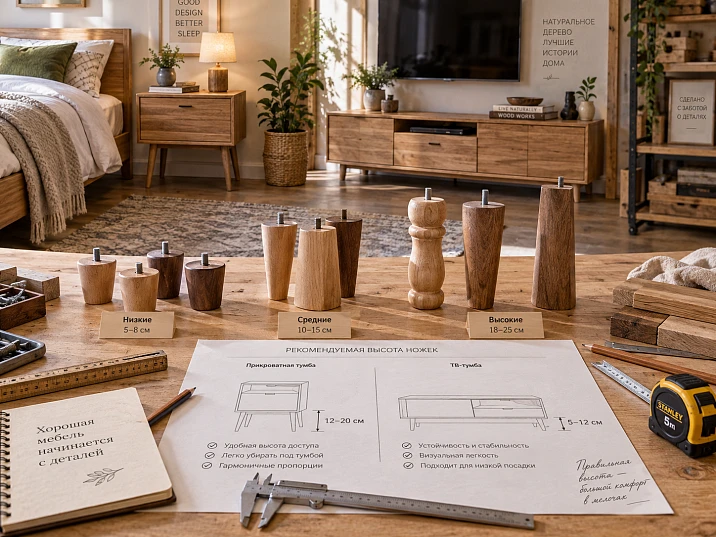
A bedside table 430 mm high stands next to a bed whose mattress top surface is 610 mm above the floor. If wooden legs 180 mm high are installed under the cabinet without recessing or additional modifications, the top of the bedside table will be approximately 610 mm high. In this case, the dimensions add up favorably. But if the same legs are transferred to a 510 mm high cabinet, the furniture will rise to 690 mm, which may be inconvenient for a person lying on the bed.
A TV stand has a different purpose. Here, wooden legs determine not so much the convenience of reaching the top surface with your hand, but rather the height of the low cabinet, the clearance for cleaning, the placement of equipment, and the proportions of the entire TV area. Legs that work well for a compact bedside table will not necessarily be a good solution for a long piece of furniture under a TV.
Wooden legs for a cabinet should be chosen based on the furniture's function and the desired final height. First, measure the cabinet and determine where its top surface should be. Then calculate the required actual extension of the supports, check the free space under the furniture, and only after that choose a specific model made of solid wood.
At the same time, the product height listed in the catalog and the height that the leg actually adds after installation may differ. Recessed mounting, a mounting plate, a glide, or an angle change the position of the cabinet.
For a joinery workshop, this calculation helps avoid reworking furniture that has already been made. For the owner of a ready-made cabinet, it helps to select new supports without an unpleasant change in height or a loss of stability.

Nightstand and TV stand: why you can't choose the same legs for both
The word "nightstand" unites furniture with different purposes. It is the purpose that determines the first criterion for choosing supports.
For a bedside nightstand, the top surface should be convenient for the person lying in bed. They place a phone, glasses, or a book on it, set down a glass of water, or use a lamp. Furniture that is too high forces them to raise their arm, while furniture that is too low makes them reach down. The placement of the drawer also matters.
For a TV stand, the top surface is part of the overall composition with the television. It may hold a screen on its standard base, a soundbar, or other equipment. If the TV is mounted on the wall, the height of the furniture does not directly change the screen's position, but it affects the distance between them and the perception of the entire wall.
For a long TV stand, the support structure is also important. Four wooden legs under a compact cabinet and four identical legs under a two-meter-long piece of furniture create completely different working conditions for the base.
| Criterion | Bedside table | TV stand |
|---|---|---|
| Main task | Convenience next to the bed | Overall composition of the TV area |
| Relative height | Mattress level and ease of access | Position of the screen, cabinet, and equipment |
| Drawers | Accessibility from a sitting or lying position is important | Ease of opening and placement of equipment matter |
| Clearance under the cabinet | Cleaning, appearance, access to outlets | Cleaning, cables, visual lightness |
| Furniture width | Usually relatively small | Can be significantly larger |
| Support structure | Compact mounting unit | It is necessary to assess the long base and the middle of the body |
| The visual role of the legs | Can become a noticeable accent of a small item | They must match the long horizontal silhouette |
Therefore, before choosing wooden legs for a cabinet determine exactly what task the supports should solve.
A beautiful profile, a suitable wood species, and an attractive price make sense only after checking the main dimensions and construction.




How to calculate the total height of a nightstand with wooden legs
In a simple case, the final height of the furniture equals the sum of the cabinet height and the actual vertical extension of the installed supports.
Total nightstand height = body height + actual leg extension.
Body height should be measured from the lower base plane to which the supports are mounted, up to the finished top surface of the furniture.
If the tabletop is already included in the body height, its thickness should not be added a second time.
If the designer specified the body size without the top panel, it is accounted for separately.
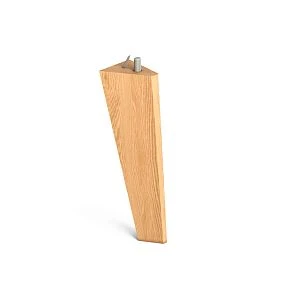
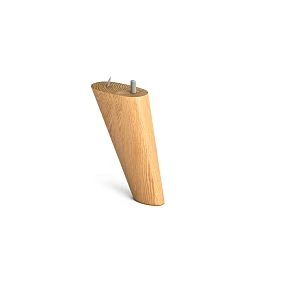
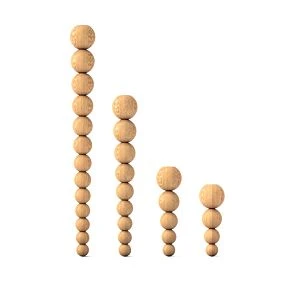
Our factory also produces:
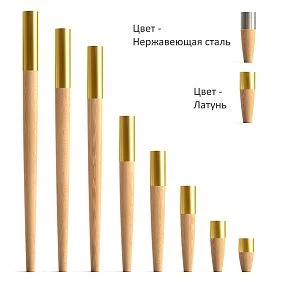
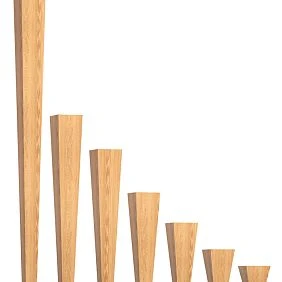
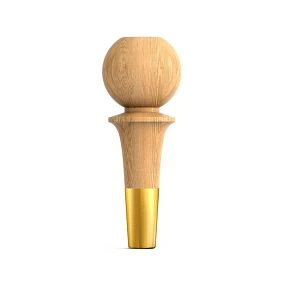
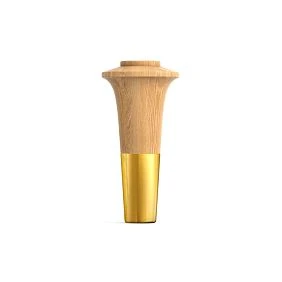
Example for a bedside nightstand
Suppose the body together with the top panel has a height of 420 mm.
The selected legs, once installed, provide an actual overhang of 150 mm.
Calculation:
420 + 150 = 570 mm.
The final height of the nightstand will be 570 mm.
If supports with a 200 mm extension are used, the result will be different:
420 + 200 = 620 mm.
The difference is 50 mm.
For a single interior, both solutions may be acceptable. But if the bed has a certain height and the nightstand is regularly used by a person in a lying position, this change needs to be assessed before purchase.
Get Consultation
Example for a TV stand
Let's take a cabinet with a height of 350 mm.
The supports create an actual vertical offset of 145 mm.
Then the total height will be:
350 + 145 = 495 mm.
If instead you use legs with a 250 mm offset, the cabinet will rise to:
350 + 250 = 600 mm.
The TV stand will become 105 mm taller.
If the TV is placed directly on its top panel, the screen will also rise by the corresponding amount. When the TV is wall-mounted, its height will remain the same, but the distance between the screen and the top surface of the furniture will decrease.
How the options differ for a single cabinet
Let's imagine a cabinet 400 mm high without legs. The table shows conventional installation options in which the actual support overhang corresponds to the specified value.
| Support offset | Cabinet height | Final height | Possible result |
|---|---|---|---|
| 80 мм | 400 мм | 480 мм | Low compact furniture |
| 120 мм | 400 мм | 520 мм | Moderate elevation above the floor |
| 150 мм | 400 мм | 550 мм | Prominent support section |
| 180 мм | 400 мм | 580 мм | Taller cabinet on legs |
| 250 мм | 400 мм | 650 мм | Legs become a substantial part of the silhouette |
The table does not set universal standards. It shows how much the same cabinet changes when legs of different heights are chosen.
The total leg height and its actual clearance are different dimensions
In the catalog of wooden supports, dimensional designations A, B, C and sometimes additional dimensions are indicated. But to calculate finished furniture, it is necessary to establish what part of the vertical space the leg occupies after installation.
For example, a leg may partially enter the base of the furniture. In this case, its total dimension is greater than the distance between the body and the floor.
In another design, a mounting plate is located between the leg and the body, and a glide is installed underneath.
If the leg is angled, the vertical projection may be less than its length along the axis.
Example with recessing
Let's assume the vertical dimension of the wooden leg is 180 mm.
The upper part is recessed into the mounting assembly by 15 mm, and the glide adds another 3 mm to the height of the installed structure.
With this conditional scheme:
180 − 15 + 3 = 168 mm.
Therefore, the actual extension will be 168 mm.
For a cabinet with a height of 410 mm:
410 + 168 = 578 mm.
If the craftsman had simply added the nominal leg height, he would have gotten 590 mm and been off by 12 mm.
This is an example of the calculation principle, not an installation diagram for a specific STAVROS model. The actual position of the support must be determined from the connection drawing.
How to account for the mounting plate
A different situation is possible here.
Suppose the leg creates a vertical extension of 145 mm, and the plate provided by the design increases the distance between the cabinet and the leg by 5 mm.
Then the total offset, if the dimensions refer to the same vertical axis, will be 150 mm.
But you must not add the plate thickness again if it is already included in the actual dimension obtained during the trial assembly.
For the final calculation, it is enough to determine once the distance from the lower base plane of the cabinet to the floor. All elements of the mounting assembly must be accounted for within this value.
Bedside table: first measure the bed
When choosing legs for a bedside table, the starting reference is not the standard height of a standalone piece of furniture, but the actual bed next to which it will stand.
It is necessary to measure the distance from the floor to the top surface of the mattress.
Moreover, it is useful to understand the difference between the height of an unloaded mattress and its position when a person is sitting on the bed.
A soft mattress can noticeably sink under body weight. Therefore, an exact geometric match between the top surface of the bedside table and the unloaded mattress does not always mean convenience.
Let's imagine a bed where the top of the mattress is at a height of 610 mm from the floor.
For a specific project, after fitting, it was decided to position the top of the bedside table at 590 mm.
If the cabinet body has a height of 440 mm, the required leg extension is:
590 − 440 = 150 mm.
Now the choice of legs can be made based on a clear dimensional requirement.
There is no need to look for "the most beautiful model with a height from 100 to 250 mm." You need to select a product that, with the chosen mounting, provides an overhang of about 150 mm.
Should the nightstand be strictly level with the mattress?
No. This is a possible guideline, but not a universal rule.
In some projects, the top surface of the nightstand is positioned slightly below the mattress; in others, at a comparable height or higher.
The choice depends on how the person uses the furniture, where the bed is located, how wide the nightstand is, and what items are placed on it.
For example, if a phone and glasses are usually placed on the surface, a comfortable hand movement area is important.
If a tall lamp is used, its dimensions and the position of the switch are also taken into account.
If the nightstand is positioned deeper relative to the headboard, access to it may be inconvenient even at the correct height.
Therefore, it is best to verify the final decision directly next to the bed.
How to do a simple fitting
Measure the current mattress height and the intended level of the nightstand's top surface.
Then temporarily mark the desired height on the wall or use a stable mockup.
Check whether a person can comfortably reach the imagined top surface from a normal position on the bed.
It is important to consider not only the arm but also the distance between the bed and the furniture.
If the nightstand is placed too far away, a perfectly chosen height will not compensate for the inconvenient location.
How the legs affect the top drawer of a bedside table
Tall wooden supports raise the body along with all its internal elements.
This can be especially noticeable with a compact bedside table.
If the top drawer previously opened at a convenient height, after installing taller legs its handle will also be raised.
Let's look at a conditional example.
The body height is 420 mm. The center of the top drawer handle is located 100 mm below the top surface.
With an actual leg overhang of 120 mm, the final height of the bedside table will be:
420 + 120 = 540 mm.
Handle position above the floor:
540 − 100 = 440 mm.
Now let's increase the support overhang to 200 mm.
Final height:
420 + 200 = 620 mm.
The handle will be at the level of:
620 − 100 = 520 mm.
It will rise by 80 mm.
In a standing position, such a change may be perceived as unremarkable. But for a person who opens the drawer while sitting or lying on the bed, the handle position will already be different.
Why you should check more than just the handle
Ease of access to the drawer also depends on its depth.
You can easily grab the handle, but feel discomfort when taking things out from the far part of the open compartment.
Therefore, for a bedside table, it is advisable to check three situations at once: placing an object on the top surface, opening the top drawer, and reaching for an item from its depth.
This approach helps to select the height of the supports based on real use, rather than a single dimension on a drawing.
Low legs for a bedside table: when they are appropriate
A low wooden support lifts the body only slightly off the floor. The bedside table looks neat, compact, and relatively solid.
This can be a good solution when the bed is low or the table body itself is tall enough.
For example, the top of the mattress is at 530 mm, while the cabinet body is 450 mm high.
To bring the top surface to 520 mm, an overhang is required:
520 − 450 = 70 mm.
Legs with an actual overhang of 180 mm in such a situation will result in a final height of 630 mm and will noticeably raise the furniture relative to the bed.
Without modifying the body, this option may not suit the task.
When low legs are preferable
A small overhang is useful when the designer wants to preserve the dominance of the body.
If the nightstand already has a pronounced texture, decorative frames, or a large handle, a tall sculpted leg may create an unnecessary accent.
For some classic projects, a low carved support allows the lower part of the furniture to be styled without radically changing its proportions.
But low legs have a practical limitation: the space under the cabinet becomes less accessible for cleaning.
Therefore, the decision on height should take into account not only appearance.
Tall legs for a bedside nightstand: a light silhouette with limitations
High legs more noticeably separate the cabinet from the floor.
Against the wall, open space appears under the furniture, and even a small item visually becomes lighter.
For a cabinet with smooth fronts, such a support section can turn out to be the main decorative element.
But at the same time, the overall height increases.
If a 430 mm high cabinet is placed on legs with an actual overhang of 250 mm, the top surface will be at a level of 680 mm.
If the mattress is positioned at a height of 560 mm, the difference will be 120 mm.
For a specific user, this may turn out to be inconvenient.
Therefore, it is wiser to choose tall supports either for a relatively low cabinet or for a project in which a high bedside surface is planned from the outset.
One should not compensate for inconvenience with external form alone
Sometimes a designer likes a long, thin leg that looks striking in an image.
But if it makes the bedside table too tall, the solution does not become successful thanks to beautiful proportions.
Three paths are possible: change the height of the cabinet, choose a different support size, or agree on a different position for the top surface.
The choice should be made before the furniture is manufactured.
TV stand: the legs are part of the composition of the entire TV area
For a TV stand, not only its own silhouette matters.
It is perceived simultaneously with the TV, the wall, decorative panels, speakers, and other elements of the room.
If the TV area is built on a long horizontal line, excessively tall legs can change the entire visual balance.
Let's imagine a cabinet 1800 mm long and 320 mm high.
With an actual leg overhang of 100 mm, the total height is 420 mm.
If you install legs with a 250 mm extension, the result will be:
320 + 250 = 570 mm.
The difference is 150 mm.
In the first option, the TV stand remains a low horizontal volume. In the second, the cabinet rises noticeably above the floor, and the legs begin to occupy a significant portion of the furniture's total height.
Both solutions are possible. But they create different compositions.
If the TV stands on a cabinet
In this case, the height of the legs directly affects the position of the TV.
The screen is mounted on its own stand, which rests on the top panel of the furniture.
Consequently, raising the cabinet by 80 mm will raise the TV by approximately the same 80 mm, with the stand unchanged.
Before choosing the legs, you should check the final position of the screen relative to the viewer's usual position.
You should not set a single universal TV height for all rooms: it depends on the screen size, viewing distance, seat height, and the person's usual posture.
If the TV is mounted on the wall
With wall mounting, changing the height of the TV stand does not raise the TV itself.
But it reduces or increases the distance between the screen and the furniture.
For example, the bottom edge of the TV is at a height of 700 mm from the floor.
The original top surface of the TV stand is 450 mm.
There remains 250 mm between them.
If you replace the legs and raise the furniture to 550 mm, the distance will be reduced to 150 mm.
This may change the proportion of the entire TV area, although the screen itself will remain at the same height.
Therefore, with a wall-mounted TV, the calculation of the legs is primarily related to the overall composition and placement of the equipment.
What to measure in the TV area before buying legs
Start with the actual position of the TV.
If the screen is mounted on the wall, measure the distance to its bottom edge and to the intended top surface of the TV stand.
If the TV is placed on furniture, check the overall height of the screen together with the stand.
Then evaluate the equipment.
This could be a game console, receiver, media player, amplifier, or soundbar.
Each device may require a certain amount of free space, as well as access to cables and ventilation openings.
Legs alone do not solve the problem of equipment ventilation.
If an electronic device is located inside a closed compartment, it is necessary to ensure the cooling conditions specified by its manufacturer. A large gap under the cabinet does not compensate for the lack of ventilation inside the enclosure.
Example of coordinating furniture and screen
Let's say the TV is mounted on the wall, and its bottom edge is at 720 mm from the floor.
The designer wants to leave 190 mm between the screen and the cabinet.
Therefore, the top surface of the cabinet should be at a height of:
720 − 190 = 530 mm.
If the cabinet height is 380 mm, the required actual leg extension is:
530 − 380 = 150 mm.
This is already a specific task for selecting legs.
If the selected model adds 220 mm, the top of the cabinet will be at a height of 600 mm, and the distance to the screen will be reduced to 120 mm.
The feasibility of such a solution must be assessed based on the composition and the actual dimensions of the equipment.
Clearance under a TV stand: how much space is actually needed
Tall legs allow more of the floor under the cabinet to be visible and can make cleaning easier.
But the correct clearance size cannot be determined solely by the height of the selected model.
It is necessary to measure the distance from the floor to the lowest part of the furniture, including protruding elements of the base.
For example, the legs raise the mounting plane of the cabinet by 160 mm.
However, the lower band of the cabinet protrudes downward by another 30 mm.
Actual clearance under this rail:
160 − 30 = 130 mm.
If the lower part of the cabinet has an uneven geometry, the available space may also vary in width.
Therefore, it is useful to indicate the minimum free passage on the drawing.
High clearance and visual perception
When a noticeable free space forms between the floor and the cabinet, the unit is perceived as lighter.
But at the same time, cables, sockets, and rear mounting elements may become visible.
Sometimes a low support section better conceals the technical space.
This is especially relevant for a TV stand with a large amount of equipment.
Low clearance
Low legs help maintain a calm horizontal line of the furniture.
However, the space under the cabinet may be difficult to access for cleaning.
If the cabinet is placed flush against the wall and has a long body, dusting the middle part underneath it can be difficult.
Therefore, ease of maintenance is best assessed during the design stage.
How to choose legs for a robot vacuum
If a robot vacuum needs to pass under the cabinet, use the specifications of the specific device.
Different models vary in body height, protruding sensors, and clearance requirements.
Besides height, the width of the entry under the furniture, the position of the legs, and the device's ability to move also matter.
The correct calculation sequence:
Maximum robot height + clearance required for operation = required free clearance.
The clearance is chosen based on the device manufacturer's recommendations and actual operating conditions, not a single universal standard.
Calculation example
Suppose the height of the robot vacuum cleaner, including protruding parts, is 105 mm.
For the specific conditions, it was decided to allow an additional 15 mm of free space.
Required clearance:
105 + 15 = 120 mm.
Now let's check the TV stand.
Its supports provide an actual overhang of 150 mm, and the lower rail protrudes by 32 mm.
We get:
150 − 32 = 118 mm.
The 120 mm requirement is not met.
It falls short by only 2 mm, but this cannot be ignored if the device really must fit under the furniture.
At the same time, increasing the height of the supports affects the position of the entire cabinet. Therefore, the solution must also be coordinated with the requirements of the TV area.
When two requirements contradict each other
Let's assume the design height of the TV cabinet body is 370 mm.
Based on the wall composition, the maximum height of its top surface should be 500 mm.
Then the actual overhang of the supports must not exceed:
500 − 370 = 130 mm.
However, beneath the cabinet there is a downward-protruding plinth 32 mm high. The robot requires a clearance of 120 mm.
The minimum leg extension must be:
120 + 32 = 152 mm.
This creates a contradiction:
-
the total height of the cabinet allows no more than 130 mm;
-
the robot needs at least 152 mm to pass underneath.
The difference is 22 mm.
Here, both requirements cannot be met simultaneously by simply swapping one model of wooden legs for another.
It will be necessary to change the height of the cabinet, the lower plinth, the compositional distance to the TV, or to abandon the requirement for the robot to pass under the furniture.
This calculation allows you to identify the problem before cutting and ordering components.
Cables and sockets: what changes when installing high legs
On a TV stand, wires are often located under or behind the cabinet.
When the cabinet is close to the floor, some of the cables may be hidden behind the bottom panel.
If you raise the TV stand on tall supports, they become more noticeable.
Moreover, cables may run not only to the TV but also to speakers, set-top boxes, a router, and other devices.
This affects the visual neatness of the entire composition.
What to consider before ordering legs
Determine the position of outlets and cable exits.
Check where the power and signal cables will run, how they will enter the cabinet, and whether the equipment can be serviced after installation.
If the legs create a large open gap, it makes sense to provide appropriate design solutions for neat cable routing.
At the same time, cables must not be laid in such a way that they are pinched by supports, mounting elements, or moving parts of the furniture.
For equipment with ventilation openings, the space specified by the manufacturer is maintained.
Why ventilation cannot be calculated based on leg height alone
Sometimes it seems that a tall gap under the cabinet automatically solves the issue of cooling all the equipment.
This is incorrect.
If a game console is placed inside a closed compartment, the temperature inside that compartment depends on heat dissipation from the niche itself.
The air space under the furniture may not help at all if there is no intended air exchange path between it and the equipment.
Therefore, ventilation issues are solved by the design of the compartment, not just by the height of the wooden supports.
Long TV stand: are four wooden legs enough?
For a compact bedside table, a scheme with four supports is often quite obvious.
For long television furniture, the question is more complex.
Let's imagine a TV stand 1900 mm long.
The designer chose four neat wooden legs and placed them near the corners of the cabinet.
Visually, the solution looks complete. But a significant section of the base remains between the support zones.
Its ability to withstand load depends on the thickness and material of the parts, internal partitions, rigidity of the joints, placement of equipment, and other parameters.
Therefore, it cannot be claimed that four supports automatically suit any cabinet simply because each individual leg is made of solid oak.
What to check in a long base
The designer evaluates:
-
the length of spans between supporting elements;
-
the thickness and material of the bottom panel;
-
the presence of partitions and reinforcing parts;
-
the weight of equipment and contents;
-
position of the legs;
-
the strength of connections;
-
possible lateral forces during use.
In some cases, the design provides for an additional central support or a frame base.
But assigning a fifth leg based on a universal cabinet length is also incorrect. A check of the specific design is required.
The central support must not interfere with use
If an additional leg is introduced into the design, its position relative to the lower part of the cabinet, cables, and the intended cleaning area must be checked.
The central element may reduce the robot vacuum's clearance or become noticeable in the open space under the furniture.
These consequences must be taken into account during design.
Cross-section size: why the same height does not mean the same result
Let's imagine two wooden supports 180 mm high.
The first has a cross-sectional size of 60 × 60 mm.
The second has 150 × 150 mm.
Vertically, they occupy comparable space, but visually they are perceived completely differently.
The first model may look comparatively slim and light. The second becomes a pronounced geometric base.
On a small cabinet, the contrast is especially noticeable.
Example of a compact bedside table
For example, the width of the nightstand is 450 mm.
A 60 mm wide support occupies along this direction:
60 / 450 × 100 ≈ 13.3% of the cabinet width.
For a 150 mm wide support:
150 / 450 × 100 ≈ 33,3%.
This is not a proportioning standard, but a comparative calculation.
It helps to understand how prominent a place the support occupies in the composition.
But the visual result also depends on the shape: a tapered leg with a wide top and a square support of constant cross-section are perceived differently.
Why a wide support does not always look heavier
Relief, bevels, tapers, and light-and-shadow can change visual perception.
Therefore, a large overall dimension does not necessarily mean a massive silhouette along the entire height.
For example, a beveled profile may take up a lot of space at the top but narrow noticeably toward the floor.
That is why when choosing a leg for a cabinet, you should look not only at a single numerical width value but also at the entire drawing.
Real STAVROS wooden leg models: what to compare
For practical selection, several models from the manufacturer's catalog can be considered.
They differ in shape and dimensional versions, so they are suitable for comparing design solutions.
| Model | Type | Example dimensions from the catalog | The main question when selecting |
|---|---|---|---|
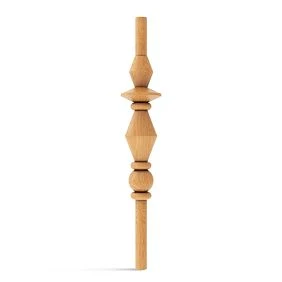
| MN-146 | Four-sided geometric | 80 × 60, 120 × 60, 180 × 60 mm | Which size will create the required overhang |
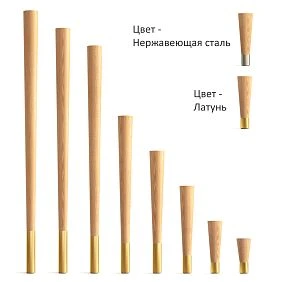
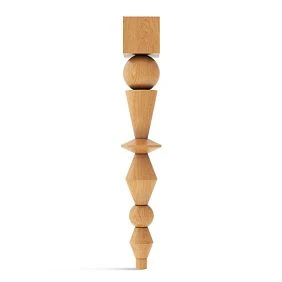
| MN-227 | Geometric | 145 × 70 × 70 mm | Compatibility with the lower area of the cabinet |
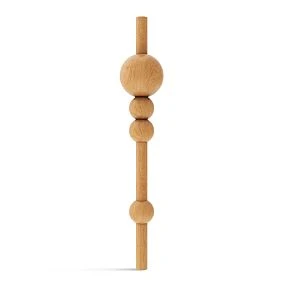
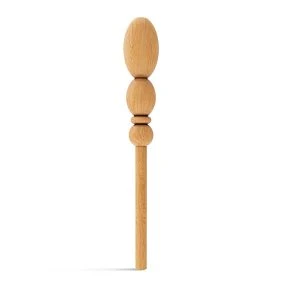
| MN-145 | Turned | 100 × 44, 150 × 44, 200 × 44 mm | Application limitations and mounting option |
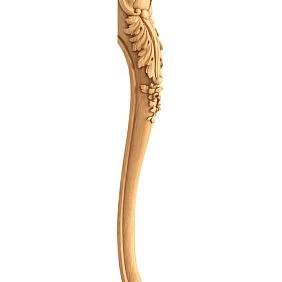
| MN-006 | Carved | 120 × 63 and 160 × 84 mm | Relief, installation and visual scale |
Dimensions are given in the designations of the respective product cards. Before ordering, be sure to review the drawings: different models may use different letter designations for dimensions.
For MN-145, the manufacturer separately specifies use for relatively light loads. Long versions of this model should not automatically be assigned to heavy TV furniture.
MN-146 offers various height options, and the product card provides recommendations for mounting hardware. However, the possibility of using a specific support also depends on the furniture body itself.
MN-146: one geometry for different heights
This model is available in several size versions.
As a result, the furniture maker can choose a similar silhouette for different cabinets while maintaining the overall character of the supports.
For example, a bedside table may require one actual offset, while a TV stand may require another.
But one must not confuse a matching model designation with an identical size.
The selected version must be recorded in full in the specification.
MN-227: when a compact geometric shape matters
A model measuring 145 × 70 × 70 mm can be considered one of the candidates for a furniture project that needs a pronounced but relatively compact geometric support.
Before purchasing, it is necessary to check the shape of the mounting part and the position of the leg relative to the front.
For a narrow bedside table, it is especially important whether the support ends up too close to the outer edge.
MN-145: a slender turned silhouette
This model has a distinctive turned shape and a relatively small cross-section.
It can look light against a smooth cabinet body.
But a slim visual silhouette does not mean universal load-bearing suitability.
It is necessary to take into account the manufacturer's recommendations for use and type of mounting, especially if the support is intended to be installed at an angle.
MN-006: expressive carved shape
A carved support can become a standalone decorative element.
For a classic bedside cabinet, such an accent is sometimes quite justified.
But in a complex composition with carved fronts, moldings, and decorative handles, an overly active leg can overload the lower part.
Before purchasing, it is useful to assess the actual scale of the ornament on the body.
Where exactly to place the legs under the cabinet body
The height of the leg determines the vertical position of the furniture, but the installation points affect its base and external silhouette.
For each model, it is necessary to check the dimensions and location of the mounting plate.
If the supports are shifted too far inward relative to the cabinet body, the support contour may change and the overhang of the bottom panel beyond the support points may increase.
If the legs are placed too close to the edge, there may not be enough room for the fasteners.
The exact position is specified in the working drawing.
For a bedside table
On a compact body, the mounting area may be limited by the bottom drawer, side panels, or internal joints.
A large leg may not fit under a narrow cabinet without modifying its base.
If the item is placed directly next to the bed, the full outer contour of the support must also be taken into account.
An angled leg may protrude toward the bed or the walkway.
For a TV cabinet
In a long cabinet body, the distances between the support points and the rigidity of the lower part are critical.
In addition, the legs may block the intended path of a robot vacuum or interfere with cable routing.
Therefore, installation coordinates should be coordinated together with the base structure and equipment layout.
Angled legs: why you need to calculate the outward offset
If a leg is installed at an angle, you need to account not only for its length, but also for the position of the point of contact with the floor.
Let's look at a simplified geometric model.
Let the length along the axis of a straight support be 180 mm, and the tilt be 8 degrees from vertical.
Vertical projection:
180 × cos 8° ≈ 178.2 mm.
Horizontal projection:
180 × sin 8° ≈ 25.1 mm.
This is an abstract example. A real furniture leg may have a complex shape, and the mounting plate and the lowest point of contact may not lie on the same straight line.
But the calculation shows why an angled support can increase the overall dimensions of furniture.
If the cabinet stands in a niche, even a small additional protrusion can become critical.
For a bedside cabinet, the direction of the tilt relative to the walkway must be checked separately.
One should not assume that any straight leg can simply be installed at an angle: the mounting method must allow for such installation.
Turned, carved, or geometric legs for the cabinet
After calculating the height and mounting area, you can choose the decorative shape.
Turned legs
Turned wooden supports are often used for classic, neoclassical, and custom furniture.
Their silhouette is formed by smooth transitions and changes in diameter.
On a bedside cabinet, a turned leg can support the lines of the bed and other bedroom furniture.
For a TV cabinet, this option is appropriate if the overall interior and construction truly suggest such a profile.
But you cannot choose a turned leg based only on style, ignoring load limitations.
Carved legs
carved furniture legs create a more active decorative lower part of the furniture.
On a bedside table, they can become part of a classic composition, especially if the body has moldings, carved overlays, or shaped fronts.
However, it is necessary to evaluate the relationship between the ornament and the dimensions of the body.
If the table is relatively small, a large carved leg may visually dominate.
Geometric legs
geometric wooden legs are suitable for furniture with clear straight lines.
They can be appropriate both for a modern bedside table and for a long TV stand.
But the same shape will be perceived differently on bodies of different widths.
For a large item, one should separately pro
Unpainted legs or items with a finished coating
unpainted wooden legs useful when a furniture workshop plans its own finishing.
This is especially convenient when making custom furniture to an approved color.
You can do a test paint on one leg at the same time as a facade sample.
If the result is suitable, the remaining parts are painted using a single technology.
furniture legs with a ready-made coating can reduce the number of operations.
But before ordering a set, check the shade, degree of gloss, and matching with existing furniture.
Do not approve the color based on a screen
The same paint can be perceived differently on a monitor and on the actual product.
In addition, natural wood has its own texture and shade.
Therefore, for an exact match, it is preferable to use a physical sample.
Especially if two bedside tables must be identical and stand on opposite sides of the same bed.
Two bedside tables: how to achieve the same height
If the bedroom includes two identical tables, it is necessary to check not only each one separately, but also the entire pair.
Even a slight difference in the height of the tabletops can be noticeable against the overall line of the bed.
For example, the left table has a body height of 430 mm, the right one — 435 mm.
If both are placed on legs with the same actual offset of 150 mm, the result will be:
Left: 430 + 150 = 580 mm.
Right: 435 + 150 = 585 mm.
The difference is 5 mm.
Depending on the placement of the furniture and the lighting, it can be noticeable, especially when the top surfaces are near the same horizontal line.
If an exact match is required, the issue must be resolved in the design of the cabinet or through coordinated adjustment of the mounting unit, rather than by randomly trimming the decorative legs.
What to check when making a pair
It is useful to agree in advance on the overall height, the size of the cabinets, the design of the supports, and the material and finish.
If one cabinet stands on a carpet and the other on a hard floor, their position should be measured under real conditions.
Glides and possible adjustment are also important.
However, the height must be adjusted within the limits of the provided design, without compromising the strength of the joints.
When the cabinet is already made: reverse calculation of the legs
For finished furniture, the task changes.
The height of the body is already fixed. Therefore, it is necessary to determine the allowable range of supports based on the desired final height.
Maximum leg extension = maximum allowable final height − height of the existing body.
Example of a bedside table
The finished body has a height of 470 mm.
After testing it next to the bed, the owner set the desired nightstand height to 590 mm.
Then the required extension:
590 − 470 = 120 mm.
If the selected model provides 180 mm, the final height will be 650 mm and will exceed the design value by 60 mm.
Without modifying the cabinet, this option may turn out to be unsuitable.
TV stand example
A cabinet with a height of 390 mm has already been manufactured.
The designer wants to keep the top surface no higher than 520 mm.
Permissible extension:
520 − 390 = 130 mm.
But for the selected robot vacuum and the lower stretcher design, a minimum of 145 mm is required.
Here, both conditions cannot be met simultaneously without changing the design.
It is necessary to reconsider the lower structure, the furniture height, or the clearance requirements for cleaning.
What is especially important when remodeling an old TV stand
If the furniture originally stood on a solid plinth, removing this plinth changes the nature of its support.
You cannot simply screw four new wooden legs to the existing bottom panel and assume that the structure will retain its former rigidity.
It is necessary to check the material of the bottom panel, the connections to the side panels, and the need for a reinforcing frame.
For a long TV stand, this is especially important.
Full-size template: how to check proportions before buying
A catalog photo does not always allow you to correctly assess the scale of a leg.
In a separate image, a large support may appear compact because there are no real objects nearby for comparison.
Therefore, before purchasing, it is useful to make a contour template.
Cut out the silhouette of the support from thick cardboard at full size.
Indicate its vertical dimension, the width of the top and bottom sections, and, if the shape is angled, the corresponding outward offset.
Place the template against the bottom part of the TV stand.
Evaluate the composition from the front and the side.
For a bedside table, also look at the result next to the bed.
For a TV stand, step back to the usual TV viewing distance and evaluate the entire horizontal silhouette of the furniture.
What cannot be checked with a cardboard outline
The template helps evaluate scale, but it does not replace a technical drawing.
It cannot be used to reliably judge the strength of the joint, the mounting contact area, or the permissible load.
These parameters are checked separately.
One trial leg before the set
If a workshop is choosing a new model, especially a large or expensive one, it is useful to first purchase one unit if the sales terms allow it.
This helps evaluate the actual geometry of the item and avoid a mistake when ordering the set.
The resulting leg can be attached to the cabinet, the mounting point checked, dimensions measured, and a test finish applied.
For a custom cabinet, such a check sometimes proves decisive.
For example, a leg looks great on a drawing, but after fitting it turns out that its wide upper part does not fit between the side panel and the internal reinforcement.
In that case, it is better to change the choice before manufacturing additional parts.
However, a single test support does not replace testing the entire furniture for stability.
For a full check of the structure, a safely assembled support unit or set is needed according to the working design.
How to document wooden legs in the production specification
For a small furniture workshop, the entry “wooden legs — four pieces” is too vague.
It does not allow unambiguous repeat purchasing and completeness verification.
It is better to record the full set of parameters.
| Field | What to record |
|---|---|
| Product | Bedside or TV cabinet, project number |
| Position | Support designation |
| Manufacturer | STAVROS |
| Article number | Exact model |
| Size | All required dimensions |
| Material | Beech or oak |
| Finish | Surface preparation and coating |
| Quantity | Depending on the specific cabinet design |
| Installation | Mounting type and drawing reference |
| Thrust bearing | If provided by the project |
| Body height | From the agreed base plane |
| Actual projection | After installation |
| Final height | Calculated value |
| Product link | Clean product page URL |
For a pair of bedside tables, it is convenient to specify the quantity for the entire project at once, and then distribute the resulting parts between the two sets.
If the TV cabinet has an additional central support, it must also be included in the schedule.
Why it is worth keeping the approved model
A few months later, the client may ask for a second identical table.
If the item code, size, material, and mounting diagram are preserved, repeating the order becomes much easier.
But natural wood from different batches may differ in shade, so with a clear finish it is advisable to keep the approved color sample as well.
What mistakes most often occur when selecting legs for a nightstand
Choosing based only on a photo. The leg looks good, but it does not fit in height or mounting plate. Before buying, you need to study the drawing.
Ignoring bed height. After installing new supports, the bedside table turns out to be inconvenient. It is necessary to check the top surface relative to the mattress and the person's usual position.
Incorrect assessment of the TV zone. Tall legs change the position of the TV if it stands on the cabinet, or reduce the distance to the wall-mounted screen. The entire composition needs to be checked.
Calculating floor clearance based on the nominal height. The lower rail reduces the actual free space. The lowest part of the body must be measured.
Overlooked cables. After raising the TV furniture, wires and extension cords become visible. Their placement must be planned in advance.
Four supports without checking the long body. For a TV stand of considerable length, the rigidity of the base and load distribution must be assessed.
Unsuitable fasteners. The mounting plate may not match the bottom structure. The connection is selected according to the drawing, not by the external similarity of the legs.
Mixing dimensional versions. One model is produced in several heights. A full specification is required for ordering.
Substituting aesthetic appeal for structural calculation. A thin leg is not necessarily weak, and a solid oak one does not guarantee sufficient strength for the entire piece of furniture. Suitability is confirmed by the design and by checking the joints.
Where to buy wooden legs for a bedside and TV stand
For selection, you can use STAVROS wooden furniture leg catalog.
If you need to buy legs for a cabinet, first determine the type of furniture and its design height.
For a bedside cabinet, the main reference point will be the convenient position of the top surface next to the bed.
For a TV cabinet — alignment with the overall TV area, the required clearance, equipment placement specifics, and base strength.
After calculation, choose geometric, turned, or carved models with suitable dimensions.
If you need furniture in a custom color, consider unfinished versions made of beech or oak. If the factory finish matches the project, you can choose items with a ready-made coating.
When ordering a set, it is useful to check in advance the number of supports, mounting compatibility, glides, and whether a sample is needed.
When placing an order, check the current price, lead times, and availability of the required size option.
Available for furniture manufacturers STAVROS cooperation terms, and the order receipt procedure is described in the section payment and delivery.
If the task is performed correctly, the new support part will not disrupt the furniture height and will match its construction.
The bedside table will remain convenient next to the bed, and the TV stand will maintain its intended position relative to the screen and equipment.
You need to choose not just a beautiful wooden leg, but a specific version that creates the required actual overhang and fits the mounting unit.
Frequently asked questions about wooden legs for a nightstand
Can a nightstand be lower than the mattress?
Yes. This is acceptable if it is convenient for the person to use the top surface and the drawers. There is no universal requirement to install a nightstand strictly level with the mattress.
Can tall legs be installed on an already finished nightstand?
Yes, if the construction allows such mounting and the final height remains convenient. Before purchasing, measure the body, determine the required overhang, and check the strength of the lower mounting part.
Will the TV rise if the legs of the TV stand are replaced?
If the TV stands on the TV stand, its position will change along with the height of the furniture. If the TV is mounted on the wall, the screen height will remain the same, but the distance between it and the TV stand will change.
How many legs should a long TV cabinet have?
The number depends on the design of the body, the spans, the internal partitions, and the loads. Four supports are not a universal solution for any long item.
Can legs be chosen by height only?
No. It is also necessary to check the cross-section, the mounting area, the fastening, the tilt, and the actual vertical projection after installation.
What should I do if the nightstand has a protruding lower stretcher?
The downward protrusion of the rail must be taken into account from the actual overhang of the support. It is the remaining free distance that determines the clearance under the furniture.
Are the same legs suitable for two bedside nightstands?
Yes, if the bodies and mounting assemblies are compatible with each other. For a symmetrical pair, it is advisable to check that the final height and finish match.
What should I do if the new nightstand stands on a carpet?
The stability and position of furniture should be assessed under real operating conditions. A soft covering can affect the support, so it is useful to confirm the design height after installation. If necessary, use the adjustment means provided by the design.
Can oak legs be used with an MDF body?
Yes, if a compatible and sufficiently strong connection is made. The body material does not have to match the material of the supports. However, the fastening structure must be developed taking into account the properties of the base.
Should you buy one leg as a sample?
This is useful for custom furniture, complex fastening, or expensive finishes. A sample allows you to check the actual dimensions and finish before purchasing a set.
Which legs are best for a modern TV stand?
Geometric or minimalist turned models are often considered, but the final choice depends on the scale of the body, the mounting structure, and the design height.
Where can you choose wooden legs for a solid wood stand?
In the STAVROS catalog, you can compare different shapes and size options in beech and oak. Before ordering, check the drawing, material, fastening, and whether the support matches the specific bedside or TV stand.