Article Contents:
- Short answer: when to choose a wooden pull handle
- What is a pull handle and why is it convenient
- Where to use wooden pull handles
- For a Wardrobe
- For a Dresser
- For Kitchen
- For a side table
- For the sideboard and display case
- How to choose the size of a pull handle
- Center-to-center distance: what to check before buying
- Wooden pull handle or knob: which to choose
- How to choose the shape of a wooden pull handle
- Pull handles for classic furniture
- Kitchen pull handles
- How to update furniture with wooden pull handles
- How to combine pull handles with other decor
- Wooden fittings: about quality you can feel with your hands
- Mistakes when choosing a wooden pull handle
- What to buy together with wooden pull handles
- FAQ: questions about wooden pull handles
- About the Company STAVROS

There are details that completely change the perception of furniture. Not the body, not the facade, not the color — but what you touch every day. The handle. It is the first thing that meets your hand, it creates the tactile impression of furniture — warm or cold, soft or sharp, expensive or random.
wooden hook handle — this is not just hardware. It is the touch of wood every time you open a cabinet, dresser, or kitchen drawer. The warm texture of solid wood, pleasant weight, a visual detail that emphasizes the style of furniture — all in one element. And with the right choice, it is the wooden bracket that makes furniture whole and the interior complete.
This article is for those who want to understand: what is the difference between a bracket and a knob, how to choose the right size, how not to make a mistake with the center-to-center distance, for which facades a wooden bracket works best — and how to combine it with legs, overlays, and other wooden decor.
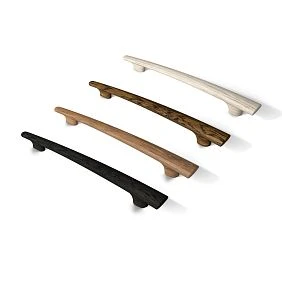
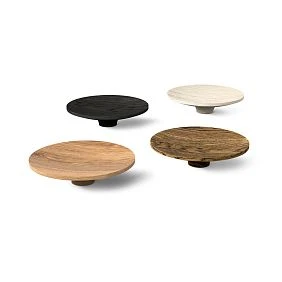
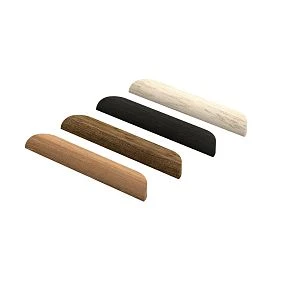
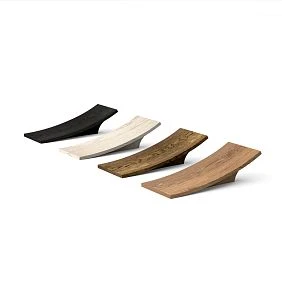
Short answer: when it's better to choose a wooden bracket handle
There are situations where the bracket is exactly the right answer. Here they are:
-
For cabinets with tall and heavy fronts — the bracket provides a comfortable grip with the whole hand, unlike a knob.
-
For kitchen fronts — in the kitchen, handles are opened dozens of times a day, and the bracket is significantly more ergonomic than a small knob.
-
For wide dresser drawers — the bracket visually balances the large front and provides a convenient pulling motion.
-
When the front is heavy — the bracket distributes the load across two attachment points, which is more reliable than the single point of a knob.
-
For updating furniture without replacing the body — replacing handles with wooden brackets radically changes the furniture's appearance.
-
When the handle should fit into a wooden decor system — to match with wooden legs, overlays, trim, and cornices.
This is a quick navigator. Next — everything in order.




What is a bracket handle and why is it convenient
Let's start with a definition, because confusion occurs even among those who work with furniture professionally.
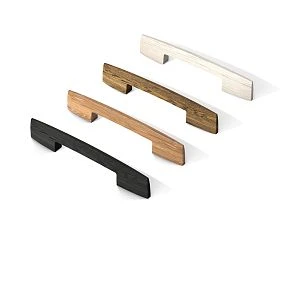
Wooden bracket handle — is a furniture handle that attaches to the facade at two points. Between the attachment points there is a bridge (an arc, a straight bar, or a shaped element) that the hand grips. Two fixation points give the handle stability, evenly distribute the load on the facade, and eliminate play during years of use.
How does a wooden bracket fundamentally differ from a metal one? First of all — in material and feel. Metal is cold, wood is warm. Literally: a metal handle on a cold morning in the kitchen is an unpleasant contact. A wooden bracket is tactilely soft, neutral in temperature, pleasant to the touch. This is not an emotional exaggeration — it's the physics of materials.
The second difference is visual. Wooden handle creates a warmer, softer, and more organic look than metal. It fits naturally into classic, country, Scandinavian, and nature-inspired interiors — effortlessly.
Third — compatibility with other wooden decor. wooden furniture handles made from the same species as legs, overlays, and trims — it's a unified system where each element contributes to the overall result.
Our factory also produces:
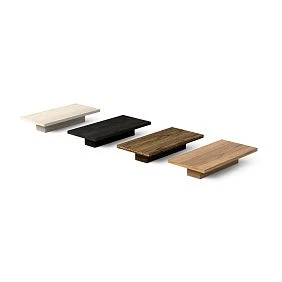
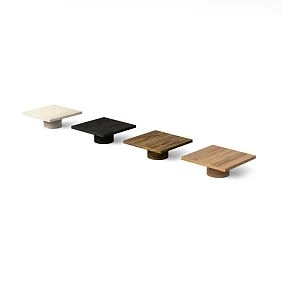
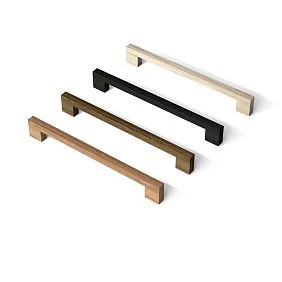
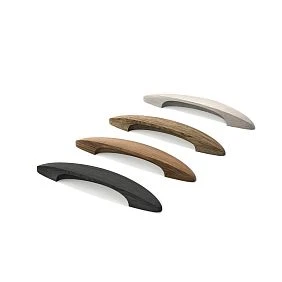
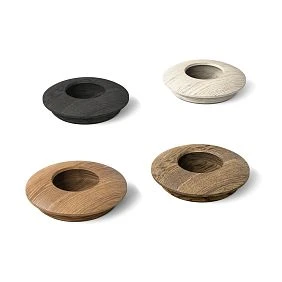
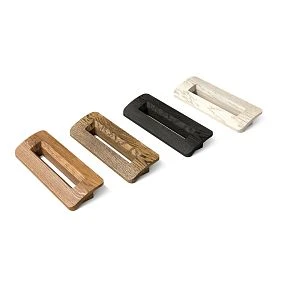
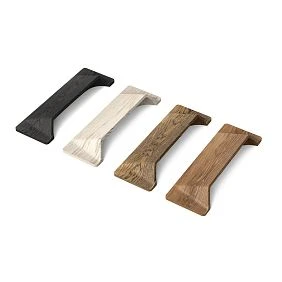
Where to use wooden bracket handles
Get Consultation
For a cabinet
A cabinet is large furniture with tall and often heavy facades. Such doors need a handle that is comfortable to grip without extra effort. furniture handle In bracket format, the functional priority is here.
On a tall cabinet front, the bracket is placed vertically — creating a visual vertical line that further elongates the front, making it slimmer. This is a subtle design trick that works even in a standard interior.
For a sliding wardrobe with overlay panels or a hinged wardrobe in a classic style, a wooden bracket looks significantly more expressive and organic than faceless metal hardware. If the kitchen and bedroom are in the same style, the handles should be unified in spirit.
For a chest of drawers
A chest of drawers is a horizontal row of drawers. Each drawer has its own front, and the handle on it is part of the rhythmic pattern of the entire piece. Place wooden brackets on all drawers in the same style — and the chest of drawers will transform from a set of rectangles into a cohesive, architecturally thought-out item.
Symmetry is especially important for a chest of drawers: handles should be placed strictly in the center of each drawer, at the same horizontal level. A slight shift — and the entire order is disrupted.
Bracket width for a chest of drawers drawer: for small drawers (width up to 40 cm) — a bracket with a center distance of 64–96 mm. For wide drawers (50–80 cm) — 96–128 mm. For very wide drawers — two brackets symmetrically are acceptable, without a single central one.
For Kitchen
The kitchen is the area of most intensive handle use. Cabinets are opened 15–20 times a day. They are pulled with wet hands, greasy after cooking, sometimes with force. Here, the handle should primarily be ergonomic and easy to maintain.
buy wooden handles For the kitchen — means choosing models with a coating that is resistant to moisture and dirt: varnish, oil-wax, or enamel. Do not leave a wooden bracket uncoated in the kitchen — the wood will absorb grease and darken within a few months.
On classic and neoclassical kitchen fronts, a wooden bracket works particularly well: it supports the organic style, echoes the wooden layout for furniture fronts and creates a cohesive interior look.
For a side table
Bedside table, TV stand, bathroom cabinet — items with small facades. Here, the bracket should be neat, not overwhelming the facade. A short bracket with a center-to-center distance of 32–64 mm is the optimal choice for cabinets.
A wooden bracket looks especially good on bedside tables in the bedroom: the warm texture of wood is aesthetically and tactilely appropriate here. If the bed has wooden elements — headboard, legs — a bracket in the same tone completes the ensemble.
For the sideboard and display cabinet
A buffet is one of the most "handle-intensive" items: several doors, several drawers, facades with glass. Here, wooden brackets from classic furniture should follow a unified style line across all facades.
For display cabinets with glass doors, the bracket is placed horizontally or vertically — depending on the facade's proportions. It is important that it does not cover the glass or disrupt the symmetry of the glass inserts.
How to choose the size of a handle bracket
Size is not just about proportion. It also involves convenience, load, and visual weight on the facade.
Dependence on facade width. A small bracket on a large kitchen door 60 cm wide is like a tie on an overly wide jacket. It gets lost, doesn't create an accent, and looks random. A bracket that is too long on a small cabinet drawer overwhelms the facade and looks absurd.
Approximate guidelines:
-
Facade up to 30 cm wide — bracket with center distance 32–64 mm
-
Facade 30–50 cm — 64–96 mm
-
Facade 50–70 cm — 96–128 mm
-
Facade 70 cm and more — 128–160 mm or two handles symmetrically
Vertical facades. On a tall cabinet door, the bracket is placed vertically. In this case, the bracket length is determined not by the facade width but by hand comfort. Standard — 96–128 mm in length.
Grip comfort. Check this physically: hold the bracket in your hand, ensure your fingers fit under the arch comfortably without excessive effort. A too thin arch is uncomfortable. A too thick one hinders quick grip.
Center distance: what to check before buying
This is a technical parameter that determines the compatibility of the handle with the facade. And it cannot be ignored — a mistake here leads to extra holes in the facade, which then need to be puttied and repainted.
What is center distance? It is the distance between the centers of the two mounting points of the bracket handle. Denoted as "center distance" or "distance between holes." Standard values: 32, 64, 96, 128, 160, 192 mm.
Why this is important when replacing old handles. If holes have already been drilled in the facade for the previous handle — the new bracket must match this center distance exactly. Otherwise, you will have to drill new holes — next to the old ones, which will leave unsightly marks.
How to measure the center-to-center distance of an existing handle. Remove the old handle. Measure the distance between the centers of the two holes in the facade. This is the required center-to-center distance for the new one. wooden furniture handle.
If the facade is new, you can freely choose the center-to-center distance to match the desired bracket size. Mark the center of the facade, drill two holes for the mounting bolts, and install the handle.
Diameter of the mounting bolt. Standard is M4 or M5. Make sure the bolts are included with the handle or check their size in advance.
Wooden pull handle or knob handle: which to choose
This is one of the most common questions. The answer depends on the specific task.
| Task | What to choose |
|---|---|
| Large cabinet with heavy doors | wooden hook handle |
| Wide dresser drawer | Wooden pull handle |
| Small bedside table | wooden button handle or a short bracket |
| Children's furniture | Round safe button or short bracket |
| Kitchen fronts | Wooden bracket — due to convenience with frequent use |
| Classic chest of drawers in the interior | Bracket or button — depends on style and proportions |
| Sideboard or display cabinet | Wooden bracket, preferably shaped or massive |
Fundamental difference: bracket — for active daily opening of large fronts. Button — for accent decor and small items. This is not a matter of taste, but an ergonomic fact.
How to choose the shape of a wooden bracket
The shape defines the character of the handle. It determines how the bracket will be perceived on the furniture — as a laconic line or as a decorative accent.
A simple smooth bracket. A straight or slightly curved arc without relief. For a modern kitchen, Scandinavian interior, minimalism. Nothing extra — just the shape. Such Wooden Furniture Handles looks good on facades of any color — both under natural wood and under enamel.
A rounded bracket. An arc with a round or oval cross-section. Soft grip, safe — no sharp corners. Suitable for children's furniture, bedroom, living room. A warm, calm image.
A figured bracket. An arc with profiling: stepped transitions, grips, decorative elements at the ends. This is a handle for classic furniture, sideboards, chests of drawers in a historical style. It creates a relief accent on the facade.
A massive bracket. A wide, heavy, expressive product. For a large wardrobe, sideboard, closet. Visually "holds" a large facade, does not get lost on it.
A neat short bracket. Length 32–64 mm, thin cross-section. For cabinets, small drawers, accent details. A delicate element that does not claim the foreground.
A bracket for enamel. This is not a separate shape, but a processing requirement. Wooden handle without coating — for self-painting to match the furniture. High-quality sanding up to 180–220 grit is mandatory. Such handles are especially convenient during restoration: you paint the furniture and handles in a single color — you get a monolithic look.
Handle brackets for classic furniture
Classic in the interior is primarily a system. Frame facades, turned legs, a cornice on top of the cabinet, decorative overlays on the center of the drawer — and all of this must be connected by a single stylistic thread. A wooden bracket in this system is no exception.
for classic furniture it is better to choose brackets with a pronounced profile: a figured arc, stepped transitions, classic relief at the ends. This echoes wooden veneer on the facades, with turned legs of a chest or cabinet, with decorative elements for furniture in the form of overlays.
The material for a classic bracket is oak or birch. Oak — for natural wood with a pronounced texture. Birch — for painting in white, cream, gray. Pine also works under enamel if there are no large knots.
Proportion matters. A figured bracket with a center distance of 96 mm on a chest drawer 45 cm wide is approximately 1:5, meaning the handle takes up about 20% of the drawer width. This is visually convincing. If the bracket is smaller, it will get lost. If larger, it will overwhelm.
Symmetry is the main law of a classic interior. Handles on all drawers must be at the same horizontal distance from the lower (or upper) edge of the facade. Not "approximately there" — but exactly according to the markings.
Handle brackets for kitchen
A separate discussion — about kitchen handles. These are the most heavily used handles in the house, and they have special requirements.
Frequency of use. In the kitchen, cabinets, drawers, and the oven are opened and closed 30–50 times a day. This is not an exaggeration — count for yourself. The handle must withstand such load without loosening, without cracks, and without changing its appearance.
Coating for the kitchen. buy wooden handles for the kitchen — means choosing models with enamel, lacquer, or oil coating. Bare wood without coating in the kitchen is not an option: moisture, grease, and frequent washing will destroy the surface within a few months.
Shape for the kitchen. A smooth or slightly rounded bracket without complex relief is preferable. Complex relief is a trap for grease and dirt: grime accumulates between the protrusions, which is difficult to clean. For a classic kitchen, this is a compromise: moderate relief is acceptable, but without deep grooves.
Combination with kitchen decor. A wooden bracket in the kitchen works well together with decorative bracket under open shelves, with wooden layout for furniture fronts along the perimeter of the doors and with wooden moldings along the top of the cabinet set. All this creates a unified organic decor system.
Practical test. Before purchasing, take a sample bracket in your hand: try to imitate the movement of opening a kitchen cabinet. If your fingers fit freely under the arch, the grip is comfortable, and your hand does not touch the facade — the handle is suitable.
How to update furniture with wooden bracket handles
This is one of the most economical and at the same time effective ways to transform furniture. It works in 90% of cases — with Soviet furniture, IKEA, and old kitchen sets.
Replacing plastic or metal with wood. Standard plastic or chrome handles are replaced with wooden brackets. If the center-to-center distance matches, installation takes 10 minutes. The result is that the furniture looks fundamentally different.
Painting furniture and handles in a single color. This is the most striking renovation technique. You paint the furniture white or dark blue — and the handles too. Uncoated wooden brackets are easy to repaint, accepting enamel as well as MDF. The furniture looks like new, expensive, and thoughtfully designed.
Adding wooden legs. If together with the brackets you install Wooden legs — for example, under a chest of drawers or a nightstand — the furniture rises above the floor, enhancing the lightness of its form. Legs + brackets in a single tone = a complete renovation.
Adding overlays and moldings. The next step is decorative overlays in the center of the drawers made of wooden decor and moldings along the perimeter of the facades. All of this in a single color with the handles — and the old cabinet looks like a classic handmade piece.
Result without large expenses. Wooden bracket handles are one of the most economical design tools. A few hundred rubles per handle, half an hour of work — and the furniture gains a completely new look. This is not an advertisement, it's a practical fact.
How to combine bracket handles with other decor
A wooden bracket is part of a system. On its own, it is good. But in the right company, it works much more convincingly.
Staples and wooden legs. Wooden legs under a chest of drawers, cabinet, or nightstand made of the same wood species and tone as the staples — this is a unified wooden furniture system. If the staples are for white enamel — the legs are also white. If the staples are made of natural oak — the legs are made of oak or birch close in tone.
Staples and decorative overlays. decor for furniture in the form of overlays placed in the center of a drawer or on a door — inside a frame made of molding. The staple is not a competitor to the overlay, but a complement to it. Together they create a complete decorative facade.
Staples and brackets. Decorative Bracket under an open shelf above a kitchen table or near a cabinet — made of the same wood species as the staples. This is key to visual coherence in the interior: when wooden details echo each other throughout the room, the space feels well-thought-out.
Staples and molding on facades. Wooden molding along the perimeter of doors creates a frame — and the wooden staple inside this frame looks like part of a unified design. The staple is not just attached to the facade — it is integrated into its decorative structure.
Staples and cornices. Along the top of a cabinet or kitchen unit — a wooden cornice from the same system. The bottom of the cabinet — Wooden baseboard or a plinth. Staples in the middle — and the furniture is built vertically as an architectural object.
The principle of a maximum of three wooden elements. A good rule for interiors: use no more than three wooden decorative elements on one piece of furniture. Bracket + legs + overlay is enough. Adding a cornice + trim + baseboard + moldings on one dresser is overload.
Wooden hardware: about quality that you can feel with your hands
Here it is important to talk about what is not always visible to the eye, but is always felt with the hands.
Sanding. High-quality wooden furniture handle must be sanded to such a degree that touching it leaves no feeling of snags or roughness. This is 180–220 grit minimum. Cheap handles with a rough surface mean splinters, poor paint, and rapid aging.
Geometry. The arc of the bracket must be symmetrical. The mounting holes must be on the same axis. If the handle is skewed or one "leg" is longer than the other, it is a defect that will become obvious immediately after installation.
Wood moisture. Handles made from raw wood can deform after installation: warp, crack, or change shape. Properly dried wood with 8–12% moisture content does not change shape under normal operating conditions.
Wood species for painting. Birch without knots is the best choice for enamel. Oak is for natural finishes. Pine is acceptable if small knots are allowed and a lively, "forest" texture is desired.
Mistakes when choosing a wooden bracket handle
An honest list without softening.
Choose only by appearance. A beautiful handle in a catalog is one thing. In hand on a specific facade — another. Always check size, center distance, and grip comfort.
Don't check the center distance. The most common mistake when replacing handles. The result — extra holes in the facade and a ruined appearance.
Put a small bracket on a large facade. A 64 mm bracket on a kitchen door 60 cm wide — a lost element without stylistic conviction.
Choose a too massive handle for a small cabinet. A massive 128 mm bracket on a cabinet 25 cm wide — it's like a bear on a cat's sofa.
Don't consider grip comfort. The handle should be primarily comfortable. A beautiful but uncomfortable element — a compromise that irritates every day.
Don't match handles with legs and overlays. A wooden bracket in one system with other wooden details — strength. Random style mismatch — visual noise.
Forget about painting. If the furniture will be painted, handles need to be removed or covered with painter's tape. Otherwise, drips and transitions will remain on the wooden bracket, ruining the result.
Mix handles of different styles on the same furniture. A figured bracket on some drawers and a smooth straight bracket on other drawers of the same dresser — style chaos. One piece of furniture — one style of handles.
Buy without a reserve. Order one or two extra handles. One may crack during installation, another may serve as a spare in a year. Individual delivery costs more than a small reserve.
What to buy together with wooden pull handles
For those who work with furniture systematically — a list for a comprehensive purchase.
wooden button handle — for small drawers, cabinets, and accent fronts. Can be paired with handles in a matching tone.
Wooden legs — for a complete furniture update. Legs and handles in one system = a cohesive result.
Buy legs for furniture uncoated — for self-painting to match handles and fronts.
decor for furniture — center overlays for drawers and doors. Paired with handles — a full classic front.
Wooden decoration — ornamental overlays for expressive accents on furniture.
Furniture Bracket — for open shelves and decorative consoles. Made from the same wood as the handles.
Wooden molding — for creating a decorative frame around the perimeter of fronts.
Wooden molding for furniture fronts — solid wood molding for kitchen doors, drawers, and cabinets.
handles for children's furniture — safe, rounded, with no sharp edges, specially for children's rooms.
Classic Furniture — if you are updating the entire interior and looking for furniture in a unified classic style with wooden handles.
FAQ: questions about wooden arch handles
What furniture is a wooden arch handle suitable for?
wooden hook handle suitable for cabinets, dressers, kitchen fronts, bedside tables, sideboards, and display cabinets — for any furniture where a comfortable and reliable grip is needed.
How is an arch handle better than a knob handle?
The arch is attached at two points and provides a comfortable grip with the whole hand. This is important for large and heavy fronts, as well as for frequently used furniture. wooden button handle — the best choice for small drawers and lightweight fronts.
How to choose the size of a bracket handle?
Consider the width of the front: for small drawers — center distance 64–96 mm, for medium ones — 96–128 mm, for large doors — 128–160 mm. Check the grip comfort by hand.
What is the center distance and why should it be checked?
The center distance is the distance between the centers of two bracket mounting points. When replacing old handles, new ones Wooden Furniture Handles must match this parameter, otherwise you will have to drill extra holes in the facade.
Can wooden pull handles be painted?
Yes. Handles for facades without coating accept enamel, varnish, stain, and oil well. Before painting — mandatory sanding and priming.
How to update old furniture with pull handles?
Replace old handles with wooden pull handles, add Wooden legs и Decorative Inserts, repaint the furniture and hardware in a single color — the furniture will be transformed without buying a new body.
About the company STAVROS
A wooden pull handle is a detail that is not chosen by chance. It represents a decision about the style of furniture, about convenience in daily use, and about what the interior will be like as a whole. STAVROS produces wooden furniture handles from an array of birch and oak — brackets, knobs, handles with and without coating. In the STAVROS catalog: wooden knob handles, Wooden legs, Decorative Inserts, Brackets and a full range of wooden moldings and fittings.
STAVROS is a manufacturer that creates furniture decor as a system. Handles, legs, overlays, trims, and moldings are designed in a unified style — so you can assemble a cohesive interior without contradictions in tone, proportion, and processing quality.