


























Article Contents:
- Same enamel — still not the same surface
- Confirmed parameters of MN-152
- Wood interacts with the composition through its own structure
- The polyurethane insert has a different base
- The relief creates its own light and shadow
- Gloss enhances the difference
- Layer thickness affects the pattern
- The material joint reveals any difference
- The sample must contain both materials
- The full system is used, not just the top coat
- Color is evaluated after the cycle is complete
- Lighting must be realistic
- The sample is labeled
- White Enamel
- Light complex shades
- Glossy finish
- Dark enamel
- Four or more legs
- Match with painted facade
- Commercial interior
- Repeat batch
- Furniture with close viewing distance
- Beech and opaque enamel
- Oak and transparent finish
- Oak under enamel
- Beech under transparent coating
- Comparison of two wood species
- Height 100 mm
- Height 150 mm
- Height 250 mm
- Height 350 mm
- Height 450 mm
- Heights 650, 700, and 750 mm
- Height selection table
- What the apron belt does in the project
- Why the issue is resolved before painting
- Polyurethane decor and tsarga
- What to pass to the engineer
- FUR-001
- FUR-012
- Direct position and painting
- Number of mountings
- FUR-017 at a 10-degree angle
- FUR-020
- How the angle affects the painted surface
- The angle cannot be achieved by randomly rotating a straight plate
- What to coordinate
- The thrust bearing is selected before the painting stage
- What the thrust bearing does not fix
- Working specification
- Questions for the painter before handing over the batch
- One contractor is not always one system
- Mandatory data
- Drawing instead of a photo
- Installation must not damage the relief
- One height
- One wood species
- One batch of finish
- One sample
- Uniform gloss
- Labeling
- One set of hardware
- One inspection card
- Contrast option
- Tonal option
- What to choose for the buyer
- Dining table
- How to check the card
- Why you can't use technology from another leg
- What is preserved during painting
- What reveals a poor finish
- Quantity
- Height
- Wood species
- Polyurethane decor
- Sizes
- Fastening
- Apron belt
- Surface
- Comparison of wood and polyurethane
- Comparison between legs
- Gloss
- Relief
- Joint
- Lower and upper parts
- Ready for Installation
- Mistake 1. Considering MN-152 fully wooden
- Mistake 2. Approving color only on a wooden swatch
- Mistake 3. Approving color only on polyurethane
- Error 4. Evaluating fresh paint
- Error 5. Looking at the sample only in the workshop
- Error 6. Assuming the same code is a guarantee
- Error 7. Using universal primer without checking
- Error 8. Applying too thick a layer on relief
- Error 9. Sanding the insert like solid wood
- Error 10. Not cleaning the joint
- Error 11. Painting legs on different days without a reference
- Error 12. Giving half the set to another painter
- Error 13. Mixing beech and oak under a semi-transparent finish
- Error 14. Trying to make polyurethane look like oak with regular clear varnish
- Error 15. Not specifying the gloss level
- Error 16. Looking at parts individually
- Error 17. Not checking side lighting
- Error 18. Ordering MN-152 without height
- Error 19. Mistaking the leg height for the furniture height
- Error 20. Choosing a high leg without a stretcher belt
- Error 21. Adding stretchers after painting
- Error 22. Buying FUR-001 or FUR-012 at random
- Error 23. Getting tilt by rotating a straight plate
- Error 24. Not calculating the overhang of the angled leg
- Error 25. Ordering FUR-020 without checking completeness
- Error 26. Adding FUR-019 after the finish
- Error 27. Leveling different heights with a leveling foot
- Error 28. Not marking the legs
- Error 29. Storing fresh parts with relief facing each other
- Error 30. Installing before the coating is ready
- Error 31. Ordering two legs now, two later
- Error 32. Not saving the sample
- Error 33. Considering relief a shade defect
- Error 34. Trying to remove shadows with extra paint
- Error 35. Not checking the finished furniture as a whole
- First, choose the modification
- Then calculate the furniture
- After the design, approve the finish
- Assemble the hardware
- Arrange a single delivery
- What is MN-152 made of?
- What breeds are available?
- What heights are available for MN-152?
- What do the dimensions 45 × 24 mm mean?
- Can 45 mm be called a diameter on my own?
- Does MN-152 come painted?
- Why can wood and polyurethane differ after painting?
- Does one enamel code guarantee a match?
- Can a test be done only on beech?
- Can I test only on the decor?
- Which sample is correct?
- When should I evaluate the color?
- Why can't I approve fresh paint?
- Where should I look at the sample?
- Do I need to check side lighting?
- What to choose for enamel — beech or oak?
- Can I paint oak with opaque enamel?
- Can I leave oak transparent?
- Will polyurethane look like oak after clear varnish?
- Can I make the insert contrasting?
- Can the entire leg be painted white?
- Why does white require checking?
- Is it harder to work with gloss?
- Can more enamel be applied to the insert?
- What should be used to prime wood?
- What should be used to prime polyurethane?
- Can one primer be used?
- Does the polyurethane insert need sanding?
- How to preserve the ornament?
- Do all four legs need to be painted at the same time?
- Can I order legs for different times?
- Is a spare leg needed?
- How to store the control sample?
- What height is suitable for a cabinet?
- What height is suitable for a table?
- Can I use MN-152 700 mm for a table?
- What should I check for a height of 750 mm?
- When is a drawer rail belt needed?
- Is it mandatory to install the same drawer rail on any furniture?
- Which fasteners are suitable for direct installation?
- How to choose between FUR-001 and FUR-012?
- Which mounts are suitable for angled installation?
- What is the angle of FUR-017?
- Can the leg with a straight mount be tilted?
- What changes when tilted?
- Is a footpad needed?
- Can the foot pad be purchased after painting?
- Will the foot pad fix different heights?
- Is the mount included in the MN-152 itself?
- How many FURs are needed for four legs?
- Where can I see other hardware?
- Where can I see other unpainted legs?
- Where to choose legs for the tabletop?
- What to check upon receipt?
- Can boxes be handed over to the painter immediately?
- Who should approve the sample?
- What should be handed over to the painter?
- What should be handed over to the furniture maker?
- How to check the finished legs?
- Why does the relief seem darker?
- Is it necessary to paint over shadows with additional layers?
- Is it possible to get a completely flat visual color?
- Where can I see the current price?
- Can I order one leg as a sample?
- How to order a batch without mistakes?
- What is the main question to ask a painter?
- What question to ask a furniture maker?
- What question to ask a manager?
- What question to ask a designer?
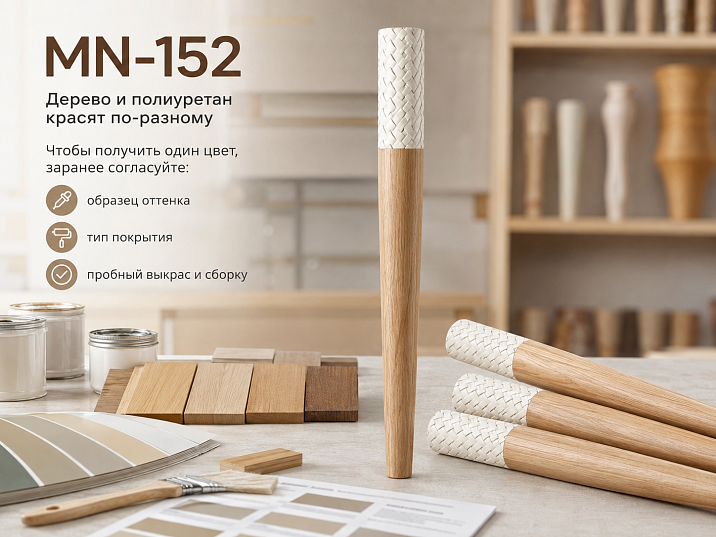
The paint is the same. The color code is the same. The painter is the same. The batch of parts is the same. Why, after drying, does the turned wooden part of the furniture leg look slightly warmer, while the relief insert looks cooler or glossier? The buyer sees MN-152 as a single product and naturally expects a uniform surface. But within one form, two different bases are combined: solid wood and unpainted polyurethane decor. They accept preparatory materials, primer, and the top coat differently, and the relief additionally changes the perception of light.
That is why the request to paint MN-152 in one color cannot be resolved with the advice "take the same enamel." Matching the paint number does not yet guarantee matching the shade, gloss, density, and texture. The result is evaluated not in the can and not immediately after application, but on a control sample after the full completion of the intended finishing cycle.
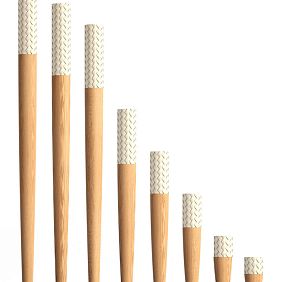
For MN-152, the turned base is made of beech or oak, and the decorative insert is made of unpainted polyurethane. Eight heights are available: 100, 150, 250, 350, 450, 650, 700, and 750 mm. For the straight position, the card suggests considering FUR-001 or FUR-012, for inclined installation — FUR-017 or FUR-020, and for adjustment, the FUR-019 foot can be used. When using supports taller than 450 mm for a table or a freestanding console, the need to increase the rigidity of the structure with a stretcher belt must be checked separately.
It turns out that before buy furniture leg MN-152, the buyer needs to solve not one, but several related questions:
-
what height suits the finished furniture;
-
is beech or oak needed;
-
should the wood texture remain visible;
-
is the entire leg painted with opaque enamel;
-
how to prepare the wooden and polyurethane parts;
-
which sample should be considered the reference;
-
what will the gloss be;
-
how to control the boundary of materials;
-
requires straight or angled mounting;
-
are foot pads needed;
-
is the rigidity of the tall structure sufficient;
-
who is responsible for the final color match.
The main rule can be formulated already on the first screen:
MN-152 cannot be painted as a uniform part without prior testing. Before launching the entire batch, a control paint-out on the wooden base and polyurethane insert is required, done with the same system, the same method, and the same degree of gloss that will be used in the finished furniture.
The same enamel is not yet the same surface
Suppose a painter received four MN-152 made of beech. The legs should become white, and the polyurethane ornament should visually blend with the turned base. The same color is applied to both parts. After drying, the wood looks softly matte, while the insert seems slightly brighter and colder. The code matched, but the eye sees a difference.
This does not necessarily mean the enamel was chosen incorrectly. The cause could be surface preparation, layer thickness, absorption, relief, application method, or different degrees of surface leveling. The error occurs earlier—at the moment when the customer approves the color based on a single flat swatch made only of wood or only of artificial material.
For MN-152, the reference must account for both bases.
Confirmed parameters MN-152
| Parameter | Confirmed data | What to check before ordering |
|---|---|---|
| Article number | MN-152 | Full designation in the invoice |
| Product type | Turned furniture leg with decorative insert | Furniture design compliance |
| Base | Solid wood | Beech or oak |
| Decorative part | Unpainted polyurethane | Preparation and finishing system |
| Heights | 100, 150, 250, 350, 450, 650, 700, 750 mm | Final furniture height |
| Constant parameters | 45 × 24 mm | Dimensions per drawing |
| Direct mounting | FUR-001 or FUR-012 | Base construction and completeness |
| Angled mounting | FUR-017 or FUR-020 | Angle, offset, and overall dimension |
| Adjustment | FUR-019 may be used | Compatibility with the lower part of the leg |
| Tall versions | For heights over 450 mm for a table or freestanding console, it is recommended to check the apron belt | Rigidity of all furniture |
| Surface condition | The leg is intended for subsequent finishing | Control sample |
| Landing page | Card MN-152 | Current price, availability, and delivery time |
The table helps to see the product but does not replace the technical data sheet. Parameters 45 × 24 mm cannot be independently called diameter, depth, or mounting size without reading the drawing. Their exact position must be verified in the technical materials.
Our factory also produces:




Why wood and polyurethane give different results
The buyer sees one leg. The painter sees two bases. It is the painter's view that should determine the preparation.
Get Consultation
Wood interacts with the coating through its own structure
Beech and oak have a natural texture. Even under an opaque finish, the surface condition affects how preparatory and finishing layers are applied. On a turned part, there are longitudinal and transverse sections of fibers, diameter transitions, convexities, and recesses. The same material may perceive the coating slightly differently in different areas of the shape.
This is not a reason to apply more enamel until the texture completely disappears. A layer that is too thick can alter the clarity of the turned profile and create heavy transitions.
The polyurethane insert has a different base
Unpainted polyurethane does not replicate the structure of wood. Its surface is prepared as an independent material. If it is treated with the same operation as wood, without checking compatibility, adhesion, smoothness, or the appearance of the finish may differ.
The article should not specify a particular primer or solvent. The correct composition depends on the chosen paint system and its official instructions. But the customer must require that the technologist confirm the suitability of the system for both materials at once.
The relief creates its own chiaroscuro
The polyurethane insert is decorative not only due to the pattern, but also due to the depth. The protruding parts catch the light, the recesses remain darker. Even with absolutely the same color, the relief will seem more contrasting than a calm turned surface.
Sometimes the buyer perceives natural chiaroscuro as a mismatch in shade. Therefore, the sample should be evaluated under the same lighting in which the furniture will stand.
Gloss enhances the difference
A matte surface softly diffuses light. A more glossy one emphasizes every unevenness, transition, and relief. If the wooden base and the insert received a slightly different preparation texture, the glossy finish will make the difference more noticeable.
Especially demanding are:
-
black and other dark colors;
-
white glossy enamel;
-
complex gray shades;
-
deep blue and green tones;
-
surfaces near a directional light fixture;
-
furniture viewed from a close distance.
Layer thickness affects the pattern
The polyurethane insert has a relief. If the layer is too thick, fine transitions become softer, recesses visually decrease, and the ornament loses clarity. On the wooden part, the same thickness may be perceived differently.
Consequently, the painter's task is not just to cover two materials with color, but to preserve the shape and make the transition between them calm.
The material joint reveals any difference
Even a slight difference is hard to notice on two parts lying separately. On MN-152, wood and polyurethane touch within a single mold. The eye compares surfaces directly along the transition line. A difference in half-tone, gloss, or texture becomes obvious.
Therefore, the control sample must be assembled exactly as a fragment of the finished MN-152, not as two unrelated swatches placed at different ends of the workshop.
What a proper control sample looks like
The phrase "make a test" is often understood too loosely. A painter applies paint to a random piece of wood, the client looks at a photo on their phone and approves the color. For a mixed product, this is not enough.
The MN-152 control sample must answer four different questions:
-
Does the color match on wood and polyurethane?
-
Does the degree of gloss match?
-
Is the relief of the decorative insert preserved?
-
Does the material boundary look uniform?
The sample must contain both materials
The best option is one control sample MN-152 or a prepared fragment from the same wood and the same polyurethane decor. If a separate leg is used, it must be included in the batch calculation in advance.
A flat wooden sample can show the shade on beech or oak, but will not say anything about the polyurethane insert. A polyurethane plate, in turn, will not convey the turned shape of the wood.
The full system is used, not just a single top coat.
The control sample is made with the same preparation that is specified for the order:
-
surface inspection;
-
specified cleaning;
-
approved preparation of each material;
-
priming stage, if it is part of the system;
-
intermediate operations;
-
finish;
-
technological holding time.
If the sample was made using a simplified scheme, but the batch was painted using a different one, the sample loses its meaning.
Color is evaluated after the cycle is completed.
Freshly applied material may look different than after drying. Therefore, it is not possible to confirm the shade a few minutes after application.
The customer is shown the finished sample after it has reached the state specified by the system for evaluating color and gloss.
Lighting must be realistic.
The sample is checked:
-
in daylight;
-
under the main evening lighting;
-
next to the facade or countertop;
-
against the background of the floor;
-
next to other furniture hardware;
-
from a normal viewing distance;
-
Under side lighting.
In the workshop, a cold lamp can hide a difference that will appear in a warm interior.
The sample is signed
On the back side or in the project card, record:
-
MN-152;
-
beech or oak;
-
color number;
-
gloss level;
-
applied system;
-
date;
-
executor;
-
number of layers according to the technology;
-
approval result;
-
photo under agreed lighting.
Such a sample becomes the standard for the entire batch and future repairs.
When a test coat is mandatory almost without discussion
For any MN-152, a sample is useful, but in some situations the risk is especially high.
White enamel
White color does not automatically hide differences. On different substrates, it can be perceived as slightly warmer or cooler. A relief insert additionally creates shadows, so even a calm matte white requires verification.
Light complex shades
Milky, gray-beige, dusty, and pastel colors are sensitive to the substrate and lighting. A slight difference is easier to notice on large open furniture.
Glossy finish
Gloss emphasizes texture, orange peel, and the quality of leveling. Wood and polyurethane must not only match in color but also reflect light identically.
Dark enamel
Black, graphite, dark blue, or deep green make the side chiaroscuro sharper. The relief looks more contrasting, and the mismatch in gloss becomes more noticeable.
Four or more legs
One leg may look successful. Four placed side by side allow the eye to compare each insert. The batch must be uniform.
Match with painted facade
When MN-152 must match the color of a cabinet, console, or kitchen facade, it is not enough to give the painter the name of the shade. Different bases and technologies can produce different results.
Compare the finished facade and the fully dried control leg.
Commercial interior
In a restaurant, hotel, store, or salon, furniture is often viewed under bright directional light. Additionally, a repeat order may be required. A saved sample helps reproduce the finish.
Repeat batch
If several legs are purchased later, the old paint code does not guarantee a perfect match. A physical reference from the first batch is needed.
Furniture with close viewing distance
For a bedside table, hallway console, or desk, the user sees the support from arm's length. The transition of materials is more noticeable than for a table in a spacious room.
Beech or oak: which wood is better for MN-152
MN-152 is made from beech and oak. Both options pair with polyurethane decor, but lead the project to different finishing scenarios.
Beech and opaque enamel
Beech is convenient to consider when the entire leg needs to be a solid color:
-
white;
-
black;
-
gray;
-
blue;
-
green;
-
beige;
-
painted to match the body;
-
contrasting with the tabletop.
With an opaque finish, the polyurethane insert may visually blend with the turned part. The ornament will be read through the relief, not through a different material.
But it is precisely this scenario that requires especially precise preparation matching: the buyer deliberately wants to get the impression of a solid leg.
Oak and transparent finish
Oak is chosen when the wood grain must remain visible. Another design question arises: what to do with the polyurethane insert?
A transparent system suitable for wood does not necessarily give the same visual result on polyurethane. Moreover, the insert does not have oak texture. Attempting to fully imitate the natural wood pattern on an artificial decor requires a separate finishing solution and cannot be considered an automatic option.
Therefore, for oak MN-152, the concept is determined in advance:
-
the insert is painted to match the wood tone;
-
the insert receives an opaque color;
-
the insert becomes contrasting;
-
the entire leg is covered with an opaque system;
-
a special approved artistic finish is used.
The article should not promise that a regular clear coat will make polyurethane look like oak.
Oak under enamel
This option is possible if the project requires an oak base, but the wood texture should not remain visible. However, before ordering, it is useful to understand why oak was chosen if the coating will be opaque.
Perhaps the reason is related to the construction, the overall furniture specification, or the desire to use one wood species for all parts. But the decision should be deliberate.
Beech under a clear coat
Beech can also be considered with visible texture if its character suits the furniture. In this case, the problem with the polyurethane insert remains the same: the artificial part does not replicate natural fibers.
Comparison of two wood species
| Criterion | Beech | Oak |
|---|---|---|
| Visual texture | Calmer | More pronounced |
| Common project scenario | Covering enamel | Transparent or tinted finish |
| How easy it is to visually combine with polyurethane | Easier under a solid-color covering system | Requires a separate solution when preserving the wood grain pattern |
| Is a test application needed | Yes | Yes |
| Can the color be chosen from the screen | No | No |
| Is it suitable for custom painting | Yes | Yes |
| What to check especially | Uniformity of a solid-color finish | Combination of natural wood with an artificial insert |
A buyer who wants order MN-152 from beech or oak, must choose not just the wood species, but the entire visual scenario.
Eight heights: one design, different furniture proportions
MN-152 is available in 100, 150, 250, 350, 450, 650, 700, and 750 mm versions. One article covers both low and high furniture legs, so you cannot write only the model name in the invoice.
Height 100 mm
A compact leg can be considered for low furniture if its design, load, and mounting method are suitable. At a low height, the decorative insert is perceived closer to the body and can create a pronounced accent at the base.
Check:
-
distance to the floor;
-
possibility of cleaning;
-
visibility of the ornament;
-
opening of lower fronts;
-
mounting;
-
thrust bearing;
-
proportion with the body.
Height 150 mm
The increased gap makes the support more noticeable. The leg now has a stronger influence on the overall silhouette of the furniture, but is still perceived as part of the lower base.
You cannot choose 150 mm just for ease of cleaning. The final height of the body will also change.
Height 250 mm
This design creates a noticeable lift. It requires checking stability and distances between supports. On a wide, heavy body, an attractive shape alone is not enough: the structure is calculated as a whole.
Height 350 mm
The leg becomes a significant part of the furniture. The polyurethane decor is well readable, and the color difference between the insert and the wood will be more noticeable.
A control paint-out is needed not only because of the material, but also because of the scale of repeating details.
Height 450 mm
This is a boundary execution in front of a group of higher supports. For each piece of furniture, the overall center of gravity, fastening, and the need for additional structural elements are checked.
Heights 650, 700, and 750 mm
Taller options may be considered for tables, consoles, and other suitable projects. For heights above 450 mm for a table or freestanding console, the manufacturer recommends checking the need to increase rigidity with an apron rail belt.
This recommendation does not mean that any table is automatically equipped with the same apron rail. The size, material, and connection method are calculated for the specific structure.
Height selection table
| Height MN-152 | Possible application scale | Main check |
|---|---|---|
| 100 мм | Low case or upholstered furniture | Gap, fastening, decor visibility |
| 150 мм | Raised case | Final height and stability |
| 250 мм | Middle support | Mounting point locations |
| 350 мм | Pronounced furniture leg | Body proportions and insert color |
| 450 мм | High support | Rigidity and overall dimensions |
| 650 мм | Tall furniture | Fastening, apron belt, stability |
| 700 мм | Table or console per project | Final height with top part |
| 750 мм | Tall construction | Ergonomics, rigidity, overhang |
This is not an automatic assignment table. The height is selected according to the furniture drawing.
In the card, you can select MN-152 height from 100 to 750 mm, but the final size is calculated together with the tabletop, body, mounting hardware, and foot.
Tall MN-152 and apron belt: color will not solve the structural problem
A decorative leg may look slim and light. This does not mean that a tall table or a freestanding console will maintain rigidity without an additional connecting element.
For MN-152 with a height over 450 mm, the manufacturer recommends checking the need for an apron belt in table or freestanding console constructions.
What the apron belt does in the project
Aprons connect supports and help furniture work as a system, rather than as a tabletop on separate legs. But their dimensions, position, and connections must be calculated by the designer.
The article does not assign a universal height or thickness for the apron.
Why the issue is resolved before finishing
If the need for the belt is discovered after finishing the legs, additional machining, drilling, or fitting may be required. This creates a risk of damaging the finished surface.
Additionally, aprons must receive a coordinated finish. If they are painted in the same color, their material is also included in the control sample.
Polyurethane decor and apron
It is necessary to check whether the apron belt intersects with a decorative insert, turned transitions, or the attachment area. A beautiful relief should not end up partially hidden by the structure.
What to provide to the engineer
-
SKU MN-152;
-
selected height;
-
number of legs;
-
tabletop size;
-
material of the upper structure;
-
direct or angled mounting;
-
intended position of the aprons;
-
a drawing;
-
thrust bearing;
-
requirements for the final height.
Direct mounting MN-152: FUR-001 or FUR-012
For vertical installation, the MN-152 card suggests considering FUR-001 and FUR-012.
FUR-001
You can buy the FUR-001 mounting kit after checking the furniture structure.
Before ordering, clarify:
-
what is included in the set;
-
What number of supports is one product item designed for?
-
How is the mounting connected to MN-152?
-
What material is the underside of the tabletop made of?
-
Is the base thickness sufficient?
-
Where are the mounting points located?
-
Can the connection be serviced after assembly?
FUR-012
Alternatively, you can buy FUR-012 kit. It also applies to direct installation, but should not be considered automatically interchangeable with FUR-001.
The choice depends on the furniture unit. First, study the drawings, then add the specific item to the invoice.
Direct position and painting
If the fastener requires preparation of the top part of the leg, all holes and seating operations should be coordinated before finishing. The painter needs to know which areas will be covered by the plate and which surfaces will remain visible.
Number of fasteners
The formula "four legs — four sets" may be incorrect if one product item contains parts for multiple supports. Completeness is checked in the product card.
Angled mounting: same color, different geometry
For angled installation, FUR-017 or FUR-020 are used. Such mounting changes not only the appearance but also the dimensions of the furniture on the floor.
FUR-017 at a 10-degree angle
To buy mounting plate FUR-017, first build the side and front projections of the furniture. The angle of 10 degrees is confirmed in the product card name.
When tilted, check:
-
vertical projection of height;
-
lower point offset;
-
overall dimensions;
-
distance between thrust bearings;
-
position of the decorative insert;
-
direction of each leg;
-
ability to place furniture against a wall;
-
free space for a person;
-
operation of the stretcher belt.
FUR-020
You can buy the mounting plate FUR-020 for the inclined installation provided by the project. In the SEO scheme, it is marked as a mounting for two inclined legs, but the actual completeness and design need to be checked in the product card.
How the incline affects the painted surface
During assembly, the leg is installed at an angle, so tools and hands may come into contact with the relief insert. The coating must undergo the specified technological curing time.
Additionally, the four inclined supports reflect light differently. Even the same finish may appear slightly lighter on the front pair and darker on the rear pair. This is a natural effect of orientation and should not be confused with a color defect.
An incline cannot be achieved by randomly rotating a straight plate
Such a solution changes the operation of the assembly and does not conform to the intended system. For inclined mounting, choose suitable hardware.
Adjustable foot FUR-019
For MN-152, the adjustable foot FUR-019 may be used. It helps correct the position of the furniture on the base but should not become a means of fixing height or attachment errors.
You can buy the adjustable foot FUR-019 after checking the bottom geometry of the selected MN-152.
What to agree on
-
installation method;
-
compatibility with the specific height;
-
preparation of the bottom edge;
-
influence on the final height;
-
adjustment range;
-
visibility;
-
contact with the floor covering;
-
quantity;
-
installation order relative to painting.
The foot plate is selected before the painting stage
If installation requires processing the lower part, the operation must be planned in advance. Drilling or fitting after applying the finish increases the risk of chips and scratches.
What the foot plate does not fix
-
different leg heights;
-
incorrect plate angle;
-
curved tabletop;
-
incorrect placement of fasteners;
-
absence of a drawer frame belt;
-
load mismatch;
-
different coating layer.
What to buy together with MN-152
The full order consists of the support itself, fastening, adjustment, finishing materials, and structural furniture elements.
| Position | Task | When to add |
|---|---|---|
| MN-152 of selected height | Main support | After furniture calculation |
| Beech or oak | Material of wooden part | Before choosing finish |
| Polyurethane insert | Relief decor | Included in test painting |
| FUR-001 | Direct mounting option | After design review |
| FUR-012 | Alternative direct mounting | According to the drawing |
| FUR-017 | 10° tilt | After overhang calculation |
| FUR-020 | Mounting of inclined supports | As per project |
| FUR-019 | Adjustable furniture foot | Before painting the lower part |
| Cargo belt | Increasing rigidity of tall structure | By calculation for heights over 450 mm |
| Materials for wood | Preparation and finish | According to approved system |
| Materials for polyurethane | Preparation of second base | According to official system instructions |
| Control leg | Test swatch | Before painting the batch |
| Physical color sample | Single standard | Before starting work |
| Drawing | Dimensions and installation | Pass to furniture maker and painter |
| Protective packaging | Preserving the coating | After finishing |
For installation, you can Buy hardware for furniture legs, and for the finishing stage — buy materials for painting MN-152. Selection of specific compositions is made only after approval of the system for wood and polyurethane.
What to pass to the painter
An oral instruction to "paint everything the same" is not a technical specification. The painter must know that MN-152 consists of two materials.
Working specification
Product: MN-152.
Quantity: 4 pcs.
Height: 700 mm.
Wooden part: beech.
Decorative insert: unpainted polyurethane.
Desired result: a single opaque color.
Color: according to physical sample.
Gloss level: specified in the order.
Control: first one trial leg.
Evaluation: after full specified drying.
Batch start: only after approval of the wood, insert, and joint.
Marking: each leg gets a number.
Fastening zones: shown on the drawing.
Bottom part: prepared for the selected foot cap.
Relief protection: do not allow loss of sharpness due to excessive layer.
The example uses a height of 700 mm and beech only to demonstrate the document format. It is not a universal order option.
Questions for the painter before batch transfer
-
Is the system confirmed for both materials?
-
Will different preparatory operations be used?
-
How will the same gloss be controlled?
-
Where is the test coating done?
-
When can the sample be evaluated?
-
How is the joint protected?
-
How is the depth of the relief preserved?
-
Are the legs painted at the same time?
-
Who approves the result?
-
How is the physical reference stored?
One performer is not always one system
A painter can use different priming stages for wood and polyurethane, but bring them to a single finish. This does not violate the task. What matters to the buyer is a uniform appearance, not the same number of operations underneath it.
What to pass on to the furniture maker
The furniture maker should receive not only painted legs, but also a complete assembly project.
Mandatory data
-
MN-152;
-
height;
-
quantity;
-
beech or oak;
-
straight or inclined position;
-
FUR-001, FUR-012, FUR-017 or FUR-020;
-
foot cap FUR-019;
-
location of each support;
-
apron belt;
-
final height of the furniture;
-
floor outlet;
-
protected surfaces;
-
coating readiness date for assembly.
Drawing instead of photo
You can download drawing MN-152 and share it with all project participants.
The photo does not show:
-
exact location of dimensions 45 × 24 mm;
-
mounting zones;
-
actual height;
-
geometry of the upper part;
-
position relative to the side rail;
-
distance to the edge of the tabletop.
Installation must not damage the relief
The polyurethane insert remains part of the front surface. The tool, clamp, or protective packaging must not press on the decorative pattern.
How to order four legs without color differences
Four identical item numbers do not guarantee a visually identical set. Uniformity is created by production discipline.
One height
All items are checked upon acceptance. The foot cap must not compensate for mistakenly mixed versions.
One wood species
Beech and oak cannot be randomly combined in one group, especially if the coating is not fully opaque.
One batch of finish
Legs are painted in one cycle, as far as the technology allows. Splitting across different days or operators increases the risk of difference.
One sample
The reference must be near the workstation, not just as a photo.
Uniform gloss
Matte and semi-matte versions of the same color look different. The gloss level is specified in the specification.
Marking
Even identical legs are useful to number. This helps control placement on furniture and inspection results.
One hardware set
All supports of one set use one agreed mounting scheme, unless otherwise specified by the project.
One inspection card
After painting, each MN-152 is compared:
-
with the reference;
-
with adjacent legs;
-
in the area of the wooden base;
-
on the polyurethane decor;
-
along the joint line;
-
by gloss;
-
by preservation of the relief.
Can the oak be left visible and the insert painted separately?
Yes, such a designer scenario can be considered, but it differs from the task of "painting everything in one color." The wooden part retains its natural texture, while the polyurethane decor receives an opaque shade.
Contrast option
For example, oak remains natural, while the insert becomes black, white, or colored. Then the difference in materials is not masked, but emphasized.
Need to check:
-
precision of the edge;
-
color combination;
-
gloss level;
-
consistency across the entire batch;
-
interaction with fasteners and the tabletop.
Tonal option
The insert can be aimed to match the overall tone of the wood, but full imitation of natural fibers cannot be promised without special technology. A flat solid brown and transparent oak will be perceived differently.
What the buyer should choose
-
If you need a solid, uniform leg, choose the covering scenario with a control color sample on two materials.
-
If you need natural wood, plan the appearance of the polyurethane insert in advance.
-
Contrast is needed — specify two separate samples and the boundary between them.
MN-152 for table
The card and SEO schema link the model to dining and writing tables, as well as consoles. But category membership does not replace design.
In the selection, you can buy wooden table legs and compare MN-152 with other supports.
Dining table
Check:
-
final height;
-
The thickness of the tabletop;
-
apron;
-
distance between legs;
-
knee space;
-
straight or angled mounting;
-
floor clearance;
-
adjustment;
-
color to match the chairs.
polyurethane insert
How to check the card
Before purchasing, look for:
- indication of solid wood;
- mention of polyurethane insert;
- condition of the decor;
- height options;
- breed;
- fasteners;
- recommendations for a tall structure.
Why you cannot use technology from another leg
Even if the neighboring model is also made of wood and polyurethane, the shape of the relief, the border, the area of the insert, and the preparation method may differ.
Comparison of MN-152 with single-base options
| Option | Advantage | Limitation |
| Solid wood leg | Single base for finishing | Different character of decor |
| Fully polyurethane part | Homogeneous artificial material | Does not replace wooden construction |
| MN-152 made of wood and polyurethane | Combines turned wooden shape and embossed insert | Requires test coating on two substrates |
| MN-152 for covering enamel | Materials can be visually combined | Need to even out color and gloss |
| MN-152 with visible wood | Preserves beech or oak | Insertion requires a separate design solution |
In the general catalog you can buy furniture legs and decide whether the complexity of mixed finishing is justified in your particular project.
Polyurethane decor should not be perceived as a random overlay
Insertion MN-152 forms relief and distinguishes the model from a regular turned support. It cannot be painted without attention to fine lines.
To understand the character of the second material, you can look at polyurethane products for painting. This category does not replace the MN-152 card, but shows that polyurethane decor is considered as an independent basis for further finishing.
What is preserved when painting
- edges of the pattern;
- the depth;
- transitions;
- symmetry;
- cleanliness of recesses;
- even finish;
- neat joint with wood.
What reveals a poor finish
- filled recesses;
- sagging;
- difference in gloss;
- visible primer boundary;
- cooler or warmer shade;
- stains;
- different grain;
- chips at the joint.
Acceptance of MN-152 before painting
The batch must be fully inspected before surface modification.
Quantity
Recount the wooden supports and ensure that decorative inserts are present in each position according to the delivery.
Height
Check all legs. Especially easy to confuse adjacent versions in a large batch.
Wood species
Beech and oak must not be mixed accidentally.
Polyurethane decor
Check the relief, edges, and overall integrity.
Dimensions
Match the product against the drawing. Do not attribute unconfirmed functions to the 45 × 24 mm dimensions.
Mounting
Check whether FUR and glides are ordered. The leg itself does not complete the mounting kit.
Apron belt
For tall supports, ensure that the rigidity decision has already been made.
Surface
Comments are recorded before priming, painting, drilling, and assembly.
Acceptance after painting
The finished batch is evaluated not only by color.
Comparison of wood and polyurethane
On each leg, the transition is checked under direct and side light.
Comparison between legs
All four or six parts are placed side by side in the same orientation.
Gloss
The surface must not randomly change character at the insertion.
Relief
The ornament must remain sharp.
Joint
No runs, chips, or rough coating steps are allowed.
Lower and upper parts
Check the attachment and pivot areas.
Ready for installation
Assembly begins only after the specified technological holding time.
Errors that cause one color to turn into two
Error 1: Considering MN-152 to be fully wooden
The painter uses one preparation for the entire surface.
Fix: specify wood and polyurethane in the task.
Error 2. Approve color only on a wooden swatch
The insert looks different after painting.
Fix: make a sample on two materials.
Error 3. Approve color only on polyurethane
A turned base gives a different visual result.
Fix: check the assembled transition.
Error 4. Evaluate fresh paint
After drying, the tone and gloss change.
Fix: wait for the stage specified by the system.
Error 5. View the sample only in the workshop
The lighting is different indoors.
Fix: check next to the furniture.
Error 6. Consider identical code a guarantee
The bases and preparation differ.
Fix: assert the physical result.
Error 7. Use a universal primer without testing
The system may work differently on wood and polyurethane.
Fix: confirm compatibility according to official instructions.
Error 8. Apply too thick a layer on the relief
The ornament loses clarity.
Fix: follow the approved technology.
Error 9. Sand the insert as an array of wood
The relief is damaged.
Fix: separate preparatory operations.
Error 10. Do not clean the joint
After finishing, a visible line appears.
Fix: check the transition before painting.
Error 11. Paint legs on different days without a reference
The batch differs.
Fix: single pattern and map.
Error 12. Give half of the set to another painter
The application method changes.
Fix: one responsible executor.
Error 13. Mix beech and oak under a translucent finish
Texture and shade diverge.
Fix: one wood species per set.
Error 14. Trying to make polyurethane look like oak with regular clear varnish
Artificial insert does not get natural fibers.
Fix: develop a separate finish.
Error 15. Not specifying gloss
The wood is matte, the insert seems semi-glossy.
Fix: fix the degree of gloss.
Error 16. Looking at parts separately
The difference is detected after assembly.
Fix: place the legs next to each other.
Error 17. Not checking side light
Relief hides defects under diffuse lighting.
Fix: inspect under directed light.
Error 18. Ordering MN-152 without height
Another modification is counted in the price.
Fix: full order line.
Error 19. Count the leg height as the furniture height
Countertop and fastening are not taken into account.
Fix: calculate the entire structure.
Error 20. Select a high leg without a stretcher belt
The furniture does not get the necessary rigidity.
Fix: check the recommendation for heights over 450 mm.
Error 21. Add stretchers after painting
Finished parts have to be redone.
Fix: design in advance.
Error 22. Buy FUR-001 or FUR-012 at random
The mount does not fit the base.
Fix: check the drawing.
Error 23. Get tilt by rotating a straight plate
The node geometry is violated.
Fix: use FUR-017 or FUR-020.
Error 24. Not calculating the overhang of the angled leg
The furniture does not fit against the wall.
Fix: build a projection.
Error 25. Order FUR-020 without checking completeness
The number of fasteners does not match.
Fix: study the product card.
Error 26. Add FUR-019 after finish
The lower part has to be drilled on the finished surface.
Fix: agree on the foot pad in advance.
Error 27. Level different heights with the foot pad
The adjustment is used for unintended purposes.
Fix: check the completeness.
Error 28. Do not mark the legs
After individual inspection, the positions are mixed.
Fix: numbering.
Error 29. Store fresh parts with relief facing each other
Prints and damage appear.
Fix: protective packaging.
Error 30. Install before the coating is ready
The tool leaves marks.
Fix: hold the system.
Error 31. Order two legs now, two later
Batches differ.
Fix: full set at once.
Error 32. Do not save the sample
A repeat order cannot be exactly reproduced.
Fix: store the reference.
Error 33. Consider relief as a shade defect
Shadows are perceived as dark spots.
Fix: evaluate the shape under real light.
Error 34. Trying to remove shadows with extra paint
The relief is filled in.
Fix: distinguish between color and light-and-shade.
Error 35. Not checking the finished furniture as a whole
The legs match each other but diverge from the facade.
Fix: final comparison on site.
Who MN-152 suits
The model should be chosen when:
- a turned wooden silhouette is needed;
- a relief decorative fragment is important;
- the project allows individual finishing;
- there is an option to make a test paint-out;
- beech or oak was chosen;
- one of the eight heights fits;
- the mounting is determined before painting;
- the painter can work with different bases;
- a high table or console is designed with rigidity in mind;
- the batch is ordered at the same time;
- the buyer is ready to approve the color physically.
Who is better off choosing a different support
Another option is more practical if:
- a fully finished painted leg is required without finishing work;
- there is no possibility to make a sample;
- the project requires natural wood texture on the entire surface, including decor;
- the polyurethane insert does not fit the style;
- no height matches the furniture;
- the fastening system does not fit the base;
- the tall structure does not allow for a belt rail;
- installation must be completed immediately;
- the client is not ready to accept the natural light and shadow of the relief;
- a solid wooden part without mixed materials is required.
In the category you can Buy wooden furniture legs and choose a model with a different finishing method.
Order MN-152 at STAVROS
First, select the modification
Open the product card and check the price of MN-152 for the required height and breed. Current availability and lead times are confirmed before payment.
Then calculate the furniture
Determine:
- final height;
- number of legs;
- tabletop or cabinet size;
- straight or angled installation;
- aprons;
- support feet;
- distances from edges.
For a complex project, you can order a furniture project with MN-152.
After the structure, approve the finish
Choose:
- beech or oak;
- covering or other scenario;
- color;
- gloss;
- control sample;
- of the executor.
Assemble the hardware
Add specific FUR and FUR-019 after checking the cards.
Arrange one delivery
Legs, fasteners, and glides are best obtained in one stage. Conditions can be checked on the page where it is available order MN-152 with Contact us to confirm shipping to your destination..
Frequently asked questions about MN-152
What does MN-152 consist of?
The turned base is made of solid wood, and the decorative insert is made of unpainted polyurethane.
Which wood species are available?
Beech and oak.
What heights does MN-152 have?
100, 150, 250, 350, 450, 650, 700, and 750 mm.
What do the dimensions 45 × 24 mm mean?
These are constant parameters of the technical scheme. Their exact position should be checked on the drawing.
Can 45 mm be independently called the diameter?
Not without a technical drawing.
Does MN-152 come painted?
The model is intended for subsequent finishing. The current configuration should be checked in the product card.
Why can wood and polyurethane differ after painting?
They have different surfaces and require coordinated preparation. Additionally, the relief reflects light differently.
Does one enamel code guarantee a match?
No. A physical control sample is needed.
Can we do a test only on beech?
It won't show the result on the polyurethane insert.
Can we do a test only on the decor?
It won't show the result on the wooden base.
Which sample is correct?
One containing both materials and the full preparation and finishing system.
When should the color be evaluated?
After the specified technological cycle is completed.
Why can't fresh paint be approved?
Its shade and gloss may change after drying.
Where can I see a sample?
In daylight and evening lighting next to the future furniture.
Do I need to check side lighting?
Yes. It shows the relief and differences in gloss.
What to choose under enamel — beech or oak?
Beech is often considered for opaque coating, but the choice depends on the project.
Can oak be painted with opaque enamel?
It can be done with an agreed system, but you need to understand the reason for choosing oak.
Can oak be left transparent?
Yes, but the polyurethane insert will require a separate finishing solution.
Will polyurethane look like oak after clear varnish?
A regular clear coating does not create natural wood grain.
Can the insert be made contrasting?
Yes, if such a design is approved on the sample.
Can the entire leg be painted white?
Yes, with a system approved for both bases and after a test coating.
Why does white color require testing?
Different bases can produce differences in warmth, density, or gloss.
Is it harder to work with gloss?
Gloss more strongly highlights differences in preparation and surface relief.
Can more enamel be applied to the insert?
An excessive layer can soften the ornament.
What should be used to prime wood?
The specific material is chosen according to the official instructions of the approved system.
What should be used to prime polyurethane?
Also, according to the system approved for this substrate.
Can one primer be used?
Only if the material manufacturer allows it for both substrates and the test gave the desired result.
Is it necessary to sand the polyurethane insert?
The specific preparation is assigned by a technologist. The relief cannot be treated by analogy with solid wood without verification.
How to preserve the ornament?
Control the preparation and thickness of the coating, avoiding flooding of recesses.
Do I need to paint all four legs at the same time?
For batch consistency, this is preferable.
Can I order the legs at different times?
Yes, but the risk of differences in wood and finish increases.
Is a spare leg needed?
It is useful for complex cutouts, serial projects, or future repairs.
How to store the control sample?
Together with the specification of color, gloss, system, and finishing date.
What height is suitable for a cabinet?
Depends on the frame, load, fastening, and required clearance.
What height is suitable for a table?
Determined together with the tabletop thickness, fasteners, and final ergonomics.
Can the MN-152 700 mm be used for a table?
Such a configuration can be considered after a full calculation.
What should be checked for a height of 750 mm?
The final height, stability, apron frame, fastening, and floor glides.
When is an apron frame needed?
When using supports higher than 450 mm for a table or a freestanding console, it is recommended to check whether it is necessary.
Is it mandatory to install the same apron frame on any furniture?
No. Its parameters are calculated for a specific project.
Which fasteners are suitable for direct installation?
FUR-001 or FUR-012.
How to choose between FUR-001 and FUR-012?
According to the drawing, base structure, and card completeness.
Which mounts are suitable for angled installation?
FUR-017 or FUR-020.
What is the angle of FUR-017?
The name confirms a 10-degree angle.
Can the leg with a straight mount be tilted?
No. The provided angled system is used.
What changes when tilted?
Vertical projection and overall furniture footprint on the floor.
Is a footplate needed?
FUR-019 may be used per the project.
Can the foot pad be purchased after painting?
Better to coordinate it earlier to prepare the bottom part without damaging the finish.
Will the foot pad correct height differences?
No. It is not intended to compensate for incorrect configuration.
Is the mounting included in the MN-152 itself?
Mounting hardware needs to be checked and added separately.
How much FUR is needed for four legs?
It depends on the configuration of the selected item.
Where can I see other hardware?
In the furniture hardware catalog.
Where can I see other unpainted legs?
In the section of wooden supports for custom finishing.
Where can I choose legs for the tabletop?
In the selection of table legs.
What to check upon receipt?
Article number, height, wood species, quantity, polyurethane decor, surface, and hardware.
Can the boxes be handed over to the painter right away?
First, you need to accept the set, check the drawing, and prepare the technical specification.
Who should approve the sample?
The customer or the designated responsible person before painting the entire batch.
What should be handed over to the painter?
Article number, quantity, height, wood species, both materials, color, gloss, and the reference sample.
What should I pass to the furniture maker?
Drawing, fastening, placement, foot cap, crossbars, and final height.
How to check the finished legs?
Place them side by side, compare the wood, the insertion, the joint, the gloss, and the relief.
Why does the relief appear darker?
The recesses create a natural shadow.
Do I need to paint over the shadows with additional layers?
No. The shadow of the shape cannot be corrected by thickening the coating.
Is it possible to achieve a completely flat visual color?
The relief will still reflect light differently. The goal is to match the coating itself, not to make the volume disappear.
Where can I see the current price?
In card MN-152 after selecting the modification.
Can I order one leg as a sample?
Yes, the control position helps to check the height, color, and fastening.
How to order a batch without errors?
Specify height, quantity, wood species, finish, gloss, mounting, glides, and apron rail.
What is the main question to ask the painter?
"How will you verify the color and gloss match on the wood and polyurethane insert before painting the entire batch?"
What question should you ask the cabinetmaker?
"What mounting and apron rail are provided for the selected height MN-152?"
What question should you ask the manager?
"Confirm the selected height, wood species, quantity, and order composition with mounting."
What question should you ask the designer?
"Should the leg look completely uniform in color, or will the polyurethane decor be highlighted with a different finish?"
One color starts not with a can of paint, but with two proven bases.
MN-152 looks solid, but finishing it requires careful consideration. The turned base is made of beech or oak, the decorative insert is of unpainted polyurethane. One enamel number does not eliminate differences in surface, preparation, relief, and light reflection.
Before ordering, choose height, wood species, quantity, painting scheme, and gloss level. Before starting the batch, perform a test paint on both materials. Then select direct or angled mounting, check FUR-019, and don't forget the recommendation for the apron rail for tall supports in tables and freestanding consoles.
STAVROS company allows you to assemble the entire route in one project: choose MN-152 from beech or oak, select one of eight heights, add mounting hardware, finishing materials, technical drawings, and delivery. When the painter, furniture maker, and client work from one sample and one specification, wood and polyurethane stop arguing with each other—the relief remains expressive, and the color is perceived as unified.