Article Contents:
- Why it's better to cover an exposed LED strip
- Visible light dots spoil the lighting line
- The strip collects dust and looks unfinished
- An open edge is harder to integrate into the interior
- Molding for hidden lighting
- Profile for LED line
- Decorative border for wall or ceiling
- Why regular molding is not always suitable
- Key features of LB30 and LB32
- LB30: compact option for a neat LED line
- LB32: profile for more expressive hidden lighting
- When to choose a narrow profile
- When a deeper profile is needed
- On the wall
- On the Ceiling
- In the kitchen
- At the mirror
- On a decorative panel or in a niche
- What not to do from scratch if you have ready-made STAVROS profiles
- What to check before ordering
- Why the length of 2.0 m is important for calculation
- If the tape is already installed and needs to be covered
- If lighting is only planned
- If lighting is needed for the kitchen
- If backlighting is needed for a mirror
- If backlighting is needed for a commercial interior
- What to add to the purchase
- Need to cover the tape on a small wall
- Need to make backlighting in a large living room
- Need to design a niche
- Need to cover the tape at the mirror
- Need to make lighting in the kitchen
- Mistake 1. Choosing only by photo
- Mistake 2. Not considering the profile depth
- Mistake 3. Confusing decorative molding with lighting profile
- Mistake 4. Not counting the number of segments
- Mistake 5. Buying different profiles without a unified concept
- Mistake 6. Leaving electrical work until the last moment
- Mistake 7. Expecting molding to function as a finished light fixture
- Suitable
- Not suitable
- What to cover the LED strip on the wall with?
- Can an LED strip be covered with molding?
- How to make hidden lighting on the wall?
- What to choose: LB30 or LB32?
- Will a molding for backlighting work for the kitchen?
- What to use to cover an LED strip on the ceiling?
- What to use to cover the LED strip near the mirror?
- How is a molding for backlighting different from a regular molding?
- Do I need to buy a profile with extra length?
- Can LB30 and LB32 be used in the same project?
- Is the backlight molding sold together with the LED strip?
- Where to buy STAVROS backlit molding?
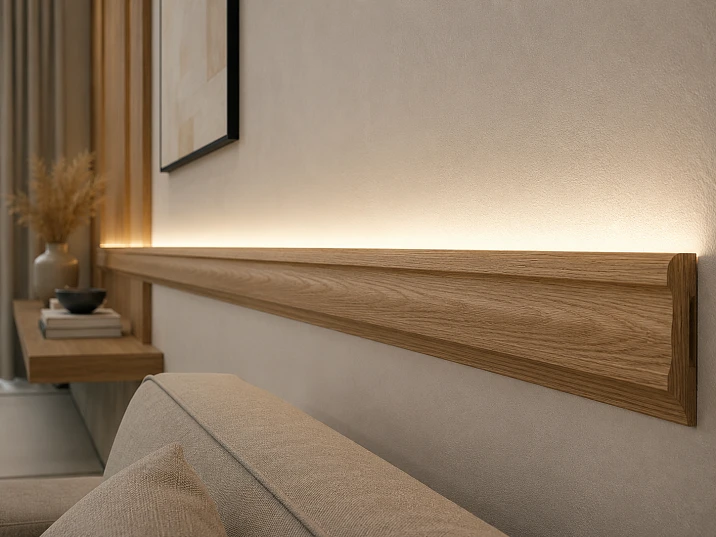
How to cover an LED strip if it is already in the project but looks too technical in the interior? Most often, the problem is not the lighting itself, but that the strip, LED points, edge of the base, wire, or uneven installation line are visible. The light should work softly and cleanly, not resemble temporary wiring after renovation.
For a wall, ceiling, kitchen, mirror, or decorative panel, it is better to plan a profile in advance that not only covers the LED strip but makes the lighting part of the finish. In STAVROS, for such a task, you can consider Hi Wood moldings LB30 and LB32: they help hide the light source, form a neat edge, and achieve a more finished lighting line.
The main mistake is trying to cover the LED strip with any decorative molding that matched the photo. A regular molding may have a beautiful shape but does not always have the necessary geometry for hidden lighting. Therefore, you need to choose not only by appearance but also by the profile's purpose, depth, size, installation location, and the future lighting effect.
In this article, we'll break down how to cover an LED strip on a wall, when a compact LB30 is suitable, when it's better to choose a deeper LB32, where such profiles are appropriate, and how not to confuse a backlit molding with a regular decorative element.


Why it's better to cover an exposed LED strip
An open LED strip rarely looks as neat as in a visualization. In a picture, the light line may seem even, soft, and expensive. In a real interior, details matter: how evenly the strip is glued, whether the light points are visible, where the light is directed, whether the end is covered, whether the wire is noticeable, and whether there is a sharp glare on the wall or ceiling.
If the strip remains visible, the backlighting is often perceived not as a design technique but as a technical strip. This is especially noticeable on smooth walls, near mirrors, in kitchen areas, in niches, and on ceiling transitions. Therefore, the question 'what to cover the LED strip with' arises not only for those doing renovations themselves. Designers, finishing craftsmen, and apartment owners face it when they want to bring the interior to a clean, finished look.




Visible light dots spoil the lighting line
An LED strip does not produce continuous light but a series of individual sources. If you look at it directly or at a slight angle, the points become noticeable. Even a high-quality strip can look rough if it's simply glued to an open surface without a profile, edge, or concealing element.
Molding for hidden lighting solves this problem differently: it helps hide the strip itself and direct the light so that a person sees not the LEDs, but the reflected glow. In an interior, this looks softer. The line becomes calmer, the wall is not fragmented by technical details, and the lighting is perceived as part of the room's architecture.
Our factory also produces:
The strip collects dust and looks unfinished
An exposed strip is on the surface. Dust settles on it, and there may be traces of glue, uneven base, finishing joints, and random gaps nearby. In a dry living room, this may not show immediately, but over time the line becomes less neat. In the kitchen or near a mirror, the problem is more noticeable: there is more moisture, dirt, reflections, and glare nearby.
A profile or molding does not replace proper electrical installation, but it helps cover the visual part of the task. Instead of an open strip, a finished edge appears. This is especially important where the lighting is in the line of sight: above a work surface, near a decorative wall, by a mirror, in a niche, next to a ceiling transition.
Get Consultation
An open edge is harder to integrate into the interior
An interior can be modern, classic, calmly minimalist, or more decorative, but an open LED strip almost always looks technically the same. It rarely supports the room's style on its own. For the lighting to look like part of the finish, it needs an architectural contour.
Hi Wood molding for lighting helps create just such a contour. It does not conflict with the interior, but works as a transition between the wall plane and the light line. As a result, the lighting ceases to be a separate electrical detail and becomes part of the wall, ceiling, niche, or decorative panel.
What to cover an LED strip with
You can cover an LED strip in different ways, but not every option is suitable for beautiful hidden lighting. One thing is simply to hide the strip from view. Another is to make the light come out evenly, softly, and not ruin the finish.
In the buyer's task, three questions are important:
1. Where the strip is located: on the wall, ceiling, in the kitchen, near a mirror, or in a niche.
2. Whether you need to completely hide the light source or only shield it from direct view.
3. What appearance should remain after installation: strict, compact, decorative, deep, or almost invisible.
Molding for hidden lighting
The most interior-friendly option is molding for hidden backlight. It is needed not only for decoration. Its task is to cover the LED strip, form a neat line, and direct the light. Such a profile is chosen when the backlight should be part of the wall or ceiling, not a separate glued strip.
For a neat LED line, you can look at LB30 molding for LED backlightThis is a compact Hi Wood profile measuring 30 mm × 15 mm × 2.0 m. It is suitable for cases where you don't want to overload the wall with a large element, but need to cover an open LED strip and make the edge of the backlight more cohesive.
Profile for LED line
A profile for an LED line is needed where the geometry of light is important. It helps maintain a straight line, hide the technical part, and make the backlight predictable. Unlike a random strip, a profile for backlighting is chosen based on shape, depth, and installation location.
If you need a more pronounced light offset and deep hidden backlighting, you should consider the LB32 Hi Wood molding for hidden backlighting. Its size is 32.5 mm × 24.0 mm × 2.0 m. Due to its greater depth, this profile is better suited for scenarios where the backlighting should be more noticeable and expressive.
Decorative border for wall or ceiling
Sometimes a customer formulates the task more simply: they need something to cover the LED strip on the ceiling or wall so that it is not visible. But essentially they need a decorative border. It covers the technical part, sets the boundary of light, and helps connect the backlighting with the finish.
Such a border is especially appropriate in the following places:
· along the wall above the decorative panel;
· along the top edge of the kitchen area;
· around the mirror;
· in a niche;
· in the ceiling transition zone;
· on an accent wall in the living room or bedroom.
In each scenario, the profile shape works differently. On the wall, the neatness of the line is important. On the ceiling, the direction of light and scale matter. Near the mirror, there should be no harsh glare. In the kitchen, a clean look and a clear boundary between the finish and the lighting are essential.
Why a regular molding is not always suitable
A regular decorative molding can cover a joint, decorate a wall, emphasize a panel, or divide a surface. But if it is not designed for hidden lighting, problems may arise: the strip will remain visible, the light will shine in the eyes, the profile will be too flat, and the lighting line will become uneven.
Therefore, the question 'can a molding cover an LED strip' is better asked more precisely: which specific molding? If you need a decorative profile for a wall without lighting, one type of product will do. If the task is to hide the LED strip and direct the light, it is better to choose a profile specifically designed for lighting.
Which Hi Wood moldings to buy for hidden lighting
Two models are important in this topic: LB30 and LB32. Both are Hi Wood moldings made of polystyrene and are used for working with hidden lighting. But they differ in size and application.
To avoid choosing at random, first understand what lighting effect is needed. A compact line and a restrained contour are one task. A deeper backlight and a noticeable light offset are another.
Key features of LB30 and LB32
|
Model |
Size and material |
Suitable for which task |
|
LB30 Hi Wood |
30 mm × 15 mm × 2.0 m, polystyrene |
Compact lighting line on the wall, in a niche, near a decorative panel |
|
LB32 Hi Wood |
32.5 mm × 24.0 mm × 2.0 m, polystyrene |
Deeper hidden backlighting, expressive light contour |
|
Hi Wood section |
Current parameters need to be checked in the card |
Selection of other profiles if you need to continue the line along the wall or ceiling |
After the table, it's easier to see the main difference. The LB30 is shallower in depth and looks calmer. The LB32 is larger, so it offers more possibilities for hidden lighting where a more noticeable light effect is desired. Both options should be selected not only by profile size, but also by installation location, light direction, type of LED strip, and the overall design concept.
LB30: compact option for a neat LED line
The LB30 is convenient where the lighting should not draw attention to itself. This profile helps cover the strip but does not make the wall heavy. It can be considered for neat lighting along a decorative panel, a small wall section, a niche, a mirror area, or an interior transition.
The size of 30 mm × 15 mm allows the profile to be used in situations where a large element would look rough. For example, if the backlighting runs on a small wall, next to thin moldings, or near minimalist furniture, a too deep profile may stand out of scale. LB30 in such a situation helps maintain a clean line.
The practical meaning of a compact profile is simple: it covers the technical part but does not turn the lighting into a massive architectural element. This is a good option when you want not a bright light show, but a calm glow that supports the interior.
LB32: profile for more expressive hidden lighting
The LB32 is deeper: 32.5 mm × 24.0 mm. Because of this, it is appropriate where the lighting should be more noticeable. Such a profile should be considered for wall lines, ceiling transitions, niches, decorative zones, and areas where it is important to hide the LED strip deeper and get a more confident light contour.
Depth is especially important when a person looks at the lighting at an angle. The closer the light source is to the open edge, the higher the risk that dots or the strip itself will be visible. A deeper profile helps better hide the technical part but requires more careful evaluation of the installation location.
The LB32 should not be chosen just because it is larger. It is chosen when the interior truly supports a more noticeable profile. In a small area, it may be unnecessary, but in a spacious living room, commercial interior, or large niche, it may look more convincing.
When to choose a narrow profile
A narrow and compact profile is needed if the lighting should be subtle. This is often the case in bedrooms, small living rooms, near mirrors, on decorative panels, in walk-through areas, and on walls where there are already other finishing elements.
LB30 should be considered if:
· the lighting line is short or medium;
· the wall is small;
· there are already decorative elements nearby;
· backlighting is needed as a soft background;
· you don't want to increase the thickness of the finish;
· need to neatly cover the open LED strip without a large edge.
Before ordering, it's useful to visualize the profile at actual scale. 30 mm in a photo and 30 mm on a wall are perceived differently. In a small area, even a compact element can be noticeable, while on a large wall it can be almost invisible.
When a deeper profile is needed
A deeper profile is chosen when the lighting effect itself is important. LB32 is suitable for scenarios where the backlighting should not just hide, but form a readable line. This could be an accent wall, a ceiling transition, a niche, a TV area, a decorative panel in a living room, or a commercial space.
LB32 is worth considering if:
· the backlight runs along a long line;
· you need to hide the LED strip deeper;
· the light should be more noticeable;
· the installation area is large enough;
· the interior allows for a more pronounced profile;
· a regular thin molding does not produce the desired effect.
When choosing the depth, it is important to consider not only the profile size but also the distance to adjacent surfaces. If there is a ceiling, furniture, mirror, or decorative panel nearby, the light may reflect differently than expected. Therefore, before purchasing, you should think about the direction of the glow and check the product card with dimensions.
LB30 or LB32: how to quickly choose the right option
|
Situation |
Better to look at |
Why |
|
Need to cover the LED strip on the wall without a large border |
LB30 |
Looks more compact and calm in small areas |
|
Need a deeper hidden backlight |
LB32 |
The profile is deeper and better suited for an expressive line |
|
Backlight near the mirror |
LB30 or LB32 on site |
It is important to avoid direct glare and check the viewing angle |
|
Ceiling area or long line |
More often LB32 |
A deeper profile can look more convincing |
|
Decorative panel, niche, local area |
More often LB30 |
Does not overload the finish and neatly covers the tape |
This table does not replace checking dimensions, but helps to eliminate unsuitable options. If the area is small, it is better to start with a compact solution. If the line is long and the lighting should be noticeable, you should look at a deeper profile.
Where to use a profile for backlighting
A profile for backlighting is chosen not separately from the interior, but for a specific place. The same molding can look different on a wall, ceiling, kitchen, or near a mirror. Therefore, before buying, it's better not just to ask "what to cover the LED strip with", but to clarify: where exactly it will be covered and what kind of light should result.
On the wall
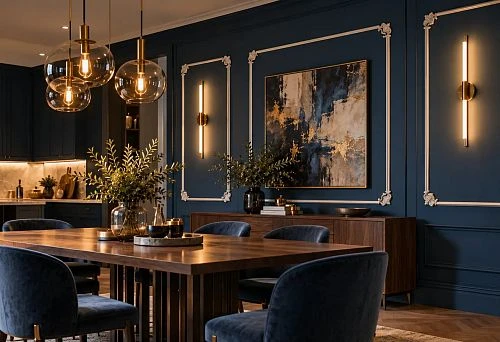
On the wall, backlighting is most often needed for accent. It can run along a decorative panel, next to moldings, along the edge of a niche, behind the TV area, around a wall composition, or along a vertical transition. Here it is especially noticeable if the strip is installed openly. A person looks directly at the wall, and any technical detail quickly catches the eye.
For a wall, it is important that the profile does not look like a random overlay. It should be connected to the overall finish: the line of furniture, ceiling, panel, mirror, or niche. LB30 works well in restrained scenarios where you need to neatly cover the strip. LB32 is more appropriate when the backlighting becomes an independent part of the composition.
If the task sounds like "how to make hidden backlighting on the wall", you should start not with choosing the brightness of the LED strip, but with choosing the location and profile. Light without an architectural outline often looks incomplete. The profile helps to set this outline and immediately understand where the line will run.
On the ceiling
Ceiling backlighting often requires more precision than wall backlighting. The line is above eye level, but a person sees it at an angle. If the light source is poorly hidden, points may be visible, especially when viewed from a far corner of the room.
In the ceiling area, it's important to assess the scale of the room. In a small room, a profile that is too large can visually lower the ceiling or make the transition heavy. In a spacious living room, hall, or commercial space, a deeper profile may look better because a thin element will get lost over a long length.
If you need to figure out what to cover an LED strip on the ceiling with, compare two scenarios. For a soft line along a small area, consider LB30. For more noticeable hidden lighting along a long line, it's worth looking at LB32. In both cases, you need to check in advance how the profile will join with the rest of the finish.
On the kitchen
In the kitchen, lighting often appears in the work area, on decorative wall sections, in niches, above the backsplash, around shelves, or in the transition zone between furniture and the wall. Here, an open LED strip especially quickly starts to look untidy: nearby there is cooking, humidity, reflective surfaces, and many straight lines.
When a customer asks what to cover an LED strip in the kitchen with, they most often need not just to hide the light, but to preserve clean geometry. The kitchen doesn't forgive random details: if the profile doesn't match the scale of the furniture, facades, and wall, it immediately looks out of place.
For the kitchen, a profile that doesn't interfere with the furniture and doesn't conflict with the backsplash will work. The compact LB30 may be suitable for local lighting. LB32 should be considered where there is room for a deeper edge and the lighting should be a noticeable part of the design. The electrical part, power supply, and the LED strip itself need to be selected separately, taking into account operating conditions.
At the mirror
The mirror amplifies all lighting errors. What is almost invisible on a regular wall can become obvious in the reflection: light spots, an uneven line, an overly bright edge, a visible strip, wire, or shadow from the profile.
When deciding how to cover an LED strip on a mirror, the main parameter is not just the size of the molding but also the viewing angle. A person will approach the mirror closely, looking from the side, top, and bottom. Therefore, an exposed strip almost always looks rougher than desired.
A molding for lighting helps make the light line softer. But before ordering, it's important to understand how the profile will be attached relative to the mirror, wall, and adjacent details. If the mirror area is small, a large profile can look heavy. If the mirror is large and the lighting should be expressive, a deeper option can provide better concealment of the light source.
On a decorative panel or in a niche
Decorative panels and niches pair especially well with hidden lighting. Light emphasizes depth, separates one plane from another, and makes the wall more voluminous. But it's precisely here that it's important not to spoil the impression with an open strip.
In a niche, the light source is often visible from different angles. On a decorative panel, the strip may intersect with relief, joints, texture, or other moldings. Therefore, the profile is needed not only as a covering element but also as part of the overall design.
For local panel lighting, a compact profile is often sufficient. For a deep niche, long line, or large accent area, you can consider the LB32. If you need to select several sections in the same style, it's better to open the section where you can buy moldings for backlighting and compare available profiles by size and purpose.
How to make hidden wall lighting without random solutions
The phrase "how to make hidden lighting" often leads to an endless selection of tape, power supply, glue, wires, and profiles. But for the external result, the main question is different: what will be visible after finishing? If the LED strip is visible, the lighting is no longer hidden. If only soft light and a neat edge are visible, the solution works correctly.
Hidden lighting starts with three decisions:
· where the line runs;
· what covers the light source;
· where the light is directed.
Molding helps cover exactly the visual part. It does not replace the electrical scheme and does not solve issues of power, connection, or safety. But it shapes what a person will see: the edge, shadow, light gap, transition from wall to light.
What you don't need to do from scratch if you have ready-made STAVROS profiles
In DIY scenarios, people often try to assemble backlighting from random strips, scraps, homemade boxes, or unsuitable decorative elements. Sometimes it works technically, but visually it looks weaker: the line is uneven, joints are visible, the profile doesn't match in height, and the light comes out too harsh.
A ready-made profile simplifies the task. There's no need to invent the shape of the side from scratch. There's no need to pick a random strip and check if it can cover the LED strip. There's no need to turn a decorative element into a technical box when there's a profile designed for hidden lighting.
The commercial route is simpler:
1. Determine the lighting location.
2. Choose a compact or deeper profile.
3. Open the LB30 or LB32 card.
4. Check the size, material, and length.
5. Calculate the number of segments.
6. Coordinate the electrical work with the master.
7. Order the profile and assemble the lighting line without random parts.
This approach is especially useful if the renovation is already close to the finishing stage. At this stage, mistakes are more costly: a random strip may not cover the tape, may not fit the scale, or may require redoing the finish.
How to choose a molding for backlighting by size
The profile size directly affects the appearance of the lighting. An error of a few millimeters can be more noticeable than it seems. If the profile is too small, it may not cover the light source. If too large, it will look heavy and clash with the finish.
The LB30 has dimensions of 30 mm × 15 mm × 2.0 m. The LB32 has dimensions of 32.5 mm × 24.0 mm × 2.0 m. The difference in height and depth changes not only the installation but also the perception. The LB30 looks more compact. The LB32 provides a more pronounced volume.
What to check before ordering
Before ordering, it is worth checking several things:
· where the LED strip will be located;
· whether it will be visible from common viewpoints;
· what gap is needed for light output;
· whether the profile depth is sufficient;
· how the profile will look next to furniture, ceiling, or mirror;
· how many segments are needed for the entire line;
· where the joints will be;
· whether painting or other finishing is needed;
· how the profile will connect with adjacent elements.
These questions help avoid the most common mistake: buying a profile based on a beautiful photo, only to find that on the actual wall it doesn't cover the tape or looks too bulky.
Why the 2.0 m length is important for calculation
Both models are specified with a length of 2.0 m. This is convenient for calculation: you can figure out in advance how many segments will be needed for a wall, niche, or ceiling line. But you need to consider not only the total length. It is important to account for joints, trimming, corners, and a margin for precise fitting.
If the lighting line is long, it's better to plan in advance where the joints will be. They should not fall in the most visible places. If the lighting runs near a mirror or on an accent wall, a joint in the center can spoil the impression. In such cases, it's better to discuss the layout with a craftsman before purchasing.
Hi Wood material: what the buyer needs to understand
LB30 and LB32 are listed as Hi Wood polystyrene moldings. This is important for the buyer for two reasons. First, the material is related to appearance and finish. Second, it affects how the profile will be perceived in the interior: as a neat decorative detail, rather than a rough technical box.
Polystyrene moldings are used in interior finishing when clean geometry, a clear size, and a decorative line are needed. But before ordering, you should still check the current data in the product card: the exact name, size, purpose, availability, and application features.
You should not automatically transfer tasks related to electrical components to the molding. The LED strip, power supply, wiring, controllers, and connection issues are selected separately. The profile is responsible for decorative concealment and forming the line, not for all the electrical work.
How to choose for different customer scenarios
Customers come to the topic of hidden lighting from different situations. One already has an LED strip glued and needs to cover it urgently. Another is just planning a renovation. A third is assembling lighting for the kitchen. A fourth is decorating a mirror. Therefore, one universal tip does not work here.
If the tape is already installed and needs to be covered
In this case, first assess where exactly the strip runs and how much space is left for the profile. Sometimes the strip is glued too close to the edge, and the chosen molding may not cover it at the required angle. Then you have to adjust the strip's position or choose a different profile.
If space is limited, start with the compact LB30. If the tape is too visible and a deeper lip is needed, look at LB32. The main thing is not to buy a profile before checking the actual distance on the wall.
If the lighting is only being planned
This is the most convenient scenario. You can immediately incorporate the profile into the project, choose a place for the strip, calculate the length, and understand how the light will emerge from behind the edge. There is less risk of rework here.
At the planning stage, it is useful to open the Hi Wood profile for hidden lighting and compare options within the same product group. This makes it easier to see which profile fits the scale and which is better left for another area.
If lighting is needed for the kitchen
For the kitchen, clean lines and practicality are important. The profile should not interfere with furniture, opening facades, shelves, or the work area. If the lighting runs near the backsplash, reflections must be considered. Glossy surfaces can enhance glare, so the tape needs to be hidden particularly carefully.
A compact profile is suitable for local areas. A deeper one is for zones where lighting should be part of the kitchen architecture. In any case, the electrical components need to be selected separately, and before ordering the profile, the dimensions should be checked against the actual furniture layout.
If lighting is needed near a mirror
Near a mirror, it's important to check the visibility of the strip in the reflection. Sometimes it seems the profile hides the light source, but in the mirror it's still visible from a different angle. Therefore, before purchasing, it's worth doing a simple check: imagine where a person will look at the mirror in the morning, evening, from the side, sitting or standing.
LB30 may be suitable for neat framing and a soft line. LB32 should be considered if the mirror is large or if the light source needs to be hidden more. However, a too deep profile on a small mirror can look heavy.
If lighting is needed for a commercial interior
In a salon, showroom, cafe, hotel, or office area, lighting works not only for aesthetics but also for impression. Open tape is especially undesirable in such an interior: it cheapens the finish and makes the space less thoughtful.
For commercial spaces, bolder lines are often more suitable because distances are greater, walls are larger, and light should be readable from afar. LB32 can be a good option for expressive lighting. LB30 is for local areas where a neat light contour without extra volume is needed.
Commercial selection block
|
User's task |
What to look at |
Where to go |
|
Close open LED strip on the wall |
LB30 Hi Wood |
|
|
Make a deeper hidden backlight |
LB32 Hi Wood |
|
|
Select other Hi Wood profiles |
Section of moldings, cornices, and baseboards |
This table helps quickly translate a task into a choice. If you need to close the strip neatly and without large volume, the first one to look at is LB30. If you need deeper backlighting, it's better to compare LB32. If the project is more complex and you need to select several lines, it's more convenient to open the Hi Wood section and compare profiles by sizes.
What to buy with backlit molding
Backlighting rarely consists of a single profile. Even if the buyer chooses only the decorative part, you need to think in advance about the line length, number of segments, joints, corners and adjacent elements. Otherwise, you can buy the right molding but make a mistake with the kit.
The main thing is not to turn the purchase into a random set. All profile segments must match in model, size, and future finish. If you use different profiles on one wall without a plan, the line may turn out uneven and visually broken.
What to add to the purchase
|
What to add |
Why it's needed |
What to pay attention to |
|
Additional segments of the same profile |
To keep the backlight line continuous |
Calculate length with allowance for trimming and joints |
|
Same profile for adjacent zone |
To make the backlight look seamless |
Do not mix LB30 and LB32 without a design reason |
|
Profiles from the same Hi Wood group |
To continue the line along the wall or ceiling |
Compare sizes and purpose in cards |
|
Mounting materials |
For fixing the profile to the base |
Select based on the base and the master's recommendations |
|
LED components |
For the lighting itself |
Tape, power supply, and electrical components are selected separately |
If the project includes multiple zones, it's better to decide in advance where LB30 will be and where LB32 will be. You can mix them, but only deliberately: for example, a compact profile in the mirror area and a deeper one in the ceiling niche. If different profiles accidentally meet on the same line, it almost always looks like a mistake.
How not to confuse a lighting molding with similar products
The buyer can easily get confused: molding, cornice, baseboard, profile, border, decorative strip — all these elements can look similar externally. But their purpose is different. For hidden lighting, it's not just the shape that matters, but the ability to cover the LED strip and direct the light.
|
Product |
Not to be confused with |
Main difference |
|
Molding for backlight |
Regular decorative molding |
Used to hide LED strip and form a light line |
|
LB30 |
With a wide ceiling profile |
More compact, suitable for a neat LED line |
|
LB32 |
With a simple wall molding |
Deeper and better suited for hidden lighting |
|
Baseboard |
With a profile for LED on the wall |
Baseboard covers the joint between floor and wall |
|
Crown molding |
Narrow wall profile |
More often works in the ceiling area and requires a different scale |
The most common mistake is to choose a regular molding because it looks nice in photos. But after installation, it turns out the LED strip is still visible. The second mistake is to buy a profile that is too large for a small area. It hides the strip but makes the wall look heavy. The third is not checking the depth and installation location, causing the light to go where it wasn't intended.
Practical selection for specific situations
Need to cover the strip on a small wall
For a small wall, a subtle profile is usually needed. It should hide the strip but not become the main element of the room. In such a situation, you can start with LB30. It is compact, so it's suitable for a neat line on the wall, in a niche, or next to a decorative panel.
Before ordering, check if the strip will be visible from the side. If the wall is in a walk-through area, a person will look at the lighting from different angles. Sometimes a compact profile is enough, and sometimes it is better to choose a deeper option.
Need to make lighting in a large living room
In a large living room, a thin line can get lost. If the lighting runs along a long wall, around the TV area, or along a ceiling transition, consider LB32. Its depth helps achieve a more expressive light contour.
But even here, you can't choose solely based on the principle 'more is better.' If there is already large furniture, panels, cornices, or decorative elements nearby, the profile should support the overall scale, not compete with it.
Need to design a niche
In a niche, the lighting is often visible from the side. Therefore, it is important to hide the light source deeper or choose a profile position where a person sees reflected light, not the tape itself. For a shallow niche, a compact profile will work. For a larger one, LB32 may look more convincing.
It's better to plan the joints in the niche in advance. If the profile breaks off in a noticeable place, the lighting loses its neatness. It's better to calculate the number of segments before installation and think about where the connections will be.
You need to close the tape near the mirror
Near a mirror, the task is more difficult due to reflections. Here, not only the profile matters, but also the placement of the light. If the tape is directed straight into the eyes or reflects in the mirror, even a good molding won't completely save the impression.
For a mirror, it's worth checking the viewing angle in advance. If the backlight is needed as a soft contour, a more compact profile will do. If the mirror is large and expressive light is required, you can consider LB32. Before ordering, it's better to compare the dimensions with the actual frame, wall, and distance to the mirror plane.
You need to make lighting in the kitchen
Kitchen lighting should look clean and not interfere with furniture. If the profile is installed near facades, it's important to consider door opening, cabinet depth, backsplash, and countertop edge. A scale error is especially noticeable here.
For a local area, you can look at LB30. For a more architectural line, LB32. But in the kitchen area, you need to separately address issues of electrical wiring, type of LED strip, and operating conditions. The molding covers and frames the line, but does not replace a full lighting calculation.
Mistakes when choosing molding for hidden lighting
Mistake 1. Choosing only by photo
A photo helps to understand the shape, but does not show the real scale in your room. A profile that looks thin in the product image may be noticeable on a small wall. Conversely, on a large wall, a compact element may get lost.
Before buying, it's better to check the dimensions. For LB30, it's 30 mm × 15 mm × 2.0 m. For LB32, it's 32.5 mm × 24.0 mm × 2.0 m. These numbers need to be correlated with wall length, ceiling height, furniture, and distance to the viewer.
Mistake 2. Not considering the profile depth
Depth affects how well the LED strip will be hidden. If the profile is too shallow, the strip may remain visible. If too deep, the light may not come out as desired. Therefore, the depth should be chosen based on the installation location and the desired effect.
LB30 is suitable for more neat solutions. LB32 is for deeper hidden lighting. But the final choice depends on where exactly the strip is placed and where the light should go.
Mistake 3. Confusing decorative molding with a profile for lighting
A regular molding can be beautiful but is not required to hide an LED strip. If it doesn't have the right shape, the light will come out incorrectly. As a result, the buyer gets a decorative strip but does not solve the main problem.
If the task is specifically to cover the LED strip, you need to look at profiles that are suitable for hidden lighting, not just any moldings of similar width.
Mistake 4. Not counting the number of segments
A profile length of 2.0 m is convenient for calculations, but you cannot only consider the total wall length. You need allowance, trimming, joints, corners, and possible waste. If you buy exactly "flush," a small section might be missing, and buying more later will complicate installation.
It's better to draw a line diagram in advance and mark where the joints will be. This is especially important for long walls, niches, and mirror areas.
Mistake 5. Buying different profiles without a unified plan
LB30 and LB32 can be used in one project, but not on the same random line. If one section is covered with a compact profile and another with a deeper one without an explainable reason, the interior looks assembled from leftovers.
Different profiles should be used where there are different tasks: for example, LB30 near the mirror, LB32 in the ceiling area. Then the difference looks logical.
Mistake 6. Leaving electrical work until the last moment
The profile for backlighting and the LED strip must be coordinated. If you first stick the strip, run the wire, close the finish, and then look for a molding, the choice narrows sharply. It may turn out that the suitable profile no longer fits.
It is better to plan the backlighting in advance: first the location, then the profile, then the electrical part and the installation diagram.
Mistake 7. Expecting the molding to function as a finished luminaire
The molding helps to cover the strip and shape the line, but by itself it is not a finished light fixture. The LED strip, power supply, control, and connection are selected separately. If you need a completely finished light fixture with a diffuser, that is a different product task.
Who is the Hi Wood molding with hidden lighting suitable for?
This solution is suitable for those who want a neat line of light without an exposed LED strip. It is especially useful in renovations where the lighting should look like part of the finish, not a technical addition after the work is completed.
Suitable
The molding with lighting is worth considering:
· apartment and house owners who want to cover an exposed LED strip;
· designers who need a clean light line on the wall or ceiling;
· finishing craftsmen who pre-assemble a kit for installation;
· buyers who install lighting in a niche, in the kitchen, or near a mirror;
· owners of commercial spaces where a neat finish appearance is important;
· those who want not just to glue a strip, but to create hidden lighting on the wall.
Not suitable
This molding should not be chosen if the buyer is looking for:
· an aluminum profile with a diffuser;
· a ready-made luminaire;
· the LED strip itself;
· power supply;
· controller;
· electrical installation components;
· technical box without decorative purpose.
This honest division is important. If a decorative hidden line is needed — LB30 and LB32 are suitable for consideration. If an electrical configuration is needed, it must be selected separately.
How to buy a molding with backlight for STAVROS
It is better to start the purchase not with the cart, but with checking the task. First, determine the location of the backlight: wall, ceiling, kitchen, mirror, niche, or decorative panel. Then choose the character of the line: compact or deeper. After that, you can proceed to product cards.
If a neat line is needed, open the LB30 card and check the size 30 mm × 15 mm × 2.0 m. If a deeper hidden backlight is needed, open the LB32 card and compare the size 32.5 mm × 24.0 mm × 2.0 m. If the project includes several zones, it is more convenient to first look at the general Hi Wood section and select profiles in one group.
Before ordering, it is worth checking:
· exact profile size;
· material;
· length;
· number of segments;
· installation location;
· joint diagram;
· compatibility with LED strip;
· installation features;
· need for finishing;
· current parameters in the product card.
If the lighting is designed for a complex area — a mirror, kitchen, ceiling transition, large niche, or commercial interior, it is better to discuss compatibility with the master in advance and clarify details with a STAVROS manager. This helps avoid a situation where the profile is purchased correctly but does not fit the actual installation location.
FAQ
What to cover an LED strip on the wall with?
For a wall, it is better to use a molding or profile for hidden lighting. It helps hide the LED strip, cover the technical edge, and get a softer light line. For a compact solution, consider LB30; for deeper lighting, LB32.
Can the LED strip be covered with molding?
Yes, but not just any molding. A regular decorative molding may not hide the strip or direct the light correctly. For this task, it's better to choose a profile specifically designed for hidden lighting.
How to make hidden lighting on the wall?
First, determine the lighting line, then select a profile that will cover the light source, and only after that plan the LED strip and electrical work. If done in reverse, the chosen molding may not fit or may not hide the strip.
Which to choose: LB30 or LB32?
LB30 is suitable for a neater and more compact LED line. LB32 is deeper and more appropriate where a more expressive hidden lighting is needed. The choice depends on the installation location, viewing angle, and wall scale.
Is a molding for lighting suitable for the kitchen?
Yes, such a profile can be considered for kitchen areas if you need to cover the LED strip and make the lighting line neater. However, the electrical work, LED strip, and operating conditions should be selected separately based on the specific kitchen.
What to use to cover an LED strip on the ceiling?
For the ceiling, you can use a profile for hidden lighting. In small areas, consider compact solutions, and for long lines and a more noticeable light effect, use deeper profiles, such as LB32.
What to use to cover an LED strip near a mirror?
Near a mirror, it's important to hide the strip so it doesn't reflect or shine in the eyes. A molding for hidden lighting will work, but before ordering, you need to check the viewing angle, distance to the mirror, and profile size.
How is a lighting molding different from a regular molding?
A regular molding primarily decorates a wall or joint. A lighting molding helps conceal the LED strip and shape the light line. Therefore, for hidden lighting, not only the decorative shape but also the profile geometry is important.
Do I need to buy the profile with extra length?
Yes, it's better to account for extra length for cutting, joints, and possible installation errors. LB30 and LB32 are 2.0 m long, so the number of segments should be calculated based on the actual line length, not just the wall size.
Can LB30 and LB32 be used in the same project?
Yes, if they have different purposes. For example, LB30 for a neat area near a mirror, LB32 for deeper lighting on the ceiling or in a niche. It's not advisable to mix different profiles on one continuous line without a plan.
Is the lighting molding sold together with the LED strip?
This article discusses Hi Wood decorative profiles. The LED strip, power supply, and electrical installation components are selected separately. Before ordering, you need to check the package contents in the product card.
Where to buy STAVROS molding for backlighting?
On the STAVROS website you can view the LB30 and LB32 cards, as well as the general section for Hi Wood moldings, cornices, and baseboards. Before purchasing, it is worth checking the dimensions, material, length, and purpose of the profile.
Result: how to cover the LED strip beautifully and without random details
An open LED strip rarely looks finished. Even if the light is chosen correctly, visible dots, wires, the edge of the base, and an uneven line can spoil the impression of the renovation. Therefore, it is better to cover the LED strip not with a random plank, but with a profile suitable for hidden lighting.
LB30 Hi Wood should be considered when a compact and neat line is needed. LB32 Hi Wood is suitable for deeper and more expressive hidden lighting. Both profiles help turn the LED strip from a technical detail into part of the interior.
Before ordering on STAVROS, check the installation location, profile dimensions, line length, number of segments, joints, and compatibility with the future LED lighting. This approach helps not just to cover the strip, but to get a clean, well-thought-out, and neat light line on the wall, ceiling, kitchen, near a mirror, or in a niche.