Article Contents:
- What is confirmed about NPU.VRS-006
- Why this article is not just another generic piece about NPU.VRS-006
- Why one large overlay can work without a molding frame at all
- Scale and geometry of the area above the sideboard
- First calculation — how proportionate NPU.VRS-006 is to the sideboard width
- Sideboard 1600 mm
- Sideboard 1800 mm
- Sideboard 2000 mm
- Center relative to the sideboard or the smooth wall field
- The sideboard is the main object
- Smooth wall as an independent panel
- Strong asymmetry
- The width of the smooth field matters more than the total wall width
- Height above the sideboard: measure not from the floor, but from the top surface of the furniture
- What the 23 mm relief changes
- Side lighting
- Perception of size
- Proximity to slats
- Why the absence of a frame requires more empty space, not less
- Slat panels nearby: who's the main character here — background or accent
- Slats — a narrow side strip
- Slats take up half the wall
- Slats run from floor to ceiling in a wide field
- Why NPU.VRS-006 above the sideboard shouldn't extend onto the slat field
- One large NPU vs. a molding frame: it's not just the price you should compare
- Scenario A. One NPU.VRS-006
- Scenario B. Frame composition
- When NPU.VRS-006 without a frame looks complete
- There is a clear horizontal base
- There is a clean wall around
- Slat panels remain an adjacent system
- There is no other large wall center in the room anymore
- The relief is read by light
- The color does not require a separate outline
- When without a frame, NPU.VRS-006 starts to look random
- Too large a smooth field
- No Connection with Furniture
- There are many small objects nearby
- The ornament is too contrasting
- The furniture is very massive
- Sideboard with mirror: NPU.VRS-006 is no longer the first candidate
- The mirror remains the main element
- NPU replaces the mirror
- NPU and the mirror work together
- Sideboard with wall sconces: you need to check not only the free space, but also the light pattern
- Sideboard with table lamps, vases, and decor: permanent items are included in the calculation
- If the sideboard has a tall superstructure, NPU.VRS-006 may not be needed
- The horizontal format of NPU.VRS-006 works well against vertical slats — under one condition
- The monochrome version is the first test for a modern interior
- The contrasting NPU.VRS-006 requires support in the interior
- 23 mm of relief and side lighting can replace part of the frame's visual function
- How to check NPU.VRS-006 with a full-size template
- Stage 1. Dimensions
- Stage 2. Real silhouette
- Stage 3. Volume
- Stage 4. Light
- Stage 5. Distance
- Installation: a large overlay requires checking the base, not just choosing the adhesive
- Markup for a meter-long NPU should be along two axes
- If the wall is uneven, a relief ornament can emphasize the problem
- NPU.VRS-006 should not become a way to hide a wall defect
- When a molding frame is still better than a single NPU.VRS-006
- The wall is very large
- The interior already has repeating molding panels
- Symmetry with another zone is needed
- The wall requires several levels of decor
- The sideboard itself is architecturally complex
- When it's better not to buy NPU.VRS-006 at all
- If NPU.VRS-006 is too large, don't automatically switch to a set of small parts
- If NPU.VRS-006 is too small for the wall, a frame is just one of the options
- Commercial calculation: how much a solution with one NPU.VRS-006 costs
- Why one NPU can be more cost-effective in terms of labor even without comparing prices
- If the renovation is already finished, one NPU creates fewer intervention zones
- How to check the wall before installation without risking the finish
- Mistake 1. Centering on the wall when the composition belongs to the sideboard
- Mistake 2. Judging size only by the screen
- Mistake 3. Ignoring the 352 mm height
- Mistake 4. Not accounting for the 23 mm relief
- Mistake 5. Moving the NPU too close to the rails
- Mistake 6. Adding a frame just because "it's more classic"
- Mistake 7. Making the NPU contrasting because it gets lost
- Mistake 8. Checking the wall without permanent decor on the sideboard
- Mistake 9. Using the NPU to mask a wall defect
- What to check 15 minutes before buying the NPU.VRS-006
- Step 1
- Step 2
- Step 3
- Step 4
- Step 5
- Step 6
- Step 7
- Step 8
- Step 9
- Step 10
- Step 11
- Step 12
- Step 13
- Step 14
- Step 15
- Full algorithm from empty space above the buffet to ordering
- Decision matrix
- Can NPU.VRS-006 be used above a console instead of above a buffet?
- Will NPU.VRS-006 fit above a buffet that is not against a wall but in a niche?
- Can NPU.VRS-006 be placed vertically?
- Is it necessary to install two identical NPU.VRS-006 units above a very long buffet?
- Can a TV be placed between the buffet and NPU.VRS-006?
- What to do if the buffet is later replaced with a wider one?
- Can NPU.VRS-006 be installed on a wall with decorative plaster?
- Is additional mechanical fixation required?
- Can NPU be painted to match the color of slat panels?
- Where to look for a more compact overlay if 1067 mm is too much?
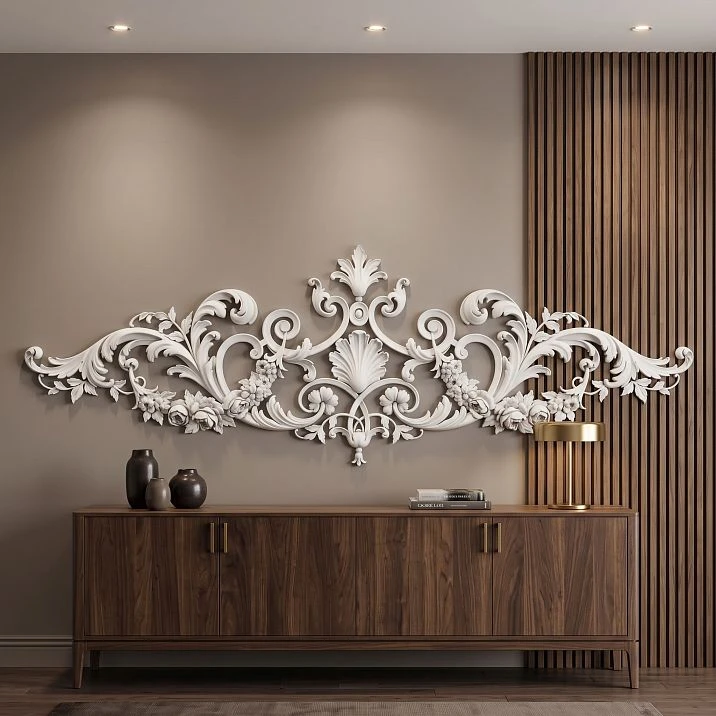
Above a low sideboard or dresser, a wide smooth wall remains, while the vertical rhythm of slat panels already works on the side. In such a zone, it's easy to start assembling the familiar classic scheme: molding frame, corner elements, central overlay, additional transitions. But NPU.VRS-006 has a different scale. This is no longer a small detail that necessarily needs architectural "support" around the perimeter.
The current polyurethane NPU.VRS-006 measures 1067 × 352 × 23 mm and costs 29,320 ₽ per piece. With a width of over a meter, it can take on an independent compositional role on a smooth wall. For such a scenario, the main question is not "which molding to match with the overlay," but:
Is one NPU.VRS-006 above the sideboard enough to make the wall look complete without a frame?
The answer depends on five things:
-
the width of the sideboard;
-
the width of the smooth field between the slat zones and other boundaries;
-
the height of the free wall;
-
the 23 mm relief and lighting;
-
the number of already existing accents nearby.
If a large overlay occupies the right share of the wall, has a clear axis with the furniture, and a calm field remains around it, the molding frame can indeed be unnecessary. Then the basket is simple:
1 × NPU.VRS-006 = 29 320 ₽
plus compatible materials for installation and final painting, if they are needed per the project.
If a meter-long ornament gets lost on a huge wall, conflicts with a mirror, sconce, or slat panel field, buying one NPU.VRS-006 does not solve the task. In such a case, it is wiser to switch to another composition rather than add more moldings around an already unsuitable element.
The first practical step before ordering is to make a full-size template of 1067 × 352 mm and test it not on an empty wall, but above a real sideboard, with installed slats, lighting, and those items that will remain in the interior.
After such a check, you can buy the carved decorative overlay NPU.VRS-006 1067 × 352 × 23 mm already as a confirmed standalone accent.
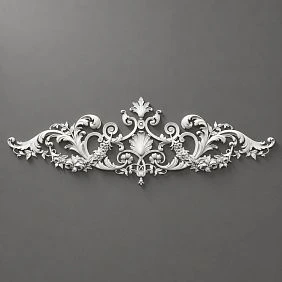
What is confirmed for NPU.VRS-006
| Parameter | Value |
|---|---|
| Article number | NPU.VRS-006 |
| Type | large decorative polyurethane overlay |
| Collection | "Versailles" |
| A, width | 1067 мм |
| B, height | 352 мм |
| C, thickness | 23 мм |
| Material | Polyurethane |
| Current price | 29 320 ₽ |
| Base quantity for the article | 1 pc. |
| Role | self-sufficient wall accent above furniture |
In the official STAVROS filter, size A is designated as width, B as height, and C as thickness. For this article, the geometric orientation is confirmed: NPU.VRS-006 is considered a horizontal ornament with a width of 1067 mm, a height of 352 mm, and a relief of up to 23 mm.
This is important because it is the horizontal format that connects the overlay to the long top surface of the sideboard.
But the numbers 1067 × 352 mm describe the overall dimensions of the product. They do not mean that the entire rectangle is filled with solid material. For final fitting, it is better to use an image, drawing, or 3D model of the actual contour, rather than just a paper rectangle.




Why this article is not just another general piece about NPU.VRS-006
On the STAVROS website, NPU.VRS-006 already appears in broad materials about classic decor, the Versailles series, and the combination of polyurethane molding with modern interior solutions.
In one of the materials, large VRS overlays are directly considered as standalone accents on the wall. This is an important confirmation of the very idea, but not a ready-made answer for a specific area.
The buyer above the sideboard still has to decide independently:
-
whether the NPU is too wide relative to the furniture;
-
whether it is too small relative to the entire smooth wall;
-
where to center it;
-
how much free space to leave;
-
whether a frame is needed;
-
how it will interact with vertical slats;
-
what will happen with side lighting;
-
whether a mirror, sconce, or painting will end up nearby;
-
whether such a degree of classical ornamentation is needed at all.
This article addresses exactly that gap.
It does not restate the product card or explain the entire Versailles collection. After reading it, a person should be able to make one of three decisions:
1. Buy one NPU.VRS-006 and leave the surrounding wall clean.
2. Do not buy NPU.VRS-006 because the scale or style does not fit.
3. Move to a full-fledged frame composition if one large overlay does not solve the wall architecture.
Our factory also produces:
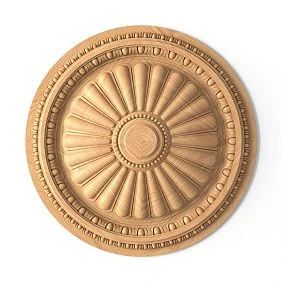
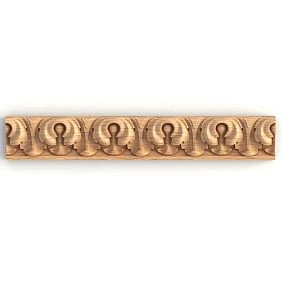
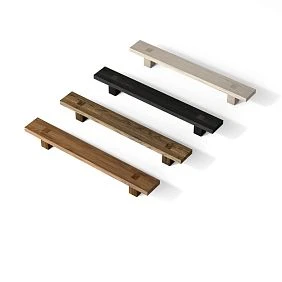
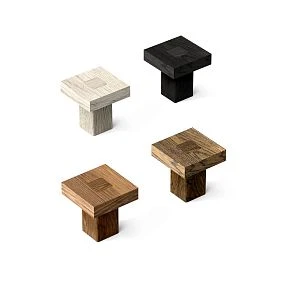
Why one large overlay can work at all without a molding frame
A molding frame is needed not because any stucco decor 'must be framed.'
It performs specific functions:
-
defines boundaries;
-
organizes the empty field;
-
connects several elements;
-
introduces repeating geometry;
-
creates architectural order on a large surface.
NPU.VRS-006 itself has a width of 1067 mm and a pronounced complex ornament. That is, it already performs some of these functions.
Above a low sideboard, it can be perceived as:
-
a stucco panel;
-
a horizontal dominant;
-
a replacement for a painting;
-
an ornamental center;
-
a relief "crown" of the furniture zone.
If you add a frame around an element that is already large enough without it, the result is not automatically "richer," but denser.
Sometimes this is necessary.
For example, if the entire wall is built from repeating classic panels.
But if there are already slatted panels nearby, the vertical rhythm is created by another material. An additional rectangular frame can become a third strong geometric system:
vertical slats → rectangular molding frame → complex floral ornament NPU.VRS-006.
Without a frame, the composition is simpler:
slats → smooth field → one large ornament.
For a modern interior with a classic accent, the second option is often more logical precisely because there is a pause between the systems.
Get Consultation
Scale and geometry of the area above the sideboard
The first calculation — how proportionate NPU.VRS-006 is to the width of the sideboard
A meter-long overlay cannot be evaluated separately from the furniture.
The sideboard sets the nearest horizontal base.
NPU.VRS-006 has a width of 1067 mm. Let's compare it with three typical furniture sizes.
| Sideboard width | Share of NPU from furniture width | Free furniture width on the sides with a common axis |
| 1600 мм | 66,7% | 266.5 mm each |
| 1800 мм | 59,3% | 366.5 mm each |
| 2000 мм | 53,4% | 466.5 mm each |
This is not a table of standards.
It shows how the scale of the connection changes.
Sideboard 1600 mm
NPU occupies approximately two-thirds of its width.
The connection is very direct: the ornament clearly belongs to this specific piece of furniture.
Sideboard 1800 mm
The NPU takes up just under 60%.
The composition becomes calmer, with more air around it.
Sideboard 2000 mm
The overlay takes up about half the width.
It already looks like a more independent center, while the furniture acts as a wide base.
None of these options can be declared universally correct. But a full-size fitting immediately shows where your interior falls on the scale from "the overlay almost repeats the furniture" to "the overlay is a compact center above a wide piece."
Center it relative to the sideboard or to the smooth wall field
This is one of the most useful questions for a real interior.
Let's imagine that the sideboard is not placed strictly in the center of a smooth wall. For example, a slatted panel starts on the right, leaving more free space on the left. Then the composition has two possible axes:
-
furniture axis;
-
axis of the smooth part of the wall.
They may not coincide.
If NPU.VRS-006 is centered on the wall, it may visually "shift" relative to the sideboard.
If centered on the furniture, different side margins will remain around it.
What to choose?
The sideboard is the main object
If the entire zone is perceived as:
sideboard + decor above it,
the main axis usually becomes the furniture.
Then the overlay belongs to the item and enhances it.
Smooth wall — independent panel
If the sideboard is low and neutral, and the entire smooth surface works as a separate architectural zone between the slats, you can focus on the center of that surface.
Strong asymmetry
If the difference between the two axes is noticeable, you cannot try to "average" the position by eye.
It is better to make two full-size mockups:
Option A — center of the NPU aligned with the sideboard;
Option B — center of the NPU aligned with the smooth field.
Then photograph both from the same point.
Such a test is more useful than any universal rule.
The width of the smooth field is more important than the total width of the wall
Next to slatted panels, you need to measure not the entire room wall, but the clean smooth zone within which the NPU.VRS-006 will exist.
If the smooth field has a width S, and the NPU is 1067 mm, the symmetrical side fields when centered are:
(S − 1067) / 2.
For example:
| Width of the smooth field | Remainder in width | Side margin when centering |
| 1400 мм | 333 мм | 166.5 mm each |
| 1600 мм | 533 мм | 266.5 mm each |
| 1800 мм | 733 мм | 366.5 mm each |
| 2000 мм | 933 мм | 466.5 mm each |
This table does not establish a "minimum allowable clearance."
It shows the nature of the composition.
With a field of 1400 mm, the overlay takes up most of the available width.
At 2000 mm, there is already a lot of empty wall around it.
Both solutions can be correct, but they look completely different.
If there is a wide slat panel with an active rhythm nearby, side fields that are too small can create a feeling that the ornament is squeezed between two systems.
If the fields are very large, another problem arises: NPU.VRS-006 may stop assembling the wall and turn into a lone object.
Height above the sideboard: you need to measure not "from the floor," but from the top surface of the furniture
NPU.VRS-006 has a height of 352 mm.
For the zone above the furniture, it is most useful to determine:
-
top of the sideboard;
-
bottom edge of the overlay;
-
top edge of the overlay;
-
the remainder up to the ceiling or cornice.
Let:
-
sideboard height — 850 mm;
-
bottom gap from the countertop to the NPU — 250 mm.
Then:
lower edge of NPU = 850 + 250 = 1100 mm from the floor;
upper edge = 1100 + 352 = 1452 mm;
center of NPU = 1276 mm.
This is not a ready-made recommendation for height.
This is a way to see the real vertical composition.
If there is a tall vase 500 mm on the buffet, the lower gap of 250 mm no longer works.
If the buffet is empty and very low, the overlay can be lowered.
If there are sconces nearby, their axes also affect the decision.
Therefore, the vertical is checked after the furniture and permanent items are already defined.
What changes the 23 mm relief
23 mm is not a decorative formality.
On a flat drawing, NPU.VRS-006 looks like a graphic ornament.
On the wall, it protrudes and creates a shadow.
This affects three things.
Side light
With side lighting, the relief becomes significantly more active.
Perception of size
A three-dimensional ornament always appears visually "heavier" than a flat template of the same 1067 × 352 mm.
Proximity to slats
The slats already create deep vertical shadows.
NPU adds a different type of relief.
If both are close, the wall can become too saturated.
Therefore, a flat paper mockup is only the first stage.
It is useful to make a simple three-dimensional test: place a material about 20–23 mm thick under the template and look at the wall in real light.
This makes it clearer whether this level of relief is needed without a frame.
Why the absence of a frame requires more empty space, not less
It seems logical: if there is no frame, then the NPU can be moved closer to the rails or furniture.
In practice, it is the opposite.
When there is no molding border, the clean wall around the overlay becomes its frame.
The empty field performs an architectural function:
-
separates the ornament from the rails;
-
shows its silhouette;
-
lets the shadow read freely;
-
prevents furniture from "sticking" to the decor;
-
creates completeness without additional profiles.
Therefore, the "one NPU without a frame" option works not through minimalism per se, but through controlled negative space.
If a smooth field is too tight, a molding system sometimes, on the contrary, helps organize it.
Slat panels nearby: who is the main here — the background or the accent
Slats can occupy different proportions of the wall.
Slats — a narrow side strip
Then they work as an architectural boundary.
NPU may be the main focus.
The slats take up half the wall
Then an equal dialogue between the two systems emerges.
The scale of the NPU needs to be checked especially carefully.
The slats run from floor to ceiling in a wide field
In this case, the vertical rhythm is already very strong.
NPU.VRS-006 may be appropriate only as a calm secondary accent, not as a competing dominant.
The first test should be to make the NPU in the color of the wall, not in contrast.
If even the monochrome version overloads the composition, the frame is definitely not needed — rather, the overlay itself should be abandoned.
Why NPU.VRS-006 above the sideboard should not extend onto the slat field
The card allows application on walls and wall panels, but the specific scenario of this article is a smooth wall next to slatted trim.
If a large NPU partially extends onto the slats, new problems arise:
-
the back surface rests on different levels;
-
the ornament crosses the vertical slats;
-
it is harder to ensure an even fit;
-
a pattern conflict appears;
-
installation ceases to be local on a single plane.
Therefore, if the dimensional template 1067 × 352 mm crosses the slat boundary, it is not a reason to automatically glue "over" it.
First, you need to:
-
check the actual contour;
-
assess whether the NPU can be shifted;
-
compare a more compact decor;
-
if necessary, leave a smooth wall.
For adjacent finishing, you can buy slat panels for walls for interior finishing, but their installation and NPU setup are two separate tasks.
One NPU.VRS-006 or a molding frame: two different design principles
One large NPU versus a molding frame: you need to compare not only the price
The main commercial alternative of the article is two different systems.
Scenario A. One NPU.VRS-006
The basket includes:
-
1 × NPU.VRS-006;
-
compatible mounting material;
-
final painting, if provided.
The price of the overlay itself is 29,320 ₽.
Scenario B. Frame composition
It may include:
-
molding around the perimeter;
-
four corner joints;
-
a central overlay;
-
additional decorative elements;
-
mounting materials;
-
painting.
But without specific selected items, it is impossible to honestly calculate its cost.
Therefore, the article does not invent "the frame will cost 40–50 thousand."
The comparison should be based on parameters:
| Criterion | 1 × NPU.VRS-006 | Molding frame + decor |
| Number of main decorative elements | 1 | several |
| Joints | no frame joints | minimum frame corners |
| Markup | one axis and height | entire perimeter |
| Visual character | one large accent | architectural system |
| Risk of overload near rails | Below | Higher |
| Composition flexibility | Below | Higher |
| Cost | known for NPU | depends on the selected profiles and details |
This table helps to understand the main point:
one NPU is not a "budget version of the frame," but a different design principle.
When NPU.VRS-006 looks complete without a frame
An independent large accent has several signs.
There is a clear horizontal base
A sideboard or dresser sets the bottom line.
The NPU does not hang "by itself," but works in conjunction with the furniture.
There is a clean wall around it
The ornament does not have to compete for space.
Slat panels remain an adjacent system
They do not enter the NPU silhouette and do not cut into it.
There is no other large wall center in the room anymore
If a large mirror, painting, or TV hangs nearby, the NPU may become redundant.
The relief is read by light
23 mm provides enough plasticity that the ornament does not need a rectangular frame just for expressiveness.
Color does not require a separate "outline"
If the NPU is painted in the tone of the wall or close to it, the relief itself creates the boundary.
In such a scenario, an additional molding often solves nothing — it just adds another layer.
When without a frame, NPU.VRS-006 starts to look random
There are opposite signs.
Too large smooth field
If the wall is 4–5 meters wide, and the NPU takes up only 1067 mm, it can get lost.
No connection with furniture
The sideboard stands in one place, and the overlay is centered on a different axis.
There are many small objects nearby
Shelves, sconces, paintings, outlets, switches break up the field.
The ornament is too contrasting
On a white wall, a gold or black NPU becomes a separate sign and requires more thoughtful support.
The furniture is very massive
A large tall sideboard can visually "outweigh" a horizontal overlay.
In such situations, a frame sometimes really helps because it expands the architectural zone around the ornament.
But before adding moldings, you need to make sure that the NPU.VRS-006 itself fits in style and scale.
Neighboring objects, light, and slat paneling: what changes the decision
Sideboard with a mirror: NPU.VRS-006 is no longer the first candidate
This is an important edge case.
Many sideboards are styled with a mirror above the countertop.
If a mirror is already present, NPU.VRS-006 cannot be considered an automatic addition.
Three solutions are possible.
The mirror remains the main element
Then it's better not to buy an NPU.
NPU replaces the mirror
Suitable if the reflection function is not needed, but you want a relief ornament.
NPU and mirror work together
This is a complex composition.
Need to check:
-
distance;
-
axes;
-
sizes;
-
reflection of slats;
-
number of decorative centers.
For the original theme, it's better not to expand the system unnecessarily.
If the mirror is already large and expressive, one NPU.VRS-006 next to it can turn the wall into a set of competing objects.
Buffet with sconces: you need to check not only the free space, but also the light pattern
Two sconces on the sides can support NPU.VRS-006 well.
But here there is a new variable — light.
Sconces can:
-
highlight the relief;
-
create double shadows;
-
visually expand the composition;
-
make the ornament too active.
If sconces are already installed, the template should be viewed specifically under their working lighting.
It is useful to check two options:
NPU between sconces;
NPU without sconces as a separate center.
If the lights are placed close together, a large ornament of 1067 mm may be too wide.
If the sconces are far apart, they, on the contrary, help form a compositional frame without molding.
In this case, the lights themselves perform part of the frame's function.
Sideboard with table lamps, vases, and decor: permanent items are included in the calculation
You cannot do a fitting over completely empty furniture if the sideboard will always be used for decor.
A tall vase, lamp, or flower arrangement may visually extend into the NPU zone.
You need to determine:
-
what remains permanently;
-
what is temporary;
-
what is the maximum height of items.
For example, with a bottom gap of 250 mm, a tall vase of 400 mm will visually cover part of the overlay.
This is not necessarily bad.
But the composition will already look different.
Therefore, a full-size mockup is checked with real items on the countertop, not on an empty scene after renovation.
If the sideboard has a tall superstructure, NPU.VRS-006 may not be needed
The theme is designed for a low sideboard or dresser.
If the furniture has:
-
display top part;
-
shelves;
-
high cornice;
-
decorative superstructure,
the free wall above it becomes smaller.
Then NPU.VRS-006 either:
-
does not fit;
-
rises too high;
-
competes with the furniture cornice.
In that case, it is better to work with the furniture itself rather than adding a meter-long ornament above it.
The horizontal format of NPU.VRS-006 works well against vertical slats — under one condition
Combining horizontal and vertical can be powerful.
Slats:
-
stretch the wall;
-
create a repetition;
-
direct the gaze upward.
NPU.VRS-006:
-
collects a horizontal zone;
-
connects with the top of the sideboard;
-
stops the gaze.
This is how balance appears.
But it only works if there is a clear boundary between the systems.
If the NPU almost touches the slats or partially enters them, instead of balance you get a collision.
Therefore, for a standalone overlay without a frame, it is especially important not to randomly bring the ornament to the adjacent slatted texture.
The monochrome option is the first test for a modern interior
If the slatted panels have a modern character, and NPU.VRS-006 has a classic floral ornament, the safest first option is to paint the overlay in the color of the smooth wall.
Like this:
-
the ornament is read through the shadow;
-
the classic motif becomes calmer;
-
the slats retain the role of a material accent;
-
NPU does not turn into a "gold appliqué".
This is especially useful in interiors where you need to combine classic and modern without theatricality.
The contrasting color should only be tested after the monochrome version has already been evaluated.
The contrasting NPU.VRS-006 requires support in the interior
A black, bronze, golden, or dark graphite overlay on a light wall will become a very strong object.
Then there should be other elements of the same level nearby:
-
hardware;
-
lighting fixtures;
-
metal;
-
furniture details;
-
cornice;
-
frames.
If contrast exists only on one NPU, it may look like a randomly added decorative emblem.
This is not a question of "can or cannot."
This is a question of system.
A standalone large ornament without a molding frame needs not a frame as such, but a clear connection with the rest of the interior.
23 mm of relief and side light can replace part of the visual function of a frame
A frame creates a boundary with a line.
NPU.VRS-006 can create a boundary with shadow.
With side light, a 23 mm relief forms its own chiaroscuro shell.
This works especially well on a solid-color wall.
In this case, the ornament reads:
-
by the outer silhouette;
-
by internal variations;
-
by shadow;
-
by changes in surface brightness.
That is, the element already has a visual "frame," not drawn with molding, but created by light.
This is a strong argument in favor of a single NPU in an interior where additional linear geometry would be superfluous.
Full-size fitting, marking, and installation on a finished wall
How to check NPU.VRS-006 with a full-size template
The fitting should be done in two stages.
Stage 1. Overall dimensions
Make a rectangle 1067 × 352 mm.
It shows:
-
place;
-
scale;
-
axis;
-
free margins;
-
intersections with other objects.
Stage 2. Real silhouette
If the first test passed, print or transfer the ornament outline itself from the available image/drawing.
This shows where the NPU has voids and protruding parts.
Stage 3. Volume
Add a conditional 23 mm of depth.
You can make a simple foam board or cardboard mock-up.
Stage 4. Light
Turn on:
-
daytime;
-
main ceiling;
-
wall sconce;
-
slat backlight.
Stage 5. Distance
Look from at least three points:
-
the entrance to the room;
-
main seating area;
-
close point at the buffet.
Only after these five stages does it become clear whether the element without a frame is needed.
Installation: a large overlay requires checking the base, not just choosing the glue
NPU.VRS-006 is wider than a meter.
Although the material is polyurethane, installation cannot be reduced to the phrase:
"take strong glue."
Need to check:
-
wall type;
-
finish strength;
-
flatness of the plane;
-
back geometry of the pad;
-
installation system recommendations;
-
temporary fixation method;
-
possibility of position adjustment.
The product card shows KUDO HIGH TACK among related materials, and the website has a separate section for stucco installation materials.
But the specific composition is chosen based on the actual substrate.
The fact that the product is sold alongside glue does not mean universal compatibility with any decorative paint, plaster, microcement, or other finish.
Marking for a meter-long NPU must be done along two axes
A small overlap can sometimes be visually corrected by a few millimeters.
NPU.VRS-006 with a width of 1067 mm shows the error more strongly.
Before installation, the following are fixed:
-
horizontal axis;
-
vertical axis;
-
the lower mark;
-
center.
If the sideboard stands level, the top line of the furniture helps check the horizontal.
But you cannot automatically assume that the floor, ceiling, and furniture are perfectly parallel.
It is better to use tool-based marking and then visually check the result from the main viewpoint.
If the wall is uneven, a relief pattern can emphasize the problem.
A long overlay over a meter in length interacts with the surface differently than small decor.
If the wall has a noticeable wave:
-
the back surface may not fit evenly;
-
the edge may peel;
-
the shadow becomes different;
-
the installation joint becomes more complex.
Significant curvature cannot be compensated with a "thick layer of glue" without verifying the technology.
First, the flatness of the wall is assessed.
If preparation is needed, it is done before painting or locally according to an agreed system.
NPU.VRS-006 should not become a way to hide a wall defect.
A large pattern can physically cover:
-
a stain;
-
a crack;
-
an unsuccessful patch.
But this does not make it a repair material.
If the base:
-
is peeling;
-
is cracking;
-
is crumbling;
-
has a weak top layer,
first eliminate the cause.
Otherwise, the mounting compound will adhere to an unstable surface.
Decor can be used on an already repaired wall, but not as a "lid" over a technical problem.
When a molding frame is still better than one NPU.VRS-006
Rejecting the frame should not become a dogma.
There are situations where frame architecture is objectively stronger.
The wall is very large
On a long, tall wall, a single overlay 1067 mm wide may not organize the entire plane.
The frame increases the architectural scale of the composition without increasing the NPU itself.
The interior already has repeating molding panels
If adjacent walls are framed, a single "bare" ornament above the sideboard may fall out of the system.
Symmetry with another zone is needed
For example, there is a mirror in a molding frame opposite.
Then a similar architectural frame above the sideboard can support the overall logic.
The wall requires several levels of decor
In a classic interior, a single NPU can look too autonomous.
The frame connects it with the cornice, baseboard, and other profiles.
The sideboard itself is architecturally complex
If the furniture has a carved cornice, panels, columns, and complex facades, a single overlay without a frame can look like a separate layer rather than a continuation of the system.
In these cases, the frame is not an "extra charge for luxury" but a tool for organizing a large wall.
Commercial choice: one NPU.VRS-006, another decor, or a full frame system
When it's better not to buy NPU.VRS-006 at all
A commercial article must provide a refusal scenario.
NPU.VRS-006 is not worth buying if:
-
the smooth field is significantly narrower than 1067 mm;
-
the overlay crosses the slatted part of the wall;
-
the sideboard is so narrow that the ornament looks wider than its visual base;
-
there is already a large mirror nearby;
-
wall sconces, paintings, or shelves break up the field;
-
the 23 mm relief is too active for a small room;
-
the classic floral ornament is not supported by the interior;
-
the wall texture itself is already a strong accent;
-
we want almost imperceptible modern decor;
-
the base is unstable;
-
future traceless dismantling is mandatory, but not confirmed;
-
the frame is needed for the logic of the whole room, not just for this zone.
In that case, it is better to Buy decorative polyurethane overlays of a different scale or leave a smooth wall altogether.
If NPU.VRS-006 is too large, there is no need to automatically switch to a set of small details
This is a typical mistake.
A person makes a template 1067 × 352 mm, sees that it is too large, and decides:
then I will take five small overlays.
But several small elements create another problem:
-
more points;
-
more axes;
-
more distances;
-
more risk of random composition.
Correct sequence:
-
understand what overall scale is needed;
-
choose one more compact central element;
-
only if the task really requires a system — assemble a set.
The catalog has different Polyurethane decorative appliques, so rejecting NPU.VRS-006 does not automatically mean switching to a "scatter" of decor.
If NPU.VRS-006 is too small for the wall, a frame is just one of the options
The opposite situation: the smooth wall is very wide.
One NPU looks small.
Allowed:
-
add a molding frame;
-
use a wider composition;
-
add sconces on the sides;
-
make a color field;
-
choose a different wall object;
-
leave more empty space if it suits the interior.
It is not necessary to necessarily "complete" the NPU with moldings.
Perhaps the product itself simply does not match the scale of the wall.
This is an important distinction between supporting a suitable element and saving an unsuitable one.
Commercial calculation: how much does a solution with one NPU.VRS-006 cost
The price of the overlay itself is 29,320 ₽.
For one zone above the buffet, the base quantity is 1 pc.
Product cost:
1 × 29 320 = 29 320 ₽.
This is where the precise calculation ends.
You cannot honestly add:
-
“500 ₽ for glue”;
-
“3000 ₽ for painting”;
-
“5000 ₽ for installation,”
if the specific materials, consumption, base, and contractor are not defined.
Therefore, the final estimate consists of two parts:
confirmed product cost — 29,320 ₽;
variable cost of installation and finishing — calculated according to the project.
If comparing a molding frame, its budget should also be calculated only after choosing:
-
molding article;
-
perimeter;
-
number of planks;
-
angles;
-
other overlays;
-
installation materials.
Thus, the commercial comparison remains fair.
Why one NPU may be more advantageous in labor intensity even without price comparison
Even if the cost of the frame is unknown, the work structure can be compared.
One NPU requires:
-
one main layout;
-
one major fitting;
-
one ornamental object;
-
one finish joint contour.
The frame requires:
-
four sides;
-
at least four corner joints;
-
diagonal control;
-
cutting;
-
corner alignment;
-
central element;
-
more seams.
This does not mean that installing NPU.VRS-006 is "easy."
A large overlay itself requires precision.
But the system is simpler in terms of the number of components.
For a finished repair, this may be more important than a small difference in price.
If the repair is already completed, one NPU creates fewer intervention zones
This is a separate scenario.
The wall is already painted.
The sideboard is installed.
The slats are mounted.
Then the frame composition means long mounting lines across the entire wall.
One NPU is a local intervention in one place.
But the advantage only works under two conditions:
-
The NPU is truly suitable;
-
The wall finish is compatible with the mounting.
If for a large element you have to aggressively prepare the base or repaint a large area, the advantage diminishes.
How to check the wall before mounting without risking the finished finish
Before purchasing, you don't need to:
If the center is chosen based on the sideboard, its vertical axis coordinate coincides with the center of the furniture. If based on the wall, it coincides with the center of the smooth field. These two versions are not mixed.
For the side free fields, a simple formula is used:
F = (Ws − 1067) / 2
only if the NPU is truly centered within the smooth field.
For the vertical:
top of NPU = Hb + G + 352
where G — the selected bottom clearance above the furniture.
These formulas do not set a standard. They turn a visual idea into a verifiable scheme.
For example, if the upper boundary of the zone is a cornice, a shelf, or the start of other decor, you can immediately see whether the vertical field is sufficient without changing the furniture itself.
The map is especially useful when there are slats on the right, a door on the left, and two sconces above the sideboard. Then the decision is made not by a single number like "1067 mm seems to fit," but by the entire system of constraints.
Operation above the sideboard: access to the wall and maintenance also influence the choice
NPU.VRS-006 has a pronounced relief. Above the sideboard, this is usually a safe decorative zone, but it remains part of the living space.
It should be taken into account that:
-
the relief collects dust more noticeably than a smooth wall;
-
access to the upper curls should be possible without moving heavy furniture;
-
tall items on the sideboard should not constantly touch the decor;
-
if the sideboard is used for serving, it is important not to turn the lower edge of the overlay into a place of constant accidental touches.
The STAVROS card indicates that polyurethane decor does not require special care. For the project, this means no complex service procedure, but it does not cancel the usual careful cleaning of the relief.
If the sideboard stands in a passage where large items are often carried past the wall, it is useful to check how protected the 23 mm protrusion is from impacts.
This is another difference from a flat picture: the ornament has physical depth.
Mistakes that make one large NPU visually weaker than the frame
Mistake 1. Centering on the wall when the composition belongs to the sideboard
Why it occurs: the wall seems to be the main object.
Consequence: the NPU and furniture diverge along the axis.
Check: two templates — along the wall and along the sideboard.
How to avoid: choose one compositional system.
Mistake 2. Estimating size only by the screen
Why it occurs: 1067 mm is hard to feel in a photo.
Consequence: the overlay turns out to be much larger than expected.
Check: 1:1 template.
How to avoid: do not buy before a full-size fitting.
Mistake 3. Ignoring the height of 352 mm
Why it occurs: attention is drawn to the meter-wide width.
Consequence: NPU takes up too much vertical space above low furniture.
Check: mark the top and bottom.
How to avoid: consider the entire vertical layout.
Mistake 4. Not accounting for the 23 mm relief
Why it occurs: the paper mockup is flat.
Consequence: the actual decor appears visually heavier.
Check: use a 3D mockup and side lighting.
How to avoid: check the depth before purchasing.
Mistake 5. Placing NPU too close to the rails
Why it occurs: the desire to fill the wall.
Consequence: two reliefs start to argue.
Check: photo from the main point.
How to avoid: leave a clean field.
Mistake 6. Add a frame just because it's 'more classic'
Why it occurs: habitual association of molding with panels.
Consequence: the interior gets an extra layer of lines.
Check: compare two layouts.
How to avoid: require a specific function from the frame.
Mistake 7. Make NPU contrasting because it gets lost
Why it occurs: incorrect scale is tried to be fixed with color.
Consequence: a random emblem appears.
Check: first monochrome.
How to avoid: change the product if the scale is poor.
Error 8. Check the wall without permanent decor on the sideboard
Why it occurs: fitting is done after furniture installation but before use.
Consequence: a vase or lamp covers part of the ornament.
Check: place real objects.
How to avoid: try it in a working scenario.
Error 9. Use NPU to mask a wall defect
Why it occurs: a large area is convenient for covering up.
Consequence: installation is done on a weak base.
Check: condition of the finish.
How to avoid: first repair the wall.
Practical check before ordering: quick test, algorithm, and decision matrix
What to check 15 minutes before buying NPU.VRS-006
Step 1
Measure the width of the buffet.
Step 2
Measure the clear width of the smooth wall.
Step 3
Make a template 1067 × 352 mm.
Step 4
Center it over the buffet.
Step 5
Make a second version on the wall if the axes do not align.
Step 6
Mark the bottom gap.
Step 7
Place permanent items on the sideboard.
Step 8
Look from the entrance.
Step 9
Look from the main seating area.
Step 10
Turn on the slat backlight and sconces.
Step 11
Model the 23 mm relief.
Step 12
Compare the version without a frame.
Step 13
Compare the simplified sketch with a frame.
Step 14
Check the wall base.
Step 15
Make a decision:
1 × NPU.VRS-006
or
another composition.
Full algorithm from empty space above the sideboard to order.
-
Fix the width of the sideboard.
-
Fix its height.
-
Measure the smooth field of the wall.
-
Mark the boundary of the slat panels.
-
Mark the mirror, sconces, outlets, and shelves.
-
Make a dimensional mockup of 1067 × 352 mm.
-
Check the axis against the furniture.
-
Check the axis against the wall.
-
Choose the more convincing one.
-
Determine the lower mark of the NPU.
-
Check the upper mark.
-
Compare with the ceiling and cornice.
-
Place real objects on the sideboard.
-
Check the view from the entrance.
-
Check the view while sitting.
-
Check the close-up view.
-
Evaluate the 23 mm relief.
-
Turn on the side light.
-
Check that the NPU does not compete with the slats.
-
Make a version in the wall color.
-
Only then check the contrasting color.
-
Make a simple sketch of the frame option.
-
Ask what specific problem the frame solves.
-
If there is no answer, do not add it.
-
Check the flatness of the wall.
-
Check the durability of the finish.
-
Choose a compatible mounting system.
-
Do a dry fit of the actual product.
-
After confirmation, order one NPU.VRS-006.
Decision matrix
| Situation | Solution |
| Sideboard 1600–2000 mm, NPU is well aligned with its axis | strong candidate for 1 NPU |
| The smooth field is tight, NPU fits close to the rails | check smaller decor |
| The smooth field is very large, NPU gets lost | frame or another composition |
| Slats are already a strong dominant | NPU in wall color or 0 |
| There is a large mirror | more often choose a mirror or NPU, not both |
| Two sconces create natural side boundaries | frame may be redundant |
| Tall items on the buffet block the NPU | change height or decline |
| The 23 mm relief looks too heavy | Another decor |
| NPU fits, the frame does not solve a separate task | 1 NPU without frame |
| The whole room is built on molding panels | consider a frame system |
| The wall base is weak | first repairs |
| All checks passed | 1 × NPU.VRS-006 for 29,320 ₽ |
Result: NPU.VRS-006 can be purchased as a standalone wall accent if the wall itself works around it
NPU.VRS-006 — large carved decorative polyurethane overlay, size 1067 × 352 × 23 mm. Current price — 29,320 ₽ per piece.
For the area above a low sideboard, this is already a sufficient scale to not consider a molding frame mandatory.
But the absence of a frame imposes its own requirements.
It is necessary that:
-
The NPU was proportionate to the furniture;
-
its axis was clear;
-
the smooth field around it remained free;
-
the slats did not enter the ornament;
-
the 23 mm relief did not overload the wall;
-
there was no second large wall center nearby;
-
the base allowed safe installation.
The most useful fitting is a full-size one.
For a 1600 mm buffet, NPU takes up about 66.7% of its width.
For 1800 mm — about 59.3%.
For 2000 mm — about 53.4%.
These are different visual relationships, and none can be chosen from a product photo.
A molding frame is needed only when it solves a separate architectural task:
-
increases the scale of the composition;
-
connects the wall with other frames;
-
organizes a field that is too large;
-
supports the classical system of the room.
If it is needed only because "the molding must be in a frame," it can be omitted.
In a modern interior, next to slat panels, one meter-long NPU.VRS-006 in the wall color can work more precisely: the vertical rhythm remains with the slats, the horizontal relief is above the sideboard, and the clean plane between them replaces additional architectural outlining.
If this scenario passes a full-scale check, a reasonable basket is 1 × NPU.VRS-006.
If it does not pass, there is no need to save the product with additional moldings. Better to look at other decorative polyurethane overlays or You can buy ready-made stucco matching the Baroque style. Calculate the quantity: linear meters of cornices and moldings, number of rosettes, pilasters, consoles, corner elements. Add a ten to fifteen percent allowance for trimming. already for a new compositional task.
FAQ
Can NPU.VRS-006 be used above a console instead of above a sideboard?
Yes, but the scale needs to be re-checked. A console is usually narrower and visually lighter, so an NPU with a width of 1067 mm may turn out to be too massive relative to the furniture.
Will NPU.VRS-006 fit above a sideboard that stands not against a wall but in a niche?
You need to measure the clear width and height of the niche. In a niche, side margins and the 23 mm relief are especially important because shadows can become stronger.
Can the NPU.VRS-006 be installed vertically?
For this article, the confirmed orientation is A as width 1067 mm and B as height 352 mm. Rotating 90° creates a separate composition; it cannot be considered the same scenario without checking the drawing and technical diagram.
Is it necessary to install two identical NPU.VRS-006 units above a very long buffet?
Not automatically. Two meter-long overlays create a repeating rhythm and require a new overall composition. For the original task, a single central NPU is considered.
Can a TV be placed between the buffet and the NPU.VRS-006?
This is a different functional center. The TV usually becomes the main object of the wall, so adding a large NPU above requires a separate project and is not a basic scenario for this article.
What to do if the buffet is later replaced with a wider one?
If the NPU is centered on the wall itself and the composition is self-contained, replacing the furniture may be easier. If the overlay is rigidly tied to the current buffet, the new furniture size needs to be aligned with the existing axis.
Can the NPU.VRS-006 be installed on a wall with decorative plaster?
Only after checking the specific finish, its strength, and compatibility with the mounting system. The name "decorative plaster" alone does not guarantee a uniform substrate.
Is additional mechanical fixation required?
The article does not prescribe a universal mounting scheme without manufacturer data and a specific substrate. Use a confirmed installation technique for NPU.VRS-006 and your wall.
Can NPU be painted to match the color of slat panels?
You can check this option, but a solid-color paint on polyurethane does not reproduce natural wood texture. It is more useful to first compare an option in the wall color.
Where can I find a more compact overlay if 1067 mm is too much?
In the section polyurethane decorative overlays You can choose a smaller scale and repeat the same full-size verification algorithm.