Article Contents:
- What Is a Ceiling Medallion?
- Ceiling Medallion vs. Ceiling Rose
- A Ceiling Medallion Is Not a Chandelier Support
- When the Chandelier Is Large
- When the Ceiling Is High
- When the Room Is Spacious
- When the Interior Already Has Architectural Ornament
- When the Ceiling Needs a Focal Point
- Step 1: Measure the Chandelier Diameter
- A Starting Ratio for Conventional Medallions
- Step 2: Measure the Room
- Step 3: Account for Ceiling Height
- Step 4: Evaluate the Surrounding Ceiling
- Step 5: Consider Ornamental Density
- Standard Living Room With an 8-Foot Ceiling
- Living Room With a 9-Foot Ceiling
- Formal Living Room With a 10-Foot Ceiling
- Two-Story Entryway
- STAVROS Large Ceiling Medallion Comparison
- CRPU-070: A 30-Inch Decorative Ceiling Composition
- CRPU-069: A 36-Inch Classical Ceiling Medallion
- RPU.VRS-001: A 36-Inch Openwork Floral Medallion
- CRPU-068: A Large 52-Inch Decorative Composition
- CRPU-071: An Approximately 54-Inch Radial Ceiling Medallion
- CRPU-067: A Monumental 70-Inch Ceiling Composition
- Conventional One-Piece Medallions
- Split Ceiling Medallions
- Modular Openwork Compositions
- Living Room Placement
- Dining Room Placement
- Entry Hall Placement
- Ceiling Medallions Without Chandeliers
- Creating a Balanced Ceiling
- Choosing Crown Molding Scale
- Adding Ceiling Molding Frames
- Incorporating Decorative Onlays
- Traditional Classical Interiors
- Neoclassical Interiors
- French Classical and Rococo Interiors
- Art Deco Interiors
- Contemporary Transitional Interiors
- Minimalist Interiors
- Shallow Relief
- Medium Relief
- Deep Sculptural Relief
- The Chandelier Must Be Supported Independently
- Verify the Existing Electrical Box
- Maintain Electrical Accessibility
- Coordinate Canopy Projection
- Use a Qualified Electrician
- Step 1: Inspect the Ceiling
- Step 2: Establish the Exact Center
- Step 3: Prepare the Installation Layout
- Step 4: Dry-Fit the Components
- Step 5: Select the Correct Adhesive
- Step 6: Install the Main Decorative Elements
- Step 7: Add Secondary and Accent Elements
- Step 8: Provide Temporary Support
- Step 9: Allow the Installation to Cure
- Step 10: Finish the Decorative Joints
- Step 11: Prime and Paint Where Required
- Step 12: Coordinate Final Chandelier Installation
- White-on-White Finishes
- Monochromatic Colored Ceilings
- Subtle Contrast
- Metallic Accents
- Antique Glazing
- Avoid Heavy Coating Buildup
- The Central Medallion
- Intermediate Ceiling Frames
- Perimeter Crown Molding
- Additional Decorative Onlays
- Choosing a Medallion From Photographs Alone
- Selecting an Undersized Medallion
- Automatically Choosing the Largest Product
- Ignoring Chandelier Proportions
- Confusing Canopy Size With Fixture Diameter
- Treating the Medallion as Structural Support
- Ignoring the Ceiling's Architectural Center
- Failing to Plan a Modular Composition
- Choosing Ornament That Conflicts With the Interior
- Failing to Coordinate the Finish
- Product Cost
- Mounting Materials
- Installation Labor
- Electrical Work
- Shipping and Delivery
- What Is a Large Ceiling Medallion?
- What Size Ceiling Medallion Do I Need for a Chandelier?
- Should a Ceiling Medallion Be Larger Than the Chandelier?
- What Size Ceiling Medallion Works With a 36-Inch Chandelier?
- What Size Ceiling Medallion Is Best for a 10-Foot Ceiling?
- What Is the Best Ceiling Medallion for a Two-Story Foyer?
- What Is the Difference Between a Ceiling Medallion and a Ceiling Rose?
- Are Polyurethane Ceiling Medallions Heavy?
- Can You Install a Large Polyurethane Ceiling Medallion Yourself?
- Can a Ceiling Medallion Support a Heavy Chandelier?
- Can You Install a Ceiling Medallion Around an Existing Chandelier?
- Do Polyurethane Ceiling Medallions Need Primer?
- Can You Paint a Ceiling Medallion the Same Color as the Ceiling?
- Can a Ceiling Medallion Be Installed Without a Chandelier?
- What Is the Difference Between a One-Piece and Modular Ceiling Medallion?
- How Do You Clean Polyurethane Ceiling Medallions?
- Where Can You Buy Large Polyurethane Ceiling Medallions?
- What to Confirm Before Ordering
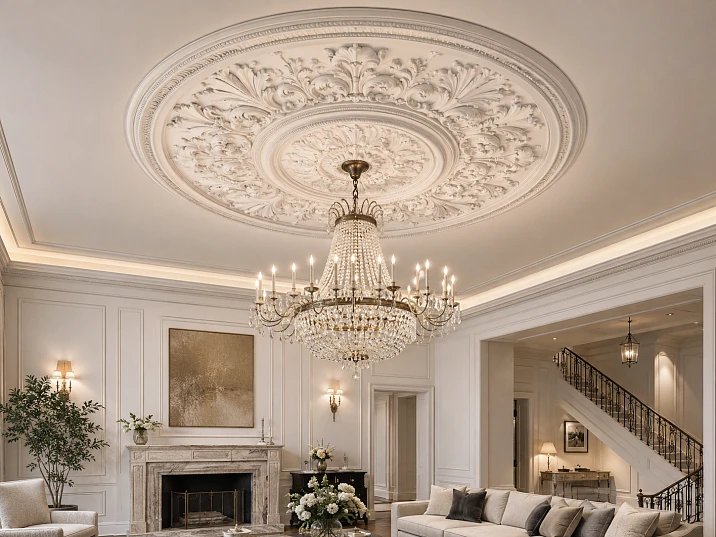
A chandelier can become the defining feature of a room, but the light fixture alone does not always create a complete architectural composition. In a spacious living room, formal dining room, or two-story entryway, the ceiling surrounding the chandelier can appear surprisingly empty. Even an expensive fixture may look visually disconnected from the architecture when its mounting point has no decorative relationship to the surrounding space.
A large ceiling medallion solves this problem by establishing an architectural center around the lighting fixture. It creates a deliberate transition between the ceiling and chandelier, introduces sculptural relief, and helps organize the proportions of the room.
The challenge is choosing the right size.
A small medallion may disappear against an expansive ceiling. An excessively large or heavily ornamented composition may compete with the chandelier, overwhelm the ceiling, or conflict with nearby crown molding.
The correct solution depends on more than diameter alone. Ceiling height, room dimensions, chandelier size, architectural style, relief depth, and the visual weight of surrounding decorative elements must all be considered.
Modern polyurethane ceiling medallions offer an attractive solution for homeowners, interior designers, architects, and remodeling professionals seeking the appearance of classical architectural decoration without the weight and fabrication requirements of traditional solid plaster.
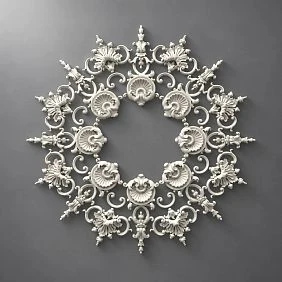
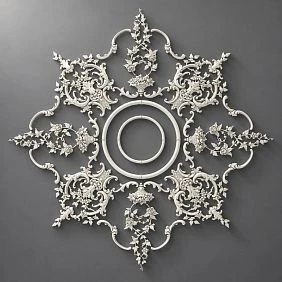
They are available in a wide range of styles, from restrained geometric compositions to elaborate arrangements featuring acanthus leaves, floral ornament, sculptural scrollwork, and concentric decorative rings.
For larger projects, modular medallions can be assembled from coordinated polyurethane elements, allowing substantial ceiling compositions to be created without manufacturing one enormous decorative disk.
The STAVROS polyurethane ceiling medallion collection includes large-scale decorative compositions designed for living rooms, dining rooms, entrance halls, and other architectural interiors.
This guide explains how to select a ceiling medallion for a chandelier, determine appropriate dimensions, compare available products, plan the ceiling composition, and coordinate safe installation with the electrical fixture.
What Is a Ceiling Medallion?
A ceiling medallion is an architectural decorative element installed on the ceiling, frequently around the mounting location of a chandelier, pendant light, or another ceiling fixture.
Traditionally, medallions were made from plaster and incorporated into elaborate ceiling decoration. They appeared in formal European interiors, historic American homes, and buildings influenced by classical architectural traditions.
Their purpose was primarily architectural and decorative.
A medallion establishes a central feature on the ceiling, creates visual hierarchy, and provides a relationship between the lighting fixture and the surrounding room.
Today, ceiling medallions are manufactured from several materials, including polyurethane, plaster, wood, and other decorative composites.
In the American market, the most familiar term is ceiling medallion.
Related search terms include decorative ceiling medallion, chandelier ceiling medallion, ceiling medallions for light fixtures, and polyurethane ceiling medallion.
The expression ceiling rosette is also used, particularly in historical architectural descriptions and some international product catalogs. However, ceiling medallion is generally the clearer product term for American homeowners and lighting buyers.




Ceiling Medallion vs. Ceiling Rose
Although the terms overlap, a useful distinction can be made.
A ceiling rose traditionally refers to a decorative ornament arranged around a central point, often with botanical or radial motifs.
A ceiling medallion may be simpler or more elaborate. It can include concentric rings, ornamental bands, sculptural decorations, or an entire assembled ceiling composition.
In practical American retail terminology, both may be sold as ceiling medallions.
Наша фабрика также производит:
Смотреть весь Каталог продукции
A Ceiling Medallion Is Not a Chandelier Support
One important technical distinction must be understood from the beginning.
A decorative polyurethane medallion is not the structural support for a chandelier.
The light fixture must be secured to an appropriate listed electrical box or another approved structural support system suitable for its weight.
The medallion surrounds or visually frames that installation.
Its purpose is decorative.
This distinction becomes especially important when installing heavy chandeliers in high-ceiling rooms or when using large modular ceiling decorations.
Получить консультацию
When Do You Need a Large Ceiling Medallion?
A large medallion is not necessary in every room.
In some interiors, a small, simple decorative ring is sufficient. In others, a substantial ceiling composition is important for visual balance.
The decision should begin with the architecture.
When the Chandelier Is Large
A chandelier with a wide armature, multiple tiers, prominent shades, or substantial decorative detail creates a strong visual presence.
If its ceiling connection is surrounded by a very small medallion, the relationship may appear disproportionate.
A larger decorative composition can help connect the fixture to the ceiling.
However, the medallion does not have to match the chandelier's outside diameter exactly.
The correct relationship depends on the chandelier's shape, canopy size, hanging height, and the architectural scale of the room.
When the Ceiling Is High
As ceiling height increases, decorative details become less visually prominent from the floor.
A small ornament that looks substantial in an 8-foot room may become almost invisible in a 14-foot entryway.
Large ceiling medallions and appropriately scaled relief help preserve architectural legibility at greater viewing distances.
This is particularly important in double-height spaces.
When the Room Is Spacious
A large room has an expansive ceiling surface.
A small decorative medallion may occupy too little visual area to establish a convincing center.
A more substantial composition can connect the chandelier to the scale of the room.
In formal living rooms and entry halls, a large medallion may serve as the primary decorative element on the ceiling.
When the Interior Already Has Architectural Ornament
Rooms with substantial crown molding, classical wall panels, pilasters, ornamental door surrounds, or decorative ceiling frames often require a coordinated central element.
A very small medallion may appear disconnected from the rest of the decorative system.
The medallion should relate to the overall architectural language.
When the Ceiling Needs a Focal Point
A large ceiling medallion can also be installed without a chandelier, provided the design and product are suitable for that application.
In this case, it functions as an independent decorative ceiling feature.
It may form the center of a coffered composition, a formal entrance hall, or an architecturally detailed room.
The decision is based on ceiling geometry and decoration rather than fixture dimensions.
How to Choose the Right Ceiling Medallion Size
Selecting a medallion should be approached as a proportional design problem.
The most useful measurements are the chandelier's overall width, the dimensions of the room, the ceiling height, and the available ceiling area surrounding the installation point.
For modular compositions, the overall decorative footprint must also be considered.
Step 1: Measure the Chandelier Diameter
Measure the maximum width of the chandelier.
For a round chandelier, this is generally the overall diameter.
For an elongated chandelier, record both the length and width.
Do not confuse the chandelier's overall dimensions with the diameter of its ceiling canopy.
The canopy is the component that covers the electrical connection at the ceiling.
A chandelier may measure 36 inches across while its canopy is only 5 or 6 inches wide.
These measurements serve different purposes.
The overall fixture size influences architectural proportion.
The canopy dimensions determine the relationship between the fixture and the medallion's central opening.
A Starting Ratio for Conventional Medallions
For many conventional round ceiling medallions, a useful initial design range is approximately one-half to two-thirds of the chandelier's overall width.
For example, a chandelier measuring 36 inches in diameter might be paired with a conventional medallion approximately 18–24 inches wide.
However, this is not an architectural requirement.
A larger medallion may be entirely appropriate in a formal room with substantial ceiling decoration.
The relationship is particularly different for openwork modular medallions.
A large modular composition may extend well beyond the chandelier without creating a heavy visual effect because it consists of separated ornamental elements rather than one continuous solid disk.
For this reason, oversized STAVROS compositions should be evaluated by their actual appearance and ceiling footprint, not simply by applying a diameter ratio intended for conventional one-piece medallions.
Step 2: Measure the Room
Record the room's length and width.
These dimensions establish the scale of the ceiling field.
For example, a room measuring 16 × 20 feet has a ceiling area of 320 square feet.
A 12 × 12-foot bedroom has only 144 square feet.
The same 36-inch medallion will feel considerably more prominent in the smaller room.
Room dimensions should therefore be evaluated together with chandelier size.
Step 3: Account for Ceiling Height
Ceiling height changes how decorative relief is perceived.
As the viewing distance increases, small details become less prominent.
Larger forms and clearer ornamental divisions help maintain visual impact.
The following table provides approximate starting ranges for conventional and architectural ceiling medallions.
| Ceiling height | Medallion size to explore | Design considerations |
|---|---|---|
| 8 feet | 10–20 inches | Compact or low-profile decoration |
| 9 feet | 16–28 inches | Moderate architectural emphasis |
| 10–11 feet | 20–36 inches | Larger medallions and more defined relief |
| 12–14 feet | 30–54 inches | Substantial decorative compositions |
| 15 feet and above | 36–70 inches or more | Large-scale or modular architectural systems |
These ranges are not fixed standards.
A spacious 9-foot-ceiling room may successfully accommodate a larger composition.
A narrow 12-foot-tall room may require a more restrained medallion.
The correct choice depends on the complete relationship between the room, chandelier, and decorative architecture.
Step 4: Evaluate the Surrounding Ceiling
A chandelier is rarely the only architectural feature affecting the ceiling.
Consider existing crown molding, ceiling beams, recessed lighting, coffers, air diffusers, sprinkler heads, and access panels.
A large medallion must fit within the available ceiling area without interfering with these elements.
For an architectural composition, the medallion should have a deliberate relationship to the ceiling perimeter.
A very large central ornament placed too close to the crown molding may create visual congestion.
The design should preserve enough uninterrupted ceiling surface to give the decorative composition a clear boundary.
Step 5: Consider Ornamental Density
Two medallions with identical outside dimensions can have very different visual weight.
A solid circular medallion with dense sculptural relief may dominate the ceiling.
An openwork composition of separate polyurethane ornaments may appear lighter, even when its overall footprint is substantially larger.
This distinction is particularly important when comparing conventional medallions with modular decorative systems.
Ceiling Medallion Size Guide by Room
The following examples illustrate how ceiling height, room dimensions, and fixture scale can be evaluated together.
Standard Living Room With an 8-Foot Ceiling
Consider a living room measuring 14 × 16 feet with an 8-foot ceiling.
The room has conventional proportions.
A large chandelier may not be appropriate if its hanging height reduces comfortable clearance below.
If a ceiling medallion is used, a restrained profile with moderate width and shallow relief may be sufficient.
A conventional medallion in the 12–20-inch range can be a useful starting point.
A much larger composition should be considered only when the room's architecture specifically supports it.
Living Room With a 9-Foot Ceiling
Now consider a 16 × 18-foot living room with a 9-foot ceiling.
The additional ceiling height allows a more substantial decorative treatment.
A chandelier measuring approximately 30–36 inches across may work with a conventional medallion around 18–28 inches, depending on the design.
A 30-inch openwork composition may also be appropriate if the surrounding ceiling has enough uninterrupted space.
Formal Living Room With a 10-Foot Ceiling
A 16 × 20-foot living room with a 10-foot ceiling offers considerably more architectural flexibility.
Suppose the chandelier measures 36 inches across.
A conventional medallion around 24 inches could provide an understated result.
A decorative composition around 30–36 inches could create a stronger classical focal point.
This is the type of room where the STAVROS CRPU-070 ceiling medallion or CRPU-069 ceiling medallion may be considered, subject to the full ceiling layout.
Two-Story Entryway
Consider a two-story entry hall measuring 20 × 24 feet, with a ceiling height of approximately 18 feet.
This is a substantially different design problem.
A small 18-inch medallion may become visually insignificant.
A large chandelier and a more expansive architectural composition are often appropriate.
A modular medallion measuring approximately 52–70 inches across may provide a suitable scale for consideration.
The final selection depends on the fixture's dimensions, hanging height, surrounding architectural details, and the proportions of the entire entry volume.
Large Polyurethane Ceiling Medallions From STAVROS
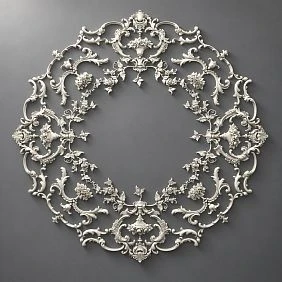
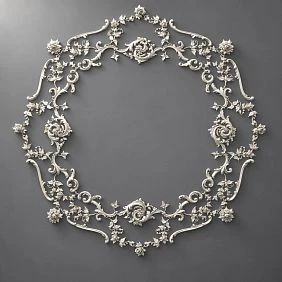
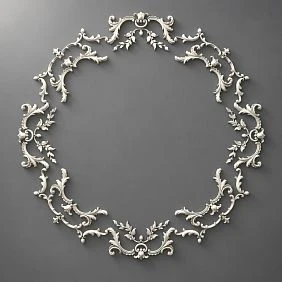
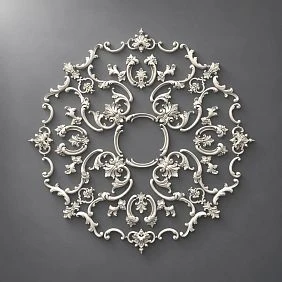
The STAVROS catalog includes several large polyurethane ceiling decorations.
An important distinction is that many of these products are modular compositions assembled from separate ornamental pieces, rather than conventional one-piece circular disks.
Their catalog measurements describe the overall width and height of the assembled design.
These dimensions should not always be interpreted as the diameter of a solid medallion.
STAVROS Large Ceiling Medallion Comparison
| Product | Assembled footprint | Maximum listed relief | Architectural character |
|---|---|---|---|
| CRPU-070 | 30.12 × 30.12 in | 0.71 in | Compact radial, star-like composition |
| CRPU-069 | 35.83 × 35.83 in | 0.59 in | Elaborate classical modular ornament |
| RPU.VRS-001 | 35.87 × 35.87 in | 0.71 in | Openwork floral composition |
| CRPU-068 | 52.17 × 52.17 in | 0.71 in | Large classical ornamental arrangement |
| CRPU-071 | 53.74 × 53.74 in | 0.75 in | Radial Baroque-inspired composition |
| CRPU-067 | 69.69 × 69.69 in | 0.79 in | Monumental classical ceiling ornament |
The measurements are rounded conversions from the product specifications. Verify the current technical drawings and component lists before purchasing.
CRPU-070: A 30-Inch Decorative Ceiling Composition
The STAVROS CRPU-070 polyurethane ceiling medallion has an assembled footprint of approximately 30.12 × 30.12 inches.
Its star-like radial geometry is created from separate decorative polyurethane elements.
The composition contains 24 pieces representing three component types.
The result is a relatively compact architectural ornament compared with the larger STAVROS systems.
CRPU-070 is worth considering for formal living rooms, dining rooms, and other spaces where a substantial ceiling accent is desired without extending across a very large area.
Its openwork geometry helps create a decorative presence without relying on a continuous solid disk.
CRPU-069: A 36-Inch Classical Ceiling Medallion
The STAVROS CRPU-069 ceiling medallion measures approximately 35.83 × 35.83 inches.
The product uses a modular arrangement incorporating multiple types of polyurethane ornament.
Its architectural language includes classical botanical forms and organized radial geometry.
The composition is more elaborate than a simple molded ring.
This makes it suitable for traditional or neoclassical rooms where the ceiling decoration is intended to complement a substantial chandelier.
The assembly should be planned using the product's component layout rather than treated as one continuous piece.
RPU.VRS-001: A 36-Inch Openwork Floral Medallion
The STAVROS RPU.VRS-001 polyurethane ceiling medallion measures approximately 35.87 × 35.87 inches.
Its composition is assembled from eight coordinated polyurethane elements: four NPU-507 pieces and four NPU-508 pieces.
The ornament incorporates floral forms, leaves, and curved decorative motifs.
Because the design is openwork rather than a solid background disk, the ceiling remains visible between the individual components.
This creates a lighter visual appearance.
RPU.VRS-001 is particularly relevant to classical and French-inspired interiors where the ceiling decoration should be expressive but not visually solid.
CRPU-068: A Large 52-Inch Decorative Composition
The STAVROS CRPU-068 polyurethane ceiling medallion has an overall footprint of approximately 52.17 × 52.17 inches.
The composition is assembled from numerous polyurethane decorative pieces.
It is designed for architectural applications where a conventional medium-sized medallion would not provide sufficient visual presence.
Its large footprint makes it particularly relevant to spacious formal rooms and high-ceiling interiors.
The overall composition should be considered in relation to the ceiling perimeter, chandelier, and other decorative elements.
CRPU-071: An Approximately 54-Inch Radial Ceiling Medallion
The STAVROS CRPU-071 polyurethane ceiling medallion measures approximately 53.74 × 53.74 inches.
It features an elaborate radial design with classical floral details, scrollwork, and concentric decorative elements.
The composition is assembled from coordinated pieces rather than manufactured as a single large disk.
A mounting template is offered separately for this model, providing a useful reference for the placement of individual components.
CRPU-071 is particularly suitable for consideration in formal living rooms, entrance halls, and other interiors requiring a strong architectural center.
CRPU-067: A Monumental 70-Inch Ceiling Composition
The STAVROS CRPU-067 polyurethane ceiling medallion measures approximately 69.69 × 69.69 inches.
This is a large-scale decorative system designed around repeated classical ornamental elements.
Its composition includes numerous polyurethane components organized into a symmetrical architectural arrangement.
At almost 70 inches across, the product should be treated as a major element of the ceiling design.
It can be considered for substantial entry halls, double-height spaces, formal reception rooms, and other architecturally ambitious interiors.
Such an installation requires a dimensioned ceiling plan, a detailed component layout, and careful coordination with the chandelier support and electrical installation.
One-Piece vs. Modular Ceiling Medallions
This distinction is especially important when shopping for oversized decorative ceiling elements.
Conventional One-Piece Medallions
A conventional ceiling medallion is manufactured as one relatively continuous decorative piece.
It may contain a central opening for a light fixture or be supplied without one.
Its principal advantages include straightforward geometric alignment and a limited number of visible decorative joints.
However, large one-piece products can be cumbersome to handle and install.
Split Ceiling Medallions
Some ceiling medallions are manufactured in two or more sections.
A split construction may allow the decoration to be installed around an existing light fixture, depending on the product and installation conditions.
The sections form a continuous medallion when joined.
The finished seams must be properly prepared and painted.
Modular Openwork Compositions
A modular composition consists of multiple individual ornaments positioned according to a defined layout.
The pieces may form a circle, square, star, floral arrangement, or another architectural pattern.
This differs fundamentally from a split solid medallion.
The ceiling itself remains visible between many of the decorative components.
Modular systems allow large decorative footprints to be assembled from manageable individual parts.
However, accurate positioning becomes more important.
The quality of the result depends on the layout, spacing, symmetry, and consistent orientation of the ornaments.
Many large STAVROS ceiling medallions belong to this category.
How to Position a Ceiling Medallion Correctly
A large medallion can be beautifully manufactured and properly painted yet still look incorrect if it is positioned on the wrong architectural axis.
The ceiling center is not always the geometric center of the room.
Living Room Placement
In a formal living room, the decorative ceiling composition may be centered on the room's architectural axis.
However, furniture placement can change the visual balance.
A chandelier positioned over a central seating area may be slightly offset from the room's geometric midpoint.
The medallion should follow the approved lighting and architectural composition.
Dining Room Placement
In a dining room, the relationship between the table, chandelier, and medallion is particularly important.
The chandelier is generally positioned in relation to the dining table.
The ceiling medallion should normally be centered on the fixture's intended axis.
This may differ from the mathematical center of the ceiling.
For a long rectangular dining table, an elongated ceiling composition or appropriately scaled round medallion may be more suitable than an oversized symmetrical ornament.
Entry Hall Placement
In a formal entry hall, the architectural axis may be established by the front door, staircase, central circulation path, or overall room geometry.
A ceiling medallion can reinforce that axis.
In a double-height entry, assess the composition from the first floor, staircase, and upper landing.
The medallion should remain visually coherent from all important viewpoints.
Ceiling Medallions Without Chandeliers
A decorative medallion may function as an independent ceiling feature.
In that situation, its center should relate to the room's architecture rather than an electrical fixture.
This can be effective in selected classical interiors, coffered ceilings, and formal circulation spaces.
How to Coordinate a Large Medallion With Crown Molding
A ceiling medallion is most effective when the surrounding architectural details reinforce its scale and style.
Crown molding provides the outer boundary of the ceiling.
The medallion establishes the center.
The uninterrupted ceiling surface between them becomes part of the composition.
Creating a Balanced Ceiling
A balanced ceiling treatment usually has a clear hierarchy.
The perimeter molding establishes the room's edges.
Optional ceiling molding frames create intermediate divisions.
The medallion provides the central focal point.
These elements should not compete equally for attention.
If the medallion is highly ornate, the surrounding profiles may benefit from a simpler design.
If the medallion is restrained, a more pronounced crown molding system may be appropriate.
Choosing Crown Molding Scale
Large rooms can often accommodate more substantial crown molding.
However, a very broad crown profile in a room with limited ceiling height can make the space feel visually compressed.
The medallion and crown molding should be evaluated together.
A large central medallion paired with extremely delicate perimeter molding may appear disconnected.
A heavily ornamented crown paired with an equally elaborate oversized medallion may create excessive decorative density.
The strongest composition balances the two.
Browse STAVROS crown molding and cornice profiles when planning a coordinated ceiling system.
Check individual product materials, because architectural trim catalogs may contain polyurethane, polystyrene, and other materials.
Adding Ceiling Molding Frames
Ceiling molding can create rectangular, square, or other geometric divisions around a central medallion.
For example, a rectangular living room might contain a central medallion surrounded by a larger molding frame.
This connects the center of the ceiling to the room's outer proportions.
A narrow profile such as STAVROS MLDPU-001 can be considered for delicate painted decorative lines.
A more substantial profile such as MLDPU-003 may provide greater architectural emphasis.
The profile must be selected according to the actual ceiling design and installation requirements.
Incorporating Decorative Onlays
Individual decorative ornaments can create intermediate accents between the medallion and the perimeter.
The STAVROS polyurethane onlays collection includes sculptural elements that can be evaluated for suitable architectural ceiling applications.
The ornament should reinforce the medallion rather than introduce unrelated decorative motifs.
Choosing the Right Ceiling Medallion Style
The medallion's ornament should correspond to the architecture of the room.
Diameter alone does not establish a successful design.
Traditional Classical Interiors
Classical interiors can accommodate substantial radial ornament, sculptural leaves, repeated decorative rings, and balanced symmetry.
A large classical chandelier may be complemented by a medallion with pronounced relief.
The medallion, crown molding, and wall decoration should share a consistent architectural vocabulary.
Neoclassical Interiors
Neoclassical interiors favor balanced proportions and restrained ornament.
A large medallion may still be appropriate, but the design should avoid unnecessary visual complexity.
Soft botanical relief, controlled concentric geometry, and monochromatic painting can create a refined result.
French Classical and Rococo Interiors
French-inspired interiors may use more fluid ornament.
Floral garlands, scrollwork, acanthus leaves, and curved decorative forms are particularly suitable.
Openwork modular compositions can be effective because they introduce rich ornament without creating a solid decorative mass.
Art Deco Interiors
Art Deco decoration favors geometry, symmetry, and controlled visual drama.
Radial patterns, concentric rings, and stylized ornamental forms can work particularly well.
A star-like composition may provide a strong geometric focal point.
The ceiling decoration can be coordinated with metallic lighting finishes and other Art Deco details.
Contemporary Transitional Interiors
Transitional interiors combine modern furnishings with selected classical architectural features.
A polyurethane medallion can introduce historical character without requiring an entirely traditional decorative scheme.
Restrained forms and tone-on-tone painting are often the most effective approach.
Minimalist Interiors
Minimalist rooms generally require caution when introducing ornate ceiling decoration.
A clean circular profile or restrained geometric medallion is often more appropriate than elaborate botanical relief.
The goal should be one intentional architectural accent rather than an accumulation of decorative elements.
How Relief Depth Affects the Appearance of a Ceiling Medallion
Ceiling height and medallion size are important, but relief depth also influences the final appearance.
A profile with shallow relief produces restrained shadows.
A profile with deeper sculptural detail creates more pronounced highlights and recessed areas.
The effect depends on lighting direction.
A decorative element near a window may receive light from one side, making the relief more visible.
A centrally positioned chandelier may illuminate the ornament differently, particularly when its light is directed downward.
Shallow Relief
Shallow relief is suitable for understated designs.
It creates architectural depth without strongly projecting from the ceiling.
This is often appropriate for neoclassical and contemporary interiors.
Medium Relief
Medium-depth ornament provides clearer visual definition.
Leaves, curved forms, and concentric borders become more apparent.
This is a versatile approach for traditional living rooms and dining rooms.
Deep Sculptural Relief
Deep relief can be effective in grand classical interiors.
However, it should be coordinated with the ceiling height, lighting conditions, and other decorative elements.
A large, deeply sculpted medallion in a compact room may appear visually heavy.
The right choice is the one that establishes the intended architectural hierarchy.
Electrical Safety: What American Homeowners Must Know
A large ceiling medallion is part of the decorative finish.
It must not be used as a substitute for a properly designed chandelier support system.
This is particularly important when the medallion surrounds a heavy or oversized chandelier.
The Chandelier Must Be Supported Independently
The electrical box or independent structural support must be suitable for the actual weight of the lighting fixture.
A decorative polyurethane medallion does not increase the load capacity of an electrical box.
It also should not be used to carry the weight of a chandelier, pendant, or ceiling fan.
Verify the Existing Electrical Box
Before installing the decorative composition, confirm that the electrical box and fixture support are appropriate.
Some fixtures require specialized support hardware or independently anchored mounting arrangements.
Do not assume that the presence of an existing ceiling box proves that it can support a new heavy chandelier.
Maintain Electrical Accessibility
The decorative medallion should not improperly cover the electrical box or obstruct required access to electrical connections.
The center opening, chandelier canopy, and mounting hardware must be coordinated.
The fixture canopy may need to cover the opening while maintaining an installation consistent with the fixture and electrical-box instructions.
Coordinate Canopy Projection
A medallion adds decorative thickness around the ceiling location.
The fixture's canopy, mounting bracket, and hardware must be compatible with the final ceiling surface.
Do not conceal an improperly positioned electrical box by simply installing a thicker decorative medallion.
Use a Qualified Electrician
When a chandelier requires rewiring, electrical-box replacement, relocation, or a change to its structural support, the work should be performed by a qualified electrician in accordance with applicable requirements.
A homeowner may be able to install suitable decorative polyurethane components, but electrical work is a separate task.
Installing a Large Polyurethane Ceiling Medallion
The installation method depends on whether the medallion is a single molded component, a split product, or a modular composition.
The following process focuses on the planning and decorative installation considerations relevant to large polyurethane systems.
Step 1: Inspect the Ceiling
The ceiling surface must be sound, clean, and suitable for the specified adhesive and support method.
Inspect for peeling paint, loose plaster, damaged drywall paper, moisture damage, and other unstable conditions.
A decorative element bonded to an unsound surface may detach together with the surface coating.
Correct defects before installation.
Step 2: Establish the Exact Center
Identify the intended architectural center of the medallion.
When the decoration surrounds a chandelier, this will generally correspond to the approved fixture location.
However, determine the center from the actual lighting and ceiling plan rather than assuming it is the center of the room.
Mark the principal horizontal and vertical reference axes.
For a symmetrical radial composition, these axes establish the placement of the individual ornamental pieces.
Step 3: Prepare the Installation Layout
For modular medallions, a full-scale layout is especially valuable.
Identify the position of every component.
Confirm whether the selected product includes a mounting template or whether one must be purchased separately.
Do not assume that a product's assembled dimensions provide enough information for accurate installation without a detailed drawing.
Step 4: Dry-Fit the Components
Before applying adhesive, arrange the individual elements according to the approved composition.
Check the orientation and spacing.
For openwork medallions, consistent gaps between adjacent elements are part of the architectural design.
An error in one segment can become increasingly visible as the composition continues around the center.
For complex systems, dry-fitting and marking the complete layout reduces the likelihood of cumulative alignment errors.
Step 5: Select the Correct Adhesive
Use an adhesive specifically approved for the selected polyurethane product and ceiling substrate.
Follow the manufacturer's instructions for application, coverage, working time, temporary support, and curing.
Do not assume that any general-purpose construction adhesive is suitable.
For large overhead installations, obtain the manufacturer's mounting recommendations and evaluate whether additional support or fastening is required.
Step 6: Install the Main Decorative Elements
Position the primary components according to the reference axes.
Check the alignment carefully.
For radial compositions, the installation should preserve symmetry around the central point.
The sequence should follow the specific product's assembly layout.
A complex modular medallion may contain several categories of ornamental elements, each with a defined position.
Step 7: Add Secondary and Accent Elements
After the main components are positioned, continue with the secondary details.
Maintain consistent orientation and spacing.
Avoid relying on visual estimation for large compositions.
Use the template, technical drawing, or approved measurement schedule to control the layout.
Step 8: Provide Temporary Support
Ceiling installation introduces different requirements from wall installation because the decorative elements are overhead.
Use the support method required by the adhesive and product manufacturer.
Temporary braces or other appropriate methods may be necessary.
Do not assume that a short initial adhesive grab time means that the component can safely remain unsupported.
Step 9: Allow the Installation to Cure
Follow the adhesive manufacturer's curing requirements.
Temperature, humidity, coating condition, and substrate characteristics can affect curing.
The decorative components should not be subjected to unnecessary stress before the specified curing period has elapsed.
Step 10: Finish the Decorative Joints
Inspect any joints or transitions intended to appear continuous.
Use compatible finishing materials where appropriate.
For openwork compositions, some gaps are deliberately part of the design and should remain visible.
Do not fill intentional spaces between ornamental components.
Step 11: Prime and Paint Where Required
Some polyurethane products are supplied with paint-ready surfaces.
Others may require specific preparation.
Spot-prime repaired areas or exposed surfaces where required.
Use a compatible architectural coating and avoid excessive paint buildup in detailed relief.
Step 12: Coordinate Final Chandelier Installation
The electrical fixture must be mounted using its approved support system.
Its canopy should align correctly with the decorative composition.
A qualified electrician should perform the electrical installation and verify that the fixture operates safely.
How to Paint a Large Polyurethane Ceiling Medallion
Painting is one of the most effective ways to integrate a decorative medallion into the surrounding ceiling.
The finish can make an elaborate composition appear restrained or turn a simple profile into a prominent visual feature.
White-on-White Finishes
A white polyurethane medallion on a white ceiling is a traditional and versatile approach.
The ornament remains visible through shadows.
This can create architectural richness without introducing additional colors.
Monochromatic Colored Ceilings
A ceiling and medallion painted in the same color can produce a sophisticated result.
Warm gray, muted blue, deep green, and other controlled colors can emphasize relief in different ways.
The effect depends on lighting and finish sheen.
Subtle Contrast
A slightly lighter or darker medallion can create a more pronounced focal point.
This approach may be effective when the ceiling has a decorative paint finish or when the medallion should remain visually distinct.
Metallic Accents
Gold, bronze, and other metallic finishes can emphasize selected sculptural details.
These finishes are particularly suitable for certain Baroque, classical, and Art Deco-inspired interiors.
However, metallic treatment should be applied selectively.
Excessive metallic ornament can overwhelm the chandelier and surrounding architecture.
Antique Glazing
An antique glaze can emphasize recessed patterns and create the appearance of historical architectural decoration.
The glaze must be compatible with the underlying finish.
It should be applied in a controlled manner so the ornament remains legible without appearing excessively dark or uneven.
Avoid Heavy Coating Buildup
Large decorative medallions may contain intricate sculptural detail.
Heavy paint accumulation can soften that detail.
Apply thin, controlled coats using suitable brushes, rollers, or professional spray techniques where appropriate.
Allow the coating to dry and cure according to the manufacturer's instructions.
Planning a Complete Decorative Ceiling System
A large medallion can be the central element of a more extensive ceiling design.
The strongest compositions establish a clear relationship between the center, intermediate ceiling zones, and perimeter.
The Central Medallion
The medallion establishes the focal point.
Its size should be determined first when it is the dominant decorative element.
Intermediate Ceiling Frames
Decorative molding may create geometric frames surrounding the central medallion.
These frames can reinforce the proportions of a rectangular room.
For a square ceiling, a square or circular arrangement may be appropriate.
For an elongated room, a rectangular composition can provide stronger architectural balance.
Perimeter Crown Molding
Crown molding establishes the outer architectural boundary.
It visually connects the decorated ceiling to the surrounding walls.
Additional Decorative Onlays
Individual polyurethane ornaments may be used within the ceiling field.
They should reinforce the central composition rather than compete with it.
Explore the STAVROS decorative ceiling collection when planning a larger coordinated arrangement.
The result should be a unified architectural system rather than a collection of unrelated decorations.
How to Prepare a Ceiling Medallion Specification
For larger projects, a professional specification helps prevent purchasing and installation errors.
Begin by recording the room dimensions and ceiling height.
Identify the approved chandelier location and fixture specifications.
Then select the decorative medallion according to the desired architectural scale.
For a modular composition, record the complete assembled footprint and product code.
The specification should also include the number of individual components, the required installation template, surface preparation, adhesive requirements, finish, and any special installation conditions.
A typical project schedule might contain the following information.
| Specification item | Information to record |
|---|---|
| Room | Living room, dining room, foyer, or other space |
| Ceiling height | Finished floor to finished ceiling |
| Ceiling dimensions | Overall length and width |
| Lighting fixture | Manufacturer, model, diameter, weight |
| Fixture location | Approved ceiling coordinates |
| Ceiling medallion | STAVROS product code |
| Medallion footprint | Overall assembled width and height |
| Component layout | Product drawing or mounting template |
| Mounting system | Manufacturer-approved decorative attachment |
| Finish | Primer and paint specification |
| Electrical support | Verified independently from medallion |
| Delivery | Confirmed availability and destination |
| Installation | Assigned contractor or installation team |
For a formal interior with multiple decorative elements, a reflected ceiling plan is especially useful.
This drawing shows the ceiling as viewed from below and allows the positions of the medallion, fixtures, decorative frames, and other architectural components to be coordinated.
Common Mistakes When Choosing Large Ceiling Medallions
Several errors repeatedly cause disappointing results.
Choosing a Medallion From Photographs Alone
A product photograph rarely communicates the actual scale of a large decorative composition.
Always evaluate the published dimensions.
For modular systems, check the assembled footprint rather than assuming the product is a solid circular disk.
Selecting an Undersized Medallion
A very small medallion can disappear against a large ceiling.
This is especially noticeable when the chandelier and surrounding architecture are substantial.
Evaluate the decoration from normal viewing distance.
Automatically Choosing the Largest Product
A larger medallion is not always the better choice.
An oversized composition may conflict with crown molding, recessed lighting, or the available ceiling area.
The correct scale depends on the entire room.
Ignoring Chandelier Proportions
The chandelier's overall width, hanging height, and decorative character influence the medallion.
A compact contemporary pendant may not require the same ornamental treatment as a large classical chandelier.
Confusing Canopy Size With Fixture Diameter
The canopy covers the electrical connection.
The fixture's overall width determines its broader visual presence.
Both measurements are important, but they serve different purposes.
Treating the Medallion as Structural Support
A decorative medallion is not a substitute for a properly rated chandelier mounting system.
The light fixture requires appropriate independent support.
Ignoring the Ceiling's Architectural Center
A medallion should follow the approved lighting and design axes.
For dining rooms, this may mean centering the decoration over the table rather than the geometric midpoint of the room.
Failing to Plan a Modular Composition
Large STAVROS medallions may include numerous separate ornamental pieces.
Without a complete layout, small positioning errors can accumulate.
Use appropriate drawings and templates.
Choosing Ornament That Conflicts With the Interior
Elaborate Baroque decoration may be unsuitable for a strongly minimalist room.
The profile should reinforce the surrounding architectural language.
Failing to Coordinate the Finish
A medallion painted without considering the ceiling and crown molding may look like an isolated addition.
Plan the decorative finish as part of the complete room.
How Much Does a Large Ceiling Medallion Cost?
The total project cost depends on the size, design complexity, number of components, installation conditions, and finishing requirements.
A conventional one-piece medallion may have a relatively straightforward installation.
A large modular composition requires more careful layout, individual component positioning, and finishing.
For projects involving a chandelier replacement or relocation, electrical work may also be required.
The total budget should therefore distinguish decorative material costs from installation and lighting-related expenses.
Product Cost
The medallion itself may be purchased as a complete decorative composition.
For modular products, verify which components are included in the listed set.
Mounting Materials
Suitable adhesive, finishing materials, primer, paint, and temporary installation supports may be required.
Installation Labor
Labor requirements depend on ceiling height, accessibility, component quantity, and installation complexity.
High ceilings may require additional access equipment.
Electrical Work
If the chandelier support or electrical box requires modification, this is a separate cost.
The decorative medallion does not eliminate the need for a suitable fixture support system.
Shipping and Delivery
Large decorative compositions may be easier to package as individual pieces, but the overall delivery cost depends on the order and destination.
For customers in the United States, international shipping arrangements, import requirements, and final delivered cost should be confirmed with STAVROS before ordering.
Frequently Asked Questions About Large Polyurethane Ceiling Medallions
What Is a Large Ceiling Medallion?
A large ceiling medallion is a decorative architectural element or assembled composition installed on the ceiling.
It commonly surrounds a chandelier or establishes an independent ceiling focal point.
Large medallions are particularly relevant to spacious rooms, high ceilings, and formal architectural interiors.
What Size Ceiling Medallion Do I Need for a Chandelier?
The appropriate size depends on the chandelier's overall dimensions, room size, ceiling height, and decorative style.
For conventional round medallions, approximately one-half to two-thirds of the chandelier's width can be a useful starting point.
Larger openwork architectural compositions may follow different proportional relationships.
Should a Ceiling Medallion Be Larger Than the Chandelier?
Not necessarily.
A conventional medallion is often smaller than the fixture's overall width.
However, a large modular ceiling composition may extend beyond the chandelier when the room's architecture supports it.
The relationship should be evaluated visually rather than controlled by a universal rule.
What Size Ceiling Medallion Works With a 36-Inch Chandelier?
A conventional medallion around 18–24 inches may provide a balanced starting point.
In a larger formal room, a 30–36-inch decorative composition may also be appropriate.
Consider the ceiling height and surrounding architectural details.
What Size Ceiling Medallion Is Best for a 10-Foot Ceiling?
Many rooms with 10-foot ceilings can accommodate medallions approximately 20–36 inches across.
The appropriate size depends on the room dimensions, chandelier, and intended architectural character.
Larger compositions may be suitable in spacious formal rooms.
What Is the Best Ceiling Medallion for a Two-Story Foyer?
A two-story foyer often benefits from a substantial decorative composition that remains visible from the first floor.
Large modular medallions in the 36–70-inch range may be considered, depending on the room's scale and chandelier.
The design should be evaluated from multiple viewpoints.
What Is the Difference Between a Ceiling Medallion and a Ceiling Rose?
The terms overlap.
A ceiling rose usually describes a radial decorative ornament.
A ceiling medallion is the more familiar American retail term and may refer to a simple molded disk or a larger architectural composition.
Are Polyurethane Ceiling Medallions Heavy?
Polyurethane decorative components are generally lighter than comparable solid plaster ornaments.
However, actual weight varies according to the product's dimensions, density, and number of components.
For large overhead installations, use the manufacturer's actual weight and mounting instructions.
Can You Install a Large Polyurethane Ceiling Medallion Yourself?
Some decorative installations may be manageable for experienced homeowners.
However, large modular compositions require accurate layout, suitable overhead support during curing, and careful finishing.
Electrical fixture installation should be handled separately and professionally when required.
Can a Ceiling Medallion Support a Heavy Chandelier?
No.
A decorative polyurethane ceiling medallion should not be used as the structural support for a chandelier.
The light fixture requires a properly rated electrical box or approved independent support system.
Can You Install a Ceiling Medallion Around an Existing Chandelier?
Some split or modular medallions may be suitable for certain retrofit installations.
However, the fixture's electrical connection, canopy, and mounting hardware must remain properly installed and accessible as required.
The exact installation method depends on the product and existing lighting assembly.
Do Polyurethane Ceiling Medallions Need Primer?
Some products are factory-primed or supplied with a paint-ready surface.
Others require additional preparation.
Repaired areas and exposed surfaces may also need spot priming.
Follow the selected product and coating specifications.
Can You Paint a Ceiling Medallion the Same Color as the Ceiling?
Yes.
Monochromatic painting is one of the most effective ways to integrate a decorative medallion into the architecture.
The ornament remains visible through light and shadow.
Can a Ceiling Medallion Be Installed Without a Chandelier?
Yes, provided the selected product is suitable for that use.
A medallion can function as an independent architectural ceiling accent.
Its position should relate to the room's overall design.
What Is the Difference Between a One-Piece and Modular Ceiling Medallion?
A one-piece medallion is manufactured as a relatively continuous component.
A modular medallion consists of separate decorative pieces installed according to a defined composition.
Large STAVROS ceiling medallions frequently use modular construction.
How Do You Clean Polyurethane Ceiling Medallions?
Dust can usually be removed with a soft brush or suitable vacuum attachment.
For painted surfaces, use cleaning methods compatible with the coating.
Avoid aggressive solvents and abrasive tools.
Where Can You Buy Large Polyurethane Ceiling Medallions?
STAVROS offers large polyurethane decorative ceiling compositions in several architectural styles.
Explore the STAVROS ceiling medallion catalog to compare dimensions, ornament, and available product sets.
Buy Large Polyurethane Ceiling Medallions From STAVROS
Selecting a large ceiling medallion is fundamentally an architectural design decision.
The medallion should relate to the room's proportions, chandelier, ceiling height, and surrounding decorative system.
STAVROS offers polyurethane ceiling medallions ranging from approximately 30-inch compositions to elaborate modular designs approaching 70 inches across.
The assortment provides several options for traditional, neoclassical, French-inspired, and other decorative interiors.
For a relatively compact architectural centerpiece, consider the CRPU-070 polyurethane ceiling medallion.
For a more elaborate composition around 36 inches, explore the CRPU-069 ceiling medallion or RPU.VRS-001 floral ceiling medallion.
For larger formal rooms, the CRPU-068 ceiling composition and CRPU-071 decorative medallion offer footprints exceeding 52 inches.
For monumental architectural interiors, the CRPU-067 large polyurethane ceiling medallion provides a composition approximately 69.69 inches across.
The selected medallion can also be coordinated with STAVROS polyurethane decorative moldings, architectural ceiling decoration, and decorative polyurethane onlays.
What to Confirm Before Ordering
Before purchasing, verify the assembled footprint, relief depth, material, complete component list, and intended installation method.
For modular compositions, confirm whether an installation drawing or full-scale template is included or available separately.
Check the compatibility of the design with the chandelier canopy and ceiling support arrangement.
If the project includes other decorative moldings or cornices, compare their architectural proportions and ornament.
Finally, confirm availability, shipping arrangements, and total delivery requirements for the project location.
For U.S. projects, international shipping and applicable import conditions should be verified directly before the order is finalized.
Conclusion: The Right Ceiling Medallion Gives the Chandelier an Architectural Setting
A large ceiling medallion is not simply decoration surrounding a lighting fixture.
It establishes the relationship between the chandelier and the ceiling, organizes the room's visual center, and connects the lighting design to the architectural character of the interior.
The correct medallion is neither automatically the largest nor the most ornate.
Its success depends on proportion.
A restrained composition may be ideal for a contemporary living room.
A detailed floral medallion may complement a traditional dining room.
A large modular polyurethane arrangement can provide the necessary architectural scale for a formal entry hall or double-height space.
Polyurethane allows these designs to be developed with precisely manufactured decorative elements, including elaborate multi-piece compositions that would be difficult to handle as single solid components.
The most successful projects begin with accurate measurements, a clear architectural concept, appropriate product selection, and careful coordination between decorative installation and electrical support.
A well-chosen ceiling medallion does not compete with the chandelier. It gives the chandelier a convincing place within the architecture.
Explore the STAVROS large polyurethane ceiling medallion collection to compare decorative compositions, dimensions, and architectural styles for your next interior design project.