












































































Customers also buy







Elena G.
September 29, 2026
Daria is a very competent specialist; she provided consultation and helped us select items. They were sent promptly.
Jony F.
September 23, 2026
We have our own furniture production and have been in touch with Stavros for many years. We regularly order sockets and brackets from them. The quality of the wooden decor in the Prestige finish is simply top-notch; the elements arrive perfectly prepared for painting. I would also like to mention the bulletproof packaging: everything is wrapped in stretch film, padded with foam material, and packed in thick cardboard. It arrives in perfect condition. A true luxury level, we will continue working together.
Mimimi
September 22, 2026
Bought cabinet handles here. Was pleased — great selection, everything is neat and well-made. The staff helped with the choice and gave quick advice. The handles fit perfectly and look even better than I expected. Good store, I can recommend it.
More than 20 years on the market
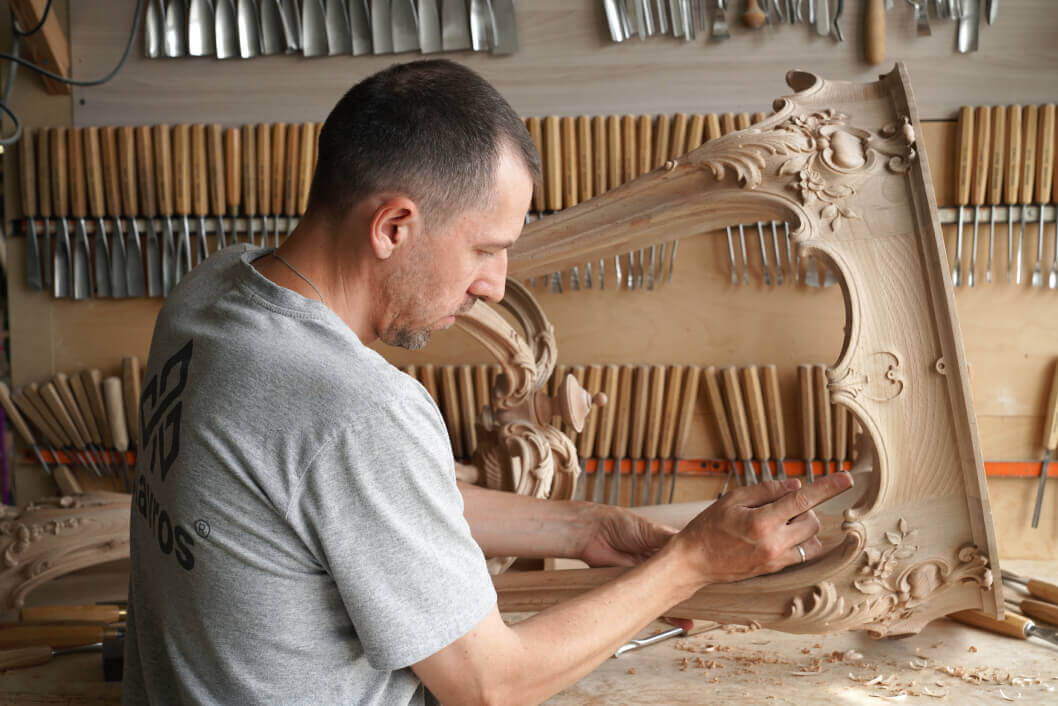
The company's success began in 2002, when two artists — Andrey Ragozin and Evgeny Tsapko — created a small creative workshop for producing wooden carved items. The masters' work was quickly noticed, and within a year they were invited to participate in the reconstruction of the Konstantinovskiy Palace in Strelna.
After the success of this project, the company focused on recreating palace interiors, furniture, church furnishings, and carved decorations in various artistic styles. They worked with cultural heritage sites: The Hermitage, the Alexandrovsky Palace, the Troitsko-Izmaylovsky Cathedral, the Sheremetyevsky Mansion, and many others.
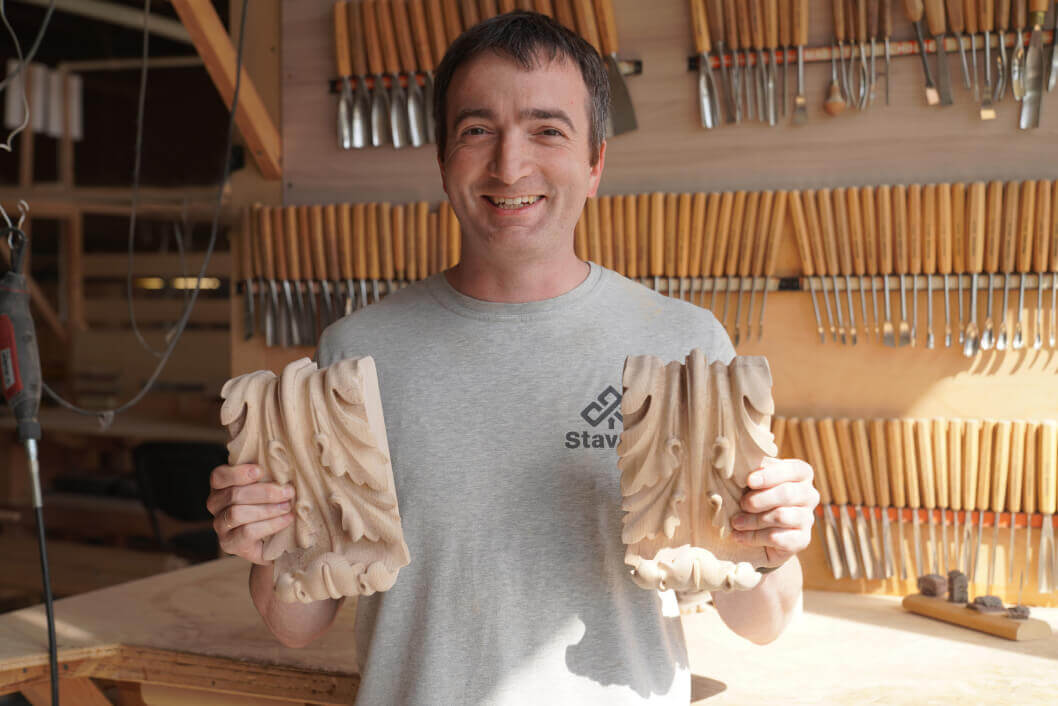
The masters' task — and still is — to create wooden items with the highest level of detail and understanding of every element, based on impeccable knowledge of artistic laws and interior styles.
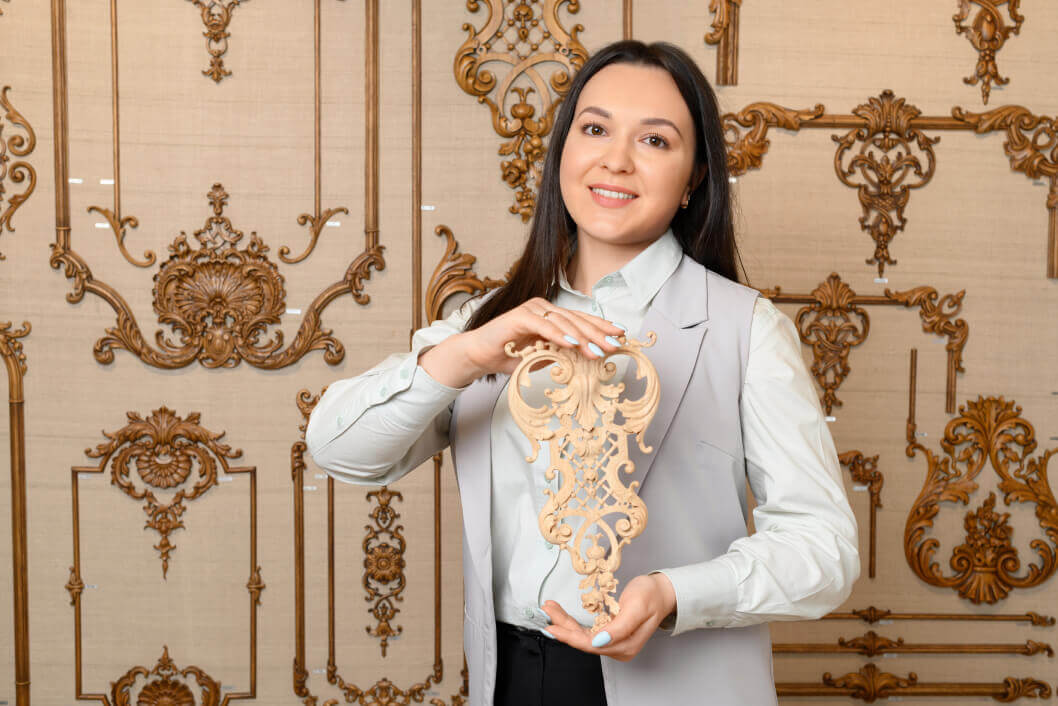
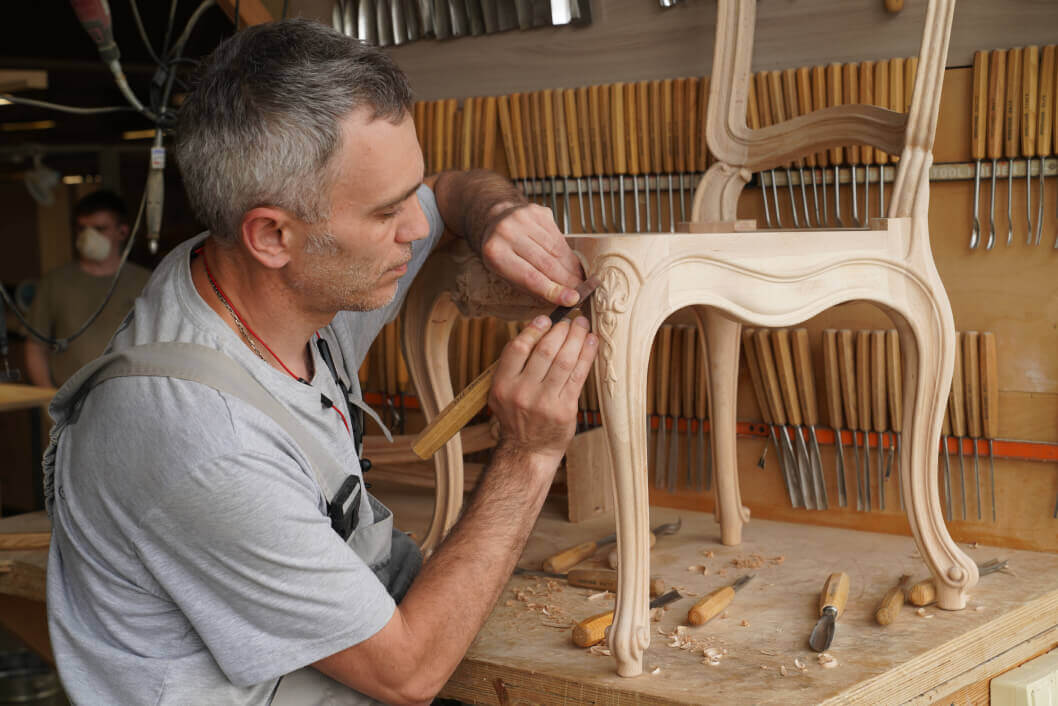
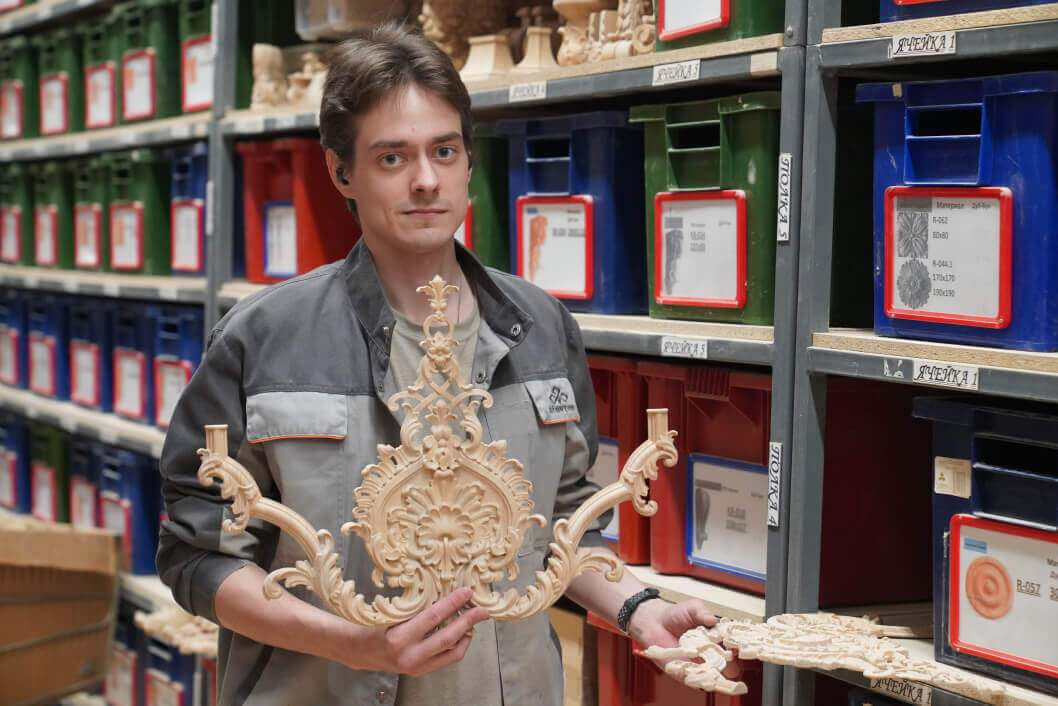
STAVROS Guarantees
Quality of products without complaints
We save your time, peace of mind, and budget
Large warehouse program
We solve your tasks with maximum speed
Adherence to production deadlines
Streamlined process reduces all risks
Delivery from 1 piece throughout Russia
Quality service regardless of order volume
Your positive business reputation
Reliable partner — the foundation of your business
More products in the molding decor category









Frequently asked questions
Our showrooms are located in Saint Petersburg and Moscow. Production is located in Saint Petersburg.
Moscow contacts: https://www.stavros.ru/contacts_all/?tab=msk
Contacts of Saint Petersburg: https://www.stavros.ru/contacts_all/?tab=spb
- Send request by email [email protected]
- Write to us at Telegram
- Write to us at WhatsApp
- Order by phone +7 (800) 555-46-75
- Visit our showroom in Saint Petersburg and Moscow
Yes, we ship orders throughout Russia and to CIS countries.
We cooperate with transportation companies such as СДЭК and DPD.
You can also arrange pickup of your order through any convenient transportation company for you.
Delivery cost depends on the size, weight of the item, and delivery address.
When placing an order, the delivery cost is calculated automatically and displayed as a separate line on our website.
Prices and availability of items on the website are always current. Data is updated daily.
Note: items in stock are stored on the warehouse in unpolished form and shipped within 3 working days.
If the item is not in stock, average production time: 5–10 working days.
This is the quality of polishing of the items.
Standard — machine polishing, at a more attractive price.
Prestige — detailed hand polishing, items do not require further work.
More details: https://www.stavros.ru/information/kachestvo/
This is the type of veneer of the items.
Under enamel: produced by gluing wooden laminates without color and texture matching. Contrast tonal and textural differences are noticeable. This blank should be chosen if the item is intended for opaque coating.
Under tinting: produced by gluing wooden laminates with color and texture matching. Tonal and textural differences may occur. This blank should be chosen if the item is intended for semi-transparent finish.
More details: https://www.stavros.ru/information/kachestvo/
Beech — dense, non-porous wood, most often used for items covered with enamel.
Oak — dense, porous wood with clearly visible natural grain. Due to its strength and decorative properties, it is often used in items with semi-transparent coating, highlighting the wood pattern.
Custom-made, if non-standard items are required, we can produce products from other types of wood, including blanks provided by the customer, manufactured according to our technical specifications.
All our furniture legs can withstand a vertical load of at least 100 kg.
Average production time for custom-made items: 5–10 working days.
Most items are stored on the warehouse in unpolished form. We need time to polish and pack orders.
Yes, we manufacture non-standard items according to individual projects, but we only accept orders with a minimum quantity.
We can manufacture items of the desired size, but we only work with bulk orders. For details, please consult the sales department manager.
Yes, some of our products can be used outdoors. For example, polyurethane items, as well as carved door casings made of pine.
Other items are produced to order using PUR glue, if minimum quantity is available. No warranty is provided for such products, as outdoor conditions are considered aggressive.
Yes, we paint items when ordering products for a total amount of 150,000 rubles or more.
- Dust removal. After sanding, the surface must be dusted.
- Priming. Apply primer in an even layer.
- Matting. After the primer has fully dried, the surface should be matted (lightly sanded for better adhesion).
- Finish coating. Apply finish coating: lacquer or enamel, in 2 layers, with interlayer drying.
More details: https://www.stavros.ru/information/sovety/
Apply adhesive to the decor. Place it on the surface and press briefly. Then, lift the decor from the surface and leave it open for 3–5 minutes. Press the decor firmly onto the surface and hold for 5–10 seconds.
More details: https://www.stavros.ru/information/sovety/
Ideally, you should prepare a design project before placing an order.
You can do this yourself by downloading drawings of our products from our website, or you can order a project from us.
If the number of decorative elements and fittings is small, our company's manager can assist you with selection.
Unfortunately, this service is not provided.
The packaging method depends on the type of items, but in each case, we ensure sufficient protection for safe transportation.
We most often use corrugated cardboard and stretch film. Fragile items are additionally secured on a rigid base to prevent damage during transport.
We ship all items starting from 1 piece.
Room measurements and item installation can be performed by our partners — carpentry companies represented in most regions of Russia.
Often searched in category Carved decor
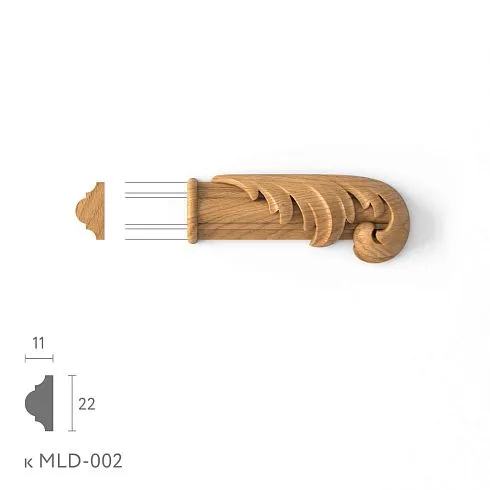
Carved molding finial N-363.1R — right finishing decor, set for MLD-002
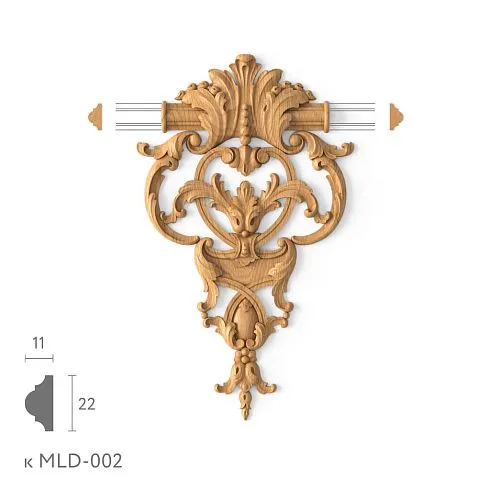
Professionals know: in molding layout, there are no trifles. Every point where a profile line begins or ends is either a decorative solution or an unhealed wound in the composition.Carved molding finial N-363.1R— is a decorative solution. Right. Precise. Made from solid wood with carved floral ornament — specifically as a set for MLD-002.
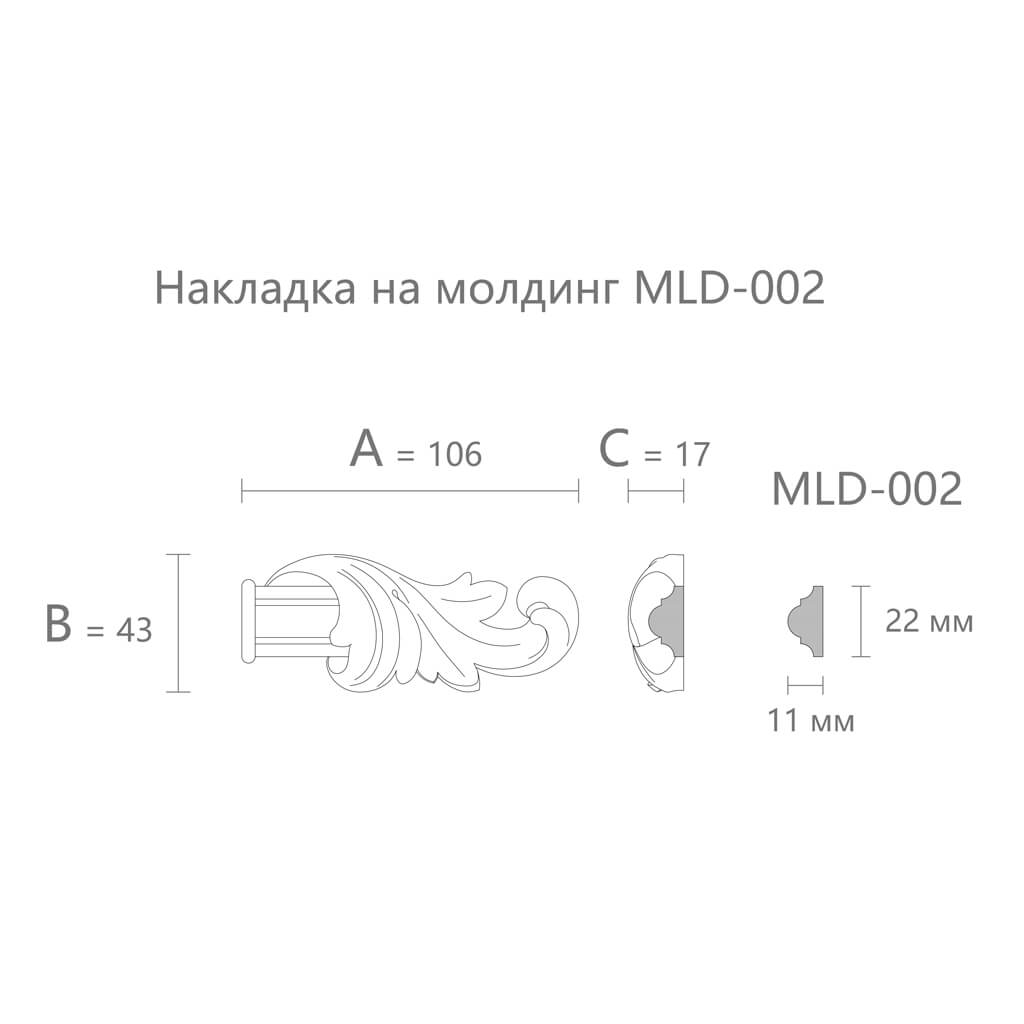
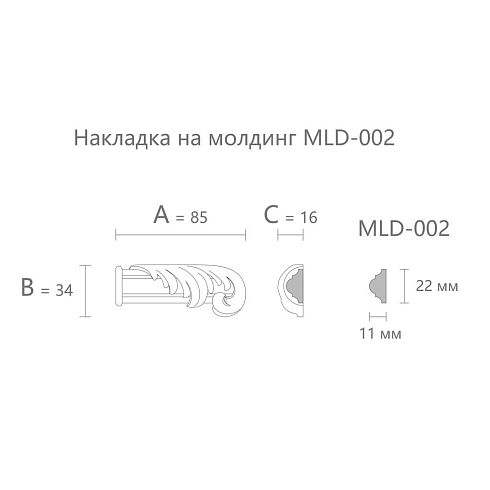
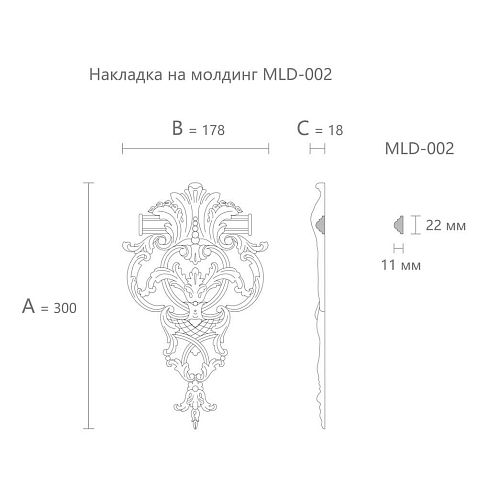
Size 106 × 43 × 17 mm. Material — beech or oak. Finish: 'Standard', for enamel. Made to order. Sounds concise — but behind these specifications lies a product that can change the perception of the entire molding system: remove the feeling of incompleteness, place a decorative full stop, and give the layout the character of expensive, deliberate work.
Carved molding finial N-363.1R — what is this product
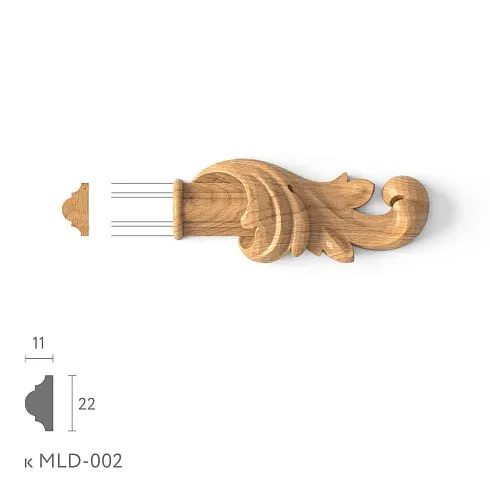
Briefly and to the point:Carved molding finial N-363.1R— is a specialized decorative element for finishing the right end of molding MLD-002. It is not an independent profile and is not used outside the molding system. Its sole and exhaustive task is to close the end of the molding line on the right with a carved ornament.
The designation R (right) in the article number is not just a letter. It indicates the orientation of the ornament and the direction of the mounting recess. The right finial is placed on the right end of the molding. Where the molding line goes left from the mounting point — that is the mirroredN-363.1L. For symmetrical layout, both are needed.
The product is made from solid wood. Two wood species are available: beech and oak. Both are suitable for enamel finishing, but each in its own way — more details in the corresponding section. The 'Standard' version means professional surface treatment, ready for priming and painting. Made to order.
A molding tip is not the kind of product bought spontaneously. It is chosen purposefully when a decision has already been made about the molding system and it needs to be completed correctly. That is why the 'kit for MLD-002' label is not a marketing note but a technical specification.
What problem does the right molding tip solve?
Molding layout without tips is an unfinished sentence. You understand its meaning, but something feels off. The gaze lingers on the profile end and doesn't know where to go next. This is the classic 'broken line' effect — when a form lacks completion.
The right molding tip N-363.1R solves exactly this problem. It closes the right end of the MLD-002 profile so that the end of the molding line stops being a break and becomes an ornamental finish. The carved motif draws the eye into the form, creating a sense of completed gesture — and the layout begins to be perceived as a thoughtful system, not just a set of profiles.
Especially importantdecorative molding tipin symmetrical compositions. When the layout is built along an axis of symmetry — as is customary in classic furniture and wall decor — the right and left sides must be designed as mirror images. The right molding end gets N-363.1R, the left — N-363.1L. Together they create symmetrical completion that reads as a deliberate design choice.
The second effect is increasing the visual 'value' of the product. Furniture with completed molding tips is perceived as more expensive and meticulously crafted — even if it's no different in materials and construction from similar pieces. This is the psychological effect of detail: the more points in the layout are 'closed' with decoration, the more professional the result appears.
And finally:Finishing element for moldingMade from solid wood — it's durable. With proper finishing, wood lasts for decades. Unlike polyurethane alternatives, solid wood doesn't crumble, doesn't yellow under paint, and doesn't lose its shape under mechanical stress.
Design and form N-363.1R: where profile ends and art begins
The tip's form is built around one idea: a smooth transition from the geometry of the molding to the organic nature of the ornament. The MLD-002 profile is quarter-round, strict in form. The N-363.1R tip takes this strictness and dissolves it in a plant motif — leaves, curls, smooth bends of classic decor.
Right orientation of the ornament (R) means the pattern unwinds to the right. This is important from a perception standpoint: the ornament "emerges" from the body of the molding and concludes in the intended direction. If you place a right tip on a left end — the ornament will face the opposite way, and the layout symmetry will be broken.
The product's relief is active, volumetric. With a thickness of 17 mm and a width of 43 mm, the tip has sufficient mass to create shadows under side lighting. It is precisely this play of light and shadow that creates a sense of craftsmanship and artistic value — something not reproducible on flat overlays.
The classic carved decor in the N-363.1R ornament fits into a wide range of styles: French classicism, Italian Renaissance, Russian classicism, neoclassicism, Empire. None of these styles assume unfinished molding lines — that's precisely why the tip is organic and necessary in them.
Compatibility with molding frames is direct: N-363.1R is designed as part of the MLD-002 system, and its proportions, relief depth, and ornamental language correspond to this molding. Using it with profiles of a different cross-section means disrupting the proportional balance of the system.
Set for MLD-002 — why it's important
The clarification "set for MLD-002" in the article number is not a decorative label, but a technical passport of the product. Let's understand what lies behind it.
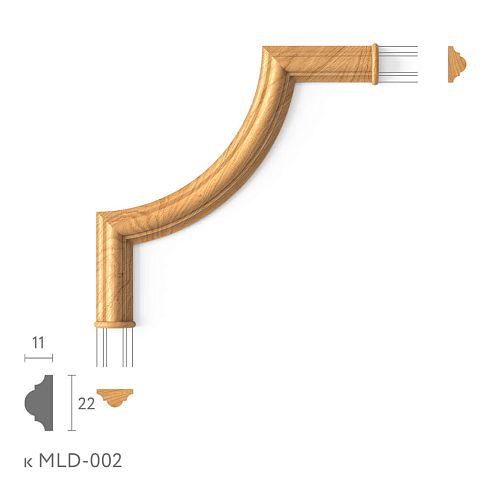
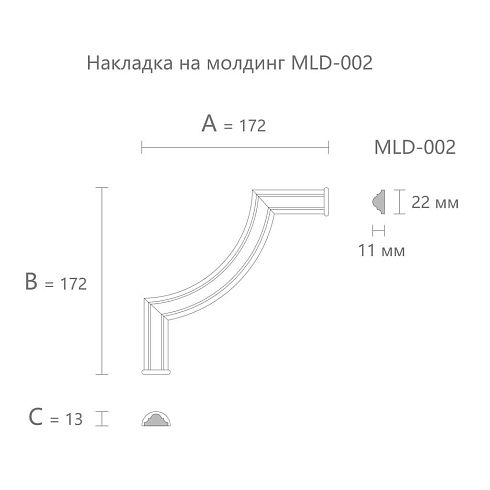
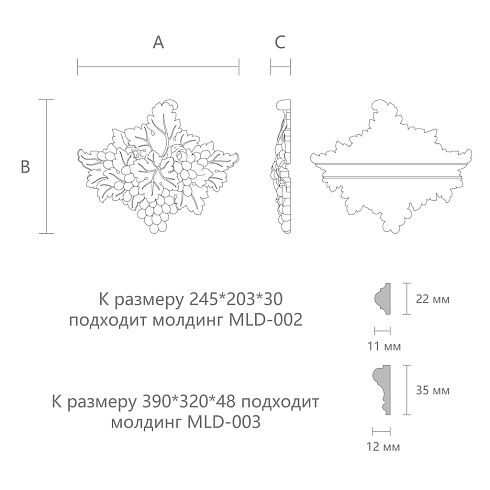
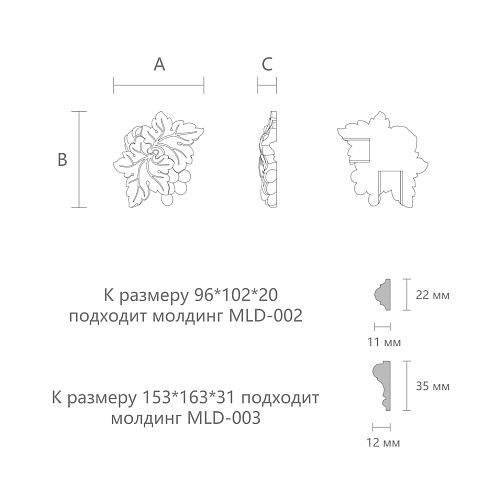
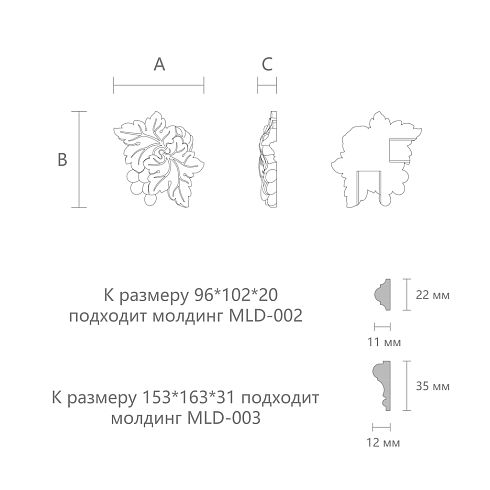
Molding MLD-002— is a wooden profile with a quarter-round cross-section of 22 × 11 mm. It is one of the basic moldings in the Stavros catalog, used for furniture fronts, frame layouts, and wall panels. The profile is concise in form, versatile in application, and takes any finish well.
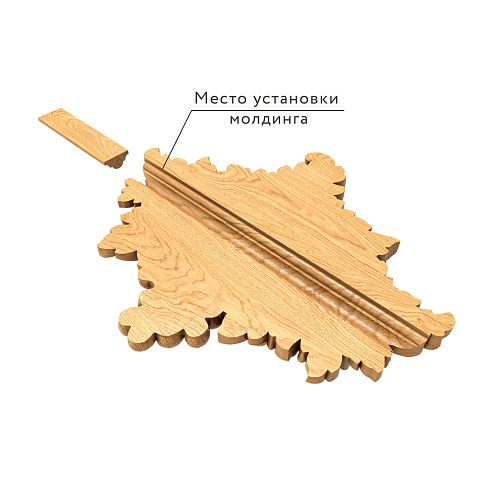
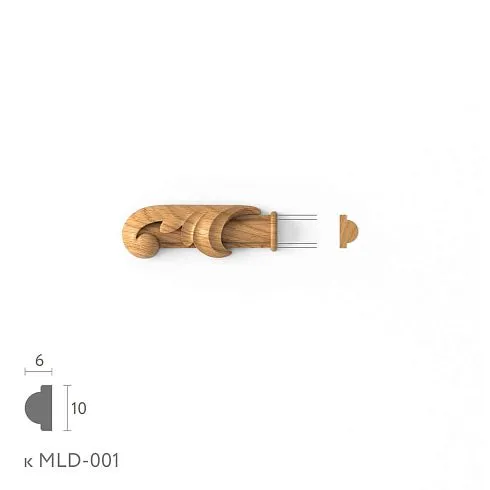
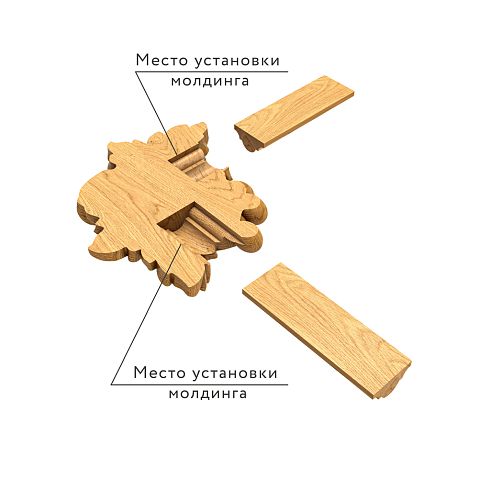
On the reverse side of the N-363.1R tip, there is a mounting recess that precisely matches the profile of this molding: 22 × 11 mm. This means no fitting is required. Take the molding, cut the end, put on the tip—it sits flush, without gaps or misalignment.
Attempting to use N-363.1R with a molding of a different cross-section will result in a gap or loose fit. That is why, when choosing decorative tips for a molding, you should always start from the profile's article number, not just the appearance of the overlay.
For those building a comprehensivedecorative system around a molding layout, the logical set looks like this:
-
Molding MLD-002— linear molding along the entire length of the layout
-
N-363.1R— right finishing tip
-
N-363.1L— left finishing tip
-
Corner element MLD-002U— decorative corner framing
This system provides a complete molding frame with decorative accents at all key points: corners and ends.
Material: beech or oak, "Standard", for enamel — how to choose
The material question is decided once — and correctly, because redoing it later is expensive. Let's examine each parameter.
Beech — the best choice for opaque finishing
Beech is a fine-grained, non-porous wood without a pronounced grain pattern. It is precisely these properties that make it the benchmark material for products that will be coated with enamel. The surface of beech has no open pores that "bleed" through the paint, no large grain pattern that distorts color under opaque coating. The enamel applies evenly, the ornament reads clearly.
Beech tipfor enamel — this is the most technologically advanced option: primer without issues, enamel without surprises, the result is stable and predictable. For production tasks with large volumes of products — this is especially important.
Oak — when wood species and texture matter
Oak has a pronounced porous structure and large grain pattern — precisely what is valued under transparent and semi-transparent coatings. Oil, wax, tinted varnish reveal oak to its full potential: it looks noble, deep, with character.
Oak tipAppropriate when the project involves visible texture: interiors in natural tones, English style, eco-style, neoclassicism with an emphasis on material. Oak is also used under enamel, but requires a pore-filling primer — without it, the paint may unevenly sink into the pores.
What 'Standard' Means
This is the basic industrial finish: milling the shape and machine sanding the surface. The product is ready for priming. Manual finishing is at the master's discretion, but even without it, the surface is sufficiently prepared for professional finishing.
What does 'For enamel' mean
This is the intended purpose of the finish: the product was designed for coating with opaque enamel paint. This implies that the shape, relief, and surface treatment are specifically calculated for an opaque coating — without the need to additionally level or treat the product before painting.
Where to use carved tip N-363.1R
The range of applications for this tip is broader than it seems at first glance. Let's examine the main scenarios.
On furniture facades
Furniture facades with molding layout are the natural environment for N-363.1R. Cabinets, wardrobes, chests of drawers, sideboards, display cases, cabinets — in any of these products, the molding line eventually ends. And how it ends determines the final impression.
The carved tip for the facade is placed on the right end of the molding MLD-002 — where the profile ends, not going into a corner. These can be horizontal moldings inside the door, vertical lines along the sides of the layout, decorative horizontal belts between body zones. Wherever there is an open end of the profile — there the correct tip is needed.
Carved molding finial N-363.1R — right finishing decor, set for MLD-002
Professionals know: in molding layout, there are no trifles. Every point where a profile line begins or ends is either a decorative solution or an unhealed wound in the composition.Carved molding finial N-363.1R— is a decorative solution. Right. Precise. Made from solid wood with carved floral ornament — specifically as a set for MLD-002.
Size 106 × 43 × 17 mm. Material — beech or oak. Finish: 'Standard', for enamel. Made to order. Sounds concise — but behind these specifications lies a product that can change the perception of the entire molding system: remove the feeling of incompleteness, place a decorative full stop, and give the layout the character of expensive, deliberate work.
Carved molding finial N-363.1R — what is this product
Briefly and to the point:Carved molding finial N-363.1R— is a specialized decorative element for finishing the right end of molding MLD-002. It is not an independent profile and is not used outside the molding system. Its sole and exhaustive task is to close the end of the molding line on the right with a carved ornament.
The designation R (right) in the article number is not just a letter. It indicates the orientation of the ornament and the direction of the mounting recess. The right finial is placed on the right end of the molding. Where the molding line goes left from the mounting point — that is the mirroredN-363.1L. For symmetrical layout, both are needed.
The product is made from solid wood. Two wood species are available: beech and oak. Both are suitable for enamel finishing, but each in its own way — more details in the corresponding section. The 'Standard' version means professional surface treatment, ready for priming and painting. Made to order.
A molding tip is not the kind of product bought spontaneously. It is chosen purposefully when a decision has already been made about the molding system and it needs to be completed correctly. That is why the 'kit for MLD-002' label is not a marketing note but a technical specification.
What problem does the right molding tip solve?
Molding layout without tips is an unfinished sentence. You understand its meaning, but something feels off. The gaze lingers on the profile end and doesn't know where to go next. This is the classic 'broken line' effect — when a form lacks completion.
The right molding tip N-363.1R solves exactly this problem. It closes the right end of the MLD-002 profile so that the end of the molding line stops being a break and becomes an ornamental finish. The carved motif draws the eye into the form, creating a sense of completed gesture — and the layout begins to be perceived as a thoughtful system, not just a set of profiles.
Especially importantdecorative molding tipin symmetrical compositions. When the layout is built along an axis of symmetry — as is customary in classic furniture and wall decor — the right and left sides must be designed as mirror images. The right molding end gets N-363.1R, the left — N-363.1L. Together they create symmetrical completion that reads as a deliberate design choice.
The second effect is increasing the visual 'value' of the product. Furniture with completed molding tips is perceived as more expensive and meticulously crafted — even if it's no different in materials and construction from similar pieces. This is the psychological effect of detail: the more points in the layout are 'closed' with decoration, the more professional the result appears.
And finally:Finishing element for moldingMade from solid wood — it's durable. With proper finishing, wood lasts for decades. Unlike polyurethane alternatives, solid wood doesn't crumble, doesn't yellow under paint, and doesn't lose its shape under mechanical stress.
Design and form N-363.1R: where profile ends and art begins
The tip's form is built around one idea: a smooth transition from the geometry of the molding to the organic nature of the ornament. The MLD-002 profile is quarter-round, strict in form. The N-363.1R tip takes this strictness and dissolves it in a plant motif — leaves, curls, smooth bends of classic decor.
Right orientation of the ornament (R) means the pattern unwinds to the right. This is important from a perception standpoint: the ornament "emerges" from the body of the molding and concludes in the intended direction. If you place a right tip on a left end — the ornament will face the opposite way, and the layout symmetry will be broken.
The product's relief is active, volumetric. With a thickness of 17 mm and a width of 43 mm, the tip has sufficient mass to create shadows under side lighting. It is precisely this play of light and shadow that creates a sense of craftsmanship and artistic value — something not reproducible on flat overlays.
The classic carved decor in the N-363.1R ornament fits into a wide range of styles: French classicism, Italian Renaissance, Russian classicism, neoclassicism, Empire. None of these styles assume unfinished molding lines — that's precisely why the tip is organic and necessary in them.
Compatibility with molding frames is direct: N-363.1R is designed as part of the MLD-002 system, and its proportions, relief depth, and ornamental language correspond to this molding. Using it with profiles of a different cross-section means disrupting the proportional balance of the system.
Set for MLD-002 — why it's important
The clarification "set for MLD-002" in the article number is not a decorative label, but a technical passport of the product. Let's understand what lies behind it.
Molding MLD-002— is a wooden profile with a quarter-round cross-section of 22 × 11 mm. It is one of the basic moldings in the Stavros catalog, used for furniture fronts, frame layouts, and wall panels. The profile is concise in form, versatile in application, and takes any finish well.
On the reverse side of the N-363.1R tip, there is a mounting recess that precisely matches the profile of this molding: 22 × 11 mm. This means no fitting is required. Take the molding, cut the end, put on the tip—it sits flush, without gaps or misalignment.
Attempting to use N-363.1R with a molding of a different cross-section will result in a gap or loose fit. That is why, when choosing decorative tips for a molding, you should always start from the profile's article number, not just the appearance of the overlay.
For those building a comprehensivedecorative system around a molding layout, the logical set looks like this:
-
Molding MLD-002— linear molding along the entire length of the layout
-
N-363.1R— right finishing tip
-
N-363.1L— left finishing tip
-
Corner element MLD-002U— decorative corner framing
This system provides a complete molding frame with decorative accents at all key points: corners and ends.
Material: beech or oak, "Standard", for enamel — how to choose
The material question is decided once — and correctly, because redoing it later is expensive. Let's examine each parameter.
Beech — the best choice for opaque finishing
Beech is a fine-grained, non-porous wood without a pronounced grain pattern. It is precisely these properties that make it the benchmark material for products that will be coated with enamel. The surface of beech has no open pores that "bleed" through the paint, no large grain pattern that distorts color under opaque coating. The enamel applies evenly, the ornament reads clearly.
Beech tipfor enamel — this is the most technologically advanced option: primer without issues, enamel without surprises, the result is stable and predictable. For production tasks with large volumes of products — this is especially important.
Oak — when wood species and texture matter
Oak has a pronounced porous structure and large grain pattern — precisely what is valued under transparent and semi-transparent coatings. Oil, wax, tinted varnish reveal oak to its full potential: it looks noble, deep, with character.
Oak tipAppropriate when the project involves visible texture: interiors in natural tones, English style, eco-style, neoclassicism with an emphasis on material. Oak is also used under enamel, but requires a pore-filling primer — without it, the paint may unevenly sink into the pores.
What 'Standard' Means
This is the basic industrial finish: milling the shape and machine sanding the surface. The product is ready for priming. Manual finishing is at the master's discretion, but even without it, the surface is sufficiently prepared for professional finishing.
What does 'For enamel' mean
This is the intended purpose of the finish: the product was designed for coating with opaque enamel paint. This implies that the shape, relief, and surface treatment are specifically calculated for an opaque coating — without the need to additionally level or treat the product before painting.
Where to use carved tip N-363.1R
The range of applications for this tip is broader than it seems at first glance. Let's examine the main scenarios.
On furniture facades
Furniture facades with molding layout are the natural environment for N-363.1R. Cabinets, wardrobes, chests of drawers, sideboards, display cases, cabinets — in any of these products, the molding line eventually ends. And how it ends determines the final impression.
The carved tip for the facade is placed on the right end of the molding MLD-002 — where the profile ends, not going into a corner. These can be horizontal moldings inside the door, vertical lines along the sides of the layout, decorative horizontal belts between body zones. Wherever there is an open end of the profile — there the correct tip is needed.
For furniture facades under white or cream enamel — this is a particularly important detail. White enamel is merciless to incompleteness: it makes everything visible. The N-363.1R tip closes the end elegantly and neatly — exactly as it should look in the final product.
On doors and panels
A cabinet door with a molding frame is a classic furniture front format. The molding runs along the perimeter, corners are closed with corner elements, and if the molding extends beyond the frame or has open ends—a tip is needed.
This is especially relevant for paneled doors with wooden inserts. Horizontal moldings, which form horizontal belts on the door, end at the edge and require decorative closure.Decorative molding endin such cases—is a mandatory detail, not an option.
On wall panels and layouts
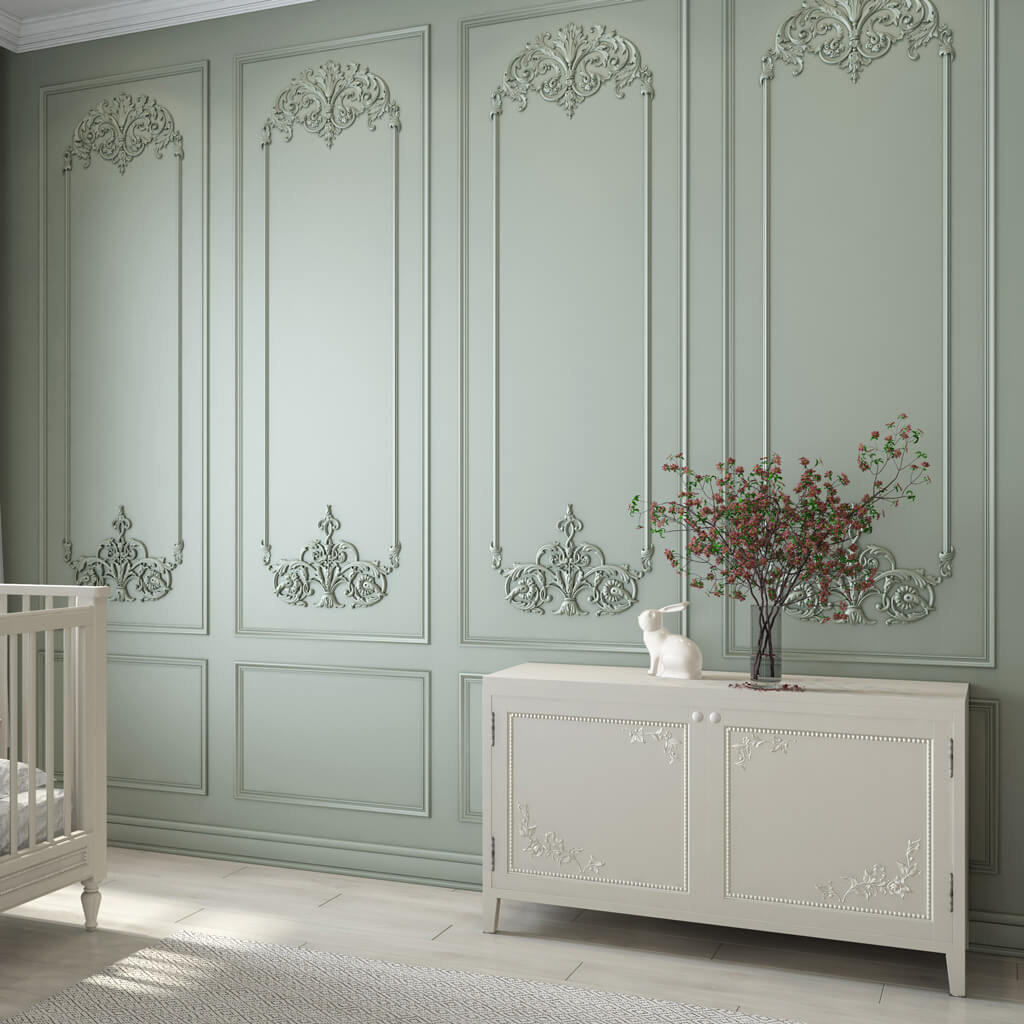
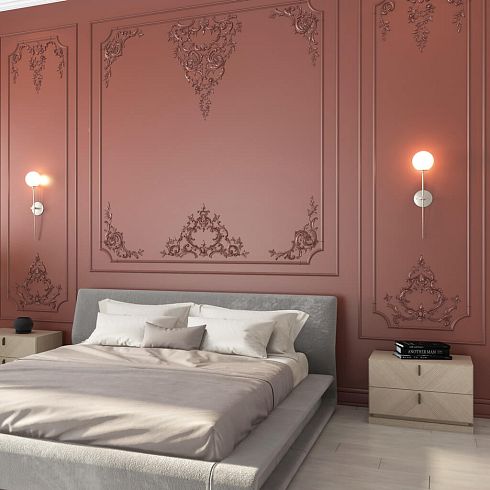
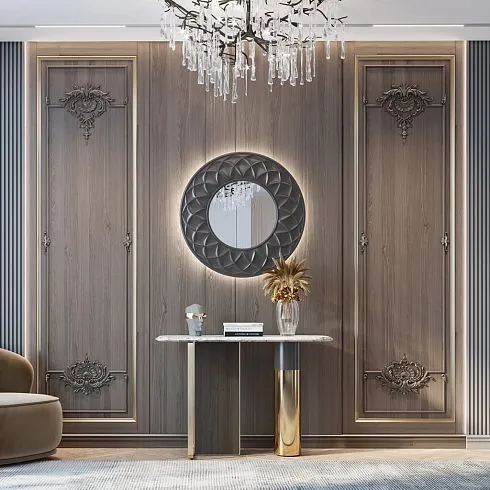
Wall panels with molding geometry are one of the most in-demand interior tools in recent years. Rhythmic frames on the wall create depth, architectural quality, and visual segmentation of the surface. When such a layout ends at a doorway, window, or zone boundary—the molding line breaks off.
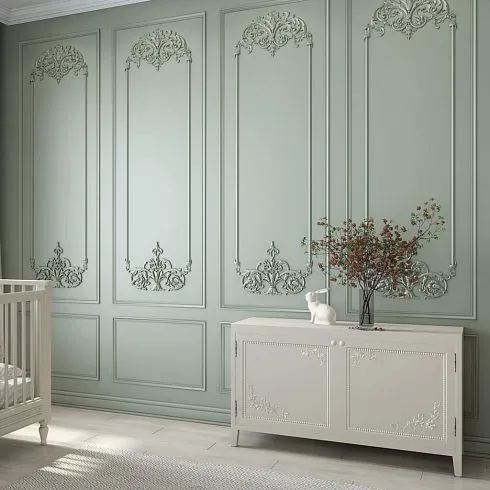
The right tip N-363.1R closes this point. A solid wood decorative element for a wall panel is incomparably more expressive than simply a cut profile end. With side lighting, the ornament's relief creates a shadow, and the tip becomes a living point in the geometry of the wall layout.
In classical and neoclassical interiors
N-363.1R is a product with a distinctly classical language. Floral ornament, organic transitions, volumetric relief—this is the vocabulary of classicism, neoclassicism, and empire style. Where decor is perceived not as an addition but as an architectural norm, the right carved tip becomes a necessary element of the system.
Hamptons, Provençal classic, English style, French neoclassicism—in all these directions, molding layouts with decorative finishes are the norm, not the exception. The N-363.1R tip fits organically into any of these contexts.
Size 106 × 43 × 17 mm: why this format is a precise fit
The proportion of the finial to the molding has its own logic. It is not arbitrary, but carefully calibrated.
The MLD-002 molding has a cross-section of 22 × 11 mm. The finial width is 43 mm, which is approximately twice the width of the profile. This creates an 'opening' effect: the ornament begins where the strict geometry of the molding ends and unfolds into a space slightly wider. The gaze does not stop at the end—it follows the ornament and is released.
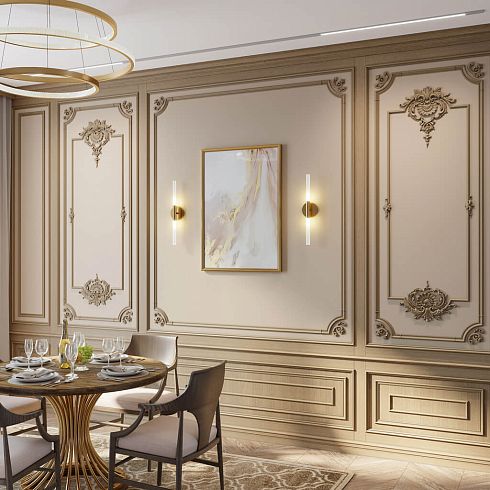
The length of 106 mm is sufficient for the ornament to be read in its entirety, but not excessive.Compact carved finialof this size is universal: it works both on small cabinet doors and on large wardrobe fronts, without disrupting proportions.
A thickness of 17 mm with a width of 43 mm provides enough volume for expressive relief. On a flat surface, such a finial does not look like a random blob: its mass is felt visually, it is perceived as a detail that has weight and artistic significance.
Decorative element for moldingin the format 106 × 43 × 17 mm is not 'just a piece of wood at the end of a profile'. It is a carefully proportioned, calculated endpoint of the system.
What to combine N-363.1R with: assembling the system correctly
A proper molding system is not a set of beautiful parts, but a thoughtful sequence of elements, each of which serves its own purpose.
Molding MLD-002— the foundation of the layout. A quarter-round profile measuring 22 × 11 mm runs the entire length of the line: along the perimeter of the frame, along the horizontal belt, and around the door. This is the starting point of the entire system.
N-363.1L— left paired tip. A mirror element to N-363.1R. For symmetrical layout, both tips are necessary. The right one closes the right end, the left one closes the left. Together they form a finished symmetrical completion.
Corner element MLD-002U— decorative framing of frame corners. If the molding forms a rectangular frame, the corners are closed with corner decor. Combined with the tips on the ends, the system achieves full decorative completeness.
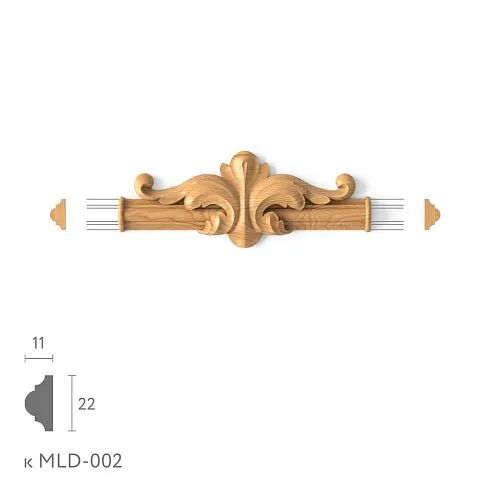
Central overlays from the seriesdecoration for moldings— for enriching the layout with additional accents on the sides or in the center of the frame. This is the next level of detailing.
Enamel finish — uniform for the entire system. Molding, tips, corner elements — everything is coated with one composition, one tone, one technology. This creates a monolithic perception: the system is read as a single artistic whole, not a set of separate parts.
Classical furniture hardware — cast handles in bronze or brass, overlay hinges with decorative plates. Hardware in a classical style continues the linguistic register of the molding layout and completes the product's image.
Installation and finishing: a step-by-step approach
The installation technology for N-363.1R is simple but requires care — especially in terms of fitting and finishing.
Surface preparation. The facade, door, or wall panel must be level, dry, and cleaned of dust and grease. MDF and solid wood are pre-primed. Any unevenness of the base will affect the fit of the molding and tip.
Molding installation. MLD-002 is positioned as needed, secured with adhesive, and additionally fastened with thin nails or pins. The end of the molding where the tip will be placed is cut strictly perpendicular.
Tip installation. The mounting recess N-363.1R is aligned with the end of the molding. The part should fit tightly, without gaps. Fixation—carpenter's PVA glue or wood glue, with additional thin nails if necessary.
Filling and sanding. Joint areas are filled with wood filler; after drying—sanding with fine-grit sandpaper (180–240).
Priming and painting. For beech—universal enamel primer, two coats. For oak—pore-filling primer, then finish primer. Enamel—two to three coats with intermediate sanding using 320-grit sandpaper. Final result: a monolithic surface where the molding and tip are perceived as a single unit.
Installing the tip on the molding—an operation that is not complicated but does not tolerate haste. It is in the finishing details that the difference between good work and flawless work lies.
Why choose N-363.1R
Among all themolding decor assortmentin the Stavros catalog, N-363.1R is the precise answer to a specific request. Not 'something similar,' not 'will fit approximately,' but exactly the element created for MLD-002.
-
Precise fit for MLD-002 profile — no adjustments, no gaps
-
Right orientation — for proper finishing of the right end in symmetrical layouts
-
Natural beech or oak solid wood — durable, eco-friendly, expressive
-
Perfect for enamel — especially in beech finish
-
Precise format 106 × 43 × 17 mm — proportional to MLD-002 molding
-
Classical floral ornament — organic in classic and neoclassical styles
-
Made to order — fresh product, not warehouse leftovers
-
System compatibility — works paired with N-363.1L, MLD-002U and central decorative overlays
This finial isn't decoration for decoration's sake. It's a professional tool for completing molding systems that transforms the perception of the entire layout.
FAQ: answers to popular questions about finial N-363.1R
Is this a standalone decor or a component element?
N-363.1R — exclusively a component element. It is used only as part of a molding system based onMLD-002. It has no independent decorative application.
Which molding does N-363.1R fit?
Exclusively for molding MLD-002 with a cross-section of 22 × 11 mm. The mounting recess on the back of the tip is designed specifically for this profile. For moldings of other cross-sections, corresponding tips from the 'Stavros' catalog are needed.
Why is a tip needed on molding?
So that the end of the molding does not look like a technical break. The tip turns the end of the profile into a decorative point with an ornament, giving the layout completeness and visual 'value'.
Is it suitable for furniture fronts?
Yes, this is the main application scenario. Cabinets, chests of drawers, sideboards, display cases, cabinets — wherever there is an open right end of the MLD-002 molding, the N-363.1R tip decoratively covers it.
Can it be installed on wall panels and doors?
Yes. Application on wall panels, doors, and panels is fully compatible. The installation technology is the same for all surfaces.
What to choose for enamel: beech or oak?
For opaque enamel coating — beech. The fine-grained, non-porous surface of beech ensures a smooth result without additional pore filling. Oak is applicable under enamel but requires the application of a pore-filling primer before the final painting.
What does 'Standard' mean?
Basic execution: milling of the shape and machine sanding of the surface. The product is ready for priming and painting. Manual finishing is possible independently but is not mandatory.
How does the right tip differ from the left?
N-363.1RandN-363.1L— mirror products. For the right (R) tip, the ornament is oriented to the right; for the left (L) tip — to the left. The right tip is placed on the right end of the molding, the left — on the left. For a symmetrical layout, both are needed in equal quantities.
How many tips are needed for one molding line?
For one molding line with two open ends — one N-363.1R (right) and one N-363.1L (left). If there are several molding lines — the quantity is multiplied accordingly. Corner points are closed separately viaMLD-002U.
Where to buy the carved tip N-363.1R?
In the online store 'Stavros' —stavros.ru. Made to order. Pickup in Moscow and St. Petersburg, delivery throughout Russia.
Your request has been sent!
Our manager will contact you within 5 minutes