








































Article Contents:
- What is decor for moldings: elements, types, logic
- Corner Elements
- Central overlays
- Inserts and paired elements
- Ornamental details
- Where and when corner decor for moldings is used
- In frames on the wall: basic and most common scenario
- In decorative panel: from simple frame to artistic composition
- In the area behind the sofa: accent without overload
- In the bedroom at the headboard: gentle geometry above the bed
- In the hallway and corridor: rhythm on a long wall
- In the study and hall: strictness and symmetry
- What tasks does corner decor solve: an honest analysis
- How to choose corner elements for different interior styles
- Neoclassicism: balance between ornament and purity
- Modern classic and Neoclassic Light: minimum ornament, maximum proportions
- Versailles Light: expressiveness and grandeur
- Botanical Garden: ornamental lyricism
- Japandi: decor without decor
- How to properly select corner elements for molding
- Width matching principle
- Principle of Stylistic Unity
- Room scale principle
- Relief height principle
- Five schemes for framing with corner decor
- Scheme 1. Classic rectangular frame
- Scheme 2. Vertical frame for piers and narrow areas
- Scheme 3. Large central frame with corner accents
- Scheme 4. System of multiple identical frames
- Scheme 5. Frame with central overlay and corner inserts
- Calculation of moldings and corner elements: practical algorithm
- Step 1. Determine the frame size
- Step 2. Choose the molding and corner piece
- Step 3. Count the number of elements
- Step 4. Multiply by the number of frames and add a margin
- Installing frames with corner decor: step-by-step practice
- Stage 1. Wall marking
- Stage 2. Dry assembly
- Stage 3. Installing corner pieces
- Stage 4. Installing moldings
- Stage 5. Puttying joints
- Stage 6. Painting
- Typical mistakes when choosing and installing corner elements
- What to buy for a frame with corner decor
- FAQ: Answers to Popular Questions
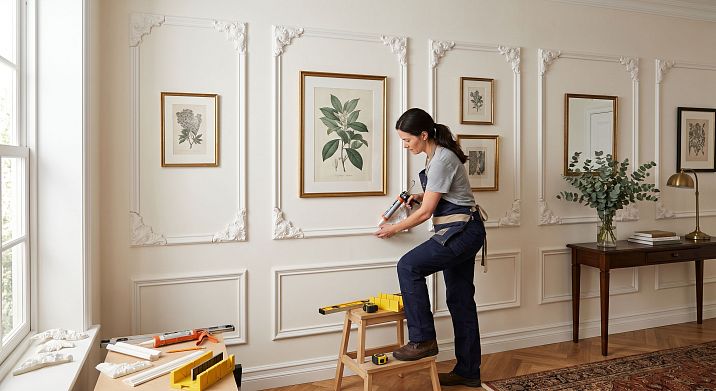
Imagine: you've bought molding, marked the wall, glued straight sections — and a problem arises at the corners of the frame. The 45-degree joint didn't match perfectly. A thin gap, a beveled edge, a barely noticeable shift of the profile. It seems like a trifle — but it's the corner you look at first. It's the corner that reveals carelessness or, on the contrary, skill.
This problem is known to everyone who has ever made frames from molding with their own hands. And it has an elegant solution — Decor for polyurethane moldings: corner elements, overlays, inserts that simultaneously cover the joint and turn a technical node into a decorative accent.
But this is only one side of the topic. The second is more important. Corner decor for moldings is not just a "patch" for a bad cut. It is a full-fledged artistic tool that determines the character of the frame, its style, its scale, and its place in the overall interior system. With the right corner elements, a molding frame ceases to be "just strips on the wall" and becomes a stucco architectural panel.



What is decor for moldings: elements, types, logic
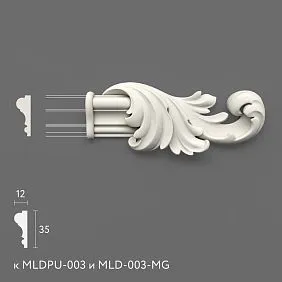
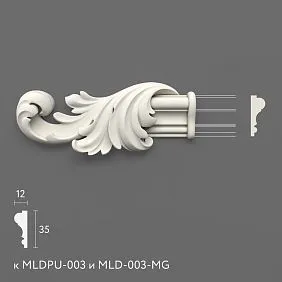
Molding corner pieces — this is a separate category of polyurethane products, which is highlighted as an independent section of the STAVROS catalog. It exists not just as an auxiliary group, but as a full-fledged family of decorative details from which the final appearance of the wall composition is built.
Let's break down in detail what is included in this group.




Corner elements
The main type of decoration for moldings. These are square or rectangular flat elements with a decorative relief that are installed at the intersection points of moldings — that is, at the corners of the frame. The standard size of corner elements corresponds to the width of the molding or is a multiple of it.
A corner element solves three tasks at once: it covers the technical joint of the moldings, creates a decorative accent at the corner of the frame, and sets the stylistic tone of the entire composition.
The width of the molding determines the minimum size of the corner element: for a 22 mm molding — a corner element from 22×22 mm. For a 35 mm molding — from 35×35 mm. In practice, corner elements are often made slightly larger than the width of the molding: this creates an expressive accent and allows the molding joint to "hide" under the element with an overlap.
Our factory also produces:



Central overlays
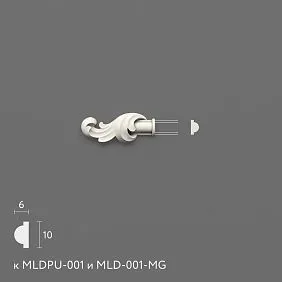
Elements that are installed in the center of the frame — on the upper or lower horizontal of the molding, on the central axis. These can be medallions, cartouches, rosettes, ornamental inserts, geometric accents. The central overlay makes the frame "alive" — it adds the main semantic center to which everything else is drawn.
Get Consultation
Inserts and paired elements
Decorative inserts are installed on straight sections of the molding — usually in the center of the side parts of the frame or rhythmically repeating along a long horizontal run. Paired elements are used in symmetrical systems: two identical elements on the sides of the central axis create clear symmetry.
Ornamental details
Small details with floral, geometric, or classical ornament. They can complement corner elements, be installed between moldings, or serve as independent accents within the panel.
STAVROSdecorative corners for moldingsare presented with filtering by size, collections, and compatible products for the molding. This greatly simplifies selection: you choose a molding, go to compatible corner elements — and get a system where all parts speak the same visual language.
Where and when is corner decor for moldings used
Frames on the wall: the basic and most common scenario
A rectangular or square frame made of moldings is the basic unit of a wall decorative system. Four molding segments, four corner elements, one completed panel.
Why are they even neededdecorative corners for moldingsin a frame, rather than a simple 45-degree miter cut? First, precise cutting requires a tool (miter saw or miter box) and practice. Second, even a perfect miter cut leaves a visible seam that shows up after painting. Third, a corner element is more decorative and expressive than a bare joint: it adds a focal point, enriches the frame with ornament, and creates a sense of completeness.
When there are several frames — on a long wall, in a hallway, in a kitchen-living room — corner elements create rhythmic points: they repeat in every corner of every frame, forming a regular pattern that makes the wall visually active but not chaotic.
Ready-made molding frames for the wall — a detailed article on how to build systems of multiple frames and what role corner decor plays in this.
In a decorative panel: from a simple frame to an artistic composition
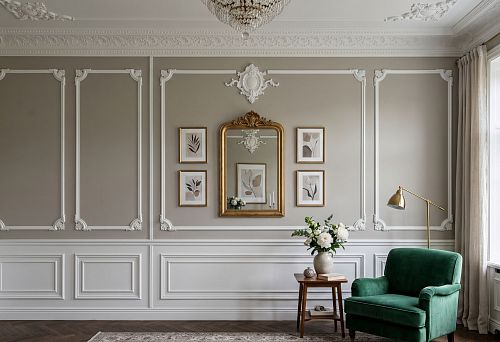
Decorative panel of stucco decor on the wall — this is the next level after a simple frame. A panel implies not only a molding outline but also a rich internal decorative life: corner elements, a central overlay, possibly internal inserts on the sides of the frame.
In a panel, corner decor works as anchors — it fixes the corners, gives the entire composition completeness, and prevents the eye from "escaping" beyond the frame. A good panel with properly selected corner elements is perceived as a single object, not as a set of individual strips.
In the area behind the sofa: accent without overload
The wall behind the sofa is a classic spot for molding frames. One large frame the width of the sofa, or three smaller frames with equal spacing — in both cases, corner elements create focal points that visually "hold" the entire area.
For the wall behind the sofa, calm, not too large corner elements are suitable: a relief but not overloaded ornament, sized proportionally to the molding width. The living room is a living space where harmony matters, not a display of decor.
In the bedroom at the headboard: gentle geometry above the bed
The bedroom requires delicacy. A frame above the headboard is one of the best ways to decorate the wall without overloading it. Here, corner elements should be concise and thin, with a soft relief. A large ornamental corner in the bedroom will look out of place — it is suitable in the living room or hall, but not above the bed.
A good choice for the bedroom: delicate corner elements from the Neoclassic Light collection — calm relief, correct proportions, no excess.
In the hallway and corridor: rhythm on a long wall
A long wall in the hallway or corridor is an ideal place for repeating frames. Three, four, five identical frames with identical corner elements create a rhythmic system that makes a long passage dynamic and architectural.stucco decor for a long wall — about building multi-section systems in corridor spaces.
In the study and hall: strictness and symmetry
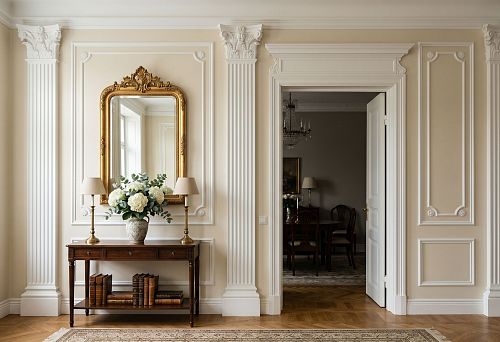
In an office or hall, corner decor operates in a "strict classic" mode. Symmetrical frames, identical corner elements with clear geometric or moderately classical relief, no floral ornamentation — only architectural clarity.
What tasks does corner decor solve: an honest breakdown
Let's list the functions without embellishment. What corner decor for moldings actually doescorner decor for moldingsin the interior?
Covers the technical joint. This is a pragmatic function. Moldings can be cut at 45 degrees, but the corner element covers the connection point with an overlap — and no inaccuracy in the cut will be visible after painting.
Gives the frame decorative completeness. A frame with corner elements looks like an artistic object. A frame without them looks like a technical outline. These are different things.
Defines the style of the system. The style is immediately read from the shape and relief of the corner elements: classic, neoclassical, art deco, modern classic. The corner element is the "cover" of the entire system.
Creates rhythmic points on the wall. With multiple frames, corner elements are placed regularly across the entire surface — and this creates a visual rhythm that holds the gaze and organizes the space.
Enhances symmetry. Symmetrical corner elements in identical frames create an ideal mirror system. The gaze confirms symmetry at every step.
Connects moldings with cornices, baseboards, and other decor.Moldings for wall framestogether with corner elements form a system that stylistically connects with the cornice at the top and the baseboard at the bottom. A unified decorative language across the entire wall.
Allows you to assemble a beautiful frame without professional cutting. This aspect is underestimated. When installing corner elements, the moldings are simply adjusted between them by length — straight cut, no 45-degree angle. This is much easier to install.
Decorative elements for the wall made of polyurethane— about the role of small forms of stucco decoration in wall systems: when corner elements are enough, and when they need to be supplemented with overlays and inserts.
How to choose corner elements for different interior styles
This is a key question. A corner element chosen "out of style" ruins the entire system. Let's break it down by style.
Neoclassicism: balance between ornament and purity
Neoclassicism is not "a lot of decor." It is correctly placed decor in the right proportions. For neoclassicism, corner elements with a calm relief are suitable: a small classical ornament, a symmetrical pattern, clear shape boundaries.
Wall decor in neoclassicism— the STAVROS collection with a full set of elements for a neoclassical interior, including corner inserts, overlays, and moldings of a unified proportional language.
Painting: white corner elements on a colored wall — classic. Corner elements in the color of the wall with a lighter molding — modern neoclassicism.
Modern Classics and Neoclassic Light: minimum ornament, maximum proportions
For modern classics, corner elements are chosen to be as laconic as possible: smooth, with barely hinted relief, without ornament. It could be just a square insert with a thin chamfer or a small geometric element.
Wall decor Neoclassic Light — a system for apartments where conciseness is important. Corner elements here are subordinate to the molding: they are more modest, cleaner, and more precise in scale.
Painting: always in the color of the wall — an 'invisible' relief that is perceived only in side light.
Versailles Light: expressiveness and grandeur
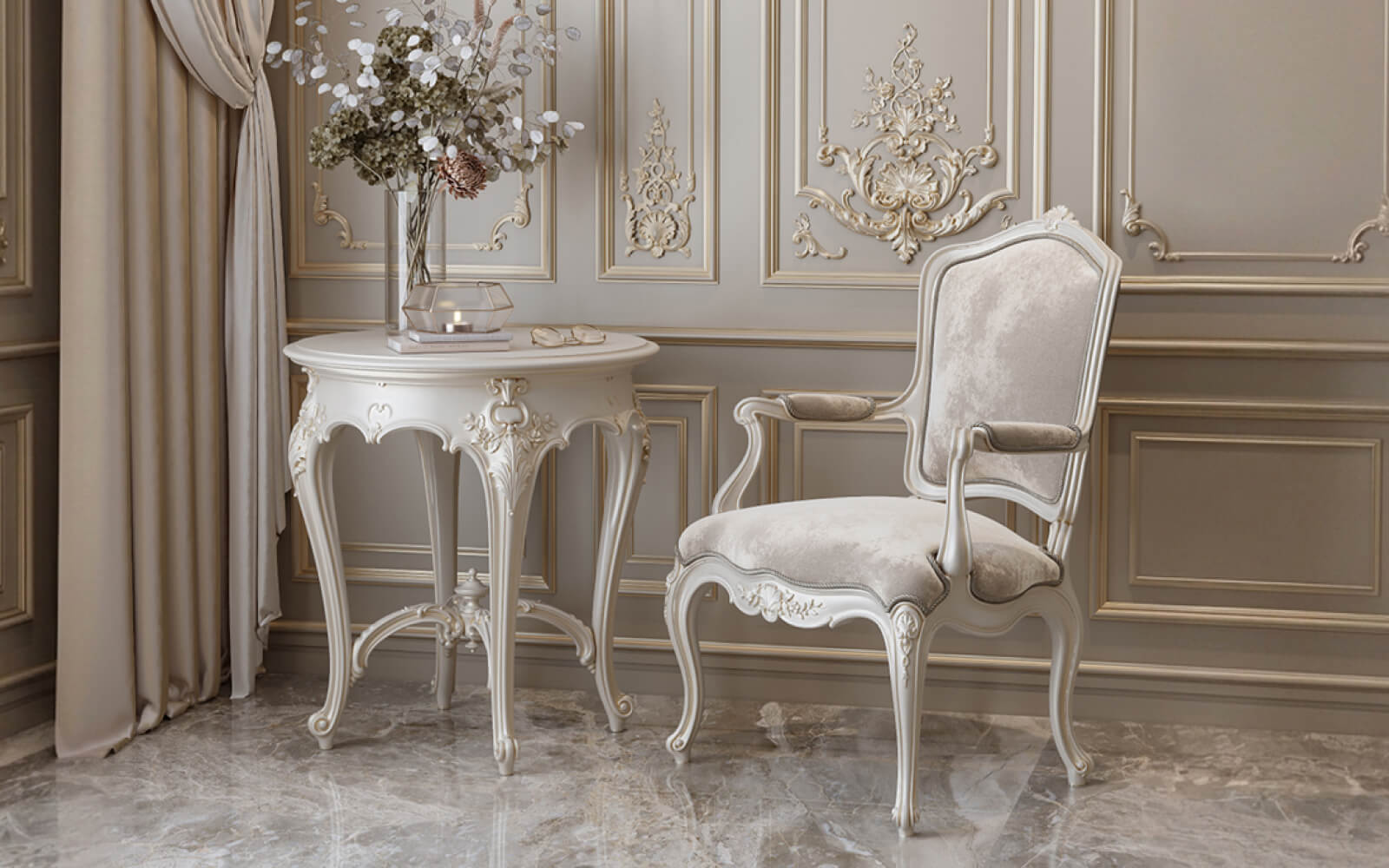
In the Versailles Light collection, corner elements are noticeably richer: a more pronounced classic ornament, a wider format, and a tangible decorative richness. This is a collection for formal interiors — halls, living rooms of country houses, and studies with high ceilings.
Classic wall decor Versailles Light — for spaces where monumentality is appropriate. Here, corner elements work as accent points: they are noticeable, rich in relief, and set the tone for the entire system.
Botanical Garden: ornamental lyricism
Stucco decor Botanical Garden offers corner and decorative elements with a plant motif: leaves, shoots, floral rosettes. This is a non-standard approach to frames — instead of a strict classic corner, there is a living, natural form.
Usage: bedroom, living room in a lively style, interior with natural-colored textiles, space with botanical prints.
Japandi: decor without decor
Wall decor in Japandi style — that's a separate story. In Japandi, the corner element should be as neutral as possible. The best option is to do without corner inserts altogether, assembling the frame from a laconic molding with a straight joint. If corner elements are still needed — only the simplest geometric shapes without ornament, matching the wall color.
How to properly select corner elements for molding
Principle of width matching
This is a fundamental rule. The corner element must match the width of the molding. If the molding is 22 mm, the corner element is 22–30 mm. If the molding is 35 mm, the corner element is 35–45 mm.
Violation of this rule is immediately visible: a corner element that is too small "sinks" into the molding and looks insignificant. One that is too large sticks out of the molding and disrupts the logic of the frame.
| Molding width | Recommended size of corner elements | Effect |
|---|---|---|
| 10–15 mm | 15–20 mm | Delicate accent |
| 20–25 mm | 22–35 mm | Balanced frame |
| 30–40 mm | 35–55 mm | Expressive corner |
| 45–60 mm | 55–80 mm | Monumental frame |
Principle of stylistic unity
The corner element and molding should belong to the same style family. A classic ornament with floral decor pairs poorly with a minimalist modern molding. A geometric corner element is inappropriate next to a rich classic profile.
In the STAVROS catalog, each polyurethane molding decoris linked to a collection — this is the most reliable way to select: take a molding from the "Neoclassic" collection and corner elements from the same collection.
Principle of room scale
For a small room up to 15 m²: delicate corner elements, low relief, thin molding. Active large decor in a small space feels oppressive.
For a large living room or hall: you can use more expressive corner elements, wide molding, central overlays. The scale of elements should match the scale of the space.
Principle of relief height
Molding and corner element should have comparable relief height. If the molding protrudes from the wall by 8 mm, the corner element should be 6–10 mm. A strong mismatch creates an ugly transition.
polyurethane wall moldings — about types of molding profiles, their sizes, and principles of selection for different types of frames and spaces.
Five schemes for framing with corner decor
Scheme 1. Classic rectangular frame
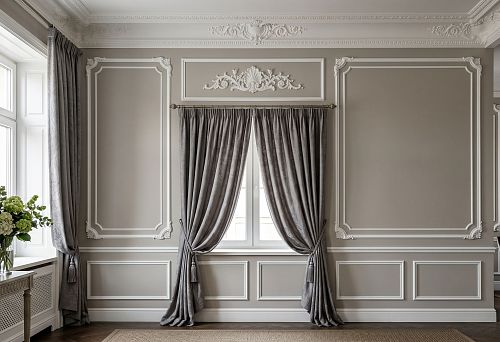
The most basic and universal option. Four corner elements in the four corners of the frame, four molding segments along the sides. The frame width is selected based on the object on the wall or the wall section.
Proportions of a good frame: height to width = 1:1.5 – 1:2 (horizontal frame). For vertical space — 1.5:1 – 2:1.
Application: any wall, any room. This is the "alphabet" of the wall system — everything else is built from this scheme.
Scheme 2. Vertical frame for piers and narrow zones
A vertical frame is tall and narrow. It has four corner elements, but the aspect ratio is different: the height is significantly greater than the width. It is used in piers, hallways with high ceilings, and areas between doors.
A vertical frame with corner elements works like a small "picture frame" — it focuses attention on a narrow vertical section, making it an artistic object.Stucco Decor for the Wall Between Windows — about vertical frames in piers and the rules of their proportioning.
Scheme 3. Large central frame with corner accents
For the wall behind a sofa, above a bed, around a mirror, console, or fireplace area. The frame occupies most of the wall's width — from 60 to 90% of the zone's width. The corner elements here are larger than usual: they set the scale of the entire composition.
In the center of such a frame is a decorative overlay or medallion. Corner elements + central overlay = a complete classic wall panel.
Stucco decor for a wall with a console and a chest of drawers — about constructing a large central frame above a console and the role of corner elements in such a system.
Scheme 4. System of several identical frames
On a long wall — three, four, or five identical frames with identical corner elements and identical gaps. This is a rhythmic system built on repetition.
Key requirement: absolutely identical corner elements in all frames. Any difference in decor disrupts the rhythm and creates visual clutter.
symmetric polyurethane wall decor— about the principles of rhythm and symmetry in multi-section systems.
Scheme 5. Frame with central overlay and corner inserts
The most saturated scheme: four corner elements at the corners + a central decorative element on one or more sides of the frame (usually on the top horizontal or in the center of the inner field).
This scheme is for classic, neoclassical, and formal interiors. It assumes a large frame area and proportionate decorative elements. In smaller rooms, corner elements without a central overlay are sufficient.
Decorative panel of stucco decor on the wall— about maximally saturated wall panels where corner elements and central overlays work as a single artistic system.
Calculation of moldings and corner elements: a practical algorithm
Calculation is always about specifics. Let's move from theory to numbers.
Step 1. Determine the frame size
The frame size is determined by two factors: the width of the wall section and the height from the baseboard to the cornice (or to the horizontal belt). The frame should not be flush with the baseboard and cornice — an indentation is needed. Standard indentation: from the baseboard — 15–25 cm, from the cornice — 10–20 cm, from the corners of the wall — 15–25 cm.
Step 2. Choose the molding and corner element
Select the molding profile (Polyurethane moldings for walls) and corner element (elements for polyurethane moldings) from the same collection.
Important: when using corner elements, the length of the molding sides is calculated between the inner edges of the corner elements, not by the full frame size. That is, if the corner element size is 40×40 mm, subtract 40 mm from each end of each run.
Step 3. Count the number of elements
One frame requires:
-
4 corner elements (one in each corner)
-
2 horizontal molding pieces (top and bottom of the frame)
-
2 vertical molding segments (left and right side)
-
1 center element (if provided by the scheme)
Length of horizontal runs: frame width − (2 × corner element width)
Length of vertical runs: frame height − (2 × height of corner element)
Step 4. Multiply by the number of frames and add a margin
Number of corner elements: 4 × number of frames
Molding length: sum of all runs × number of frames + 10–15% for reserve (trimming, defects)
Example: 3 frames, each 80×60 cm, corner elements 35×35 mm, molding 25 mm.
Length of horizontal runs: 80 − (2 × 3.5) = 73 cm → 2 runs = 146 cm
Length of vertical runs: 60 − (2 × 3.5) = 53 cm → 2 runs = 106 cm
Perimeter of one frame: 146 + 106 = 252 cm
Total for 3 frames: 252 × 3 = 756 cm + 10% reserve = 832 cm ≈ 8.4 m of molding
Corner elements: 4 × 3 = 12 pieces
how to calculate moldings and stucco decor for a wall — complete calculation algorithm for complex multi-element systems.
Installation of frames with corner decor: step-by-step practice
Stage 1. Wall Markup
Markup is 50% of success. Everything that is marked crookedly will stand crookedly — even with perfect installation.
Determine the central axis of the wall and the axis of each frame. All axes are drawn with a pencil using a laser level or a long straightedge. The frame contours are transferred to the wall: four corner points.
Stage 2. Dry Assembly
Place all elements against the wall without glue. Check: correct dimensions, horizontal and vertical alignment, matching of corner elements to the molding, overall visual balance. Only after the dry layout is approved — proceed to installation.
Stage 3. Installation of corner elements
Corner elements are installed first. Acrylic glue is applied to the back side of the element along the perimeter. Press against the wall, align with the marks, hold until set (usually 1–2 minutes). All four corners of the frame.
Stage 4. Installation of moldings
Moldings are cut to size — straight cut (not at 45 degrees, because the corners are covered with decorative elements). Glue is applied in a snake pattern along the entire length. The molding is inserted between the corner elements. Press, if necessary — secure with painter's tape until dry.
installing polyurethane molding — about the technique of clean joints, rules for applying glue, finishing treatment, and preparation for painting.
Stage 5. Puttying joints
The joints between the molding and corner elements are puttied with acrylic sealant or finishing putty. Thin seam, cleaning excess, leveling. After drying — light sanding.
Stage 6. Painting
The entire system — corner elements, moldings, wall — is painted in two coats. Between coats — light sanding. After the final coat, the boundary between elements and wall disappears: the system looks like a single whole.
installation of polyurethane molding — a practical guide to installation and finishing of polyurethane elements, including the nuances of working with corner decor.
Typical mistakes when choosing and installing corner elements
Let's be honest — everyone makes mistakes here. Even experienced craftsmen. Let's list the most common ones.
Corner element does not match the width of the molding. The most common mistake. A small corner on a wide molding — sinks in. A large corner on a narrow molding — sticks out. Check dimensions before ordering.
Corner element from a different style. Floral ornament on a minimalist wall, or a strict geometric corner in a classic interior — these are style conflicts that destroy harmony.
Too large corner elements in a small room. In a room of 10–12 m², large decorative corners create a feeling of overload. The scale of the decor should match the scale of the space.
Frames are placed without symmetry. Different margins on the left and right, different distances between frames, misalignment with furniture. Symmetry is not pedantry, but a condition for the system to work.
Sockets, switches, and radiators are not accounted for. A frame that had to be cut due to a switch is an irreparable mistake. Always mark the location of all electrical and engineering objects on the plan.
Moldings and corner elements are painted at different times. If elements were painted separately and then glued on, the joints will be visible. The system should be painted after full installation.
A dry layout was not done. Without a preliminary fitting, it is difficult to assess the final result. Dry assembly is a mandatory step that allows you to correct errors before applying glue.
The spare molding for cutting is forgotten. Always take 10–15% above the calculated footage. Cutting errors happen.
What to buy for a frame with corner decor
List of all necessary items to create a complete system:
-
decorative corners for moldings— corner inserts for frames from the selected collection
-
Polyurethane moldings for walls— profile for straight frame runs
-
Polyurethane decorative appliques — central elements for rich frames
-
polyurethane wall decor— ready-made systems and kits for walls
-
Polyurethane wall molding— ornamental overlays and inserts
-
Cornice and baseboard frompolyurethane productsin a unified style
By collections:
-
Neoclassical— corner elements and moldings for classic systems
-
Neoclassic Light— minimalist decor for modern apartments
-
Versailles Light— expressive corner elements for grand interiors
-
Botanical Garden— corner details with floral ornament
stucco decor in the color of the wall or contrasting— about the principles of choosing a color scheme for corner elements and moldings depending on the style and task.
Stucco decor for a wall with a bookcase and shelves— about how frames with corner decor combine with cabinet furniture and built-in shelves.
FAQ: Answers to popular questions
Why are corner elements for moldings needed?
Molding corner pieces solve two tasks at once: they cover the joint of straight molding runs (without the need for precise 45-degree cutting) and create a decorative accent in the corners of the frame, giving the entire system architectural completeness.
Can you make a frame from moldings without 45-degree cuts?
Yes, that's exactly what corner decor is for. When using corner elements, the moldings are cut with a straight cut and fitted between the elements — no 45-degree angle, no miter box. This simplifies installation and gives a perfect result.
How many corner elements are needed for one frame?
For one rectangular frame — 4 corner elements, one in each corner. For a system of three frames — 12 corner elements. For a system of five frames — 20.
How to choose corner elements for molding?
Three criteria: width (the corner element should match or be slightly wider than the molding), style (from the same collection), and relief height (comparable to the molding). In the STAVROS catalog, decorative molding elements have filtering by compatible products — this is the most reliable way to select.
Can you paint decorative molding elements?
Yes, polyurethane accepts acrylic paint without restrictions. Corner elements and moldings are painted together with the wall in one go after full installation — this creates a uniform surface without visible joints.
How to avoid mistakes with the scale of corner elements?
Focus on three parameters: molding width, room area, and ceiling height. For small rooms — delicate elements. For spacious living rooms and halls — you can choose more expressive decor. The main thing is matching the molding and collection.
What else is needed to create a frame besides corner elements and moldings?
For a basic frame — only moldings and corner elements. For a more elaborate system — addPolyurethane decorative appliquesin the centers of frames, a cornice, and a baseboard in a unified style.