










































































Article Contents:
- What is a pilaster and how is it different from a column
- What a classic pilaster consists of
- Where to use pilasters in interior design
- Pilasters in the living room: verticality as an organizing principle
- Pilasters in the hallway and foyer
- Pilasters at the doorway: the portal effect
- Pilasters on a long wall: vertical rhythm on a large surface
- Pilasters in piers
- What problems do pilasters on the wall solve?
- Types of polyurethane pilasters
- Narrow pilasters for apartments and compact spaces
- Wide pilasters for living rooms and halls
- Pilasters with capital and base: classic full set
- Laconic pilasters for modern classic style
- Pilasters in wall color: invisible architecture
- What to combine pilasters with
- Pilasters and moldings: basic wall system
- Pilasters and cornice
- Pilasters and baseboard
- Pilasters and decorative overlays
- Pilasters and stucco decor for moldings
- Pilasters and ready-made wall kits
- Five schemes for decorating a wall with pilasters
- Scheme 1. Two pilasters on the sides of the central composition
- Scheme 2. Pilasters around a doorway
- Scheme 3. Pilasters as section dividers on a long wall
- Scheme 4. Pilasters in piers
- Scheme 5. Pilasters and molding frames — a complete wall system
- How to choose the size of pilasters
- Height of pilaster
- Width of pilaster
- Scale and placement of furniture
- How to calculate the number of pilasters for a wall
- For a portal scheme (two pilasters)
- For a sectional scheme on a long wall
- Additional elements
- Installation of polyurethane pilasters
- Surface Preparation
- Marking
- Installation
- Painting
- Stylistic solutions with pilasters
- Neoclassicism: symmetry and order system
- Versailles Light: monumental expressiveness
- Neoclassic Light: modern classic
- Botanical Garden: decorative expressiveness with character
- Mistakes when decorating a wall with pilasters
- What to buy for decorating a wall with pilasters
- FAQ: Answers to Popular Questions
There are walls that remain silent. A flat white plane without a single architectural statement. Furniture is arranged, lighting is thought out, color is chosen — but the wall still remains a backdrop. Not because it is poorly painted. But because it lacks verticality. It lacks that architectural impulse that sets the tone for the entire space.
It is the vertical line — the oldest and most expressive technique in interior architecture. Column. Pillar. Pilaster. Three millennia of European architecture were built on these elements — not because they are "beautiful," but because they work. They organize space, set scale, create symmetry, and make the wall readable.
TodayPolyurethane pilastersallow you to achieve this architectural effect without colossal costs and without specialists in stucco. Lightweight, paintable, precisely reproducing classical proportions — and the wall gains verticality, character, and architectural depth.


What is a pilaster and how it differs from a column
Before moving to practice, it is worth understanding the terminology — because "pilaster," "half-column," and "column" are different elements with different functions.
A column is a self-supporting (or decorative) vertical element standing separately from the wall. It has a round or polygonal cross-section. In interiors, it is a zoning, monumental object.
A half-column is a column that is half-recessed into the wall. It protrudes from the wall plane by about half its diameter. It creates strong relief and deep shadow.
A pilaster is a flat or moderately relief vertical element that is attached to the wall and barely protrudes beyond its plane. It is not a structural element but a decorative one. It reproduces the image of a column, preserving its proportions and language, but works as wall decor.
Decorative pilasters for the wallmade of polyurethane is a modern interpretation of this classic element. They are made of rigid polyurethane by injection molding, accurately reproducing the relief and ornamentation of classical prototypes, and are mounted with acrylic glue without complex construction work.




What a classic pilaster consists of
A classic pilaster consists of three parts:
-
Base — the lower part, standing on the baseboard or floor. It widens downward, creating a sense of stability.
-
Shaft — the central vertical part. It can be smooth, fluted (with vertical grooves), or decorated with ornament.
-
Capital — the upper part crowning the pilaster. The architectural order is determined by the shape of the capital: Doric, Ionic, Corinthian.
In modernpolyurethane pilasters, all three parts can be sold as a single element or as separate parts that are combined on the wall. This provides flexibility: you can adjust the height of the pilaster to any ceiling simply by changing the length of the shaft.
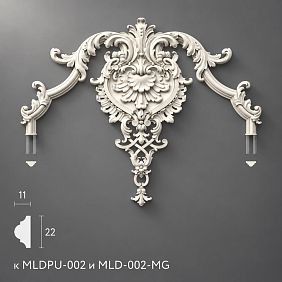
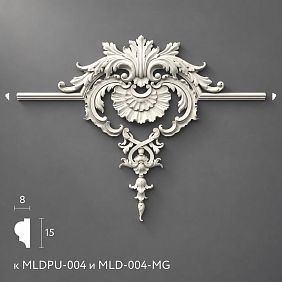
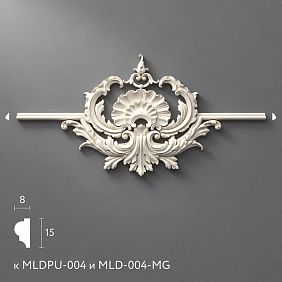
Our factory also produces:


Where to use pilasters in interior design
Get Consultation
Pilasters in the living room: verticality as an organizing principle
The living room is a space where pilasters work most expressively. They are used in several scenarios, each with its own logic.
TV area. Two pilasters on either side of the TV create a portal effect: the TV area gets an architectural frame, transforming from 'just a TV on the wall' into a full-fledged interior object. Between the pilasters and the TV panel, frames, horizontal bands, and decorative overlays are often installedPolyurethane moldings for walls— frames, horizontal bands, decorative overlays. This creates a complete symmetrical system.
Fireplace area. A fireplace with pilasters on the sides is a classic interior portal. The pilasters support the horizontal line of the fireplace mantel, create a sense of architectural depth, and make the fireplace the center of the entire wall. More on this topic in the articlepolyurethane decor for the wall with a fireplace.
Sofa group. Pilasters along the edges of the wall behind the sofa create a 'frame' for the entire sofa group. In combination with molding frames, they turn the wall behind the sofa into a formal architectural plane.
Pilasters in the hallway and foyer
A hallway in an apartment with high ceilings or a foyer in a country house is a space that creates the first impression. Pilasters here work in a dual way: they create a vertical rhythm and signal the character of the entire interior.
In a long foyer, pilasters are placed in pairs on opposite walls — at the same height and with the same spacing. This creates an enfilade effect: the space is perceived as an architectural corridor, not just a long hallway.
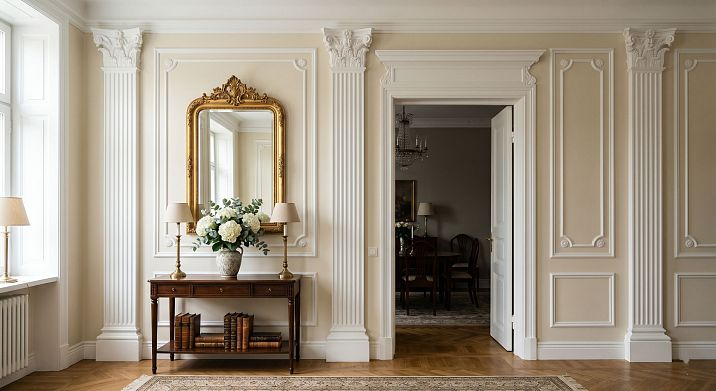
In a hallway with a wall at the entrance door, a pair of pilasters frames the console and mirror area.Vertical wall decor made of polyurethane— about the principles of vertical systems in hallways and foyers with limited space.
Pilasters at the doorway: portal effect
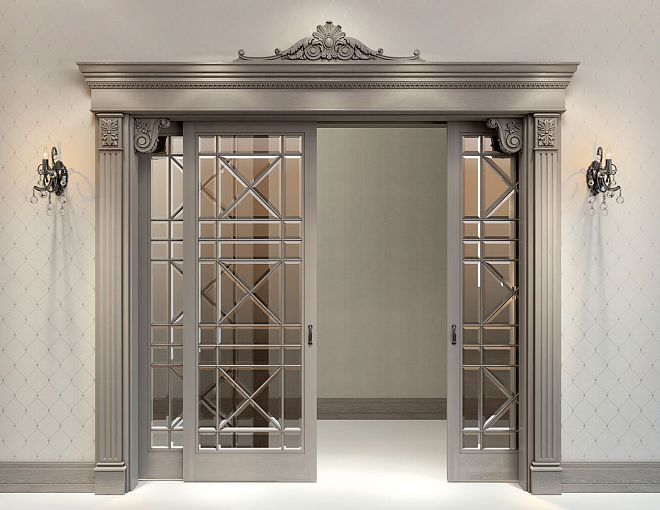
A doorway framed with pilasters turns into a portal. This is one of the most expressive techniques in classical and neoclassical interior decoration. The principle is simple: two pilasters on the sides of the opening, a horizontal lintel (entablature) above it.
This technique is especially effective when transitioning from the hallway to the living room, from the living room to the dining room, or when entering a study. A portal with pilasters marks the transition between spaces — not physically (like a door), but architecturally. It gives significance to each space.
Stucco decor around doors and openings— a detailed analysis of portal systems with pilasters for different types of doorways.
Pilasters on a long wall: vertical rhythm on a large surface
On a long wall — 5 m or more — pilasters work as vertical section dividers. Unlike simple molding lines, pilasters create a more expressive division: they protrude from the wall plane, cast a strong vertical shadow, and are perceived as architectural elements rather than just decorative strips.
Three or four pilasters on a long wall divide it into equal sections. In each section between the pilasters, molding frames are installed. This is a full wall system: pilasters set the verticals, frames fill the sections.stucco decor for a long wall — about schemes for decorating extended surfaces with vertical divisions.
Pilasters in Piers
A narrow pier between windows, between a door and a wall, between a niche and an opening — this is an ideal place for a single pilaster. It fills the vertical plane without creating horizontal elements that would visually narrow an already small space.
Stucco Decor for the Wall Between Windows — about how a single pilaster in a pier unites windows into a single architectural system.
What Tasks Do Pilasters Solve on a Wall
A pilaster is not just a "beautiful element." Behind each use lies a specific architectural or design task. Let's list them explicitly:
-
They stretch the wall vertically. A vertical element from the baseboard to the cornice directs the gaze upward. This is especially important with a ceiling height of 2.5–2.6 m: pilasters create the illusion of greater height.
-
Create symmetry. Paired pilasters at the edges of a wall or on the sides of a central object organize a symmetrical composition that is perceived as architecturally complete.
-
Frame a portal. Pilasters + horizontal lintel = an architectural portal around a door, fireplace, niche, or TV.
-
Divide a long wall into sections. In combination with moldings, pilasters create a full sectional system.
-
Connect moldings, cornice, and baseboard into a single vertical system. A pilaster is the "spine" of the wall system: it runs from the baseboard to the cornice, linking horizontal elements into a unified vertical logic.
-
Make the interior architectural. This cannot be precisely described by a formula, but pilasters transform an interior from a "furnished room" into an "architectural space."
Types of polyurethane pilasters
Narrow pilasters for apartments and compact spaces
For an apartment with a ceiling of 2.5–2.7 m — pilasters 60–100 mm wide. These are delicate verticals that give a sense of architectural presence without bulkiness. They work well in hallways, near doorways, and in wall niches.
NarrowPolyurethane pilasters— the most commercially sought-after type. They do not require a large wall or high ceiling, easily fit into a standard apartment, and deliver an expressive result with minimal resources.
Wide pilasters for living rooms and halls
For spaces with ceilings of 2.8 m and higher — pilasters 120–180 mm wide and above. This is already a real architectural element that requires an appropriate room scale. In the hall of a country house with a 3.2 m ceiling, a wide pilaster with an expressive capital is a monumental statement.
Wide Decorative pilasters for the wall are used in formal interiors: lobbies, halls, living rooms with high ceilings, dining rooms of country houses.
Pilasters with capital and base: classic full set
A full pilaster with a base, shaft, and capital is a classic interior system. The capital creates a visual "completion" of the vertical and serves as a transition from the pilaster to the horizontal cornice or entablature.
Wall decor in neoclassicism — the STAVROS collection, which features elements for creating complete pilaster systems: bases, shafts, capitals, entablatures. Everything is matched in a unified proportional language.
Laconic pilasters for modern classic
Modern classic does not need Corinthian capitals and rich ornaments. A laconic pilaster is a vertical element with a clean rectangular or slightly profiled cross-section, without ornamentation. Minimum decor, maximum architectural presence.
Wall decor Neoclassic Light — a collection for those who want architectural verticality without classical pomp. Laconic pilasters here are combined with thin moldings and calm geometry.
Pilasters in wall color: invisible architecture
One of the subtlest techniques: pilasters painted in the exact shade of the wall. They create relief that is visible in side light and almost imperceptible in frontal light. This is "invisible architecture" — the wall seems to have an internal structure that you feel but cannot immediately explain.
stucco decor in the color of the wall or contrasting — about the principles of choosing color for pilasters and moldings depending on the interior's task.
What to combine pilasters with
A pilaster rarely works alone. Its strength lies in the system. Let's examine each connection in detail.
Pilasters and moldings: basic wall system
Pilasters set the vertical axes of the system. Moldings create horizontal and frame elements between these axes. Together they form a complete wall system where each element enhances the other.
Moldings for frames with pilasters — the main working material of the wall system. Profiles 22–40 mm create frames between pilasters, horizontal belts, top and bottom rails. All in a unified style.
Pilasters and cornice
A cornice is a horizontal crowning element of a wall. The pilaster capital should visually "meet" the cornice: either adjoin its lower edge or be positioned at the same height as the key horizontal line of the cornice. This creates the impression that the pilaster "carries" the cornice — as in classical architecture.
how to combine stucco decor with baseboards and cornices — a detailed breakdown of the "baseboard–pilaster–cornice" system and the rules for their joint design.
Pilasters and Baseboard
The pilaster base rests on the baseboard — or forms a single lower tier of the wall system with it. The width of the pilaster base should be no narrower than the baseboard: if the baseboard is 80 mm, the pilaster base is at least 80–90 mm. This creates a sense of stability and proper proportions.
Pilasters and Decorative Inserts
Polyurethane decorative appliques are placed on the pilaster shaft (in the center or in the upper third) or in sections between pilasters. On the shaft — this is a medallion, cartouche, geometric insert. In the section — this is a central frame insert. Inserts add decorative richness without increasing the number of elements.
Pilasters and Stucco Decor for Moldings
Decor for polyurethane moldings — corner inserts and central elements for frames that are mounted between pilasters. In combination with a pair of pilasters and a molding frame, they create a complete classical wall panel. This is an architectural system consisting of three types of elements — and each of them is necessary.
Pilasters and Ready-Made Wall Kits
Polyurethane wall decor — ready-made sets that include all elements of the wall system: moldings, corner inserts, decorative overlays. Pilasters are added separately to such kits as structural vertical accents.
Five schemes for decorating a wall with pilasters
Scheme 1. Two pilasters at the edges of the central composition
The most common scheme. The central object (TV, fireplace, mirror, console, painting) is framed by a pair of pilasters on the sides. The pilasters set the vertical boundaries of the composition. Between them and the central object are molding frames or horizontal bands.
This works because it creates a three-part structure: left vertical — center — right vertical. This is one of the basic principles of classical composition, which is perceived as "correct" on an intuitive level.
Polyurethane TV zone decor — about building three-part systems with pilasters for a TV zone: symmetry calculation, profile selection, element arrangement.
Scheme 2. Pilasters around a doorway
Portal scheme: two pilasters on the sides of the opening, a horizontal lintel above it. The pilasters are installed flush with the door frame slopes or with a slight offset (5–10 cm). The horizontal lintel — a molding profile or a ready-made entablature element — connects the two vertical elements from above.
Height of pilasters: from the floor (or top of the baseboard) to the lower edge of the lintel. The lintel is at the level of the door casing or slightly higher.
This technique completely changes the perception of the doorway: from a technical hole in the wall, it turns into an architectural entrance worthy of a formal interior.
Scheme 3. Pilasters as dividers of sections on a long wall
Three to four pilasters are placed along the long wall with equal spacing. Each pair of adjacent pilasters forms a "bay" — a section filled with a molding frame.
Pilaster spacing: depends on the wall length and desired number of sections. For a 6 m wall — three pilasters with 150 cm spacing create two bays. Four pilasters — three bays. Five — four bays.
symmetric polyurethane wall decor — on building symmetrical systems with a rhythmic pattern of pilasters and molding frames.
Scheme 4. Pilasters in piers
A single pilaster in a pier is the most economical option. One element, properly installed, completely transforms a narrow vertical plane. The pilaster is placed in the center of the pier, from the baseboard to the cornice.
If the pier is wide enough (70–90 cm), narrow molding frames are mounted on its sides — left and right of the pilaster. This creates a three-part system within one pier: frame–pilaster–frame.
Stucco Decor for the Wall Between Windows — on working with piers of different widths: when molding is sufficient and when a pilaster is needed.
Scheme 5. Pilasters and molding frames — a complete wall system
This is the most complex and most expressive scheme. The wall is fully covered with an architectural system: pilasters define the verticals, the cornice defines the top horizontal, the baseboard defines the bottom, and moldings form frames in each bay. Additionally — corner inserts in the frames, decorative overlays on the pilasters or in the centers of the frames.
This is a classic wall system that can be seen in the grand interiors of European palaces. Today — reproducible in any living room usingpolyurethane products for interiorwithout special construction work.
How to choose the size of pilasters
Choosing the size is not a formality. The wrong scale destroys the entire system.
Pilaster height
Standard pilaster height: from the top edge of the baseboard to the bottom edge of the cornice. This is the "clean" wall height. The pilaster must fit exactly into this gap: the base rests on the baseboard, the capital adjoins the cornice.
If there is no cornice, the pilaster goes up to the ceiling or ends at a conditional horizontal line marked by a horizontal molding belt.
With a non-standard ceiling height, the pilaster shaft is trimmed: this is one of the main advantages of polyurethane over plaster — flexibility in height selection.
Pilaster width
Depends on three parameters:
-
Ceiling height: pilaster width ≈ 1/12–1/15 of its height. For a ceiling of 2.5 m (pilaster ≈ 2.3 m) — width 15–19 cm. For a ceiling of 3 m (pilaster ≈ 2.8 m) — width 19–23 cm.
-
The width of the pier or section: the pilaster should not occupy more than 15–20% of the width of its section.
-
Scale of baseboard and cornice: the width of the pilaster should be proportional to the width of the cornice. Cornice 80 mm — pilaster 120–160 mm. Cornice 120 mm — pilaster 160–220 mm.
| Ceiling Height | Pilaster height | Recommended width |
|---|---|---|
| 2.4–2.6 m | 2.1–2.3 m | 100–160 mm |
| 2.6–2.8 m | 2.3–2.5 m | 130–180 mm |
| 2.8–3.2 m | 2.5–2.9 m | 160–220 mm |
| 3.2–3.6 m | 2.9–3.3 m | 200–260 mm |
Scale and placement of furniture
Pilasters should not conflict with furniture. A pilaster behind which a sofa stands is a mistake: the sofa will cover it. Pilasters are placed at the edges of furniture groups or in piers where there is no furniture.
If a pilaster is located next to a door casing, its width should correlate with the width of the casing: if the pilaster is wider than the casing, the casing looks fragile. Optimal: pilaster width = casing width or 20–30% wider.
How to calculate the number of pilasters for a wall
For a portal scheme (two pilasters)
Always two — on each side of the central object. Distance between pilasters = width of the central object + 20–40 cm on each side (indent from the object to the pilaster).
Example: TV panel 120 cm wide. Indent of 20 cm on each side. Distance between inner edges of pilasters = 120 + 20 + 20 = 160 cm.
For a sectional scheme on a long wall
Number of pilasters = number of sections + 1 (pilasters are placed at the boundaries of sections, including the outer ones).
Example: three sections on a wall — four pilasters. Four sections — five pilasters.
Pilaster spacing = (wall length − width of outer indents from corners) ÷ number of sections.
Example: wall 6 m, indents from corners of 20 cm each, three sections. Working length = 600 − 40 = 560 cm. Spacing = 560 ÷ 3 ≈ 187 cm. Pilasters are placed 187 cm apart.
Additional elements
Added to pilasters:
-
Moldings for frames in sections: perimeter × number of sections
-
Molding corner pieces: 4 × number of frames
-
Polyurethane decorative appliques: 1 per frame (or only on the central one)
-
Cornice and baseboard: length = wall length + 10–15% margin
how to calculate moldings and stucco decor for a wall — full calculation algorithm for complex systems with pilasters, moldings, and decorative overlays.
Installation of polyurethane pilasters
Installation of polyurethane pilasters is fundamentally simpler than gypsum or wooden ones. The lightweight material — no more than 2–4 kg per element — is mounted with acrylic glue without anchor connections.
Surface preparation
The wall must be level, dry, dust-free, and degreased. If the wall is covered with wallpaper, the wallpaper is removed at the pilaster installation points. If the wall is painted, the surface is sanded to improve adhesion.
Marking
Marking is the most important stage. All pilaster axes are transferred to the wall using a laser or bubble level. Vertical lines must be absolutely vertical — even a slight deviation will be visible to the eye.
First, the central axes of the pilasters are applied to the wall. Then, the contours of the base, shaft, and capital. Only after marking — installation.
Installation
Acrylic glue is applied to the base of the pilaster in a snake pattern along the entire length. The pilaster is pressed against the wall and held until the glue sets. For long elements, temporary fixation with painter's tape or wooden supports is used.
Joints between the base, shaft, and capital — if necessary, are puttied with acrylic putty and sanded.
installation of polyurethane molding — a practical guide for 2026 on installing large polyurethane elements, including pilasters.
Painting
Polyurethane accepts acrylic paint without additional priming. The entire system — pilasters, moldings, cornice, baseboard — is painted in one go, in two coats with interlayer sanding. This gives a uniform surface with no boundaries between different elements.
Pilasters can be painted:
-
In the color of the wall — relief without contrast, "invisible" architecture
-
In white on a colored wall — classic contrast
-
In a dark color on a light wall — a modern graphic technique
-
In gold or bronze — for formal ceremonial interiors
installing polyurethane molding— about the technique of clean joints between pilasters and moldings, finishing treatment and painting of the entire system.
Style solutions with pilasters
Neoclassicism: symmetry and the order system
Neoclassicism is a style for which pilasters are made. Symmetrical compositions, full pilasters with capitals and bases, horizontal entablatures, molding frames in each section.
Wall decor in neoclassicism— the STAVROS collection with a complete system for neoclassical interiors. Pilasters here are the central structural element of the entire system.
For neoclassicism: an odd number of sections (3 or 5), the central section is accent (wider or with a decorative overlay), the side ones are calm. White or light cream pilasters on a rich colored background.
Versailles Light: monumental expressiveness
Versailles Light is the next level: richer capitals, expressive bases, pilasters with fluting or ornamental decor on the shaft. For country houses with high ceilings and a ceremonial atmosphere.
Classic wall decor Versailles Light— a collection for interiors where monumentality is important. Pilasters in this collection create the feeling of a palace hall.
Neoclassic Light: modern classic
A modern apartment with classic taste. The pilasters here are laconic — without ornamentation on the shaft, with a simplified capital and base. The moldings are thin. No gilding.
Wall decor Neoclassic Light — for those who want an architectural vertical without historical references. Modern, restrained, convincing.
Botanical Garden: decorative expressiveness with character
Stucco decor Botanical Garden — a collection with ornamental inserts of a botanical nature. Pilasters combined with this collection receive decorative inserts on the shaft — medallions, cartouches, geometric elements. This is a non-standard but very expressive approach.
Mistakes when decorating a wall with pilasters
Pilasters that are too massive in a small room. A pilaster 180 mm wide in a room of 12 m² with a ceiling of 2.5 m is an architectural dissonance. The scale of the element must match the scale of the space.
No symmetry. One pilaster on a wall without a pair is a strange object without meaning. Pilasters work in pairs or in a system of multiples.
Pilasters are not connected to moldings. Single pilasters without horizontal connections — moldings, cornice, entablature — look like glued-on columns. A system is needed.
Pilasters conflict with door casings. A pilaster placed close to a casing and having the same width as it merges with it. A clear indentation or a distinct difference in width is needed.
Baseboard not accounted for. The pilaster base "eats" the baseboard — or the baseboard is interrupted before the pilaster. A system is needed: either the baseboard runs under the pilaster base, or the base replaces the baseboard in its area.
Too much relief on one wall. Rich pilasters + elaborate frames + decorative overlays on each frame + ornamental cornice — this is overload. Hierarchy principle: one element dominates, the others support.
Pilasters placed without a compositional purpose. A pilaster in a random spot on the wall without symmetry or logic is a mistake. Each pilaster must be part of a well-thought-out scheme.
A classical pilaster chosen for a minimalist interior. A pilaster with a Corinthian capital in a space with white walls, concrete floor, and minimalist furniture is a style conflict. For minimalism — only laconic vertical elements without classical decorative features.
polyurethane decorative wall panels — for situations where a pilaster is excessive and a calmer vertical system is needed.
What to buy for decorating a wall with pilasters
Full commercial list for creating a system with pilasters:
-
Polyurethane pilasters for walls — main structural vertical elements
-
Polyurethane moldings for walls — for frames in sections between pilasters, horizontal bands, and entablatures
-
Decor for polyurethane moldings— corner inserts and central elements for frames
-
Polyurethane decorative appliques— for central accents in frames and on pilaster shafts
-
polyurethane wall decor— ready-made systems and kits for full wall panels
-
Cornice and baseboard fromcatalog of polyurethane productsin a unified style with pilasters
By style — choose a collection:
-
Neoclassical— classic symmetrical systems with pilasters
-
Neoclassic Light— modern classics for apartments
-
Versailles Light— monumental systems for country houses and formal interiors
-
Botanical Garden — decorative inserts and overlays for expressive pilaster systems
FAQ: Answers to popular questions
What are polyurethane pilasters?
Polyurethane pilasters — these are vertical decorative elements that imitate flat columns. They are mounted on the wall with acrylic glue, reproduce the proportions of classical architecture, and are used to decorate piers, portals, TV zones, fireplace areas, and long walls.
Where is the best place to use pilasters in an interior?
Optimal places: living room (TV zone, fireplace area, sofa group), hall and entryway, near doorways, in piers between windows, on long walls of a country house. Anywhere where verticality, symmetry, and architectural depth are needed.
What to combine pilasters with on the wall?
Pilasters work as a system. Necessary components: moldings for frames, cornice, baseboard, Molding corner pieces. Additionally —Decorative Inserts and ready-made wall kits.
Can polyurethane pilasters be painted?
Yes, without restrictions. Acrylic paint of any color can be applied to polyurethane without special priming. Pilasters are painted together with the entire system — to match the wall, in white, or in a contrasting color.
Which pilasters to choose for an apartment?
For an apartment with a ceiling height of 2.5–2.7 m — pilasters with a width of 100–160 mm with a laconic or moderately classic capital. From collections: Neoclassic Light or Neoclassic. For a country house with a ceiling height of 2.8 m or more — you can choose more expressive options from Versailles Light.
How to correctly calculate the number of pilasters?
For a portal — always two. For a sectional scheme: number of pilasters = number of sections + 1.Algorithm for calculating moldings and stucco decor — with examples for different wall configurations.
Is special wall preparation needed?
The wall must be level, dry, and clean. Wallpaper is removed at the installation points. A painted surface is sanded for better adhesion. The adhesive is acrylic, applied in a snake pattern to the base of the pilaster.