








































































Article Contents:
- Why the ceiling in the hallway and hall is important
- How the hallway differs from the hall
- Entry Hall
- Hallway
- Hall
- Which elements to use in the hallway and hall
- Ceiling Cornice
- Ceiling Moldings
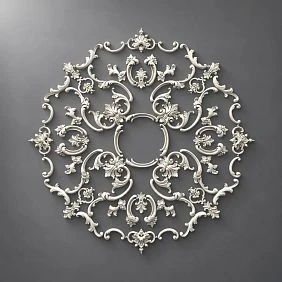
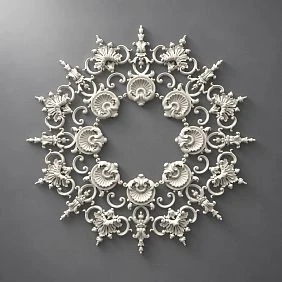
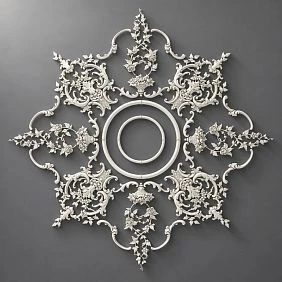
- Ceiling rosette
- Ready-made set of ceiling decor
- How to choose decor for a small hallway
- How to design a long corridor with ceiling stucco
- How to design the ceiling above the entrance area
- Ceiling decor above the mirror, console, and wardrobe
- How to choose decor for a spacious hall
- Ceiling decor for a hall with a staircase
- Which kit to choose: CPU-P5, CPU-P1, CPU-P3 or CPU-P4
- CPU-P5 — for a small entryway and corridor
- CPU-P1 — for a calm hall in an apartment
- CPU-P3 — for a spacious hall
- CPU-P4 — for a grand hall
- How to combine ceiling decor with walls in an entryway
- Mistakes when choosing ceiling decor for an entryway and hall
- Mistake 1. Making too heavy decor in a small entryway
- Mistake 2. Not considering cabinets and doors
- Mistake 3. Using one large center in a long corridor
- Mistake 4. Not connecting the ceiling with the light
- Mistake 5. Making the ceiling "richer" than the walls
- Where to buy ceiling decor for hallway and hall STAVROS
- FAQ: Answers to Popular Questions
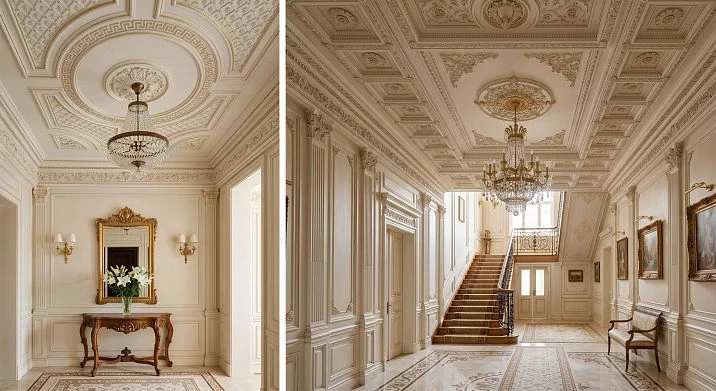
There is a question rarely asked aloud, but almost always thought about during renovations: is it even worth doing anything with the ceiling in the hallway? The room is small, people pass through — they don't linger. Why waste effort?
The answer to this question lies not in the area or the length of the corridor. It lies in the psychology of space perception. The hallway is the first thing a person sees upon entering. Not the kitchen, not the living room, not the bedroom. It is the entry zone that creates that very "first impression," which, as is known, is much harder to fix later than to create from scratch. And that is whyceiling decor for hallway and hall — is not a whim, but a conscious architectural decision.
Properly selected stucco on the ceiling in the hallway connects the front door, mirror, console, wardrobe, lights, and wall finishes into a single space — complete, thoughtful, with character. It is this effect of "cohesion" that makes the entry zone truly expensive — in the good sense of the word.
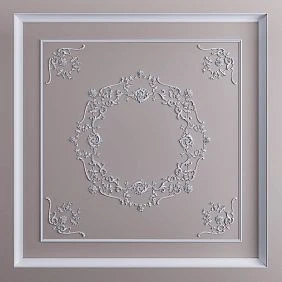
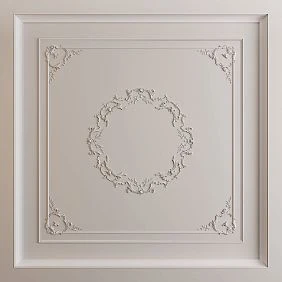
Why the ceiling in the hallway and foyer matters
Architects have long known: in a space through which people move, the gaze does not linger on walls and furniture as much as it does on the ceiling. The entrance area is perceived "from bottom to top" quickly, almost instantly. And it is the ceiling here that carries the function of a visual "ceiling of expectations" — it either sets the tone for the entire interior or leaves the space unfinished.
Ceiling decor in the hallway performs several specific functions:
-
Completes the architecture of the entrance area. A cornice around the perimeter or a molding frame above the mirror turns "just walls and ceiling" into a designed space.
-
Supports the interior style. If the living room is classic or neoclassical, the entrance area without appropriate decor will stand out — even if it is done well.
-
Creates a sense of scale. Even a small hallway with a neat cornice seems more "expensive" and proportionate than the same room without decorative ceiling treatment.
-
Connects furniture, light, and walls. A ceiling frame above a console or a light fixture within a molding composition is not just decor. It is a principle of space organization.
Decorating the entrance area with stucco is especially important in classic and neoclassical interiors: there, an empty white ceiling is perceived as incompleteness, as "not finished." Ceiling decor in the entrance area is the period that the architect places in the sentence about style.




How the hallway differs from the foyer
Before discussing specific solutions, it is important to distinguish three scenarios: hallway, corridor, foyer. Each has its own geometry, its own function, and its own principles for working with ceiling decor.
Our factory also produces:

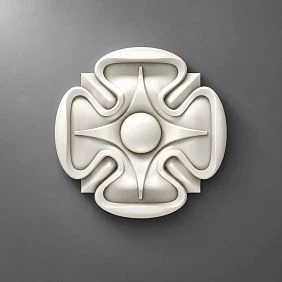
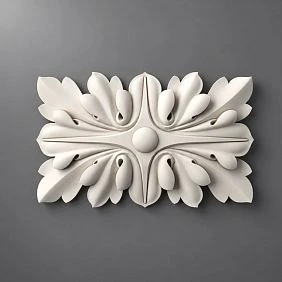

Entryway
The hallway in a typical city apartment is a relatively small space near the entrance door. The area is usually from 4 to 12 m², the ceiling is from 2.5 to 2.8 m. Here there are cabinets, mirrors, a bench, and a shoe rack. The space is functionally saturated, which means the ceiling decor should be calm and not compete with other elements.
Ceiling decor for a small hallway is about neatness and lightness. A cornice around the perimeter, a thin molding frame above the mirror, a small rosette under the central light fixture — that's the working arsenal. Stucco on the ceiling in a small hallway without overload creates completeness without weighing down the space.
Light ceiling decor in the hallway is not a compromise. It is architectural precision: a small space needs small but well-thought-out elements.
Get Consultation
Corridor
A corridor is about length. Narrow, often long, with several doors on the sides. Here, one large ceiling composition in the center will look alien — like a tie without a shirt. Ceiling decor for a corridor is built on a different principle: rhythm, repetition, axial logic.
Ceiling decor in a long corridor consists of molding frames repeating at a certain interval and coordinated with the placement of lights. A cornice along the two long sides (or around the entire perimeter, depending on the width) sets a horizontal rhythm that visually "lengthens" the space rather than shortening it. Moldings on the ceiling in a long corridor with the correct step create the feeling of an enfilade — a sequence of spaces, not one endless tunnel.
Hall
A hall is a different scale of conversation. In an apartment, it is often an open entrance area combined with or located in front of the living room. In a private house, it is a full-fledged independent room with a staircase, a second light, a central chandelier, and all the attributes of a "grand entrance."
Ceiling decor in a hall can be significantly more expressive than in a hallway. Here, ready-made sets of ceiling decor, full molding frames, larger cornices, and central elements under the chandelier are appropriate. Stucco on the ceiling in a hall is a full architectural statement, not just a "decorative detail."
Which elements to use in the hallway and hall
Ceiling cornice
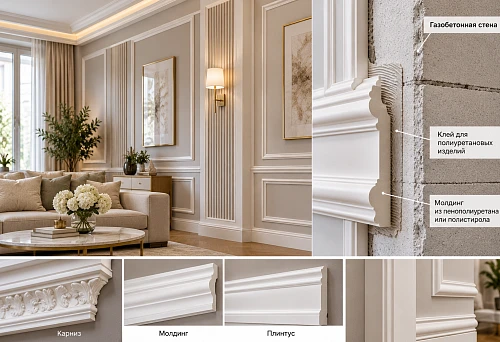
Polyurethane Crown MoldingSTAVROS is the first and most versatile element for decorating the ceiling in any room, including the hallway and corridor. The cornice serves a dual function: it completes the transition from wall to ceiling and sets a perimeter "frame" that organizes the space.
A ceiling cornice in the hallway should be proportionate. For a small hallway with a ceiling of 2.6–2.7 m, a profile no wider than 80–100 mm. This is a neat line that is present as an interior detail but does not claim grandeur. A ceiling cornice in a hall with a more spacious room and a higher ceiling can be wider and more expressive — from 100 to 130 mm and above, depending on the room's proportions.
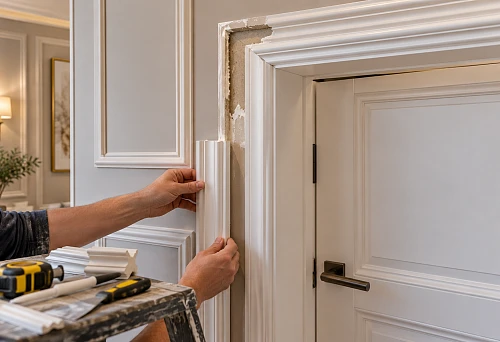
A polyurethane cornice in the hallway is mounted with special adhesive — no drilling, no hidden fasteners, no dust or hammer drill noise. This is especially important in the hallway: the entrance space does not require major construction intervention. The cornice is installed after finishing — as the final architectural gesture.
Ceiling moldings
Moldings made of polyurethane— the next level of working with the ceiling of the hallway and foyer. If the cornice organizes the perimeter, then moldings create internal geometry: frames, zones, accents.
Moldings on the ceiling in the hallway are most often used as a rectangular frame above the entrance area — above the door, above the mirror and console, above the central light fixture. This frame anchors the space: it tells the eye "here is the center." For a small hallway, one frame is enough.
Moldings on the ceiling in the foyer — this is a more complex system. Here you can build multi-level contours coordinated with the room dimensions. In a foyer of 15–20 m² — a rectangular frame with corner overlays and a central accent. In a larger foyer — a full ceiling system as part of a ready-made CPU kit.
Moldings on the ceiling in the corridor: repeating small frames with a step tied to the placement of light fixtures. If the lights are placed every 120 cm — the molding frames are also every 120 cm. The rhythm must be unified: it is this that turns a long corridor from a tunnel into an enfilade.
Ceiling rosette
Polyurethane ceiling rosettesSTAVROS — an element appropriate where there is a pendant light or chandelier in the hallway or foyer. In a small hallway — a rosette with a diameter of 150–200 mm: small, clean, without excessive ornament. In a foyer with a central chandelier — a rosette with a diameter of 250–350 mm or a central ceiling dominant integrated into the molding frame from a ready-made CPU kit.
A ceiling rosette in the hallway makes the central light fixture not just a functional object, but an architectural detail. A chandelier, rosette, and cornice around the perimeter — this is already a full ceiling system, albeit in a minimalist version.
Ceiling decor around the light fixture in the hallway is important precisely along the axis: the rosette, light fixture, molding frame, and console must be aligned along one vertical axis. Then the entrance area is perceived as intentionally organized, rather than a set of random details.
Ready-made ceiling decor set
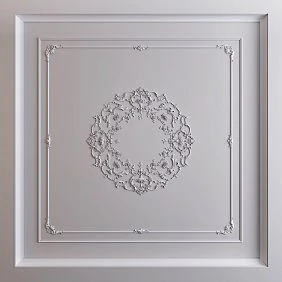
When the hallway or foyer is spacious enough to accommodate a full ceiling system, it is worth consideringceiling decorin the format of a ready-made CPU kit. This is not just a "set of stucco" — it is a coordinated architectural scheme: the cornice, molding contours, corner accents, and central element are already selected into a unified system.
A ready-made hall decor set is a solution that saves time on selecting elements and eliminates the risk of scale mismatch. This is especially important for the hall: a space visible from the doorstep does not forgive decorative mistakes.
How to choose decor for a small hallway
A small hallway is a challenge for any designer. The area is small, there are many mirrors and cabinets, doors open in several directions, there is only one light fixture — and all of this must coexist without interfering with each other.
Ceiling decor for a small hallway is based on one main principle: less, but more precise. One neat element placed in the right spot works better than several decorative details competing for attention.
How not to overload the ceiling in the hallway:
-
Cornice — moderate in profile, no more than 80–100 mm. Not massive, not with an overhanging voluminous relief.
-
Molding frame — one. Above the mirror, above the central light fixture, or above the front door — choose one, but not all three at once.
-
Painting — monochrome. Stucco in the color of the ceiling eliminates visual fragmentation of the plane.
-
Rosette — small. 150–180 mm in diameter for a compact ceiling light fixture.
Stucco in the hallway without overload is architectural confidence in its own scale. It is this approach that makes a small hallway beautiful, not cramped.
Molding decor set CPU-P5— the main product answer for a small hallway. CPU-P5 for the hallway is a chamber, calm, proportional system. 8 types of products, ceiling area 3200 × 3200 mm with a height from 2.6 m and an area of 18–25 m². For a hallway where you want real decor without a palatial effect, this is a perfect fit.
With a hallway area of 8–12 m², CPU-P5 gives exactly the result that most people describe as "beautiful but not overloaded." Cornice A130V1, neat corner accents, a calm central element under the chandelier — all this works in a small space without a feeling of crampedness.
Ceiling decor in a hallway of 4–5 m² is a separate conversation. Here, a full CPU set is not needed. A cornice around the perimeter and a small rosette for the light fixture are enough. This will suffice to make the hallway ceiling look finished, not empty.
How to design a long corridor with ceiling stucco
A long corridor is not a problem, but an opportunity. If approached correctly, it turns into one of the most expressive interior elements: enfilade, perspective, rhythm. All this is created through the ceiling.
Ceiling decor in a long corridor works not through one large central accent, but through repetition. Molding frames placed at equal intervals and light fixtures on the same axis — that is the basic scheme.
Stucco for a long corridor: practical recommendations:
-
Determine the lighting step. If the light fixtures are placed every 100–120 cm, the molding frames are made with the same step — each light fixture inside its own frame.
-
Use a cornice along the two long sides. It sets the horizontal axis and "pulls" the walls to a common plane.
-
Do not place frames too close to the cornice. The distance from the edge of the frame to the cornice should be at least 15–20 cm. This creates spatial "air" between the two decorative elements.
-
Avoid complex ornamentation. In a narrow corridor, ornamental dominants look excessive.Moldings made of polyurethanewith a simple profile — is the right choice.
How to visually widen a corridor with ceiling decor: a cornice on two long sides (without a cornice on the end walls) creates the optical illusion of "spread apart" walls. The eye follows the horizontal line of the cornice along the corridor — and the space appears wider.
Moldings on the ceiling in a corridor without overload: the main rule is not to mix the rhythmic system of frames with active ornamentation. If there are frames, the cornice should be calm. If the cornice is expressive, the frames should be minimalist. In a narrow corridor, decorative competitions do not work.Polyurethane Crown MoldingSTAVROS for the corridor — moderate profiles 60–80 mm wide with a clean, uncluttered relief.
How to design the ceiling above the entrance area
The entrance area is not only the hallway and corridor. In modern apartments, it can be the space by the door that immediately transitions into the living room, kitchen-living room, or open hall. In this case,the ceiling decor of the entrance areamust work in two modes simultaneously: complete the entrance space and echo the decor of adjacent rooms.
Ceiling decor above the front door: a ceiling frame located above the doorway creates a visual "portal" — an architectural frame that accentuates the moment of transition from one space to another. This technique is used in classic interiors as a way to "mark" the entrance without a physical partition.
What does a properly designed entrance area look like:
-
A cornice around the perimeter of the room — or at least along three walls, if the fourth is a passage to the living room.
-
A molding frame above the front door or above the mirror and console.
-
A central light fixture on the axis of the composition — above the middle of the frame.
-
A ceiling rosette for the light fixture — small and proportionate.
Ceiling decor in the entrance area with monochrome painting (molding in the color of the ceiling) creates exactly the effect that is called "expensive renovation without explanation": there seem to be few details, but each is in its place. This impression shapes the first glance upon entering.
Ceiling decor above the mirror, console, and wardrobe
This section is for those who want to understand how to connect the ceiling with specific furniture and decor elements in the hallway. This is a practically important question because in the hallway, furniture and mirrors are not just functional items. They are focal points around which the entire architecture of the entrance area is built.
Ceiling decor above the mirror in the hallway. The mirror in the hallway is the most obvious focal point for the eye. A ceiling frame above the mirror creates a vertical axis of "mirror — light fixture — ceiling accent." This axis organizes the entire space around it. The molding frame on the ceiling should be approximately equal to the width of the mirror — or slightly wider. A frame that is too small above a large mirror will look random.
Ceiling decor above the console in the hallway. The console is a horizontal accent. The ceiling frame above it supports this accent vertically. A light fixture (sconce or ceiling spotlights) on the axis of the console, with a ceiling frame above — this is a complete "niche" composition within the hallway. Molding in the hallway with a mirror and console: a frame above the mirror + a frame or cornice above the console — two elements that work together if they are on the same spatial axis.
Ceiling decor above the wardrobe in the hallway. A built-in wardrobe covering the entire wall is a facade that occupies a significant part of the visual field. Ceiling decor here should work not with the wardrobe, but alongside it. A cornice running along the wall without the wardrobe and a molding frame above the mirror on the opposite wall is the working scheme. There is no need to try to "decorate" the ceiling above the wardrobe: its facade already carries the decorative load. A cornice in front of the wardrobe can create a problem if the height of the cornice profile is not coordinated with the height of the wardrobe.
How to combine ceiling decor and a mirror in the hallway: the rule of a single axis. The center of the mirror — the center of the frame — the center of the light fixture. Everything on one vertical line. Then the decor is perceived as intentional, not random.
How to choose decor for a spacious hall
A spacious hall is a different story. Unlike a small hallway, there is no need for restraint to save space. Here, on the contrary, confidence is needed — the ceiling decor must match the scale of the room and create that very "first impression" for which the entire interior is conceived.
Ceiling decor for a large hall: with an area of 15–25 m² and a ceiling height of 2.8 m or more, this is already the zone for a full CPU set. The only question is which specific set matches the scale and decorative ambitions of the owner.
Ceiling decor in a large hall should create a central axis: a visual path from the front door to the next room. A central chandelier on the axis, a ceiling frame around it, a cornice along the perimeter — this is the minimum necessary decorative set that makes a large hall feel "put together".
A hall that transitions into a living room or dining room requires coordination of decor: the ceiling system in the hall should be related to the system in the living room — from the same collection, with the same cornice, with the same logic of scale. Otherwise, the transition from one room to another will create a decorative "break".
Ceiling decor for a hall in a private house is a conversation about formal architecture. Here, the choice shifts from modest, intimate systems to more expressive sets, where the ceiling system becomes the central architectural statement of the entire entrance space.
Ceiling decor for a hall with a staircase
A staircase hall is a special scenario, found mainly in private houses, but sometimes also in multi-level apartments. Here, the ceiling is perceived from different levels — from below at the entrance, from the side when climbing the stairs, from above when looking through the opening. This three-dimensional perception dictates its own requirements for decor.
Ceiling decor in a hall with a staircase:
-
The scale of the decor should be readable from a distance. Small patterns get lost in double-height spaces and high ceilings. Clear, well-readable elements are needed — a wide cornice, expressive corner accents, a large central rosette for the chandelier.
-
The cornice and moldings should "accompany" the staircase. In a hall with a staircase, the ceiling decor works in tandem with the wall decor: the cornice along the top of the wall follows the direction of the stair railing — this creates a visual rhythm of ascent.
-
Double-height spaces require a larger scale for all elements. With a ceiling of 5–6 m, decorative details measuring 80–100 mm simply won't be noticeable.
Polyurethane wall decorSTAVROS in a stair hall works in tandem with ceiling decor: wall panels, a cornice along the top, moldings along the staircase — a unified decorative system that turns the hall into a true grand entrance.
Ceiling decor for a hall with double-height space: large dominant elements, an expressive central piece for a massive chandelier, a wide cornice along the visible part of the ceiling — that's the working scheme. For a hall with a 4–5 m ceiling, standard "apartment" elements don't work: specially selected larger profiles are needed.
Stucco for a hall with a high ceiling follows a different proportional logic. The rule "cornice profile no more than 5% of wall height" at a height of 4 m already gives 200 mm for the cornice. This is a different class of elements — expressive, monumental, matching the scale of a grand entrance.
Which set to choose: CPU-P5, CPU-P1, CPU-P3 or CPU-P4
CPU-P5 — for a small entryway and corridor
Molding decor set CPU-P5— the optimal choice for a small entryway, entrance area in an apartment, and a corridor of standard proportions. 8 types of products, chamber system, cornice A130V1, area 3200 × 3200 mm with a ceiling height from 2.6 m.
CPU-P5 for a small hallway delivers exactly the result that combines decorative completeness with spatial lightness. The system creates a neat ceiling frame with corner accents and a central element — without pomp, without massive relief, without the feeling of "too much" in a small space.
CPU-P5 for a corridor: in a standard-width corridor, the central area of 3200 × 3200 mm can be used as a reference point with several repeating molding frames. One "main" center + cornice around the perimeter + repeating frames along the corridor axis — this is a complete ceiling system for the entrance space.
Who is CPU-P5 for in the context of the entrance area:
-
hallway 8–18 m² with a ceiling of 2.6–2.8 m;
-
corridor in an apartment;
-
small hall without grand ambitions;
-
interior without excessive ornamentation.
CPU-P1 — for a calm hall in an apartment
Stucco decor set CPU-P1 — the next level of expressiveness. Area 3200 × 3200 × 83 mm, more detailed corner accents, central element NPU-462.1 with a diameter of 330 mm. The CPU-P1 card indicates proportionality at a height of 2.7–2.8 m in rooms from 20 m².
CPU-P1 for a hall in an apartment is when you want a cohesive, architecturally clear entrance area that supports the style of the entire apartment but does not aspire to the grandeur of a large country house. A neoclassical hallway with a mirror, console, doors in classic architraves, and classic moldings on the walls — this is where CPU-P1 looks organic and convincing.
CPU-P1 for the entrance area: in an apartment where the living room is already decorated with CPU-P1 or similar classic decor, using the same set in the entrance hall creates decorative continuity — one style, one scale, one architectural tone from the doorstep to the sofa.
Who is CPU-P1 for in the context of the entrance area:
-
hall in an apartment, area from 15–20 m²;
-
entrance area with a mirror and console in a neoclassical interior;
-
hall transitioning into a living room with similar decor;
-
ceiling height 2.7–2.8 m.
CPU-P3 — for a spacious hall
Molding decor set CPU-P3 — a universal option for an entrance area that should look noticeable but not palatial. Ceiling zone 3200 × 3200 × 83 mm, more detailed field overlays NPU-472L/R and NPU-309, expressive corner system.
CPU-P3 for a spacious hall: with an area of 20–35 m² and a ceiling from 2.7 m, CPU-P3 creates a full-fledged ceiling center in the hall. Central accent under the chandelier, molding contours, corner overlays — the system is convincing, well-readable, sufficiently grand for a representative apartment.
CPU-P3 for a hall transitioning into a living room: if the living room is already decorated with CPU-P3 or CPU-P4, a hall with CPU-P3 will become a logical decorative "introduction" — of the same tone, the same scale, but slightly more modest (or completely identical, if the space allows it).
CPU-P3 for the entrance area of an open space: in open-plan layouts where the entrance area exists without partitions, CPU-P3 helps visually "separate" the entrance from the living room or kitchen area — not with walls, but with architectural accents on the ceiling.
Who is CPU-P3 for in the context of the entrance area:
-
spacious hall 20–35 m²;
-
entrance area in a large apartment;
-
hall that transitions into the living room;
-
ceiling from 2.7 m.
CPU-P4 — for the grand hall
Molding decor set CPU-P4 — this is a different architectural class. 21 product types, four levels of corner accents, a ceiling system for a grand hall of 28–45 m² with ceilings from 2.8 m. In the context of an entryway and hall, CPU-P4 is only appropriate where the entrance space itself is grand — large, high, with a staircase, with a claim to a serious architectural class.
CPU-P4 for a large hall in a private house: this scenario is the ideal environment for this set. A country house, a hall of 30–45 m², a ceiling of 3 m and higher, a central chandelier with a diameter of 600–800 mm, a staircase with wooden railings and classic balusters — here, four levels of corner accents of CPU-P4 create a ceiling architectural scene worthy of the most grand entrance area.
CPU-P4 for a grand hall: if the architectural task is to make the entrance "as it should be in an expensive house" — CPU-P4 fully realizes this task. The space at the entrance says: "this is a serious interior." The ceiling with CPU-P4 needs no explanation.
For whom is CPU-P4 in the context of the entrance area:
-
large grand hall 28–45 m²;
-
hall with staircase in a private house;
-
ceiling from 2.8 m;
-
expensive classic interior.
How to combine ceiling decor with walls in the hallway
Ceiling decor in the hallway and hall works most effectively only when the walls support its architectural logic. This is especially true for classic and neoclassic styles: in these styles, the ceiling and walls are a single system.
Hallway with moldings and stucco: if the ceiling has a cornice and a molding frame, then the walls should support this architectural language.Polyurethane wall decor— frames, molding panels, corner overlays — create this support. A wall with molding frames next to a mirror and under a classic cornice is already a full-fledged classic hallway.
Hall with moldings and ceiling stucco: the principle is the same, but the scale is wider. In the hall, the wall molding system can cover all four walls, creating a unified decorative space. In combination with the CPU ceiling system and, friezes, rosettes.the perimeter creates a full-fledged classic interior for the entrance area.
How to combine ceiling decor and a mirror in the hallway: a mirror in a frame with wall sconces on the sides, a ceiling frame above it on the same axis, a cornice around the perimeter — this is a complete "niche" for the entry mirror. Everything on the same vertical line, everything in the same scale, everything in the same style.
In a narrow hallway — do not overload the ceiling and walls at the same time. If there is a cornice and a frame on the ceiling, the walls should be calmer: thin moldings or just plain paint without frames. If there is an active molding system on the walls, the ceiling is made more modest: only a cornice around the perimeter.
Polyurethane moldingsSTAVROS for hallway walls — overlays, rosettes, corner accents — complements the ceiling system and creates a unified decorative environment for the entrance area. It is this combination of ceiling and wall decor that transforms the hallway from "just a corridor by the door" into an architectural statement.
Practical installation tips:installation of polyurethane moldingin the hallway andinstalling polyurethane moldingare applied with special glue. Allpolyurethane interior itemsSTAVROS are lightweight, do not require heavy fastening, and are installed after finishing. For the hallway, this is an ideal property: decor installation takes a few hours and does not create construction disruption.
Mistakes when choosing ceiling decor for the hallway and foyer
Mistake 1. Making the decor too heavy in a small hallway
A large cornice with an active relief in a 6 m² hallway with a 2.6 m ceiling is not a beautiful classic. It feels like "looming." Stucco in a small hallway should be proportionate: a neat profile, calm geometry, monochrome painting.
Mistake 2. Not considering cabinets and doors
In a hallway, there are many doors and often a built-in wardrobe. Ceiling decor must coexist with them — not compete. If the wardrobe takes up an entire wall, a cornice on the same side will create a visual conflict. Decor is placed where there is space to "breathe."
Mistake 3. Using one large center in a long corridor
One large ceiling rosette in the center of a long narrow corridor is a "plug," not decor. A corridor requires rhythm: repeating elements coordinated with light fixtures work incomparably better.
Mistake 4. Not connecting the ceiling with light
A molding frame without a light fixture inside loses its meaning — or looks random. Every accent on the ceiling should be linked to a light source. A light fixture inside a frame, a rosette under a central chandelier, spotlights along the cornice axis — this is the principle of "light and decor in one scheme."
Mistake 5. Making the ceiling "richer" than the walls
In a hall especially: if the ceiling is grand — CPU-P4 with four levels of corner accents — and the walls are painted without any decorative elements, this creates an imbalance. The ceiling "by itself" looks glued on, not part of the interior. Ceiling decor in a hall requires a decorative "response" from the walls.
Where to buy ceiling decor for hallway and hall STAVROS
The STAVROS catalog features a full range ofceiling decor for hallway and foyer — from individual cornices and moldings to ready-made sets of the CPU-P series.
For a small hallway and corridor — CPU-P5: chamber system, light decor without overload, ceiling from 2.6 m. For a calm foyer in an apartment — CPU-P1: neat classics, proportional at a height of 2.7–2.8 m. For a spacious foyer and open entrance area — CPU-P3: a universal expressive option for an area of 25+ m². For a grand foyer, foyer with stairs, and country house — CPU-P4: architectural scene, 21 types of products, four levels of corner accents.
For ready-made sets — a full range of individual elements: Polyurethane Crown Molding, moldings on the ceiling in the hallway, ceiling rosettes, Polyurethane moldingsandWall Decor to create a unified system of ceiling and walls.
STAVROS is a Russian manufacturer of architectural decor made from polyurethane and dense HIWOOD polystyrene. In-house production, precisely calibrated profiles, and a range suitable for any room size: from a small hallway to a grand foyer. The cluster articles provide comprehensive guides on related topics:a set of stucco decor for the ceiling, ceiling molding for 2.6–2.8 m ceilings, which CPU ceiling decor set to choose, Ceiling decor for the living room, Stucco decor for a high ceiling.
FAQ: Answers to popular questions
Can you put molding on the ceiling in a small hallway?
Yes. The key is to choose subtle elements: a neat cornice, a thin molding frame, a small rosette. Molding in the same color as the ceiling does not weigh down the space.
Which ceiling decor should you choose for a narrow corridor?
A cornice along the two long sides and repeating molding frames along the ceiling axis with spacing coordinated with the lighting. One large central set does not work in a narrow corridor.
Which STAVROS set is suitable for a hallway?
CPU-P5 — for a small hallway with a 2.6–2.8 m ceiling.CPU-P1 — for a more spacious apartment hallway or foyer of 15–20 m².
What to choose for a grand hallway?
CPU-P4— for a hallway with stairs, a large grand hallway of a private house, ceiling from 2.8 m, area 28–45 m².
How to combine ceiling decor with a mirror in the hallway?
Align the axis: center of the mirror — center of the light fixture — center of the molding frame on the ceiling. All on the same vertical line. Then the ceiling and mirror work together as a single architectural detail.
Is ceiling decor needed in a hallway if it is small?
It is needed — precisely because it is small. A neat cornice around the perimeter and one small frame make a small hallway feel 'put together'. An empty ceiling in a small hallway gives a sense of incompleteness.
How to choose a cornice for the hallway?
For a ceiling of 2.6–2.7 m — profile 60–100 mm. Without active ornament. In the color of the ceiling or in the color of the walls. Select from the STAVROS assortment by profile size.cornices made of polyurethaneSTAVROS by profile size.