














































Article Contents:
- Can you install stucco on a 2.6–2.8 m ceiling
- Why stucco sometimes "lowers" the ceiling
- How to choose lightweight ceiling decor for an apartment
- Stucco for a 2.6 m ceiling
- Stucco for a 2.7 m ceiling
- Stucco for a 2.8 m ceiling
- Which kit to choose: CPU-P1, CPU-P5 or CPU-P3
- CPU-P5 — for a 2.6 m ceiling and rooms 18–25 m²
- CPU-P1 — for ceilings 2.7–2.8 m and rooms from 20 m²
- CPU-P3 — for living rooms or kitchen-living rooms from 25 m²
- How to choose ceiling moldings in an apartment
- How to choose a cornice for a low ceiling
- How to paint stucco so the ceiling doesn't look lower
- Where is it best to use stucco in an apartment
- In the bedroom
- In the living room
- In a Children's Room
- In the study
- Mistakes when choosing stucco for a low ceiling
- Mistake 1. Choosing a cornice that is too large
- Mistake 2. Creating a strong color contrast
- Mistake 3. Overloading both corners and the center
- Error 4. Not taking into account the room area
- Mistake 5. Buying individual elements without a scheme
- Where to buy STAVROS stucco for a regular ceiling
- FAQ: Answers to Popular Questions
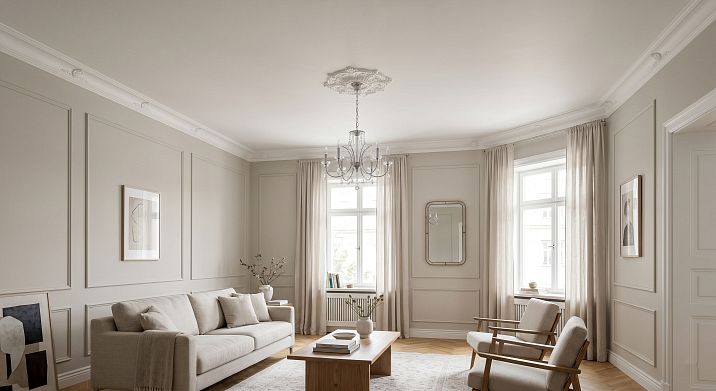
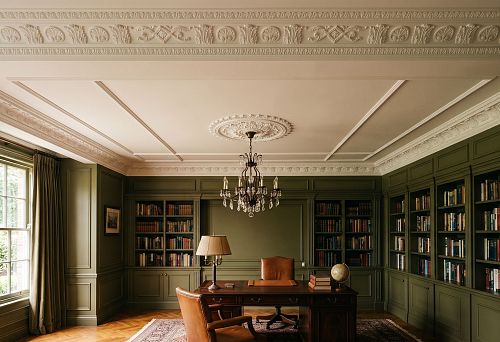
This is an honest question. And the answer is not "no, never" — nor "go ahead, it will work out." The precise answer is: stucco for a low ceiling is possible if you understand what exactly creates the feeling of heaviness. The problem is never in the stucco itself — the problem is in the wrong scale, excessive ornament saturation, contrasting paint, and incorrect selection of elements for the specific height and area. The rightceiling decor in an apartmentworks quietly and elegantly — it is present but does not overwhelm.


Can you install stucco on a 2.6–2.8 m ceiling
The direct answer: yes, you can. But with important conditions that determine the result.
A ceiling of 2.6–2.8 m is the standard height for the vast majority of urban apartments in Russia. Millions of people live at this height. And it is here that stucco on the ceiling in an apartment historically existed in pre-revolutionary houses, whose ceilings were often 2.8–3 m. The difference is insignificant, but the decorative language was different: modest thin cornices, neat narrow moldings, small rosettes under the chandelier. Not palace stucco — but homey, residential, of human scale.
Ceiling stucco without visual heaviness is possible by following several principles:
-
do not use elements whose scale is designed for a height of 3 m or more;
-
do not create a dark color contrast between the molding and the ceiling plane;
-
do not overload corners and the center simultaneously — it is better to have one calm accent;
-
do not try to 'fill' the entire ceiling with ornament in a small room;
-
consider the area, not just the height: a room of 12 m² with a 2.7 m ceiling and a living room of 28 m² with the same height require fundamentally different approaches.
Can you do molding on a 2.6 meter ceiling? Yes — if you choose a kit specifically designed for this height and the corresponding room area. Can you do molding on a 2.7 meter ceiling? Here there are already more options. Can you do molding on a 2.8 meter ceiling? Here a full range of choices opens up, where a 'low ceiling' can only be conditionally discussed.




Why molding sometimes 'lowers' the ceiling
Let's honestly break down this fear in detail. Molding does not lower the ceiling by itself — it is the combination of specific mistakes that does this, each of which is well known and easily preventable.
Too wide cornice. A cornice with a profile of 150–180 mm on a 2.6 m ceiling takes up almost 7% of the wall height. The eye perceives this as a 'heavy frame' that physically reduces the perceived space. The rule is simple: the lower the ceiling, the more modest the cornice profile.
Active contrasting ornament. When the molding is painted in a color sharply different from the ceiling, it 'cuts' the plane into parts. These parts are visually perceived as heavier than a single monochrome surface. Ceiling decor without a palatial effect always uses molding in the same tone as the ceiling.
Excessive ornamental saturation across the entire area. A small room with relief covering the entire ceiling field gives the impression of a space that has "shrunk." How to avoid overloading the ceiling with stucco: work with one zone — the central one or above the key furniture piece. The rest — a calm cornice around the perimeter.
Too large a rosette. A ceiling rosette with a diameter of 500 mm for a chandelier on a 2.6 m ceiling is a spot that visually occupies a significant part of the ceiling field of a small room. How to avoid lowering the ceiling with stucco: the rosette should be proportionate to the room, the chandelier, and the height.
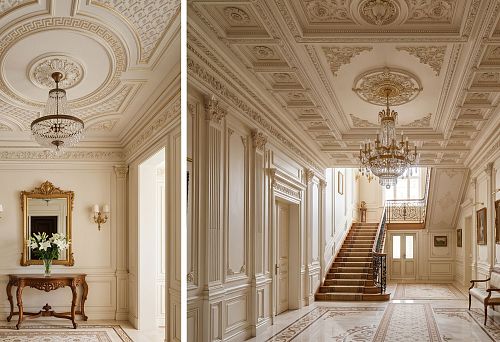
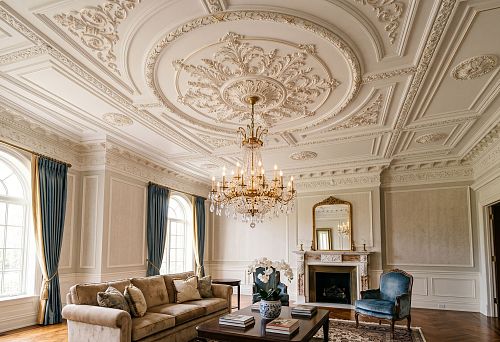
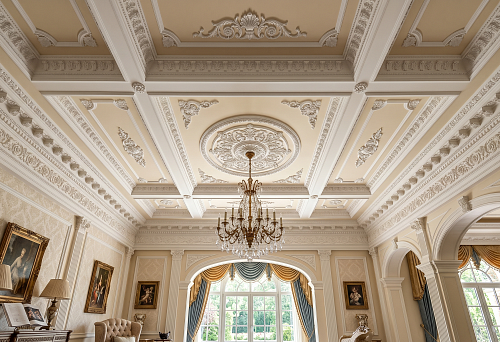
Attempting to recreate a "palace ceiling" in a standard apartment. This is the most understandable mistake. Classic formal interiors were designed for ceilings of 4–5 m. Trying to transfer their system to an apartment with a 2.7 m ceiling creates exactly the "heavy" effect that everyone fears. Ceiling stucco without overload is not a simplified palace. It is an independent residential classic with a different scale.
Our factory also produces:






How to choose lightweight ceiling decor for an apartment
Proper selection starts with three parameters: ceiling height, room area, and interior style. Only their combination provides the answer to the question of the suitable set and scale of decor.
Lightweight ceiling decor for an apartment is not a compromise or a "poor version" of classic style. It is an architecturally competent choice where stucco works most effectively in specific conditions. Here is what it looks like in practice:
-
Thin or moderate molding. The profile for a standard apartment is 20–35 mm wide. Such molding creates a clear geometric line that reads as an architectural detail but does not overload the surface.
-
Calm cornice. For a ceiling of 2.6–2.7 m — a cornice with a profile no more than 80–100 mm. At 2.8 m — you can consider a slightly more expressive option if the room is not too small.
-
Stucco in the color of the ceiling. Monochrome painting is a key technique. White stucco on a white ceiling reads through light and shadow, not through color contrast. The relief is present, but the space is not fragmented.
-
One central accent. A ceiling frame above the sofa, bed, or chandelier is one architectural gesture that makes the ceiling complete. There is no need to create several zonal systems in a small space.
-
A neat ceiling rosette. For a standard apartment ceiling — a rosette with a diameter of 150–250 mm for a compact or medium-sized chandelier.Polyurethane ceiling rosettesSTAVROS are produced in a wide range of diameters — from very small to grand — allowing you to choose exactly the right size.
Ceiling decor for an apartment is, essentially, managing attention: directing the gaze to a beautiful detail without drawing unnecessary attention to the plane. This is exactly what light stucco does.
Get Consultation
Stucco for a 2.6 m ceiling
This is the most delicate height. 2.6 m is the lower limit at which stucco remains appropriate but requires special attention to scale. There is no room for error here: a too-large cornice or an active ornament will immediately create that "lowered" effect.
Stucco for a 2.6-meter ceiling is a story of restraint. One central accent above the main furniture area is better than a system of several ceiling frames. A perimeter cornice is desirable, but with a calm profile that does not aspire to monumentality. Painting should be monochrome, without contrast.
Which decor to choose for a 2.6-meter ceiling?Molding decor set CPU-P5— this is the main answer to this question. The CPU-P5 card directly indicates the proportionality of the system for a ceiling height of 2.6 m: cornice A130V1 with a profile of 100 × 83 mm, zone 3200 × 3200 mm, room space 18–25 m². These are not random parameters — this is an architectural calculation in which the scale of the cornice, molding contours, and central element are coordinated specifically for this height.
CPU-P5 for a 2.6-meter ceiling: what does it provide? Calm geometry of the central zone without excessive relief, a cornice that reads as the completion of the ceiling plane rather than a heavy frame, and an overall feeling of architectural completeness — without "palatialness," without pomposity, without losing spatial air.
For an 18 m² bedroom with a 2.6 m ceiling, CPU-P5 is exactly the scale at which stucco decor appears in the interior as a quiet classical gesture. The ceiling does not become lower — it becomes designed.
Stucco for a 2.7 m ceiling
2.7 m is the most common height in modern apartment buildings. This is the height at which stucco on a 2.7-meter ceiling ceases to be a risky endeavor and becomes a fully realizable architectural project.
At 2.7 m, the range of choices is wider than at 2.6 m: you can make a ceiling frame, use a moderately expressive cornice, consider sets with a more complex corner system — if the room area corresponds.
Moldings on a 2.7-meter ceiling: a rectangular or square frame of moldings above the main area of the room — above the sofa in the living room, above the bed in the bedroom, above the dining table in the dining room.Moldings made of polyurethaneSTAVROS in profiles with a width of 25–40 mm is the optimal range for an apartment ceiling of 2.7 m.
Which CPU kit to choose for a 2.7-meter ceiling? Depends on the area:
-
Room 18–25 m² —CPU-P5: a calm chamber system that at 2.7 m looks slightly more confident than at 2.6 m — due to a slightly greater visual distance to the ceiling plane.
-
Room from 20 m² —CPU-P1: a neat classic system, the card of which directly indicates proportionality at a height of 2.7–2.8 m in rooms from 20 m².
-
Living room from 25 m² —CPU-P3: a more expressive option that at an area of 25+ m² and a height of 2.7 m gives the result that people dream of — a noticeable, designed, architecturally convincing ceiling without "palatial" pathos.
Stucco for a 2.7 m ceiling with monochrome painting in the color of the ceiling is that very restrained classic ceiling that simultaneously decorates the interior and does not raise a single unnecessary visual question. It simply exists — and it feels good.
Ceiling molding for 2.8 m ceiling
2.8 m is no longer a "low" ceiling in the strict sense. At this height, limitations can only be discussed for small rooms: in a spacious living room of 30–35 m², a 2.8 m ceiling provides enough spatial air for full ceiling decor.
Ceiling decor for a 2.8 meter ceiling is the intersection of two scenarios: "standard apartment with slightly higher height" and "transitional ceiling to more upscale spaces." This is where CPU-P3 reveals itself as the most versatile choice for a city apartment.
Ceiling decor for a 2.8 meter ceiling by room:
-
Bedroom and children's room — CPU-P5for an intimate, cozy, calm space where the ceiling should be present but not dominate.
-
Quiet living room or study — CPU-P1for neat classics, where the interior gains architectural quality without excessive decorative load.
-
Living room 25–40 m² — CPU-P3for a more expressive center, a molding frame above the sofa or dining area, a system of corner accents.
CPU-P3 for a standard ceiling at a height of 2.8 m in a living room of 30 m² is no longer a "modest stucco for an apartment." It is a full-fledged ceiling system that makes the interior architecturally significant. With monochrome painting and proper lighting, such a ceiling looks like a professional design project.
Stucco for a ceiling of 2.8 m with good lighting (warm spotlights or track systems with an oblique light vector) creates expressive shadow play on the relief of moldings and corner accents. Light and shadow are the "paints" of stucco: they turn a white relief surface into living architectural graphics.
Which set to choose: CPU-P1, CPU-P5 or CPU-P3
This is a key practical question, and the answer depends on the specific room. Let's look at each option in detail.
CPU-P5 — for a ceiling of 2.6 m and rooms of 18–25 m²
Molding decor set CPU-P5 — this is the main character of this article. An intimate system created specifically for those spaces where height and area require special restraint. The CPU-P5 card specifies a scenario of 2.6 m height and 18–25 m² area — this is a direct technical match for most bedrooms, children's rooms, and small living rooms in standard city apartments.
What makes CPU-P5 the right choice for such rooms? The A130V1 cornice with a profile of 100 × 83 mm is proportionate and neat, without monumentality. The 3200 × 3200 mm zone for the central ceiling system is optimal for a room of 18–25 m² because it occupies a significant but not overwhelming part of the ceiling field. The corner accents and field overlays are calm, with a soft relief that, with monochrome painting, is read through shadow rather than contrast.
CPU-P5 for a bedroom in an apartment is a calm decorative scenario above the bed or in the center of the room, which visually completes the interior without turning it into an architectural statement. This is the kind of ceiling called "quiet classic": it is there — and it feels good. CPU-P5 for a children's room is a safe choice where ceiling decor adds coziness and soft structure without pomposity or excessive maturity.
CPU-P1 — for a ceiling of 2.7–2.8 m and a room from 20 m²
Stucco decor set CPU-P1 — this is a step forward from the most intimate option to a more confident classical architecture. The CPU-P1 card states that at a height of 2.7–2.8 m, the set looks proportionate in rooms from 20 m². This means: with the correct area match, the system looks complete and proportionate — neither too small nor excessive.
CPU-P1 for an apartment is a neat, clear classic that works in a study, in a living room up to 25 m², and in a bedroom with sufficient area. Its difference from CPU-P5 is a slightly more pronounced relief of corner accents and a more readable geometry of the central zone. At the same time, it remains within the "apartment" scale, without pretending to the grandeur of halls and country houses.
CPU-P1 for a small room with proper monochrome painting: the decor is present as an architectural fact — like a frame for a painting. It organizes the space, sets its boundaries, gives the ceiling completeness — and does all this quietly, without unnecessary words. Ceiling decor for an apartment of this level is most often what is sought: "to be beautiful, but without pomposity."
CPU-P3 — for a living room or kitchen-living room from 25 m²
Molding decor set CPU-P3 — this is the most expressive option for a city apartment with a ceiling of 2.7–2.8 m. It is designed for a living room of 25–40 m², where the 3200 × 3200 mm zone becomes the central ceiling system, visible from all points of the room.
The CPU-P3 card specifies a scenario of a living room of 25–40 m² with ceilings from 2.7 m — and this is important: it is precisely this area that allows the ceiling system to unfold proportionally. In a small room of 16 m² with a ceiling of 2.7 m, CPU-P3 will be too saturated. In a spacious living room of 30 m² — just right.
CPU-P3 for a living room in an apartment with a ceiling of 2.8 m: more expressive corner accents, molding contours with greater relief depth, a central element for a chandelier — all this with monochrome painting creates a ceiling system that is not ashamed to be called "designer." CPU-P3 for a kitchen-living room works especially well when you need to highlight the dining area or island as the functional center of an open space.
| Parameter | CPU-P5 | CPU-P1 | CPU-P3 |
|---|---|---|---|
| Ceiling height | from 2.6 m | from 2.7 m | from 2.7 m |
| Room area | 18–25 m² | from 20 m² | 25–40 m² |
| Decorative richness | chamber | neat | Expressive |
| Main Scenario | Bedroom, children's room | study, living room | living room, kitchen-living room |
| Sense of result | quiet classic | calm architecturality | noticeable center without overload |
How to choose moldings for the ceiling in an apartment
Moldings are lines. On the apartment ceiling, they work like quiet geometric graphics: set a frame, create order, define a zone. When chosen correctly, you almost don't notice them as a separate element — you just see that the ceiling is "assembled" and complete.
How to choose moldings for a low ceiling: start with the profile. For a height of 2.6–2.7 m — moldings 20–30 mm wide. For 2.7–2.8 m — 25–40 mm. Wider than this range makes no sense for an apartment ceiling: the molding will become a noticeable element on its own, rather than a frame for the ceiling field.
Moldings made of polyurethaneSTAVROS produces a wide range of profiles — from thin, laconic lines to more complex classical sections. For a standard apartment with a ceiling of 2.6–2.8 m, profiles with moderate relief are suitable: not too flat (they get lost on a white background), not too convex (they create excessive shadow on a low ceiling).
Moldings on the ceiling in an apartment: the main principle of placement is linking to function. A frame above the sofa in the living room: the center of the frame coincides with the center of the sofa group. A frame above the bed: coincides with the central axis of the headboard. A frame above the dining table: along the perimeter of the zone with the chandelier inside. Thin ceiling moldings work as an architectural confirmation of the furniture solution — they say: 'here is a zone, here is a place.'
How to decorate a ceiling with moldings in an apartment without unnecessary complications: one frame per functional center. Not three frames in different parts of the room — one, but precisely calculated. Symmetry, correct indentation from the walls (usually 30–50 cm), alignment with the axis of the furniture and the axis of the chandelier. This is what creates the feeling of a professional designer ceiling.
installing polyurethane molding— a task that can be solved independently or with the help of a craftsman. Polyurethane moldings are mounted with special glue, do not require drilling or hidden fastening, and are cut with a miter saw with precision to a degree. The corners of a rectangular frame are cut at 45° — this gives a neat joint without a visible seam.
How to choose a cornice for a low ceiling
The cornice is the first thing a person sees when entering a room. Not the ceiling frame, not the rosette — it is the cornice that sets the overall first impression of the decorative treatment of the ceiling. And that is why a mistake with the cornice is the most costly in terms of impression.
Polyurethane Crown MoldingSTAVROS — a wide range of profiles for any ceiling height. For a ceiling of 2.6–2.7 m, the rule is simple: the height of the profile should not exceed 4–5% of the wall height. With a ceiling of 2.6 m, this is 104–130 mm. A cornice with a profile of 83–100 mm is just right. A cornice with a profile of 150 mm and above is already risky.
For a low ceiling, it is better to choose a cornice with a moderate relief without overhanging voluminous details. A classic 'ogee profile' at a low height is a good solution: it creates an expressive shadow that separates the wall and ceiling but does not impose additional decorative weight.
Ceiling cornice for an apartment: another important point is the length of the room. In a narrow room with long walls, even a moderate cornice can create a 'framing' effect that compresses the space. In such cases, it makes sense to abandon the cornice on the short wall or choose a very minimal profile for it.
A lightweight cornice for a ceiling in an apartment is one that exists as an interior detail, not as an architectural element. Its task is to mark the transition from wall to ceiling, not to become an independent decorative statement. It is this type of cornice that allows adding a ceiling system CPU-P5 or CPU-P1 without the feeling of "layering" decor.
How to choose a cornice for a low ceiling in the end: one simple rule — if you are hesitating between two profiles, choose the smaller one. In an apartment with a ceiling of 2.6–2.8 m, modest restraint of the cornice is a professional solution, not a lack of courage.
How to paint stucco so the ceiling does not appear lower
This is perhaps the most practically important question in the context of standard city apartments. Many have seen interiors where stucco is painted contrastingly — white stucco on a gray or beige ceiling plane. This looks beautiful in a certain context — but not on a ceiling of 2.6–2.7 m.
Monochrome painting is the main principle for a low ceiling. Stucco in the color of the ceiling means that the decor and the plane are perceived as a single surface with relief. The gaze does not "get stuck" on the contours of the molding or rosette, but glides over the surface — and notices the relief only when light falls at a certain angle. This is exactly the effect that makes stucco on a low ceiling an invisible "load" and a noticeable "decoration".
The color of the ceiling with stucco for an apartment. White, warm white, milky, light beige, ivory — all of these work. Important: the stucco and ceiling are painted with the same tint in one pass. If you paint the ceiling and then touch up the stucco, minor tonal discrepancies may appear, creating exactly that undesirable contrast.
How to technically paint stucco on a low ceiling: polyurethane stucco perfectly accepts water-based and acrylate paints — the same ones used for painting ceilings. Putty the joints with mounting sealant (which is also paintable), paint in one or two coats with matte paint — and the ceiling with stucco turns into a single architectural surface.installation of polyurethane moldingincludes all necessary recommendations for final painting.
Matte paint vs gloss. On a low ceiling, matte paint is always preferable: it absorbs excess light and makes the ceiling plane appear more "receding" upward. Glossy paint, on the contrary, reflects light and attracts more attention to the ceiling, visually lowering it.
Ceiling stucco without overload is achieved precisely through monochrome: the relief exists — it works through shadow — but the gaze does not forcibly stop on it. This is quiet, intelligent, professional classic.
Where is it better to use stucco molding in an apartment
In the bedroom
The bedroom is one of the most successful scenarios for stucco molding in a standard city apartment. It is here that a person looks at the ceiling while lying in bed: this is a space that is perceived from the bottom up much more often than in any other room.
Stucco molding on the ceiling in a bedroom in an apartment: a neat ceiling frame above the head of the bed is a strong design technique. The frame "covers" the bed area from above, creating the feeling of an architectural "canopy" — without a physical canopy. CPU-P5 for the bedroom is the right choice: a chamber system without excessive relief, a calm cornice, a central accent for a chandelier or lamp.
Ceiling decor in a bedroom in an apartment should not be complex. In the bedroom, calmness is important: one quiet classic gesture is better than several decorative zones.
In the living room
The living room is the main interior scenario of an apartment. It is here that ceiling decor works most noticeably: the living room is perceived from different points, including the entrance angle, and it is the ceiling that forms the first overall impression of the room.
Stucco molding for a living room in an apartment: a central ceiling system above the sofa group or in the center of the room is the main architectural gesture. Ceiling decor for a living room in an apartment using CPU-P3 with an area of 25–35 m² and a ceiling of 2.7–2.8 m is already a full-fledged interior solution that can easily be mistaken for a professional design project.
In the children's room
A children's room with stucco molding is a non-obvious but very successful solution. Here, decor without pomposity is important: light, white, neat. Stucco molding on the ceiling in a children's room in an apartment in the form of a simple rectangular frame or a small ceiling rosette for a lamp is not "adult" stucco molding transferred to a children's room. It is respect for the child's space and a desire to give them an architecturally complete interior.
CPU-P5 for a children's room: a chamber system that, with monochrome painting, creates exactly the desired effect — a quiet presence of decor that makes the room cozy and collected.
In the study
Ceiling decor for a home office in an apartment is a functional technique. An office requires concentration: stucco molding here should be as calm as possible. Moldings on the ceiling in an office in the form of a simple frame around the perimeter of the ceiling field are an element that creates the feeling of an "office" in a good sense: a collected, structured, professional space.
CPU-P1 for an office with a ceiling of 2.7–2.8 m and an area of 15–20 m² is an excellent choice. A neat classic system without unnecessary decorativeness.
Mistakes when choosing moldings for a low ceiling
Mistake 1. Choosing a cornice that is too large
A cornice 150–180 mm high on a 2.6 m ceiling takes up more than 7% of the wall's vertical. This creates a feeling of overhang. How to avoid lowering the ceiling with moldings: check the ratio of the cornice height to the room height on paper before purchasing.
Mistake 2. Creating a strong color contrast
Dark moldings on a light ceiling or white moldings on a gray plane are solutions for high ceilings or very spacious rooms. For an apartment ceiling of 2.6–2.8 m, monochrome is the only correct choice.
Mistake 3. Overloading both corners and the center
One of the most common mistakes when selecting decor independently: a person buys corner overlays, ornamental field dominants, a large rosette, and a heavy cornice — and all of this ends up on a small ceiling at the same time. How to avoid overloading the ceiling with moldings: a maximum of one accent per zone.
Mistake 4. Not considering the room area
A 2.7 m ceiling in a 12 m² room and a 2.7 m ceiling in a 28 m² living room are fundamentally different spaces. A small room requires a minimal system: one thin cornice, one small central accent. A large living room requires a full set. Which CPU set to choose for an apartment always depends on both height and area simultaneously.
Mistake 5. Buying individual elements without a scheme
This is a common story: a person sees a beautiful cornice, buys it, then separately takes a rosette, then adds moldings — and the result is a set of mismatched details, each good on its own, but together they do not create a unified architectural statement. The ready-made ceiling decor set for an apartment from the CPU-P series solves this problem: all elements are already coordinated in scale, style, and proportions.
Where to buy STAVROS stucco for a standard ceiling
In the STAVROS catalog, the sectionfor polyurethane ceiling decor offers a full range of ready-made sets of the CPU-P1–CPU-P6 series for any height and area. For a ceiling of 2.6 m and a room of 18–25 m² —CPU-P5, the best choice for a bedroom, children's room, and cozy living spaces. For a ceiling of 2.7–2.8 m and rooms from 20 m² —CPU-P1, a neat classic system for a living room and study. For a spacious living room or kitchen-living room of 25–40 m² with a ceiling from 2.7 m —CPU-P3, a more expressive option with a noticeable architectural center.
For ready-made sets, STAVROS offers a full range of additional elements:Polyurethane Crown Molding for perimeter decoration,Moldings made of polyurethane for wall frames and ceiling contours,Polyurethane ceiling rosettesunder the chandelier,Polyurethane moldings for decorative overlays andPolyurethane wall decor for creating a coordinated wall system. All materials are from the single "Classic" collection, the entire rangepolyurethane products for interior — on the website.
STAVROS is a Russian manufacturer of architectural decor made from polyurethane and dense HIWOOD polystyrene. Own production, precise material formulations, refined profiles and ornaments. Ceiling stucco in an apartment from STAVROS is a solution that works in favor of the space, not against it: neat, correctly scaled, lively and elegant.
FAQ: Answers to popular questions
Can stucco be used on a low ceiling?
Yes. At a height of 2.6–2.8 m, stucco is possible and appropriate if you choose proportionate elements, monochrome painting, and a ready-made kit designed for this height.
Which stucco is suitable for a 2.6 m ceiling?
For a height of 2.6 m, the best choice is CPU-P5: a chamber system, directly indicated in the card as proportionate for this height in rooms of 18–25 m².
Which stucco is suitable for a 2.7–2.8 m ceiling?
For 2.7–2.8 m in a room from 20 m², CPU-P1. For a spacious living room of 25+ m², CPU-P3.
How to make stucco molding without a palace effect?
Use monochrome painting in the color of the ceiling, choose calm moldings with moderate relief, do not overload the ceiling with several decorative zones, and choose a kit designed specifically for your area and height.
What is better for an apartment: individual moldings or a ready-made kit?
A ready-made kit is safer and more effective. All elements are already coordinated in scale and style. Independent selection requires professional expertise, otherwise there is a high risk of proportion mismatch.
Is a cornice needed if a ready-made kit has already been purchased?
A perimeter cornice complements the zonal kit: it connects the walls with the ceiling and creates a context for the central system. Without a cornice, the ceiling system looks like a decorative 'island' without architectural framing. It is recommended to use both solutions together.
How to paint stucco molding to make the ceiling look higher?
Paint the stucco molding and ceiling the same color — warm white, milky, or light beige. Use matte paint. Avoid contrast between the molding and the surface. Stucco molding in the color of the ceiling works through shadow in oblique light — this creates volume without 'lowering' the space.
Can stucco molding be used in a children's room with a 2.6 m ceiling?
Yes. CPU-P5 for a children's room is the right choice: a small ceiling frame and cornice create a cozy architecture for the children's room without pomposity or visual heaviness.