








































Article Contents:
- Why a high ceiling requires more expressive decor
- How to tell if your ceiling needs large stucco decor
- Which elements are important for a high ceiling
- Large ceiling cornice
- Molding frame
- Ornamental overlays
- Central accent for the chandelier
- How to choose a kit based on ceiling height
- Ceiling 2.8–3 m
- Ceiling 3–3.2 m
- Ceiling above 3.2 m or double-height space
- CPU-P4, CPU-P6 or CPU-P2: which set to choose
- CPU-P4 — an expressive set for high ceilings
- CPU-P6 — the ultimate grand option
- CPU-P2 — restrained classic for high ceilings
- Stucco decor for a large hall
- Stucco for a formal living room
- How not to lose the scale of stucco on a high ceiling
- How to combine a high ceiling with a chandelier and lighting
- How to connect ceiling decor with walls in a tall room
- Mistakes when choosing stucco for a high ceiling
- Mistake 1. Choose small decor
- Mistake 2. Leave only the cornice
- Mistake 3. Not considering the chandelier
- Mistake 4. Make the ceiling richer than the walls
- Mistake 5. Buy elements without a ready-made scheme
- Where to buy stucco decor for a high ceiling STAVROS
- FAQ: Answers to Popular Questions
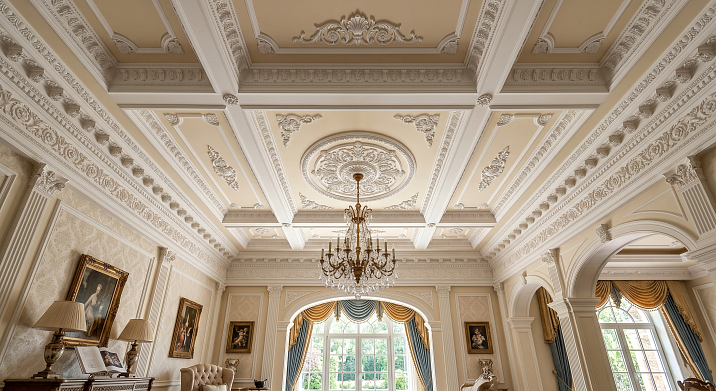
A high ceiling is an architectural gift. The space breathes, the chandelier hangs like a sculpture, light is distributed vertically naturally and generously. But this is where the main challenge lies: the higher the ceiling, the more obvious its emptiness. A large white field without decor in an expensive classic interior looks not like a minimalist gesture, but like an unfinished work.
Stucco decor for a high ceiling — this is not ornament for ornament's sake. It is an architectural solution that turns an empty upper plane into a structured scene: with a center, with a perimeter, with corner accents and a light relief. Stucco molding for a high ceiling responds to the spatial request — to give the room scale, order, and grandeur. Without it, even the most expensive interior feels unfinished from below.


Why a high ceiling requires more expressive decor
A question often asked at the initial stage of renovation: "Is stucco needed at all if the ceiling is high and light?" The answer is yes, and precisely because the ceiling is high.
On a standard 2.5 m ceiling, even a modest molding is noticeable because a person is physically close to that plane. On a ceiling of 3 m or higher, the distance between the observer's gaze and the upper plane is perceived as spatial distance. At this distance, small decor — thin moldings, a small rosette, light overlays — simply ceases to be readable. It does not physically disappear, but visually dissolves into the neutral white background. This is called loss of scale.
A classic high ceiling requires large forms. The cornice must be wide enough for its silhouette to be visible from below at a distance of 4–6 meters. The molding frame must have a profile width that reads from that distance as a clear line, not a shadow. Ornamental overlays in the ceiling field must be proportionate to the chandelier and the viewing distance. A luxurious ceiling with stucco in an expensive interior is always a system where all elements are calibrated to the scale of the space.
An empty ceiling in a large hall with a height of 3 m is not minimalism. It is a lack of architectural solution. Ceiling decor for high ceilings allows creating that vertical rhythm which connects the chandelier, walls, furniture, and the ceiling plane into a single spatial system. Without it, the interior remains a set of separate, albeit expensive, elements. With it, it becomes an architectural statement.




How to understand that the ceiling needs large stucco decor
There are several specific signs, in the presence of which ceiling decor for high ceilings ceases to be a matter of taste and turns into an architectural necessity:
-
ceiling height is 2.9 m or more;
-
room area exceeds 28–30 m²;
-
the room has a large hanging chandelier with a diameter of 60–80 cm or more;
-
the interior is designed in classic, neoclassical, Empire, or Art Deco style;
-
walls are decorated with moldings, pilasters, frames, or high panels;
-
furniture is large and expressive in silhouette;
-
when looking up, the ceiling seems empty and unfinished against the backdrop of rich walls.
Each of these signs individually is already an argument. Together, they form a clear request: which stucco molding to choose for a high ceiling so that it does not get lost and becomes a full-fledged part of the architecture?
The answer is to use a system where the scale of elements is calibrated to the height and area of a specific room. For this purpose, the STAVROS catalog has ready-made sets of the CPU-P series, in which all components — cornice, molding contours, corner accents, field overlays, and the central element — are already coordinated with each other in a single architectural system. Ceiling decor for a home with high ceilings through a ready-made set is a solution where proportions are thought out for the buyer.
Our factory also produces:





Which elements are important for a high ceiling
Get Consultation
Large ceiling cornice
The cornice is the first and most important element for a high ceiling. It sets the scale of the entire vertical of the room, connecting the top edge of the wall with the ceiling plane. On a high ceiling, a narrow and thin cornice gets lost just like a thin ring on a monumental column.
Decorating a high ceiling starts with the cornice: its profile height should be proportionate to the height of the room.Polyurethane Crown MoldingSTAVROS offers a wide range of profiles of different heights and relief complexity: from classic two-tier to rich three-tier systems with ornamental friezes. The cornice for a high ceiling should be chosen with a margin in scale: for a room height of 3 m or more, a profile height of 100–120 mm is recommended, which creates a clear silhouette at a distance.
In addition to the visual function, the cornice at a ceiling of 3 m and above opens up the possibility for contour LED lighting: a hidden groove behind the cornice profile allows creating a soft diffused glow around the entire perimeter of the room, which emphasizes the relief and makes the ceiling voluminous in evening lighting.
Molding frame
If the cornice is the perimeter, then the molding frame is the internal geometry of the ceiling field. On a high ceiling of a large hall, the molding contour around the central zone acts as an architectural "frame": it delimits the ceiling field and introduces spatial order into it.
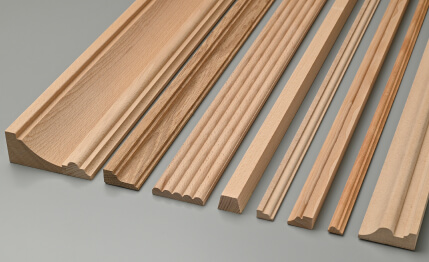
Moldings made of polyurethaneSTAVROS is produced in several profiles corresponding to classical and neoclassical ornamental systems. For a high ceiling, profiles with a width of 40–60 mm and above are needed: narrower moldings get lost in the scale of a large room. Moldings for a high ceiling with a wider profile create an expressive shadow line under oblique lighting, which, even in a neutral white color, gives the ceiling architectural depth.
The molding contour also serves a practical function: it defines the boundaries of the ceiling field, which is decorated with ornamental overlays. Without this contour, the overlays in the ceiling field may appear arbitrarily placed, but with it, they become part of a well-thought-out geometric system.
Ornamental overlays
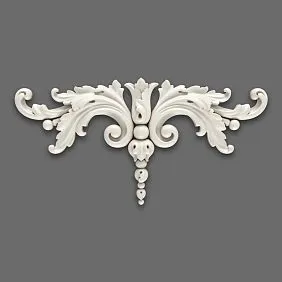
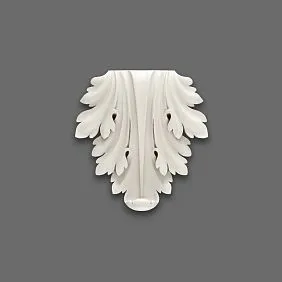
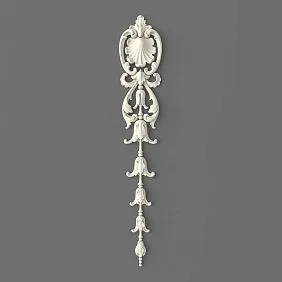
These are elements that create decorative richness in the ceiling field: corner accents, ornamental dominants, frieze overlays, and inserts at intersections of molding lines. On a high ceiling, they work as an ornamental "voice" that must be audible from below.
For a height of 3 m and above, the size of the overlays is directly significant. Large stucco for the ceiling refers to overlays whose ornamental dominants measure 250 × 250 mm or more. The CPU-P6 kit includes NPU-464 elements measuring 300 × 420 mm and NPU-475 measuring 350 × 180 mm — this is precisely the scale that reads as an architectural accent on a high ceiling, not as a background ornament.
Polyurethane moldingsSTAVROS is made of dense material with high relief detailing. Ornamental overlays are produced by injection molding, ensuring perfect repeatability of geometry in each piece — this is important for a strict symmetrical scheme of a high ceiling, where any deviation from symmetry is immediately visible.
Central accent under the chandelier
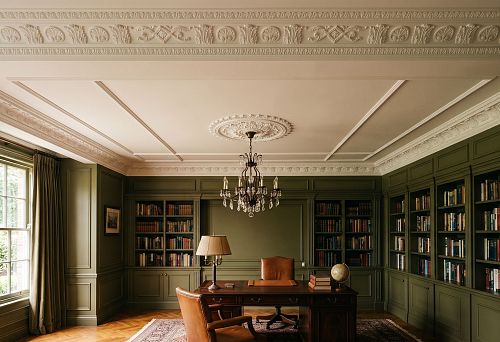
On a high ceiling of a large formal living room, the central accent is not an optional element but an architectural necessity. A chandelier without a ceiling frame at a height of 3 m looks like a suspended object in space, connected to nothing. A chandelier with a ceiling rosette and a decorative frame around it becomes the center of the architectural ceiling scene.
Polyurethane ceiling rosettesSTAVROS is available in a wide range of diameters and relief patterns — from laconic laurel wreaths to complex multi-tiered ornaments. For a high ceiling, a rosette with a diameter of 350 mm or more is recommended: only such a size creates a noticeable architectural accent, proportionate to a large chandelier and ceiling height. Decor around the chandelier for a high ceiling is always about proportionality: the diameter of the rosette ≥ the diameter of the upper bowl of the chandelier.
How to choose a set based on ceiling height
Ceiling 2.8–3 m
This is the zone where the formal interior begins. The height is already sufficient for expressive stucco, but does not yet require maximum ornamental saturation. The main argument: at a height of 2.8–3 m, the principle of "expressive but balanced" should apply.
Stucco for a 3-meter ceiling is a system where the cornice is large enough, the molding frame is proportionate to the room area, and the central element creates an accent under the chandelier without excessive ornamental overload.Molding decor set CPU-P4— the main choice for this height range: 21 product types, four levels of corner accents, a rich but architecturally balanced system recommended for rooms of 28–45 m² with ceilings from 2.8 m.
CPU-P4 for a 3-meter ceiling is a solution where each element of the system is visible and readable from a distance, but the set does not create a feeling of a "heavy formal ceiling" inappropriate in a living space. Ceiling decor for a 3-meter ceiling via CPU-P4 is the right balance between expressiveness and proportionality.
Ceiling 3–3.2 m
At a height of 3 to 3.2 m, the interior already acquires features of a formal space — and the ceiling decor should reflect this. An empty ceiling at this height looks especially cold: the distance from the eye to the upper plane is too great for the ceiling to be perceived as part of living comfort.
Stucco for a 3.2-meter ceiling: two strong options open up here. The first isCPU-P4for spacious rooms where expressiveness is needed, but the interior is not yet fully formal. The second isCPU-P6for large halls from 35 m², where the ceiling should become the main architectural accent.
A stucco set for a 3.2-meter ceiling via CPU-P6 is no longer just decor. It is the creation of a formal ceiling scene with large ornamental dominants, deep relief, complex corner accents, and a central element for a large chandelier. CPU-P6 for a 3.2-meter ceiling in a living room of 35 m² and above is exactly the level of architectural decor that makes the room indistinguishable from a European classical villa.
Ceiling above 3.2 m or double-height space
This is a special architectural scenario. In private houses and country residences, a double-height space — a room with a ceiling from 5 to 7 m — is the main architectural event. Ceiling decor for a double-height space requires a fundamentally different approach.
Here, you should not be afraid of scale: you need to embrace it. Stucco molding on a ceiling with a double-height space must work with the existing height. The cornice around the perimeter of the double-height space is typically a large three-tier profile. Molding frames in the ceiling field are large, with wide profiles and corner accents. The central ceiling rosette for the main chandelier of the hall or living room has a diameter of 500 mm or more.
Ceiling decor in a house with a double-height space: the STAVROS catalog contains all the necessary components for such a system —Polyurethane Crown Moldingwith large profiles,Polyurethane moldingsin the form of ornamental dominants of the required scale,Polyurethane ceiling rosettesin a wide range of diameters. For a double-height space, the ready-made set CPU-P6 is supplemented with individual large elements around the perimeter — this is an individual design task that STAVROS supports through a full range of individual products.
CPU-P4, CPU-P6 or CPU-P2: which set to choose
This is the central practical question of the article. Each of the three sets has its own character, its own application conditions, and its own visual result. Let's analyze them sequentially.
CPU-P4 — an expressive set for a high ceiling
Molding decor set CPU-P4 — is an architecturally rich system designed for a 3200 × 3200 × 83 mm zone. 21 product types, four levels of corner accents, a developed ornamental relief of the central field, a full cornice and molding contours. For a living room or hall of 28–45 m² with ceilings from 2.8 m, CPU-P4 is the primary recommended choice.
What sets CPU-P4 apart from simpler kits? Four levels of corner accents — this means the corner system creates not one, but several ornamental transitions that, under oblique lighting, produce a volumetric play of shadows. When viewed from below, the corner of the room does not appear as an ordinary intersection point of the ceiling and wall planes, but becomes an architecturally detailed element — as in classic Italian or French formal interiors.
CPU-P4 for a formal living room up to 45 m²: this is the upper working limit of the kit. For areas above 40–45 m², the 3200 × 3200 mm zone may appear proportionate if the room has a more or less square configuration — then the ceiling system occupies a significant part of the ceiling field. If the room is elongated, it is better to supplement CPU-P4 with molding frames around the perimeter or consider CPU-P6.
CPU-P4 for a large hall — the choice when a high level of architectural decor is needed, but without maximum ornamental overload. This balance is the main advantage of CPU-P4 over CPU-P6: it is rich, expressive, architecturally convincing — and at the same time does not cross the line where formality becomes pomposity.
CPU-P6 — the ultimate formal option
Molding decor set CPU-P6 — is the pinnacle of the STAVROS line in terms of ornamental richness. The most complex solution in the «Classic» collection, created for spaces where the ceiling should become the main architectural statement of the room. Recommended for living rooms and halls from 35 m² with ceilings from 2.9–3 m.
The CPU-P6 includes large ornamental dominants: NPU-464 with dimensions of 300 × 420 mm and NPU-475 with dimensions of 350 × 180 mm. These are large decorative elements that read from a distance of 5–6 meters as full-fledged ornamental objects. On a high ceiling of a large hall, they create precisely the visual richness that transforms the ceiling from a background plane into an architectural scene.
CPU-P6 for a large living room — this is the choice of those who design a country house, a formal hall, a foyer with a large chandelier, or a representative space where the first impression is created primarily through the interior, not through furniture or art objects. The formal ceiling decor CPU-P6 is an interior declaration that is visible at first glance and cannot be confused with anything else.
Why is CPU-P6 better than a random set of large decorative elements? Because it is a system. All product types in the CPU-P6 are coordinated in ornamental language, scale, and proportions. Corner accents, field overlays, cornice, and central element — all are developed as a single architectural whole. CPU-P6 for a formal hall with a 3 m ceiling and a chandelier with a diameter of 80 cm or more is precisely the system that allows you to achieve a result at the level of an architectural project without independently selecting elements.
CPU-P2 — restrained classic for a high ceiling
Molding decor set CPU-P2 — this is the answer for those who want a high ceiling with classic stucco, but without the maximum ornamental saturation of CPU-P6 and even without the richness of CPU-P4. CPU-P2 is an elegant, restrained architectural system that works well in interiors where the ceiling should not dominate, but should be finished and architecturally convincing.
For a formal hall of 35–50 m² with ceilings from 3 m, the 3200 × 3200 × 83 mm zone looks proportionate. Corner overlays in the CPU-P2 set with dimensions of 225–250 mm do not get lost in the scale of a high room — and at the same time do not assert themselves too loudly. CPU-P2 for a high ceiling is what designers call "the right tone": a classic that is present in the interior without excessive self-display.
A special scenario for CPU-P2 is contour LED lighting. The card for this kit describes a scenario with a central chandelier and hidden lighting behind the cornice: soft diffused light around the perimeter of the ceiling creates the effect of a "floating" ceiling volume, in which the stucco is perceived through soft shadows and glow simultaneously. With a ceiling height of 3 m, this effect is especially expressive: the ceiling seems to detach from the walls and turns into an independent light object.
A ceiling with stucco and lighting through CPU-P2 is not only a decorative but also a lighting architectural solution. A classic ceiling with a chandelier and stucco plus contour lighting behind the cornice — three lighting levels in one space, each performing its own architectural function.
| Parameter | CPU-P2 | CPU-P4 | CPU-P6 |
|---|---|---|---|
| Room area | 35–50 m² | 28–45 m² | from 35 m² |
| Ceiling height | from 3 m | from 2.8 m | from 2.9–3 m |
| Ornamental saturation | Restrained | rich | Maximum |
| Number of product types | basic set | 21 types | Extended |
| Size of corner overlays | 225–250 mm | large | 300–420 mm |
| Main Scenario | neoclassical, hall, calm room | living room, hall, representative interior | grand hall, house, large chandelier |
Stucco decor for a large hall
A large hall is a special architectural unit. Not just an enlarged living room, but a space with a fundamentally different logic of perception: here, the first glance from the threshold, covering the entire room, is important. And it is the ceiling that is the first thing this glance fixes — even before the chandelier, furniture, or walls are noticed.
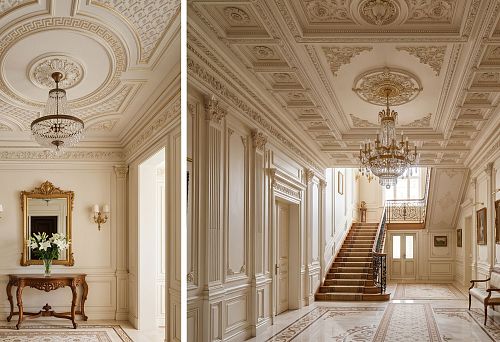
Stucco molding on the ceiling in a large hall should create a visual center: a point around which spatial perception is built. Without this center, the gaze in a large hall 'floats' along the perimeter, not finding an architectural anchor. A set of ceiling decor for a large hall via CPU-P6 or CPU-P4 creates exactly such a center: a 3200 × 3200 mm zone above the main area of the hall, surrounded by molding contours and corner accents, immediately sets the spatial order.
Ceiling decor in a large hall also works with the perimeter: a cornice along the entire contour of the room creates an architectural belt that connects the walls with the ceiling. In a large hall, this belt is especially important: without a cornice, the walls and ceiling in a high room look like independent planes assembled randomly. With a cornice, they become part of a single vertical system.Polyurethane Crown MoldingSTAVROS are available in profiles of several heights — for a large hall, it is recommended to choose large profiles that are readable from a distance.
Ceiling decor for a large hall also takes into account furniture arrangement. In a formal hall, furniture groups are often arranged symmetrically relative to the central axis: sofas, armchairs, a coffee table — everything in the center. The ceiling system should support this symmetry: a central element on the chandelier axis, molding contours parallel to the walls, corner accents strictly at the corners of the zone. A stucco ceiling in a large hall is like an architectural stage — it is the consistency of every detail with the others.
Stucco for a formal living room
A formal living room differs from an ordinary one not only in area and ceiling height. The main difference is the function of first impression. This is the room a guest enters and immediately gets an image of the home, its owners, and their aesthetic choices. In this sense, a formal living room with stucco is not just a beautiful interior. It is an architectural statement.
What makes the ceiling of a formal living room special? Ornamental elements should be larger and more readable than usual: a luxurious ceiling with stucco in the living room is achieved not by the number of details, but by their scale and expressiveness. The stucco ceiling rosette should be proportionate to the chandelier and read as an independent architectural object. Corner accents should be noticeable from the entrance — that is, from a distance of 5–7 meters. Molding frames should set a clear geometry of the ceiling field, which is read without extra effort.
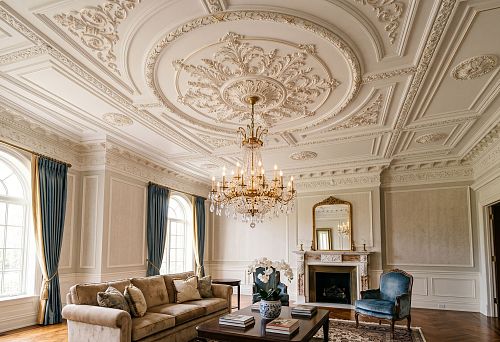
A stucco kit for a formal living room via CPU-P6 is the maximum level. Such a system turns the living room ceiling into an architectural dominant of the space: the first thing a person sees upon entering, and the main thing that remains in memory. Ceiling decor in a formal living room via CPU-P4 is an expressive level with a balance between complexity and proportionality: an excellent choice when the interior should be formal but not overloaded.
Ceiling decor for a formal living room in a private house is a special scenario, where the room often has a non-standard configuration: corner windows, a coffered cornice, or high ceilings with a beam. In such cases, the CPU-P6 or CPU-P4 ceiling system is supplemented with individual elements from the catalogmoldings from polyurethaneSTAVROS, which allow creating a custom solution for a specific architecture.
How not to lose the scale of stucco on a high ceiling
This is the most practical block of the article — and the most important for those who have already made mistakes with the scale of decor or have seen similar mistakes in others.
Why does small stucco get lost on a high ceiling? Physically, this is explained by the laws of perspective perception: as the distance increases, the angular size of an object decreases proportionally to the distance. An element that occupied 5° of the field of view at a height of 2.5 m occupies only 3.5° at a height of 3.5 m. Visually, this means a reduction in perceived size by almost one and a half times — not due to the actual reduction of the element, but due to the increase in distance.
What size of molding to choose for a high ceiling: a simple rule — multiply the estimated ceiling height in meters by 80–100. This gives an approximate minimum size of a significant decorative element in millimeters. For a 3 m ceiling, these are elements from 240–300 mm. For a 3.5 m ceiling, from 280–350 mm. The ornamental dominants CPU-P6 (300 × 420 mm, 350 × 180 mm) are designed precisely with this principle in mind.
How not to lose the scale of molding on a high ceiling: practical rules:
-
Do not use molding profiles with a width of less than 40 mm for the main contour of the frame with a ceiling of 3 m or more;
-
do not choose a ceiling rosette with a diameter of less than 350 mm for a large chandelier with a ceiling height of 3 m or more;
-
do not leave the corner points of the molding frame without large corner overlays — they fix the geometry and create scale;
-
do not make decor only along the perimeter without a central ceiling system — a cornice without a central composition on a high ceiling looks like an unfinished outline;
-
do not ignore the distance from which a person will look at the ceiling: in a large hall it is 5–7 meters, and the decor should be readable from this distance.
How to choose molding for a high ceiling in the end: always start with the scale of the room, then determine the level of decorative saturation (CPU-P2, CPU-P4 or CPU-P6), then consider the chandelier and lighting scheme. A ready-made setfrom the STAVROS catalogalready solves the scaling problem: all elements in it are calibrated relative to each other and relative to the 3200 × 3200 mm zone.
How to combine a high ceiling with a chandelier and lighting
The ceiling is not just decor. It is a light stage. And on a high ceiling, the lighting component works especially powerfully: at a height of 3 m or more, the fixture is located significantly farther from the lower levels of the space, meaning its light scatters differently, shadows fall at different angles, and the entire light pattern of the interior changes.
A classic ceiling with a chandelier and stucco at a height of 3 m is a visual system of several levels. The first level is the central chandelier, which is the main source of formal lighting. The second level is the ceiling rosette and molding contours around it, which, under oblique light from the chandelier, create a system of soft shadows. The third level is the contour lighting behind the cornice, which works in evening lighting as diffused perimeter light, emphasizing the relief of the cornice profile.
Ceiling with stucco and lighting: a hidden LED groove behind the cornice is not just a light effect. It is a way to give a high ceiling "warmth": a cold white volume, when the contour lighting is turned on, turns into a softly lit space with warm accents on the relief of the cornice and molding contours.
Ceiling decor for a high ceiling with a chandelier: recommendation for selecting a chandelier for a formal space — the diameter of the chandelier should be at least 1/3 of the width of the room. In a living room 6 × 6 m, this is a chandelier with a diameter of at least 2 m. In a hall 8 × 8 m, from 2.5 m. The ceiling rosette for such a chandelier is at least 500 mm. The decorative frame around it is through a molding system of the CPU-P6 or CPU-P4 kit, which forms a transition zone from the central accent to the ornamental field.
installation of polyurethane moldingFor a system with contour lighting: the groove behind the cornice should be provided at the design stage. The cornice is mounted with an offset from the ceiling plane, creating a hidden shelf for the LED strip. The width of the shelf depends on the profile of the cornice. It is recommended to coordinate this point before starting installation work.
How to connect ceiling decor with walls in a high room
In a high room, walls do not just surround the interior — they become architectural surfaces that bear visual load on par with the ceiling. At a height of 3 m or more, the wall has an area comparable to or even exceeding that of the ceiling. This means that leaving the walls empty, decorating only the ceiling, creates a disproportion between the decorative levels.
Stucco decor for high walls and ceilings should be designed as a system. Wall moldings, pilasters, decorative panels, and cornice belts on the walls — all of this should be coordinated with the ceiling system in scale and ornamental language.Polyurethane wall decorSTAVROS is produced in the same "Classic" collection as the ceiling kits — this guarantees ornamental unity of the entire system.
How to combine stucco on the ceiling and walls: the basic principle is from simple to complex from bottom to top. The lower belt of the wall is paneling or a baseboard. The middle belt is molding frames or a smooth surface. The upper belt is a cornice system transitioning to the ceiling. The ceiling field is a CPU-P4 or CPU-P6 set. All of this is one decorative narrative told on three vertical levels.
Moldings made of polyurethaneon the walls of a tall room: a horizontal decorative belt at mid-wall height is a classic technique for rooms with high ceilings. It visually "lowers" the space to a comfortable scale without physically reducing it. In a formal hall with a 3.2 m ceiling, a horizontal molding belt at a height of 2.2–2.4 m creates an architectural division of the wall that corresponds to the classical order system.
Decor of a high ceiling and walls as a single system: this approach is the main secret of interiors that look like a professional architectural project. In such interiors, there is no feeling of "randomly added ceiling decor" — because the decor everywhere speaks the same language, on the same ornamental wave.installing polyurethane moldingis a separate professional task, which STAVROS supports with a detailed guide.
Mistakes when choosing stucco for a high ceiling
Mistake 1. Choosing small decor
The most common mistake. A person sees a beautiful molding in a catalog, orders it, installs it at a height of 3 m — and the ceiling looks like a white plane with a barely noticeable shadow around the perimeter. At height, fine detailing is lost. How to choose stucco for a high ceiling: start with scale, not with ornament.
Mistake 2. Leaving only a cornice
A cornice around the perimeter is a necessary condition, but insufficient for a high formal ceiling. For a large hall, a central ceiling system is needed: molding contours, corner accents, field overlays, and a central element under the chandelier. Without this, the ceiling remains a "framed emptiness" — with a beautiful edge and nothing inside.
Mistake 3. Not considering the chandelier
A large chandelier without a ceiling frame on a high ceiling looks like a suspended art object with no connection to the architecture. A ceiling rosette and a decorative frame around the chandelier are what turn the light fixture from just a light fixture into the central architectural accent of the space.
Error 4. Making the ceiling richer than the walls
If the walls are empty and the ceiling is saturated with a maximum CPU-P6 kit with large ornamental dominants, a disproportion occurs where the ceiling "presses down" on the space. Ceiling decor should be part of the system: its decorative saturation should not sharply exceed the saturation of the walls and the cornice transition.
Error 5. Buying elements without a ready-made scheme
For a high ceiling, chaotic selection of individual decorative elements without a preliminary scheme is especially dangerous. Proportions, scale, distances, placement of corner accents — all of this requires a design solution. A ready-made stucco kit for a high ceiling from the CPU-P series solves this problem: proportions and scale are already coordinated within the system.
Mistakes when choosing stucco for a high ceiling are mistakes of scale, system, and context. Each of them is solved in one way: by using a ready-made STAVROS kit, where all these issues are already resolved for you.
Where to buy STAVROS stucco decor for high ceilings
The STAVROS catalog features a full range ofceiling decor for high ceilingsmade of polyurethane: ready-made CPU-P series kits, individual cornices, moldings, ceiling rosettes, stucco overlays, and wall decor. For an expressive and balanced solution with a ceiling height of 2.8 m or more —CPU-P4 kitFor the most formal interior, a large hall, and a country house with ceilings from 3 m —CPU-P6 kitFor restrained classic style with high ceilings and contour lighting —CPU-P2 kit.
All STAVROS kits are made of dense polyurethane and HIWOOD polystyrene, designed for an area of 3200 × 3200 × 83 mm, sold as ready-made sets without the need to select elements yourself. Full rangepolyurethane products for interior— in the catalog on the website.
STAVROS is a Russian manufacturer of architectural polyurethane decor with its own production and full quality control. The "Classic" collection is a coordinated system of ceiling and wall decor for all residential scenarios: formal living room, large hall, foyer, master space, and country house. STAVROS stucco decor for high ceilings is an architectural solution created with respect for scale, proportion, and classical ornamental language.
FAQ: Answers to popular questions
Which stucco molding to choose for a high ceiling?
For a high ceiling, large elements are needed: a cornice with a profile from 100 mm, molding frames with a wide profile from 40–60 mm, ornamental overlays from 250 mm, a ceiling rosette with a diameter from 350 mm. The optimal choice is a ready-made CPU-P4 or CPU-P6 kit, where the scale is already coordinated.
Which STAVROS kit to choose for a 3-meter ceiling?
For a 3 m ceiling in a living room of 28–40 m² —CPU-P4For a living room of 35 m² or a grand hall with a ceiling height of 3 m —CPU-P6For a restrained classical solution —CPU-P2.
Is CPU-P6 suitable for an ordinary room?
CPU-P6 is designed for spacious rooms: living rooms and halls from 35 m² with ceilings from 2.9–3 m. In a small room, its decorative richness may be excessive — in this case, it is better to consider CPU-P4 or CPU-P2.
How not to lose the scale of stucco on a high ceiling?
Choose elements proportionate to the height: moldings from 40 mm wide, rosettes from 350 mm in diameter, ornamental overlays from 250 mm. Do not leave the center of the ceiling empty. Use a ready-made kit where the scale is already calibrated.
What is better for a high ceiling: individual elements or a ready-made kit?
For a high ceiling, a ready-made kit is safer and more effective: proportions, scale, and ornamental language are already coordinated. Random selection of individual elements requires professional design calculation — otherwise, there is a high risk of scale error or ornamental mismatch.
Can I add contour lighting behind the cornice?
Yes — all STAVROS cornices allow installation of a hidden LED groove. For the CPU-P2 kit, this scenario is directly described in the card: contour lighting creates a 'floating' ceiling effect with soft shadow play on the relief.
How to connect ceiling decor with walls in a high room?
Use a unified ornamental system: wall moldings from the same collection as the ceiling set, a cornice as a transitional element between the wall and ceiling, decorative belts at mid-wall height. The entire range. Clear lines, created using modern technologies, emphasize the strict aesthetics of the room. Each decorative element harmoniously fits into the overall concept, creating a sense of order and thoughtfulness.STAVROS is made in the same "Classic" collection as the ceiling sets.