Article Contents:
- Oak or beech: first decide what the finished handle should be like
- The wood should remain visible
- The wood should be hidden under color
- Unfinished handles
- Coated handles
- Mistake 1. Choosing the wood species before choosing the finish
- Mistake 2. Assuming oak is automatically the best material
- Mistake 3. Assuming beech is only a material for painting
- Mistake 4. Comparing color on a screen
- Mistake 5. Mixing wood species accidentally
- Mistake 6. Ordering the full set before checking one piece
- Mistake 7. Ignoring the scale of the handle
- Which is better for furniture handles — oak or beech?
- Which handles are best left under natural wood?
- Which is better under enamel — oak or beech?
- Can beech handles be tinted?
- Which wooden handles are better under oil?
- Can oak handles be combined with a painted facade?
- Should a test finish be applied to the handle?
- Can oak and beech be used in the same furniture?
- How do unfinished handles differ from coated handles?
- Where to buy oak and beech furniture handles?
Page description: How to choose oak or beech furniture handles: natural texture, enamel, oil, lacquer and tinting. Unfinished and ready-made STAVROS wooden handles for cabinets, dressers and kitchens.
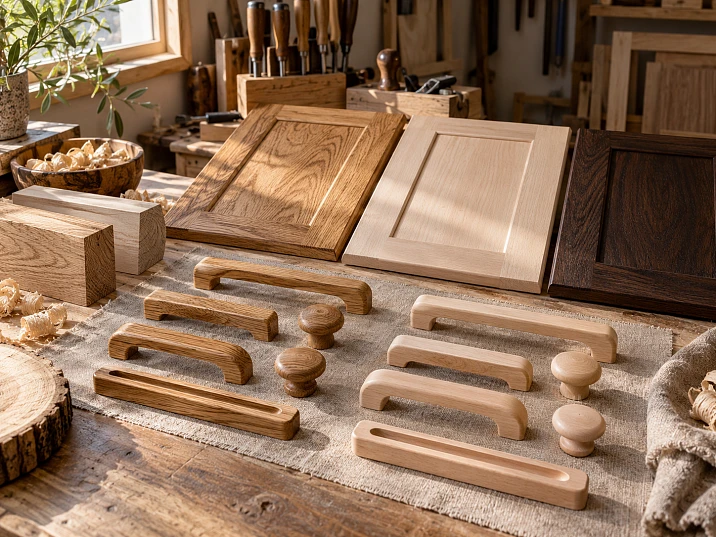
The same wooden handle on two facades can look completely different. On the first, it remains natural, and the wood grain becomes part of the furniture. On the second, the handle is painted to match the facade, so the eye notices not the wood but the shape. This is exactly where the choice between oak and beech becomes practical rather than abstract.
If the handle is planned to be left under a clear or semi-transparent finish, the species will be clearly visible. In such a project, oak is often chosen for its more pronounced natural texture. If the handle should be the same color as the facade under opaque enamel, beech often turns out to be a clear and convenient option.
But this is not a rule that "oak is only natural, beech is only painted." Oak can also be painted, and beech can be left under a clear finish. First you need to envision the finished furniture, choose the finishing method, and only then decide which wood is best suited to this particular project.
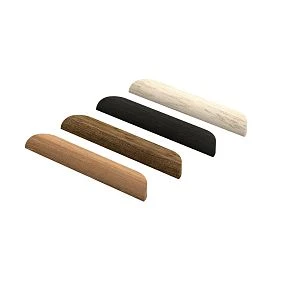
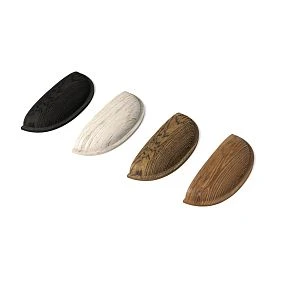
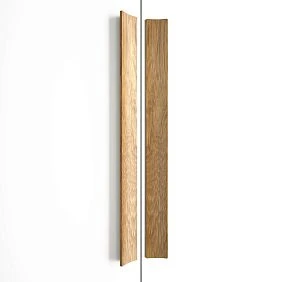
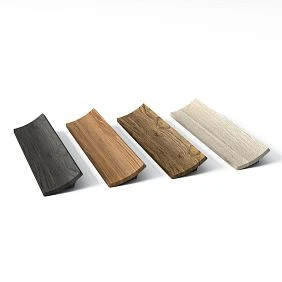
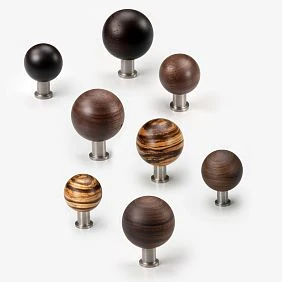
Oak or beech: first decide what the finished handle should be like
Starting with the question "which wood is better" is inconvenient. Neither oak nor beech has a universal advantage over the other. What matters more is the result you need after finishing.
There are two completely different scenarios.




The wood should remain visible
The handle is coated with oil, clear lacquer, stain, or tint. The wood grain remains part of the appearance.
Then the species is immediately noticeable.
On an oak handle, the surface usually looks more expressive. The natural wood grain contributes to the design almost as much as the shape itself.
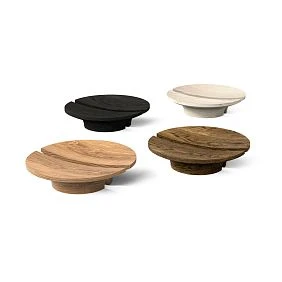
Our factory also produces:
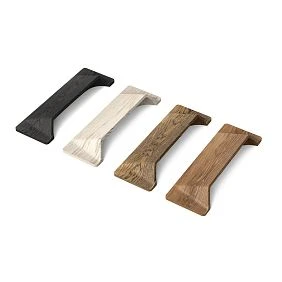
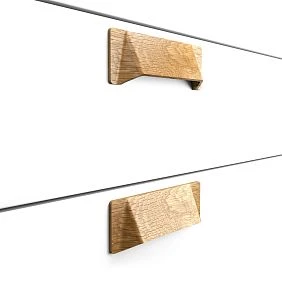
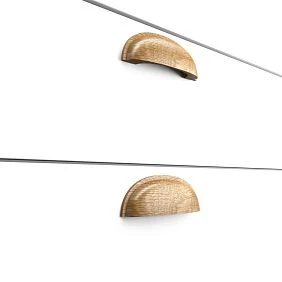
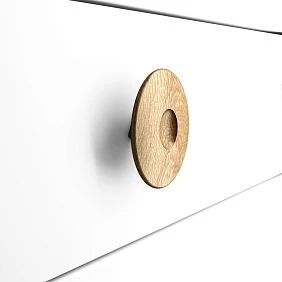
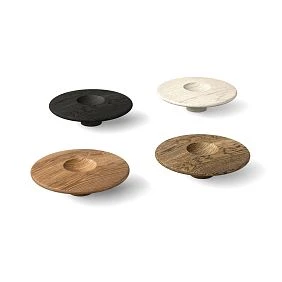
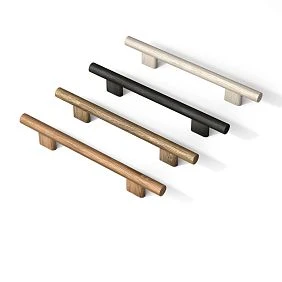
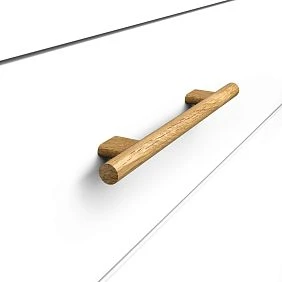
The wood should be hidden under color
The handle is primed and painted with opaque enamel together with the front or separately in the same color.
Then the natural texture of the wood takes a back seat. Much more important is the shape of the handle, the quality of surface preparation, the neatness of the edges, and the evenness of the paint.
In such a situation, beech often turns out to be a sensible choice.
So the correct order is simple:
first the facade and the future finish → then oak or beech → then the specific handle.
If you change the sequence, it is easy to buy a good component whose material advantages will not be visible at all in the finished furniture.
Get Consultation
When it makes sense to choose oak handles for furniture
Oak is especially interesting where the handle should be perceived specifically as wooden.
Let's imagine a matte painted chest of drawers with small natural oak handles on it. The body is calm and solid-colored, while each handle provides a lively wood grain. Here oak works not only as a material, but also as a decorative accent.
Another example is furniture that already has oak details:
- oak countertop;
- oak legs;
- open wooden frame;
- oak shelves;
- moldings or overlays with visible texture.
In this case, oak furniture handles can tie these parts together.
The material looks especially good under:
- clear lacquer;
- oil;
- light tinting;
- stain that does not hide the wood grain.
But there is a downside. If the entire handle is covered with dense white enamel, the pronounced oak texture ceases to be the main advantage. You can still choose oak, but for other reasons.
Therefore, oak should be ordered not "because it is better," but because its grain is needed for a specific furniture appearance.
When it makes more sense to choose beech furniture handles
Beech is especially fitting in projects where the handle should become part of a painted facade.
For example:
- white kitchen;
- colored cabinet;
- dresser under thick enamel;
- children's furniture;
- a cabinet where the handles completely match the color of the body;
- a classic facade, where the shape of the handle should be more noticeable than the wood texture.
Here, a person first of all sees the silhouette of the handle: whether it is round, elongated, angular, thin, or massive.
The wood is hidden under the coating, so its natural pattern hardly contributes to the overall look.
Beech is also convenient when the craftsman wants to select the shade himself. An unfinished handle can be prepared together with other wooden parts and included in a single finishing system.
But beech should not automatically be considered only "wood for enamel." It can be tinted, oiled, or lacquered. It is simply better to see the result in advance on a real sample.
The same shape in oak and beech is perceived differently
Let's imagine two completely identical handles.
The size matches.
The shape matches.
The mounting method matches.
One is made of oak, the other of beech.
While both are unfinished, the difference is visible in the surface itself. After a clear finish, it usually becomes even more pronounced. On a long handle, the wood grain reads along the entire length. On a small knob, it becomes a small natural accent.
After a dense enamel coating, the difference almost disappears from view. Then a person perceives primarily the shape.
This is the main point of the choice.
The wood species does not change the size of the handle. It changes how the material will participate in the design after finishing.
That is why a technical drawing is not enough if the wood will remain visible. You need to look at real oak and real beech.
Proun HL-053-1: one size, two wood species, and its own finishing
A good example is Furniture handle Proun HL-053-1.
Its size is 28 × 28 × 29 mm. The product page offers options in beech and oak. The handle is supplied without a finished decorative coating, so the craftsman can choose the further finishing themselves.
On such a small detail, it is easy to see why the decision is better made based on the project rather than the name of the wood species.
If the handle needs to match a painted front, you can take beech and coat it with the same enamel system.
If you want a small natural wooden accent, it makes sense to look at oak and a clear or tinted finish.
The shape will remain the same.
The material changes, and so does what a person will see on the surface.
Proun HL-053-1M: when the finish is already part of the ready-made solution
У Proun HL-053-1M the same size 28 × 28 × 29 mm, but this is already the version with a coating.
Here the choice is structured a little differently.
In the unfinished version, the craftsman is responsible for the final color and character of the surface. In the coated version, the appearance is already defined much more strongly.
So you have to choose not only between oak and beech, but also between two degrees of readiness:
unfinished handle → we apply our own finish;
coated handle → we evaluate an already finished combination of wood and coating.
For a workshop, this is an important difference.
If all the furniture is painted in a custom color, the unfinished version is more convenient.
If the ready-made handle color already fits, you can remove another operation from the workflow.
ORB HL-002M: wood species cannot be chosen separately from the entire furniture piece
Another example — ORB HL-002M.
The handle size is 44 × 44 × 45 mm. The product page offers options in oak and beech. This model is used on dressers, cabinets, and kitchen fronts.
The spherical handle is small but clearly noticeable. On a calm, solid-color front, it can become a distinct focal point.
If you choose the oak option with a finish, the wood will work as a standalone material.
If the goal is to choose a handle that fits the overall painted palette, you need to look at the specific color and how it combines with the front.
The same handle on a white kitchen, on a dark oak sideboard, and on a colorful children's dresser solves three different decorative tasks.
Therefore, choosing oak or beech without seeing the entire piece of furniture is pointless.
Luna HL-005: the long handle shows the wood more strongly
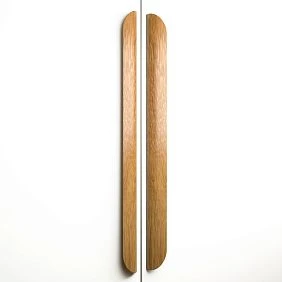
Unpainted Luna HL-005 handle measures 130 × 32 × 16 mm and is available in oak and beech.
On such an elongated shape, wood is perceived differently than on a small knob.
The longer the visible surface, the more space the natural wood grain receives.
On oak, it can become part of the overall line of the front.
On beech with a dense finish, a long handle, on the contrary, can almost completely blend with the front and be perceived as its three-dimensional continuation.
Therefore, size also influences the choice of material.
On a small knob, natural wood works as a point.
On a long handle — as a line.
Oak handle on a painted front
It is not necessary to make an oak handle the same color as the furniture.
Sometimes the best effect comes precisely from contrast.
For example:
matte green facade + natural oak handle.
Or:
warm grey cabinet + oiled oak handles.
Or:
white kitchen + oak handles that match the countertop.
In a project like this, the handle serves two purposes at once.
The first is ordinary: it's used to open the facade.
The second is decorative: it ties the painted furniture together with the other wooden parts of the interior.
With a solution like this, it's especially important to check the actual shade of the oak. Two photos on a screen won't give a precise answer as to whether the handle will match the countertop.
You need a real sample next to the real material.
Beech handle in the facade color
Another approach is to make the handle almost invisible in color.
For example, the entire dresser is painted dark blue. The beech handle is also coated with the same enamel.
The shape remains visible thanks to volume and shadow, but the material does not create a separate color accent.
This approach works especially well if the furniture already has many details:
- facade frame;
- molding;
- carved overlay;
- pilaster;
- decorative leg.
Additional natural texture on the handle could overload the composition. A handle in the color of the facade, on the contrary, remains functional but does not compete with the rest of the decor.
Can oak and beech handles be mixed in the same furniture?
Technically, yes.
The question is why.
If on one cabinet some handles are oak and some are beech, and all of this remains under a clear finish, the difference will most likely be noticeable.
In a product photo, this may seem like a minor detail. On a real facade, the handles sit next to each other and repeat. Any difference turns into a pattern.
Therefore, for one set it is better to decide in advance:
- all visible handles are oak;
- all visible handles are beech;
- or the mixing of species is done intentionally as part of the design.
Mixing materials by accident is not worth doing.
Especially if the furniture is expensive and should look like a single, complete piece.
When the difference between oak and beech is almost invisible
The most obvious case is a dense, opaque enamel.
If both wood species:
- are prepared in the same way;
- primed;
- painted in the same color;
- the coating completely covers the wood grain,
then the visual difference is greatly reduced.
But even here, it is useful to record the material in the working list.
The reason is simple: the furniture may be reordered six months later.
If the first batch was made of beech, and the second accidentally arrived as oak, the craftsman will get a different base for finishing and a different cost.
The buyer may not notice this. Production will.
A test finish matters more than a catalog photo
The screen shows the shape of the handle well. Color and wood grain — only approximately.
The result is influenced by:
- lighting;
- screen;
- the shade of the wood itself;
- the sanding method;
- stain;
- oil;
- varnish;
- number of layers;
- Degree of gloss.
Therefore, for an important order, it is worth making a test sample.
The procedure is simple:
- Choose a specific handle model.
- Take the desired wood species.
- Make a test finish.
- Place the handle next to the cabinet front.
- Look at it under normal room lighting.
- Only after that, approve the entire set.
This is especially important when tinting oak and when trying to match a wooden handle to an existing countertop or furniture shade.
First one handle, then drilling all the fronts
Material is not the only thing a sample checks.
A physical handle lets you understand:
- how convenient it is to grab;
- how it looks on the front;
- whether it protrudes too much;
- is the size suitable;
- where the mounting should be located.
Therefore, for a new model, it is wise to first test one handle, and only then drill the entire batch of fronts.
This is especially important for custom furniture.
A mistake in one hole is unpleasant.
The same mistake on ten fronts is already a serious rework.
Knob handle: wood works as a small accent
A small wooden knob has a small surface, but it is right in front of the eyes and hand.
If the knob is oak and remains natural, the texture turns into a small decorative spot.
On a painted front, the effect can be very noticeable.
If the same knob is painted to match the furniture, the wood almost disappears visually. Only the volume remains.
Therefore, when choosing — of premium quality. We use solid oak, walnut, ash, beech — species that are beautiful, strong, and pleasant to the touch. Each button is hand-turned or carved by our artisans, processed with attention to texture, shape, and finish. you need to understand right away: do we want to show the wood or hide it under the color.
Pull handle: on a long piece, the texture is more visible
The larger the exposed surface of the handle, the more noticeable the wood grain.
On a long pull, the grain runs along the entire visible part. Under a clear finish, this becomes one of the main elements of the appearance.
Therefore, for wooden handle brackets the choice between oak and beech is especially clear when the surface is left natural.
Under enamel, the situation changes. Length, thickness, curve, and grip comfort come to the fore.
Profile handle and facade line
Wooden profile handle is usually perceived not as a separate point, but as part of the edge of the facade.
If the wood is left exposed, the material forms a noticeable horizontal or vertical line.
On several adjacent cabinets, this line repeats.
Therefore, a random mix of oak and beech may be more noticeable here than on a single handle.
If the entire line should be natural, it is better to agree in advance on one wood species and one finish for all the furniture.
Unfinished handles or coated handles
The choice of wood species is also closely related to the degree of readiness of the product.
Unfinished handles
Section unfinished wooden handles convenient if the craftsman wants to achieve the final color himself.
This is a good option for:
- enamel in the color of the facade;
- your own stain;
- oils;
- toning;
- clear lacquer;
- exact matching with other wooden parts.
Handles with finish
Handles with a ready-made coating reduce the amount of work.
They make sense to choose if the finished color and surface already suit the project.
But here you need to look more carefully at the combination with the furniture. Changing an already finished appearance is more difficult than finishing an unpainted handle yourself.
How to choose the material of handles for a small furniture series
One handle allows for experimentation.
Ten identical chests of drawers — no longer.
If a workshop is making a small series, the wood species must be approved before ordering the entire batch.
For example, five chests of drawers with eight handles each:
5 × 8 = 40 handles.
If you first order twenty oak ones and then replace the rest with beech without changing the design, under a clear finish the series may visually split into two parts.
Therefore, before purchasing a batch, they record:
- handle model;
- size;
- breed;
- quantity;
- finish;
- the furniture for which it is intended.
This record is especially useful for reordering.
How to record handles in a working specification in plain language
It is not necessary to use complex designations.
A clear table is enough.
| Model | Material | Size | Quantity | Finish |
|---|---|---|---|---|
| Proun HL-053-1 | Beech | 28 × 28 × 29 mm | 8 | Enamel in the color of the facade |
| ORB HL-002M | Oak | 44 × 44 × 45 mm | 6 | Ready-made coating |
| Luna HL-005 | Oak | 130 × 32 × 16 mm | 4 | Oil |
That way, after a few months it is clear what exactly was used.
The entry "Proun handles — 8 pieces" is much worse. It says nothing about the wood species or the finish.
Common mistakes when choosing oak and beech handles
Mistake 1. Choosing the wood species before choosing the finish
A person first decides: "I want oak," and then coats the handle with thick enamel.
Better approach: first determine the appearance of the finished furniture.
Mistake 2. Assuming oak is automatically the best material
Oak is good where its properties and appearance are needed. Under thick paint, some of its visual advantages simply go unused.
Mistake 3. Assuming beech is only a material for painting
Beech can be left under a clear finish. The decision should be made based on a real sample.
Mistake 4. Comparing color on a screen
A photograph does not show the exact result of oil, stain, or varnish.
What is better: make a test finish.
Mistake 5. Mixing species randomly
On one set of clear handles, the difference becomes part of the design, even if no one planned it.
Mistake 6. Ordering the entire set before checking one part
You can make a mistake not only with the material, but also with the size, grip, or protrusion.
Mistake 7. Not taking the scale of the handle into account
On a small knob, wood is a dot. On a long pull or profile, it is a large line. The larger the surface, the more noticeable the species.
What to choose: a short guide
| Task | What is more often worth considering |
|---|---|
| Natural handle with a noticeable texture | Oak |
| Handle for clear lacquer | Oak |
| Handle for oil | Oak |
| Tinting with a pronounced wood grain | Oak |
| Dense enamel in the facade color | Beech |
| The handle should visually blend with the furniture | Beech |
| Natural oak should match the countertop | Oak |
| Have doubts | Check both wood species on a sample |
This is not a law, but a convenient starting point.
If the result on the sample shows otherwise and it is the one that suits the furniture, you should choose the result, not the table.
Where to buy wooden handles made of oak and beech
Main section — STAVROS wooden furniture handles.
If you plan to do the finishing yourself, it is more convenient to look unpainted wooden handles.
If you need a finished exterior look — Handles with Finish.
After choosing a model, check three things:
- size;
- the available wood species;
- finish option.
Only after that does it make sense to order the full set.
Which is ultimately better — oak or beech
If you need the shortest answer, here it is.
Oak is more often chosen when you want to see the wood.
It makes sense to consider it under a clear finish, oil, stain, or tint when the natural grain should be part of the design.
Beech is more often chosen when you want to see the shape and color of the finish.
It is well suited for handles under enamel, especially if the handle should be the same color as the front.
But the final decision is best made not based on the name of the wood species.
Take a specific handle. Look at it next to a specific cabinet front. Do a test finish. Check whether it is comfortable to grip.
After that, the choice between oak and beech becomes more obvious and significantly more reliable.
Frequently Asked Questions
Which is better for furniture handles — oak or beech?
If the handle should remain natural and show the wood grain, oak is more often chosen. If a dense paint finish in the color of the cabinet front is planned, beech is often convenient. But the final choice depends on the finish.
Which handles are best left under natural wood?
Those where the wood itself is part of the design. Oak is especially well suited for this scenario thanks to its noticeable texture.
What is better under enamel — oak or beech?
For many furniture projects intended for dense enamel, it is reasonable to consider beech. But oak can also be painted. Before a production run, it is useful to do a test paint finish.
Can beech handles be tinted?
Yes. But the result will differ from oak, so the shade is best evaluated on an actual beech handle or a sample of the same wood.
Which wooden handles are better under oil?
If you want to emphasize the natural texture, oak is often chosen. Oil leaves the wood visually open, so the species reads well.
Can oak handles be combined with a painted front?
Yes. This is one of the expressive techniques: a solid-color front and a natural oak handle. It works well if the wood echoes the countertop, legs, or other furniture details.
Should a test finish be done on the handle?
If color and appearance matter, it is advisable. Especially with stain, oil, tinting, and when trying to match the handle precisely to the front.
Can oak and beech be used in the same piece of furniture?
Yes, if the design allows for it. Under a clear finish, the difference will be more noticeable. Under a dense enamel, it may almost disappear.
How do unfinished handles differ from coated handles?
The craftsman finishes an unfinished handle themselves. With a coated handle, the appearance is already set by the manufacturer. These are two different levels of readiness.
Where to buy oak and beech furniture handles?
Suitable models can be selected in the STAVROS wooden furniture handles catalog. First choose the shape and size, then check the available wood species and finish option.