








































Article Contents:
- Anatomy of price: what makes up the cost of slat panels
- Base material: the first and main pricing factor
- Surface coating: the second most significant price factor
- Profile geometry: complexity of milling
- Format and length: logistics as a pricing factor
- Manufacturer and warranty
- Molded decor: manufacturing, materials and pricing
- Polyurethane vs. gypsum: fundamental difference
- Polyurethane Density: The Key Parameter That Determines Everything
- Profile Complexity and Production Tooling
- Serial Products vs. Custom Manufacturing
- Why Similar-Looking Materials Have Different Prices: Analysis of Real Situations
- First Situation: Different Density with the Same Profile
- Second Situation: Different Backing Material with Similar Appearance
- Third Situation: Different Milling Accuracy
- Fourth Situation: 'Paint-Ready' Surface with Different Preparation Levels
- Difference Between Product, Relief, and Brand: How Not to Pay for Nothing
- Product: Pay for Material Quality and Production
- Relief: pay for design complexity
- Brand: sometimes you pay only for the name
- When custom-made stucco decor is justified
- When a serial product is the right choice
- When custom manufacturing is justified
- Hidden costs: what is usually not included in the calculation
- Trim elements
- Fasteners and mounting materials
- Primer and paint (for paintable products)
- Foundation Preparation
- Delivery
- Master's work
- How not to overpay for an empty picture: a practical guide
- Principle one: request technical specifications
- Principle two: compare by parameters, not by price
- Principle three: order samples
- Principle four: calculate the cost per square meter of the finished wall
- Principle five: don't skimp on order quantity
- Slatted panels in different zones: how cost calculation changes
- Living room: accent wall + ceiling cornice
- Bedroom: headboard area + minimalist cornice
- Hallway: lower protective zone
- Kitchen and bathroom: special requirements
- Types of Molding Decor and Their Application with Slatted Panels
- Ceiling Cornice: Horizontal Architecture of the Room
- Chair Rail Molding: Horizontal Wall Division
- Baseboard: The Lower Boundary
- Rosettes and Corner Overlays: Point Decor
- Table: What Determines the Cost and How to Check It
- When Expensive Material Pays Off, and When It Doesn't
- FAQ: Popular Questions About the Cost of Slatted Panels and Molding Decor
- About the Company STAVROS

Two people visit the same website. Both are looking for slatted panels and molding decor for a living room of roughly the same size. One leaves with an order for a reasonable amount and gets a result worth every penny. The second chooses 'cheaper,' and six months later redoes everything — because the panels warped, the molding crumbled, the seams separated. The final cost of the second option turns out to be twice as high as the first.
What's the difference? Not luck. It's understanding what makes up the price. The cost of a slatted panel is not a random number on a price tag. It's the sum of specific technological solutions, materials, production standards, and logistical factors. Those who know how to read this sum don't overpay for the brand and don't skimp where saving leads to redoing the work.
This article is about how to read the price correctly. About slatted panels, about molded decor, about manufacturing and about the real cost of quality.


Anatomy of price: what makes up the cost of slatted panels
When they say 'slatted panel cost', they mean the figure per square meter or per piece. But this figure is the result of many factors. Let's break down each one.




Base material: the first and main pricing factor
slatted panels for wallsare made from fundamentally different base materials, and this determines not only the price, but also the product's behavior in operation.
MDF - medium density fiberboard - is the most common material. Density is of fundamental importance: products made from MDF 750–780 kg/m³ are geometrically stable, mill well, and hold fasteners. Density below 700 kg/m³ is already a different class: softer, holds shape worse, prone to deformation when humidity changes.
The price difference between MDF 750 and MDF 680 on a finished panel is 15–25%. The difference in behavior after three years in real conditions is incomparable.
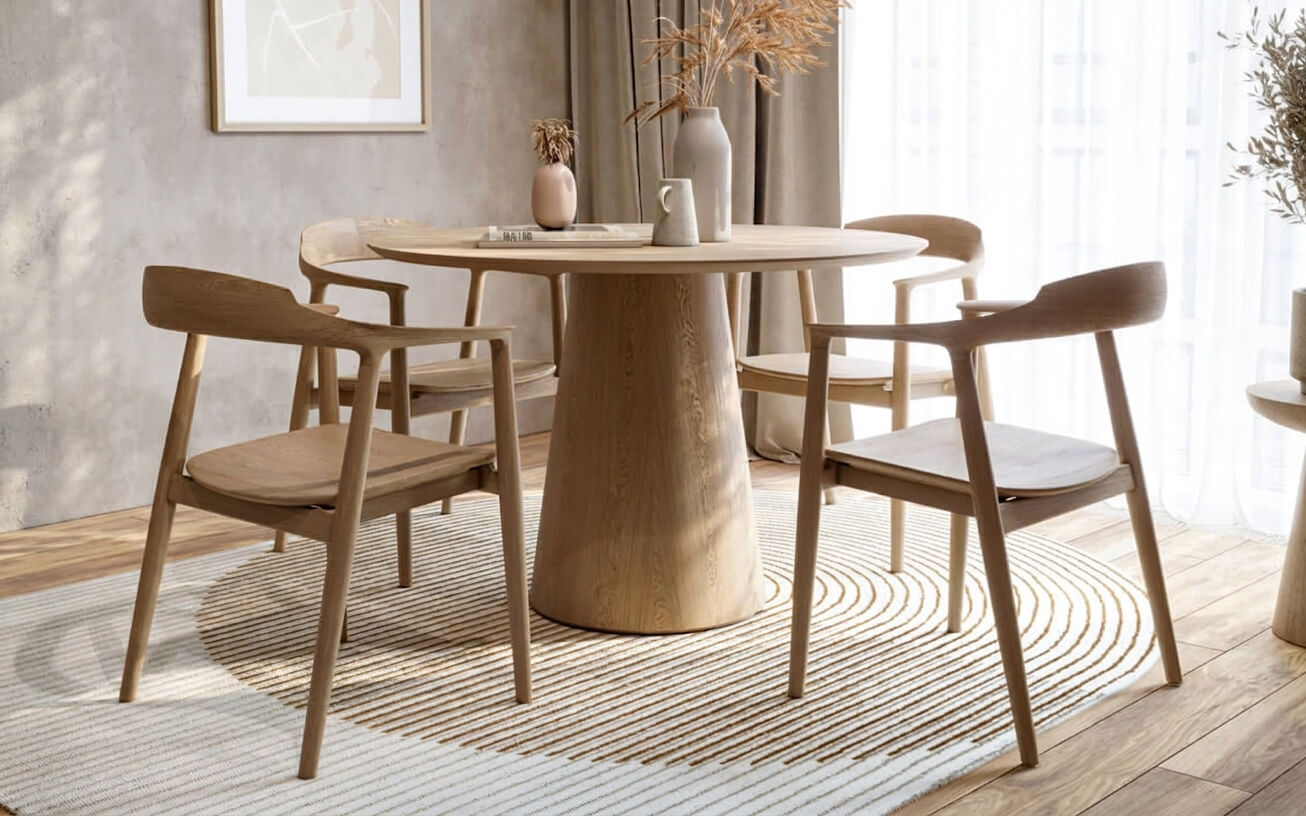
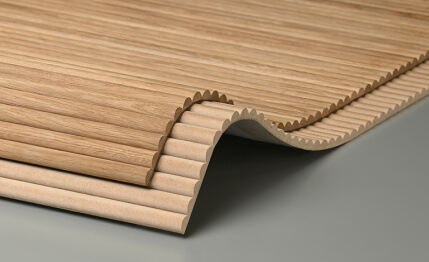
Solid wood - the upper price segment.Wooden slat panelsmade of oak cost 2–4 times more than similar format MDF products. You pay for the living texture of the fiber - unique, unreproducible by any film coating. For the possibility of surface restoration after 10–15 years. For a material that only becomes more interesting over time.
WPC (wood-polymer composite) - a specific class, more expensive than MDF, but significantly more resistant to moisture and mechanical stress. Used where wood cannot cope.
Our factory also produces:


Surface finish: the second most significant pricing factor
An unfinished slatted panel is a blank. The finish is what you see and touch every day. And its quality affects the price no less than the base material.
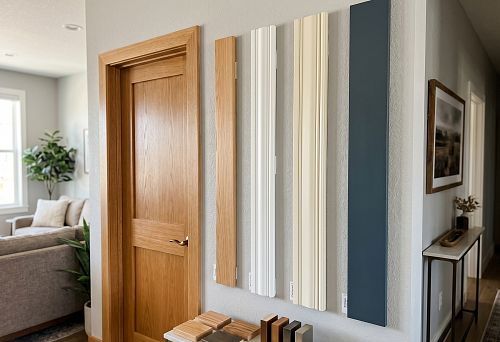
Primer for painting — the minimal, most affordable finish.paintable slatted wall panelsoffer maximum freedom in color choice but require additional costs for the paint itself and the painter's work. The total cost is higher than it seems when buying 'cheap' unfinished panels.
Melamine film — a budget category. A thin pressed-on finish with a printed pattern. Holds up well on flat surfaces but is vulnerable on the edges. It chips under mechanical stress.
Veneer — a natural wood slice glued onto MDF. Preserves all the visual properties of solid wood at a lower cost. Requires careful handling of the edges.
Oil-wax or varnish on solid wood — a final finish that protects the wood, highlights the grain, and determines maintenance. Different oils produce different effects: matte, semi-matte, with emphasis on dark wood species.
Why is this important for understanding the cost of a slatted panel? Because two panels of the same size made from MDF of the same density can cost differently precisely because of the finish. And this is not a 'brand' markup — it's a real difference in production costs and performance characteristics.
Get Consultation
Profile geometry: complexity of milling
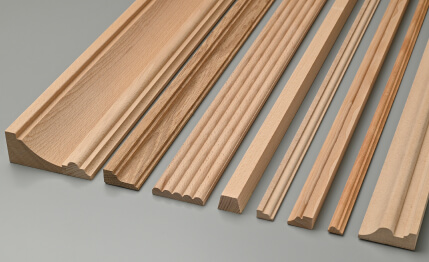
Lath MDF Panelswith rectangular slat cross-sections are technologically simpler to produce than panels with chamfered or rounded slats. Multi-pass milling with several operations is more expensive than single-pass.
But it's not just about complexity. The precision of milling directly affects the installation result. If the slats in a module vary in width or spacing—the joints between modules will be noticeable. Precision manufacturing with a tolerance of 0.1–0.2 mm is more expensive than production with a tolerance of 1–2 mm. And this difference is visible on the installed wall.
Format and length: logistics as a price factor
Long panels—2700 and 3000 mm—are more expensive than 2400 mm panels, all else being equal. The reason: they are more difficult to produce (require longer equipment and careful transportation), and create fewer transverse joints during installation.
For large surfaces—living rooms, bedrooms with high ceilings—the long format pays off aesthetically: fewer horizontal seams, a more continuous rhythm of slats.
Manufacturer and warranty
The price tag of a manufacturer with established quality standards, a system for incoming material control and outgoing product inspection—is higher than that of a small workshop without documentation. But this is not a 'brand name markup.' It is the cost of predictability of the result.
When you order slatted panels for an entire living room and receive a batch with the same shade, the same geometry, the same coating quality—this is not a coincidence. It is the result of production standards that cost money.
Molded decor: manufacturing, materials, and pricing
The cost of a slatted panel is relatively easy to analyze—there are measurable parameters. With the cost of molded decor, it's more difficult: here, the price is influenced by both the material and the complexity of manufacturing, and whether it's a serial product or a custom one.
Polyurethane vs. gypsum: a fundamental difference
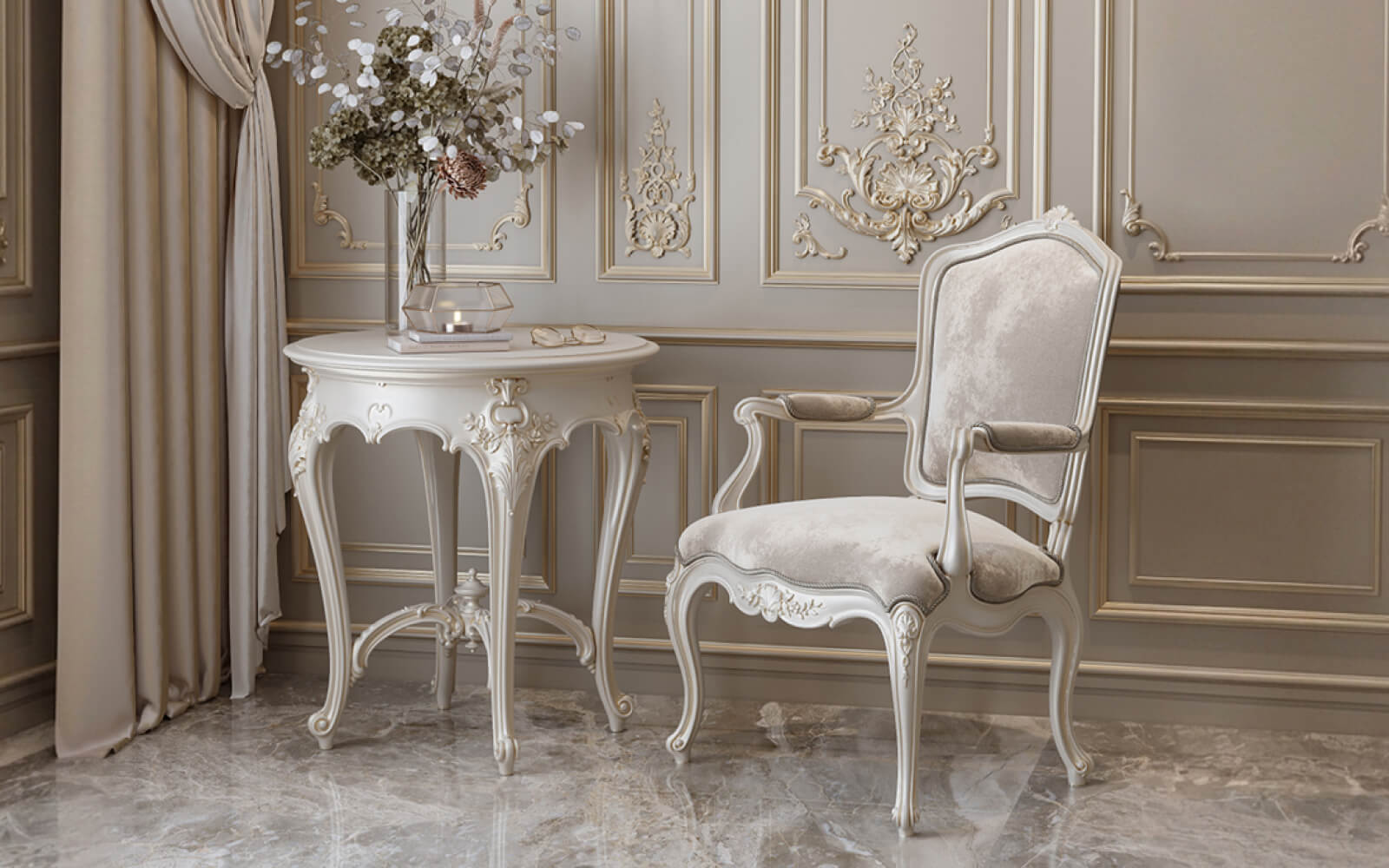
Historically, plasterwork was made from gypsum—a labor-intensive manual process, heavy material, high cost. Modernstucco decor manufacturingwhich is based on polyurethane—is a completely different story.
Polyurethane: density 80–120 kg/m³ for architectural decor. Lightweight—8–10 times lighter than gypsum. Durable—does not break during transportation and installation. Smooth surface with minimal porosity—paint applies in 1–2 coats without prior priming. Moisture-resistant—does not swell or crumble with humidity changes. And—critically important—fully reproduces the complexity of classical gypsum profiles.
Price difference: a polyurethane cornice of the same profile as gypsum costs 3–7 times less. Yet, in painted form, the visual result is indistinguishable.
Polyurethane density: the key parameter that determines everything
Not all polyurethane products are the same. This is a case where details make all the difference.
Density 80–120 kg/m³: rigid structure, sharp profile edges, stable geometry, resistance to mechanical impacts. Products in this category maintain their shape throughout their service life.
Density 40–60 kg/m³: soft, tactilely reminiscent of foam. Edges are blurred—relief is unclear. They dent when pressed. Molding corners round off not by designer intent, but due to low material density.
The difference is not visible in catalog photos. In a real interior—it's obvious.
Profile complexity and production tooling
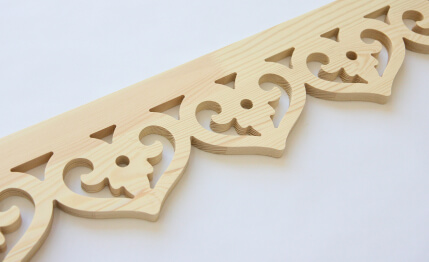
decorative polyurethane elements— Trim moldings, cornices, and baseboards are produced by casting or extrusion in special molds. The mold for a simple flat molding is relatively inexpensive. The mold for a complex multi-stage classical cornice with twists, shelves, and reverse curves is significantly more expensive.
This means the cost of a complex profile is higher not only due to material consumption but also due to the amortization of production tooling. Understanding this allows for a sober assessment of the price difference between 'simple' and 'complex' molding: it is justified.
Mass-produced items versus custom fabrication
A mass-produced item—a molding from a catalog—costs significantly less than an item made for a specific project. The mold is already made, the technology is proven, and batches are produced regularly.
When is custom fabrication of stucco decoration justified? In several situations:
-
A historical object where it is necessary to accurately reproduce a lost profile
-
An object with non-standard radii (rounded walls, domed ceilings)
-
A prestigious project where uniqueness is valuable in itself
In typical residential interiors, even high-end ones, mass-produced items fully cover all needs. Overpaying for 'custom fabrication' in a standard apartment is money spent not on quality, but on the illusion of exclusivity.
Why materials that look similar in photos have different prices: analysis of real situations
One of the most common sources of disappointment when buying finishing materials is the mismatch between the picture and reality. Two moldings that looked similar on screen arrived different. Why?
Situation one: different density with the same profile
In the photo, a cornice with a classic profile, 80 mm wide. In another photo — exactly the same. The price of the first is twice that of the second.
What's the difference? Density. The first — 100 kg/m³, sharp edges, monolithic structure. The second — 55 kg/m³, edges slightly blurred, slight smudging at curve transitions. On screen — identical. On a wall with side lighting — the difference is obvious, because the relief of the first creates a sharp play of shadows, while the second 'blurs' this play.
Situation two: different backing material with similar appearance
MDF Slatted Wall Paneland a slatted panel made of HDF (low-density fiberboard) with the same veneer — indistinguishable in a photo. In hand — the difference is tangible: HDF is significantly softer, holds screws worse, and is prone to delamination at the ends.
Ends are a diagnostic element. Cut off a corner or look at the end cut: high-density MDF has a uniform, fine-grained, dense structure. Cheap analogues have a loose, fibrous, sometimes layered structure.
Situation three: different milling precision
Two slatted modules of the same profile and material. The first — CNC production, slat width tolerance 0.1 mm. The second — production with less precise equipment, tolerance 1.5–2 mm.
When installing the first next to the second — this becomes visible. The visual rhythm of the second is uneven. Gaps between slats 'dance'. Joints between modules are noticeable. What seemed identical in the photo results in completely different outcomes on the wall.
Situation four: 'paint-ready' surface with varying degrees of preparation
Two panels — both paint-ready, both primed. The first has a meticulously primed surface with sealed MDF pores — paint will apply evenly in two coats. The second — a surface with open pores, uneven primer — paint will require three to four coats and intermediate sanding.
Costs for paint and painter's work are higher for the second. The final cost of the slatted panel in the project — is also higher.
The difference between product, relief, and brand: how not to pay for nothing
In the finishing materials market, there are three different bases for a high price. Understanding each of them allows for informed decisions.
Product: pay for material and production quality
This is a justified markup. High-quality MDF, precise milling, quality coating, strict geometry control — all of this costs money. It makes sense to pay for this because it affects the result you will get and live with for years.
Cost of a slatted panelmade from quality MDF with a good coating is higher than that of a cheap analog. The difference lies in the predictability of the result, durability, and aesthetics.
Relief: pay for design complexity
This is also a justified markup — provided that the design complexity is actually present in the product, not just in the description. Deep milled relief, complex cornice profile, ornamental rosette with multi-level relief — this is the real cost of design and production tooling.
Check: the relief should be clear, sharp, without blurred edges. Relief with unclear transitions is poor material with a surcharge 'for complex profile'.
Brand: sometimes you pay only for the name
This is the only category that needs to be critically evaluated. A well-known name on the packaging does not mean that a specific product is better than a less known competitor. In the finishing materials market, brand recognition often reflects marketing expenses, not production standards.
The question to ask: 'What is the technical parameter I am paying a surcharge for?' If the answer is specific (MDF density, type of coating, milling precision) — the markup is justified. If the answer is 'it's a prestigious brand' — you might be paying for the image.
When custom-made decorative molding is justified
relief decoration installationand manufacturing are two different topics. Installing a serial product can be done by any careful person with basic tools. Manufacturing is a production process that justifies different approaches in different situations.
When a serial product is the right choice
In 95% of residential interior cases, a serial polyurethane product fully meets the task. Catalogs of leading manufacturers offer hundreds of profiles of cornices, moldings, rosettes, overlays — for any style and any room scale.
Advantages of a serial product:
-
Affordable price
-
Immediate availability (in stock)
-
Proven manufacturing technology
-
System compatibility with other elements of the same series
When custom manufacturing is justified
Historical objects. Restoration of an apartment in a historical building where it is necessary to accurately recreate lost stucco elements. Here the profile is determined not by a designer, but by a historical sample — and a serial equivalent may not exist.
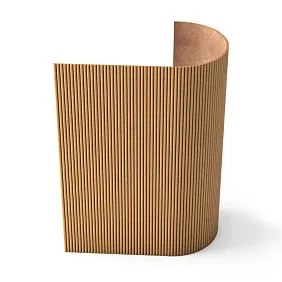
Non-standard geometry. Rounded walls, elliptical arches, domed ceilings — where straight molding physically won't fit. For radius surfaces, there aresoft slat panelsand flexible polyurethane molding.
Representative projects. When uniqueness is part of the concept and the project budget allows for the production of a custom mold.
Important to understand: custom manufacturing of polyurethane stucco decor costs significantly more than serial production. Mold production is a substantial one-time expense that is amortized over the entire production run of items from that mold. For small volumes (one apartment) — this results in a very high unit cost.
Hidden costs: what is usually not included in the calculation
The price in the catalog for a slatted panel is the cost of the panel itself. But the real cost of finishing a wall includes much more. Let's break down the full list of what is often forgotten.
Fitting elements
Corner trims, end strips, starter profiles — these are 8–15% of the cost of the panels themselves. You cannot complete the installation properly without them. They are often not included in the initial calculation.
Fasteners and installation materials
Self-tapping screws or finishing nails for panels, mounting adhesive for decorative molding, putty for sealing joints — these are consumables that make up 3–7% of the total material cost.
Primer and paint (for paintable products)
If you choosepaintable slatted wall panelsand polyurethane moldings — you need to budget for primer and paint. Paint consumption on a slatted surface is higher than on a smooth wall due to the relief.
Foundation Preparation
If the wall has irregularities exceeding 5 mm — a frame or leveling is required.Installation of batten panelsMounting on a frame requires additional metal profiles, anchors and significantly increases the labor intensity of the work.
Delivery
Long, bulky cargo — slatted panels 2700–3000 mm — is transported in special packaging. Delivery cost is calculated by volumetric weight, and for a full set of materials for one room, this is a noticeable amount that needs to be included in the estimate from the start.
Master's Work
If installation is not DIY, the labor cost can range from 30–60% of the material cost depending on the project complexity, region, and contractor's qualifications.Installation of slatted wall panels— is a relatively simple operation that can be done independently. Installing molded decor with precise miter cuts requires care and good tools.
How to avoid overpaying for empty visuals: a practical guide
Now for specifics. Several principles that will help make informed decisions.
First principle: request technical specifications
Any serious manufacturer or supplier should be able to provide:
-
For slatted panels: MDF density, coating type, geometric tolerances
-
For polyurethane decor: material density, standard element length, availability of corner blocks in the system
If someone answers 'high-quality material' to the question 'what is the density of polyurethane?' — that's not an answer. It's a reason to look for another supplier.
Second principle: compare by parameters, not by price
Two cornices of the same width and similar profile are not identical products. Comparing by price without comparing by parameters is meaningless. Create a table: density, length, availability of corner elements, surface type, warranty period. Only after that — compare prices.
Third principle: order samples
A sample of a slatted panel measuring 30×40 cm will allow you to:
-
Verify the exact color under your lighting
-
Assess the quality of the coating tactilely
-
Check the joining of two samples — the evenness of the slat rhythm
-
Perform a trial fastening — how easily and precisely the screw fits in
The cost of a sample is insignificant. Its value is fundamental.
Principle four: calculate the cost per square meter of the finished wall
Not the price of one panel. Not the price of one molding. The full cost per square meter of the finished, decorated wall: panels + accessories + stucco decor + consumables + delivery + labor. This is the only figure that allows for an honest comparison of different options.
Principle five: don't skimp on the order quantity
Recommended reserve — 10–15% above the calculated quantity. This is insurance against defects in the batch, errors during cutting, and the need to purchase additional items from another batch (with the risk of color mismatch). Saving 10% on materials — and spending 40% on delivery of additional purchases and rework — is bad math.
Slatted panels in different zones: how the cost calculation changes
The cost of a slatted panel in the living room and in the hallway — these are different calculations. Each zone has its own specifics.
Living room: accent wall + ceiling cornice
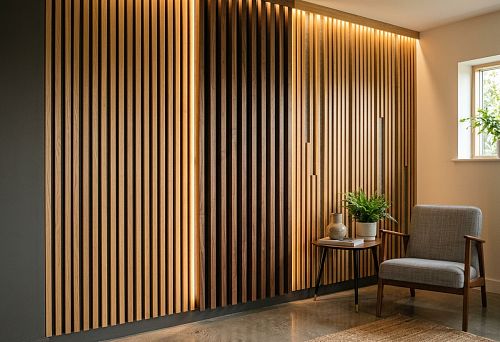
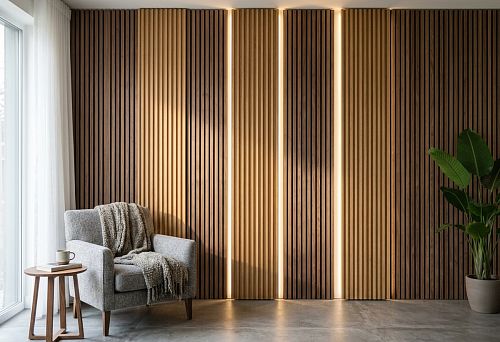
Standard project: one accent wall behind the sofa or behind the TV plus a ceiling cornice around the perimeter.Slatted panels in the living room interiorThis is the most voluminous and visually significant part of the project. The area of one wall is 4.0 × 2.7 m = 10.8 m². The perimeter of the room for the cornice is 18–22 linear meters.
Here, choosing a more expensive material — solid wood or high-quality veneered MDF — is justified. The living room is the central space that guests see and where you spend a significant amount of time.
Bedroom: headboard zone + minimalist cornice
slatted panels in the bedroom— typically a fragmentary solution: the wall behind the bed, width 1.5–2.5 m, height up to 150–160 cm or to the ceiling. The volume of material is significantly less than in the living room. Here you can afford solid wood, as the area is small, and the visual effect is maximum.
Hallway: lower protective zone
Slatted panels in the hallway interior— perform a protective function: they cover the lower zone of the walls, which is most susceptible to mechanical impact. Here, the priority is the durability of the coating. MDF with high-quality varnish or paintable MDF with a final wear-resistant varnish.
Kitchen and bathroom: special requirements
Slatted panels in the kitchen— only in areas not directly exposed to steam and grease. Moisture resistance of the coating is a critical parameter. The ends of the panels in wet areas must be additionally treated — with silicone sealant or a special impregnation.
Types of molding decor and their application with slatted panels
Varietypolyurethane molding decoration— allows solving completely different tasks in one interior. Let's systematize by function.
Ceiling cornice: horizontal architecture of the room
Function: finishing the slatted surface at the ceiling, creating horizontal division, forming the architectural character of the room. Scale: from 30 mm (minimal neutral profile) to 200 mm and more (rich classical cornice for high ceilings).
Scale selection principle: ceiling height divided by approximately 30–35. Result — recommended cornice height in mm. For a 2.7 m ceiling: 2700 ÷ 32 = ~85 mm. For a 3.2 m ceiling: 3200 ÷ 32 = ~100 mm.
Chair rail: horizontal wall division
Used as a boundary between the panel field and the neutral part of the wall above. Profile — simpler than a ceiling cornice. Function — to mark the transition, give completeness to the upper edge of the panel surface.
Baseboard: lower boundary
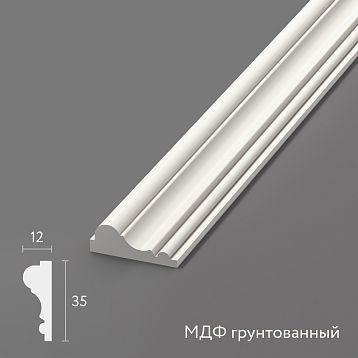
decorative polyurethane elementsinclude a wide range of baseboards — from simple rectangular ones 40 mm high to complex classical profiles 150–200 mm high. The baseboard completes the panel surface from below or marks the lower boundary of the finish.
Rosettes and corner overlays: point decor
Ceiling rosettes — decorative element around a light fixture. Corner overlays — decorative element at the junctions of moldings at an angle. These products are the third level of decorative hierarchy: point accents after background (panels) and structural (moldings, cornices).
Table: what determines the cost and how to check it
| Factor | What determines the cost | How to check when purchasing |
|---|---|---|
| MDF Density | Stability, resistance to deformation | Request from supplier, kg/m³ |
| Coating type | Durability, appearance | Tactile, sample under lighting |
| Milling precision | Joint quality during installation | Compare two samples side by side |
| Polyurethane density | Relief clarity, resistance to deformation | Press with finger — should not dent |
| Profile complexity | Chiaroscuro effect, style | View under side lighting |
| Element length | Number of joints during installation | Clarify standard length |
When expensive material pays off, and when it doesn't
This is a question rarely asked directly. But it's fundamental for decision-making.
Expensive material pays off:
-
In the living room and bedroom — central rooms that everyone sees and where maximum time is spent
-
In projects with high ceilings, where the scale of decor is maximally expressed
-
When an array is chosen — a material capable of restoration after 10–15 years
-
When panels cover a large area — a slight difference in price per square meter multiplies by a large number of meters
Expensive material does NOT pay off:
-
In utility rooms, storage areas, technical zones
-
In rental housing, where the living horizon is 1–2 years
-
When a 'premium brand' is chosen without specific technical advantages over a more affordable alternative
FAQ: popular questions about the cost of slatted panels and stucco decor
Why do slatted panels of the same size cost differently from different sellers?
Different MDF density, different coating, different production precision. Externally — similar. In characteristics — different products. Request technical parameters before comparing prices.
Is it worth paying more for solid wood panels instead of MDF?
It depends on the room and planning horizon. For a living room or study — yes, especially if you plan to live in this space for a long time.Wooden slat panelsSolid oak panels can be restored after 15–20 years, develop a patina, and only become more interesting.
How to distinguish good polyurethane molding from cheap?
Three tests: press your finger on the profile — it shouldn't dent. Look at the edge at an acute angle — it should be clear, not blurry. Rub the surface — it should be smooth, almost without porosity.
Does it make sense to order custom-made plaster decor for a standard apartment?
In 99% of cases — no. The standard range fully covers the needs of any residential interior.stucco decor manufacturingCustom-made involves significant additional costs, justified only in specific situations.
What is the optimal material reserve when ordering?
10% for simple rectangular surfaces, 15% if there are openings and non-standard corners, 20% for horizontal laying or complex geometry.
Is it possible to save on decorative molding without compromising quality?
Yes — if you choose standard products made from high-quality polyurethane of the required density instead of plaster or 'exclusive' custom fabrication. A quality polyurethane cornice costs significantly less than its plaster counterpart while delivering comparable visual results.
How to calculate the actual cost of wall finishing before starting purchases?
Create a table: panel area + additional elements + linear meters of moldings + consumables + delivery + labor. Calculate the final cost per square meter of the finished wall. Only this figure allows for an honest evaluation and comparison of options.
About the company STAVROS
Understanding what you're paying for is the first part of the task. The second is finding a supplier whose price corresponds to real quality.
STAVROS is a Russian manufacturer of architectural materials for interior finishing, backed by concrete production standards, not just marketing imagery.
The STAVROS catalog offers a complete system for any project:
-
Buy slatted panels for walls— High-density MDF, solid oak, WPC in a wide range of formats, profiles, and finishes
-
molded decoration made of polyurethane— Cornices, moldings, rosettes, overlays made from polyurethane with a density of 100–120 kg/m³ and crisp profile edges
-
Polyurethane trim— Baseboards, chair rails, corner elements in a unified stylistic system
-
Professional consultations on quantity calculation, selection of compatible items, choice of coating for specific operating conditions
At STAVROS, the question 'what makes up this price?' gets a specific answer with technical parameters — because behind every number lies a real production decision.
Pay for quality you understand — with STAVROS.