

















































































Article Contents:
- St. Petersburg interior and two languages of finishing: what is the essence of the contradiction
- What is important when buying slatted panels: criteria that determine everything
- Base material: MDF, solid wood or DPK
- Slat profile: the shape that creates character
- Color and coating: synchronization with stucco
- Center of stucco decor: what it is and why it is needed in a modern interior
- Ceiling rosettes: the dot over the 'i' in the interior
- Moldings and cornices: horizontal architecture
- Overlays and frame elements: decor within decor
- How to combine slats, moldings, rosettes, and overlays: the three-level method
- Level one: background — slatted panels
- Level two: structural — moldings and cornices
- Level three: point — rosettes and overlays
- Which rooms best support the combination of slats and stucco decor
- Living room: the main arena
- Bedroom: intimate architecture
- Hallway and corridor: small space, big character
- Study: intellectual interior
- Kitchen: caution, there are limitations
- Style defines everything: which molding decor is compatible with which battens
- Modern classic and neoclassic
- Minimalism with a wooden accent
- Art Deco
- Scandinavian Style
- How to maintain measure: rules of balance
- Decorative overload mistakes: seven scenarios to avoid
- First mistake: battens on all four walls
- Second mistake: different styles of battens and moldings
- Third mistake: too many moldings
- Fourth mistake: scale mismatch
- Fifth mistake: ignoring vertical transitions
- Sixth mistake: different shades of white
- Mistake seven: decor without function in key zones
- Slatted panels on the ceiling: when decor goes upward
- Practice: step-by-step project assembly algorithm
- Flexible and modular panels: when standard doesn't fit
- Installation: the sequence that determines the result
- FAQ: popular questions about combining slatted panels and stucco decor
- Petersburg character of interior: conclusion
- About the Company STAVROS

St. Petersburg is a city where interior culture has been shaped by palace architecture, northern light, and a special Petersburg taste for details. Here, people don't just do 'simple repairs'—they create spaces. And when it comes to buying slatted panels in St. Petersburg while also finding stucco decor that can work in the same project with them—the question is no longer about price or product availability. The question is about logic: how can two strong decorative languages avoid becoming a stylistic conflict and instead enhance each other?
This is exactly what the entire article is about. No fluff, with a specific methodology, room examples, and an honest discussion about mistakes even experienced designers make.


Petersburg interior and two finishing languages: what's the essence of the contradiction
There is something fundamentally different in the nature of slatted panels and molded decor. Slats are rhythm, line, movement. Molding is a point, an accent, a pause. The first speaks in horizontals or verticals, the second in volume and ornament. Placing them side by side without a system means creating a space where the eye doesn't know where to look.
But it is precisely in this seeming contradiction that their strength as a duo lies. The rhythmic slatted surface creates an architectural background—structured, lively, warm. Molded decor against this background gains weight and significance that it would never achieve on a smooth, homogeneous wall.
The problem is not in the combination itself. The problem is in the random, unconsidered selection of elements. When slats are chosen based on one criterion ('liked them in the store'), moldings on another ('cheaper'), and a ceiling rosette is from a completely different style altogether. That's when the interior falls apart.
Slatted panels in interior design— is not a separate decorative element. It is an architectural solution that sets the scale and rhythm of the entire room. And the molded decor that works with it must either obey this rhythm or, conversely, consciously break it—but always with intent.




What's important when buying slatted panels: criteria that determine everything
When looking for where to buy slatted panels in St. Petersburg, most often people look at two parameters: price and availability. This is understandable—but insufficient. Panels bought at a good price from the right warehouse can delaminate, warp, or fail to align with extensions after a year. Let's examine what is actually important.
Our factory also produces:



Base material: MDF, solid wood, or WPC
slatted wall panels for interior finishingare produced in three fundamentally different material versions.
MDF is the most common option. A density of 750 kg/m³ and above ensures geometric stability, precision in profile milling, and good adhesion of the finish coating.Painted MDF plank panels— is a separate class, allowing for painting in any color from the RAL or NCS catalog directly on-site. Veneered MDF comes with a ready-made natural finish.
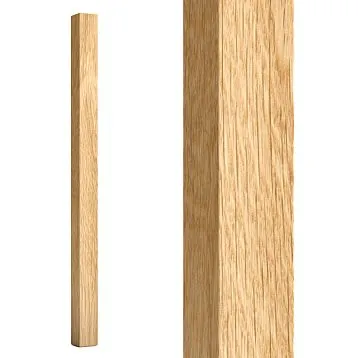
Solid wood — the highest level.Wooden slat panelsMade of oak, ash, walnut — a living wood grain texture that cannot be reproduced by any veneer. Over time, solid wood develops a patina that only enhances its value. But it requires acclimatization before installation and proper care.
WPC (wood-polymer composite) — for specific conditions: high humidity, temperature fluctuations, areas at risk of mechanical damage. Less commonly used in residential interiors.
For St. Petersburg apartments with characteristic humidity fluctuations during transitional seasons — MDF with moisture-resistant properties or solid wood under a high-quality oil-wax finish. Poor-quality MDF swells at the edges in the St. Petersburg climate.
Get Consultation
Batten profile: the shape that creates character
The batten profile — its cross-section — determines the visual character of the entire surface. A rectangular batten with flat faces gives a geometric, laconic rhythm, suitable for modern styles. A beveled batten with a chamfer creates a play of shadows that enlivens the wall depending on the angle of light. A rounded batten is softer, closer to classical and neoclassical aesthetics.
For combining with stucco decor, one thing is important: the richer the profile of the molding or rosette, the simpler the batten should be. This is the law of scale. A complex batten profile + a complex cornice profile = visual noise.
Color and finish: synchronization with stucco
If the stucco decor is painted the same color as the batten panels — the system becomes monolithic and very convincing. White battens + white stucco on a white ceiling — a classic of St. Petersburg interiors in the neoclassical spirit. Chocolate-colored solid wood battens + dark stucco on a light ceiling — a modern interpretation of contrast.
If the colors are different — the break must be intentional. Not 'dark battens were found, and the stucco is white because it was more convenient,' but a conscious color decision: dark solid wood on one wall as an anchor — and white stucco on the ceiling as a counterbalance.
Center of Decorative Molding: What It Is and Why It's Needed in Modern Interiors
The concept of a 'center of decorative molding' has long transcended the physical address of a store. Today, it means a full range of polyurethane products—from ceiling rosettes to frame moldings—in one catalog, with a unified system of profiles and guaranteed compatibility of elements.
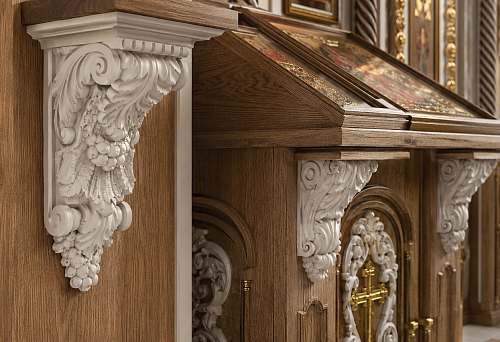
Buy Molded DecorationCorrectly—means not just choosing a liked element, but understanding how it integrates into the system. Let's break down the basic categories.
Ceiling Rosettes: The Period on the 'i' in Interior Design
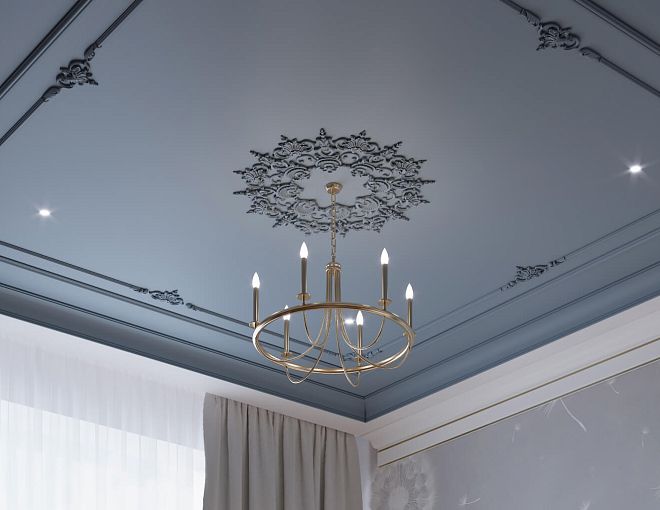
A rosette is a decorative element that frames a light fixture on the ceiling. It might seem like a detail. But it is the rosette that sets the stylistic tone for the entire ceiling. A geometric rosette with clean straight lines—modern minimalism or art deco. A classic rosette with acanthus or volutes—neoclassical, empire, baroque.
When combined with slatted panels on the walls, the rosette acts as a semantic pause. The slatted surface is movement, directionality. The rosette is a focal point, a center from which all rhythms emanate.
Moldings and Cornices: Horizontal Architecture
A ceiling cornice—a horizontal molding at the junction of the wall and ceiling—is one of the key elements in a project with slatted panels. It performs three tasks simultaneously:
-
Finishes the upper edge of the slatted surface, concealing technical gaps
-
Creates a horizontal accent that works in dialogue with the vertical rhythm of the slats
-
Sets the stylistic tone for the entire room — through profile and scale
Sculptural decoration SPBIn St. Petersburg apartments with high ceilings, it is especially expressive: with a ceiling height of 2.8–3.2 m, a cornice 80–120 mm high is perceived as an architectural element, not just a decorative strip.
Overlays and frame elements: decor within decor
Polyurethane overlays are a separate class of products. Mirror frames, niche framing, decorative panels, cartouches, consoles. When combined with slatted panels, overlays are used in two ways:
First way: overlay as a frame around the slatted field. A polyurethane frame-molding, framing an accent slatted wall around the perimeter, transforms it from 'just a finish' into an architectural object.
Second way: overlay in a neutral zone, contrasting with the slatted one. On the wall opposite the slatted one — a clean, painted canvas with decorative overlays in a frame system. This is a classic technique of alternating saturated and neutral.
How to combine slats, moldings, rosettes, and overlays: the three-level method
Chaotic decor is not an excess of elements. It is a lack of hierarchy. The three-level method allows you to build a system where each element knows its place.
First level: background — slatted panels
buy slatted wall panels— is to create the foundation. The slatted surface occupies the largest area and sets the tonality of the entire room. This is the background level of decor. It should be restrained in details — so as not to compete with the elements of the next levels.
Principle: one wall with slat cladding as an accent, the remaining walls are neutral. Or the entire perimeter in the lower zone — and a neutral upper zone. Do not clad all four walls from floor to ceiling with slats: this creates a tunnel effect and eliminates the possibility for other accents.
Level two: structural — moldings and cornices
Moldings work at the level of architectural articulation of space. Ceiling cornice, dado molding, frame molding — this is a structure that organizes space, divides it into zones, and sets proportions.
At this level, unity of profile is important. All moldings in one room should belong to the same stylistic system. The profile of the ceiling cornice is more complex. The profile of the dado molding is simpler. The profile of the frame element is the most laconic. Such a hierarchy of complexity creates a logic that a person intuitively reads, even without realizing it.
Level three: point — rosettes and overlays
Rosettes, cartouches, consoles — these are point accents. Their task is to create a visual center, a pause in the rhythm. One element on the ceiling, one overlay as a decorative panel — that is enough. Each added element at this level requires justification.
The question to ask before each addition: 'What exactly does this element give to the space?' If the answer is 'nothing, just beautiful' — most likely, it's better without it.
Which rooms best withstand the combination of slats and stucco decor
Not every room benefits equally from this duo. Let's break it down by zones.
Living room: the main arena
The living room is the perfect space for combining slatted panels and stucco decor. The ceiling height allows for a full cornice. The wall area is sufficient for an accent slatted surface.Slatted panels in the living room interior— this is the most common application, and not without reason.
Typical scheme: a slatted wall behind the sofa or behind the TV area, a cornice around the perimeter, a rosette for the central chandelier. A molding frame around the TV area as an additional accent. The three levels work harmoniously.
TV area with slatted panels— is a separate topic. When a slatted surface serves as a background for the screen, it is important to consider reflection: very dark glossy slats create glare. A matte surface or texture imitating natural wood is the optimal choice.
Bedroom: intimate architecture
In the bedroom, the combination of slats and stucco decor works in a more restrained key.slatted panels in the bedroom— this is predominantly the headboard area: a fragmentary slatted surface with a height from floor to ceiling or up to a level of 150–160 cm, limited in width by the size of the bed plus small indents.
Stucco decor in the bedroom is more subtle. A large cornice profile in a small bedroom feels oppressive. Here, a narrow neutral molding of 30–40 mm is appropriate as a horizontal line near the ceiling — and possibly a small rosette above the bed if there is spot lighting. Overlay elements in the headboard — a frame system made of thin molding around the slatted field — create the effect of a painting on the wall.
Hallway and corridor: small space, big character
The hallway in a St. Petersburg apartment is often narrow, dark, with one function: to greet and see off. It is precisely here that the correct use of slats and moldings can radically change the perception of space.
Slatted panels in the hallway interiorin the lower zone — from the floor to 100–120 cm — is a classic technique. Wall protection + decorative rhythm + a visual horizontal line that expands the space.
Molding decor in the hallway: one thin cornice around the perimeter. No rosettes — no center is needed here. No overlays — too little space for additional point accents. A waist molding at the top edge of the slatted field — and that's enough.
Study: an intellectual interior
The study is a space where molding decor and slats meet, perhaps most organically.Slatted panels in interior designof the study is a rich background that is associated with library interiors, English clubs, and St. Petersburg studies of the 19th century.
Dark solid wood or MDF slats in wenge + a rich ceiling cornice + a small rosette for a spot light above the desk. This combination reads as an intellectual statement. Without excess, but with character.
Kitchen: caution, there are limitations
Slatted panels in the kitchen— a separate topic. The kitchen requires materials resistant to moisture and grease. Exposed MDF edges in areas of intense steam generation swell and delaminate. For the kitchen — only MDF with a moisture-resistant coating or solid wood under high-quality varnish, and only outside the work zone.
Molded decor in the kitchen — keep it minimal. Grease and moisture vapors settle in the relief of the profiles. A thin, smooth molding near the ceiling — acceptable. An intricate, relief cornice in the stove area — not acceptable.
Style determines everything: which molded decor is compatible with which battens
This is not a matter of personal taste — it's a matter of stylistic logic. Let's analyze the main pairs.
Modern Classicism and Neoclassicism
Light MDF battens with a minimal profile — flat or with beveled edges — combined with a medium-complexity ceiling cornice. The cornice profile includes a scotia and a fillet, height 60–80 mm. A ceiling rosette above the central light fixture with a moderate ornament. A waist molding along the top edge of the batten field.
Colors: a unified white field (battens + molding), or battens in a warm beige tone + white decor.
Minimalism with a wooden accent
Wooden slat panelsSolid wood battens without additional painting — in natural shades from light oak to dark walnut. Molded decor — only a thin horizontal molding 20–25 mm near the ceiling, no rosettes, no overlays. Minimalism does not tolerate excess in decor — the battens are the main and only accent here.
Art Deco
Battens with a geometric profile — rectangular cross-section with clear edges, in two or three contrasting colors (black + gold, green + copper). Molded decor: geometric moldings with right angles, no organic ornaments. Rosette — strictly geometric, sunburst or stepped form. This is a style of strong contrasts and architectural lines.
Scandinavian style
White or light gray battens, minimal profile. Molded decor — either completely absent, or represented by one thin white cornice matching the walls and ceiling. Scandinavian interior is about the purity of surfaces, not about their decorative saturation.
How to maintain measure: rules of balance
The question of measure in decor is one of the most difficult. Because 'too little' seems unfinished, and 'too much' is created imperceptibly, step by step: added a rosette—good, added a cornice—even better, added a waist molding—almost there; added wall overlays—and now the space is overwhelmed.
Several working rules:
Rule of one accent per plane. Each horizontal or vertical plane—a wall, a ceiling—can handle one decorative accent. A wall with slatted panels is already an accent. A perimeter ceiling cornice is an accent for the ceiling. A rosette is a point accent on the ceiling. Two strong accents on one plane is already overload.
Rule of neutral space. After each decorative element, 'silence' is needed—a neutral surface without relief. Slatted wall + three neutral walls. A rich ceiling cornice + clean walls without overlays.
Rule of a unified profile. All moldings in one room—from the same series, same manufacturer, with a unified profile logic. Mixing profiles of different styles is a sure path to chaos.
Rule of size hierarchy. One large decorative element. Medium ones—no more than two or three. Small details—as needed. You cannot use several large elements simultaneously: they will compete for attention.
Errors of decorative overload: seven scenarios to avoid
Let's look at specific errors—not abstract advice, but real scenarios encountered in practice.
First error: slats on all four walls
The most common one. A person concludes: if one wall with slats is beautiful, then four walls are four times more beautiful. The result is a tunnel. Four slatted walls create a confined space without 'breathing room.' The accent disappears because an accent is always a contrast with a neutral background. Without neutrality, there is no accent.
Mistake two: mismatched styles of battens and moldings
Rustic battens in aged oak paired with a classic cornice featuring an acanthus ornament. Or the opposite: sleek geometric Art Deco battens alongside a Baroque rosette with cherubs. This isn't eclecticism or bold fusion—it's stylistic confusion, permanently set in material.
Mistake three: too many moldings
Ceiling cornice + dado molding + vertical moldings every 80 cm + a panel molding system on every wall + a ceiling rosette. All in a single 18 m² room. The sum of the decor exceeds the sum of the space. The eye has nowhere to rest.
Mistake four: scale mismatch
A 150 mm high cornice in a room with 2.5 m ceilings. A huge 60 cm diameter rosette in a small bedroom. Decor that is larger than the space it's meant to adorn overwhelms that space. The scale of the decor must match the scale of the room.
Mistake five: ignoring vertical transitions
Lower zone: battens. Upper zone: moldings. And between them—an exposed plaster wall with a different texture and a slightly different shade. The transition is not thought through. A dado molding at the boundary of the zones is precisely meant to make this transition clean.Wall finishing with slatted panelsalways requires detailing of the top and bottom edges.
Mistake six: different shades of white
MDF slatted panels are painted in 'pure white' RAL 9003. The polyurethane ceiling cornice is in 'warm white' with a slightly creamy tint. The ceiling is in 'cool white'. In one room — three different whites that clash. Solution: a unified color for all white surfaces — panels, moldings, ceiling.
Mistake seven: decor without function in key zones
Overlays and moldings in the hallway where they cover an outlet or interfere with doors. An outlet above the chandelier — but the chandelier is not centered on the ceiling axis, it's offset. Molded decor should interact with the actual layout and furniture placement — otherwise it becomes a hindrance, not an adornment.
Slatted panels on the ceiling: when decor goes upward
A separate topic often overlooked during planning.Batten panels for ceilings— is a completely different solution than wall panels. A slatted ceiling creates the feeling of a 'wooden sky' — a warm, structured space overhead.
When using slats on the ceiling, the logic of molded decor changes. A ceiling cornice at the junction of the slatted ceiling and the wall is mandatory. It creates a clean transition and conceals technical mounting elements. An outlet on a slatted ceiling is a non-standard solution requiring a special approach: either it's mounted flush or a surface-mounted version in the same style as the slats is used.
Slatted panels with lightingon the ceiling — are especially effective. An LED strip in the space between the slats creates diffused light that emphasizes the wood texture and gives the ceiling volume.
Practice: step-by-step project assembly algorithm
So, you have a desire to buy slatted panels in St. Petersburg, add molded decor, and get a space with character. How do you move from desire to result?
Step one: define the style. Choose one word that describes the desired character of the interior: calm, dynamic, classic, natural, urban. This is not a style type—it's a feeling. Check all subsequent decisions against this feeling.
Step two: define the areas for slatted panels. One accent wall or a lower perimeter zone. No more. Measure, calculate the area.
Step three: choose the slat profile and material. First—profile (shape), then—material (MDF, solid wood, WPC), then—color. In this sequence—not the other way around.
Step four: choose the molding. One profile for the ceiling cornice. A simpler one—for the dado molding. Even simpler—for frame elements. Ensure all profiles belong to the same stylistic system.
Step five: define the point decor. Rosette—is it needed? If there is a central ceiling light fixture on axis—yes. Overlay elements—are they needed? Only if there is a specific function: a frame for a mirror, framing a niche, a decorative panel on a neutral wall.
Step six: check the hierarchy. Is there one main accent in the project? Are there neutral zones for 'breathing out'? Are all decorative elements of the same style? If the answer to all three questions is 'yes'—the project is ready for implementation.
Flexible and modular panels: when standard doesn't fit
Saint Petersburg is a city of complex layouts. Arches, slopes, radius walls in bay windows, non-standard angles—all this creates challenges that a rigid straight panel cannot solve.
soft slat panels—a flexible format that allows cladding rounded surfaces, columns, arched openings. For St. Petersburg apartments with historical arches, this is a fundamental option.
slatted modular wall panel—a ready-made block with precisely maintained slat spacing, which installs faster than linear slats on a substrate. For complex layouts with multiple angles, the modular format allows for more accurate waste calculation and simplifies installation.
Installation: the sequence that determines the result
installation of slatted panelson the wall is a technically simple operation with proper preparation. The sequence is important:
-
Base preparation: checking wall evenness with a level. If the deviation exceeds 5 mm — leveling or installing a frame.
-
Marking: horizontal and vertical lines using a level. This determines the accuracy of the slat rhythm.
-
Installing the first panel: it sets the entire row. The first panel is always aligned with a level — regardless of whether the wall is even or not.
-
Installing the remaining panels: checking joints and vertical alignment every 3–5 panels.
-
Installing additional elements: corner trims, end strips.
-
Installing moldings and stucco decor: only after the slat field is fully completed. Stucco covers the ends — not the other way around.
How to attach slat panels to the wall— described in detail in a separate guide. The key here is to understand the principle: adhesive + finish fasteners on an even base; adhesive + frame on an uneven wall or when installing with lighting.
FAQ: Popular Questions About Combining Slatted Panels and Molded Decor
Can dark slatted panels be combined with white molded decor?
Yes, and this is one of the most expressive techniques. Dark slats act as an anchor for the space. The white cornice and rosette serve as a light counterpoint. Works with ceiling heights from 2.6 m.
Is a cornice needed if the panels run from floor to ceiling?
It is needed as a finishing element. The end of the panel that meets the ceiling, without molding, is exposed MDF, which collects dust and gets damaged over time. The cornice covers this end and creates a clean line.
Is molded decor expensive?
Polyurethane molded decor is many times more affordable than plaster. At the same time, the visual result is practically indistinguishable. The difference lies in weight (polyurethane is lighter) and installation technology (simpler, without special tools).
AreBatten panels for ceilings suitable for St. Petersburg apartments with low ceilings?
With caution. With a ceiling height of 2.4–2.5 m, a slatted ceiling visually reduces the height. It is better to use light-colored slats—they compensate for the lowering effect by reflecting light.
Can slat panels be installed independently?
Yes.DIY slatted wall panels— this is a realistic option if you have basic tools. The critical moment is marking and the first panel. Everything else is a consequence of a correct start.
How to choose molding decor to match already installed slatted panels?
Focus on the profile of the slat. A straight rectangular slat — look for molding with straight or beveled lines. A rounded slat — molding with smooth curves. And always — one stylistic key for all decor in the room.
Types of slat panels— which is better for St. Petersburg with its climate?
High-density MDF with quality lacquer or oil coating, or solid oak under oil-wax. Moisture resistance of the coating is a key parameter for the St. Petersburg climate.
Where to look for inspiration for interiors with slats and molding?
Slatted panels in living room interior photos— a good starting point. Also look at real projects with specific materials — not renders.
St. Petersburg character of the interior: the result
The city of white nights and heavy facades has cultivated a special taste for combining austerity and detail. Slatted panels in a St. Petersburg interior are not a trend or a fashion. They are a natural response to the climate, architecture, and culture of a space where not only functionality matters, but also the dignity of every surface.
Stucco decoration here is not a contradiction—it is a co-author. One holds the rhythm, the other places the accents. The main thing is to understand which one speaks first in each specific room.
About the company STAVROS
The right interior begins with the right supplier. The one who can offerslatted panels for wallsandmolded decoration made of polyurethanewithin a unified system is a manufacturer, not a middleman.
STAVROS is a Russian manufacturer of architectural materials for interior finishing. The STAVROS catalog contains everything needed to implement projects of any complexity and any style:
-
Buy slatted panels in St. Petersburgwith delivery—MDF for painting, MDF with a finish coating, solid oak, WPC, flexible modules for rounded surfaces
-
Decorative Molding Center—polyurethane overlays, frame systems, cartouches, rosettes in a unified stylistic system
-
Polyurethane moldings and cornices—from a thin neutral profile to a classic multi-step cornice
-
Pogonazh iz massiva—wooden additional elements, baseboards, moldings
STAVROS delivers to St. Petersburg and all regions of Russia. Professional consultation on material selection, quantity calculation, and item compatibility is free with your order.
A St. Petersburg interior with character is a choice in favor of STAVROS.