








































































Article Contents:
- Why the TV wall is the main wall of the living room
- Three concepts for placing a slatted panel under the TV
- Concept "Full Wall"
- Concept "Slatted Island"
- Concept "Media Wall" with niches
- Materials for a slatted panel under the TV: what works best
- Natural oak: the undisputed leader
- MDF with matte enamel: monochrome precision
- Veneer on MDF: The Golden Mean
- Parameters of a Slatted Panel for TV: Detailed Technical Analysis
- Slat Width: Scale and Proportion to the TV
- Gap: Rhythm and Air Behind the Slats
- Slat Thickness: Shadow and Volume
- Slat Orientation: Vertical, Horizontal, Diagonal
- TV on a Slatted Wall: The Technical Side of the Issue
- Hidden Wiring: How to Do It Right
- TV Bracket on a Slatted Wall
- TV Heat Dissipation and Slatted Surface
- TV Slat Panel Lighting: Scenes and Effects
- Track Spotlights: 'Reveal' the Wood
- LED Behind Slats: Atmosphere from Within
- Cornice with Hidden LED: 'Flowing' Light from Above
- Lighting Scenes: Three Media Zone Modes
- Five Ready-Made TV Slat Panel Concepts
- Concept 1: 'Amber Night' — Oak in a Dark Interior
- Concept 2: 'Scandinavian Clarity' — Whitewashed Oak and White Walls
- Concept 3: 'Green Theater' — MDF in Dark Green
- Concept 4: 'Japandi Meditation' — Dark Ash and Silence
- Concept 5: 'Neoclassical Media Wall' — oak, moldings, symmetry
- Dimensional guidelines: how much slatting is needed for a media zone
- Installation of a slatted panel under a TV: sequence and critical points
- Finishing the slatted field of a media zone: details that make all the difference
- Frequently asked questions about slatted panels under a TV
- Can a TV be hung directly on slats?
- How hot does the wall get behind a working TV?
- What is better for a media zone — natural oak or MDF?
- How to install slatted panels under a TV yourself?
- Is wall finishing with slatted panels needed throughout the living room or only under the TV?
- How to combine a slatted panel under the TV with slatted panels on the ceiling?
- Conclusion
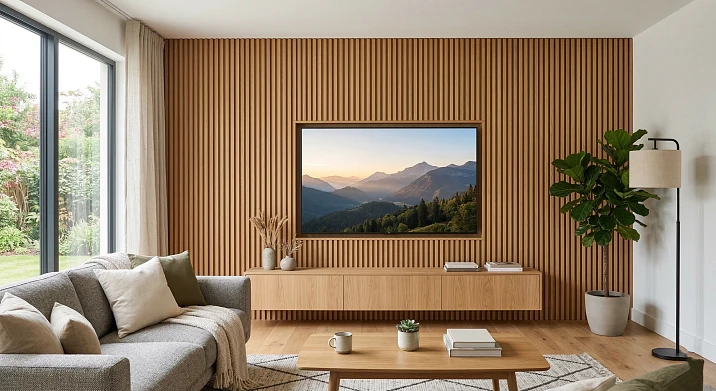
There is one spot in the apartment that absolutely everyone sees—both the owners every evening and guests from the first seconds after stepping through the door. It's the wall with the TV. It sets the tone for the entire living room interior. It's the focal point during family evenings, movie nights, and simply lazy Friday evenings with a glass of wine.
And it is this wall that in most Russian apartments looks... like nothing. Just a white wall with a black rectangular screen. Maybe with a cabinet underneath. Sometimes—with a couple of shelves nearby. There is space. There is potential. But there are no solutions.
A slatted panel under the TV is a solution that transforms this wall beyond recognition. Not 'enhances,' not 'improves'—but truly transforms. It turns a functional surface with an attached screen into an architectural statement: thoughtful, beautiful, alive. Vertical slats of natural wood, LED glow from the gaps, the TV as part of a natural wooden composition—this is not an expensive design project. It's a well-considered system of material, parameters, and light.
But for the result to be exactly that, and not 'well, why was this done,' you need to understand the logic. That's exactly what we're breaking down—in detail, with numbers, specific concepts, and technical solutions.
Why the wall under the TV is the main wall of the living room
Before talking about material and parameters—let's state the obvious but important. The wall with the TV is not just a place where a screen hangs. It's the visual focal point of the entire living room.
The sofa is placed opposite it. The gaze upon entering the room—first goes to it. During dinner, conversation, in silence—the gaze returns again and again to this wall. Everything else in the living room—the sofa, rug, curtains, coffee table—is context. But the main wall is the center.
That's why any investment in decorating the wall under the TV gives the maximum 'return' in terms of the impression of the interior. A new chandelier will change the atmosphere. A new sofa will change the comfort. Buta slatted wall panel under the TVchanges the very foundation—the character of the space.
The second important point: a TV on a slatted wall ceases to be a 'foreign' electronic device in a living interior. A black rectangular screen on a white wall always looks like 'equipment.' The same screen on a wooden slatted surface is an element of a well-thought-out visual system. The natural background 'accepts' the technology, organically integrating it into the interior.




Three concepts for placing a slatted panel under the TV
Before moving on to the parameters, you need to understand: what exact format of slatted panel do you want to create? There are three fundamentally different approaches here, and each yields a different result.
Our factory also produces:




Concept: 'Full Wall'
The slatted field occupies the entire accent wall—from floor to ceiling, edge to edge. The TV is mounted on a bracket directly onto the slatted surface. A TV stand or cabinet underneath is either built-in (specially made to match the slats) or freestanding with a gap from the slatted wall.
Result: maximum architectural expressiveness. The wall is completely 'covered' with natural wood. The TV is an integrated element. With a dark slatted surface, the black screen practically dissolves into the background.
Suitable for: living rooms from 20 sq. m, ceilings from 2.6 m.
Get Consultation
Concept: 'Slatted Island'
A slatted field of limited width—wider than the TV by 30–50 cm on each side. Height—from the bottom edge of the stand (or from the floor with a floor-standing stand) to the ceiling. Adjacent parts of the wall are neutral paint or wallpaper.
Result: an accent "screen" made of wood with a TV in the center. The rest of the wall is a neutral background that doesn't compete with the slatted island. For medium-sized living rooms and apartments where you want an "accent" but not "total" slatted coverage.
Suitable for: living rooms 16–25 sq. m, any ceiling height.
Concept: "Media Wall" with niches
The slatted panel is integrated into a system with open niches or shelves. The TV is in the central niche between the slatted sections. Shelves on the left and right are for books, decor, and audio equipment. Slats are on the back walls of the niches and on the vertical posts of the system.
Result: a functional media wall with a natural wooden aesthetic. One of the most architecturally rich options for a living room.
Suitable for: living rooms from 25 sq. m with high ceilings and a need for storage.
Materials for a slatted panel under the TV: what works best
The wall under the TV is a "dry" zone with minimal mechanical loads. It doesn't require moisture resistance (like in a kitchen or hallway) and there's no intense physical contact (like the wall behind a sofa). This opens up the widest possible range of material choices—the decision is based solely on aesthetics.
Natural oak: the undisputed leader
Oak is the absolute number one choice for a slatted panel under the TV. No other material offers such natural expressiveness combined with durability.
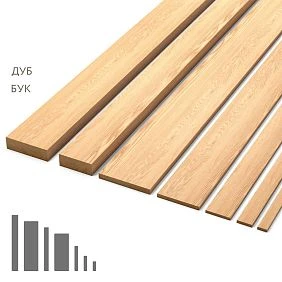
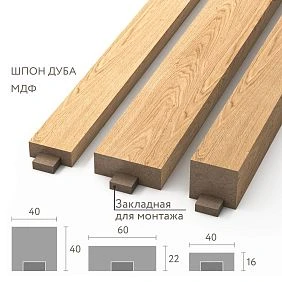
Wooden slat panelsOak slats possess that rare quality that makes an interior feel 'alive': each slat is unique. The natural grain pattern varies from plank to plank. The tone has slight variations from slat to slat. It is this 'imperfection' that creates a sense of naturalness, which no synthetic material can imitate.
With an oil finish, oak literally 'breathes': the surface is tactilely warm, matte, natural. Under side lighting from a track spotlight, each slat becomes a separate object with its own play of light and shadow. A TV on such a surface is like a cinema screen on a natural wooden backdrop: a powerful image that works for the interior.
Oak stains for media zones: natural amber for warm, 'natural' interiors; bleached for Scandinavian and modern neutral concepts; 'tobacco' – warm dark brown for classic and Japandi spaces; 'smoky' – grey-brown for modern, restrained living rooms; 'dark walnut' – for deep, 'cinematic' concepts where a dark background dissolves the black screen.
Pogonazh iz massivaOak and ash are the foundation for a slatted TV panel with maximum natural expressiveness.
MDF with matte enamel: monochrome precision
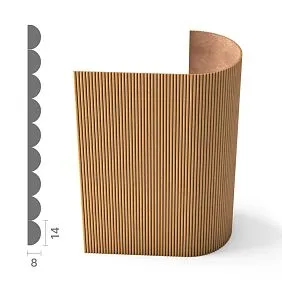
MDF slatted panel for TV– the choice for monochrome interiors and concepts with precise color solutions. MDF slats with matte RAL enamel provide a rich, even color across the entire surface without natural variations.
Dark green (RAL 6005) slatted wall under the TV is one of the strongest designer images in recent years. Anthracite (RAL 7016) is maximally 'cinematic': the dark background dissolves the black screen and creates a 'floating' image effect. Blue (RAL 5011) is unexpectedly elegant in modern interiors.
An important technical advantage of MDF for media zones: geometric stability. MDF does not react to temperature fluctuations from a working TV – it does not warp or 'move'. Natural wood under prolonged thermal exposure can theoretically deform – although with proper oil or varnish coating and normal room humidity (40–60%), this risk is minimal.
paintable slatted wall panelsMDF slats are for those who want conceptual flexibility: in a few years, you can repaint the slatted wall to a new interior color without dismantling.
Veneer on MDF: The Golden Mean
Veneered slats (MDF base + natural oak or walnut veneer 0.6–1.2 mm) — a natural surface with authentic wood grain and the technical stability of MDF. For a media zone — one of the best options: the naturalness of real wood without the risk of warping from the heat of a working TV.
TV slat panel parameters: a detailed technical breakdown
Slat panel parameters determine the final visual result. For a media zone — with its specific task of 'integrating' the TV into a wooden composition — the parameters are especially important.
Slat width: scale and proportion relative to the TV
A TV is a rectangular object with horizontal proportions (16:9). A slat panel is a vertical rhythm. The task is to create a harmonious interaction between the horizontal and vertical.
TV 55–65 inches (standard for a modern living room):
-
30–40 mm slat — optimum: a sufficiently expressive rhythm without 'fine chopping'
-
40–50 mm slat — a more 'architectural', monumental rhythm
TV up to 50 inches:
-
Slat 25–35 mm — proportionally sized to a smaller screen
TV 75–85 inches:
-
Slat 45–60 mm — a large screen requires a proportionate slat rhythm
Rule: slat width should be proportionate not only to the room but also to the specific TV size. Too narrow slats next to a large screen create 'flicker'. Too wide ones next to a small screen overwhelm it.
Gap: rhythm and air behind the slats
For a media zone, the gap serves an additional purpose — it 'accepts' or 'does not accept' LED backlighting. If an LED strip is planned behind the slats, the gap must be sufficient for the glow to be visible.
For LED backlighting behind slats: gap minimum 12 mm, optimally 15–18 mm.
Slat/gap ratio for a media zone: 2.5:1 optimal. With a 35 mm slat — 14 mm gap. With a 40 mm slat — 16 mm gap.
Slat thickness: shadow and volume
For a media zone with track lighting, the recommended slat thickness is 20–25 mm. This thickness creates an expressive shadow in the gaps under side lighting — a 'cinematic' effect.
Slats thinner than 15 mm on a media wall with track lighting lose volume and appear flat — creating the effect of 'wallpaper imitating wood' rather than a genuine wooden surface.
Slat orientation: vertical, horizontal, diagonal
Vertical orientation is the standard for media zones. Visually 'raises' the ceiling, creates a sense of upward movement, and balances the horizontal TV. The most architecturally strong option.
Horizontal orientation 'emphasizes' the TV's horizontal format. Creates a 'layered' space effect. Not recommended for low ceilings (2.4 m): visually 'weighs down' the space.
Diagonal orientation is a rare but powerful technique for unconventional interiors. Requires more complex installation (mitered cuts at an angle) and bold design decisions.
For most living rooms — vertical orientation. Justified exceptions exist when there is a clear design concept.
TV on a slatted wall: technical considerations
A beautiful appearance is good. But a TV is electronics with wires, a bracket, and heat generation. Technical installation issues must be resolved BEFORE the first slat is mounted on the wall.
Concealed wiring: how to do it right
Concealed wiring is the only professional option for a slatted wall behind a TV. Wires protruding from behind the slatted surface completely ruin the effect of a natural wooden wall.
Rule one: all wiring is installed BEFORE mounting the slats. After installation, it is impossible to hide the wires without dismantling.
Hidden wiring diagram for the media zone:
-
Determine the exact position of the TV (the height of the center of the screen, horizontal position)
-
Determine the exit point for all cables: HDMI, optical, antenna, power
-
Channels for cables are chiseled into the wall — down to the outlet level (a hidden outlet under the TV) and to the exit point for signal sources
-
A corrugated pipe with a diameter of 20–25 mm is laid into the channels (to allow pulling new cables in the future)
-
The channels are plastered over
-
The frame is mounted
-
Additional wiring (LED strip, if planned) is laid on the frame
-
The slats are mounted
With adhesive mounting method (without battens) — wiring is only chased, in the wall.
Rule two: lay spare channels. Technologies change — today you need one HDMI, in three years you'll need a second one and also USB. Corrugated pipe allows pulling new cables without renovation.
TV bracket on a slatted wall
A TV on a slatted wall is mounted on a bracket that is fixed to the wall (not to the slats). Slats are a decorative element, not a load-bearing structure. The load from the bracket with the TV (usually 15–35 kg) should be borne by the main wall.
Three options:
1. The bracket is attached to the wall before installing the slats. The bracket is mounted on the wall in a precisely calculated position. Slats are installed around the bracket — with holes or cutouts for the bracket to pass through. The most 'clean' option: the bracket emerges from behind the slatted surface.
2. The bracket is attached to a reinforced batten. The batten at the bracket attachment point is reinforced with an additional crosspiece or 40×60 mm timber. The bracket is attached through the slats to the reinforced batten. Requires load calculation and correct choice of fasteners.
3. TV on a floor stand in front of the slatted wall. The slatted wall is a backdrop, the TV is on a separate floor stand in front of it. The simplest option technically, but the stand is an additional element in the space.
For most projects — option 1 or 2 if battens are present. Distance from the slatted surface to the screen with a flat bracket: 30–50 mm. With a tilt bracket: 60–120 mm. Consider that a tilt bracket 'moves' the TV away from the slatted surface — you need to cover the gap with a decorative profile or accept it as an architectural element.
TV heat dissipation and slatted surface
Modern OLED and QLED TVs primarily dissipate heat through the back panel and lower ventilation openings. The heat flow from a 100–150 W TV at a distance of 30–50 mm from the slatted surface is minimal. With oil and varnish finishes on oak and normal room humidity (40–60%), there is no impact on the condition of the slats.
The only thing to avoid: do not mount the slats flush against the back of the TV (the gap between the TV's back panel and the slatted surface should be at least 20 mm). This ensures free air circulation and proper equipment cooling.
Lighting the slatted panel under the TV: scenes and effects
Lighting the media zone is a topic deserving separate attention. This is where the difference between 'just slats on a wall' and an 'architectural media zone' becomes most apparent.
Track spotlights: 'reveal' the wood
Track spotlights on the ceiling, aimed at the slatted panel at a 30–45° angle, are the primary lighting tool for the media zone. They create shadows in the gaps between the slats, transforming a flat surface into a three-dimensional relief.
Technical requirements: color temperature 2700K (warm white), power 7–10 W per spotlight, CRI (color rendering index) not lower than 90. A CRI below 80 'kills' the natural wood tone—amber oak becomes dull and gray.
Quantity: one spotlight for every 1.2–1.5 m of slatted field width. For a slatted panel 3.5 m wide—2–3 spotlights.
A dimmer is essential. In the evening before a movie, you want soft, subdued light, not full-brightness 'work' lighting.
LED behind the slats: atmosphere from within
LED strip fixed on a substrate behind the battens creates a soft warm glow from the gaps. This is the 'bottom layer' of the media zone's lighting scene — atmospheric, intimate, working as 'ambient light' for the screen.
When watching a movie: the main track lighting is dimmed to 10–20%, LEDs behind the battens are at 30–50% brightness. The soft warm glow from the gaps creates a 'halo' around the screen — reducing eye strain during prolonged viewing in a dark room. This effect, known as 'bias lighting,' is recommended by ophthalmologists specifically as a way to reduce contrast load on the eyes when watching video.
Technical requirements for LEDs behind the battens in the media zone: strip 2700K (2200K for the warmest 'amber' glow), density 60–120 diodes/meter, IP20 class, mandatory dimmer with smooth adjustment 0–100%.
The strip is mounted horizontally on the back wall of the batten field or vertically in every other gap — depending on the gap width and desired glow intensity.
Cornice with hidden LED: 'flowing' light from above
a polyurethane cornicewith a groove for LED along the top edge of the batten field creates an effect of 'cascading' warm light down the batten surface from top to bottom. The light source is hidden behind the cornice, only the result is visible: warm glow envelops the wooden battens, the TV is 'immersed' in natural wooden light.
For a cinematic effect in the living room — one of the most powerful lighting techniques.
Lighting scenes: three modes of the media zone
A properly built lighting system for a batten media zone operates in several modes:
'Daytime' mode: track spotlights 80–100%, LEDs behind the battens — off. The batten wall is fully illuminated, the wood is 'revealed' by the spotlights.
"Evening" mode: track spotlights 40–50%, LED behind battens 50–70%. Warm atmosphere, the batten wall "glows" from within. For family gatherings, for background video on the screen.
"Cinema": track spotlights 5–15% or off, LED behind battens 20–40%. Maximally subdued light with warm atmospheric glow from the gaps. A film on the screen surrounded by a natural wooden "halo".
Control: smart switch or remote with scene control. Each scene — one press.
Five ready-made concepts for a batten panel under the TV
Theory is important. But the best way to understand the result is through specific images with precise parameters.
Concept 1: "Amber Night" — oak in a dark interior
Material: natural oak, "tobacco" tint (warm dark brown), oil finish.
Bat parameters: width 40 mm, gap 18 mm, thickness 22 mm, vertical.
Format: full wall, from floor to ceiling.
Backing: black matte felt or painted wall RAL 9005 (black matte).
LED behind slats: 2200K, ultra-warm amber light.
Adjacent walls: warm light gray (RAL 7044) or creamy white.
Furniture: sofa in neutral tones — light gray, white, beige — contrasting with the dark slatted wall.
TV: OLED with a matte screen, maximally flat bracket.
Concept: cinematic living room. A dark slatted wall with warm glow from the gaps and a dark screen in the center — an atmosphere that literally 'draws you in' to watching. In the evening with the LED behind the slats on — the living room becomes an amber cave with soft natural light.
Concept 2: 'Scandinavian Clarity' — whitewashed oak and white walls
Material: oak, whitewashed oil finish (milk tone).
Slat parameters: width 25 mm, gap 12 mm, thickness 18 mm, vertical.
Format: slatted island — 40 cm wider than the TV on each side, from the bottom edge of the floor cabinet to the ceiling.
Backing: white wall.
LED behind slats: 2700K, warm.
Adjacent walls: white or light gray (RAL 7035).
Furniture: light gray sofa, wooden elements made of natural ash.
Concept: a fresh, airy Scandinavian living room. Whitewashed slats on a white background — a delicate natural texture without dark accents. The most 'lightweight' version of a slatted media zone. In daylight — a snow-white natural relief. In the evening with warm LED — a soft amber glow on a white background.
Concept 3: 'Green Theater' — MDF in dark green
Material: E1 MDF with matte enamel RAL 6005 (dark green).
Slat parameters: width 35 mm, gap 16 mm, thickness 20 mm, vertical.
Format: full wall.
Backing: painted wall RAL 6005 (matching the slats) — a monolithic green background with barely noticeable gaps.
LED behind slats: 2700K, warm — warm glow on a green background.
Adjacent walls: warm cream-white (RAL 1013).
Details:solid wood cornicealong the upper edge of the slatted field — natural oak as a contrast to the green slats.
Image: botanical theater. A dark green slatted wall with a TV — an unexpectedly strong image. Green is the color of nature, the color of growth, a color that 'calms' the eye. The black TV screen against a green background is almost invisible when turned off. When watching, the image 'floats' in a green natural context.
Concept 4: 'Japandi Meditation' — dark ash and silence
Material: ash with 'smoky' tint (dark gray-brown), oil finish.
Slat parameters: width 20 mm, gap 10 mm, thickness 18 mm, vertical.
Format: full wall.
Underlay: dark anthracite felt.
LED behind slats: off in main mode, 2200K in 'cinema' mode — minimal atmospheric glow.
Adjacent walls: warm light beige.
Furniture: low, without legs or on thin metal legs. No ornaments.
Image: meditative emptiness in the Japanese spirit. Narrow dark slats on a dark background — a delicate rhythm that doesn't 'fill' the gaze. The TV is simply a screen against a natural backdrop. When turned off — practically invisible. A living room where one craves silence.
Concept 5: 'Neoclassical Media Wall' — oak, moldings, symmetry
Material: natural oak, 'walnut' tint, matte lacquer finish.
Slat parameters: width 40 mm, gap 20 mm, thickness 22 mm, vertical orientation.
Format: slatted media wall with niches. Central niche (width — for TV + 40 cm) — slatted oak back panel. Side sections — open shelves with slatted back panels. All within a unified system.
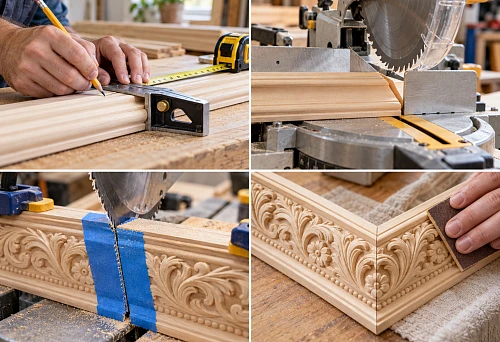
Completion:Oak moldingsAround the perimeter of each section — profiled framing.
Backing: slatted surface matching the slats in tone.
Image: library-media wall in natural material. A symmetrical system of slatted niches with molding framing — the architectural centerpiece of the living room, where the TV is just one element of a well-thought-out system.
Dimensional guidelines: how much slatting is needed for a media zone
Practical calculation for typical media zone formats.
Slatted wall island format for a 65" TV in a living room with a 2.7 m ceiling:
Island width: 65" TV is approximately 145 cm wide. The island is 40 cm wider on each side: 145 + 80 = 225 cm = 2.25 m.
Height: from the bottom edge of the cabinet (cabinet height is usually 40–50 cm) to the ceiling = 2.7 – 0.45 = 2.25 m.
Area of the slatted field: 2.25 × 2.25 = 5.06 sq. m.
With a slat width of 35 mm and a gap of 16 mm: one slat + gap = 51 mm. Number of slats in width: 2250 / 51 = ~44 slats.
Length of each slat: 2.25 m.
Total linear meters of slats: 44 × 2.25 = ~99 lin. m.
With a 12% reserve: ~111 lin. m.
Full wall format in a living room 4 m × 2.7 m:
Area: 4 × 2.7 = 10.8 sq. m. Minus openings (if there is a door): 10.8 – 2 = 8.8 sq. m.
With 35 mm slats / 16 mm gap: number of slats by width: 4000 / 51 = ~78 slats.
Linear meters: 78 × 2.7 = ~211 lin. m. With a 12% margin: ~237 lin. m.
To calculate a specific project: measure the exact wall dimensions, account for all openings and cutouts, add a 12–15% margin.
Installing a slatted panel for a TV: sequence and critical points
installation of slatted panelsfor a media zone has its own specifics compared to a regular wall — due to the need to integrate a bracket and wiring.
Stage 1: Wiring and wall preparation.
Before any installation work — chase and lay cables in conduit. Check: all cables are in place, conduits are plastered, wall is leveled.
Stage 2: Marking and installing the batten frame.
Laser level — mandatory. Batten frame 40×20 mm with a pitch of 400–500 mm. At the bracket mounting point — reinforced crosspiece 40×60 mm. The batten frame is aligned to the level: tolerance — no more than 2 mm over 2 m.
Stage 3: Mounting the TV bracket (for the 'bracket to batten frame' option).
The bracket is attached to the reinforced crosspiece of the sheathing through pre-marked holes. Load: 4 attachment points, 6–8 mm fasteners. Check the bracket for level.
Step 4: Mounting the battens.
The first batten — strictly vertical using a level. This is the guide. Battens are mounted with finishing nails or clips to the sheathing. The gap is set using spacers of uniform thickness.
At the bracket exit point — battens are cut with a precise notch for the bracket profile. Cutting accuracy: ±1 mm. Tool: jigsaw with fine teeth.
At the cable exit point — the batten has neatly drilled holes for the cable diameter.
Step 5: Mounting the LED and electrical components.
The LED strip is fixed to the substrate behind the battens. Connecting wires — through gaps or in the technical channels of the sheathing. Check: LED works, dimmer functions.
Step 6: Perimeter finishing.
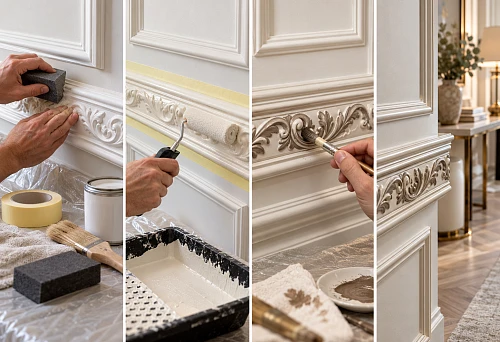
Baseboard at the bottom, cornice at the top, moldings on the sides.Installation of batten panelsInstallation is complete: mount the TV on the bracket, connect the cables — and evaluate the result.
FullStep-by-step guide for DIY installation of slatted panels— with detailed schematics for each stage.
Finishing the slatted wall media zone: details that make all the difference
Professional execution of a slatted panel for a TV — in perimeter finishing. Unfinished edges 'ruin' the look even with perfect slats.
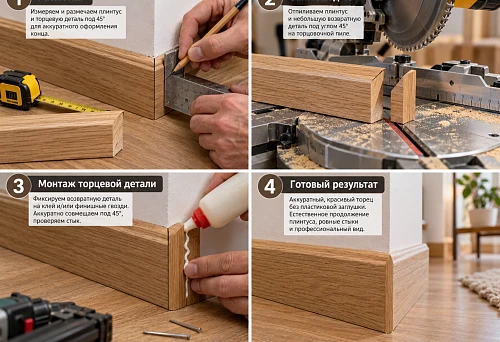
Skirting board:solid wood baseboardin the same tone as the slats. Height 80–100 mm for ceilings 2.6–2.8 m. Straight profile for modern concepts, profiled — for neoclassical.
Crown molding:a polyurethane cornicewith an LED groove along the top edge of the slatted field. For whitewashed or light slats — a white cornice in the same tone. For dark ones — dark or natural oak as a contrasting element.
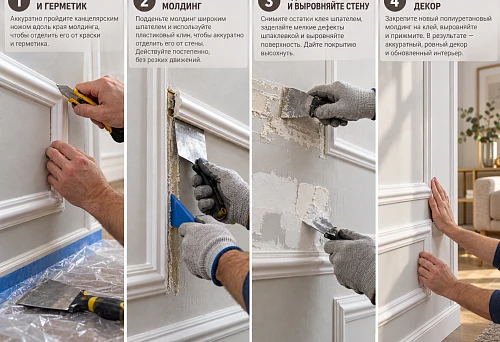
Side moldings:Solid wood moldingsalong the side edges of a slatted island or full wall. They transform the slatted field into a finished architectural panel.
Corner elements: when a slatted field transitions to an adjacent wall — a wooden corner profile hides the slat ends. A clean angle without visible cuts is a sign of professional installation.
Frequently asked questions about slatted panels for TVs
Can you hang a TV directly on the slats?
No. The slats are a decorative element, not a load-bearing structure. A bracket with a TV weighing 15–35 kg must be attached to a solid wall or reinforced sheathing. The slats will not withstand such a load—they will deform or be pulled out with the fasteners.
How hot is the wall behind a working TV?
Modern TVs generate significantly less heat than models from 10–15 years ago. With a gap of 20 mm or more between the back panel of the TV and the slatted surface and free air circulation, the slatted panel does not heat up to dangerous temperatures. Natural wood and MDF are in a safe range at temperatures up to 40–50°C.
What is better for a media zone—natural oak or MDF?
For aesthetics—natural oak. For monochrome concepts with precise RAL colors—MDF with matte enamel. For maximum practicality—veneered MDF: the natural surface of oak with the technical stability of MDF.
How to install slatted panelsinstall a slatted panel under the TV yourself?
Technically, it is possible for a person with basic woodworking skills. Key requirements: a laser level for aligning the first slat, a miter saw for trimming, precise marking of the bracket and cable outlet locations. The main difficulty is making a neat cut in the slats for the bracket. Without experience using a jigsaw, it is better to entrust it to a professional installer.
Is it necessary to Wall finishing with slatted panelsinstall slatted panels throughout the living room or only under the TV?
Only under the TV (in the format of a 'slatted island' or a 'full accent wall') is a self-sufficient and effective solution. Slatted finishing on all walls in the living room is possible in large spaces (35+ sq. m), but requires a very thoughtful approach, otherwise it can create a feeling of a 'wooden cage'.
How to combine a slatted panel under the TV with with slatted panels on the ceiling?
With vertical wall battens — ceiling battens are mounted perpendicularly (horizontally). Material and tinting: identical for a unified natural look. The wall-ceiling transition is finished with a wooden corner profile. This is one of the most architecturally rich techniques — a 'natural grotto' above the sofa area.
Conclusion
A slatted panel for the TV is not a decorative detail. It is an architectural solution that changes the character of the entire living room, transforming the functional wall with a screen into a natural, living center of the space. The right material, precise batten and gap parameters, properly designed wiring, a well-thought-out lighting system, and professional perimeter finishing — these elements combine to create a media zone that you want to admire even with the TV turned off.
decorative slatted wall panelsmedia zones,Wooden slat panelsmade of natural oak and ash,Pogonazh iz massivafor slatted systems, moldings, cornices, and baseboards for finishing — a full range for a slatted media zone of any format and style is presented in the STAVROS company catalog.
STAVROS is a Russian manufacturer of slatted systems and millwork products made from solid natural wood. Full-cycle production: from wood drying to applying the finish. Professional consultation on selecting material, parameters, and lighting system for your media zone. Because the wall with the TV is too important a place in your home to leave it as just a white wall.